

Looking to advance your career in privacy management within high-security roles? The Certified Information Privacy Manager (CIPM) certification equips professionals with the expertise to design, implement, and oversee privacy programs in sensitive environments. Here’s what you need to know:
- What It Is: A globally recognized certification from IAPP, focusing on managing privacy programs rather than just understanding laws.
- Who It’s For: Ideal for security-cleared professionals managing sensitive data in government or defense sectors.
- Exam Details: 90 multiple-choice questions, 2.5 hours, $550 fee, and approximately 30 hours of study time.
- Key Domains: Privacy program governance, operational life cycle, data protection, incident response, and more.
- Preparation Tools: Study guides, practice exams, and IAPP training courses are available to help you succeed.
- Career Impact: Opens doors to roles like Privacy Program Manager and Data Protection Officer, especially in classified settings.
This certification not only validates your skills but also positions you as a leader in privacy management for high-stakes roles. Ready to get started? Gather study materials, plan your schedule, and take the first step toward certification.
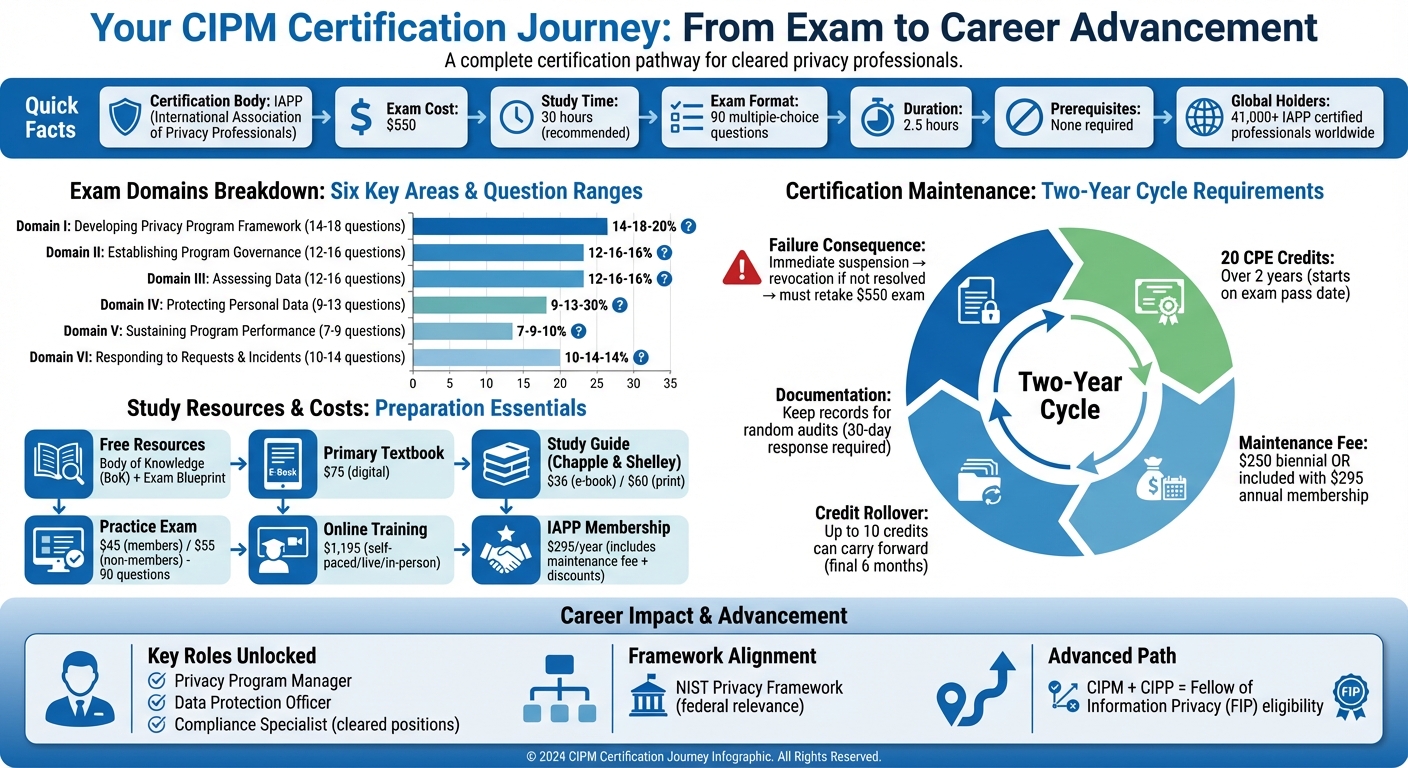
CIPM Certification Path: Requirements, Exam Structure, and Maintenance Timeline
Free Certified Information Privacy Manager Certification Training | How To Clear CIPM in 30 Days?
sbb-itb-bf7aa6b
CIPM Certification Requirements and Exam Details
For cleared professionals looking to expand their qualifications, the CIPM certification offers an accessible and practical pathway. Below, you’ll find key details about the requirements and structure of the exam.
Eligibility and Prerequisites
The CIPM certification has no strict professional experience or educational prerequisites [1]. This means anyone, whether new to privacy or an experienced manager, can take the exam. You don’t need a specific degree or years of documented experience – just a solid understanding of privacy program management.
This open policy is especially useful for cleared professionals. It allows individuals to shift from cybersecurity into privacy-focused roles or enhance their credentials for managing classified data environments.
Exam Format and Knowledge Domains
Now that eligibility is clear, here’s a closer look at the exam’s structure and what it covers.
The test includes a mix of stand-alone questions and case-study scenarios designed to evaluate how well you can apply privacy principles in real-world situations. Correct answers earn one point each, and there’s no penalty for incorrect answers [2].
You can take the exam at over 6,000 Pearson VUE testing centers worldwide or opt for remote proctoring, which lets you take the test from your home or office [2].
The exam focuses on six core domains, each targeting essential skills for managing privacy programs, particularly in sensitive or classified environments. Here’s a breakdown:
| Domain | Focus Area | Question Range |
|---|---|---|
| Domain I | Developing a Privacy Program Framework | 14–18 |
| Domain II | Establishing Program Governance | 12–16 |
| Domain III | Operational Life Cycle: Assessing Data | 12–16 |
| Domain IV | Operational Life Cycle: Protecting Personal Data | 9–13 |
| Domain V | Operational Life Cycle: Sustaining Program Performance | 7–9 |
| Domain VI | Operational Life Cycle: Responding to Requests and Incidents | 10–14 |
Recent updates to the Body of Knowledge have introduced new performance indicators, including aspects of AI governance and global compliance challenges [3]. The exam focuses on practical application, so you’ll need to show how to implement privacy controls effectively rather than just memorizing terms or definitions.
How to Prepare for the CIPM Exam
Study Materials and Resources
To tackle the CIPM exam, you’ll need to lean on well-curated study resources that align with the demands of managing privacy in sensitive environments. The IAPP provides two essential starting points for free: the Body of Knowledge (BoK) and the Exam Blueprint. These documents outline the exam’s core topics and help pinpoint areas where additional study might be required before purchasing supplemental materials.
The primary textbook, Privacy Program Management: Tools for Managing Privacy Within Your Organization, is an indispensable resource, available in digital format for US$75. If you’re looking for a more structured guide, the IAPP CIPM Certified Information Privacy Manager Study Guide by Mike Chapple and Joe Shelley is a great option. It includes chapter reviews, pre-assessments, and access to online tools like flashcards and practice tests. The e-book version costs about US$36, while the print edition is priced at US$60.
For practice, the official CIPM Practice Exam is a must-have. It includes 90 questions (some retired from past exams) and costs US$45 for IAPP members or US$55 for non-members. This practice test is designed to familiarize you with the format and pinpoint areas needing improvement [4]. Taking it under timed conditions is an excellent way to simulate the actual exam environment and improve time management.
If you prefer a guided learning experience, the IAPP offers online training for US$1,195. Options include self-paced, live, or in-person formats. Additionally, becoming an IAPP member for US$295 annually provides perks like discounts on study materials (including the practice exam) and covers the certification maintenance fee.
Once you’ve gathered your materials, create a well-structured study schedule to maximize your preparation time.
Study Timeline and Schedule
The IAPP suggests dedicating at least 30 hours to studying for the CIPM exam [1]. This is a manageable commitment, even for professionals with demanding schedules in security-cleared roles. Whether you’re new to privacy or already hold certifications, this recommended study time lays a strong foundation. Keep in mind that you have up to one year from the date of exam purchase to schedule and take the test [2], offering flexibility to accommodate work obligations.
Kick off your preparation with the free IAPP mini-course, "How to prepare for an IAPP certification." This course can help you craft a personalized study plan [5]. Use the Exam Blueprint to identify domains with a higher concentration of questions, allowing you to focus your efforts where it matters most.
When you’re ready to schedule the exam, you’ll find flexible testing options designed to accommodate the operational needs of security-cleared professionals. The exam format will remain consistent with the structure outlined earlier.
Staying informed on privacy trends can also give you an edge. Subscribing to the IAPP Daily Dashboard is a great way to stay updated on topics like AI governance and global compliance challenges, which may appear on the exam.
A strong study plan not only sets you up for success on the exam but also equips you with the knowledge to excel in your privacy-focused role.
Using CIPM Certification in Cleared Positions
Career Opportunities for CIPM-Certified Professionals
Earning a CIPM certification opens doors to unique roles where privacy management and national security intersect. Government agencies and defense contractors are increasingly tasked with managing sensitive personal data while ensuring compliance with strict privacy regulations. This growing demand creates opportunities for professionals with expertise in both privacy and security clearance. With a CIPM, you’re well-positioned for roles like Privacy Program Manager, Data Protection Officer, or Compliance Specialist within organizations handling classified information.
What sets you apart is your ability to translate regulatory requirements into practical, actionable policies. This skill is especially valuable in cleared positions where privacy expertise must align with security protocols. The certification’s alignment with the NIST Privacy Framework makes it particularly relevant for federal roles, as many government agencies and defense contractors rely on this framework for risk management. By holding a CIPM, you demonstrate proficiency in implementing these standards in daily operations.
When applying for cleared roles, focus on the Privacy Program Governance domain, which emphasizes performance measurement and effectively communicating privacy risks – two areas that are top priorities in defense-related work.
The next section will explore how to put these skills into action in your workplace.
Applying CIPM Skills on the Job
With clear career paths available, your CIPM certification equips you to manage privacy effectively in environments with high-security requirements. In these roles, aligning privacy management with cybersecurity efforts is not just beneficial – it’s essential.
Your CIPM training prepares you to navigate complex data environments. Start by conducting data inventories and flow mapping to track how information moves within your organization. Incorporate Privacy by Design (PbD) principles early in the system development life cycle, ensuring privacy considerations are built into processes from the ground up. Additionally, assess technical, physical, and environmental controls to safeguard sensitive data. By focusing on understanding your data rather than applying broad restrictions, you’ll align with both privacy and cybersecurity best practices – an approach that directly supports the stringent security needs of cleared positions.
Use your training to establish measurable privacy metrics, which are critical for oversight and demonstrating the effectiveness of your privacy program. Conduct evidence-based privacy audits to showcase how your program delivers value, particularly to stakeholders who are more familiar with traditional security measures. Leaders in government and defense sectors rely on this kind of data to evaluate program performance and ensure compliance.
When incidents arise, your CIPM skills will help you differentiate between privacy and security breaches, allowing you to respond appropriately and maintain the integrity of classified environments. Given the strict protocols for breach reporting in these settings, this capability is invaluable. Additionally, develop and implement training programs to ensure all personnel are aware of their privacy responsibilities. By fostering a workplace culture that prioritizes privacy, you’ll complement and enhance existing security practices.
"CIPM certification demonstrates an understanding of implementing privacy regulatory requirements in day-to-day operations." – IAPP [1]
Maintaining Your CIPM Certification
Once you’ve started applying your CIPM skills in the workplace, keeping your certification active is key to maintaining your professional edge.
Annual CPE Requirements
To keep your CIPM certification valid, you’ll need to complete 20 Continuing Professional Education (CPE) credits over a two-year period [1]. This cycle starts the day you pass your exam and pay the maintenance fee, ending on the last day of the same month two years later [9]. The two-year window gives you plenty of time to plan your professional development.
Earning these credits is simple. Activities hosted by the IAPP – like conferences, live webinars, or KnowledgeNet meetings – are credited automatically [9]. For external activities, such as seminars, speaking engagements, or privacy-related courses, you’ll need to report those credits yourself using the online CPE Submission Form [9]. Be sure to submit credits within 90 days of completing an activity. If you earn extra credits in the final six months of your cycle, you can carry up to 10 of those credits into the next term [7][8][9].
If you hold multiple IAPP certifications, such as CIPP or CIPT, you’re in luck – credits often overlap and can be applied to more than one certification [7]. Just remember to keep documentation for any non-IAPP activities, as the IAPP conducts random monthly audits and may ask for proof within 30 days if selected [9].
Recertification Steps
Recertifying your CIPM involves two main tasks: submitting 20 CPE credits and paying the Certification Maintenance Fee (CMF), which is $250 for each two-year cycle [1][9]. If you’re an IAPP member, the $295 annual membership fee covers the CMF and also gives you access to additional resources [1].
Failing to meet either of these requirements results in an immediate suspension of your certification. If your two-year cycle ends while you’re suspended, your CIPM certification will be revoked, and you’ll need to retake the $550 exam to regain it [2]. Additionally, if you’re suspended for not meeting the CPE requirement, you can’t apply credits from the previous cycle to make up for the shortfall. Instead, you’ll need to earn the missing credits during the new term, on top of the standard 20 credits [9].
For those holding multiple IAPP certifications, all your credentials will align with the expiration date of the earliest one. To avoid any interruptions, keep track of your deadlines and ensure both your credits and maintenance fee are submitted on time. Staying on top of these requirements is essential for advancing your career in privacy management.
Conclusion
The CIPM certification demonstrates your ability to integrate privacy requirements into everyday operations, particularly within high-security settings [1]. With over 41,000 professionals worldwide holding IAPP certifications [12], earning this credential places you among a global network of privacy experts skilled at minimizing risks and safeguarding organizations from financial and reputational setbacks [6].
To get started, review the free CIPM Body of Knowledge and Exam Blueprint, which outlines the six key domains of the certification [1]. The exam costs $550 and can be purchased through the IAPP store [2]. The IAPP suggests dedicating at least 30 hours to studying, using the official textbook, Privacy Program Management: Tools for Managing Privacy Within Your Organization [1]. You might also consider the 90-question practice exam, available for $55, to assess your readiness before taking the actual test [1]. Once certified, your focus will shift to maintaining your credentials.
To keep your certification active, you’ll need to earn 20 CPE credits annually and pay a $250 biennial fee. Alternatively, an IAPP membership at $295 per year covers these costs and provides additional perks [1]. For professionals aiming to deepen their expertise, combining the CIPM with a CIPP certification can help meet the requirements for the prestigious Fellow of Information Privacy (FIP) designation [10].
This certification opens doors to higher earning potential, a broader range of career opportunities across both public and private sectors, and the confidence to lead privacy programs effectively [10][11]. Ready to take the next step? Download the Body of Knowledge, gather your study resources, and begin your journey toward becoming a certified privacy leader in high-security environments.
FAQs
Is CIPM worth it for cleared roles?
The CIPM certification holds strong value for professionals in cleared roles. It demonstrates a high level of expertise in managing privacy programs and equips individuals with the skills needed to oversee these programs effectively at every stage of their lifecycle. As a globally recognized standard, this certification underscores leadership in privacy management, making it a powerful tool for career growth in cleared environments.
How hard is the CIPM exam?
The CIPM exam isn’t easy – it’s designed to test your expertise thoroughly. You’ll face 90 multiple-choice questions that must be completed in just 2.5 hours. To succeed, you’ll need a strong grasp of privacy program management and a clear understanding of the Body of Knowledge. Dedicating time to focused study and mastering the key concepts will be crucial to performing well.
Can CIPM CPEs overlap with other IAPP certs?
Yes, you can apply CIPM Continuing Privacy Education (CPE) credits to other IAPP certifications. If the activities align with multiple certifications, the credits can count toward each one. There’s no need to earn separate credits for every individual certification.