

The Certified Data Privacy Solutions Engineer (CDPSE) certification is a top choice for cleared professionals in government and defense who need to integrate privacy into system design. It validates your ability to turn privacy regulations into technical solutions, making you stand out in roles like Privacy Architect or Chief Privacy Officer. With over 16,000 certified professionals and average salaries around $150,000, the CDPSE is a key credential for advancing in privacy-focused careers.
Key Details:
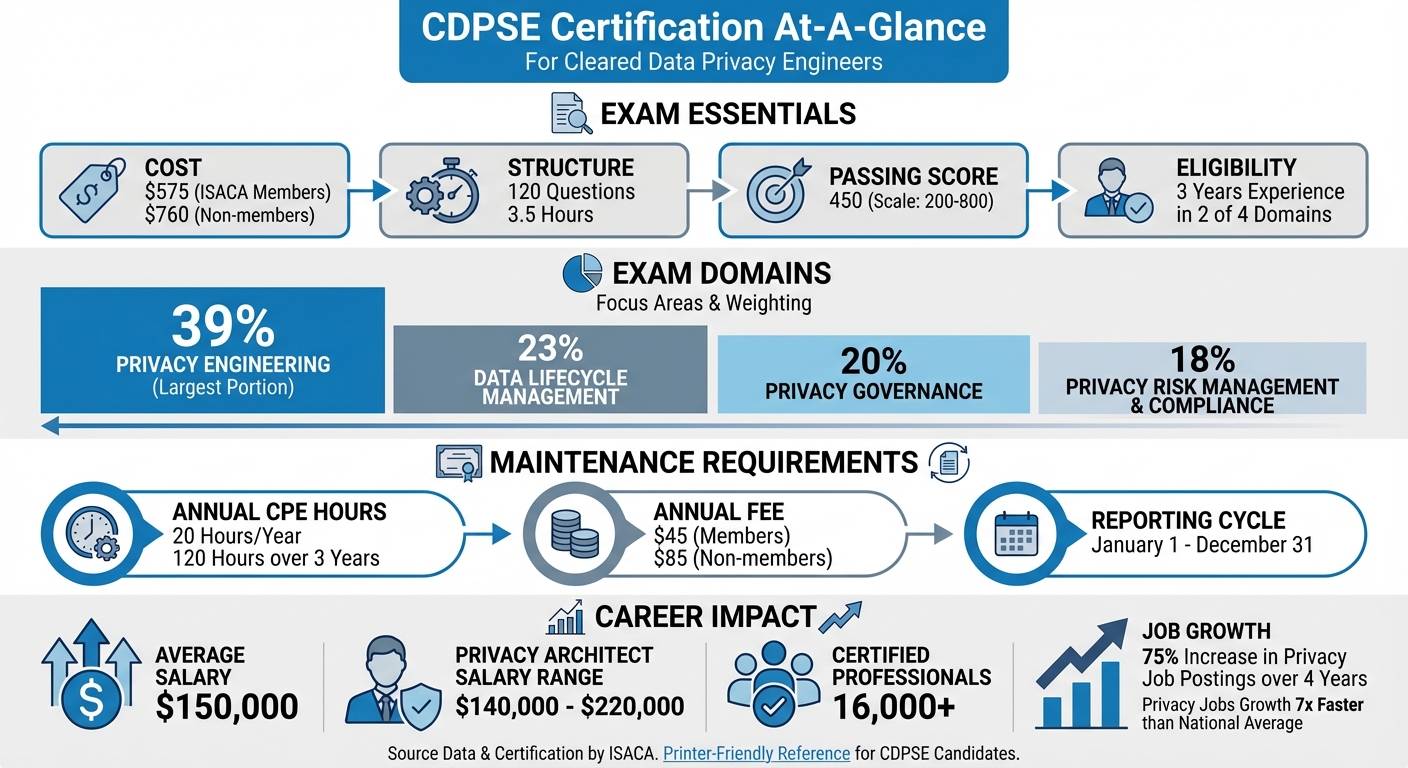
- Exam Cost: $575 (ISACA members) / $760 (non-members)
- Structure: 120 questions, 3.5 hours
- Domains: Privacy Governance (20%), Privacy Engineering (39%), Data Lifecycle Management (23%)
- Eligibility: 3 years of experience in 2 of 4 domains, verified by a supervisor
- Annual Maintenance: 20 CPE hours, $45 fee (members)
The certification covers technical areas like encryption, Privacy Enhancing Technologies (PETs), and secure data lifecycle management. It’s especially relevant for cleared professionals managing classified data while meeting federal privacy standards. The demand for privacy experts is growing, with job postings increasing by 75% over four years.
This guide explains how to prepare for the exam, meet eligibility, and use the certification to advance your career in high-security environments.
CDPSE Certification Quick Reference Guide: Costs, Domains, and Career Benefits
What is the CDPSE Certification?
CDPSE Certification Overview
The Certified Data Privacy Solutions Engineer (CDPSE) is a certification built on real-world experience. It confirms your ability to design, build, and implement privacy-focused solutions from the ground up [1][3]. Specifically, it certifies expertise in embedding privacy controls into IT systems, networks, and applications.
For professionals working in defense and intelligence, the CDPSE demonstrates your ability to turn federal privacy mandates into effective technical designs. It shows you can translate complex legal requirements into practical system designs that safeguard sensitive data throughout its lifecycle.
"If I’m hiring somebody that has the CDPSE, that individual has a fairly extensive body of knowledge. It’s not just legal, it’s not just IT, it’s not just governance, it’s not just security. It’s an amalgam of all those various domains and disciplines." – Matt Stamper, CISO and Executive Advisor [7]
The exam consists of 120 questions based on real-world scenarios [2]. Starting June 2, 2025, the certification will follow a four-domain structure, emphasizing technical controls and collaboration. This ensures certified professionals can work seamlessly with developers, engineers, and project managers in high-security environments.
The 3 Core Domains Explained
While the exam includes four domains, three are especially relevant for cleared professionals handling technical responsibilities:
Privacy Governance (20%) focuses on creating a strong framework for managing personal data. This includes understanding transparency, accountability, and federal regulations, as well as managing vendor relationships in secure environments.
Privacy Engineering (39%) dives into the technical side of privacy. It covers the Secure Development Life Cycle (SDLC), identity and access management (IAM), encryption, hashing protocols, and Privacy Enhancing Technologies (PETs) like anonymization and pseudonymization.
Data Lifecycle Management (23%) ensures data is handled securely at every stage – from collection and classification to retention and destruction – while complying with federal guidelines.
| Domain | Weight | Focus Areas |
|---|---|---|
| Privacy Governance | 20% | Privacy laws, policies, vendor management, and incident response [2] |
| Privacy Engineering | 39% | Infrastructure, SDLC, encryption, IAM, and Privacy Enhancing Technologies [2] |
| Data Lifecycle Management | 23% | Data classification, inventory, retention, and secure destruction [2] |
These domains are the foundation for thriving in roles that demand both technical skills and a deep understanding of privacy.
How CDPSE Supports Cleared Career Goals
The CDPSE bridges the gap between legal requirements and technical execution, making it easier to implement Privacy by Design and Default in government systems [1]. Privacy engineering roles are often harder to fill compared to legal or compliance positions [3]. Earning a CDPSE demonstrates your ability to perform Privacy Impact Assessments (PIAs), conduct threat and vulnerability assessments, and collaborate across teams. This means you can take policy requirements and turn them into actionable technical specifications for developers and auditors.
"Modern privacy laws and regulations require organizations to implement privacy by design and by default into IT systems, networks, and applications… We designed the CDPSE certification to promote privacy-enhanced design that works cross-functionally." – Kim Cohen, ISACA Senior Director of Credentialing [7]
With the exam covering AI and Machine Learning privacy topics [2], you’ll also be prepared for emerging challenges. As government agencies increasingly rely on advanced analytics and automation, your ability to integrate privacy controls into these systems will become even more critical.
sbb-itb-bf7aa6b
CDPSE Certification Requirements and Eligibility
What You Need to Get Certified
Earning the CDPSE certification involves meeting three key requirements. First, you must pass a 3.5-hour exam consisting of 120 questions, achieving a minimum score of 450 on a scale of 200–800 [5]. Second, you need at least three years of professional experience in data privacy governance, architecture, or lifecycle management. This experience must span at least two of the four domains and must be within the past 10 years [11]. Finally, you must agree to follow ISACA’s Code of Professional Ethics, which outlines expected professional and personal behaviors [8].
"Members of ISACA and/or holders of the CDPSE designation agree to a Code of Professional Ethics to guide professional and personal conduct." – ISACA [8]
Unlike some other certifications from ISACA, the CDPSE does not allow for substitutions or waivers. A university degree will not shorten the three-year experience requirement, and all work experience must be verified by a supervisor, manager, colleague, or client. Verification from Human Resources departments or family members is not accepted [11].
Eligibility Guidelines for Cleared Engineers
If you’re a cleared engineer, the certification process adapts to accommodate classified work environments. Documentation focuses on general practice areas rather than project-specific details to maintain confidentiality [11]. Cleared professionals also have some flexibility: you can take the exam before completing the three-year experience requirement. Once you pass, you’ll have up to five years to accumulate and verify the necessary work experience [1].
When documenting your experience in classified settings, emphasize broader job responsibilities, such as implementing privacy-enhancing technologies or managing data lifecycle processes. Your verifier should be someone familiar with your technical work who can confirm your responsibilities within the CDPSE domains, without requiring disclosure of classified information [11].
For those who pass the exam before completing the required experience, the five-year window provides ample time to meet the work history criteria in areas like privacy governance or architecture. This setup allows you to focus on preparation and certification while planning your career path to meet the remaining requirements.
Tips to prepare for the 2025 ISACA CDPSE 3rd Edition exam
How to Prepare for the CDPSE Exam
Getting ready for the CDPSE exam requires a clear understanding of its structure, a solid study plan, and effective time management. Here’s how to set yourself up for success.
Exam Format and Structure
The CDPSE exam consists of 120 multiple-choice questions, and you’ll have 3.5 hours to complete it. To pass, you’ll need a scaled score of 450 (on a scale from 200 to 800) [2][7][12]. You can take the exam at an authorized PSI testing center or opt for remote proctoring, giving you the flexibility to choose a setting that works best for you [1].
The exam is divided into four domains, each weighted differently. Domain 4 (Privacy Engineering) is the heaviest, making up 39% of the exam. Domain 3 (Data Life Cycle Management) accounts for 23%, followed by Domain 1 (Privacy Governance) at 20%, and Domain 2 (Privacy Risk Management and Compliance) at 18% [2]. After registering, you have 12 months to schedule your exam, and appointments can be booked as early as 48 hours after payment. If needed, you can reschedule for free up to 48 hours before your appointment [1].
With the logistics covered, let’s dive into the tools and strategies that can help you prepare.
Study Materials and Strategies
The ISACA CDPSE Review Manual and the Questions, Answers & Explanations (QAE) Database are your go-to resources for studying [12][9]. According to CDPSE top scorer Chris Fraker:
"ISACA’s CDPSE Questions, Answers & Explanations (QAE) manual closely mirrors the exam, with beneficial explanations." [9]
The QAE Database includes about 300 practice questions, a personalized dashboard to track your progress, and a 12-month subscription. Additionally, ISACA offers an online review course that takes roughly 22 hours to complete and provides 12 CPE credits.
Here’s a breakdown of costs:
- Exam fees: $575 for ISACA members, $760 for non-members.
- Review manual: $105 for members, $135 for non-members.
- ISACA membership: $135 annually, which also provides access to the "Engage" online community for study groups and peer support.
When studying, focus on understanding the core privacy concepts rather than just memorizing answers. Fraker emphasizes:
"Don’t cram, learn. All IT certifications have foundational elements that a certified professional should know and understand." [9]
A well-rounded understanding will not only help you pass the exam but also ensure you’re prepared for real-world applications.
Managing Your Study Schedule
Consistency is key when it comes to preparing for the CDPSE exam. Create a daily study routine, ideally at the same time of day as your scheduled exam, to build focus and reduce stress [9]. Fraker suggests:
"Find the best time of day to study and stay consistent… Find out what works best for you and try and make it a routine." [9]
If you’re working in a classified environment, set up a study space outside secure areas to access online materials and practice exams. Remote proctoring offers additional flexibility, allowing you to take the exam in a controlled environment that fits your needs.
Since Domain 4 (Privacy Engineering) carries the most weight, dedicate extra study time to mastering this section. However, don’t neglect the other domains – use the QAE Database’s tracking features to identify areas where you need improvement [1]. A balanced and consistent approach will help you stay on track and boost your confidence as exam day approaches.
Maintaining Your CDPSE Certification
CPE Requirements Explained
Passing the exam is just the beginning – you’ll need to stay active in maintaining your certification. For professionals working in classified environments, this process comes with unique considerations.
To keep your CDPSE certification, you must complete 20 CPE hours annually and a total of 120 hours over three years. Each CPE hour represents 50 minutes of focused study, excluding breaks and meals [4]. Your reporting cycle starts on January 1 after you earn your certification, and any hours accumulated from your certification date to December 31 count toward your first cycle [4].
There’s also an annual maintenance fee: $45 for ISACA members and $85 for non-members. If you hold more than two certifications, the fee drops to $25 for members and $50 for non-members for each additional certification [10].
"The goal of this continuing professional education (CPE) policy is to ensure that all CDPSEs maintain an adequate level of current knowledge and proficiency in data privacy governance, privacy architecture, and data lifecycle" [4].
Failure to meet the CPE requirements or pay your fees by December 31 will result in your certification being revoked. Reinstating it requires a $50 fee plus any unpaid back fees [10].
Now, let’s explore the types of CPE activities available for cleared professionals to meet these requirements.
CPE Activities for Cleared Professionals
There are plenty of ways to earn CPE hours, and many activities can count toward multiple ISACA certifications. If you’re an ISACA member, you can earn up to 36 free CPE hours annually through webinars and online training [10]. Additionally, completing ISACA Journal quizzes provides one CPE hour per quiz, with up to six hours available each year [13].
For cleared professionals, in-house corporate training and government-sponsored workshops qualify as CPE activities, provided you have a certificate of completion [4]. In environments where formal certificates aren’t issued, you can document your attendance using ISACA’s "Verification of Attendance" form, signed by your manager [14].
If you’re teaching or presenting at conferences, you’ll earn five times the duration of your presentation for the first delivery. For example, a two-hour presentation would net you 10 CPE hours [4]. Enrolling in university courses also counts: 15 CPE hours per semester credit hour or 10 hours per quarter credit hour [4].
Volunteering is another option. Serving on ISACA boards, working groups, or the ISACA Foundation can earn you up to 20 CPE hours annually [10]. Mentoring colleagues or helping others prepare for the CDPSE exam can add up to 10 CPE hours per year [4]. Even passing a related professional exam earns you two CPE hours for every hour of exam duration [4].
Make sure to keep detailed records of all your activities. This includes your name, the sponsoring organization, the activity title, the date, and the total hours awarded. Retain these records for at least 12 months after your three-year cycle ends, as ISACA conducts random audits of certified professionals each year [10]. To avoid last-minute stress, report your CPE hours in the MyISACA portal as you earn them. This ensures you stay on top of requirements and maintain your certification status [4].
Using CDPSE to Advance Your Cleared Career
New Career Opportunities
Earning the CDPSE certification opens doors to senior-level roles that demand expertise in technical privacy, such as Chief Privacy Officer (CPO), Chief Risk Officer (CRO), and Lead Privacy Manager [16][6]. These roles are especially important in government and defense contracting, where meeting privacy compliance standards is directly tied to mission success.
The demand for skilled technical privacy professionals has skyrocketed. Over four years, job postings mentioning "data privacy" or "data protection" rose by 75%. Privacy analyst roles have doubled, and overall, data privacy jobs are projected to grow more than seven times faster than the national average. Globally, there are an estimated 3.5 million unfilled cybersecurity roles, with demand for experts in building and securing enterprise systems expected to increase by 164% in the next five years [15].
For professionals with security clearances, the CDPSE certification is especially valuable in defense and national security, where technical expertise is needed to translate legal requirements into actionable technical frameworks [16]. To seize these opportunities, you need to stand out in the competitive cleared job market.
Standing Out in the Cleared Job Market
The CDPSE certification equips you with a unique mix of skills across IT, security, governance, and legal domains. This multidisciplinary expertise is a significant advantage, particularly in government environments where legal teams often lack the technical know-how to manage data collection, storage, retrieval, and packaging effectively [7].
With 64% of organizations citing insufficient training as a major cause of privacy failures [16] and nearly 60% of data breaches stemming from human error [6], employers are prioritizing candidates who can implement technical controls over those who only understand policy. Your CDPSE certification highlights your ability to work with Privacy Enhancing Technologies (PETs), manage secure development life cycles, and integrate privacy into IT system architectures – skills that directly address these common vulnerabilities.
Platforms like Cleared Cyber Security Jobs can help you find roles requiring privacy expertise, connecting you with employers who value your technical credentials. Roles such as Privacy Solutions Architect, which align with CDPSE expertise, offer salaries ranging from $140,000 to $220,000 [17].
Beyond showcasing your expertise, staying ahead of industry trends is crucial for long-term career growth.
Staying Current with Industry Trends
The privacy field is evolving quickly, and the CDPSE certification ensures you stay on top of these changes. One major shift is the growing emphasis on "privacy by design and by default", which requires professionals who can implement privacy controls rather than just interpret regulations [7].
"Modern privacy laws and regulations require organizations to implement privacy by design and by default into IT systems, networks, and applications. We designed the CDPSE certification to promote privacy-enhanced design that works cross-functionally" [7].
With over 120 countries enforcing privacy laws or regulations [16], organizations need engineers capable of navigating frameworks like GDPR and CCPA while deploying technical solutions across various jurisdictions. The certification’s focus on Privacy Engineering – representing 39% of the exam [2] – prepares you to tackle these challenges with practical skills rather than just theoretical knowledge.
As new technologies like AI and machine learning introduce complex privacy challenges, CDPSE-certified professionals must address issues such as anonymization, pseudonymization, and advanced PETs [2]. Additionally, with the move to cloud-based systems, you’ll need to manage shared responsibility models, secrets management, and container security to prevent data exposure [18].
Data privacy has become a top priority for corporate boards, ranking among their top three concerns due to the financial and reputational risks tied to breaches [15]. This increased focus translates into more resources and career opportunities for technical privacy experts. By maintaining your certification through annual CPE requirements, you’ll ensure your skills remain aligned with emerging technologies and regulations, keeping you competitive in the cleared job market.
Conclusion
The CDPSE certification bridges the gap between legal compliance and technical application, making it a sought-after credential in the cleared community. By combining your technical privacy skills with this certification, you can position yourself as a key player in the cybersecurity field.
To get started, confirm your eligibility and begin preparing for the exam. The official CDPSE Review Manual and the Questions, Answers & Explanations database are excellent resources to help you tackle the 120-question, 3.5-hour exam. Once you pass, submit your application within five years, pay the $50 certification fee, and provide proof of your work experience [7]. Keep your certification active by meeting the annual CPE requirements, ensuring your expertise stays relevant as privacy laws evolve across over 120 countries [16].
The financial benefits of this certification are hard to ignore. CDPSE-certified professionals in data privacy roles earn an average of $150,000 annually, with Privacy Solutions Architect positions offering salaries between $140,000 and $220,000 [7]. This certification is especially valuable in cleared roles, where organizations need experts who can implement privacy controls alongside regulatory compliance. With advancements in technologies like AI and machine learning, the CDPSE credential showcases your ability to navigate complex privacy challenges while adhering to strict federal standards.
Take advantage of platforms like Cleared Cyber Security Jobs to connect with employers looking for technical privacy specialists. Update your LinkedIn profile and business cards with the CDPSE designation to highlight your qualifications [4]. Visit ISACA’s website to begin your certification journey today. With the demand for technical privacy expertise growing, the CDPSE certification is your opportunity to stand out in the cleared cybersecurity landscape.
FAQs
Is CDPSE worth it for cleared engineers vs. privacy lawyers?
The CDPSE certification holds strong value for cleared engineers. It confirms their technical privacy expertise, opens doors to better career prospects, and can even result in higher salaries. Unlike privacy lawyers, who concentrate on legal compliance and policy, the CDPSE focuses on professionals handling privacy in technical and operational environments. This makes it particularly relevant for cleared engineers involved in data privacy and security tasks.
How can I verify CDPSE experience without revealing classified work?
To verify CDPSE experience, you need to provide evidence of professional work across at least two of the exam domains. Use examples from non-classified, technical, or project-related work that clearly showcase your skills and expertise. Make sure your submission aligns with ISACA’s professional ethics guidelines and continuing education requirements. This way, you can validate your experience without sharing any sensitive or classified information.
What’s the best way to study if Privacy Engineering is the biggest domain?
To get ready for the CDPSE exam with an emphasis on Privacy Engineering, begin by thoroughly reviewing all three domains, with extra attention to the Privacy Engineering section. Dive into the detailed content outline to understand the scope of the material. Leverage specialized study guides and take practice exams to build your expertise in critical areas like privacy-by-design and risk modeling. A well-organized study plan combined with practicing real-world scenarios can solidify your knowledge and increase your confidence.