

The Certified Threat Intelligence Analyst (CTIA) certification by EC-Council is a must-have for security-cleared professionals in threat intelligence. It focuses on the complete intelligence lifecycle – planning, collection, analysis, and dissemination – helping analysts turn raw data into actionable insights. Recognized by the U.S. Army and Navy COOL programs, CTIA is ideal for defense, military, and federal roles, offering career growth in a field expected to grow 29% from 2024 to 2034. With salaries ranging from $100,000 to $170,000, it’s a strong choice for transitioning from SOC or incident response roles to specialized threat intelligence positions.
Key Points:
- CTIA aligns with frameworks like MITRE ATT&CK, Cyber Kill Chain, and Diamond Model.
- It fulfills DoD 8570.01-M requirements and qualifies for military funding.
- Exam: 50 questions, 2 hours, 70% passing score, $450 fee.
- Preparation: Training costs range from $999 to $3,500; self-study options available.
- Renewal: Valid for three years, requiring 120 continuing education credits.
CTIA-certified professionals gain a competitive edge in government, defense, and critical infrastructure sectors by mastering structured intelligence methods and transitioning into higher-paying, specialized roles.
What is CTIA Certification and Why It Matters for Cleared Professionals
CTIA Certification Explained
The Certified Threat Intelligence Analyst (CTIA) is a specialized program created by EC-Council to validate expertise in identifying and analyzing previously unknown threats. This certification emphasizes a structured, methodical approach to the threat intelligence lifecycle, which includes planning, data collection, processing, analysis, and dissemination. The ultimate goal? To transform raw technical data into actionable intelligence that can drive decision-making.
CTIA focuses heavily on practical applications of well-known industry frameworks. For instance, you’ll learn to use the MITRE ATT&CK framework for mapping adversary behavior, apply the Cyber Kill Chain to bolster defensive operations, and leverage the Diamond Model of Intrusion Analysis for profiling threat actors. Additionally, it covers advanced techniques in OSINT (open-source intelligence), HUMINT (human intelligence), and CCI (counterintelligence), which are critical in national security scenarios. The certification exam consists of 50 multiple-choice questions, with a 2-hour time limit and a passing score of 70%[5]. EC-Council has already certified over 237,000 security professionals worldwide, including members of the U.S. Army, FBI, and United Nations[2].
A standout feature of CTIA is its focus on structured reporting. You’ll learn to use tools like the Pyramid of Pain to create intelligence reports that directly influence high-stakes decision-making. As Gartner explains, "Threat intelligence (TI) is evidence-based knowledge, including context, mechanisms, indicators, implications, and actionable advice, about an existing or emerging menace or hazard to assets that can be used to inform decisions regarding the subject’s response to that menace or hazard"[2].
This comprehensive approach makes CTIA an essential certification for cleared professionals looking to advance in threat intelligence.
Benefits for Cleared Threat Intelligence Analysts
CTIA’s methodology not only enhances operational capabilities but also aligns with key regulatory requirements. For example, it fulfills the DoD 8570.01-M requirement for the Cyber Network Defender (CND) category[6] and qualifies for military funding through COOL programs, which cover the $450 exam fee and related training expenses[3][2].
For cleared professionals, CTIA bridges the gap between tactical Security Operations Center (SOC) tasks and strategic intelligence reporting. If you’re currently involved in incident response or security monitoring, this certification demonstrates your ability to transition from reactive alert handling to proactive threat hunting and intelligence-driven defense. With salaries for threat intelligence roles averaging between $100,000 and $170,000[3] and a projected 29% job growth for information security analysts from 2024 to 2034[2], CTIA opens doors to positions like Military Intelligence Specialist, Active Cyber Defense Operator, or Senior Intelligence Analyst.
Beyond career advancement, CTIA boosts operational effectiveness by teaching the frameworks and methodologies used by defense and intelligence agencies. For professionals in sectors like energy, defense, and critical infrastructure – where nation-state threats are a constant concern – the certification equips you with the tools to neutralize sophisticated adversaries before they strike[3].
sbb-itb-bf7aa6b
CTIA Certification Requirements and Prerequisites
Experience and Technical Skills Needed
To qualify for the CTIA certification, the EC-Council provides two distinct pathways. The first option involves completing an accredited CTIA course through an authorized EC-Council training center. Alternatively, candidates can choose the self-study route, which requires proof of at least two years of experience in information security and a $100 application fee for credential review [3].
Candidates often bring 2–3 years of practical experience in fields like SOC operations, incident response, or security monitoring. Alongside this, a strong understanding of the intelligence lifecycle and technical skills such as OSINT collection, basic Python scripting for automation, and familiarity with threat intelligence platforms (e.g., MISP or ThreatConnect) is crucial. Additionally, knowledge of frameworks like MITRE ATT&CK, the Cyber Kill Chain, and the Diamond Model of Intrusion Analysis is highly valuable. While educational backgrounds can vary – ranging from computer science and digital forensics to criminology and law enforcement – a solid technical foundation in cybersecurity provides a significant advantage.
How Security Clearance Affects CTIA Eligibility
While technical expertise is critical, having a security clearance can significantly enhance your CTIA qualifications. Although it doesn’t alter the basic eligibility criteria, it provides distinct advantages. The CTIA certification aligns with the National Initiative for Cybersecurity Education (NICE) Cybersecurity Workforce Framework and is listed in the DoD COOL programs for both Army and Navy personnel. This alignment allows military professionals to access funding for the $450 exam fee and related training [3][2].
"CTIA aligns with NICE framework tasks and appears in DoD COOL listings, making it a viable credential for military or defense-related roles." – Programs.com [3]
For those working in national security, CTIA stands out due to its focus on structured intelligence methodologies and standardized reporting practices widely used in government and defense sectors. Roles like All-Source Cyber Threat Intelligence Analyst or Active Cyber Defense Operator often require U.S. citizenship and at least a Public Trust clearance. To determine if you qualify for exam and training reimbursement, check your branch’s COOL portal.
CTIA Exam Format and How to Prepare
Exam Structure and Content Areas
The CTIA exam (code 312-85) is a 50-question, multiple-choice test with a 2-hour time limit. To pass, you’ll need a score of at least 70% – each question contributes 2% to your total score [3]. The exam is administered through the EC-Council Exam Center, with an option for remote proctoring [4].
The exam focuses on the threat intelligence lifecycle rather than specific tools or hands-on skills. Here’s how the content is divided:
- Data Collection and Processing: 24%
- Data Analysis: 16%
- Requirements, Planning, Direction, and Review: 14%
- Dissemination and Reporting: 14%
- Introduction to Threat Intelligence: 12%
- Cyber Threats and Attack Frameworks: 8%
- Threat Hunting and Detection: 6%
- CTI in SOC, IR, and Risk Management: 6% [4]
In terms of difficulty, the CTIA exam is considered moderately challenging. It’s tougher than entry-level certifications like Security+ but not as demanding as advanced ones like CISSP or GCTI [3]. Knowing the exam’s structure can help you focus your preparation on the most important areas.
Study Materials and Training Programs
The EC-Council’s official courseware – spanning over 800 pages – is your main resource for exam prep [3]. Training options include:
- Self-paced training: Around $999
- Instructor-led courses: Between $3,000 and $3,500 [3]
- Additional materials: e-Courseware package ($250) and six-month iLabs access ($199) [2]
For professionals, a 6–8 week study plan is often recommended [3]. A 60-hour study schedule might allocate approximately 15 hours to Data Collection and Processing and 10 hours to Data Analysis [4]. During the exam, aim to answer all 50 questions in 60 minutes (about 72 seconds per question), leaving time to review flagged items [4].
To supplement your study, dive into resources like MITRE ATT&CK whitepapers and recent APT reports. Practice crafting mock threat intelligence reports based on real-world incidents. Creating a portfolio with 3–5 redacted briefs, a sample collection plan, and an ATT&CK-mapped detection idea can also showcase your skills to potential employers [4].
Managing Study Time with Cleared Job Duties
Balancing exam prep with job responsibilities requires careful planning. Set aside three dedicated study sessions each week [4]. Since the CTIA exam is theoretical and doesn’t include lab work, focus on understanding the shared terminology and reporting structures used by SOC teams and executives [3].
Consider keeping a “CTI habits” notebook to track intelligence products, analytic methods, and reporting strategies. Use this knowledge to guide threat-hunting exercises tailored to your work environment. This approach allows you to prepare effectively without disrupting your professional duties or compromising security.
Using CTIA Certification to Advance Your Career
Cleared Job Roles That Benefit from CTIA Certification
CTIA certification opens doors to various cleared career paths, especially in roles focused on cyber threat intelligence and response. For instance, cyber threat hunters rely on CTIA training to proactively detect adversarial activity by using threat hunting loops and identifying tactics, techniques, and procedures (TTPs). Meanwhile, SOC threat intelligence analysts integrate threat intelligence feeds into SIEM platforms and effectively deploy indicators of compromise (IoCs) to bolster organizational defenses [2] [7]. Similarly, incident responders use CTIA frameworks – like the Cyber Kill Chain and Diamond Model – to analyze intrusion contexts and create detailed incident reports [2] [7].
This certification is particularly valuable for professionals looking to transition from general security operations into more specialized intelligence roles. It formalizes expertise in threat intelligence and helps shift the focus from reactive security practices to structured, intelligence-driven strategies [3]. Salaries for threat intelligence roles that value CTIA certification typically range between $100,000 and $170,000, with the average hovering around $106,000 [3].
CTIA also fits well into a long-term certification strategy for cleared professionals at different career stages. For early-career analysts (1–3 years), combining CTIA with foundational certifications like CEH or CND after gaining hands-on SOC or incident response experience can be a smart move. Mid-career professionals (3–7 years) can pair CTIA with certifications like CISSP or CISM to strengthen their leadership credentials. For those already specializing in intelligence, CTIA can serve as a stepping stone to advanced certifications like GCTI [3]. These tailored benefits align naturally with the needs of government and defense employers.
How CTIA Meets Government and Defense Employer Requirements
CTIA certification is designed to meet the high standards of government and defense employers, making it a valuable asset for professionals in cleared roles. Its focus on the intelligence lifecycle – covering planning, collection, analysis, and dissemination – sets it apart from broader certifications like CISSP. This specialization makes CTIA particularly relevant for intelligence-led positions, as it demonstrates a deep understanding of structured threat intelligence processes [3].
The certification is included in the U.S. Department of Defense COOL (Credentialing Opportunities On-Line) listings for Army and Navy personnel, further cementing its relevance in government and defense sectors [3]. Additionally, EC-Council has certified over 237,000 security professionals working with organizations such as the U.S. Army, FBI, and United Nations [2]. For cleared contractor roles, CTIA can also help meet DoD 8570.01-M requirements, which sometimes mandate certifications for positions like Cyber Network Defender (CND) [6].
When interviewing for government positions, showcasing your expertise with industry-standard frameworks – such as the Diamond Model, Cyber Kill Chain, and MITRE ATT&CK framework – can set you apart. CTIA training emphasizes these models, enabling you to create well-structured intelligence reports that directly support executive decision-making [2] [3]. For maximum impact in the cleared sector, consider pairing CTIA with broader certifications like CISSP or CEH to showcase both your comprehensive security knowledge and specialized threat intelligence skills [3].
EC-Council CTIA v2 Certification: Complete 2025 Guide to Becoming a Threat Intelligence Analyst
CTIA Certification Costs and Return on Investment
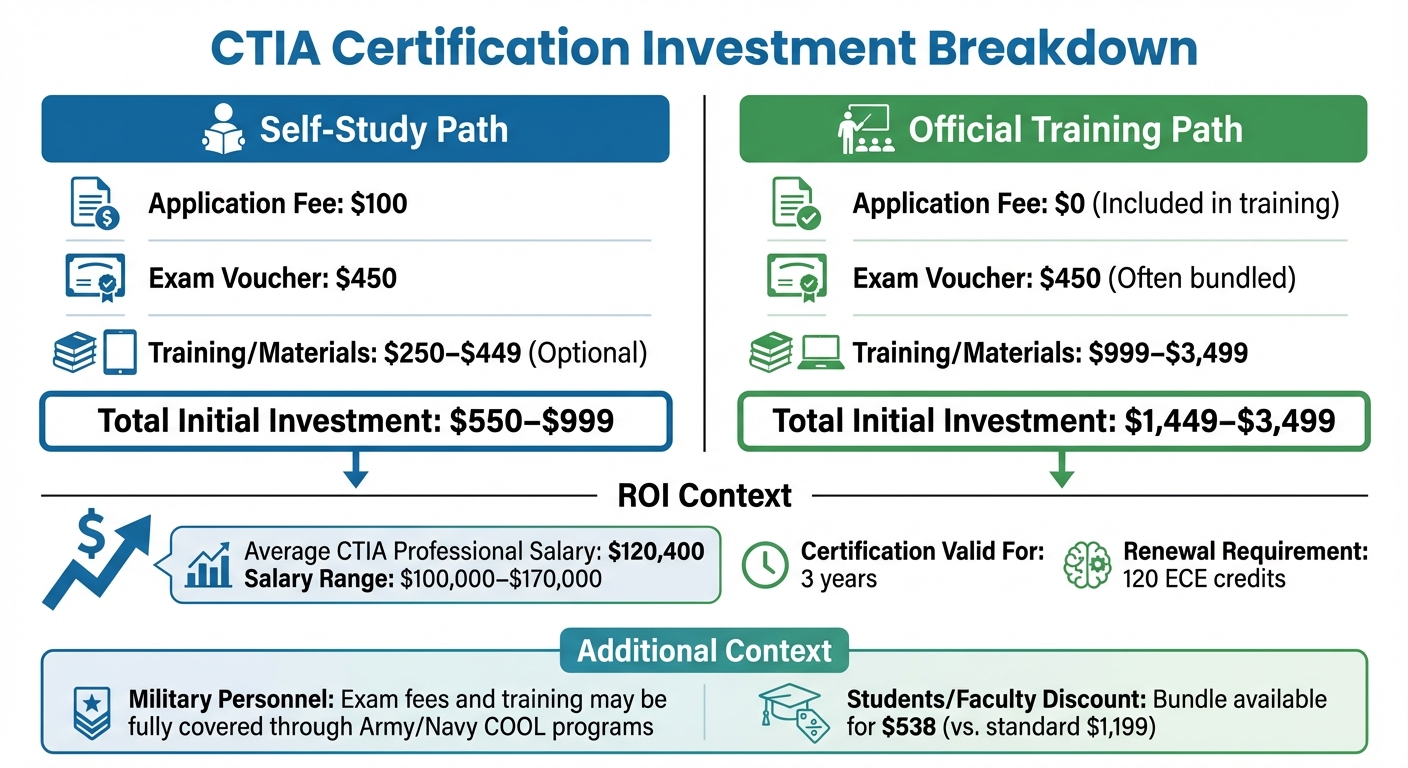
CTIA Certification Cost Comparison: Self-Study vs Official Training Path
Exam Fees, Training Costs, and Renewal Expenses
The cost of CTIA certification depends on the training path you choose. The exam fee is $450, but self-study candidates must also pay a $100 application fee to verify their two years of relevant experience before purchasing the exam voucher [3]. Additionally, the official textbook costs $257 [8].
Training options vary widely in price. Self-paced training programs typically cost between $999 and $1,399, with many packages bundling the exam voucher, course materials, and lab access for added value [3]. For those who prefer more structured learning, instructor-led training can cost up to $3,000 [3]. EC-Council also offers an unlimited on-demand training option, starting at $3,999 [7].
Renewing the certification involves ongoing expenses. CTIA certification is valid for three years, after which you’ll need to earn 120 Continuing Education (ECE) credits and pay an annual membership fee to maintain active status [3].
For active-duty military personnel, programs like the U.S. Army or Navy COOL may fully cover exam fees and training expenses [3]. Students and faculty can also benefit from significant discounts through the EC-Council Academia Partner Program. This program offers a bundle – including the eBook, iLabs, and exam voucher – for $538, compared to the standard $1,199, while waiving the $100 application fee and experience requirements [10].
When you weigh these costs against the certification’s career benefits, the potential return becomes clear.
Calculating ROI for Cleared Professionals
Breaking down these costs is essential for understanding the career advantages CTIA certification can provide. On average, CTIA-certified professionals earn $120,400 annually, with salaries for specific roles ranging from $100,000 to $170,000 [9]. ZipRecruiter data places salaries at the 75th percentile around $120,500 [3].
Rather than guaranteeing promotions, the certification serves as a career accelerator. It opens doors to specialized roles in cyber threat intelligence and strengthens your position during salary negotiations, particularly in industries like defense, finance, and energy [3]. Additionally, CTIA meets DoD 8570.01-M requirements, making it a necessity for certain cleared contracts and government roles [6].
The demand for cyber threat intelligence professionals further supports the certification’s value. Currently, there are over 148 active remote job postings in this field offering salaries as high as $192,000. The Bureau of Labor Statistics also projects a 29% growth rate for Information Security Analysts between 2024 and 2034 [3][2]. For cleared professionals whose employers reimburse certification costs, the return on investment can be almost immediate. Even at the upper end of training expenses (up to $3,499), the certification can pay for itself within months through higher salaries or new job opportunities.
| Cost Component | Self-Study Path | Official Training Path |
|---|---|---|
| Application Fee | $100 | $0 (Included in training) |
| Exam Voucher | $450 | $450 (Often bundled) |
| Training/Materials | $250–$449 (Optional) | $999–$3,499 |
| Total Initial Investment | $550–$999 | $1,449–$3,499 |
Maintaining CTIA Certification and Ongoing Professional Development
Renewal Process and Continuing Education Requirements
CTIA certification is valid for three years, during which you’ll need to earn 120 EC-Council Continuing Education (ECE) credits and pay an Annual Membership Fee (AMF) to keep your credential active [2][3].
The 120-credit requirement offers flexibility in how you stay updated. Options include attending cybersecurity conferences, hosting webinars or presentations on information security, publishing research papers or technical articles, or pursuing additional industry certifications [2]. Activities like digital forensics workshops and relevant coursework also contribute to your renewal credits [2].
If you don’t meet the 120 ECE credit requirement within three years, you’ll need to retake the CTIA exam, which comes with an additional fee of $450 [2][3]. Staying on top of these requirements not only helps you avoid extra costs but also ensures your skills remain sharp and aligned with the latest developments in cybersecurity.
This renewal process keeps you actively engaged with the evolving threat intelligence landscape. For professionals in government or defense roles, this ongoing education is particularly critical, as it enhances your ability to assess and counter emerging threats to national security systems. The structured approach to renewal reinforces your expertise and prepares you for the constantly shifting challenges in cybersecurity.
Using CTIA as a Foundation for Advanced Certifications
CTIA serves as an excellent stepping stone for further specialization. It bridges the gap between entry-level certifications, such as Security+ or CEH, and advanced credentials like GCTI [3]. While GCTI focuses on advanced technical skills, its cost – over $7,000 – makes CTIA a more budget-friendly option for building a solid foundation in threat intelligence first [3].
Maintaining your CTIA certification not only validates your current knowledge but also prepares you for advanced certifications that are essential for leadership roles. Combining CTIA with broader credentials like CISSP or CISM demonstrates both technical expertise in threat intelligence and strategic leadership capabilities, positioning you for senior-level roles requiring a mix of analytical and managerial skills [3][2].
Additionally, CTIA aligns with the NICE Special Publication 800-181 Cybersecurity Workforce Framework and meets DoD 8140/8570 requirements, making it a valuable certification for professionals in government career paths [1][11]. As you progress, CTIA credentials support your transition from analyst roles to leadership positions, equipping you to design and oversee comprehensive threat intelligence programs.
Conclusion
CTIA certification provides threat intelligence analysts with a direct path to advancing their careers in cybersecurity. The U.S. Bureau of Labor Statistics anticipates a 29% increase in analyst jobs between 2024 and 2034 [2], highlighting the growing need for professionals skilled in transforming raw data into meaningful intelligence.
This certification not only aligns with industry demand but also showcases your expertise in operational intelligence. It’s especially valuable for those aiming to secure roles in government and defense contracting, where this validation can set you apart.
The financial commitment is reasonable. The exam costs $450, while training options range from $999 to $3,000. Considering potential salaries between $100,000 and $170,000 [3], the return on investment is hard to ignore.
"CTIA is best viewed as a career-pivot accelerator rather than a direct salary booster. The cert’s true value is in opening doors to intel-specific roles." – Expert Takeaway, Programs.com [3]
To make the most of this opportunity, start by defining your career objectives. Decide whether official training or self-study suits your learning style. Building a portfolio with redacted threat briefs and ATT&CK-mapped detection ideas can further demonstrate your practical skills to employers [4]. Whether you’re currently working as a SOC analyst or in incident response, CTIA provides the tools and credibility to transition into critical intelligence roles that contribute to national security.
FAQs
Is CTIA worth it if I already work in a SOC or incident response?
Earning a CTIA certification can definitely make a difference, even if you’re already working in a SOC or handling incident response. It equips you with specialized knowledge in threat intelligence, sharpening your skills to analyze and address threats before they escalate. Plus, it opens doors for career growth in the cybersecurity field. This certification helps you stand out by showcasing expertise in areas that are crucial for high-level cybersecurity roles requiring clearance.
What’s the fastest way to get CTIA using DoD COOL funding?
The fastest route to earning the CTIA certification using DoD COOL funding is by signing up for an approved training program. Options include online or instructor-led courses, like the official EC-Council CTIA course. These programs usually offer a 3-day intensive training session and include the exam voucher. Funding is accessible through the Army Credentialing Assistance program.
How do I turn CTIA knowledge into a cleared threat intel portfolio?
To build a strong cleared threat intelligence portfolio, focus on demonstrating how you’ve applied Cyber Threat Intelligence Analyst (CTIA) skills in practical situations. Highlight your work with threat intelligence frameworks, data collection methods like OSINT or malware analysis, and the creation of actionable reports. Be sure to emphasize your familiarity with the threat intelligence lifecycle, your role in threat mitigation efforts, and your ability to collaborate with leadership. Showing how you’ve translated complex technical data into strategic insights will help underline your expertise and value in cleared positions.