

The CIPP/US certification is a must-have for U.S.-based professionals working in privacy and cybersecurity, especially those with security clearance. It validates expertise in U.S. privacy laws, federal data protection standards, and compliance requirements critical for federal and defense roles. Here’s what you need to know:
- What It Is: A globally recognized credential from the IAPP, focusing on privacy laws and regulations.
- Why It Matters: Employers value CIPP/US-certified professionals for their ability to navigate privacy challenges in sensitive environments.
- Earning Potential: Certified professionals earn $20,000–$30,000 more annually, with starting salaries around $135,000 and median earnings up to $205,000.
- Preparation: Requires 30+ hours of study, official textbooks, and practice exams. Exam costs $550, with ongoing maintenance fees every two years.
- Career Growth: Opens doors to roles like Privacy Officer and Data Protection Officer, with opportunities to expand into CIPM or CIPT certifications.
Whether you’re advancing your career or transitioning into privacy-focused roles, the CIPP/US certification is a powerful tool to showcase your expertise and meet federal compliance standards.
The Complete CIPP Certification Guide (2025) – Requirements, Exam Tips & Career Value
sbb-itb-bf7aa6b
Benefits of CIPP Certification for Cleared Professionals
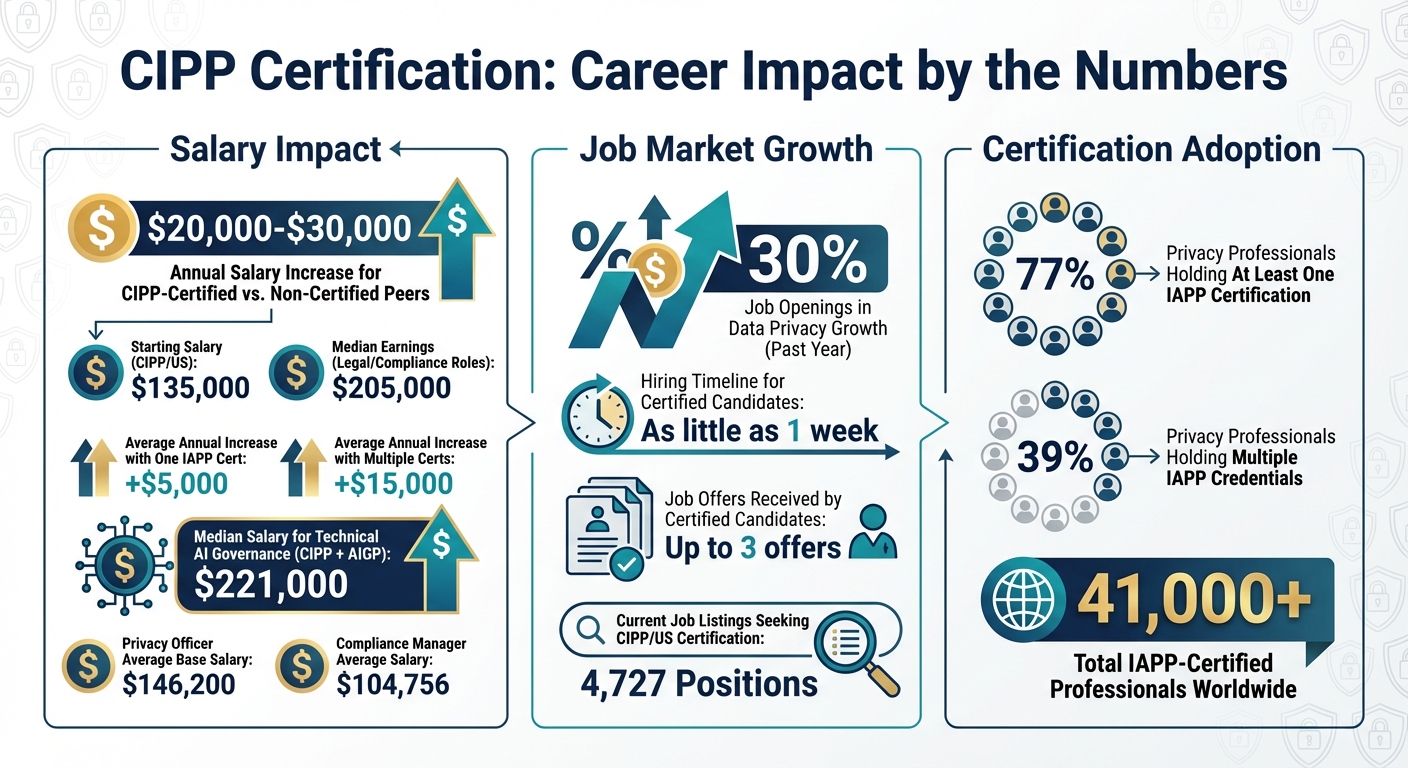
CIPP Certification Salary Benefits and Career Statistics for Privacy Professionals
For professionals with security clearances, the CIPP/US certification offers more than just a career boost – it solidifies essential privacy expertise critical for working in sensitive federal environments.
Higher Salaries and Career Advancement Opportunities
IAPP-certified professionals enjoy a significant salary edge, earning $20,000–$30,000 more annually. Specifically, those with a CIPP/US certification can expect starting salaries around $135,000, with median earnings reaching $205,000 in legal and compliance roles[4][5][8].
The demand for privacy experts is skyrocketing. Over the past year, job openings in data privacy grew by 30%, drastically reducing hiring timelines to as little as a week. Certified candidates often receive up to three job offers[5]. For cleared professionals, the certification’s emphasis on national security and law enforcement data access provides an additional competitive edge.
Adding more certifications can further accelerate career growth. Around 39% of privacy professionals hold multiple IAPP credentials, which correlates with higher median salaries[4]. For instance, earning the Fellow of Information Privacy (FIP) designation – by combining CIPP with credentials like CIPM or CIPT – can open doors to senior roles like Data Protection Officer[2][5].
These benefits highlight how the CIPP/US certification not only boosts earning potential but also demonstrates expertise in compliance, making it a valuable asset for cleared professionals.
Proving Your Privacy Compliance Expertise
The CIPP/US certification is accredited by ANAB under ISO 17024:2012, which ensures it meets stringent federal and defense standards[2][6].
"Accreditation signifies holders have the skills to work across national and international jurisdictions." – IAPP[6]
This certification validates knowledge of U.S. privacy laws, including the FTC Act, GLBA, HIPAA, and CPRA[7]. A recent job search revealed 4,727 listings specifically seeking candidates with CIPP/US certification[7]. For cleared professionals, this credential signals to employers, clients, and vendors that you possess the expertise needed to navigate complex privacy requirements in both national and international contexts. This is especially vital in cleared environments, where trust and proven skills are non-negotiable. The certification’s focus on national security and law enforcement data requirements makes it even more valuable for professionals in these roles.
In addition to validation, the CIPP/US certification opens doors to a wide range of industry opportunities.
Industry Applications for Cleared Professionals
The CIPP/US certification is highly adaptable, making it relevant across multiple industries. In healthcare, it ensures compliance with HIPAA regulations, which is essential for managing sensitive medical data in government health programs and defense medical facilities[8]. In financial services, its coverage of the GLBA is critical, while professionals in technology and AI governance also benefit significantly.
Some individuals pair the CIPP/US with the AI Governance Professional (AIGP) certification to handle the ethical challenges of deploying AI systems. Those specializing in technical AI governance have reported median salaries as high as $221,000[4]. Moreover, government contractors working in telecommunications, defense systems, and intelligence rely heavily on the privacy law expertise that the CIPP/US provides.
This certification’s versatility allows cleared professionals to seamlessly transition between industries while maintaining its relevance. With 77% of privacy professionals holding at least one IAPP certification, the CIPP/US is widely recognized as a credential that maximizes career opportunities while adhering to security clearance requirements[4]. For cleared professionals, it’s a powerful tool for staying competitive in high-demand, high-value sectors.
How to Get CIPP Certified
Eligibility Requirements and Exam Structure
The CIPP exam is open to everyone – there are no prerequisites required to take it [2]. This inclusive approach makes it accessible to professionals at any point in their careers.
"Eligibility criteria for examination and certification as a Certified Information Privacy Professional… are applied equally to all individuals regardless of age, race, religion, gender, national origin, veteran status or disability." – IAPP Certification Candidate Handbook [2]
The CIPP/US exam includes 90 questions focusing on U.S. federal and state privacy laws, sector-specific regulations like HIPAA and GLBA, and enforcement practices. You’ll have 2.5 hours to complete the test, with a mandatory 15-minute break. Scoring ranges from 100 to 500, and you’ll need at least 300 to pass. Testing is available at over 6,000 Pearson VUE centers worldwide, or you can take it remotely through OnVUE on a personal computer (VPNs are not allowed).
Before scheduling your exam, make sure the name on your MyIAPP profile matches your government-issued ID. If you need accommodations, such as screen readers or interpreters, submit your request at least 30 days before your test date. If you don’t pass on your first attempt, you’ll need to wait at least seven days before retaking the exam.
These guidelines ensure a smooth process and help maintain the rigorous standards needed for high-level privacy and cybersecurity roles.
Study Resources and Training Programs
The IAPP suggests allocating at least 30 hours of focused study for the CIPP exam. To kick off your preparation, take advantage of the free mini-course and downloadable study guide. These tools will help you create a solid study plan before diving into additional resources. Two must-haves for your prep are the Body of Knowledge, which outlines all exam topics, and the Exam Blueprint, which breaks down the number of questions per subject area.
For more in-depth preparation, you can choose from several training options: online courses, live sessions, or in-person classes. Here’s a breakdown of costs:
- CIPP/US Online Training: $1,195.00
- Practice Exam: $55.00
- U.S. Private-Sector Privacy Textbook: $95.00 (print) or $75.00 (digital)
Practice exams are especially helpful for simulating the actual test environment and identifying areas where you need improvement. Additionally, the IAPP Resource Center offers a range of privacy tools, and subscribing to the Daily Dashboard newsletter provides real-world insights into privacy issues that align with exam topics.
Once you feel confident in your preparation, you can move on to the registration process.
Registration Process, Costs, and Employer Sponsorship
When you’re ready, registering for the CIPP exam is straightforward. Purchase the exam for $550.00 through the IAPP store, then schedule it in the "My Purchases" section of your MyIAPP account. Keep in mind that your exam purchase is valid for one year, so it’s a good idea to schedule your test date as early as possible.
After passing the exam, you’ll need to pay a Certification Maintenance Fee (CMF) every two years to keep your credential active. If you’re an IAPP member, this fee is included in your membership benefits. Non-members can pay the CMF at the time of the exam to ensure their certification is activated immediately upon passing.
Many professionals seek employer sponsorship or reimbursement for certification costs. Employers interested in supporting certification efforts can contact IAPP at sales@iapp.org to discuss sponsorship opportunities. The MyIAPP "My Purchases" system is also designed to simplify employer-funded transactions and reimbursement processes.
Using CIPP Certification in Cleared Roles
Practical Applications in Federal Cybersecurity
The CIPP/US certification offers a solid foundation for addressing privacy challenges in federal cybersecurity roles. It provides training on legal requirements for handling personal data in federal settings, along with guidance on navigating state data security laws and federal breach notification protocols during incidents. This certification also prepares you to manage privacy issues in civil litigation, such as e-discovery and cross-border data transfers. Additionally, it helps you understand the intricate landscape of U.S. federal and state privacy laws, as well as sector-specific regulations for industries like healthcare and finance. This unique combination of technical and legal knowledge is essential when creating privacy policies or advising leadership on compliance strategies. It also facilitates a smooth transition into specialized roles focused on privacy. [3]
Applying CIPP Knowledge to Privacy-Focused Positions
The operational expertise gained from CIPP certification directly supports roles such as Privacy Officer, Compliance Manager, and Data Protection Officer in cleared environments. These positions come with competitive salaries – Privacy Officers earn an average base salary of $146,200, while Compliance Managers average $104,756. In these roles, you’ll ensure compliance with federal, state, and local privacy laws, oversee data collection restrictions related to national security, and implement workplace privacy tools throughout the employment lifecycle. You’ll also be responsible for crafting policies that safeguard both employee and customer data, ensuring alignment with sector-specific regulations. These responsibilities highlight the blend of technical skills and legal insight that the certification fosters. [10]
Promoting Privacy Awareness in Cleared Organizations
CIPP-certified professionals play a pivotal role in fostering privacy-conscious practices within their organizations. They bridge the gap between technical security measures and legal compliance, ensuring that security policies align with privacy requirements. Armed with this certification, you’ll be positioned to advocate for "Privacy by Design" principles, integrating privacy considerations into every stage of federal product and service development. By leveraging exam guidelines, you can pinpoint specific privacy domains in need of attention, enabling the creation of tailored training programs and awareness initiatives for your cleared environment. With over 41,000 professionals worldwide holding IAPP certifications, you’ll be part of a growing community dedicated to advancing privacy standards across government and defense sectors. [9]
Maintaining and Expanding Your CIPP Credential
Once you’ve earned your CIPP credential and started applying your knowledge, it’s crucial to keep it active and look for ways to grow your expertise. Doing so ensures you remain competitive in cleared roles and stay up-to-date with evolving privacy standards.
Continuing Education and Recertification Requirements
To maintain your CIPP certification, you’ll need to earn 20 Continuing Privacy Education (CPE) hours every two years and pay a $250 Certification Maintenance Fee (CMF) – though this fee is waived if you’re an IAPP member. While CPE credits from IAPP events are automatically tracked, activities outside the IAPP must be self-reported using the CPE Submission Form within 90 days. Be sure to save documentation in case of an audit.
If you earn more than 20 CPE credits, you can carry over up to 10 extra credits into your next cycle, provided they’re earned in the final six months of your current term. However, some activities have limits: for example, reading materials can only count for 5 CPEs per term, and attending KnowledgeNet meetings is capped at 3 CPEs per term. Missing these requirements leads to suspension, and eventually, revocation of your certification – requiring you to retake the exam to regain your credential [11].
Once your CIPP is secure, you might consider expanding your qualifications with additional certifications.
Additional Certifications: CIPM and CIPT
Building on your CIPP foundation, you can deepen your expertise by pursuing certifications like the CIPM (Certified Information Privacy Manager) or the CIPT (Certified Information Privacy Technologist).
- The CIPM is ideal for professionals tasked with managing privacy compliance across an organization, focusing on operationalizing privacy programs.
- The CIPT is designed for IT and engineering professionals, emphasizing how to embed privacy into products and services.
Both certifications align with your existing CIPP credential, and their expiration dates will match your CIPP cycle. In many cases, the same CPE credits can apply to multiple certifications if the material is relevant. Additionally, if you hold a CIPP along with either a CIPM or CIPT, you may qualify for the Fellow of Information Privacy (FIP) designation, provided you meet the required experience criteria [12].
For those interested in cutting-edge fields, the AI Governance Professional (AIGP) credential focuses on responsible AI systems and emerging regulations [1].
Networking and Professional Development Opportunities
Maintaining your CIPP credential is just part of the equation. Advancing your career also depends on professional development and building a strong network.
Networking not only opens doors but also enhances your learning. Local KnowledgeNet meetings are a great way to connect with peers and earn up to 3 CPEs per term [11]. Broader industry engagement opportunities, like IAPP conferences and live web events, also provide automatic CPE tracking.
The IAPP Career Central platform is another valuable resource. It offers a dedicated job board where you can filter opportunities by country and work model – whether remote, hybrid, or in-person – to find roles that align with your expertise.
You can also earn CPE credits through various activities:
- Mentoring provides 3 CPEs per mentorship.
- Authoring articles earns 2 CPEs per publication.
- Speaking at industry events typically grants 3 CPEs per hour of presentation [11].
For professionals in security-cleared roles, platforms like Cleared Cyber Security Jobs offer additional resources tailored to privacy-focused careers in federal and defense sectors. These opportunities can help you stay ahead in your field while contributing to your professional growth.
Conclusion
The CIPP certification positions cleared professionals for advanced roles in privacy and cybersecurity. With more than 4,700 job listings specifically seeking CIPP/US-certified candidates and an average salary of $140,000 for those holding the credential, it’s clear this certification unlocks career opportunities in federal and defense sectors [7][13]. Its emphasis on U.S. federal and state privacy laws – particularly regarding government access to private-sector data – makes it a strong fit for professionals in national security contexts.
The certification’s structure is designed to support swift career growth. Since there are no prerequisites, professionals can quickly transition into privacy-focused roles. The tiered model (CIPP, CIPM, CIPT) also provides a clear pathway for long-term career development [7][14]. Notably, certified professionals earn a financial edge: those with one IAPP certification typically earn about $5,000 more annually than non-certified peers, while holding multiple certifications can increase that figure to $15,000 [7].
The certification’s credibility is further reinforced by its ANSI accreditation under ISO 17024:2012 standards [2]. As Stephen Holland and Christopher Stevens, both retired military intelligence professionals, explained:
"A tiered certification process, starting with CIPP, followed by CIPM… demonstrates a lifelong commitment to the information privacy profession" [14].
For U.S.-based cleared professionals, the CIPP/US specialization addresses key challenges in federal contracting, from HIPAA compliance and financial data protection to state-specific laws like the CCPA. This equips professionals to meet both privacy and security demands head-on.
While the $550 exam fee and ongoing maintenance costs may seem like an investment, they come with tangible returns: higher earning potential, access to specialized roles such as Data Protection Officer, and expanded job opportunities. With privacy-related job openings up 30% and hiring timelines as short as one week [15], there’s no better time to pursue the CIPP certification.
FAQs
Which cleared roles benefit most from CIPP/US?
Cleared roles such as privacy and compliance managers, privacy officers, and data protection professionals are the primary beneficiaries of the CIPP/US certification. It provides a thorough understanding of U.S. privacy laws and regulations, which are essential for excelling in these roles.
How should I study if I have a full-time cleared job?
Studying effectively while working full-time can feel like a juggling act, but it’s absolutely doable with the right approach. Start by using flexible and focused resources like the IAPP’s free CIPP/US Study Guide. This guide covers key topics and includes practice questions to help you prepare efficiently.
Aim to dedicate at least 30 hours to your study plan. Use a mix of tools such as textbooks, online courses, and practice exams to reinforce your understanding. To make the most of your time, leverage self-assessment tools to identify areas where you need improvement.
Consistency is key. Schedule short, regular study sessions that fit around your work commitments. This approach helps you stay on track without feeling overwhelmed, making it easier to balance both your job and your study goals.
What CPEs count toward maintaining my CIPP/US?
To maintain your CIPP/US certification, you can earn Continuing Privacy Education (CPE) credits through various activities. These include participating in web conferences, attending industry conferences, volunteering, joining KnowledgeNet meetings, or completing online training related to privacy. Just make sure these activities are directly tied to privacy topics and are properly documented to meet the certification requirements.