• Skip to primary navigation
  • Skip to main content
Cleared Cyber Security Jobs | CyberSecJobs.com

Cleared Cyber Security Jobs | CyberSecJobs.com

Cleared Cyber Security Jobs

  • Home
  • Search Cleared Cyber Jobs
  • Job Fairs
  • Career Resources

CyberSecJobs Editorial

Wireless Security Specialist Career Path for Cleared Professionals

CyberSecJobs Editorial · March 20, 2026 ·

Wireless Security Specialists with security clearances play a critical role in protecting classified government networks, including those used by the DoD, CIA, and NSA. These professionals secure wireless environments such as mobile devices, IoT systems, and hybrid networks using advanced tools like Wireless Intrusion Detection Systems (WIDS) and WPA3 protocols. The demand for these roles is growing, with over 470,000 cybersecurity job openings posted in the U.S. between May 2023 and April 2024.

Key takeaways:

  • Skills required: Expertise in wireless protocols (e.g., 802.11), authentication methods (e.g., 802.1X), and tools like WIDS/WIPS, combined with strong communication and critical thinking.
  • Certifications: CWSP, CISSP, and CompTIA Security+ are highly valued, with CWSP focusing on wireless security and CISSP offering senior-level credentials.
  • Career progression: Entry-level roles (e.g., SOC Analyst) offer salaries around $99,000/year, while senior positions (e.g., Wireless Security Architect) can exceed $180,000/year.
  • Job search tips: Use platforms like Cleared Cyber Security Jobs, maintain a complete profile, and network with defense contractors like Northrop Grumman and Lockheed Martin.
  • Emerging technologies: Stay updated on trends like WPA3-Enterprise, Protected Management Frames, and post-quantum cryptography.

This field offers strong earning potential and career growth, especially for professionals with active security clearances and specialized certifications.

Wireless Security Specialist Career Path: Salaries, Certifications, and Progression

Wireless Security Specialist Career Path: Salaries, Certifications, and Progression

Required Skills for Cleared Wireless Security Specialists

Securing classified wireless networks isn’t just about technical know-how – it’s also about sound judgment and strong interpersonal skills. Specialists in this field need to master wireless protocols, authentication methods, and vulnerability assessments tailored to secure environments. Just as important is the ability to communicate effectively, uphold integrity, and demonstrate reliability when handling sensitive information.

Technical Skills

Technical expertise is the foundation of this role. A deep understanding of 802.11/802.11i protocols, Layer 2/3 routing (like ARP, Ethernet, TCP/IP, OSPF), and VPN deployment over 802.11 networks is essential. Modern wireless defense also hinges on mastering WPA3 and the Simultaneous Authentication of Equals (SAE) handshake, which ensures forward secrecy and guards against offline cracking attempts [10].

Tools like Wireless Intrusion Prevention Systems (WIPS) and Wireless Intrusion Detection Systems (WIDS) are crucial for monitoring classified networks. Familiarity with government-specific cloud platforms, such as AWS GovCloud and Microsoft Azure Government, is equally important. Additionally, specialists must be skilled in WLAN discovery, protocol analysis, and vulnerability assessments to meet stringent government standards.

For authentication, implementing 802.1X with RADIUS servers is a key step. This replaces shared passwords with per-user authentication and role-based access, enhancing overall security [10]. A solid grasp of Robust Security Networks (RSN), Key Management Protocols, and advanced authentication methods like WPA2/WPA3 Enterprise is also necessary. Finally, the ability to segment WLANs for different device categories – such as IoT, BYOD, and corporate systems – helps contain potential security breaches [10].

Interpersonal Skills

Technical skills alone won’t cut it in this field. Effective communication and reliability are just as important. Working in a cleared environment means maintaining the highest level of integrity and being able to communicate clearly with others. Chris Romeo, CEO of Kerr Ventures, highlights the importance of these qualities:

"Soft skills: this is huge for us; need to understand if you can communicate with others and are you capable of listening" [9].

Critical thinking is another must-have. Specialists need to handle unexpected challenges and spot unauthorized access points quickly and effectively [9].

Reliability is non-negotiable. Adjudicators assess candidates using the "whole-person concept", focusing on loyalty and the ability to maintain operational security (OPSEC) [8]. Under Continuous Vetting, cleared professionals must promptly report significant life events to their Facility Security Officer (FSO) [8]. This approach fosters a culture of transparency, with the FSO seen as a trusted partner in maintaining both personal and professional accountability.

sbb-itb-bf7aa6b

Certifications for Cleared Wireless Security Specialists

Certifications play a crucial role in advancing careers in cleared wireless security. Government agencies and defense contractors often require specific certifications to comply with DoD 8570.1 requirements [13]. These credentials not only affect your career trajectory but can also significantly influence your earning potential. Among the most sought-after certifications in this field are CWSP, CISSP, and CompTIA Security+, each offering unique benefits for professional growth.

Certified Wireless Security Professional (CWSP)

The CWSP is a vendor-neutral certification tailored for securing enterprise wireless networks. The current version, CWSP-208, was introduced in December 2025 [11][15]. This exam evaluates expertise in areas like 802.11 analysis, WPA3 implementation, and Wireless Intrusion Prevention Systems (WIPS).

To qualify for the CWSP, candidates must first hold the Certified Wireless Network Administrator (CWNA) certification [11][12]. The exam consists of 60 multiple-choice questions to be completed in 90 minutes, with a passing score of 70% (instructors must achieve at least 80%) [11][15]. Notably, 50% of the exam focuses on WLAN Security Design and Architecture [15].

Here’s a breakdown of costs:

  • Exam voucher: $349.99
  • Self-paced training kit (includes digital guide, practice test, and voucher): $474.99
  • All-in bundle with eLearning modules: $1,224.99 [11][15]

The certification remains valid for three years, and passing the CWSP exam will also renew your CWNA for another three years [11][14].

"CWSP is the certification that turns ‘I think our Wi‑Fi is secure’ into ‘I can prove it.’" – FlashGenius [15]

To prepare, consider setting up a lab environment with tools like FreeRADIUS, enterprise access points, and Wireshark. This allows you to observe key processes like 4-way and SAE/OWE handshakes. The 2026 exam emphasizes modern wireless standards such as WPA3-Enterprise and Opportunistic Wireless Encryption (OWE), aligning with the industry’s gradual move away from legacy open networks [15].

Certified Information Systems Security Professional (CISSP)

The CISSP is often regarded as the benchmark certification for senior-level security professionals. It requires at least five years of experience and covers a wide range of topics, including security architecture, engineering, and management. For cleared specialists, earning a CISSP is a significant step toward high-level roles within defense contractors and government agencies.

CISSP-certified professionals report impressive salaries:

  • Average base salary: $133,000 per year [17]
  • Northrop Grumman employees: $152,035
  • Leidos employees: $160,573 [17]

Top employers hiring CISSP-certified individuals include Booz Allen Hamilton, the U.S. Air Force, Raytheon, Lockheed Martin, Northrop Grumman, and the U.S. Department of Defense [17]. While the CISSP isn’t focused on wireless security, it validates broad expertise in enterprise-level security, making it invaluable for those aiming for management or architect roles.

CompTIA Security+ and Other Certifications

CompTIA Security+ serves as the foundational certification for anyone entering cleared cybersecurity roles. It verifies essential skills in securing hybrid environments like cloud, mobile, and IoT, as well as monitoring networks for potential threats. Many entry-level cleared positions list Security+ as a baseline requirement, making it an ideal starting point before pursuing specialized certifications like CWSP.

For beginners, starting with CompTIA Network+ helps build a solid understanding of networking fundamentals before advancing to Security+ [1]. Another certification to consider is the Certified Security Administrator and Engineer (CSAE), which covers areas like network, data, and physical security [12].

Many defense contractors offer support for professional development, including funding for exam vouchers or training materials. With employment for information security analysts projected to grow 29% by 2034 [16], earning these certifications can set you up for long-term success in the cleared wireless security field.

These credentials not only validate your knowledge but also provide a clear pathway for career advancement, from entry-level roles to senior positions.

Career Path for Wireless Security Specialists

The career journey for wireless security specialists offers a structured path with plenty of opportunities for growth, particularly for professionals holding security clearances. As you climb the ladder, your clearance becomes a powerful asset, granting access to high-stakes projects unavailable to those without it.

Entry-Level Positions

When starting out, you’ll typically land roles like Information Security Analyst, SOC Analyst, Junior IT Security Administrator, or even Help Desk Technician with security responsibilities [18][19]. These positions focus on critical tasks such as network monitoring, managing threats, and strengthening system defenses. According to the U.S. Bureau of Labor Statistics, the demand for information security analysts is projected to grow by 29% between 2024 and 2034, ranking it as the fifth fastest-growing job in the U.S. [19].

Salaries for entry-level roles are attractive. For example, Information Security Analysts earn an average of $99,274 annually, while Junior IT Security Administrators can expect between $77,500 and $109,500 [18][19]. A CompTIA Security+ certification is often your first step, meeting DoD 8570 requirements and opening doors to these roles. Entry-level tasks may include monitoring Wireless Intrusion Detection Systems (WIDS) or supporting Technical Surveillance Countermeasures (TSCM) [6][20]. While 56% of cybersecurity professionals hold a bachelor’s degree, 23% begin with an associate degree, proving that there’s more than one way to get started [19]. With the right certifications and foundational skills, you can quickly move into more advanced roles.

Mid-Level Positions

Once you’ve gained experience, mid-level roles bring more responsibility and complexity. Positions such as Wireless Security Engineer, Penetration Tester, or Security Advisor introduce tasks like designing security systems, conducting audits, and managing access control infrastructure [2]. Salaries in these roles are highly competitive, with Information Security Engineers earning between $60,000 and $153,000 and Security Advisors making $79,000 to $141,000 [2].

Certifications like CWSP (Certified Wireless Security Professional) can set you apart, showcasing your specialized expertise in wireless security. Additionally, holding an active clearance – especially one issued within the last two years – makes you an attractive candidate, as it reduces the time and cost for employers to conduct background checks [3]. Companies like Northrop Grumman, Raytheon, and Lockheed Martin are always on the lookout for cleared professionals to work on classified wireless infrastructure projects [4]. At this stage, your clearance evolves into a key competitive advantage.

Senior and Management Positions

After excelling in mid-level roles, senior positions require a combination of technical expertise and leadership skills. Roles like Wireless Security Manager or Wireless Security Architect focus on strategic planning and oversight. Salaries for senior positions reflect their importance, with Information Security Managers earning between $129,000 and $187,000 [2]. Responsibilities include configuring large-scale security architectures, advising on critical security policies, performing WLAN security audits, and creating disaster recovery strategies [5][21].

"Obtaining a security clearance can be a transformative step in one’s career, especially for those aiming to work in government, defense, or cybersecurity roles." – FFX NOVA [4]

High-level clearance, such as Top Secret, opens the door to exclusive projects in defense and intelligence sectors. These roles often involve overseeing classified projects tied to defense technologies and cyber operations [4]. To secure such positions, you’ll need advanced certifications like CISSP (Certified Information Systems Security Professional), proven wireless security expertise through CWSP, and an active clearance. This combination positions you as a top candidate for the most prestigious roles in the field.

Job Search Strategies for Cleared Wireless Security Specialists

Using Cleared Cyber Security Jobs

Cleared Cyber Security Jobs

Landing the right cleared position takes more than just scrolling through job boards. Your profile on Cleared Cyber Security Jobs acts as your first impression for recruiters. Make sure it’s complete by highlighting your key skills and preferred work locations – this is the information recruiters see in their searches [22]. Logging in regularly to update your "last active" status also helps keep you visible to potential employers [22]. With your clearance, you’re already a highly sought-after candidate for these specialized roles.

When searching, use zip codes with mileage radiuses rather than city names to avoid missing opportunities due to variations like "St. Louis" versus "Saint Louis" [22]. Broaden your search by including all clearance levels you qualify for. For example, if you hold a Top Secret clearance, don’t overlook Secret-level roles [22]. You can also use Boolean search techniques to find positions, combining terms like "Wireless Security", "Network Security", or "RF Engineer" [24, 25].

"Employer search results are your profile information, not your resume. That’s why it’s so important to fully complete your profile, detailing your Key Skills and where you want to work." – ClearedJobs.Net [22]

Your resume should feature a dedicated technical skills section, highlighting tools like firewalls and intrusion detection systems. Use the STAR method (Situation, Task, Action, Result) to showcase accomplishments with measurable outcomes – such as the number of vulnerabilities mitigated or the percentage reduction in security risks [26, 27, 28]. Keep it concise (one to two pages) by removing outdated or irrelevant details. If you’re currently employed, use the "block employer" feature to protect your privacy [22].

While optimizing your online presence is crucial, building industry connections can take your career even further.

Networking and Professional Development

Networking is a powerful way to grow your career within the cleared community. Focus on connecting with recruiters and professionals at leading defense contractors like Booz Allen Hamilton, Lockheed Martin, Raytheon, Northrop Grumman, Leidos, General Dynamics Information Technology (GDIT), and SAIC – all of which regularly hire cleared wireless security specialists [17].

Joining organizations such as the Certified Wireless Network Professional (CWNP) can also be a game-changer. CWNP offers the CWSP credential and access to specialized webinars, such as "Wi-Fi in Constrained Devices", which dives into RF design and roaming for embedded clients [11]. When interviewing with defense contractors, ask about opportunities for employer-funded certifications like CISSP or CISM, as many companies invest in advancing the skills of their cleared professionals [16]. Staying active in technical webinars and professional cybersecurity groups not only keeps you updated on the latest wireless security trends but also opens doors to new job opportunities [16, 11].

Staying Current with Wireless Security Tools and Technologies

New Wireless Security Technologies

The world of wireless security for cleared professionals is advancing quickly, and keeping up means understanding the tools and technologies being implemented in classified settings today. For instance, WPA3-Enterprise 192-bit mode has become the standard encryption protocol for Department of Defense (DoD) wireless LANs, replacing the older WPA2, which is vulnerable to offline cracking attempts [25]. Another critical development is the mandatory use of Protected Management Frames (PMF/802.11w) to guard against deauthentication attacks – an essential measure for defense environments.

Post-quantum cryptography is also making its mark. In January 2026, QuSecure, Inc. secured a $3.9 million SBIR Tactical Funding Increase (TACFI) contract through AFWERX. This initiative focuses on delivering quantum-resilient communications for Air Force Global Strike Command (AFGSC). Specifically, the QuProtect R3 platform aims to secure platforms like the B-52 bomber, with an Impact Level 6 (IL6) authorization target set for Q3 2026 [23]. This reflects a broader trend toward crypto-agility, where modular systems adapt quickly to new NIST post-quantum standards – a shift that’s gaining traction not only in classified environments but also in the commercial sector.

Commercial solutions are also making headway in classified spaces. In June 2025, Persistent Systems became the first to have a mobile ad hoc network (MANET) solution included on the NSA’s Commercial Solutions for Classified (CSfC) component list. Their Wave Relay devices allow U.S. military personnel to securely transmit classified data over networks like 5G or Starlink by layering IPsec VPN and MACsec encryption onto commercial MPU5 handheld devices [24]. Leslie Hulser, Executive Vice President at Persistent Systems, highlighted the significance of this development:

"The NSA CSfC approval of our commercial networking solution ensures that warfighters will have secure access to classified data even when working with foreign partners" [24].

For those in the field, consulting the NSA’s CSfC component list is a practical step to identify approved commercial technologies. These advancements emphasize the importance of staying adaptable and continuously updating your knowledge.

Resources for Ongoing Learning

Keeping up with these evolving wireless security standards requires a commitment to ongoing education. Start by exploring the Certified Wireless Security Professional (CWSP) section for exam details, and reinforce your learning with practical lab exercises and webinars. CWNP offers a Continuing Education (CE) pathway, letting you maintain your certification through annual updates rather than retaking exams every three years [15].

Hands-on practice is equally important. Consider setting up a permanent test environment that includes enterprise access points, a RADIUS/802.1X server (like FreeRADIUS or NPS), and packet capture tools such as Wireshark to test and validate vendor security claims [15]. The CISA National Initiative for Cybersecurity Careers and Studies (NICCS) training catalog is another valuable resource, offering government-approved wireless security courses tailored to cleared professionals. Additionally, CWNP hosts specialized webinars, including sessions like "Wi-Fi in Constrained Devices", which delve into RF design and roaming for embedded clients [11].

Conclusion

Building a career in cleared wireless security requires a mix of technical expertise, targeted certifications, and smart career planning. This article has mapped out the journey from foundational credentials to senior leadership roles. Start with the Certified Wireless Network Administrator (CWNA) certification, which is a prerequisite for the advanced Certified Wireless Security Professional (CWSP) credential. These certifications equip you with essential skills like 802.11 protocol analysis, WLAN discovery, and Wireless Intrusion Prevention Systems (WIPS) – all critical for roles such as Information Security Specialist or Information Security Manager [5][2].

The security clearance process is just as crucial. Under the 2026 Trusted Workforce 2.0 framework, clearance timelines can vary based on the level you need. With adjudicators now paying closer attention to your digital activity, maintaining good digital hygiene and documenting foreign contacts will simplify your SF-86/eApp submission. The shift to Continuous Vetting (CV) means it’s vital to self-report major life changes to your Security Officer without delay [8]. Combining the right certifications with proper clearance can fast-track your path to higher-level roles.

This field also offers strong earning potential. Salaries rise significantly as you advance from entry-level positions to management. With the demand for information security analysts projected to grow 28% by 2026, the need for wireless security professionals is clear [7]. Keep in mind, though, that the CWSP certification requires recertification every three years to stay current with industry standards [5][7].

Explore opportunities through Cleared Cyber Security Jobs, which connect you with employers who value your clearance. Attending industry job fairs and seeking mentorship can also be instrumental in transitioning from technical roles to leadership positions [2].

"I have learned a ton of information that is helping my job experience and personal career goals, because of my CWAP/CWDP/CWSP studies" [5].

FAQs

Do I need an active clearance to get hired?

Yes, jobs in cleared cybersecurity fields, such as wireless security specialists, usually require an active security clearance. These roles often involve handling classified information, which means candidates must go through the security clearance process. An active clearance confirms that you’ve met the required vetting standards to work in these sensitive positions.

Which certification should I get first for wireless security?

The CWNA (Certified Wireless Network Administrator) is the ideal starting point for anyone diving into wireless security. It covers the essentials of wireless networking and lays the groundwork for more advanced certifications, such as CWSP. By earning the CWNA, you’ll build a solid knowledge base, setting yourself up for success as you advance in the field of wireless security.

How do I build hands-on wireless security experience fast?

To dive into wireless security and build practical skills, consider certifications like CWSP (Certified Wireless Security Professional). These programs emphasize hands-on learning, covering areas like securing Wi-Fi networks, spotting potential attacks, and implementing effective defenses.

Focus on essential topics such as WPA3, secure roaming, and WIDS/WIPS (Wireless Intrusion Detection/Prevention Systems). Pair your studies with practice using tools like Wi-Fi analyzers and intrusion detection systems. Whether on real or simulated networks, this approach will help you refine your skills. Also, keep an eye on the latest wireless security trends to stay ahead in the field.

Related Blog Posts

  • Cisco CCNP Security Career Guide for Cleared Network Engineers
  • Cisco CCIE Security Career Guide for Cleared Expert Engineers
  • Threat Intelligence Analyst Career Path for Cleared Professionals
  • Cryptanalyst Career Path for Cleared Intelligence Professionals

Network Security Engineer Career Path for Cleared Professionals

CyberSecJobs Editorial · March 20, 2026 ·

Looking to build a career as a Network Security Engineer in the cleared sector? Here’s what you need to know:

  • Role Overview: Network Security Engineers design and secure IT systems for government and defense projects. They manage classified and unclassified networks, ensuring compliance with strict security protocols.
  • Clearance Requirements: Roles often require active security clearances like Secret, Top Secret (TS), or TS/SCI, which can significantly enhance hiring prospects and salaries.
  • Key Skills & Certifications: Proficiency in network protocols (TCP/IP, BGP), firewalls (Cisco, Palo Alto), and tools like SIEM (Splunk). Certifications such as CISSP, Security+, and CCNA are essential for career growth.
  • Education: A bachelor’s degree in Cybersecurity or related fields is common, but certifications and hands-on experience are equally critical.
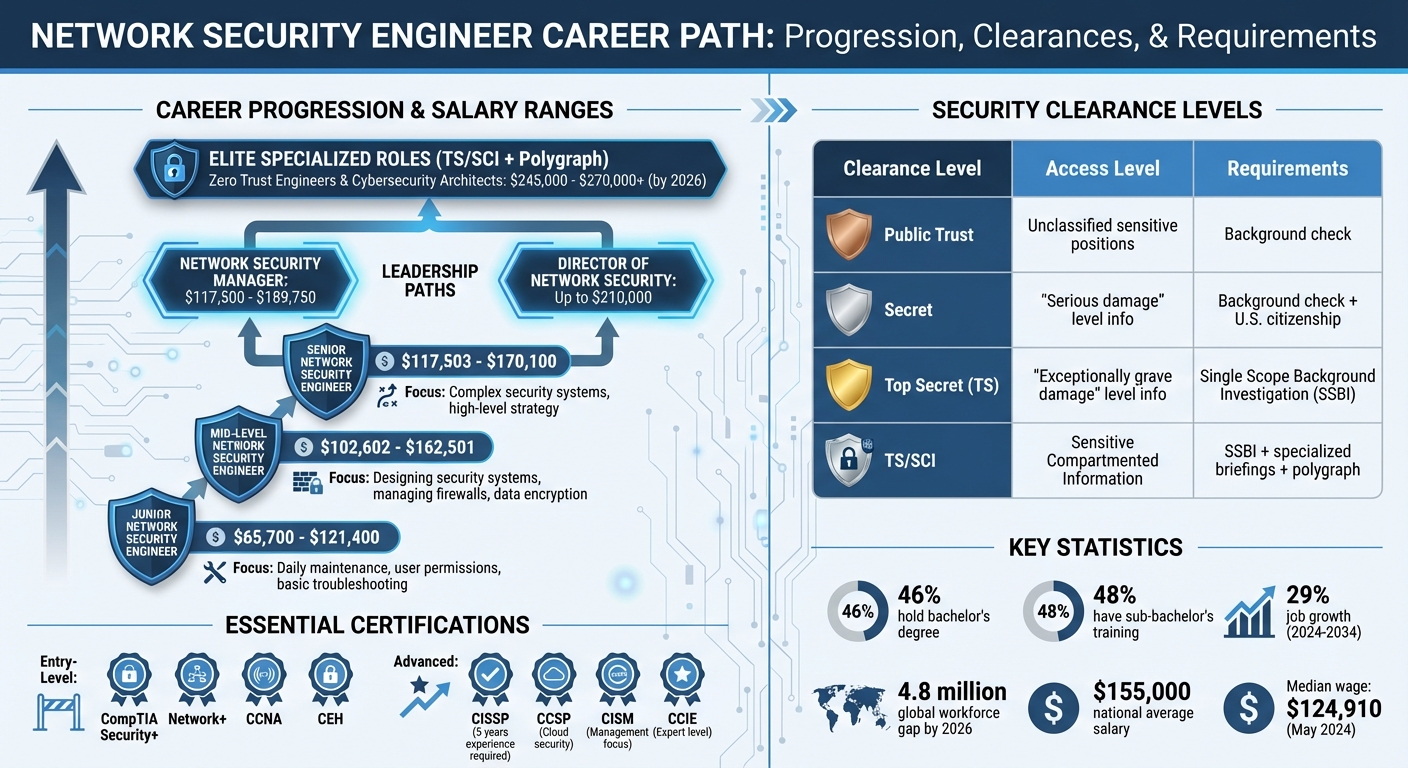
  • Career Path: Entry-level roles start at $65,700, with senior positions reaching over $170,000. Specialized roles in cloud security or Zero Trust architecture can command even higher salaries.
  • Job Market: High demand for cleared professionals driven by national security needs. Key employers include DISA, NSA, and major contractors like Raytheon and Lockheed Martin.

Tip: Maintain your clearance, pursue certifications, and build a strong professional network to stay competitive in this growing field.

Network Security Engineer Career Path: Salary Progression and Clearance Levels

Network Security Engineer Career Path: Salary Progression and Clearance Levels

Job Responsibilities and Clearance Requirements

Core Responsibilities

Network Security Engineers in cleared roles focus on high-level design and implementation rather than routine maintenance tasks. Their responsibilities include developing secure architectures for both classified and unclassified networks, resolving complex security challenges, and deploying advanced security technologies that demand deep technical knowledge.

Handling classified networks involves strict compliance with DISA controls. This includes using specialized encryption for national security data, enforcing stringent physical access controls, and ensuring complete separation between Secret/Top Secret networks and unclassified systems. Regular network audits, monitoring for unauthorized activity, and conducting incident response are key aspects of the job. As agencies upgrade legacy systems and integrate automation tools, you’ll likely work with AI-based security platforms and software-defined networking to identify threats more efficiently [1].

These technical duties are closely tied to clearance requirements, which directly influence access and responsibilities.

Security Clearance Levels

Your clearance level plays a critical role in determining the projects and facilities you can access, complementing your technical expertise.

  • Secret Clearance: This level requires a background check and U.S. citizenship. It grants access to information that, if disclosed, could cause "serious damage" to national security. Professionals with this clearance often support defense contracting roles, including Navy missions, medical operations, or enterprise data management [1].
  • Top Secret (TS) Clearance: This clearance allows access to information that could cause "exceptionally grave damage" if disclosed. It requires a Single Scope Background Investigation (SSBI). TS clearance is often necessary for high-level government consulting or critical infrastructure projects, such as Tier 2 and Tier 3 support for the Department of Energy.
  • TS/SCI Clearance: This level includes access to Sensitive Compartmented Information (SCI) and requires additional compartment briefings and often a polygraph examination. Professionals with TS/SCI clearance may handle Cross Domain Solutions or work in secure Network Operations Centers for the Intelligence Community [2].
  • Public Trust: Although not a formal clearance, this suitability check is required for sensitive but unclassified positions. It involves a thorough background check.
Clearance Level Description Typical Requirement
Secret Access to info that could cause "serious damage" Background check and U.S. citizenship
Top Secret (TS) Access to info that could cause "exceptionally grave damage" Single Scope Background Investigation (SSBI)
TS/SCI Access to Sensitive Compartmented Information SSBI plus specialized briefings; often requires polygraph
Public Trust High-level suitability check for unclassified roles Background check

Maintaining an active clearance requires consistent personal responsibility, as periodic background checks are necessary to retain eligibility. Having an active clearance can also speed up the hiring process and make you a more appealing candidate for agencies like DISA and DoD, as well as leading contractors such as Lockheed Martin, Raytheon, and Northrop Grumman [1].

sbb-itb-bf7aa6b

Education, Certifications, and Required Skills

Educational Background

To start a career in network security, a bachelor’s degree in fields like Computer Science, Cybersecurity, or Network Engineering is typically required. Programs aligned with the National Initiative for Cybersecurity Education (NICE) Workforce Framework are especially beneficial, as they are often developed alongside national intelligence agencies. These programs help ensure students are prepared for real-world security challenges.

Interestingly, 46% of security engineers hold a bachelor’s degree, while 48% have sub-bachelor’s training, such as associate degrees or specialized certifications [4]. For those aiming for advanced or management roles, a Master’s degree in Cybersecurity, Information Assurance, or Security Engineering can be a valuable asset. Veterans, in particular, can take advantage of GI Bill benefits to earn certifications like CompTIA Security+ while pursuing their degrees. This combination can open up higher-level opportunities in federal service that certifications alone might not achieve.

While formal education lays the groundwork, certifications are crucial for honing the specific skills needed in this field.

Key Certifications

Industry certifications are essential for demonstrating your expertise and readiness to tackle complex security challenges.

The Certified Information Systems Security Professional (CISSP) is widely regarded as the gold standard for enterprise security roles. It focuses on leadership and strategic planning, requiring at least five years of work experience in two or more of its eight domains, which range from risk management to software security. For those specializing in cloud security, the Certified Cloud Security Professional (CCSP) is a must. This certification requires five years of IT experience, including one year in cloud security, and addresses areas like cloud data and platform security.

For beginners, certifications such as CompTIA Security+, Network+, Certified Ethical Hacker (CEH), and Cisco’s CCNA are excellent starting points to land junior roles. For experienced professionals eyeing leadership positions, the Certified Information Security Manager (CISM) is ideal, focusing on security management and governance. GIAC certifications are also highly respected for technical expertise, while the Cisco Certified Internetwork Expert (CCIE) showcases advanced networking and software integration skills, making it valuable for top-tier roles.

Holding an active security clearance alongside these certifications can further boost your qualifications for government-focused positions.

Certification Focus Area Experience Required Primary Career Benefit
CompTIA Security+ Foundational Security Entry-level Quick entry into junior cleared roles
CISSP Strategic Security Leadership 5 years in 2+ domains Access to enterprise-level jobs and higher salaries
CCSP Cloud Security 5 years IT, 1 year cloud Demonstrates expertise in securing cloud environments
CEH Ethical Hacking Entry to mid-level Skills in penetration testing and vulnerability assessment
CISM Security Management 5 years, 3 in management Prepares for leadership roles in security governance

Technical Skills

Technical expertise is the backbone of a successful career in network security.

A strong understanding of TCP/IP, routing protocols like BGP and OSPF, and network design is essential. Familiarity with hardware from leading vendors such as Cisco, Juniper, and Palo Alto Networks is equally important. Security engineers must also know how to configure firewalls (e.g., Cisco ASA, Checkpoint, Fortinet) and manage intrusion detection/prevention systems and web application firewalls. For those working in cloud environments, proficiency in managing identities, encryption, and logging – especially in platforms like AWS GovCloud – is critical.

Programming skills in Python, Bash, and PowerShell are invaluable for automating tasks and responding to incidents efficiently. Similarly, experience with SIEM tools like Splunk or QRadar is a must for effective threat detection and response. Familiarity with security frameworks such as the NIST Cybersecurity Framework, ISO 27001, and Zero Trust architecture is also key to ensuring compliance with industry standards.

Building a home lab using platforms like Hack The Box or TryHackMe is a great way to gain hands-on experience and practice real-world scenarios.

"Textbook theory will only take you so far in a real-world security incident." – Steve Petryschuk, Director and Technology Evangelist, Auvik

Looking ahead, the demand for cybersecurity professionals remains high. The global workforce gap is projected to reach 4.8 million by 2026, and employment for information security analysts is expected to grow by 29% from 2024 to 2034 [5]. The median annual wage for these roles in the U.S. was approximately $124,910 in May 2024, with California leading at $140,730 in May 2023 [5]. Contributing to open-source security projects is another way to showcase your skills to employers while building a strong professional portfolio.

Career Progression and Advancement Strategies

Entry-Level to Advanced Roles

Cleared network security careers offer a clear path from entry-level roles to highly specialized and senior positions, each with defined salary ranges. At the starting point, Junior Network Security Engineers focus on tasks like daily system maintenance, managing user permissions, and basic troubleshooting. These roles, which pay between $65,700 and $121,400 annually [3], are essential for building expertise in network protocols while working under the guidance of more experienced colleagues.

As you gain experience, you can step into mid-level Network Security Engineer roles. These positions involve designing and implementing security systems, managing firewalls, and applying data encryption methods. Salaries for these roles range from $102,602 to $162,501 [3]. At this stage, your responsibilities grow to include making decisions that directly impact system performance and security.

For those advancing further, Senior Network Security Engineers take on more complex responsibilities, such as overseeing sophisticated security systems and influencing high-level strategies. Salaries at this level range from $117,503 to $170,100 [3]. From here, career paths diverge:

  • Network Security Managers focus on team leadership and policy development, earning between $117,500 and $189,750.
  • Directors of Network Security can earn up to $210,000, leading organizational security strategies [3].
  • Alternatively, you can specialize in areas like Cloud Security Engineering, Penetration Testing, or Compliance Auditing, gaining deep expertise in specific fields [3].

Certifications play a crucial role in career progression. Starting with basic credentials like CCNA and advancing to certifications like CISSP or CISM enhances your qualifications for leadership roles [1][7]. Experience with both classified and unclassified networks, as well as familiarity with platforms like Cisco and Juniper, further strengthens your profile for senior positions [1]. For cleared professionals, this structured path accelerates growth and opens doors to advanced opportunities. Moreover, maintaining an active clearance significantly boosts your career potential.

Using Security Clearance for Career Growth

An active security clearance is a powerful asset that can fast-track your career. It eliminates lengthy background checks during hiring, making you a preferred candidate for roles, especially in agencies like the Defense Information Systems Agency (DISA), NSA, FBI, and CIA, where clearances are mandatory [1].

Clearance holders gain access to high-demand sectors such as tactical communications, critical infrastructure defense, and aerospace [1]. For example, network engineers at DISA manage global command-and-control systems that require flawless uptime and compliance with NSA encryption standards [1]. Additionally, major defense contractors like Lockheed Martin, Raytheon Technologies, and Northrop Grumman actively seek cleared professionals for classified projects, offering job security even during economic downturns [1].

To fully leverage your clearance, it’s critical to maintain responsible conduct, as losing your clearance can immediately disqualify you from top-tier defense roles [1]. Focus your job search on platforms like USAJOBS.gov and DISA’s career portal, where many of these opportunities are listed [1]. Federal IT roles often provide compensation comparable to or exceeding private-sector salaries, along with the unique chance to contribute to mission-critical national security work [1].

Industry Trends and Job Market Data

High-Demand Sectors

The demand for cleared Network Security Engineers is being driven by a mix of nation-state threats, strict frameworks like CMMC (Cybersecurity Maturity Model Certification) and Zero Trust architecture, and a growing shortage of high-level cleared professionals [8]. This combination is reshaping both the job market and the salaries employers are prepared to offer.

Private sectors like finance and healthcare are also fueling demand due to their need for rigorous regulatory compliance. However, the most sought-after roles are those that blend technical expertise with governance at the policy level. Positions such as Zero-Trust Engineers and Cloud Security Leads are seeing rapid salary growth as organizations overhaul their security frameworks [8]. Leading employers in the field include CACI, Leidos, Northrop Grumman, Peraton, and Hewlett Packard Enterprise, with key hiring locations in Chantilly, VA, Bethesda, MD, San Antonio, TX, and San Diego, CA [9].

The focus has shifted from hiring general IT professionals to seeking individuals with "verified trust" – those capable of working in highly sensitive, mission-critical environments [8]. The push for digital transformation and cloud migration is accelerating this trend as businesses and government agencies move away from traditional on-premise data centers [3]. Industry growth for these roles is rated at 9 out of 10, reflecting a sharp increase in demand [3]. These shifts are directly influencing salary levels and job growth, as detailed below.

Salary and Job Growth Statistics

In the cybersecurity field, holding a security clearance has become the most impactful factor in determining salary. A representative from FullScope Staffing emphasized:

"The clearance itself has become a strategic asset, and in 2026 it will be the single strongest determinant of compensation for top technical cybersecurity roles" [8].

This "clearance premium" significantly boosts pay for professionals with verified trust and mission-critical readiness.

For those with TS/SCI and Full-Scope Polygraph clearances, salaries for elite roles like cybersecurity architects and Zero Trust engineers are expected to range between $245,000 and $270,000+ by the end of 2026 [8]. Even professionals with just two years of experience in cleared positions can anticipate earning between $120,000 and $200,000, while the national average salary for Security Engineers currently stands at $155,000 [6].

Defense contractors are being urged to increase their labor budgets to counter the shrinking pool of TS/SCI talent [8]. For cleared professionals aiming to maximize their earnings, focusing on areas like Zero Trust architecture and Cloud Security modernization provides the quickest route to these high-paying roles [8].

Networking and Job Search Tips

Building Professional Networks

Securing a cleared Network Security Engineer position often hinges on a mix of skills and connections. In fact, many cleared professionals find their next role through relationships with peers, mentors, and recruiters [10]. Think of networking as a mutual exchange: share job leads, make introductions, and offer assistance when possible.

When building connections, don’t limit yourself to recruiters – reach out to peers at your target companies. Fellow Network Security Engineers are often more accessible and can provide internal referrals, which are highly valued by hiring managers [11]. As Bryan Acton, Military & Veterans Program Leader at Peraton, explains:

"Engage your peers and get an employee referral. That’s something I can’t give you as a recruiter" [11].

One effective strategy is to schedule short informational interviews (15–20 minutes) to learn about a company’s culture and hiring practices. When reaching out, personalize your message and explain why you’re interested in speaking with them. These personal connections can streamline your job search on platforms like Cleared Cyber Security Jobs.

Using Cleared Cyber Security Jobs

Cleared Cyber Security Jobs

Cleared Cyber Security Jobs is a resource designed specifically for U.S. citizens with active security clearances. The platform provides free tools for job searches, resume uploads, and job alerts, directly connecting you with employers who hire cleared professionals – skipping the middleman of staffing firms. To maximize your chances, upload your resume and activate alerts for Network Security Engineer roles.

After applying, take the extra step of following up with recruiters, either through LinkedIn or the platform itself. This follow-up not only confirms your application but also gives you a chance to share additional information [11]. Kirsten Renner, VP of Talent Strategy at SilverEdge Government Solutions, points out:

"Sometimes what you see posted is just a glimpse into what’s possible" [11].

By engaging with recruiters, you may uncover hidden opportunities that aren’t publicly advertised. Once you’ve made these connections, fine-tune your resume to make the most of them.

Writing Resumes for Cleared Roles

Your resume is your first impression, so it needs to clearly showcase your expertise [12]. Start by listing your security clearance level (e.g., Secret, TS/SCI, or TS/SCI with polygraph) and the issuing agency prominently at the top, alongside your contact details. Add a technical skills section that emphasizes your experience with tools and systems like firewalls, IDS/IPS, SIEM solutions, RMF, and vendor-specific platforms such as Palo Alto or Cisco, as outlined in job descriptions.

To highlight your achievements, use the STAR method (Situation, Task, Action, Result). For example: "Implemented new protocols that improved efficiency by 35%" [12]. Keep your resume concise and focused on measurable results to underscore your technical qualifications and clearance. Include DoD 8570 certifications and any in-progress credentials, along with expected completion dates. Bill Branstetter from 9th Way Insignia advises:

"Keep subjective self-descriptions out of your summary section. I’m looking at you, Results-Oriented Team Players" [13].

Lastly, avoid listing your clearance level on public LinkedIn profiles. Many cleared contractors view this as a potential security risk [12].

Why Network Security ? – Salaries, Certifications, Cons and a lot more

Conclusion

Achieving success as a cleared Network Security Engineer requires a combination of the right certifications, an active security clearance, and a strong professional network. These elements unlock opportunities that are unavailable to those without clearance, granting access to roles that safeguard critical national infrastructure.

Certifications such as CISSP and CEH showcase your technical skills and dedication to staying ahead in a fast-paced field. Pairing these credentials with an active security clearance can open doors to higher-paying positions. It’s crucial to keep your clearance active through regular reinvestigations to maintain your eligibility.

Building a strong network is just as vital. Tapping into employee referrals and conducting informational interviews can lead directly to new job opportunities.

Platforms like Cleared Cyber Security Jobs make it easier to take the next steps in your career. They connect you with employers actively seeking cleared Network Security Engineers and provide tools like free job alerts, resume uploads, and career resources tailored for the cleared community. By combining your certifications, clearance, and networking efforts with a focused job search strategy, you’ll be well-prepared to advance in this high-demand field.

Keep your certifications updated, protect your clearance, and invest in your professional relationships. These efforts will ensure you’re ready to seize the next opportunity in your career journey.

FAQs

How do I get my first security clearance for a Network Security Engineer role?

Getting your first security clearance involves navigating the U.S. government’s process, which includes a thorough background investigation under the Trusted Workforce 2.0 initiative. Here’s an overview of the key steps:

  • Meet Eligibility Requirements: This typically means being a U.S. citizen and having a clean background, free of disqualifying issues.
  • Secure a Job That Requires Clearance: Most clearances are sponsored by employers, so finding a position that needs one is essential.
  • Complete the Background Investigation: This step involves an in-depth review of your personal, professional, and financial history.
  • Maintain Your Clearance: After approval, you’ll need to stay in compliance with government standards and provide updates as required.

Each step is crucial, and the process ensures that individuals granted clearance meet strict standards of trust and reliability.

Which certifications matter most for cleared Network Security Engineers?

If you’re aiming to excel as a cleared Network Security Engineer, certain certifications are practically essential. These include CISSP, Security+, CISA, CISM, and a variety of Cisco certifications. These credentials are highly regarded in the industry and frequently appear as requirements for roles in this field. Earning them not only sharpens your skills but also positions you as a strong contender in the cleared community.

How can I keep my clearance active and avoid losing eligibility?

To ensure your clearance remains active, be mindful of the 24-month reactivation window after your sponsorship ends. Begin preparations around 18 to 20 months before your clearance is set to expire. This includes updating necessary documents, actively seeking positions that require clearance, and connecting with employers experienced in hiring for cleared roles.

It’s crucial to avoid gaps longer than 24 months between cleared positions, as this can lead to delays or even require a full re-investigation. Additionally, maintaining strong professional conduct and staying up-to-date on clearance requirements will help safeguard your eligibility.

Related Blog Posts

  • Cisco CCNP Security Career Guide for Cleared Network Engineers
  • Cisco CCIE Security Career Guide for Cleared Expert Engineers
  • Cloud Security Engineer Career Path for Cleared Professionals
  • Data Security Analyst Career Path for Cleared Professionals

Best Cybersecurity Certifications 2026: Complete Guide for Cleared Professionals

CyberSecJobs Editorial · March 19, 2026 ·

Best Cybersecurity Certifications 2026:
The Definitive Guide for Cleared Professionals

From a $404 Security+ to the $8,000 SANS pipeline — which certifications actually move the needle on your salary and career. With DoD 8140 compliance mapping and ROI analysis.

20 min read
13 certifications ranked
ROI analyzed
DoD 8140 mapped

The cybersecurity certification market has never been more crowded — or more consequential. In the cleared workforce, your certifications aren’t just career credentials: they’re DoD 8140 compliance requirements, contract award factors, and the single fastest way to add $10K–$35K to your annual salary.

This guide cuts through the noise. We ranked every major certification by ROI, DoD compliance value, salary impact, and career trajectory — so you know exactly which certifications to pursue first, and which ones to skip unless your employer is paying.

What’s Inside

  1. Quick Comparison Matrix
  2. Best Entry-Level Certifications
  3. Best Mid-Career Certifications
  4. Best Senior & Leadership Certifications
  5. Certification Roadmaps by Career Path
  6. DoD 8140 Requirements
  7. Cost vs. ROI Analysis
  8. Certification Stacking Strategies
  9. Cloud Security Certifications
  10. Frequently Asked Questions
47x
Peak first-year ROI on CISSP investment at $749 exam cost. +$25K–$35K average salary premium for CISSP holders in cleared environments — the highest absolute return of any cybersecurity certification.

Quick Comparison Matrix

All 13 major cybersecurity certifications ranked by level, cost, salary impact, and DoD 8140 compliance category. Use this as your master reference — then dive into each section for detailed analysis.

Certification Level Exam Cost Avg Salary Impact DoD 8140 Best For
CompTIA Security+ ⭐ Entry $404 +$10–15K IAT II / Baseline Everyone
CISSP Senior $749 +$25–35K IAM III Mgmt / Architecture
CISM Senior $760 +$20–30K IAM II Security Management
CEH Mid $1,199 +$12–18K CDA Pen Testing / Red Team
OSCP Mid–Sr $1,749 +$15–25K CDA Offensive Security
CySA+ Mid $404 +$8–12K CSSP SOC / Blue Team
CASP+ Senior $509 +$12–20K IAM III Architecture (CISSP alt)
PenTest+ Mid $404 +$8–12K CDA Pen Testing (budget)
CCSP Senior $599 +$15–25K — Cloud Security
GSEC Entry–Mid $2,499 +$15–20K — Premium Entry
CISA Mid–Sr $760 +$15–22K IAT III IT Audit / GRC
CRISC Senior $760 +$18–25K — Risk Management
AWS Security Specialty Mid–Sr $300 +$12–20K — AWS Cloud
Security+ is the only certification that’s genuinely non-negotiable in cleared cyber. Every other cert should be chosen based on your target career path and whether your employer will fund it.

Best Entry-Level Certifications

Start here. These three certifications form the foundation of every cleared cybersecurity career. The right choice depends on whether you’re headed toward blue team or red team — but Security+ is mandatory regardless.

CompTIA Security+

+$10–$15K

$404 exam · 2–3 mo study · IAT Level II · DoD 8140 Baseline
Most requested cert in DoD contracting — Non-negotiable

CompTIA CySA+

+$8–$12K

$404 exam · 3–4 mo study · CSSP Requirements
Blue team specialist — Required for many SOC analyst DoD roles

CompTIA PenTest+

+$8–$12K

$404 exam · 2–3 mo study · DoD 8140 CDA
Red team entry path — Budget-friendly OSCP precursor

#1 Must-Have: CompTIA Security+ — The Non-Negotiable

Verdict: Non-negotiable. Get this first, no exceptions.

Security+ is the DoD 8140 baseline for every cleared technical position. Without it, you simply won’t get hired for most cleared cyber roles. It appears in more cleared cybersecurity job postings than any other certification by a wide margin — the #1 most-requested cert in DoD contracting environments — and satisfies the IAT Level II baseline for system administrators, network engineers, and security analysts.

$404
Total exam cost for Security+. At 2–3 months of self-study, it’s the most efficient cert investment in cybersecurity — delivering 25–37x ROI in year one. CompTIA offers federal discounts for active duty, veterans, and government contractors.

→ Full Security+ Career Guide for Cleared Professionals

Blue Team Upgrade: CompTIA CySA+ — The Blue Team Specialist

Best for: SOC analysts, blue team, incident responders.

CySA+ bridges the gap between Security+ and more advanced analyst roles. It satisfies the CSSP (Cyber Security Service Provider) baseline, making it a requirement for many SOC analyst positions on DoD contracts. At $404 — same price as Security+ — with significantly higher specialization value for blue team roles, this is your immediate next step if you’re targeting a SOC or defense role.

The exam requires Security+ or equivalent experience as a prerequisite, covering threat detection, behavioral analytics, and incident response — skills that translate directly to day-one work in a cleared SOC environment.

Red Team Entry: PenTest+ or eJPT — The Offensive Starting Point

Best for: Aspiring penetration testers, red teamers.

PenTest+ is CompTIA’s entry-level penetration testing cert and satisfies the CDA (Cyber Defense Analyst) work role baseline at $404. It’s theory-heavy but recognized across DoD contracting environments — a solid choice if you need DoD 8140 CDA compliance on a budget before pursuing OSCP.

The eJPT (eLearnSecurity Junior Penetration Tester) at $249 is increasingly respected as a practical alternative. While not DoD-baseline, it demonstrates real hands-on skill and pairs well with PenTest+ for building your red team portfolio early in your career.

Best Mid-Career Certifications

You have Security+ and 2–4 years of experience. Now the question is specialization. Mid-career certifications sort you into the highest-paying tracks in cleared cyber — and the salary jumps are substantial.

OSCP

+$15–$25K

$1,749 all-in · 3–6 mo prep · DoD 8140 CDA
Gold standard in practical pen testing — $130–180K w/ TS/SCI

CEH

+$12–$18K

$1,199 exam · 2–4 mo study · DoD 8140 CDA
DoD contracting favorite — Best when employer-sponsored

GIAC Certifications (SANS)

+$15–$25K

$2,499+ exam ($5–8K w/ course) · Multiple work roles
Industry gold — Only pursue with employer funding

Gold Standard: OSCP — The Offensive Security Credential

“OSCP changed how I approach every engagement. It’s not just a cert — it’s a mindset shift. After passing, I was getting $15–20K more per role because employers knew I could actually break into things.” — Senior Penetration Tester, TS/SCI cleared, DoD contractor

The Offensive Security Certified Professional is the gold standard in practical penetration testing. The infamous 24-hour practical exam requires you to compromise multiple systems in a controlled lab environment — no multiple choice, no memorization shortcuts.

OSCP holders command premium rates in cleared environments. With a TS/SCI clearance, $130–180K is realistic at mid-career. Employers treat it as a strong signal that you can actually do the work, not just pass tests.

→ Full OSCP Career Guide for Cleared Offensive Security Professionals

DoD Favorite: CEH — The Contracting Workhorse

Certified Ethical Hacker is theory-heavy compared to OSCP, but it’s deeply embedded in DoD contracting requirements. Many contracting vehicles explicitly list CEH as preferred or required for red team and vulnerability assessment roles.

If your employer is sponsoring the cert, take it — the $1,199 price tag hurts less and the CDA compliance value is real. Without sponsorship, OSCP gives you better practical skills for the same DoD category at a higher cost.

GIAC Suite: The SANS Portfolio

GIAC certifications from SANS Institute are the most respected technical credentials in the industry. They’re expensive — often $5,000–8,000 with the associated SANS course — but carry enormous weight with cleared employers. Key certs include:

  • GCIH — Incident Handler
  • GPEN — Penetration Tester
  • GCFA — Forensic Analyst
  • GCIA — Intrusion Analyst
  • GREM — Reverse Engineer
Get your employer to fund SANS training. Many cleared contractors maintain SANS work role agreements or can access government training budgets. Never pay $5,000+ for GIAC out of pocket if you can avoid it.

Best Senior & Leadership Certifications

Senior certifications are career multipliers. They don’t just add salary — they open entire new job categories: ISSO, ISSM, CISO, Cloud Architect, Security Director. If you have 5+ years of experience, this is where the real money is.

+$25K
Average salary premium for CISSP holders in cleared environments. At the senior end, CISSP + TS/SCI consistently unlocks $160–200K+ salary bands for ISSO, ISSM, and principal architect roles.

CISSP — The Career Multiplier

The Certified Information Systems Security Professional is the single highest-impact certification you can earn in cleared cyber. It satisfies IAM Level III under DoD 8140, making it required for ISSO, ISSM, and senior security architect positions across virtually every DoD program.

The $749 exam fee is deceptive — the real investment is the 5 years of qualifying experience and 3–6 months of intensive study. The 6-hour adaptive exam tests breadth across all 8 domains of the CISSP Common Body of Knowledge.

Don’t have 5 years yet? CASP+ satisfies the same IAM III DoD requirement without the experience threshold. Use CASP+ as your bridge cert at $509, then upgrade to CISSP when you hit the experience bar.

→ Full CISSP Career Guide for Cleared Cyber Professionals

CISM — The Management Track

CISM (Certified Information Security Manager) from ISACA is the premier credential for security management roles. If you’re on a path toward CISO or security program manager, CISM is often preferred over CISSP by organizations focused on governance rather than technical implementation. At $760 with a +$20–30K salary impact, it delivers 26–39x ROI for management-track professionals.

CASP+ — The Experience-Free CISSP Alternative

CompTIA Advanced Security Practitioner satisfies IAM Level III under DoD 8140 — the same requirement as CISSP — without the 5-year experience prerequisite. At $509, it’s the fastest path to senior DoD compliance requirements for professionals still building their experience base.

CISSP

+$25–$35K

$749 exam · 5yr exp required · IAM Level III
Highest absolute ROI in cleared cyber — 33–47x year-one return

CISM

+$20–$30K

$760 exam · 3–5 mo study · IAM Level II
Premier management credential — 26–39x ROI

CASP+

+$12–$20K

$509 exam · No exp threshold · IAM Level III
CISSP bridge cert — Same DoD category, no experience gate

CRISC

+$18–$25K

$760 exam · Risk management track
ISACA’s premier risk credential — GRC / compliance leader

CISA

+$15–$22K

$760 exam · IAT Level III · IT Audit / GRC
Essential for IG offices, auditors, ISSO compliance roles

CCSP

+$15–$25K

$599 exam · ISC² Cloud Security Professional
DoD cloud recognized — Pairs perfectly with CISSP

Certification Roadmaps by Career Path

Don’t collect random certifications. Build a deliberate stack aligned to your target career path. These six roadmaps map the typical cleared cyber career trajectories from entry-level to principal or leadership roles.

🔴 Offensive Security (Red Team)

Penetration testing, red team operations, adversary simulation — $80K → $200K+

Entry
Security+ $80K
Foundation
PenTest+ / eJPT $100K
Mid-Career
CEH $120K
Advanced
OSCP $145K
Expert
OSCE / CRTO $165K
Principal
CRTL / Lead Operator $200K+

🔵 Defensive Security (Blue Team)

SOC analysis, incident response, threat hunting — $70K → $170K+

Entry
Security+ $70K
Foundation
CySA+ $90K
Mid-Career
GCIH (SANS) $110K
Advanced
BTL1 $125K
Senior
CISSP $145K
Lead
BTL2 / Security Director $170K+

📋 GRC & Security Management

Risk, compliance, ISSO/ISSM, CISO track — $65K → $200K+

Entry
Security+ $65K
Foundation
CAP / RMF $85K
Mid-Career
CISA $105K
Advanced
CRISC $130K
Senior
CISM $155K
CISO Track
CISSP / CISO $200K+

☕ Cloud Security

DoD cloud, JWCC, C2E environments — $80K → $200K+

Entry
Security+ $80K
Foundation
CCSK $105K
Mid-Career
AWS Security Specialty $135K
Senior
CCSP $160K
Architect
CISSP + Cloud Arch $200K+

🔬 Digital Forensics & Threat Intel

DFIR, malware analysis, CTI — $70K → $180K+

Entry
Security+ $70K
Foundation
CHFI $95K
Mid-Career
GCFA (SANS) $120K
Advanced
GNFA / GREM $150K
Principal
CTIA / Lead Analyst $180K+

🌐 Network Security Engineering

Infrastructure, perimeter defense, zero trust — $75K → $185K+

Entry
CCNA + Security+ $75K
Mid-Career
CCNP Security $95K
Advanced
CCNP Security $120K
Specialist
PCNSE / Fortinet NSE $145K
Expert
CCIE Security $185K+

DoD 8140 Requirements

DoD 8140 (formerly 8570) defines the certification requirements for cyberspace workforce positions across all DoD agencies and contracts. If you work on DoD programs, your specific work role determines which certifications you must hold.

✓ DoD 8140.01 Manual DoD 8140 replaced 8570 in 2023, introducing the DCWF (DoD Cyberspace Workforce Framework) which expands beyond the original IAT/IAM structure. However, many contracts still reference 8570 certification categories. Both frameworks are currently in force.

Work Role Category Example Positions Required / Baseline Certifications
IAT — Technical System admin, network admin, help desk (security-focused) Security+, CySA+, CASP+, CISSP
IAM — Management ISSO, ISSM, senior security analyst, CISO Security+, CISM, CISSP, CAP
CSSP — Service Provider SOC analyst, incident responder, security engineer CySA+, GCIH, CEH, CISSP
CDA — Defense Analysis Penetration tester, vulnerability analyst, red team operator CEH, PenTest+, OSCP, GPEN
Security+ gets you in the door for every DoD 8140 category at baseline level. After that, specialize based on your target work role — don’t collect certifications across multiple categories randomly. Note: DoD 8140 specifies minimum requirements. Individual program offices may require higher-level certifications. Always check the specific PWRR (Position Work Role Requirements) for your target role.

Cost vs. ROI Analysis

Not all certifications are equal investments. Here’s a frank dollar-for-dollar analysis of which certifications deliver the highest return on your time and money — and which ones require employer sponsorship to make financial sense.

“If your employer pays, take every cert you can. If you’re paying out of pocket, prioritize CompTIA and ISC² certs for the best dollar-for-dollar return.” — CybersecJobs.com Analysis, March 2026

Best ROI — 5 Stars (Self-Fund These)

CompTIA Security+

25–37x ROI

$404 exam · 2–3 months study
+$10–15K salary impact year 1. At $404 all-in, the most efficient cert investment in cybersecurity. Non-negotiable for cleared roles. CompTIA 2025

CISSP

33–47x ROI

$749 exam · 3–6 months study · 5yr exp required
+$25–35K salary impact. The highest absolute dollar return of any cybersecurity cert. Requires experience but delivers career-defining results. ISC² 2025

AWS Security Specialty

40–67x ROI

$300 exam · 2–3 months study
+$12–20K on top of existing cloud skills. Highest ROI-per-dollar cert for cloud-experienced professionals in the cleared market. AWS 2025

Good ROI — 4 Stars (Self-Fund or Employer)

CompTIA CySA+

20–30x ROI

$404 exam · 3–4 months study
+$8–12K salary impact. Excellent value for blue team specialization. DoD CSSP compliance makes it essentially required for SOC analyst roles. CompTIA 2025

CISM

26–39x ROI

$760 exam · 3–5 months study
+$20–30K for management track professionals. Outstanding ROI if targeting ISSO, ISSM, or security director positions. ISACA 2025

OSCP

9–14x ROI

$1,749 all-in · 3–6 months prep
+$15–25K salary impact. Higher cost, but practical credibility is unmatched. ROI improves dramatically with cleared-environment salary premiums. Offensive Security 2025

Moderate ROI — 3 Stars (Employer Sponsorship Recommended)

CEH (self-funded)

10–15x ROI

$1,199 exam · 2–4 months study
+$12–18K, but the $1,199 exam fee stings without sponsorship. Theory-heavy approach means skills don’t match the cost. Get employer to fund this one. EC-Council 2025

GSEC (self-funded)

3–4x ROI

$2,499 exam + $5,000+ SANS course
+$15–20K salary impact doesn’t justify $7,500+ out-of-pocket. GSEC is excellent — but only when employer-funded. Never pay for SANS training yourself if you can help it. SANS/GIAC 2025

Certification Stacking Strategies

The highest-earning cleared professionals don’t hold one great certification — they hold two or three that form a coherent, specialized stack. Stacking signals depth, not breadth. Here are the proven stacks by career track.

Career Track Stack Target Salary (TS/SCI) DoD Compliance
Red Team / Pen Test Security+ + CEH + OSCP $130–$180K IAT II + CDA
Blue Team / SOC Lead Security+ + CySA+ + GCIH $115–$155K IAT II + CSSP
ISSO / ISSM Security+ + CAP + CISSP $140–$195K IAT II + IAM III
Cloud Security Architect Security+ + AWS Security + CCSP $160–$210K IAT II
GRC / Compliance Lead Security+ + CISA + CISM $130–$175K IAT II + IAM II
Security Director / CISO CISSP + CISM + CRISC $180–$300K+ IAM III
The sweet spot for most cleared professionals is 2–4 strategically chosen certifications aligned to a single career path. A focused stack of Security+ + OSCP + CEH signals deeper red team expertise than 8 certs scattered across GRC, cloud, and offensive tracks. Employers see through credential inflation — depth beats breadth every time.

Cloud Security Certifications

Cloud security has become one of the highest-paying specializations in cleared cyber, driven by massive DoD cloud adoption (C2E, JWCC, OC2). Senior cloud security engineers with TS/SCI clearances are commanding $180–220K+ in the current market.

$220K+
Senior cloud security engineers with CISSP + AWS/Azure certs + TS/SCI are consistently hitting $180–220K+ in the current cleared contractor market. DoD cloud spend is projected to reach $10B+ through 2028.

AWS Security Specialty

+$12–$20K

$300 exam · Most in-demand cloud cert for DoD work
Highest ROI in the cloud track — 40–67x return

CCSP

+$15–$25K

$599 exam · ISC² Cloud Security Professional
DoD-recognized — Pairs perfectly with CISSP

Azure AZ-500

+$10–$18K

$165 exam · Critical for DISA, Army, Air Force
Essential in Microsoft Azure Government environments

GCP Professional Security

+$10–$16K

$200 exam · Niche but high-value
Increasingly valuable for Google Cloud DoD contracts

CCSK

+$8–$12K

$395 exam · Cloud Security Alliance
Inexpensive entry point to cloud security specialization

CRISC

+$18–$25K

$760 exam · ISACA risk management premier
Especially valuable combined with cloud architecture roles

CISSP + cloud specialty is the highest-earning combination in cleared cyber right now. Senior cloud security engineers with CISSP and AWS/Azure certs and TS/SCI clearances are consistently hitting $180–220K+ in the current contractor market.

Frequently Asked Questions

What is the best cybersecurity certification for beginners?

CompTIA Security+ is the best starting certification for beginners, with no exceptions. At $404 and 2–3 months of self-study, it’s the most accessible path to a cleared entry-level position. It satisfies DoD 8140 IAT Level II baseline — which means almost every cleared cyber job posting lists it as a requirement or preference. After Security+, choose your next cert based on your career direction: CySA+ for blue team/SOC, or PenTest+ for red team/offensive. Don’t skip Security+ to start with a specialty cert — it rarely works out.

Is CISSP worth it in 2026?

Yes — CISSP is absolutely worth it if you have 5 years of qualifying experience. In cleared environments, CISSP delivers the highest absolute salary premium of any certification: +$25–35K on average, with ROI of 33–47x on the $749 exam investment in year one alone. CISSP satisfies IAM Level III under DoD 8140, which is the baseline for ISSO, ISSM, and senior security architect positions. If you’re targeting those roles — which typically pay $160–200K+ with TS/SCI — CISSP is non-negotiable. Don’t have 5 years yet? Consider CASP+ as a bridge cert — it satisfies the same DoD category without the experience requirement.

Which certifications does the DoD require?

DoD 8140 certification requirements depend entirely on your specific work role category. There’s no single universal requirement — the DoD has organized positions into work role categories (IAT, IAM, CSSP, CDA) and each category has specific baseline certifications at different levels. That said, Security+ is the most commonly referenced baseline across all categories. It satisfies IAT Level II, which covers the broadest range of cleared technical positions. System/Network Admins (IAT): Security+, CySA+, CASP+. ISSO/ISSM (IAM): Security+, CISM, CISSP, CAP. SOC Analysts (CSSP): CySA+, GCIH, CEH, CISSP. Pen Testers (CDA): CEH, PenTest+, OSCP, GPEN.

How many cybersecurity certifications do I need?

Most cleared professionals perform best with 2–4 strategically chosen certifications aligned to a specific career path. More isn’t always better — a focused certification stack (e.g., Security+ + OSCP + CEH for red team) signals deeper expertise than a random collection of 8 certs across different domains. Entry (0–2 yr): 1–2 certs — Security+ plus one specialty baseline. Mid-career (3–7 yr): 2–3 certs — add a practical/advanced specialty. Senior (8+ yr): 3–4 certs — leadership cert (CISSP/CISM) plus specializations.

Cybersecurity certifications or a degree — which is better for cleared jobs?

For cleared cyber specifically, certifications beat a degree on pure ROI — especially in the short term. Security clearances are the primary hiring filter in this market, not academic credentials. A cleared candidate with Security+ and CySA+ will outcompete a non-cleared candidate with a master’s degree for most entry-to-mid positions. For immediate cleared employment: Certifications. Start with Security+ and get placed within 3–6 months. For long-term SES/leadership roles: A degree becomes increasingly important for GS-15, Senior Executive Service, or program director positions. Best of both worlds: Many cleared contractors offer tuition assistance. Get hired with certs, then pursue your degree on the employer’s dime.

Ready to Choose Your Certification Path?

Use our free tools to find the right certifications for your career stage, target salary, and DoD compliance requirements. Then search cleared cyber roles that match your certification stack.

Browse All 55 Cert Guides →
Cybersecurity Salary Guide

CyberSecJobs.com is the cybersecurity career resource of ClearedJobs.Net, a veteran-owned company serving the security-cleared community since 2001.

Entry Level Cybersecurity Jobs 2026: Your Complete Starter Guide

CyberSecJobs Editorial · March 19, 2026 ·

Entry Level Cybersecurity Jobs 2026:
Your Complete Guide to Starting a Cleared Career

Most guides give you the same generic list. This one shows you the fastest path to six figures — through the cleared cybersecurity market.

22 min read
PayScale 2026 data
8 career paths
Updated March 2026
What’s Inside

  1. The 2026 Market — Why Now Is the Time
  2. 8 Best Entry-Level Roles (With Salary Data)
  3. Breaking In With No Experience
  4. The Cleared Career Advantage
  5. Essential Certifications
  6. Salary Breakdown by Role & Location
  7. Career Path Progression
  8. Frequently Asked Questions

The 2026 Market — Why Now Is the Time

The cybersecurity talent shortage has become one of the defining economic facts of the tech industry. The Bureau of Labor Statistics projects 33% growth in information security analyst roles through 2034 — roughly 175,000 professionals currently employed in the field, with demand consistently outstripping supply.

But the headline number that matters for your career decision is this: CyberSeek estimates over 500,000 unfilled cybersecurity positions in the United States right now. That gap isn’t closing — it’s widening as AI-powered attacks, cloud migration complexity, and federal spending on cyber defense all accelerate simultaneously.

500K+
Unfilled cybersecurity positions in the US right now. The cleared market has an even more severe shortage — and it’s the fastest path to six figures at the entry level. ✓ CyberSeek
33%
Job growth projected through 2034 — more than 4× the national average for all occupations. ✓ BLS
$13B
Federal cybersecurity budget for 2026. Government spending is the single largest driver of cleared cyber demand — and it creates entry-level positions at every major defense contractor. ✓ OMB

Three macro forces are driving this demand with no signs of reversal:

  • AI-powered threats: Attackers are deploying generative AI for phishing, code generation, and automated vulnerability scanning — defense organizations need analysts who can counter these at scale.
  • Cloud migration complexity: Federal agencies moving to hybrid cloud architectures under CMMC 2.0 and FedRAMP need security professionals who understand both legacy and cloud-native environments.
  • Regulatory pressure: CMMC 2.0 certification requirements now affect 300,000+ defense contractors, creating massive demand for GRC and compliance professionals at every level.
“In the cleared cybersecurity market, the shortage isn’t theoretical — it’s a line item on every defense contractor’s quarterly earnings call. A motivated person can go from zero to $80-100K+ in 12–18 months if they target the right path.”

The practical implication: this is one of the few fields where a motivated person can, in 12–18 months, go from zero cybersecurity experience to a $80–100K+ position with job security that rivals any profession. The cleared market amplifies this — a Secret clearance alone adds $10–20K to your base salary, and the process can begin before you’ve accumulated significant experience.

Browse current cleared cybersecurity jobs to see what employers are hiring for right now.

8 Best Entry-Level Cybersecurity Roles

Not all entry-level cybersecurity jobs are created equal. The roles below represent the best combination of low barrier to entry, high salary ceiling, and strong demand in the cleared market. Each listing shows both national market rates and cleared/government contractor rates — the gap is significant and worth targeting.

SOC Analyst (Tier 1)
$80K–$110K cleared
Experience: 0–2 yrs  |  National: $60K–$85K
Key certs: Security+, CySA+, Splunk Core
→ View SOC Analyst career path
GRC Analyst
$75K–$115K cleared
Experience: 0–2 yrs  |  National: $60K–$90K
Key certs: Security+, CISA, CRISC
→ View GRC Analyst career path
Information Security Analyst
$85K–$140K cleared
Experience: 1–3 yrs  |  National: $67K–$120K
Key certs: Security+, CySA+, CISSP (later)
Junior Penetration Tester
$90K–$130K cleared
Experience: 1–2 yrs  |  National: $73K–$100K
Key certs: eJPT, PenTest+, OSCP
→ View Penetration Tester career path
IT Security Specialist
$85K–$130K cleared
Experience: 1–3 yrs  |  National: $70K–$110K
Key certs: Security+, Network+, Linux+
Digital Forensics Analyst
$70K–$150K cleared
Experience: 1–2 yrs  |  National: $52K–$129K
Key certs: GCFA, EnCE, Security+
→ View Digital Forensics career path
Incident Response Analyst
$60K–$120K cleared
Experience: 1–2 yrs  |  National: $42K–$97K
Key certs: GCIH, Security+, CySA+
Security Operations Engineer
$90K–$140K cleared
Experience: 2–3 yrs  |  National: $75K–$110K
Key certs: Security+, Linux+, AWS/Azure cert
Two roles stand out for someone with zero experience: SOC Analyst Tier 1 and GRC Analyst. Both are genuinely accessible at the 0–2 year experience mark, both have Security+ as their primary requirement, and both are in extreme demand in the cleared market where new contractors are constantly being stood up to support government programs.

Breaking In With No Experience

The question “how do I get into cybersecurity with no experience?” has a concrete, actionable answer. Here’s the exact path that works — structured as a 6–18 month staircase that ends at a cleared position paying $80–100K+.

Month 1–3
Build Your IT Foundation — CompTIA A+ and Network+  Baseline
Month 3–5
Get Security+ — DoD 8140 Required  Non-Negotiable
Month 4–6
Build a Home Lab — Splunk, Wireshark, HackTheBox  Portfolio
Month 5–12
Get Real Experience — Help desk, CTFs, bug bounty  Experience
Month 6–18
Target Cleared Positions — $80–100K+  $80K–$100K+

Step 1: Build Your IT Foundation (Months 1–3)

CompTIA A+ and Network+ are not glamorous, but they are the baseline. Security concepts are 10× easier to grasp when you understand how networks, operating systems, and hardware actually work. A+ proves you can troubleshoot. Network+ proves you understand TCP/IP, routing, and the infrastructure security lives on top of. Together they take 2–3 months to prep and pass.

Step 2: Get Security+ — This Is Non-Negotiable (Months 3–5)

At $404, CompTIA Security+ is the single best investment you can make in your cybersecurity career. It’s DoD 8140 mandatory — meaning every federal agency and cleared defense contractor is legally required to have it for baseline security roles. Two to three months of focused study. Pass this and you’re immediately eligible for dozens of entry-level cleared positions.

Step 3: Build a Home Lab (Months 4–6)

Paper certifications only get you so far. Employers at cleared contractors want to see that you’ve actually done things. Set up VirtualBox with Windows and Linux VMs. Install Splunk Free and ingest some logs. Run Wireshark and analyze real traffic. Try a beginner CTF on HackTheBox or TryHackMe. Document everything in a GitHub repository or write-ups — this becomes your portfolio.

Step 4: Get Real Experience (Months 5–12)

The fastest path is often lateral: get a help desk or IT support role at a company with security operations. You gain professional experience while being in proximity to the security team. Alternatively: participate in CTF competitions, contribute to bug bounty programs, or volunteer for a nonprofit’s IT/security needs. The goal is to have something in the “experience” section that isn’t just “studied at home.”

Step 5: Target Cleared Positions — The Fast Track to $100K+ (Months 6–18)

With Security+ and any demonstrable experience, start applying to cleared positions at defense contractors like Leidos, SAIC, Booz Allen, ManTech, and Peraton. Be explicit in your cover letter that you’re willing to undergo the clearance process. The contractor will sponsor you — they absorb the cost of the investigation in exchange for your commitment. A Secret clearance takes 3–6 months on average and immediately boosts your earning potential by $10–20K per year.

Defense contractors actively hire junior candidates and sponsor clearances because the talent shortage is so severe. Security+ plus a willingness to go through the clearance process puts you in a very small — and very well-paid — talent pool.

The Cleared Career Advantage

Security clearances are the most underappreciated salary multiplier in the American labor market. Each level of clearance is, essentially, a guaranteed raise — not a one-time bonus, but a structural premium baked into your compensation for every position you hold in the cleared market.

No Clearance
$60K–$85K — Starting point. Competing with the full national talent pool.  Baseline
Secret
$70K–$100K — +$10–20K/yr. Unlocks 60–70% of cleared positions.  3–6 months
Top Secret
$85K–$120K — +$15–30K/yr. NSA, CIA, DIA positions.  6–12 months
TS/SCI
$95K–$140K — +$20–50K/yr. IC work, SIGINT, intelligence community.  Rare talent pool
TS/SCI + FSP
$110K–$160K — +$30–60K/yr. NSA, CIA, NRO. Peak demand.  +40% premium
40%
The premium a Full Scope Polygraph adds to your base salary. That’s not a signing bonus — it’s every year. ✓ PayScale 2026
3–6mo
Average timeline to receive a Secret clearance when sponsored by a defense contractor. Your employer pays the cost. ✓ DCSA
“A security clearance isn’t a background check — it’s a career-long asset that compounds in value every year you hold it. The strategic play: get Security+, get hired uncleared, get your Secret in 3–6 months, and you’ve just given yourself a $10–20K raise that costs you nothing but patience.”

For deeper context on the cleared market, read our analysis of TS/SCI salary premiums, what to expect from the security clearance interview process, and whether upgrading from Secret to Top Secret is worth it at your career stage.

Essential Certifications for Entry-Level Jobs

Certifications in cybersecurity serve two distinct purposes: demonstrating competence to employers, and satisfying DoD 8140 regulatory requirements for government and contractor positions. Understanding the difference helps you prioritize.

Certification Cost Study Time Salary Impact DoD 8140 Best For
⭐ Security+ $404 2–3 months +$10–15K REQUIRED Everyone
CySA+ $404 3–4 months +$8–12K CSSP Blue Team / SOC
PenTest+ $404 2–4 months +$8–12K CDA Red Team
CEH $1,199 3–4 months +$12–18K CDA DoD Pen Testing
GSEC $2,499 4–5 months +$15–20K YES Premium Entry
Security+ is the single highest-ROI certification in cybersecurity. At $404, it’s required for every DoD cleared position and recognized across the industry. Get it first, no exceptions. After Security+, your path depends on which specialization you’re targeting: CySA+ for blue team/SOC, PenTest+ or CEH for offensive security, CISA for GRC and compliance.
CompTIA Security+
+$10–$15K
DoD 8140 mandatory for baseline clearance roles. The non-negotiable first cert for the cleared market. $404 — highest ROI in the industry.
→ Security+ complete study guide
CompTIA CySA+
+$8–$12K
Ideal next cert for SOC and blue team roles. Covers threat detection, analysis, and incident response. DoD 8140 CSSP-qualified.
CEH (Certified Ethical Hacker)
+$12–$18K
DoD CDA-approved for penetration testing roles. Higher cost but strong cleared contractor demand for offense-oriented positions.
GIAC GSEC
+$15–$20K
Premium entry credential. $2,499 — get employer reimbursement first. GIAC carries significant weight in the cleared market and IC community.
eJPT (eLearnSecurity)
Entry Offensive
Best first cert for offensive/pen testing track. Affordable, practical, and widely recognized as proof of hands-on skill. Great for building toward OSCP.
CISA (Certified Info Systems Auditor)
GRC Track
Best cert for GRC and compliance track. Requires 5 years experience to fully certify, but studying for it early signals seriousness to cleared contractors.

One note on GSEC: the $2,499 price tag is steep for a first cert, but GIAC certifications carry significant weight in the cleared market and employer reimbursement is common once you’re hired. If your employer will pay for it, GSEC over Security+ is a meaningful credential. Read our complete cybersecurity certifications guide for full certification roadmaps by career track.

Entry-Level Cybersecurity Salary Breakdown

The following salary data is based on PayScale 2026 reporting combined with cleared market analysis. The “With TS/SCI” column represents realistic compensation at major defense contractors in top cleared markets — these are not outliers, they’re what the market currently pays.

Salary by Role — National vs. Cleared

Role Entry-Level National Avg With Secret With TS/SCI
Cyber Security Analyst $70,828 $83,525 $93K–$110K $105K–$130K
Penetration Tester $72,823 $102,472 $100K–$125K $115K–$150K
Security Engineer $76,332 $103,573 $105K–$135K $120K–$155K
Incident Response Analyst $55,000 $68,400 $75K–$95K $85K–$115K
Digital Forensics Analyst $58,000 $74,991 $80K–$100K $90K–$130K
Malware Analyst $72,000 $92,880 $95K–$120K $110K–$145K
SOC Analyst (Tier 1) $60,000 $74,000 $80K–$95K $95K–$115K
GRC Analyst $62,000 $77,500 $82K–$100K $95K–$125K

Salary by Location — The Four Cleared Cyber Hubs

Location is one of the most powerful salary levers in the cleared market — arguably more impactful than experience level for the first 3–5 years of your career.

DC Metro

Northern Virginia · Maryland · DC · NSA · CIA · NGA · Pentagon
Entry SOC (Secret)$85K–$100K
Entry SOC (TS/SCI)$100K–$120K
Mid Security Engineer$130K–$165K
Location Premium+15–25%

San Antonio, TX

NSA Texas · AFCYBER · JBSA · Lower cost of living offset
Entry SOC (Secret)$75K–$90K
Entry SOC (TS/SCI)$88K–$108K
Mid Security Engineer$110K–$140K
Location Premium+10–15%

Colorado Springs, CO

NORAD · US Space Command · Mountain West operations
Entry SOC (Secret)$72K–$88K
Entry SOC (TS/SCI)$85K–$105K
Mid Security Engineer$105K–$135K
Location Premium+5–10%

Augusta, GA

Army Cyber Command · NSA Georgia · Growing cyber hub
Entry SOC (Secret)$68K–$82K
Entry SOC (TS/SCI)$80K–$98K
Mid Security Engineer$98K–$125K
Location Premium~National avg
The DC Metro premium of 15–25% is real and persistent, but factor in cost of living: NoVA and Maryland housing prices can absorb that premium quickly. Colorado Springs and San Antonio offer a compelling middle ground — cleared salaries with significantly lower cost of living. For a full salary analysis across all experience levels, see our cybersecurity salary guide.

Career Path Progression

Understanding the full arc of a cybersecurity career helps you make smarter early decisions. The choices you make in years 0–2 (which role, which certs, cleared vs. uncleared) compound significantly by years 5–10.

Years 0–2: Foundation Phase ($60K–$85K uncleared / $80K–$115K cleared)

🛡 Blue Team / Defensive

SOC Analyst Tier 1Alert triage, SIEM monitoring, log analysis
IT Security SpecialistEndpoint security, patch management, tool admin
GRC AnalystPolicy writing, risk assessments, CMMC/NIST
Key CertSecurity+ → CySA+

🔴 Red Team / Offensive

Junior Pen TesterVulnerability scanning, report writing, CTFs
Security ResearcherBug bounty, CVE research, tool development
Forensics AnalystEvidence collection, malware triage, imaging
Key CerteJPT → PenTest+ → OSCP

Years 2–5: Specialization Phase ($100K–$140K cleared)

The choices you made in the foundation phase start to compound. Blue teamers move into SOC Tier 2/3, incident response lead, or threat hunting roles. Offensive security professionals pursue OSCP, red team operations, and exploit development. GRC analysts become compliance managers and ISSOs supporting classified programs.

Years 5+: Senior Leadership ($150K–$280K)

Senior Role Salary Range Clearance Typical
Security Architect $150K–$200K TS/SCI
CISO / Deputy CISO $180K–$280K TS/SCI
Director, Cyber Operations $160K–$230K TS/SCI
VP Cybersecurity $200K–$280K TS/SCI
Principal Security Engineer $165K–$225K TS/SCI + Poly
Red Team Lead $150K–$200K TS/SCI
The split that determines your 10-year trajectory happens around year 2–3: do you go technical (offensive, defensive specialization, engineering) or managerial (GRC, compliance, operations leadership)? Both paths reach the $150K+ range at the senior level. The cleared market rewards both equally — CISO roles at major defense contractors regularly post at $220–280K, and senior pen testers with TS/SCI can exceed $200K in total comp.

For detailed roadmaps by track, see our career path guides: SOC Analyst Career Path · Penetration Tester Career Path · GRC Analyst Career Path

Frequently Asked Questions

Can I get a cybersecurity job with no experience?

Yes — and cybersecurity is one of the more accessible technical fields for career changers, specifically because demand so heavily outstrips supply. The two roles most accessible with no direct experience are SOC Analyst Tier 1 and GRC Analyst. Both primarily require Security+ (a certification you can earn in 2–3 months of study) and demonstrable interest in the field. The key is to treat certifications and a home lab as your substitute for experience. Build a lab, document it, practice with real tools like Splunk and Wireshark, and compete in a few CTFs. Defense contractors — who are constantly under pressure to fill positions — will look at motivated candidates with certifications and demonstrated initiative over experienced candidates who don’t have the drive.

What is the best entry-level cybersecurity certification?

CompTIA Security+ — without qualification. At $404, it’s mandatory for every DoD-cleared position under DoD 8140, recognized by virtually every employer in the field, and covers exactly the breadth of knowledge you need at the entry level: network security, cryptography, identity management, risk management, and threat analysis. After Security+, your next cert depends on your track: CySA+ for blue team/SOC, PenTest+ or eJPT for offensive security, CISA for GRC and compliance.

How much do entry-level cybersecurity jobs pay?

Entry-level cybersecurity salaries range significantly based on role, location, and whether the position is cleared. For uncleared commercial positions, expect $55,000–$85,000 for most entry-level roles. For cleared entry-level positions, add $10,000–$25,000 to those figures immediately. A SOC Analyst with a Secret clearance at a Northern Virginia contractor is typically looking at $80,000–$95,000 at career entry. With a TS/SCI, the same role jumps to $95,000–$115,000. PayScale 2026 data shows entry-level Cyber Security Analysts earning $70,828 nationally, rising to $105,000–$130,000 with a TS/SCI clearance.

Do I need a degree for a cybersecurity job?

No — but it helps, and it depends on the employer and role. The cybersecurity industry has moved significantly toward certifications as the primary credential signal, partly because the university system produces too few graduates relative to demand and partly because certifications are better proxies for actual job-readiness than a four-year degree. For cleared positions specifically: the federal government and most defense contractors officially accept DoD 8140-qualifying certifications as equivalent to degree requirements for many roles. A Security+ + CySA+ combination can get you into roles that would otherwise require a bachelor’s in computer science. The degree matters more as you progress toward senior and leadership roles.

How long does it take to get a cybersecurity job?

With focused effort and zero background in tech: 6–12 months to your first position. This assumes you’re dedicating meaningful study time (1–2 hours daily minimum), following the structured path in Section 3, and targeting entry-level roles at cleared contractors specifically. The timeline breaks down roughly as: 2–3 months for foundational certs (A+, Network+), 2–3 months for Security+ prep and exam, 1–2 months building a lab and applying. If you already have an IT background, compress this to 3–6 months. The cleared path adds time after hiring: expect 3–6 months for a Secret clearance to come through. But the job offer comes first — you don’t need the clearance to start, just the willingness to go through the process.

Ready to Launch Your Cybersecurity Career?

Everything you need to go from zero to a six-figure cleared position — career guides, cert roadmaps, and active job listings in one place.

Browse Cleared Jobs →
Certification Finder

CyberSecJobs.com is the cybersecurity career resource of ClearedJobs.Net, a veteran-owned company serving the security-cleared community since 2001.

Endpoint Security Engineer Career Path for Cleared Professionals

CyberSecJobs Editorial · March 19, 2026 ·

Endpoint Security Engineers with security clearances are in high demand, protecting sensitive government and defense networks. Here’s what you need to know:

  • Job Market: Nearly 470,000 cybersecurity jobs were open between May 2023 and April 2024. Salaries range from $68,000 (entry-level) to $165,000 (senior roles).
  • Skills: Proficiency in EDR tools (e.g., Crowdstrike, Microsoft Defender), scripting (PowerShell, Python), Windows/Linux administration, and network security is essential.
  • Certifications: Start with CompTIA Security+ for entry-level roles. CISSP is highly valued for senior positions, with advanced certifications boosting earnings by $50,000-$60,000 annually.
  • Clearances: Roles often require Secret, Top Secret, or TS/SCI clearances, with processing times ranging from 60 to 365+ days.
  • Career Growth: Entry-level roles focus on monitoring and basic automation. Mid-level positions demand threat modeling and auditing, while senior roles involve strategic security planning and leadership.

This field offers strong growth opportunities, driven by the increasing need for national cybersecurity expertise.

Required Skills for Endpoint Security Engineers

Technical Skills for Cleared Professionals

Endpoint Security Engineers need a strong foundation in technical skills to excel in their roles. A key requirement is proficiency in Endpoint Detection and Response (EDR) platforms, particularly enterprise-grade tools like Crowdstrike, Microsoft Defender (E5), Trellix (formerly McAfee), Symantec, Tanium, and Tripwire. These tools are essential for detecting and responding to cyber threats within defense networks.

Another critical area is scripting and automation. Knowledge of PowerShell, Bash, and Python is invaluable for creating automated processes and developing custom tools that integrate seamlessly with Security Information and Event Management (SIEM) systems.

Expertise in Windows and Linux administration is necessary for managing hybrid infrastructures in cleared environments. Additionally, a solid understanding of network security concepts – such as firewalls, VPNs, and intrusion detection/prevention systems (IDS/IPS) – is essential to support broader cybersecurity strategies. Familiarity with Identity and Access Management (IAM) technologies, including multi-factor authentication (MFA), single sign-on (SSO), and public key infrastructure (PKI), is also critical for implementing Zero Trust security models.

Security operations skills are another cornerstone of the role. These include log analysis, incident response, threat hunting, and digital forensics, all of which help identify and mitigate breaches before they affect critical systems. It’s worth noting that the U.S. Bureau of Labor Statistics predicts a 32% growth in employment for information security analysts between 2022 and 2032, far outpacing the 3% average for all occupations[3]. This demand partly stems from the fact that only 15% of organizations worldwide in 2023 reported a "mature" level of cyber risk preparedness[3].

Skill Category Essential Technical Skills Common Tools/Frameworks
Endpoint Protection EDR, XDR, Antivirus, Host Intrusion Prevention Crowdstrike, Microsoft Defender, Trellix, Tanium
Infrastructure Windows/Linux Admin, Cloud Security, Virtualization Azure, AWS, VMware
Automation Scripting, Orchestration, Tool Integration PowerShell, Bash, Python
Network Security Firewalls, VPNs, IDS/IPS, DNS Filtering Cisco, Palo Alto, Fortinet
Compliance Risk Management, Auditing, Governance RMF, FISMA, ITIL, NIST

These technical skills form the backbone of an Endpoint Security Engineer’s expertise, providing the tools to protect critical systems effectively.

Soft Skills for Career Growth

While technical abilities are crucial, advancing your career in this field also requires strong soft skills. Communication is especially important in cleared environments, where you must explain complex security issues to executives who may not have a technical background. As Greg Belding, an experienced IT professional, puts it, "Senior security engineers should have… highly developed communication skills, especially when it comes to communicating security-related issues to different teams within their organization"[4].

Analytical thinking is another key trait, enabling you to research attack vectors, conduct security assessments, and differentiate between real threats and false positives. Attention to detail is equally important, whether you’re auditing systems for compliance with frameworks like the Risk Management Framework (RMF) or documenting infrastructure changes.

Teamwork plays a significant role as well. In Security Operations Centers (SOCs), Endpoint Security Engineers collaborate with network administrators, systems engineers, and threat intelligence analysts. This collaboration is essential for coordinating incident responses, integrating security tools into existing systems, and ensuring compliance across the organization.

Finally, problem-solving is a daily necessity. Whether addressing breaches, troubleshooting tool issues, or balancing security requirements with operational needs, engineers must think on their feet to maintain the integrity of mission-critical environments.

sbb-itb-bf7aa6b

Certifications and Clearance Levels

Top Certifications for Endpoint Security Engineers

The Department of Defense (DoD) now follows DoD 8140 guidelines, aligning certifications with specific work roles as defined by the NICE Framework. Without a DoD 8140-compliant certification, you cannot legally perform cybersecurity tasks under DoD contracts [7].

For junior to mid-level positions, CompTIA Security+ is often the starting point. It meets IAT Level II and IAM Level I requirements and is approved for 31 work roles under DoD 8140 [8]. Certifications like CompTIA CySA+ and Certified Ethical Hacker (CEH) are ideal for those specializing in active monitoring or incident response, as they align with CSSP Analyst, Auditor, and Incident Responder roles [7].

For senior roles, advanced certifications are key. The CISSP (Certified Information Systems Security Professional) is applicable to 44% of approved work roles across five of the seven workforce areas in DoD 8140 [8]. This certification is essential for positions in engineering, architecture, and management. Another option is SecurityX (formerly CASP+), which satisfies IAT III and IASAE requirements without the five-year experience prerequisite needed for CISSP [7]. Notably, professionals holding advanced certifications like CISSP can earn $50,000 to $60,000 more annually compared to those with baseline certifications like Security+ [8].

New hires are required to obtain the baseline certification within 180 days of starting [6][7]. The entire certification process – including exam fees, study materials, and training – typically costs between $3,000 and $8,000 over several years. Additionally, certifications must be maintained through Continuing Professional Education (CPE) credits, as expired certifications can result in removal from cleared contracts [8].

These certifications form the foundation for meeting the clearance requirements discussed below.

Clearance Level Requirements

Beyond certifications, meeting clearance level requirements is critical for Endpoint Security Engineer roles in the defense sector.

These positions often require Secret (Tier 3), Top Secret (Tier 5), or TS/SCI eligibility [9]. Security clearances are granted through sponsorship by a federal agency or a cleared contractor after receiving a conditional job offer [9]. Since 2026, the e-QIP system has been replaced by eApp, a digital platform for completing the Standard Form 86 (SF-86) [9].

Clearance processing times vary widely. Secret clearances typically take 60 to 150 days, while Top Secret clearances can take 120 to 240 days [9]. For TS/SCI roles requiring a polygraph, processing times may extend to 180–365+ days, as scheduling the polygraph can introduce delays [9]. However, Interim Secret clearances may be granted in 10 to 30 days based on preliminary checks, enabling candidates to start work on certain tasks while awaiting full clearance [9].

The Defense Counterintelligence and Security Agency (DCSA) handles 95% of all federal background checks [9]. Under the Trusted Workforce 2.0 framework, periodic reinvestigations have been replaced by Continuous Vetting, an automated system that monitors criminal, financial, and travel records in real time [9]. Financial issues (Guideline F) are the most common reason for clearance denials or revocations [9], so performing a self-audit to address any financial delinquencies is highly recommended before applying.

Having an active clearance within the past 24 months makes you more attractive to employers by reducing onboarding time and costs. Clearances become inactive if not renewed within two years of leaving a position that required them, unless a new sponsor picks them up [9]. Maintaining the appropriate DoD 8140 certification is often necessary to retain your clearance or privileged system access; failure to comply can lead to suspension or removal from your role [7].

Cybersecurity Engineering Careers: Endpoint, SIEM, Threat Intelligence & Automation

Career Progression for Endpoint Security Engineers

Endpoint Security Engineer Career Progression: Skills, Certifications, and Salary by Level

Endpoint Security Engineer Career Progression: Skills, Certifications, and Salary by Level

Building on the skills and certifications mentioned earlier, the career path for cleared Endpoint Security Engineers unfolds through defined stages, each offering greater responsibilities and challenges.

Entry-Level Roles and Requirements

Starting a career in endpoint security as a cleared professional typically involves roles like Junior Cyber Security Technician, Jr. Information Security Analyst, or Security Tools Engineer. These positions are designed for those with zero to two years of experience and focus on fundamental tasks such as identifying security measures, responding to breaches, and automating straightforward processes [4].

To qualify, candidates generally need a DoD 8570 IAT Level II certification (often CompTIA Security+) and basic Windows and Linux administration skills. Entry-level engineers are responsible for monitoring system health, troubleshooting issues, and becoming proficient with deployed endpoint security tools. Salaries in these roles start at approximately $68,000 per year in the United States [1].

These positions require a Public Trust or Secret clearance, making them suitable for those beginning the clearance process. Professionals in these roles focus on developing hands-on experience with endpoint detection and response (EDR) platforms, gaining a solid understanding of security policies, and learning scripting languages like PowerShell and Bash for basic automation tasks [1].

Mid-Level and Senior Positions

Once foundational skills are established, professionals can advance to roles that demand greater technical expertise and a focus on strategic security management.

After gaining two to five years of experience, cleared professionals can move into roles such as Endpoint Security Engineer, Trellix Administrator, or Cybersecurity Engineer II. These mid-level positions involve tasks like threat modeling, analyzing attack vectors, and auditing security controls [4]. Success at this stage requires deeper expertise in platforms like Trellix EDR, Threat Intelligence Exchange (TIE), and Data Exchange Layer (DXL), along with certifications specific to these tools [2].

Senior roles, including Senior Endpoint Security Engineer, Lead Cybersecurity Engineer, and Information Systems Security Engineer (ISSE), typically require five to ten years of experience and TS/SCI clearance for environments with heightened security needs. At this level, the focus shifts from technical execution to managing organizational security strategies. Responsibilities include creating enterprise-wide security plans, overseeing protocol development, and driving large-scale changes like upgrading security solutions across the organization [4]. Senior engineers are also expected to communicate complex security concepts to non-technical stakeholders and make high-level decisions. Salaries for senior-level roles can reach up to $165,000 per year [1].

These positions often require strong technical documentation skills, such as drafting system design diagrams, data flow diagrams, standard operating procedures (SOPs), and test plans [2]. Many high-clearance senior roles, particularly those requiring TS/SCI with Full Scope Polygraph, also demand full-time, on-site work at secure facilities [2].

Finding Jobs on Cleared Cyber Security Jobs

Cleared Cyber Security Jobs

If you’re ready to dive into an endpoint security career, the next step is finding the right role. Cleared Cyber Security Jobs simplifies the process by offering tailored search tools for cleared professionals. It connects you directly with employers in defense and intelligence sectors.

Using Job Search Filters

To narrow your search, use keywords like "Endpoint Security Engineer," "Cyber Security Engineer," or "Endpoint Protection" [1][13]. For example, as of March 19, 2026, searching for "Cyber Security Engineer" yielded 1,825 open positions on the platform [13].

One standout feature is the clearance level filter, which lets you select from options like Secret, Top Secret, TS/SCI, TS/SCI Poly, and Public Trust. This ensures you’re only seeing jobs that match your current clearance level [11][13]. Secret clearance roles are the most abundant, with 2,388 listings, while TS/SCI positions account for 715 openings [11].

You can also refine your search by location. High-demand areas include Virginia (559 jobs), California (535 jobs), and Maryland (533 jobs). If you’re looking for flexibility, the "Remote" filter reveals 2,203 positions [11]. Additionally, you can focus on opportunities with major defense contractors like Northrop Grumman, RTX, Booz Allen Hamilton, or Sierra Nevada Corporation [11]. To streamline your search further, sort job listings by "Relevance" to align with your skills or by "Date" to view the latest openings [13].

Using Career Resources

The platform offers more than just filters – it provides tools to enhance your job search. For example, you can set up job alerts to get notified about new roles that match your clearance level and expertise [12][5][13]. Uploading your resume is another smart move, as it allows recruiters from top defense firms to find you directly [10].

If you’re transitioning from the military, take advantage of specialized Veteran Talent Communities. These communities provide resources and events tailored for cleared veterans, helping them translate military skills into civilian cybersecurity roles [5]. Additionally, career fairs hosted on the platform offer direct access to hiring managers from defense contractors. These resources are particularly beneficial for endpoint security positions, which often require both technical know-how and security clearances [5].

Conclusion

Being an Endpoint Security Engineer with clearance requires a mix of technical know-how, relevant certifications, and the right level of clearance. Proficiency with tools like Microsoft Defender, Tanium, and HBSS, combined with certifications such as CompTIA CySA+, helps you stand out in this competitive field. Your clearance – whether it’s Secret, TS/SCI, or TS/SCI with Polygraph – opens the door to a wide range of roles in government contracting and defense sectors.

The demand for professionals with these qualifications continues to grow, reflecting the critical need for endpoint security expertise in these industries.

Platforms like Cleared Cyber Security Jobs can help you navigate this career path. Use personalized job alerts with keywords like "Endpoint Security", "HBSS", "Tanium", or "Microsoft Defender" to stay updated on new opportunities [12][14]. Uploading your resume also allows recruiters to find you directly.

Your technical skills, certifications, and active clearance are the building blocks for success in endpoint security. Whether you’re starting out or aiming for senior roles, leveraging these qualifications and utilizing specialized career resources can help you uncover opportunities that align with your expertise.

FAQs

Do I need an active clearance to get hired?

Yes, most Endpoint Security Engineer positions require candidates to hold an active security clearance. Employers usually prefer clearances that are either current or have been valid within the past two years. Possessing an active clearance can greatly improve your chances of landing these roles.

Which certification should I get first for DoD roles?

If you’re aiming for roles within the Department of Defense (DoD), DoD 8140 certifications are your starting point. One essential step is completing the Cyber 101 course. This course serves as a baseline to demonstrate your foundational knowledge, making it a highly recommended first move for cleared professionals interested in these positions.

How can I gain endpoint security experience without an EDR admin role?

To build expertise in endpoint security, start by pursuing certifications like CompTIA Security+. These credentials provide a solid understanding of security principles and are widely recognized in the industry. Combine this with hands-on projects, such as setting up and managing endpoint security tools like Microsoft Defender in lab environments. These practical exercises can deepen your technical knowledge.

You can also enhance your skills by exploring online courses, attending workshops, and connecting with cybersecurity professionals through networking events or forums. Additionally, entry-level roles in areas like security analysis or IT support offer valuable, real-world experience. These positions can help you establish a strong foundation in endpoint security, even if you’re not in a dedicated EDR (Endpoint Detection and Response) administrator role.

Related Blog Posts

  • Security Plus Certification Career Guide for Cleared Entry Level
  • Cisco CCIE Security Career Guide for Cleared Expert Engineers
  • Threat Intelligence Analyst Career Path for Cleared Professionals
  • Cloud Security Engineer Career Path for Cleared Professionals

Related Guides

  • Application Security Engineer Career Path for Cleared Professionals
  • Cloud Security Engineer Career Path for Cleared Professionals
  • Security Architect Career Path for Cleared Professionals
  • TS/SCI Salary Premium: Real 2026 Numbers
  • Security Clearance Interview: What to Expect
  • « Go to Previous Page
  • Go to page 1
  • Interim pages omitted …
  • Go to page 38
  • Go to page 39
  • Go to page 40
  • Go to page 41
  • Go to page 42
  • Interim pages omitted …
  • Go to page 73
  • Go to Next Page »
  • Facebook
  • Instagram
  • LinkedIn
  • Twitter
  • YouTube

Cleared Cyber Security Jobs | CyberSecJobs.com

  • Contact
  • About
  • Privacy Policy