• Skip to primary navigation
  • Skip to main content
Cleared Cyber Security Jobs | CyberSecJobs.com

Cleared Cyber Security Jobs | CyberSecJobs.com

Cleared Cyber Security Jobs

  • Home
  • Search Cleared Cyber Jobs
  • Job Fairs
  • Career Resources

CyberSecJobs Editorial

Cleared Cyber Analyst Jobs at CISA Complete Guide

CyberSecJobs Editorial · April 11, 2026 ·

CISA cyber analysts protect critical systems and networks, playing a key role in national security. To qualify, you need a security clearance (Secret or Top Secret), relevant certifications (like CISSP or CEH), and technical expertise. The job offers strong growth prospects, with salaries starting at $65,000 and reaching over $200,000 for senior roles.

  • Clearance Levels: Secret (renew every 10 years) or Top Secret (renew every 5 years).
  • Certifications: CompTIA Security+, CISSP, CEH, and others.
  • Responsibilities: Threat monitoring, incident response, and vulnerability management.
  • Application Process: Use USAJobs.gov with a detailed federal-style resume.
  • Career Growth: Salaries increase with experience, certifications, and specialized skills like cloud security or AI.

CISA also supports professional development, funds certifications, and offers clear career advancement paths. Prepare by gaining hands-on experience with tools like Splunk, Python, and Kali Linux. Tailor your resume, network at hiring events, and stay updated on federal cybersecurity priorities.

1% Cybersecurity Jobs DHS & CISA

sbb-itb-bf7aa6b

Security Clearance Requirements for CISA Cyber Analysts
CISA Security Clearance Levels and Requirements Comparison

CISA Security Clearance Levels and Requirements Comparison

This section dives into the security clearance levels and background checks essential for CISA cyber analyst roles, following the introduction’s overview.

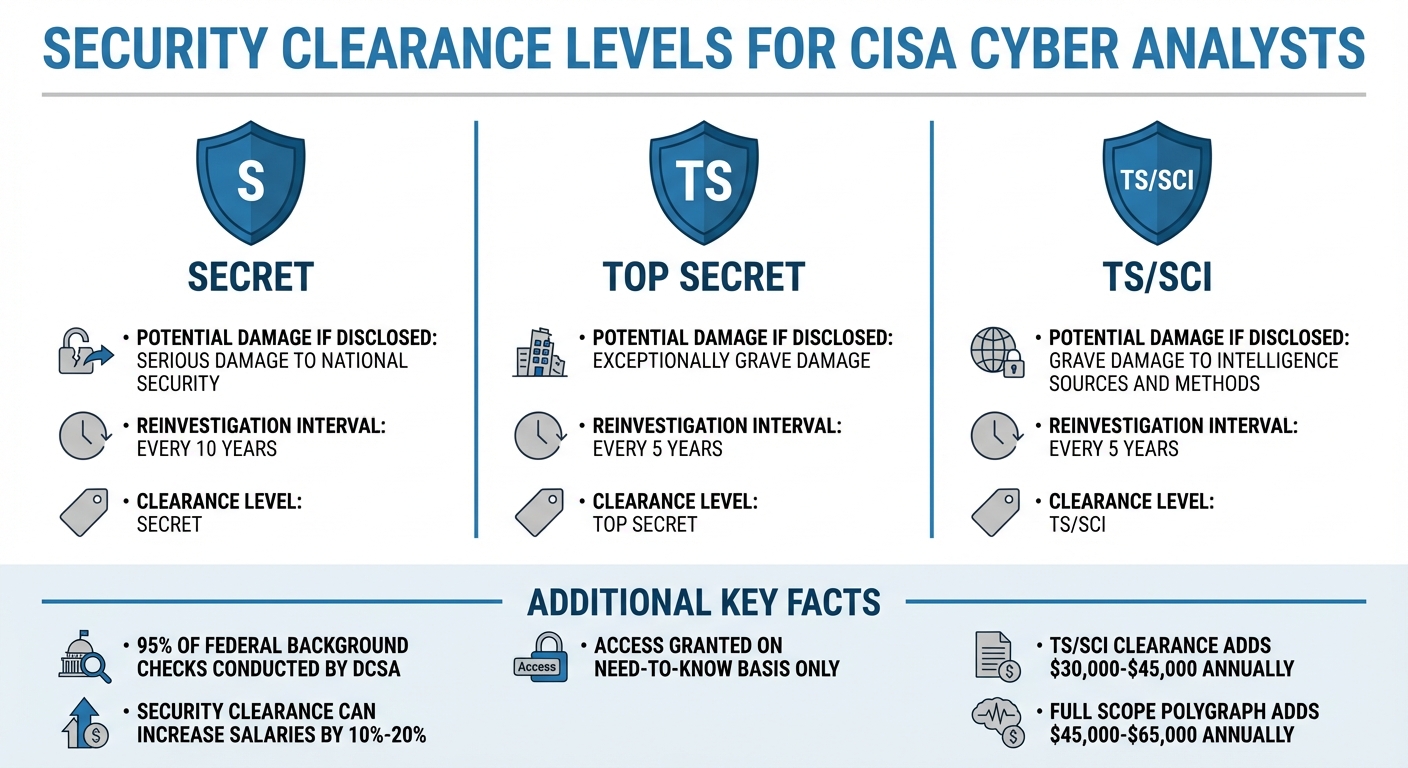
CISA cyber analysts typically need either a Secret or Top Secret clearance, depending on the role’s sensitivity and the systems involved. These clearance levels align with the potential national security risks posed by unauthorized information disclosure. A Secret clearance is required when disclosure could cause serious damage, while a Top Secret clearance is necessary for information that could result in exceptionally grave damage [1][2].

Federal background investigations are conducted to ensure employees are reliable, trustworthy, and loyal to the United States [1]. For CISA cyber analysts, this is particularly important because the role involves defending classified networks like SIPRNet, analyzing sensitive threat intelligence, and securing critical national infrastructure. As stated in Executive Order 10450, "The scope of the investigation shall be determined… according to the degree of adverse effect the occupant of the position sought to be filled could bring about… on the national security" [1].

Clearance Level Potential Damage if Disclosed Reinvestigation Interval
Secret Serious damage to national security Every 10 years [1][2]
Top Secret Exceptionally grave damage Every 5 years [1][2]
TS/SCI Grave damage to intelligence sources and methods Every 5 years [1]

It’s important to note that holding a clearance doesn’t grant unrestricted access to classified information. Access is strictly limited to a need-to-know basis [1][3], ensuring risks are reduced even within the cleared community.

Most federal background checks – around 95% – are conducted by the Defense Counterintelligence and Security Agency (DCSA) across more than 100 federal agencies [3]. Additionally, having a security clearance may increase salaries by 10%–20% [2], making the process not only a career necessity but also a financial advantage.

These clearance requirements lay the groundwork for understanding the broader qualifications and responsibilities that will be discussed in the upcoming sections.

Required Qualifications and Certifications

CISA assesses cyber analyst candidates based on a mix of education and professional experience [5]. A bachelor’s degree in fields like computer science or cybersecurity lays a solid technical foundation. This academic background ensures familiarity with key areas such as network architecture, security protocols, and threat analysis – essential for protecting federal systems effectively.

Professional certifications can significantly boost your technical profile. Some widely recognized certifications include CompTIA Security+, Certified Information Systems Security Professional (CISSP), Certified Ethical Hacker (CEH), and Certified Information Security Manager (CISM). The ISACA Certified Information Systems Auditor (CISA) certification, particularly valuable for compliance roles, requires five years of work experience. The certification costs $575.00 for ISACA members or $760.00 for non-members, with an additional $50.00 application fee. Interestingly, 70% of certified professionals report improved performance at work, and 22% experience a salary increase [6].

CISA also supports ongoing professional development by funding certifications after hiring [5]. This allows you to start with foundational qualifications and advance your expertise while on the job. Additionally, U.S. citizenship is a mandatory requirement for all positions [5]. Below are some certifications that can help enhance your professional and technical capabilities.

Top Certifications for Cyber Analysts

Although CISA provides funding for certifications post-hire, arriving with established credentials shows initiative and technical skill. Here’s a breakdown of key certifications:

  • CompTIA Security+: Ideal for beginners, this certification covers network security, threat management, and basic cryptography.
  • CISSP: Designed for experienced professionals, it focuses on managing security programs across various domains.
  • CEH: Specializes in ethical hacking and penetration testing, including the use of AI to detect threats [4].
  • CISM: Highlights information security governance and risk management, making it valuable for analysts bridging technical teams and leadership.
  • ISACA CISA: Focuses on IT auditing and governance, making it a strong choice for roles emphasizing compliance and control evaluations [6].

Each certification addresses specific areas of cybersecurity. The best choice depends on whether your interests lie in hands-on threat detection, designing security systems, or navigating governance and compliance challenges.

What CISA Cyber Analysts Do

CISA cyber analysts are the frontline defenders of federal networks and critical infrastructure, working tirelessly to counter evolving cyber threats. Their responsibilities revolve around three key areas: threat monitoring, incident response, and vulnerability management. These elements form the backbone of efforts to keep government systems secure. On any given day, they might be investigating anomalies, tracking advanced persistent threats, or analyzing potential vulnerabilities.

This role demands unwavering attention. Anthony Messina, a Security Analyst, provides a glimpse into his typical day:

"My workday typically involves me logging into my organization’s security information and event management system to hunt through volumes of alerts from various endpoints and detection sources." [7]

Instead of waiting for alarms to sound, these analysts take a proactive stance, actively searching for warning signs that could escalate into full-blown attacks.

David Pickett, a Senior Cybersecurity Analyst, highlights the dynamic nature of the job:

"Threat hunting is about 90 percent of my days. I wake up in the morning and I’m like, ‘What is going to be the best attack of the day? What are they going to throw at us today?’" [8]

To uncover potential breaches, analysts scrutinize network activity for unusual patterns, investigate unauthorized devices, and monitor suspicious application behaviors. They rely on tools like VirusTotal, Maltego, and Shodan to gather threat intelligence and follow established frameworks such as MITRE ATT&CK and NIST SP 800-53 to guide their investigations.

When an incident occurs, the focus shifts to containment and resolution. Analysts follow a structured process that includes detection, analysis, containment, eradication, and recovery. They document every step meticulously, conduct root cause analyses, and implement measures to prevent future occurrences. This often involves scripting in Python or PowerShell, managing workflows with platforms like ServiceNow and JIRA, and collaborating across agencies. Amy Moses, another Security Analyst, sums up the mission:

"You’re out there protecting other people and fighting off the bad guys." [8]

Daily Tasks and Responsibilities

CISA cyber analysts tackle a range of challenges through three primary duties:

  • Threat monitoring and analysis: Analysts examine network traffic and logs to identify anomalies, such as rogue devices or unauthorized software installations. They correlate events across systems to distinguish actual threats from false positives.
  • Incident response: When a breach is detected, analysts act quickly to contain the threat, cut off the attacker’s access, and restore systems. They create detailed reports, document every action, and develop recovery plans to bolster defenses for the future.
  • Vulnerability management: Analysts perform asset discovery, run scans (both credentialed and non-credentialed), and prioritize vulnerabilities using the Common Vulnerability Scoring System (CVSS). By addressing the most critical weaknesses first, they reduce the risk of exploitation. Their work often involves tools like Kali Linux for security testing, Amazon AWS/S3 for cloud operations, and Jupyter Notebooks for data analysis – requiring a high level of technical expertise.

CISA cyber analysts are not just problem-solvers; they are protectors, working behind the scenes to safeguard critical systems and ensure the nation’s cybersecurity remains resilient. Their dedication and technical skills are vital in the face of ever-changing threats.

How to Apply for CISA Cyber Analyst Positions

If you’re aiming for a cyber analyst role at CISA, understanding the federal application process is key. Unlike private sector applications, federal hiring follows a unique system centered around USAJobs, the official employment site for U.S. government positions. Here’s how to get started.

First, create a detailed account on www.usajobs.gov. This profile will serve as the foundation for all your federal applications, so make sure it’s complete. Include your contact details, work history, and education information. Once your profile is set, use the keyword search to find positions under "Cybersecurity and Infrastructure Security Agency." Each job posting will outline specific requirements and grade levels, so read them carefully to understand the qualifications, duties, and evaluation criteria.

Once you find a role that aligns with your experience, prepare a federal-style resume and gather any necessary documents. For example, federal employees need to upload their SF-50 form, while others might need to provide transcripts, certifications, or proof of their security clearance. Submit all materials through the application portal to complete your application.

Writing Your Resume for Cleared Positions

Federal resumes are more detailed than those used in the private sector. They should include exact employment dates, supervisor contact information, hours worked per week, and salary details. These specifics are essential to meet federal HR standards.

Tailor your resume to the job posting by using the exact title listed in the announcement. For instance, if the job is titled "Cyber Defense Analyst", include that precise title in your resume. This ensures your application passes through Applicant Tracking System (ATS) filters.

Highlight your technical expertise by listing the tools and technologies you’ve worked with, and include measurable achievements. For example, mention the number of incidents you handled, vulnerabilities you fixed, or systems you secured. Be sure to include your security clearance details – such as the level, granting agency, and investigation date – and certifications relevant to the role. Certifications like C|EH or CISSP can even boost your earning potential by 10% to 15% [4].

Preparing for CISA Interviews

CISA interviews typically combine behavioral and technical questions. Before your interview, research CISA’s mission and its role in safeguarding critical infrastructure and coordinating cybersecurity efforts across federal agencies. Familiarize yourself with recent CISA advisories, alerts, and initiatives to demonstrate your understanding of the agency’s priorities.

For behavioral questions, use the STAR method (Situation, Task, Action, Result) to structure your responses. Expect questions about scenarios like identifying critical vulnerabilities or managing security incidents under pressure. These questions assess both your technical skills and your ability to communicate, collaborate, and solve problems effectively.

On the technical side, be ready to discuss topics such as threat hunting, incident response, and frameworks like MITRE ATT&CK or NIST SP 800-53. Share examples of your hands-on experience with security tools and scripting languages, emphasizing how you’ve applied these skills in practical settings.

Once you’ve completed the interview, you’ll be ready to explore strategies for strengthening your candidacy, which we’ll cover in the next section.

How to Improve Your Chances of Getting Hired

Make yourself stand out as the perfect candidate by focusing on networking, targeted job searches, and sharpening your skills.

Showcase practical experience with tools like SIEM platforms (e.g., Splunk or Graylog), intrusion detection systems (e.g., Snort or Suricata), and vulnerability scanners (e.g., Nessus or Qualys) [9][10]. Highlight your knowledge of Python automation, which could save up to 15 hours a week [9]. Additionally, cloud security expertise is highly sought after and can lead to better salary opportunities [10]. Kimberley Tyler-Smith, Senior Hiring Manager, emphasizes:

"The best resumes are tailored to the specific job requirements and showcase the candidate’s relevant skills and experience" [9].

Customizing your resume this way not only makes it more effective but also creates a solid foundation for successful networking.

Keep an eye on CISA’s hiring events page and register for their one-stop hiring events, which often include early interview opportunities [11]. Recent graduates can reach out to StudentCareers@cisa.dhs.gov, while veterans and military spouses can connect with Veterans@cisa.dhs.gov for tailored support [11]. Be ready for virtual assessments, as CISA uses HireVue, an on-demand interview tool, for certain positions [11].

Using Cleared Cyber Security Jobs to Find CISA Opportunities
Cleared Cyber Security Jobs

Pair your targeted resume and networking efforts with tools that simplify your job search. Cleared Cyber Security Jobs is a great resource for finding CISA positions and other roles requiring security clearances. Its search filters let you refine results by clearance level, location, and agency, saving you from sorting through irrelevant listings.

You can also upload your resume to the platform’s database, allowing employers to find you directly. Set up job alerts to stay informed about new CISA cyber analyst openings, giving you the chance to apply early. Since federal job postings often close once they hit a certain number of applicants, acting quickly can make a big difference. The platform also offers career resources specifically for cleared professionals, such as tips on certifications and resume writing for federal jobs.

Building Your Network in the Cleared Community

Tailoring your application is important, but connecting with others in the field can also boost your chances. Attend CISA-hosted job fairs and hiring events to meet recruiters in person and show your enthusiasm for their mission. As CISA explains:

"participate in a variety of job fairs and hiring events, including hosting one-stop hiring events where pre-qualified candidates can be interviewed and even receive tentative job offers on the spot" [11].

Networking with current and former CISA employees through professional associations or federal cybersecurity conferences can give you valuable insights into the agency’s hiring process, workplace culture, and upcoming opportunities. Referrals from employees often carry significant weight, signaling both your skills and your fit for the team. You can also join online communities focused on cleared cybersecurity work, where members share job leads, interview advice, and tips for navigating the federal hiring system.

Salary and Career Advancement at CISA

CISA cyber analyst roles follow the GS pay scale, starting at GS-9 for entry-level positions and reaching up to GS-15 or even the Senior Executive Service (SES) for leadership roles. For context, a GS-14 (Step 5) position in Washington, D.C. earns a base salary of $163,104. Once you factor in the 33.94% locality adjustment and federal benefits, total compensation approaches $221,000 [12]. These numbers highlight how factors like location and security clearance can significantly impact earnings.

Geographic location plays a big role in pay. For example, $145,000 in the D.C. area translates to the equivalent of about $118,000 in San Antonio or $112,000 in Huntsville when adjusted for cost-of-living differences [12]. Additionally, security clearances can boost earnings considerably. A TS/SCI clearance often adds $30,000 to $45,000 annually, while a Full Scope Polygraph can add another $45,000 to $65,000 [12].

When it comes to career growth, CISA offers a clear progression path. Entry-level analysts typically start at the GS-9 to GS-11 level, earning between $65,000 and $100,000 during their first two years. After gaining 2–5 years of experience, many move to GS-12 or GS-13 roles, with salaries ranging from $90,000 to $140,000. Around the five-year mark, professionals often hit what’s known as the "5-Year Clearance Cliff." At this point, their accumulated knowledge and program-specific clearances lead to sharper salary increases. Senior technical and leadership roles at the GS-14 or GS-15 level can offer salaries between $150,000 and $220,000 for those with 10–15 years of experience [12].

Specialized skills can significantly increase pay. For instance, expertise in Zero Trust Architecture is highly sought after, with senior roles in this area earning between $185,000 and $250,000 due to federal priorities. Similarly, professionals with cloud security expertise in GovCloud environments or skills in OT/ICS security are in demand as federal spending shifts toward these areas. Additionally, with 10% of cybersecurity job listings now mentioning AI, professionals with AI/ML security expertise can earn an extra $20,000 to $40,000 on top of standard salaries [12].

Certifications also play a key role in boosting earnings. A CISSP certification, for example, can increase salaries by $15,000 to $25,000. For those aiming for executive roles, the Certified Chief Information Security Officer (C|CISO) certification can help qualify candidates for senior positions with salaries over $200,000. Other specialized certifications can add an estimated 10% to 15% to overall compensation [12][4]. These credentials not only enhance technical skills but also speed up career advancement within CISA.

Final Thoughts on CISA Cyber Analyst Careers

Landing a role as a CISA cyber analyst takes thoughtful preparation. You’ll need the right security clearance, essential certifications, and practical experience that shows you understand the full scope of cyber threats. Combining technical know-how with strong investigative instincts sets the stage for making an impact now and building a solid career for the future.

Interestingly, experience doesn’t have to come from conventional tech roles. A varied professional background can actually be a strength. As Matthew Psencik, Director of Endpoint Security at Tanium, points out:

"I’ve also found that this additional skill set allows people from less technical backgrounds to shine. Some of the best analysts I know come from backgrounds that have nothing to do with tech" [13].

What truly makes a difference is cultivating an investigative approach and honing practical skills. Hands-on practice with tools like Splunk, Elastic, and Arkime can help you build the expertise needed for these roles.

CISA positions are also financially rewarding. Salaries start at an average of $141,000 for specialists and can exceed $200,000 for senior roles, especially with specialized clearances and locality adjustments [5][4]. Career paths are well-defined, whether your goal is to become a technical expert or step into leadership roles like Chief Information Security Officer (CISO).

Platforms like Cleared Cyber Security Jobs are tailored for professionals with security clearances, offering tools like job search filters, resume uploads, and custom job alerts. These features connect you directly with employers, cutting through the clutter of general job boards.

To strengthen your candidacy, focus on building core skills and earning certifications. Joining professional groups such as ISSA or ISC2 can provide valuable networking opportunities. Setting up a personal lab to simulate real-world scenarios can also help you stand out. With the average cost of a data breach projected to hit $4.9 million in 2024, the demand for skilled cyber analysts at agencies like CISA is only growing [5]. By combining clearance, certifications, and hands-on experience, you’ll position yourself for success and longevity in this field.

FAQs

Can I apply to CISA without an active security clearance?

No, you can’t apply to CISA without holding an active security clearance. Almost all positions list a current clearance as a minimum requirement for eligibility. Make sure to check the exact clearance level required for the specific role you’re targeting before submitting your application.

Which CISA cyber analyst specialties pay the most?

CISA cyber analyst positions, such as Threat Operations Analysts and Incident Response Analysts, offer annual salaries ranging from $80,000 to $200,000. Those with advanced experience or higher security clearance levels may earn even more.

What’s the fastest way to build hands-on experience for CISA roles?

The fastest route to gaining practical experience for CISA roles is through cybersecurity training and hands-on labs that mimic real-world situations. Programs like the Federal Cyber Defense Skilling Academy and CISA Learning offer virtual courses on key topics such as incident detection, malware analysis, and ethical hacking. These resources are designed to build the specific, practical skills needed for CISA cyber analyst positions.
Related Blog Posts

  • CySA Plus Certification Career Guide for Cleared SOC Analysts
  • Threat Intelligence Analyst Career Path for Cleared Professionals
  • Cryptanalyst Career Path for Cleared Intelligence Professionals
  • Cleared SOC Analyst Jobs Complete Career Guide

Cleared Cyber Analyst Jobs at CYBERCOM Complete Guide

CyberSecJobs Editorial · April 10, 2026 ·

Looking to work at CYBERCOM? Here’s what you need to know:

  • Location: CYBERCOM operates out of Fort Meade, Maryland, with 133 cyber teams defending DoD networks.
  • Clearance Levels: Roles require security clearances like Secret, Top Secret (TS), or TS/SCI, often with polygraphs. Higher clearances offer salaries up to $230,000+.
  • Key Skills: Proficiency in network defense, threat analysis, scripting (Python/PowerShell), and tools like Splunk, Wireshark, and cloud platforms (AWS/Azure).
  • Certifications: Security+, CISSP, CEH, and GIAC are commonly required, with costs ranging from $400 to $1,200.
  • Application Process: Apply via USAJOBS.gov, ensure your resume highlights active clearances, and prepare for in-depth technical and behavioral interviews.
  • Demand: With 26% of U.S. cybersecurity roles unfilled and salaries 20%-40% higher than the private sector, opportunities abound.

This guide covers everything from clearance requirements to resume tips, ensuring you’re prepared to land a role at CYBERCOM.

The Life of an Air Force Defensive Cyber Warfare Operator – Chief’s Corner #28

sbb-itb-bf7aa6b

Security Clearance Requirements at CYBERCOM

CYBERCOM

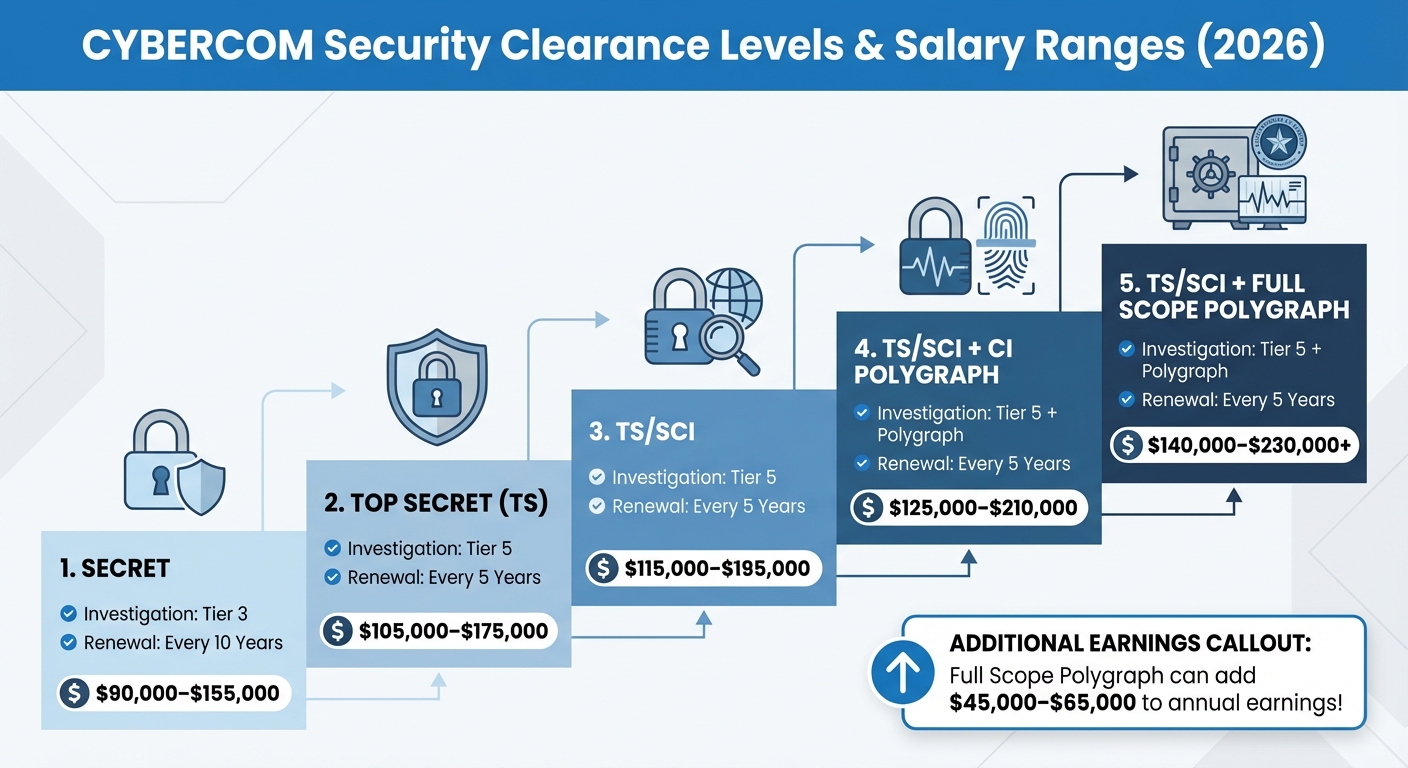
CYBERCOM Security Clearance Levels and Salary Ranges 2026

CYBERCOM Security Clearance Levels and Salary Ranges 2026

Clearance Levels Explained

CYBERCOM roles demand one of three main clearance levels, each granting access to increasingly sensitive information. For many entry-level government contractor positions, Secret clearance is the starting point. It requires a Tier 3 investigation and must be renewed every 10 years [5].

For roles involving critical national security information, Top Secret (TS) clearance is necessary. This level involves a more rigorous Tier 5 investigation, with renewals required every 5 years [5].

An additional layer, TS/SCI, is available for those with TS clearance. It provides access to intelligence managed under formal control systems [1][5]. Many CYBERCOM and NSA positions also require a Counterintelligence (CI) Polygraph or a Full Scope Polygraph (FSP). The FSP, which includes both counterintelligence and lifestyle questions, tends to narrow the candidate pool but often comes with higher salary offers [3].

Clearance Level Investigation Tier Renewal Period 2026 Salary Range
Secret Tier 3 10 Years $90,000–$155,000
Top Secret Tier 5 5 Years $105,000–$175,000
TS/SCI Tier 5 5 Years $115,000–$195,000
TS/SCI + CI Poly Tier 5 + Poly 5 Years $125,000–$210,000
TS/SCI + Full Scope Tier 5 + Poly 5 Years $140,000–$230,000+

Next, let’s look at what it takes to qualify for these clearances.

Eligibility Requirements

To apply for any Department of Defense (DoD) security clearance, U.S. citizenship is mandatory [4][5]. Applicants must complete the SF‑86 questionnaire through the eApp platform, which uses logic-based questions and built-in error checks to streamline the process [7]. The Defense Counterintelligence and Security Agency (DCSA) handles the majority of federal background checks, using 13 adjudicative guidelines to evaluate candidates [7].

One major factor in clearance approval is financial stability. In fact, financial issues are the top reason for clearance denials or revocations [6][7]. Applicants should gather 10 years of records, including details on residences, foreign contacts, employment, and education. It’s a good idea to pull your credit report early and address any delinquencies – having a repayment plan in place can help mitigate concerns during the review process.

The timeline for investigations varies, typically taking between 6 and 18 months. However, candidates with current clearances are often prioritized [2][5].

Understanding these requirements is key as you prepare for a CYBERCOM application.

How to Maintain Your Clearance

Under the Trusted Workforce 2.0 initiative, the process for maintaining clearance has shifted to Continuous Vetting, which monitors records in real time and eliminates the need for periodic reinvestigations [7]. This system also improves clearance reciprocity across agencies through a "clear once, trusted everywhere" approach.

Adjudicators may review public online activity, including social media and platforms like GitHub, to identify potential vulnerabilities [7]. To protect your clearance, follow strict guidelines regarding foreign contacts, financial management, and the handling of sensitive information. Before your investigation begins, secure your social media privacy settings and be transparent when filling out the SF‑86. Falsifying information is a serious disqualifier, so it’s better to provide context for any potential red flags.

For TS/SCI positions at CYBERCOM, work is typically conducted on-site in a Sensitive Compartmented Information Facility (SCIF). Personal devices like phones and recording equipment are prohibited in these secure environments [8].

Required Qualifications and Experience

CYBERCOM cyber analyst roles demand a mix of technical expertise, intelligence analysis, and strong communication skills. With the U.S. Bureau of Labor Statistics projecting a 33% growth in cybersecurity jobs through 2030 [10], it’s clear that these skills are in high demand. Here’s a closer look at what CYBERCOM seeks in its candidates.

Technical Skills Required

CYBERCOM analysts rely on an all-source intelligence approach, integrating HUMINT (Human Intelligence), SIGINT (Signals Intelligence), GEOINT (Geospatial Intelligence), and OSINT (Open-Source Intelligence) to build comprehensive threat assessments. This method helps identify adversaries’ strengths, weaknesses, and operational patterns.

Proficiency in network defense is critical. Analysts should be skilled with SIEM platforms like Splunk, ArcSight, or QRadar, as well as intrusion detection and prevention systems (IDS/IPS). Expertise in network protocols, packet analysis tools like Wireshark, and log analysis is also essential. Familiarity with the MITRE ATT&CK framework enables analysts to understand the Tactics, Techniques, and Procedures (TTPs) used by threat actors, moving beyond simple indicators of compromise.

Scripting and automation skills in Python or PowerShell are a must. These capabilities allow analysts to streamline tasks, create custom security tools, and manage large datasets efficiently. Additionally, as government agencies increasingly adopt cloud platforms, expertise in securing environments like Microsoft Azure or AWS is highly valued – potentially boosting salaries by over $15,000 [9]. Knowledge of DevSecOps principles and integrating security into the software development lifecycle is becoming standard practice.

Skill Category Essential Technical Skills Relevant Tools/Frameworks
Intelligence All-source analysis, TTP identification HUMINT, SIGINT, OSINT, MITRE ATT&CK
Defense Intrusion detection, Network monitoring SIEM, IDS/IPS, Firewalls, Wireshark
Analysis Scripting, Malware analysis, Forensics Python, PowerShell, SQL, Forensics tools
Infrastructure Cloud security, OS administration Azure, AWS, Windows, Linux, VMs
Compliance Risk management, Regulatory guidelines NIST, ISO, GDPR, HIPAA

Knowledge of cybersecurity frameworks such as NIST, ISO, and CIS is expected, especially for roles involving compliance and risk management. For incident response positions, skills in digital forensics and malware analysis are invaluable, helping to minimize damage during active threats.

Relevant Professional Backgrounds

Candidates with Computer Network Defense (CND) experience are highly sought after, particularly those who have worked in protection, detection, response, and sustainment roles within Computer Incident Response teams [4]. Military cyber units, government contractor roles, or private sector cybersecurity positions provide the kind of hands-on experience CYBERCOM values.

Experience in network traffic analysis, forensics, SOC operations, and frameworks like the Cyber Kill Chain or Intelligence Driven Defense demonstrates readiness for CYBERCOM’s fast-paced environment [4]. Highlighting expertise with Unix/Linux command line tools, Netflow analysis, and scripting languages on your resume can further strengthen your application.

Interpersonal Skills That Matter

Technical skills alone aren’t enough – communication and teamwork are equally vital. As noted in an NSSFed job posting, the ideal candidate is a "motivated self-starter with strong written and verbal communication skills, and the ability to create complex technical reports on analytic findings" [4]. Analysts must regularly brief senior leadership, work with legal teams, and coordinate with national-level agencies, making clear communication a priority.

"The most important skill an individual on a threat analyst team can have is the ability and inclination to continue learning and evolving their competencies." – Flashpoint [10]

Adaptability and a team-oriented mindset are also crucial. According to the U.S. Air Force, successful candidates exhibit "adaptability, a team mentality, leadership potential and a strong dedication to contribute to the Air Force’s mission" [11]. During high-pressure scenarios, creative problem-solving and the ability to stay calm while collaborating across diverse teams are essential. Be sure to showcase examples of leadership, teamwork, and adaptability in your application [11].

Job Responsibilities and Daily Duties

CYBERCOM cyber analysts work tirelessly to safeguard federal networks from advanced threats around the clock. As one Leidos team member explained, "Our team provides mission critical, 24/7 operational support to the customer’s mission of protecting federal networked systems and services from cyber threats impacting national security." [12] This role isn’t your standard 9-to-5 job – many positions involve rotating shifts, including daytime, evening, and overnight hours, ensuring constant vigilance. [12] These duties build upon the technical and interpersonal skills discussed earlier.

Threat Detection and Analysis

Cyber analysts are on the front lines, monitoring networks for unusual activity, identifying new threats, and profiling Advanced Persistent Threats (APTs). Using frameworks like MITRE ATT&CK, they assess adversary tactics and evaluate Indicators of Compromise (IOCs) and Indicators of Behavior (IOBs) to generate actionable intelligence. Their work extends to cloud environments, analyzing threats aimed at platforms like AWS, Azure, O365, and containerized systems. To streamline operations, they often design automated tools that feed threat data directly into security controls, cutting down response times and reducing manual tasks. Mastery of query languages such as SPL (Splunk) or KQL (Kusto) is vital for efficiently searching through vast datasets. [12]

Incident Response and Mitigation

In addition to detecting threats, analysts play a critical role in responding to incidents. They support "Hunt" missions and Defensive Cyber Operations by providing Indications & Warnings and key pivot points to guide investigations and containment strategies. Their expertise in models like the Cyber Kill Chain and the Diamond Model of Intrusion Analysis helps them understand the progression of attacks and prioritize responses effectively. Analysts also produce intelligence reports tailored to strategic, operational, and tactical levels, ensuring that everyone from military commanders to senior leaders is informed about emerging threats and their potential impact on national security. Clear communication is crucial here, as they must translate complex technical findings into actionable recommendations. [12]

Working with CYBERCOM Teams

Collaboration is at the heart of CYBERCOM’s mission. Analysts frequently partner with network administrators, computer systems analysts, and intelligence teams to ensure robust network security and document recovery processes. [13][14] They provide critical advice to military commanders on force protection and deliver real-time threat alerts to aid operational decision-making. [16]

"Intelligence is one of the best and most important weapons at our disposal." [16]

How to Write Your Resume for CYBERCOM

When crafting your resume for CYBERCOM, it’s crucial to emphasize your cybersecurity skills and experience in a way that stands out to hiring managers and navigates Applicant Tracking Systems (ATS). With recruiters spending less than a minute reviewing applications, every detail matters [23]. Make sure your security clearance, technical expertise, and relevant accomplishments are front and center.

Where to List Your Security Clearance

Your active security clearance is a major asset, so don’t bury it in your resume. Highlight it near the top of the first page, either in your professional summary or directly below your contact information [17][19]. Use specific terms like TS/SCI, CI Poly, or Full Scope Poly instead of vague descriptions like "top-level clearance" [19].

"List your active clearance level (e.g., Secret, Top Secret, TS/SCI) near the top of your resume – ideally in your professional summary or contact section. Make it easy for hiring managers and recruiters to see immediately." – LaunchCode [17]

Include details such as the issuing agency (e.g., Department of Defense) and the date your clearance was granted or renewed [19]. If you hold Special Access Program (SAP) or Need-to-Know (NTK) clearances, mention these too, but avoid revealing classified project specifics [19]. To improve ATS compatibility, weave keywords like "security clearance", "TS/SCI", and "polygraph" throughout your resume [17][19][21].

Once your clearance is highlighted, shift focus to showcasing your work history.

How to Present Your Experience

Organize your work history in reverse chronological order, concentrating on the past decade of relevant roles [24][21]. Start each bullet point with strong action verbs like "Detected", "Investigated", "Hardened", or "Mitigated" to convey initiative and responsibility [21]. Use measurable results to demonstrate your impact.

For example, instead of saying "Improved threat detection", opt for something like, "Reduced Mean Time to Detect (MTTD) from 8 hours to 45 minutes by optimizing SIEM workflows and implementing automated playbooks" [22]. Pair your clearance with quantifiable achievements, such as, "Maintained TS/SCI while managing secure networks for 5,000+ users with 99.9% uptime" [17].

Provide context about your work environment, such as the size of the organization, the number of endpoints you managed, or whether you worked in a 24/7 Security Operations Center (SOC) [21]. Tailor your language to reflect the terminology used in the CYBERCOM job posting. For instance, if the listing mentions "Microsoft Sentinel", use that exact term instead of "Azure Sentinel" [22][21].

"An analyst who lists some tools is telling me they know how to navigate and operate the tool, but do they know why they were doing it… a security analyst who talks about functions they’ve performed suggests they understand the process – the work beyond the tools." – Peter Gregory, Senior Director for Cybersecurity, GCI Communication Corp [25]

Focus more on your role in security processes than simply listing tools. Highlight tasks like "analyzing and triaging alerts" or "performing risk analysis." Employers can train you on new tools, but they value a solid understanding of core security principles [25].

Finally, round out your resume by emphasizing your certifications and technical training.

Including Certifications and Training

Certifications are critical in cybersecurity, so make them easy to find. Dedicate a section near the top of your resume for certifications rather than tucking them into a general skills list [22][23].

"Certifications are non-negotiable in cybersecurity. Security+, CySA+, or CISSP should be in a dedicated section, not hidden in your skills list." – WriteCV Guide [22]

List certifications by their full name along with the date obtained. If you’re working toward a certification like CISSP or CEH, include it with an expected completion date to ensure it’s visible to recruiters [20].

Organize your technical skills into categories like SIEM/SOAR, Cloud Security, Scripting/Languages, and Vulnerability Management. This helps hiring managers quickly identify your expertise [22][21]. Also, demonstrate knowledge of frameworks relevant to government roles, such as NIST 800-53, MITRE ATT&CK, and DISA STIGs [21][9]. If you lack professional experience, consider adding a "Projects" section to showcase home labs, Capture the Flag (CTF) competitions, or tools you’ve used in training [18][23].

Stick to an ATS-friendly format: use a clean, single-column layout, standard fonts like Calibri or Arial (10–12 pt), and clear section headings [22][21]. Save your resume as a PDF unless the job posting specifies otherwise [21][23]. Keep in mind that ATS systems for cybersecurity roles often evaluate resumes based on Keywords (40%), Security Metrics (25%), and Structure/Formatting (35%) [22].

Certifications for CYBERCOM Cyber Analysts

Certifications are a must-have for CYBERCOM roles, as outlined in DoD Directive 8570.01-M and DoD 8140. These credentials prove you have the technical know-how and practical skills to handle critical tasks like incident response, defensive operations, and offensive security.

Most Requested Certifications

One of the most common starting points is CompTIA Security+, a foundational certification required for many DoD 8140 roles. With more than 700,000 holders globally [27], it’s priced between $404 and $425 and covers core security principles. For those advancing to intermediate positions, CompTIA CySA+ (also $404) focuses on incident detection and response, making it ideal for Cyber Defense Analysts.

If you’re aiming for senior-level jobs like Security Manager or Senior Security Engineer, the CISSP is the gold standard. It costs $749 and is frequently listed in cybersecurity job postings. Cleared professionals with a CISSP often earn between $150,000 and $180,000. Keep in mind that while five years of experience are required, a four-year degree can waive one year of this prerequisite.

For roles emphasizing offensive tactics, the Certified Ethical Hacker (CEH) is highly regarded. Approved under DoD 8570, its cost ranges from $950 to $1,199. The latest version, CEH v13, even includes AI-focused material to address modern threats. Additionally, GIAC certifications like GCIH (around $999) and GSEC are popular choices for hands-on roles in incident response and cyber defense.

Once you’ve identified the certifications that align with your career goals, the next step is understanding how to earn and maintain them.

Getting and Renewing Certifications

Start by selecting the certification that matches your target role. Review the official exam objectives to identify areas where you may need additional study. Resources like self-study guides, eLearning platforms such as CompTIA CertMaster, or in-person training can help you prepare. Gaining practical experience through virtual labs, Capture the Flag (CTF) events, or personal lab setups is equally important.

Most certifications have a three-year expiration period and require renewal through continuing education or reexamination to stay relevant in the fast-changing cybersecurity landscape. Don’t forget to check with your employer – about 40% of cybersecurity professionals report that their companies cover the costs of exams, training, and renewal fees [26].

The CYBERCOM Hiring Process

The hiring process at CYBERCOM is thorough and requires patience and careful attention to each step. From submitting your application through federal platforms to completing security onboarding, every stage demands preparation and precision.

How to Apply

Most CYBERCOM job postings are found on USAJOBS.gov, the federal government’s employment website. To get started, you’ll need to create a profile and upload a resume formatted to meet federal standards. This typically involves a detailed chronological format that includes information like supervisor contact details and the number of hours worked per week for each role.

For security clearance applications, the federal government now uses the eApp platform under the Trusted Workforce 2.0 framework [7]. To save time, gather 10 years of residential, employment, and foreign contact history before starting your eApp submission. This preparation can significantly reduce processing delays. If you already hold a security clearance from another agency, reciprocity transfers are supposed to take between 30 and 75 days. However, delays of 90 to 150 days are common [7]. Even with these delays, having an active clearance gives you a strong advantage.

Clearance Level Average Processing Time Key Factors
Secret (Tier 3) 60 to 150 days Completeness, foreign contacts, backlog [7]
Top Secret (Tier 5) 120 to 240 days Complexity of background, travel, foreign ties [7]
TS/SCI with Polygraph 180 to 365+ days Polygraph appointment waitlist [7]
Interim Secret 10 to 30 days Initial automated checks [7]

Once your application is submitted, you’ll need to prepare for a rigorous interview process.

Interview Preparation Tips

CYBERCOM interviews are designed to evaluate both your technical expertise and your ability to operate in classified environments. Expect technical questions that test your experience with tools like SIEM platforms (e.g., Splunk, Microsoft Sentinel), EDR tools, and threat intelligence platforms such as Recorded Future or ThreatConnect [28][30]. Additionally, you’ll need to demonstrate strong communication skills, especially your ability to explain complex technical threats in terms that non-technical stakeholders can understand. Using analogies instead of technical jargon is key here [28][29].

To tackle behavioral questions, use the STAR method (Situation, Task, Action, Result). Be prepared to discuss high-pressure incidents and walk through the incident response lifecycle: identification, containment, eradication, recovery, and lessons learned [29]. For scenario-based questions, such as dealing with an "unknown threat actor", focus on immediate isolation of affected systems followed by forensic analysis [28].

Another critical step is reviewing your digital footprint. Hiring managers and adjudicators often examine public-facing online activities, including GitHub contributions, professional forums, and social media profiles, to assess your operational security (OPSEC) awareness [7]. Before applying, audit your social media privacy settings and professional networking profiles to ensure they reflect sound judgment and avoid any vulnerabilities that could be exploited [7].

"Falsification on the SF-86, even on a minor point, is often the most easily preventable yet fatal mistake. Candor is paramount" [7].

Onboarding and Initial Training

If you pass the interview and your clearance is approved, the onboarding process begins. New hires are briefed into classified programs and required to sign non-disclosure agreements (NDAs) [7]. Training often takes place at specialized facilities like the DC3 Cyber Training Academy [31]. Depending on your service branch, additional training may occur at locations such as the U.S. Army’s Cyber Center of Excellence (CCoE), the Navy’s Center for Information Warfare Training (CIWT), or the Air Force’s Cyberspace Technical Center of Excellence (CyTCoE) [31].

Once hired, you’ll be monitored under Continuous Vetting (CV). This system replaces periodic reinvestigations with real-time monitoring of criminal, financial, and travel records [7]. To maintain your clearance, you’ll need to self-report significant life events, such as arrests, large debts, or foreign contacts, to your Security Officer. The Defense Counterintelligence and Security Agency (DCSA), which handles over 95% of federal background investigations, oversees these continuous checks [7].

Using Cleared Cyber Security Jobs to Find CYBERCOM Positions

Cleared Cyber Security Jobs

For cyber professionals looking to contribute directly to CYBERCOM’s mission, this platform provides tailored tools and resources to simplify the search for positions in the cleared cybersecurity field.

Job Search Tools and Filters

Cleared Cyber Security Jobs offers advanced filters designed for professionals with security clearances seeking CYBERCOM roles. You can narrow down opportunities by job title, location – such as Fort Meade, MD (CYBERCOM headquarters), or Augusta, GA, a key hub for U.S. Cyber Command [1][32] – and by work type (Remote, Hybrid, or On-site) [32]. The platform also features automated job alerts that align with your skills, career goals, and clearance level [32]. When setting up your profile, make sure to highlight your highest clearance level – having a Full Scope Polygraph (FSP) can increase annual earnings by $45,000–$65,000 over your career [1]. By joining the platform’s talent community, you’ll gain access to notifications about CYBERCOM-related events, including tech talks, open houses, and even hackathons tailored for the defense and intelligence sectors [32]. These tools streamline your job search and connect you directly with opportunities to engage with recruiters at specialized events.

Attending Job Fairs

Cleared Cyber Security Jobs also organizes job fairs where cleared professionals can meet CYBERCOM recruiters and defense contractors face-to-face. These events are a direct channel to discuss roles and showcase your expertise. Meeting hiring managers at these fairs can speed up the hiring process, as they are well-versed in the specific requirements of cleared cyber analyst positions. With cybersecurity roles expected to grow by 35% over the next decade [15] and 26% of positions projected to remain unfilled by 2026 [1], attending these fairs gives you a competitive edge in securing interviews. Beyond these events, the platform offers additional resources to help refine your career strategy.

Career Resources Available

The platform also provides tailored career guides for cleared professionals. These include detailed tips for clearance interviews, insights into salary premiums, and pathways to entry-level certifications [1]. An interactive Career Path Finder offers personalized job recommendations based on your experience and clearance level [1]. For salary benchmarking, the Cybersecurity Salary Guide is a valuable tool – it shows that in Augusta, GA, the average cleared salary is $108,000, which adjusts to $122,700 when factoring in the area’s lower cost of living [1]. Additionally, certifications like CISSP or C|EH can boost your salary by 10% to 15% [15]. These resources equip you with the knowledge to navigate the cleared cybersecurity job market effectively.

Conclusion

This guide has covered the key steps needed to land a cyber analyst role at CYBERCOM, emphasizing that success requires more than just technical expertise. A combination of the right security clearance, targeted certifications, and a strategic job search is essential. With 26% of cybersecurity roles projected to remain unfilled by 2026 and demand expected to grow by 29% through 2034, the field offers strong opportunities for those who meet these rigorous criteria [13][1]. Notably, obtaining a Full Scope Polygraph can increase annual earnings by $45,000–$65,000, significantly enhancing long-term income potential [1].

Start by securing foundational certifications like Security+, which align with DoD standards, and consider applying in high-demand areas such as Augusta, GA [2][1].

To streamline your job search, leverage platforms tailored to cleared professionals. Upload your resume to sites like Cleared Cyber Security Jobs, set up alerts based on clearance and location, and attend industry events to connect with CYBERCOM recruiters and top defense contractors [2].

Build a practical portfolio that highlights your skills in threat detection and incident response using tools like Splunk, Wireshark, and ACAS [2][33]. Showcase your abilities through home labs, GitHub projects, and other hands-on work. Keep in mind, many roles require on-site work in secure environments [1]. Position yourself strategically to stand out in this competitive but rewarding field.

FAQs

Can I apply to CYBERCOM without an active clearance?

To apply for roles at CYBERCOM, having an active security clearance is a must. This requirement applies to nearly all positions within CYBERCOM and other similar cybersecurity roles that require clearance.

What can delay a TS/SCI or polygraph the most?

The primary reason for delays in getting a TS/SCI clearance or polygraph is examiner availability and scheduling problems. With a limited number of examiners and various logistical hurdles, the process often takes longer than expected. On top of that, delays may increase if multiple polygraph sessions are required or if initial attempts result in failures, adding further complications to scheduling. These issues are the most frequent roadblocks in the clearance process.

What should I build to prove I can do the job?

To stand out as a cyber analyst at CYBERCOM, create a technical portfolio that demonstrates your ability to spot, analyze, and address cyber threats. Emphasize expertise in areas such as network defense, forensic investigations, and incident response. Include examples of hands-on experience with tools like Intrusion Detection Systems (IDS), Security Information and Event Management (SIEM) platforms, and Endpoint Detection and Response (EDR) solutions. Additionally, earning certifications such as CompTIA Security+ or CISSP can showcase your knowledge and dedication to meeting cybersecurity standards.

Related Blog Posts

  • Threat Intelligence Analyst Career Path for Cleared Professionals
  • Cryptanalyst Career Path for Cleared Intelligence Professionals
  • Cyber Warfare Specialist Career Path for Cleared Military
  • Cleared Cyber Analyst Jobs at NGA Complete Guide

Cleared Cyber Analyst Jobs at NGA Complete Guide

CyberSecJobs Editorial · April 10, 2026 ·

The National Geospatial-Intelligence Agency (NGA) offers cyber analyst roles that combine cybersecurity expertise with geospatial intelligence (GEOINT) to support national security. These positions require Top-Secret/SCI clearance, technical skills, and certifications like CISSP or Security+. Here’s a quick overview:

  • What NGA Does: Provides geospatial intelligence for U.S. defense, intelligence, and policy decisions.
  • Cyber Analyst Role: Tracks cyber threats, evaluates foreign cyber capabilities, and integrates geospatial data with cybersecurity.
  • Qualifications: Bachelor’s degree in Cybersecurity or related fields, hands-on experience, and certifications.
  • Clearance Requirements: TS/SCI clearance with periodic reinvestigations every five years.
  • Application Process: Apply via intelligencecareers.gov/nga, complete assessments, and undergo security clearance checks.

This guide covers qualifications, skills, certifications, and how to prepare for NGA’s hiring process. Keep reading for detailed steps to start your career at NGA.

What I Wish I Knew Before I Started My Intelligence Career

sbb-itb-bf7aa6b

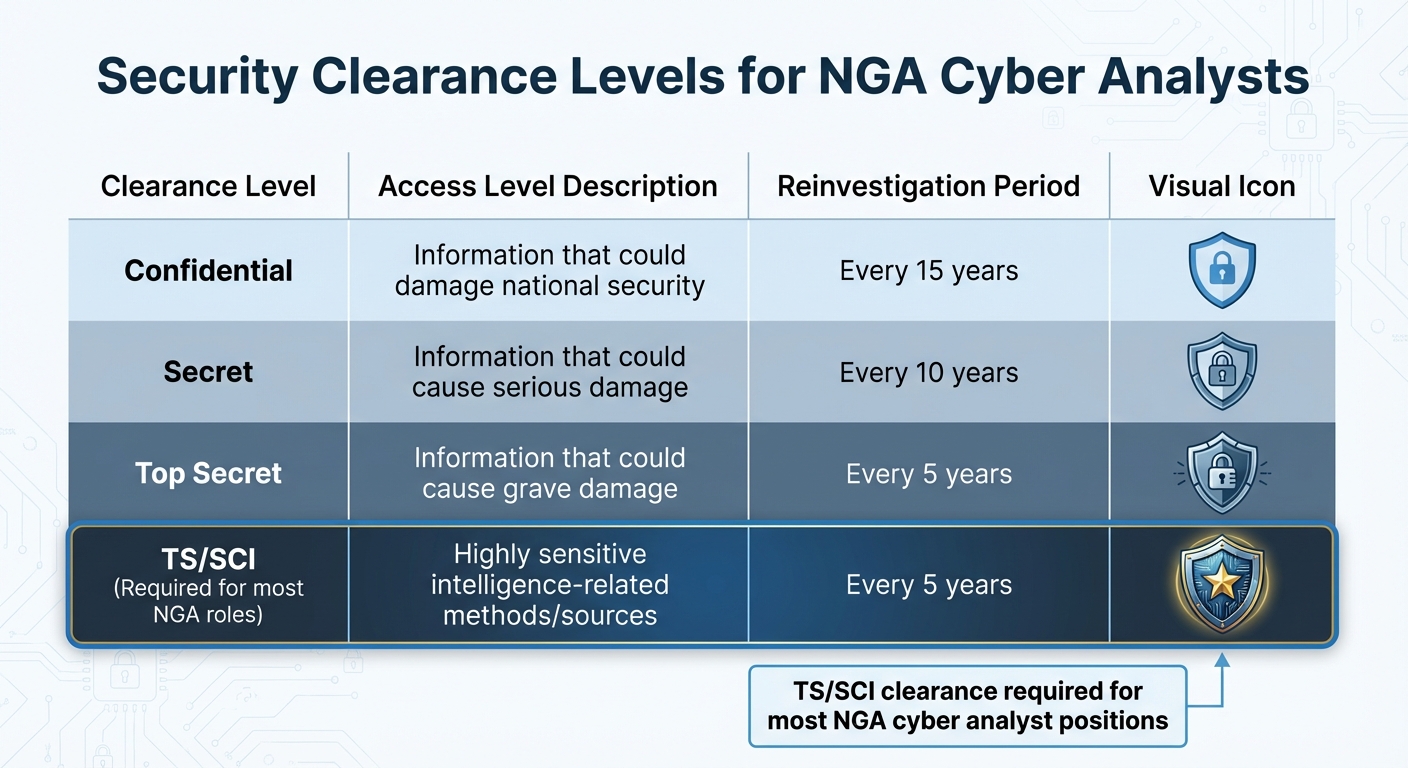
Security Clearance Requirements

Security Clearance Levels and Requirements for NGA Cyber Analysts

Security Clearance Levels and Requirements for NGA Cyber Analysts

Becoming a cyber analyst at the NGA involves navigating a demanding security clearance process. To qualify, applicants must secure a Top-Secret (TS) security clearance with access to Sensitive Compartmented Information (SCI) [6]. While this is the standard requirement, certain roles may also necessitate additional polygraph tests, such as counterintelligence-scope or full-scope polygraphs.

Clearance Levels Required

Some roles may require only Secret or Top-Secret clearances without SCI access, but these are less common. A Top-Secret clearance protects information that could cause grave harm to national security if leaked, while the SCI designation adds further restrictions for intelligence programs requiring compartmentalization.

Clearance Level Access Level Reinvestigation Period
Confidential Information that could damage national security Every 15 years
Secret Information that could cause serious damage Every 10 years
Top Secret Information that could cause grave damage Every 5 years
TS/SCI Highly sensitive intelligence-related methods/sources Every 5 years

How to Obtain or Upgrade Your Clearance

The clearance process begins only after accepting a conditional job offer from the NGA [7][8]. Even if you already hold a clearance, the process can take 9–12 months due to the agency’s rigorous checks.

The first step is completing Standard Form 86 (SF-86), a detailed questionnaire covering your personal history, including addresses, employment, education, foreign contacts, and financial records. Investigators then verify this information by contacting references. You’ll also need to undergo a counterintelligence polygraph and, in some cases, a psychological or medical evaluation.

Clearances are adjudicated under the 13 guidelines in Security Executive Agent Directive 4 (SEAD 4). These guidelines assess factors like allegiance to the U.S., foreign influence, financial stability, drug use, and criminal history. Poor financial management is the most common reason for clearance denial, so staying on top of bills and maintaining good credit is crucial. However, isolated concerns – such as past debt or drug use – don’t automatically disqualify you if you demonstrate transparency and positive changes.

"Any false claims or withheld information may impact whether you receive a final job offer." – U.S. Intelligence Community Careers [8]

Once approved, strict adherence to clearance standards is mandatory.

How to Maintain Your Clearance

After obtaining a TS/SCI clearance, you’ll need to undergo formal reinvestigations every five years to maintain eligibility [2][3][4]. Additionally, agencies now use continuous evaluation to monitor cleared individuals between these periodic reviews.

Maintaining your clearance requires strict compliance with behavioral and reporting standards. Avoid illegal drug use, as it is a major disqualifier, and promptly report life changes – such as marrying a foreign national, significant financial events, or extensive foreign travel – that could impact your status. SEAD 5 also allows investigators to review publicly available social media activity, so ensure your online presence reflects responsible behavior.

"The primary considerations in an investigation are the individual’s honesty, candor, and thoroughness in the completion of their security clearance forms." – Cybersecurity Guide [10]

Financial responsibility is critical throughout your career. Pay bills on time, manage debt wisely, and avoid situations that could make you vulnerable to coercion or blackmail. Any lapse in compliance can trigger a reinvestigation or even clearance revocation, potentially ending your career at the NGA.

Required Qualifications, Skills, and Certifications

Securing a cyber analyst role at the NGA requires a combination of focused education, hands-on experience, technical expertise, and industry-recognized certifications. Meeting these criteria is key to aligning your profile with the agency’s needs.

Education and Experience Requirements

To qualify for most cyber analyst positions at the NGA, you’ll need a bachelor’s degree in Cybersecurity, Computer Science, or a related field [11][12]. In fact, around 88% of cybersecurity job postings specify this educational requirement [12]. For leadership roles or positions involving specialized tasks like security architecture, a master’s degree is often preferred [11][12].

However, academic credentials alone aren’t enough. The Intelligence Community highly values practical, hands-on experience [13]. This includes internships, entry-level roles, or fieldwork where you’ve monitored network traffic or responded to real-time security incidents [11]. Enrolling in a program designated as a National Center of Academic Excellence in Cyber Defense Education ensures your degree meets the rigorous standards expected by government agencies [11][12].

When it comes to clearances, NGA and DIA tend to process them faster than other Intelligence Community agencies, with timelines averaging nine months for internships [13]. While base salaries align with the General Schedule (GS) pay scale, some STEM roles offer additional pay incentives, such as a 12% bonus, though these incentives typically don’t apply beyond the GS-12 level [13]. Together, these academic and experiential elements lay the groundwork for developing the technical skills needed for this role.

Technical Skills You’ll Need

Cyber analysts at NGA must be proficient in a variety of technical areas. Threat intelligence is central to the role, requiring an understanding of strategic, operational, and tactical intelligence to identify adversaries’ tactics, techniques, and procedures (TTPs) [15]. Analysts must also be skilled in working with Windows, Linux, and macOS systems, including their command-line interfaces and vulnerabilities [14].

Scripting expertise in Python or PowerShell is crucial for creating custom tools and automating tasks [14]. Familiarity with frameworks like NIST, ISO, and the MITRE ATT&CK framework is equally important to ensure security measures align with organizational objectives [14]. As government agencies increasingly adopt cloud technology, cloud security knowledge is becoming essential, often commanding salary premiums of over $15,000 [14].

"The most important skill an individual on a threat analyst team can have is the ability and inclination to continue learning and evolving their competencies." – Flashpoint [15]

Beyond technical know-how, strong communication skills are vital for translating complex technical findings into actionable insights for non-technical stakeholders, such as executives or legal teams [14][15]. Staying informed through resources like SANS StormCast, CISA Alerts, and the OWASP Top 10 showcases your dedication to staying ahead in the field [14]. To formally validate these skills, NGA requires specific certifications.

CISSP, Security+, and Other Certifications

CISSP

Certifications are often a prerequisite for accessing government information systems, as outlined in DoD Directive 8570.01-M [18]. The CompTIA Security+ certification is a common starting point, with over 700,000 holders globally. It costs between $392 and $425 and meets DoD requirements by validating foundational security knowledge [17][18].

For more advanced roles, the ISC2 CISSP certification is highly regarded. It demonstrates your ability to manage cybersecurity programs across eight domains. The exam costs $749, and while it requires five years of experience, a four-year degree in computer science can waive one year of this requirement [17]. The EC-Council Certified Ethical Hacker (CEH) certification, which costs $950 to $1,199, is essential for roles focused on offensive security. Its latest version (v13) even includes AI-related content [16][18].

Certification Cost Primary Focus Experience Required
CompTIA Security+ $392-$425 Foundational Security None
CEH $950-$1,199 Penetration Testing None
CISSP $749 Security Management 5 years (waivable to 4)
CISM $575-$760 Governance/Management 5 years
GCIH $999 Incident Handling Recommended

Many government agencies and contractors cover the costs of training and certification exams [17]. Additionally, specialized certifications can boost your salary by 10-15% on average, making them a smart investment for advancing your career at NGA [16]. These qualifications equip you to effectively support the agency’s mission of securing and analyzing critical cyber and geospatial data.

How to Apply for NGA Cyber Analyst Jobs

This section walks you through finding cyber analyst positions at the National Geospatial-Intelligence Agency (NGA), understanding the hiring process, and crafting an application that stands out.

Where to Find and Apply for NGA Jobs

To locate cyber analyst roles at NGA, start with the Intelligence Community careers portal at intelligencecareers.gov/nga [9]. This is the primary platform for civilian job opportunities at NGA. Additionally, platforms like Cleared Cyber Security Jobs provide job alerts and allow you to upload your resume for broader visibility.

NGA has a presence at over 100 U.S. locations and 20 international sites, with key hubs in Springfield, Virginia, as well as St. Louis and Arnold, Missouri [1]. Pay close attention to job location requirements, as some positions may require you to work on-site. If you’re an active service member nearing the end of your military service (within 180 days), you might also explore the SkillBridge program. This initiative offers internships or apprenticeships at NGA, providing valuable civilian work experience [9].

Once you’ve identified a position, familiarize yourself with the hiring process to better prepare your application.

The NGA Hiring Process

The hiring process at NGA is designed to be thorough and can take anywhere from two months to over a year, depending on factors like your residential, work, and travel history. According to NGA: "As a member of the Intelligence Community, our hiring process may take as little as two months up to more than a year" [9].

The process typically involves several steps, including:

  • Submitting a resume
  • Completing technical assessments
  • Participating in interviews
  • Undergoing security clearance verification [6]

If you’re applying through a government contractor instead of directly with NGA, it’s wise to research the contractor’s track record to ensure the position is stable and secure [6].

Once you understand the process, the next step is to focus on creating a strong application that aligns with NGA’s core mission.

How to Write a Strong Application

Your application should clearly demonstrate how your skills as a cyber analyst contribute to NGA’s geospatial intelligence (GEOINT) mission. NGA serves as both an intelligence and combat support agency, so showcasing relevant expertise is key [1].

Highlight your experience in areas like:

  • Network monitoring
  • Threat intelligence
  • Incident response

If you hold any security clearances, such as Public Trust, Secret, or TS/SCI, make sure to emphasize them. Certifications like CISSP or Security+ are also critical, as they validate your technical skills and meet Department of Defense requirements for accessing government systems.

Tailor your resume and cover letter to reflect NGA’s GEOINT focus and ensure your qualifications align with the agency’s mission [1]. A personalized, detail-oriented application will help set you apart.

How to Prepare for NGA Interviews

Getting an interview with the NGA means your application has already made an impression. Now, it’s time to gear up for a process that dives deep into your technical skills and how well you align with their mission. Expect a mix of technical and behavioral interviews, often conducted by a panel of hiring managers who will evaluate how your expertise supports geospatial intelligence operations.

Interview Questions to Expect

Technical questions will focus on network security basics, such as explaining the difference between firewalls and Intrusion Detection Systems (IDS), or describing how Virtual Local Area Networks (VLANs) help isolate sensitive data. You’ll also need to demonstrate knowledge of security frameworks like the NIST Cybersecurity Framework (Identify, Protect, Detect, Respond, Recover) and the CIA triad (Confidentiality, Integrity, Availability) [19][20].

Given NGA’s focus on geospatial intelligence, be ready for questions that connect cybersecurity with GEOINT. For example, you might be asked to explain the difference between raster and vector data in Geographic Information Systems (GIS) or discuss how geospatial analysis aids decision-making. Be prepared to walk through incident response scenarios, like handling a Distributed Denial-of-Service (DDoS) attack or mitigating a Man-in-the-Middle (MITM) threat. A solid understanding of cryptography concepts, including symmetric vs. asymmetric encryption and the role of Public Key Infrastructure (PKI), is also critical [20][22].

You’ll also want to highlight your experience with cybersecurity tools and geospatial platforms, focusing on your specific role in using them. If your work involved classified systems, follow the process-not-content rule: explain your methods, the scope of the data, and the tools used without revealing sensitive details.

"Describe what you did (the process and skills), not what you found or who you targeted (the content)"

  • Brad Tachi, CEO of Best Military Resume [21].

Showcase moments where your cybersecurity expertise intersected with geospatial analysis, as this directly ties into NGA’s mission. These foundational questions will often lead into practical assessments.

Preparing for Technical Tests

NGA’s technical assessments are designed to test how well you can apply your knowledge in practical situations. These may include simulations, labs, and written exams. For GPC roles, expect a test with 100 to 150 multiple-choice questions covering geospatial data management, imagery analysis, and systems integration – all within a 3-hour time frame [28][29].

To prepare, practice using tools like Wireshark for packet analysis or Nmap for network discovery. Brush up on core cybersecurity frameworks, such as ISO/IEC 27001, and refine your PowerShell scripting skills for automation tasks [27][19]. If you’re focusing on GEOINT-specific areas, study technologies like Synthetic Aperture Radar (SAR), Remote Sensing, and GIS. Simulations can help you pinpoint weak spots and improve your time management for answering over 100 questions efficiently [29].

The key is to focus on application, not memorization. The assessments test your ability to critically analyze real-world scenarios, such as identifying vulnerabilities, outlining incident response steps, or explaining how network segmentation minimizes attack surfaces.

"The GPC exam challenges candidates to apply critical thinking and problem-solving skills across a range of GEOINT domains… including data collection, processing, analysis, and interpretation"

  • Examzify [28].

Once you’ve fine-tuned your technical skills, shift your attention to effectively communicating your professional experiences.

Answering Behavioral Questions

Behavioral questions are best tackled using the STAR method (Situation, Task, Action, Result) or STARL (adding "Learning"). Allocate about 60% of your response time to the Action, with the Situation (20%), Task (10%), and Result (10%) rounding out the rest [23][24]. Including a Learning component shows you’re adaptable – an important trait in cybersecurity, where threats evolve constantly.

Prepare 5 to 7 professional stories that highlight leadership, problem-solving, and technical adaptability. Use metrics to quantify your accomplishments, such as "reduced phishing click rates by 75%" or "contained the incident within 2 hours" [24]. Focus on your individual contributions by using "I" statements instead of "we" [23].

Tailor your examples to reflect NGA’s mission and values. Research their goals, like their dedication to "showing the way" and protecting national security, to make your answers resonate [26].

"The cybersecurity field evolves rapidly… Hiring managers want to see that you’re technically competent and also capable of learning from experiences and adapting to new challenges"

  • CyberPath Coaching [24].

Keep your examples recent and relevant to the cyber analyst role you’re pursuing [25].

Using Cleared Cyber Security Jobs to Find Opportunities

Cleared Cyber Security Jobs

Once you’ve prepared for interviews, the next step is finding roles that match your clearance level. For agencies like the NGA, which have stringent clearance requirements, Cleared Cyber Security Jobs simplifies the process. Its precise filtering system helps you focus only on positions you qualify for, making it easier to connect with NGA opportunities.

Features of Cleared Cyber Security Jobs

This platform is tailored to help users search by clearance levels, such as Public Trust, Secret, Top Secret, TS/SCI, and Polygraph. Since NGA roles generally require TS/SCI clearance, this feature ensures your search stays relevant [6]. You can also upload your resume and set up personalized alerts for NGA-specific roles, like cyber analyst positions. Additionally, the platform includes a dedicated NGA company profile, offering insights into the agency’s mission and highlighting its key locations in Springfield, VA, St. Louis, and Arnold, MO [5][30].

Another advantage is access to contractor opportunities with NGA’s major partners, including Leidos, Booz Allen Hamilton, and Amentum. This broadens your options within the NGA ecosystem. With approximately 14,500 civilian, military, and contractor employees spread across more than 100 U.S. locations, having visibility into both direct-hire and contractor roles can significantly expand your career possibilities [5][31].

How to Find NGA Job Listings

To refine your search, use geographic filters for locations like Springfield, VA, or St. Louis/Arnold, MO, in combination with clearance filters like TS/SCI or Polygraph [5]. You can also search using specific keywords, such as "Cyber Analyst", since NGA is the leading federal agency for geospatial intelligence [5].

Setting up job alerts for terms like "NGA" or "Cyber Analyst" ensures you’re notified as soon as new positions are posted [30]. Given that NGA postings can be limited at times, these alerts help you stay ahead. If a listing closes, the platform’s "similar jobs" feature can point you toward contractor roles in the same area [31].

Attending Job Fairs for Cleared Professionals

Online searches are helpful, but attending job fairs can take your networking to the next level. Cleared Cyber Security Jobs hosts job fairs specifically for cleared professionals, connecting you directly with recruiters and hiring managers. These events are a great opportunity to meet employers looking for candidates with your clearance level.

For NGA roles – where the hiring process is as rigorous as the CIA or NSA – job fairs offer a chance to ask detailed questions about the agency’s mission, upcoming openings, and the day-to-day of GEOINT roles. It’s also a chance to build connections with professionals already working in the field, giving you an edge in your career search [6].

Conclusion

Key Points to Remember

The National Geospatial-Intelligence Agency (NGA) plays a crucial role in geospatial intelligence (GEOINT) and cyber analysis. As both an intelligence and combat support agency, NGA provides critical support for military operations, disaster response, and national policy-making. With over 100 locations across the U.S., its influence is far-reaching[5].

For cyber analysts, roles often require TS/SCI clearance and certifications like CISSP or Security+[6]. Success in NGA’s selection process demands careful preparation, from building a strong application to excelling in technical and behavioral assessments.

Use this information to strategically plan your steps toward a career with NGA.

Next Steps for Your Career

Start by verifying your clearance status and focusing on NGA’s key locations, such as Springfield, VA, and St. Louis, MO[5]. If you don’t currently hold TS/SCI clearance, look into roles that offer sponsorship opportunities[6].

Set up job alerts for NGA Cyber Analyst openings to stay informed about new opportunities. Additionally, consider contractor positions with major NGA partners like Leidos, Booz Allen Hamilton, or Peraton, as these can provide valuable entry points into the agency. Keep advancing your skills by maintaining certifications, attending cleared job fairs, and connecting with GEOINT professionals. While the journey to NGA may take time, the chance to contribute to critical national missions makes it a rewarding pursuit.

FAQs

Will NGA sponsor my TS/SCI clearance?

The National Geospatial-Intelligence Agency (NGA) does not provide sponsorship for TS/SCI clearances. Generally, individuals need to already possess this level of clearance or secure it through their employer. In many cases, NGA may require candidates to have an active TS/SCI clearance as a condition of employment.

How can I explain classified work on my resume?

Top Secret/SCI Clearance

I have extensive experience managing and safeguarding classified information, ensuring strict adherence to established security protocols. My work has involved handling sensitive materials and participating in projects that required the utmost discretion. I am well-versed in compliance with security regulations and have consistently demonstrated the ability to maintain confidentiality in high-pressure environments.

Additionally, I hold industry-recognized certifications, including CISSP (Certified Information Systems Security Professional) and Security+, which underscore my expertise in security practices and protocols. These qualifications reflect my commitment to upholding the highest standards in information security and risk management.

Which certifications matter most for NGA cyber analysts?

Certifications such as CISSP and Security+ carry significant weight for cyber analyst positions at NGA. The CISSP is widely regarded as a top-tier credential in information security, showcasing advanced knowledge and expertise that is highly respected across the industry.

Related Blog Posts

  • Threat Intelligence Analyst Career Path for Cleared Professionals
  • Cryptanalyst Career Path for Cleared Intelligence Professionals
  • Cleared Cyber Analyst Jobs at NSA Complete Guide
  • Cleared Cyber Analyst Jobs at CIA Complete Guide

Cleared Cyber Analyst Jobs at DIA Complete Guide

CyberSecJobs Editorial · April 9, 2026 ·

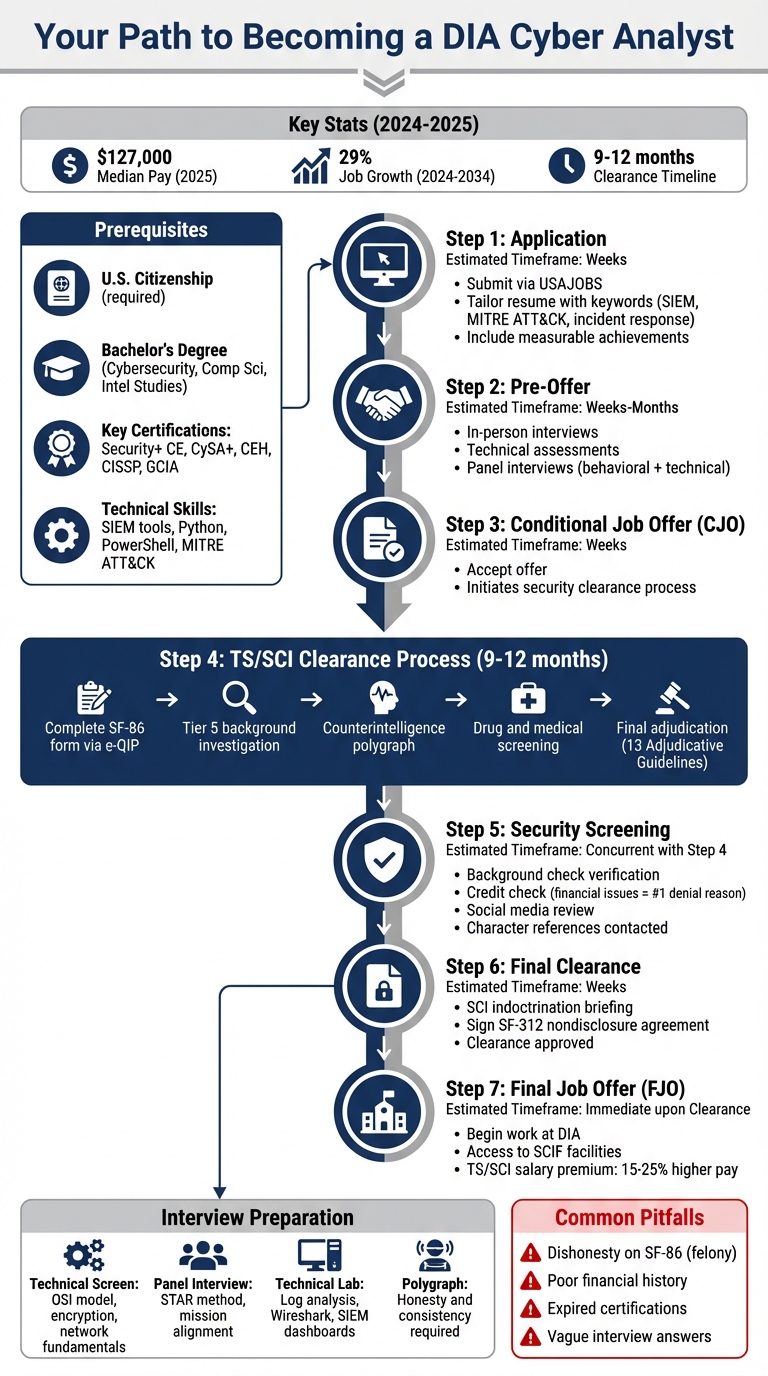
Looking to join the Defense Intelligence Agency (DIA) as a cyber analyst? Here’s what you need to know:

  • Role Overview: Cyber analysts protect classified networks, monitor for breaches, and mitigate vulnerabilities using tools like Splunk and CrowdStrike.
  • Pay and Demand: Median pay as of 2025 was $127,000, with demand for cybersecurity analysts projected to grow by 29% from 2024 to 2034.
  • Security Clearance: A TS/SCI clearance is mandatory, requiring a detailed background check, polygraph, and adjudication process (9–12 months on average).
  • Qualifications: A bachelor’s degree (e.g., Cybersecurity, Computer Science) and certifications like Security+ or CISSP are often required.
  • Application Process: Apply via USAJOBS with a tailored resume highlighting technical skills and measurable achievements.
  • Interview Prep: Expect technical assessments, scenario-based tasks, and behavioral questions. Familiarity with frameworks like MITRE ATT&CK is key.

This guide outlines everything from clearance requirements to interview tips to help you secure a DIA cyber analyst role. Ready to start your journey? Let’s dive into the details.

DIA Cyber Analyst Application Process Timeline and Requirements

DIA Cyber Analyst Application Process Timeline and Requirements

What Cyber Analysts Do at DIA

Main Job Duties

Cyber analysts at the Defense Intelligence Agency (DIA) play a critical role in protecting classified networks. They monitor network traffic using SIEM tools like Splunk, IBM QRadar, and Elastic SIEM to detect unusual activity. When anomalies arise, they investigate and prepare detailed incident response reports to document their findings and actions taken [1]. Their responsibilities also include installing and managing security tools such as firewalls and encryption software, addressing vulnerabilities before they can be exploited, and conducting regular risk assessments and penetration tests to uncover potential weaknesses in the system [1]. These efforts are vital to securing national intelligence data.

Another key aspect of their work involves transforming technical intelligence into reports that are useful for both technical teams and decision-makers [11]. To do this, they rely on threat intelligence platforms like Recorded Future, which processes billions of data points daily. Using frameworks like MITRE ATT&CK, CVE data, and the Diamond Model, analysts contextualize threats and recommend mitigation strategies [5][11]. Additionally, they develop and test disaster recovery plans to ensure the agency can bounce back after a cyberattack [10].

Work Environment at DIA

The work environment for cyber analysts at the DIA goes beyond technical tasks, emphasizing teamwork and ongoing learning. Analysts collaborate with intelligence professionals, subject matter experts, and external partners to ensure the accuracy and reliability of intelligence products [11]. They often work in blue teams, analyzing logs to distinguish between normal network activity and potential threats [10].

The DIA is also embracing advanced technology to strengthen its cybersecurity efforts. The agency is adopting an "AI-first" approach, using artificial intelligence tools to enhance threat analysis and ensure dependable cybersecurity outcomes [6]. Analysts have access to cutting-edge tools across different security domains and classification levels. These include endpoint detection and response platforms like CrowdStrike Falcon and SentinelOne, network traffic analysis tools like Wireshark and Zeek, and automation solutions such as Palo Alto Cortex XSOAR [7].

Next, we’ll explore the security clearance requirements needed for these roles.

sbb-itb-bf7aa6b

Security Clearance Requirements

What TS/SCI Clearance Means

TS/SCI, or Top Secret/Sensitive Compartmented Information, combines a Top Secret clearance with additional access authorization to highly compartmented intelligence, strictly restricted to those with a "need-to-know" basis [12][13][14]. This clearance is a must for cyber analyst roles at the Defense Intelligence Agency (DIA), as these roles involve working with intelligence that, if leaked, could cause "exceptionally grave damage" to national security [12][13]. Since the DIA is part of the 18-agency Intelligence Community, it handles classified sources, methods, and analysis processes that demand this level of security. Most of this work occurs in a Sensitive Compartmented Information Facility (SCIF), where electronic devices are strictly forbidden [12][14].

"SCI (Sensitive Compartmented Information) is not a clearance level – it is an access authorization applied on top of a Top Secret clearance." – ClearedJobs.Net [12]

U.S. citizenship is a non-negotiable requirement for TS/SCI roles at the DIA [14]. While the Department of Defense might occasionally allow non-citizens access to Secret-level information under rare circumstances, TS/SCI positions require full U.S. citizenship [14]. Additionally, individuals holding TS/SCI clearance often earn 15–25% more than their counterparts without clearance [12][13].

Understanding these requirements is crucial before diving into the clearance process.

How the Clearance Process Works

The clearance process kicks off once you accept a conditional job offer from the DIA. On average, the process takes between 9 to 12 months to complete [4][12][13].

The first step is completing the SF-86 form through the e-QIP system. This detailed questionnaire covers the past decade of your life, including addresses, employment, education, foreign contacts, and financial history [14][16]. Having all your documentation ready beforehand can help speed things along [14][16].

"Your character, conduct and discretion must be above reproach and you must have unquestioned loyalty to the United States." – Defense Intelligence Agency [2]

Next comes the Tier 5 background investigation. Investigators will verify your character and history by reaching out to friends, neighbors, former colleagues, and employers [13][14]. They may also review publicly available social media, following SEAD 5 guidelines [15]. Financial issues are the most common cause of clearance denials, so keeping your credit report clean and ensuring all taxes are filed and paid is critical [15][16].

A counterintelligence-scope polygraph examination is also required. This test focuses on topics like espionage, sabotage, terrorism, and unauthorized disclosures of classified information [14]. To perform well during the polygraph, stick to your normal routine. As Teresa Tennyson, a journalist and retired Army officer, advises, "The best way to pass any lie detector test is to not lie" [14].

After passing drug and medical screenings, your case goes to final adjudication. An adjudicator reviews all findings against the 13 Adjudicative Guidelines outlined in SEAD 4 to determine your eligibility [15]. Once approved, you’ll attend an indoctrination briefing for SCI access and sign a nondisclosure agreement (SF-312) [12]. It’s important to note that dishonesty or omission of information on the SF-86 is a felony and a common reason for clearance disqualification [14][15]. This thorough process ensures that only those who meet the highest standards of trustworthiness are granted access to the nation’s most sensitive intelligence.

Once your clearance is finalized, the next step is preparing your application and interview for a DIA cyber analyst position.

Required Qualifications, Skills, and Certifications

Education and Experience Requirements

For roles as a DIA cyber analyst, a bachelor’s degree in fields like Cybersecurity, Computer Science, Intelligence Studies, or Technology is typically required [8][9]. However, the agency also values non-traditional career paths and unique experiences [17]. Highlighting how your background – whether conventional or unconventional – equips you to tackle advanced threats can make your application stand out. According to the U.S. Bureau of Labor Statistics, the demand for cybersecurity professionals is anticipated to grow by 33% through 2030 [17].

Besides academic qualifications, technical expertise plays a critical role in distinguishing candidates.

Technical Skills You Need

While a degree is important, technical know-how is what truly sets candidates apart. DIA cyber analysts must excel in several key areas, including coding, intrusion detection and prevention systems, understanding attack methods, security operations, and incident response technologies [17]. Building hands-on experience with tools like Wireshark, Splunk, and scripting languages such as Python and PowerShell is highly recommended [19][21].

"Cyber threat intelligence analysts play an indispensable role in helping organizations understand their threat landscape and protect themselves from risk." – Flashpoint [17]

To succeed, you’ll need to master strategic, operational, and tactical skills to analyze threat actor tactics, techniques, and procedures (TTPs) [17]. Given the constantly shifting nature of cyber threats, continual skill development is a must.

Top Certifications for DIA Roles

DIA cyber analysts must comply with the Department of Defense Directive (DoDD) 8140, which outlines mandatory certifications for individuals with privileged access to DoD information systems [18][20]. These certifications are categorized by job functions, including Information Assurance Technical (IAT), Information Assurance Management (IAM), and Cybersecurity Service Provider (CSSP) [18][20].

Certification Issuing Body Focus Areas Experience Level DIA/DoD Relevance
Security+ CE CompTIA Foundational security, troubleshooting Entry/Mid Standard for IAT Level II roles
CySA+ CompTIA Threat hunting, incident response Mid Approved for CSSP Analyst & Incident Responder
CEH EC-Council Offensive tactics, vulnerability scanning Mid Core requirement for CSSP Analyst roles
CISSP ISC2 Security engineering, risk management Senior Required for IAM Level III (Management)
GCIA GIAC Intrusion analysis, network traffic Intermediate Specialized for CSSP Analyst roles

If you’re just starting, focus on earning the CompTIA Security+ certification, as it’s often required for IAT Level II roles [20]. For analyst-specific positions, certifications like CEH, CySA+, or GCIA – under the CSSP Analyst category – are highly relevant [18][20]. Keep in mind, certifications must remain active. Expired certifications can disqualify candidates from working on cleared federal projects. For instance, CompTIA certifications like Security+ need renewal every three years [20].

"Certifications aren’t just ‘nice to have’ – they’re often mandatory. Cyber threats are growing, and hiring someone without the right skills and credentials can delay projects or even put national security at risk." – CCS Global Tech [20]

How to Apply for DIA Cyber Analyst Jobs

Applying Through USAJOBS

USAJOBS

To land a DIA cyber analyst position, start with USAJOBS, the main platform for federal job applications. Create a detailed profile and craft a resume tailored to the job posting. Use specific keywords like "SIEM," "MITRE ATT&CK," and "incident response" to ensure your resume passes Applicant Tracking Systems (ATS) [23].

Focus on showcasing measurable accomplishments instead of listing generic responsibilities. For instance, replace "responsible for incident response" with specifics like "reduced incident response times by 20%" or "mitigated over 200 phishing attempts monthly" [23]. Highlight expertise in government frameworks such as NIST 800-53 and DISA STIGs. Use clean, professional formatting – fonts like Calibri or Arial – and save your resume as a PDF to ensure it looks polished [23].

Once your application is submitted, the hiring process follows several structured steps.

Security Screening and Hiring Steps

After receiving a Conditional Job Offer (CJO), you’ll undergo a multi-stage security screening process, including a background check, polygraph, drug testing, and medical exams. These steps are in place to ensure candidates meet strict qualifications for handling sensitive national security information.

Hiring Stage Key Components
Application Submit via USAJOBS, tailor your resume, and pass the initial screening.
Pre-Offer Participate in in-person interviews and technical assessments.
Conditional Offer Accept the CJO, which initiates the security clearance process.
Security Screening Undergo a background investigation, TS/SCI adjudication, and polygraph.
Medical & Suitability Complete drug testing, medical exams, and credit checks.
Final Decision Receive either a Final Job Offer (FJO) or a negative determination.

Be prepared for potential delays, especially during the adjudication phase. Some candidates report waiting five to six months after the initial investigation for SCI access [3]. As one applicant, Wombat_in_Combat, shared:

"The security office does not communicate where you are in the process with the hiring staff or managers, their current workload, or timelines" [3].

If you encounter delays, reach out to DIA Personnel Security (PERSEC) or the ODNI Scattered Castles hotline to check your clearance status [3].

Using Cleared Cyber Security Jobs to Find Opportunities

In addition to USAJOBS, consider using platforms like Cleared Cyber Security Jobs to simplify your search for DIA roles. This site offers filters tailored to clearance levels such as "TS/SCI + CI Poly," which are essential for DIA cyber analyst positions [22]. You can set up job alerts to receive notifications about relevant openings and upload your resume to make it easily accessible to recruiters [24]. Since the platform focuses solely on positions requiring security clearances, it eliminates irrelevant listings and connects you directly with employers hiring for these specialized roles.

Next, we’ll dive into how to prepare for the DIA interview process.

Preparing for DIA Interviews

What to Expect in Interviews

Once you’ve made it through the application process, it’s time to prepare for the DIA interviews. These interviews are designed to evaluate both your technical expertise and your ability to communicate effectively. You’ll face questions on network fundamentals – think firewall types, segmentation strategies, and practical applications of the OSI model. Be ready to clearly explain the steps of the incident response lifecycle, covering everything from preparation and detection to containment, eradication, recovery, and post-incident review.

You’ll also encounter questions on the MITRE ATT&CK framework and need to distinguish between tactical and strategic threat intelligence. Familiarity with tools like SIEM platforms (e.g., Splunk or Microsoft Sentinel), EDR solutions (like CrowdStrike or Carbon Black), and network analysis tools (such as Wireshark or Snort) is essential. Additionally, you should be able to explain encryption methods, hashing, and their appropriate use cases.

Real-world examples are key. Grace Abrams, a hiring manager, highlights the importance of layered defense strategies:

"A secure network architecture consists of several key components that work together… I like to think of it as a multi-layered approach that ensures a robust defense against potential threats."

Prepare specific examples of times you’ve identified vulnerabilities, reduced incident response times, or simplified technical issues for non-technical leadership. If you’re unsure of an answer during the interview, admit it honestly and explain how you’d research the solution instead of making guesses.

You may also face tabletop exercises where you’ll walk through hypothetical scenarios like a DDoS attack, phishing campaign, or zero-day exploit. These exercises test your ability to prioritize actions, contain threats without disrupting operations, and conduct root cause analysis. A solid understanding of the CIA triad – confidentiality, integrity, and availability – is crucial, as this framework underpins information security decisions across the intelligence community.

Interview Stages and Preparation Tips

DIA interviews are structured to assess different competencies at each stage. Here’s a breakdown of what to expect:

Interview Stage Focus Preparation Tip Common Pitfall
Technical Screen Core knowledge (OSI model, encryption, tools) Review basics like common port numbers and key definitions. Giving vague or overly "textbook" answers without context.
Panel Interview Behavioral fit and communication Use the STAR method (Situation, Task, Action, Result) to frame responses. Failing to show how your work aligns with the agency’s mission.
Technical Lab/Scenario Hands-on skills (log analysis, packet capture) Practice with tools like Wireshark and SIEM dashboards. Document your process clearly. Rushing through tasks without showing your thought process.
Polygraph Exam Integrity and security clearance Be honest and consistent throughout the exam. Trying to "outsmart" the exam or being evasive.

During the technical screen, you’ll need to explain foundational concepts like network protocols, the differences between IDS and IPS, and attack vectors such as Man-in-the-Middle, Cross-Site Scripting, and brute-force attacks. Focus on explaining these ideas clearly, not just reciting definitions.

The panel interview will dive into behavioral scenarios, emphasizing how your experience supports the DIA’s mission. Practice discussing situations where you communicated technical issues to leadership, resolved team conflicts, or handled sensitive information under pressure. The ability to translate technical jargon into plain language for non-technical stakeholders is highly valued. Tailor your responses to reflect the agency’s role in national security.

In the technical lab or scenario, you’ll be expected to analyze logs, investigate network traffic, or respond to a simulated incident. Take your time documenting your methodology as you work – interviewers want to see how you approach problems, not just whether you arrive at the correct answer.

Finally, the polygraph exam is all about integrity. Be truthful and consistent, as this stage is designed to confirm your suitability for handling classified information, not to trip you up.

Final Thoughts

Achieving a role as a cleared cyber analyst at the DIA requires careful planning and dedication. From meeting stringent clearance standards to honing technical skills, every step plays a crucial part in your preparation.

Obtaining a TS/SCI clearance is a critical component. This clearance mandates a spotless background, which includes maintaining clean credit records and demonstrating financial responsibility. The process itself is thorough, involving polygraph exams, drug tests, and in-depth background checks. Be ready for a lengthy and meticulous vetting process that can take several months to complete.

On the technical side, earning certifications like CompTIA Security+, GIAC GSEC, or CISSP can validate your expertise and help fill any gaps in experience. While 61% of cybersecurity analysts hold a bachelor’s degree [1], certifications ensure your skills remain sharp and up to date. Additionally, proficiency in programming languages such as Python, JavaScript, or C/C++ can set you apart in technical roles [1].

The application process and interviews are equally demanding. Expect multiple evaluation rounds designed to test your technical knowledge and communication skills. Clear, confident communication is just as important as technical expertise during these stages.

Platforms like Cleared Cyber Security Jobs simplify the job search for professionals with security clearances. Instead of combing through generic job boards, you can focus on positions specifically requiring clearances, such as those at the DIA. This platform offers free tools like job alerts, resume uploads, and career resources tailored to the cleared community. By using these resources, you can streamline your journey from obtaining certifications to landing your dream role at the DIA.

FAQs

Can I apply if I don’t already have TS/SCI?

To qualify for a cleared cyber analyst position at the DIA, you must already hold a TS/SCI clearance. This clearance is a fundamental requirement for these roles and is non-negotiable.

What issues most often delay or derail TS/SCI approval?

The delays in obtaining TS/SCI approval often arise from the intricate nature of the adjudication process. Common issues include cases with past drug use, financial complications, or incomplete and inconsistent submissions. Additionally, external events, such as public security incidents or high-profile cases, can lead to heightened scrutiny and create backlogs. When deeper investigations or additional clarifications are required, the process can extend to a year or even longer.

How can I build DIA-relevant experience without prior intel work?

To prepare for a role at the Defense Intelligence Agency (DIA), focus on building transferable cybersecurity skills and earning certifications that are highly regarded in the intelligence community. Key areas to prioritize include collection management, tradecraft, and fundamental cybersecurity principles like auditing and analysis.

By pursuing certifications and training relevant to the field, you not only demonstrate your commitment but also make up for any lack of direct intelligence experience. Developing expertise in defense-oriented skills is a critical step toward being ready for DIA opportunities.

Related Blog Posts

  • Threat Intelligence Analyst Career Path for Cleared Professionals
  • Cryptanalyst Career Path for Cleared Intelligence Professionals
  • Cleared SOC Analyst Jobs Complete Career Guide
  • Cleared Cyber Analyst Jobs at CIA Complete Guide

Cleared Cyber Analyst Jobs at FBI Complete Guide

CyberSecJobs Editorial · April 9, 2026 ·

Want to join the FBI as a Cyber Analyst? Here’s what you need to know:

  • Role Overview: FBI Cyber Analysts protect national security by analyzing threats like malware, cyberattacks, and espionage. These positions require strong technical and analytical skills.
  • Qualifications: A bachelor’s degree in computer science, IT, or related fields with a minimum 3.0 GPA is required. Certifications like CISSP, CEH, or CompTIA Security+ can strengthen your application.
  • Clearance: Applicants must obtain Top Secret clearance with SCI access, involving a thorough background check, polygraph, and continuous vetting.
  • Application Process: Jobs are listed on USAJobs. The hiring process includes multiple testing phases, interviews, and can take 6-18 months.
  • Career Growth: Opportunities include roles in specialized teams like the Cyber Action Team, or advancing to senior analyst or Special Agent positions.

Key Takeaway: The path to becoming an FBI Cyber Analyst is challenging but rewarding, with opportunities to make a real impact on national security.

Life on an FBI Cyber Squad: An Insider’s Look into Technical Career Paths at the FBI

FBI

sbb-itb-bf7aa6b

Security Clearance Requirements

FBI cyber analyst roles come with a critical requirement: Top Secret clearance with Sensitive Compartmented Information (SCI) access. Mishandling this level of classified information could severely jeopardize national security [4]. This clearance allows unescorted access to FBI facilities and highly sensitive intelligence. Interestingly, out of the approximately 4.3 million Americans holding security clearances, nearly 85% work under the Department of Defense [5][6].

Top Secret and SCI Clearance Levels

The FBI uses three main clearance levels, each tied to the potential damage caused by unauthorized disclosure:

  • Confidential: Protects information that could cause "damage" if disclosed. Requires reinvestigation every 15 years.
  • Secret: Covers information that could cause "serious damage" and is reinvestigated every 10 years.
  • Top Secret: Reserved for information that could cause "grave damage." This level requires a thorough background investigation spanning the last 10 years, with reinvestigation every five years [4].

SCI, while not a separate clearance, refers to intelligence-related methods and sources. It’s typically granted to those with Top Secret clearance after completing the rigorous Single Scope Background Investigation. As FBI.gov explains, "A Top Secret clearance may be granted to those persons who have a ‘need-to-know’ national security information, classified up to the Top Secret level, and who need unescorted access to FBI facilities" [4].

With the clearance levels outlined, the next step is understanding how to navigate the complex process of obtaining a Top Secret clearance.

How the Clearance Process Works

The clearance process kicks off only after you receive and accept a conditional job offer from the FBI – this isn’t something you can start on your own [7][9]. After accepting the offer, you’ll complete the SF-86 form through the "eApp" portal, detailing your personal history over the past decade. From there, the process includes digital fingerprinting, criminal background checks, and a Tier 5 (Single Scope) investigation. This investigation involves in-person interviews with people like your neighbors, coworkers, and personal references. Additionally, a counterintelligence-scope polygraph examines areas such as criminal activity, drug use, and espionage [7][8].

The FBI aims to process Top Secret clearances within 6 to 9 months. However, positions requiring polygraphs often face delays, extending the timeline to anywhere from 180 days to over a year due to appointment backlogs [4][7]. Your case file is reviewed against 13 Adjudicative Guidelines using a "whole-person concept", which evaluates your overall eligibility. Once granted, your clearance is maintained through Continuous Vetting, a system that monitors criminal records, financial activity, and travel in real time [7].

What Can Disqualify You from Getting Clearance

Even with a thorough clearance process, certain factors can result in denial.

One of the most common issues is financial irresponsibility. This includes significant credit problems, defaulted loans, unpaid taxes, or overdue child support [7][9]. Despite state-level legalization, marijuana use remains a federal disqualifier [7][9].

Errors or omissions on the SF-86 form are another major pitfall. As Kevin James puts it, "Falsification on the SF-86, even on a minor point, is often the most easily preventable yet fatal mistake. Candor is paramount" [7]. Even small inconsistencies can lead to denial under the "Personal Conduct" guideline. The U.S. Intelligence Community stresses, "Your character, conduct and discretion must be above reproach and you must have unquestioned loyalty to the United States" [8].

Additional disqualifiers include:

  • Felony convictions
  • Ties to organizations seeking to overthrow the U.S. government
  • Failure to register with the Selective Service System (for eligible males)
  • Close relationships with foreign nationals or foreign business dealings
  • Refusing a drug test or failing the polygraph exam [7][8][9]

For cybersecurity positions, adjudicators are increasingly scrutinizing digital footprints. This includes GitHub contributions, forum activity, and social media posts, looking for signs of poor judgment [7].

Meeting these stringent requirements is a pivotal step in becoming an FBI cyber analyst.

Required Qualifications and Skills

FBI cyber analyst roles demand specific education and technical expertise to meet the agency’s high standards.

Education and Experience Requirements

To qualify for these roles, candidates must hold a bachelor’s degree or higher from an accredited U.S. institution in fields like computer science, engineering, information systems, mathematics, operations research, statistics, or related areas [1][2]. Applicants must also maintain a 3.0 cumulative GPA throughout the application process [11]. As the FBI Jacksonville Field Office puts it:

"In today’s complex world, a degree in criminal justice doesn’t meet any of our hiring needs" [11].

Alternatively, candidates may qualify with 24 to 30 credit hours in the approved fields [1][2]. For Digital Forensic Examiner positions, at least 24 credit hours in computer science, engineering, digital forensics, or IT are required. Another pathway is having four years of full-time professional experience in digital forensics [14].

Role Minimum Education Preferred Degree Fields
Computer Scientist Bachelor’s Degree Computer Science, Engineering, Information Science [1]
IT Specialist Bachelor’s Degree Computer Science, Information Systems [2]
Digital Forensic Examiner Bachelor’s (24+ tech credits) Digital Forensics, IT, Engineering, Math [2]
Data Analyst Bachelor’s Degree Statistics, Data Science, Mathematics [1][12]

In addition to academic qualifications, certifications play a key role in demonstrating expertise.

Certifications the FBI Values

Industry-recognized certifications can significantly strengthen a candidate’s profile, especially for specialized roles like Digital Forensic Examiner [14]. Key certifications for cybersecurity positions include:

  • CompTIA Security+
  • Certified Ethical Hacker (CEH)
  • Certified Information Systems Security Professional (CISSP) [2][15]

Networking specialists benefit from certifications like Cisco Certified Network Associate (CCNA) or advanced credentials such as CCNP Security [13]. For those in forensic accounting, certifications like Certified Public Accountant (CPA), Certified Fraud Examiner (CFE), and Certified in Financial Forensics (CFF) are highly valued [14]. Newly hired forensic accountants also undergo a five-week Forensic Accountant Core Training Session at the FBI Academy in Quantico, Virginia [14].

Camila Rojas, a Forensic Examiner and Cryptanalyst at the FBI, highlighted the importance of FBI-provided training:

"My proudest achievement with the Bureau would be my first court testimony… It was a combination of hard work and also the great training that the FBI offered" [14].

These certifications and training opportunities ensure professionals are well-prepared for their roles.

Technical and Professional Skills

Beyond education and certifications, FBI cyber analysts must excel in both technical and professional skills. On the technical side, expertise in digital forensics, network security, system integration, and encryption is critical [1][2]. Analysts are tasked with combating malware, investigating computer intrusions, and tracking international cyber threats [1]. They also handle evidence from diverse sources, including mobile devices, drones, and security cameras [2].

Strong communication skills are equally important. Analysts write detailed technical reports and deliver presentations to law enforcement partners and private organizations [2][3]. As FBI Jobs explains:

"Our technology careers are the backbone of many key functions relating to security, system capabilities, and the investigative work at the FBI" [2].

Key professional skills include critical thinking, attention to detail, and the ability to simplify complex technical ideas for non-technical audiences [2].

Skill Category Essential Technical Skills Essential Professional Skills
Cyber Defense Malware analysis, encryption, network security Critical thinking, problem-solving
Forensics Digital evidence preservation, mobile/drone forensics Attention to detail, reporting
Data Analysis Data mining, vulnerability assessment, risk management Logical reasoning, trend identification
Operations System integration, architectural design, troubleshooting Collaboration, interpersonal ability

With cybersecurity jobs projected to grow by 33% through 2033, meeting these qualifications can give candidates a competitive edge in pursuing FBI roles [2].

How to Apply for FBI Cyber Analyst Jobs

FBI Cyber Analyst Hiring Process Timeline and Requirements

FBI Cyber Analyst Hiring Process Timeline and Requirements

Getting through the FBI’s application process takes time and careful preparation, as the hiring process can stretch beyond a year [16]. Knowing the steps involved can help you stay on track and meet key deadlines.

Applying Through USAJobs

USAJobs

All FBI cyber analyst job openings are listed exclusively on USAJobs, the federal government’s official job site. Crafting a federal resume is different from creating a standard one – you’ll need to include detailed information about your education, work experience, and security clearance eligibility. Along with your application, you must provide proof of U.S. citizenship, Selective Service registration (for male applicants), and confirm your compliance with student loan obligations, federal and state taxes, and any court-ordered child support [10].

Once your application is submitted, the FBI typically takes about 10 days to determine if you meet the minimum qualifications [16]. If you pass this step, you’ll receive an invitation to Phase I testing, which you must schedule and complete within 21 days [16]. Before applying, it’s critical to ensure you meet the FBI’s suitability standards, which include adherence to the FBI drug policy and a clean record with no felony convictions – failing to meet these standards results in immediate disqualification [10]. From there, candidates move through a structured series of tests and interviews.

The FBI Hiring Process Timeline

After the application and initial testing, the hiring process continues in clearly defined stages. The FBI has separate hiring tracks for Intelligence Analysts and Special Agents with a cyber focus, and each track has its own set of tests and timelines.

For Intelligence Analysts, the process includes:

  • A Phase I online test that evaluates logic-based reasoning and personality traits.
  • A Phase II timed writing test, which simulates reviewing intelligence reports.
  • A Phase III structured interview to gauge communication abilities [3, 19].

Special Agent candidates follow a different path:

  • A proctored Phase I exam.
  • A Physical Fitness Test (PFT).
  • A Phase II written assessment and structured interview, conducted by a panel of three agents [16].

"The average background investigation takes approximately six months, but can take 18 months or more depending on where you have lived, worked, and traveled." – FBIJOBS [16]

If you successfully complete these steps, you’ll receive either a Conditional Job Offer (CJO) as an Intelligence Analyst or a Conditional Appointment Offer (CAO) as a Special Agent. These offers are typically issued within seven days of passing Phase II [3, 19]. However, the offer is contingent on passing a detailed background investigation, which includes a polygraph test, drug screening, and a personnel security interview. While this process usually takes about six months, it can extend to 18 months or longer in some cases [3, 19].

Here’s a quick breakdown of the key hiring stages for cyber analyst roles:

Hiring Stage Intelligence Analyst Path Special Agent Cyber Path Typical Timeline
Application Screening Resume and transcript review Resume and transcript review ~10 days [16]
Phase I Testing Online logic and reasoning Proctored exam + PFT 21 days to schedule [16]
Phase II/III Writing test + structured interview Written test + 3-agent interview Results in 1–3 weeks [16]
Conditional Offer CJO issued CAO issued Within 7 days [3, 19]
Background Check Polygraph, drug test, security interview Polygraph, drug test, medical review 6 to 18+ months [3, 19]
Training 12-week BFTC at Quantico 18-week BFTC at Quantico Post-clearance [3, 19]

Once cleared, Intelligence Analysts attend a 12-week Basic Field Training Course (BFTC) at the FBI Academy in Quantico, while Special Agents undergo an 18-week training program [3, 19]. Intelligence Analyst candidates must also agree to a mobility agreement, which allows the FBI to assign them to headquarters or any field office as needed [3]. Additionally, all new hires participate in a four-day Onboarding New Employee (ONE) seminar at Quantico during their first week to get acquainted with the FBI’s mission and culture [3].

How to Prepare for FBI Interviews

After navigating the rigorous qualification and clearance steps, preparing for the FBI interview is your final hurdle toward becoming a cyber analyst. The interview process is designed to test both your technical expertise and your behavioral readiness. With a reported pass rate of 50% to 60% for the Phase 2 assessment and only one retest opportunity allowed (a year after the original interview), thorough preparation is non-negotiable [17].

Preparing for Technical Tests

The 90-minute writing assessment challenges you to analyze a scenario and craft a concise, objective report that integrates multiple data points [17]. Your task is to identify relevant details while discarding irrelevant ones, all while maintaining a formal tone devoid of personal opinions or speculation [17]. Since there’s no spellcheck, practice writing reports manually to ensure your grammar, spelling, and punctuation are flawless [17].

"Your writing will be evaluated based on clarity, grammar, structure, coherence, and your ability to distinguish between relevant and irrelevant details – skills that are crucial in real-world FBI reports." – JobTestPrep [17]

For cyber-focused roles, hone your ability to tackle scenario-based problems like analyzing malware alerts, studying network traffic patterns, and setting up firewall rules [18]. Simulating a malware attack response can help you refine your triaging and threat mitigation skills [18]. If you’re aiming for a security engineering role, ensure you’re comfortable with Python and adept at conducting root cause analyses for incident investigations [18].

Once you’ve mastered technical reporting and problem-solving, the next step is preparing for the live panel interview to showcase your behavioral qualifications.

Showing You’re Ready for Clearance Work

Beyond technical know-how, you’ll need to demonstrate that you’re prepared to work in a high-security clearance environment. The 60-minute structured panel interview, a pivotal component of the FBI Phase 2 assessment, is conducted by three Special Agents who evaluate you on eight key competencies: Collaboration, Communication, Flexibility and Adaptability, Initiative, Interpersonal Ability, Leadership, Organization and Planning, and Problem Solving and Judgment [17]. Use the STAR method (Situation, Task, Action, Result) to prepare examples that highlight how you’ve handled ethical dilemmas, resolved conflicts, and performed under pressure [17].

Additionally, get ready for the Personnel Security Interview by organizing a detailed timeline of your employment history, foreign travel, and financial background [16]. Tailor your responses to emphasize your dedication to public service and alignment with the FBI’s mission, steering away from any focus on corporate interests [3].

"The FBI Phase 2 interview is known to be one of the most challenging parts of the hiring process. It’s a high-pressure, in-person panel interview conducted by three Special Agents trained to assess your behavioral competencies under stress." – JobTestPrep [17]

Career Advancement Opportunities

Becoming an FBI cyber analyst opens the door to a variety of career growth paths. Most cyber-related roles follow the General Schedule (GS) pay scale. Entry-level positions typically start at GS-7 or GS-9, mid-level roles are at GS-11 or GS-12, and senior positions can reach GS-13 [1]. For instance, Data Analysts progress from GS-7/9 to GS-13, with median salaries ranging from $107,000 to $113,000 [1][2]. These opportunities reward not only technical skills but also leadership and strategic abilities, paving the way for specialized team roles.

Moving Up to Senior Analyst Positions

Advancing in this field often requires focusing on specific areas of expertise. Intelligence Analysts, for example, can specialize in one of five key functions: Threat Analysis, Collection Management, Domain Analysis, Targeting Analysis, or Reports Management [3]. Each area demands unique skills, such as evaluating real-time threats or distributing raw intelligence to the right teams. To support career growth, the FBI’s Data Analytics Support Hub (DASH) provides mentorship and an annual training stipend for data analysts and scientists [1].

Some professionals may choose to transition into tactical roles, such as Staff Operations Specialist or Tactical Specialist, where they provide direct support during field investigations [3]. Alternatively, career paths can lead to becoming a Special Agent, where responsibilities include investigating cyber threats firsthand and testifying in court. However, applicants for Special Agent roles must meet the age requirement of 23 to 36 years old [2][3].

Working on FBI Cyber Action Teams

For those drawn to fast-paced environments, joining the Cyber Action Team (CAT) is a prestigious option. This elite group is deployed nationwide within hours of a significant cyber incident, offering both investigative and technical expertise on-site [19]. The FBI also maintains dedicated cyber squads in all 56 field offices, ensuring comprehensive coverage across the country [19].

Beyond CAT, opportunities exist with CyWatch, the FBI’s 24/7 operations center that monitors and coordinates responses to cyber incidents in real time [19]. Analysts interested in international collaboration can serve as Cyber Assistant Law Enforcement Attachés at U.S. embassies, working with global partners to address transnational threats [19]. Another option is joining the National Cyber Investigative Joint Task Force (NCIJTF), a collaborative effort involving over 30 co-located agencies from law enforcement and the intelligence community [19]. Participating in these specialized teams not only advances your career but also strengthens your role in the FBI’s cybersecurity mission.

"It allows you to touch on… multiple cases on your particular squad, so you’re not limited or relegated to a single case or two cases. At the same time, there’s really never a dull moment." – Jagdeep Singh Narula, Intelligence Analyst, FBI [3]

Conclusion

Becoming an FBI cyber analyst is no small feat – it requires dedication, preparation, and a commitment to excellence. To qualify, you’ll need to meet stringent eligibility criteria: U.S. citizenship, a spotless record, and adherence to the FBI’s drug policies [2]. Academically, a bachelor’s degree in a STEM field like computer science or information technology lays the groundwork, followed by a rigorous multi-phase selection process designed to test your analytical thinking, writing ability, and other key skills [3].

The path to joining the FBI is lengthy, often taking up to a year. With an acceptance rate below 20%, the process includes securing Top Secret clearance through an exhaustive background investigation after receiving a Conditional Offer [2][3]. Once cleared, you’ll undergo specialized training at the FBI Academy to prepare for the challenges ahead.

Inside the Bureau, the career possibilities are both diverse and impactful. From roles in Threat Analysis and Collection Management to joining elite groups like the Cyber Action Team or even transitioning into Special Agent positions, the opportunities are vast [3][19]. But beyond the variety, the work carries a profound sense of purpose. As FBI Intelligence Analyst Jagdeep Singh Narula explains:

"It’s about helping Americans stay safe. So that, you know, it gives me a lot of fulfillment knowing that my work actually matters" [3].

This sentiment underscores the meaningful nature of the role, where every effort contributes to protecting the nation.

FAQs

Can I apply if I don’t already have a Top Secret/SCI clearance?

Yes, you can apply for cyber analyst roles at the FBI even if you don’t already have a Top Secret/SCI clearance. If you’re offered the job, the FBI will start the security clearance process as part of your hiring procedure.

How strict is the FBI on past marijuana use, debt, or foreign contacts?

The FBI enforces strict guidelines when it comes to past marijuana use, financial responsibilities, and foreign associations. Applicants must not have used marijuana in any form within one year prior to applying. Financial concerns, such as defaulting on student loans or failing to pay child support, can lead to disqualification. Additionally, foreign connections, whether through family ties or financial interests, undergo thorough scrutiny. These factors can affect security clearance if they are not fully disclosed or adequately addressed during the background investigation.

What can I do now to improve my chances before applying?

If you’re aiming for a role as an FBI cyber analyst, it’s all about honing the right skills, earning relevant certifications, and deepening your knowledge. Start by familiarizing yourself with the FBI’s mission and its focus on combating cyber threats.

To stand out, consider earning cybersecurity certifications like CompTIA Security+ or Certified Information Systems Security Professional (CISSP). These can demonstrate your technical expertise. Sharpen your skills in threat analysis and ensure you stay current on the latest security practices and trends in the industry.

Finally, prepare thoroughly for FBI assessments and tailor your application to meet their specific requirements. The better aligned you are with their expectations, the stronger your chances will be.

Related Blog Posts

  • Threat Intelligence Analyst Career Path for Cleared Professionals
  • Cryptanalyst Career Path for Cleared Intelligence Professionals
  • Cleared Cyber Analyst Jobs at NSA Complete Guide
  • Cleared Cyber Analyst Jobs at CIA Complete Guide

  • « Go to Previous Page
  • Go to page 1
  • Interim pages omitted …
  • Go to page 36
  • Go to page 37
  • Go to page 38
  • Go to page 39
  • Go to page 40
  • Interim pages omitted …
  • Go to page 78
  • Go to Next Page »
  • Facebook
  • Instagram
  • LinkedIn
  • Twitter
  • YouTube

Cleared Cyber Security Jobs | CyberSecJobs.com

  • Contact
  • About
  • Privacy Policy