

Looking to build a career as a Network Security Engineer in the cleared sector? Here’s what you need to know:
- Role Overview: Network Security Engineers design and secure IT systems for government and defense projects. They manage classified and unclassified networks, ensuring compliance with strict security protocols.
- Clearance Requirements: Roles often require active security clearances like Secret, Top Secret (TS), or TS/SCI, which can significantly enhance hiring prospects and salaries.
- Key Skills & Certifications: Proficiency in network protocols (TCP/IP, BGP), firewalls (Cisco, Palo Alto), and tools like SIEM (Splunk). Certifications such as CISSP, Security+, and CCNA are essential for career growth.
- Education: A bachelor’s degree in Cybersecurity or related fields is common, but certifications and hands-on experience are equally critical.
- Career Path: Entry-level roles start at $65,700, with senior positions reaching over $170,000. Specialized roles in cloud security or Zero Trust architecture can command even higher salaries.
- Job Market: High demand for cleared professionals driven by national security needs. Key employers include DISA, NSA, and major contractors like Raytheon and Lockheed Martin.
Tip: Maintain your clearance, pursue certifications, and build a strong professional network to stay competitive in this growing field.
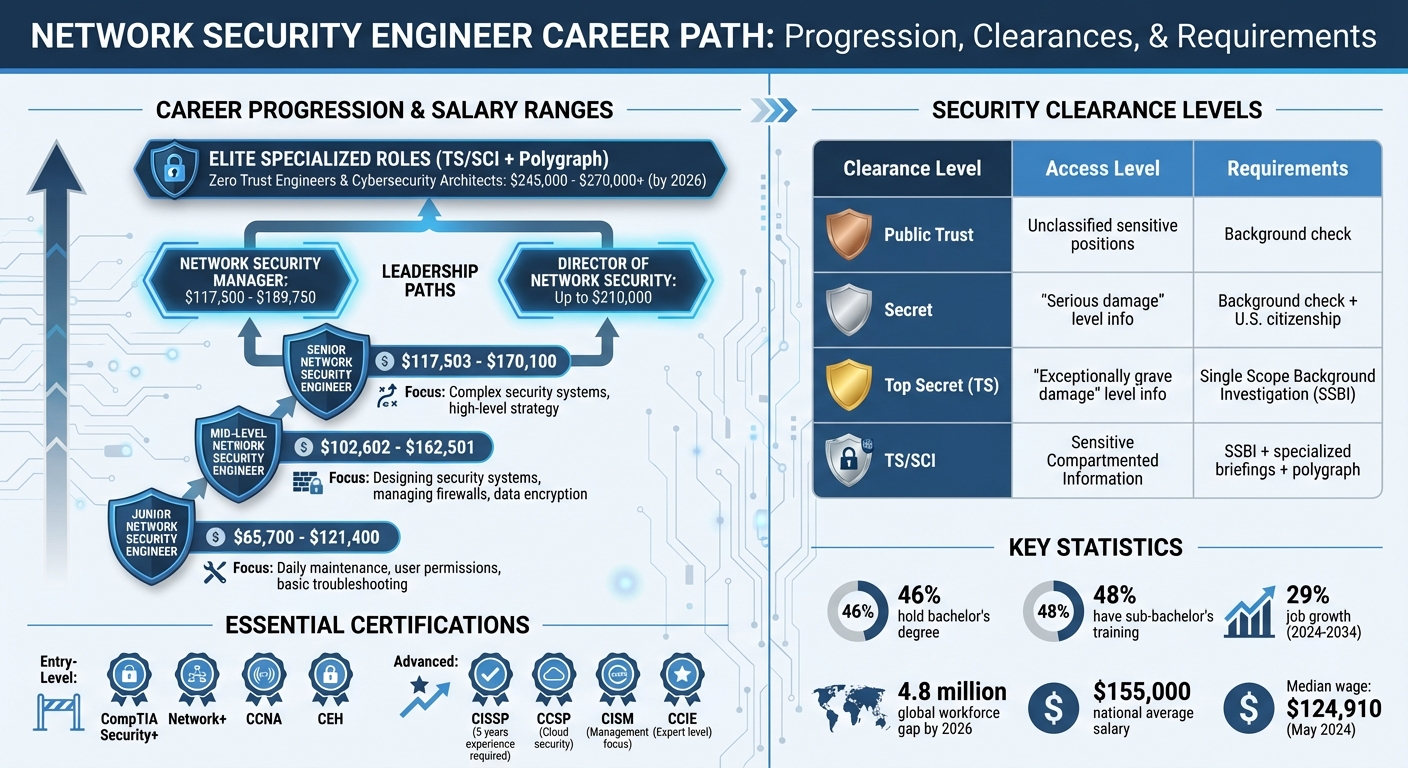
Network Security Engineer Career Path: Salary Progression and Clearance Levels
Job Responsibilities and Clearance Requirements
Core Responsibilities
Network Security Engineers in cleared roles focus on high-level design and implementation rather than routine maintenance tasks. Their responsibilities include developing secure architectures for both classified and unclassified networks, resolving complex security challenges, and deploying advanced security technologies that demand deep technical knowledge.
Handling classified networks involves strict compliance with DISA controls. This includes using specialized encryption for national security data, enforcing stringent physical access controls, and ensuring complete separation between Secret/Top Secret networks and unclassified systems. Regular network audits, monitoring for unauthorized activity, and conducting incident response are key aspects of the job. As agencies upgrade legacy systems and integrate automation tools, you’ll likely work with AI-based security platforms and software-defined networking to identify threats more efficiently [1].
These technical duties are closely tied to clearance requirements, which directly influence access and responsibilities.
Security Clearance Levels
Your clearance level plays a critical role in determining the projects and facilities you can access, complementing your technical expertise.
- Secret Clearance: This level requires a background check and U.S. citizenship. It grants access to information that, if disclosed, could cause "serious damage" to national security. Professionals with this clearance often support defense contracting roles, including Navy missions, medical operations, or enterprise data management [1].
- Top Secret (TS) Clearance: This clearance allows access to information that could cause "exceptionally grave damage" if disclosed. It requires a Single Scope Background Investigation (SSBI). TS clearance is often necessary for high-level government consulting or critical infrastructure projects, such as Tier 2 and Tier 3 support for the Department of Energy.
- TS/SCI Clearance: This level includes access to Sensitive Compartmented Information (SCI) and requires additional compartment briefings and often a polygraph examination. Professionals with TS/SCI clearance may handle Cross Domain Solutions or work in secure Network Operations Centers for the Intelligence Community [2].
- Public Trust: Although not a formal clearance, this suitability check is required for sensitive but unclassified positions. It involves a thorough background check.
| Clearance Level | Description | Typical Requirement |
|---|---|---|
| Secret | Access to info that could cause "serious damage" | Background check and U.S. citizenship |
| Top Secret (TS) | Access to info that could cause "exceptionally grave damage" | Single Scope Background Investigation (SSBI) |
| TS/SCI | Access to Sensitive Compartmented Information | SSBI plus specialized briefings; often requires polygraph |
| Public Trust | High-level suitability check for unclassified roles | Background check |
Maintaining an active clearance requires consistent personal responsibility, as periodic background checks are necessary to retain eligibility. Having an active clearance can also speed up the hiring process and make you a more appealing candidate for agencies like DISA and DoD, as well as leading contractors such as Lockheed Martin, Raytheon, and Northrop Grumman [1].
sbb-itb-bf7aa6b
Education, Certifications, and Required Skills
Educational Background
To start a career in network security, a bachelor’s degree in fields like Computer Science, Cybersecurity, or Network Engineering is typically required. Programs aligned with the National Initiative for Cybersecurity Education (NICE) Workforce Framework are especially beneficial, as they are often developed alongside national intelligence agencies. These programs help ensure students are prepared for real-world security challenges.
Interestingly, 46% of security engineers hold a bachelor’s degree, while 48% have sub-bachelor’s training, such as associate degrees or specialized certifications [4]. For those aiming for advanced or management roles, a Master’s degree in Cybersecurity, Information Assurance, or Security Engineering can be a valuable asset. Veterans, in particular, can take advantage of GI Bill benefits to earn certifications like CompTIA Security+ while pursuing their degrees. This combination can open up higher-level opportunities in federal service that certifications alone might not achieve.
While formal education lays the groundwork, certifications are crucial for honing the specific skills needed in this field.
Key Certifications
Industry certifications are essential for demonstrating your expertise and readiness to tackle complex security challenges.
The Certified Information Systems Security Professional (CISSP) is widely regarded as the gold standard for enterprise security roles. It focuses on leadership and strategic planning, requiring at least five years of work experience in two or more of its eight domains, which range from risk management to software security. For those specializing in cloud security, the Certified Cloud Security Professional (CCSP) is a must. This certification requires five years of IT experience, including one year in cloud security, and addresses areas like cloud data and platform security.
For beginners, certifications such as CompTIA Security+, Network+, Certified Ethical Hacker (CEH), and Cisco’s CCNA are excellent starting points to land junior roles. For experienced professionals eyeing leadership positions, the Certified Information Security Manager (CISM) is ideal, focusing on security management and governance. GIAC certifications are also highly respected for technical expertise, while the Cisco Certified Internetwork Expert (CCIE) showcases advanced networking and software integration skills, making it valuable for top-tier roles.
Holding an active security clearance alongside these certifications can further boost your qualifications for government-focused positions.
| Certification | Focus Area | Experience Required | Primary Career Benefit |
|---|---|---|---|
| CompTIA Security+ | Foundational Security | Entry-level | Quick entry into junior cleared roles |
| CISSP | Strategic Security Leadership | 5 years in 2+ domains | Access to enterprise-level jobs and higher salaries |
| CCSP | Cloud Security | 5 years IT, 1 year cloud | Demonstrates expertise in securing cloud environments |
| CEH | Ethical Hacking | Entry to mid-level | Skills in penetration testing and vulnerability assessment |
| CISM | Security Management | 5 years, 3 in management | Prepares for leadership roles in security governance |
Technical Skills
Technical expertise is the backbone of a successful career in network security.
A strong understanding of TCP/IP, routing protocols like BGP and OSPF, and network design is essential. Familiarity with hardware from leading vendors such as Cisco, Juniper, and Palo Alto Networks is equally important. Security engineers must also know how to configure firewalls (e.g., Cisco ASA, Checkpoint, Fortinet) and manage intrusion detection/prevention systems and web application firewalls. For those working in cloud environments, proficiency in managing identities, encryption, and logging – especially in platforms like AWS GovCloud – is critical.
Programming skills in Python, Bash, and PowerShell are invaluable for automating tasks and responding to incidents efficiently. Similarly, experience with SIEM tools like Splunk or QRadar is a must for effective threat detection and response. Familiarity with security frameworks such as the NIST Cybersecurity Framework, ISO 27001, and Zero Trust architecture is also key to ensuring compliance with industry standards.
Building a home lab using platforms like Hack The Box or TryHackMe is a great way to gain hands-on experience and practice real-world scenarios.
"Textbook theory will only take you so far in a real-world security incident." – Steve Petryschuk, Director and Technology Evangelist, Auvik
Looking ahead, the demand for cybersecurity professionals remains high. The global workforce gap is projected to reach 4.8 million by 2026, and employment for information security analysts is expected to grow by 29% from 2024 to 2034 [5]. The median annual wage for these roles in the U.S. was approximately $124,910 in May 2024, with California leading at $140,730 in May 2023 [5]. Contributing to open-source security projects is another way to showcase your skills to employers while building a strong professional portfolio.
Career Progression and Advancement Strategies
Entry-Level to Advanced Roles
Cleared network security careers offer a clear path from entry-level roles to highly specialized and senior positions, each with defined salary ranges. At the starting point, Junior Network Security Engineers focus on tasks like daily system maintenance, managing user permissions, and basic troubleshooting. These roles, which pay between $65,700 and $121,400 annually [3], are essential for building expertise in network protocols while working under the guidance of more experienced colleagues.
As you gain experience, you can step into mid-level Network Security Engineer roles. These positions involve designing and implementing security systems, managing firewalls, and applying data encryption methods. Salaries for these roles range from $102,602 to $162,501 [3]. At this stage, your responsibilities grow to include making decisions that directly impact system performance and security.
For those advancing further, Senior Network Security Engineers take on more complex responsibilities, such as overseeing sophisticated security systems and influencing high-level strategies. Salaries at this level range from $117,503 to $170,100 [3]. From here, career paths diverge:
- Network Security Managers focus on team leadership and policy development, earning between $117,500 and $189,750.
- Directors of Network Security can earn up to $210,000, leading organizational security strategies [3].
- Alternatively, you can specialize in areas like Cloud Security Engineering, Penetration Testing, or Compliance Auditing, gaining deep expertise in specific fields [3].
Certifications play a crucial role in career progression. Starting with basic credentials like CCNA and advancing to certifications like CISSP or CISM enhances your qualifications for leadership roles [1][7]. Experience with both classified and unclassified networks, as well as familiarity with platforms like Cisco and Juniper, further strengthens your profile for senior positions [1]. For cleared professionals, this structured path accelerates growth and opens doors to advanced opportunities. Moreover, maintaining an active clearance significantly boosts your career potential.
Using Security Clearance for Career Growth
An active security clearance is a powerful asset that can fast-track your career. It eliminates lengthy background checks during hiring, making you a preferred candidate for roles, especially in agencies like the Defense Information Systems Agency (DISA), NSA, FBI, and CIA, where clearances are mandatory [1].
Clearance holders gain access to high-demand sectors such as tactical communications, critical infrastructure defense, and aerospace [1]. For example, network engineers at DISA manage global command-and-control systems that require flawless uptime and compliance with NSA encryption standards [1]. Additionally, major defense contractors like Lockheed Martin, Raytheon Technologies, and Northrop Grumman actively seek cleared professionals for classified projects, offering job security even during economic downturns [1].
To fully leverage your clearance, it’s critical to maintain responsible conduct, as losing your clearance can immediately disqualify you from top-tier defense roles [1]. Focus your job search on platforms like USAJOBS.gov and DISA’s career portal, where many of these opportunities are listed [1]. Federal IT roles often provide compensation comparable to or exceeding private-sector salaries, along with the unique chance to contribute to mission-critical national security work [1].
Industry Trends and Job Market Data
High-Demand Sectors
The demand for cleared Network Security Engineers is being driven by a mix of nation-state threats, strict frameworks like CMMC (Cybersecurity Maturity Model Certification) and Zero Trust architecture, and a growing shortage of high-level cleared professionals [8]. This combination is reshaping both the job market and the salaries employers are prepared to offer.
Private sectors like finance and healthcare are also fueling demand due to their need for rigorous regulatory compliance. However, the most sought-after roles are those that blend technical expertise with governance at the policy level. Positions such as Zero-Trust Engineers and Cloud Security Leads are seeing rapid salary growth as organizations overhaul their security frameworks [8]. Leading employers in the field include CACI, Leidos, Northrop Grumman, Peraton, and Hewlett Packard Enterprise, with key hiring locations in Chantilly, VA, Bethesda, MD, San Antonio, TX, and San Diego, CA [9].
The focus has shifted from hiring general IT professionals to seeking individuals with "verified trust" – those capable of working in highly sensitive, mission-critical environments [8]. The push for digital transformation and cloud migration is accelerating this trend as businesses and government agencies move away from traditional on-premise data centers [3]. Industry growth for these roles is rated at 9 out of 10, reflecting a sharp increase in demand [3]. These shifts are directly influencing salary levels and job growth, as detailed below.
Salary and Job Growth Statistics
In the cybersecurity field, holding a security clearance has become the most impactful factor in determining salary. A representative from FullScope Staffing emphasized:
"The clearance itself has become a strategic asset, and in 2026 it will be the single strongest determinant of compensation for top technical cybersecurity roles" [8].
This "clearance premium" significantly boosts pay for professionals with verified trust and mission-critical readiness.
For those with TS/SCI and Full-Scope Polygraph clearances, salaries for elite roles like cybersecurity architects and Zero Trust engineers are expected to range between $245,000 and $270,000+ by the end of 2026 [8]. Even professionals with just two years of experience in cleared positions can anticipate earning between $120,000 and $200,000, while the national average salary for Security Engineers currently stands at $155,000 [6].
Defense contractors are being urged to increase their labor budgets to counter the shrinking pool of TS/SCI talent [8]. For cleared professionals aiming to maximize their earnings, focusing on areas like Zero Trust architecture and Cloud Security modernization provides the quickest route to these high-paying roles [8].
Networking and Job Search Tips
Building Professional Networks
Securing a cleared Network Security Engineer position often hinges on a mix of skills and connections. In fact, many cleared professionals find their next role through relationships with peers, mentors, and recruiters [10]. Think of networking as a mutual exchange: share job leads, make introductions, and offer assistance when possible.
When building connections, don’t limit yourself to recruiters – reach out to peers at your target companies. Fellow Network Security Engineers are often more accessible and can provide internal referrals, which are highly valued by hiring managers [11]. As Bryan Acton, Military & Veterans Program Leader at Peraton, explains:
"Engage your peers and get an employee referral. That’s something I can’t give you as a recruiter" [11].
One effective strategy is to schedule short informational interviews (15–20 minutes) to learn about a company’s culture and hiring practices. When reaching out, personalize your message and explain why you’re interested in speaking with them. These personal connections can streamline your job search on platforms like Cleared Cyber Security Jobs.
Using Cleared Cyber Security Jobs

Cleared Cyber Security Jobs is a resource designed specifically for U.S. citizens with active security clearances. The platform provides free tools for job searches, resume uploads, and job alerts, directly connecting you with employers who hire cleared professionals – skipping the middleman of staffing firms. To maximize your chances, upload your resume and activate alerts for Network Security Engineer roles.
After applying, take the extra step of following up with recruiters, either through LinkedIn or the platform itself. This follow-up not only confirms your application but also gives you a chance to share additional information [11]. Kirsten Renner, VP of Talent Strategy at SilverEdge Government Solutions, points out:
"Sometimes what you see posted is just a glimpse into what’s possible" [11].
By engaging with recruiters, you may uncover hidden opportunities that aren’t publicly advertised. Once you’ve made these connections, fine-tune your resume to make the most of them.
Writing Resumes for Cleared Roles
Your resume is your first impression, so it needs to clearly showcase your expertise [12]. Start by listing your security clearance level (e.g., Secret, TS/SCI, or TS/SCI with polygraph) and the issuing agency prominently at the top, alongside your contact details. Add a technical skills section that emphasizes your experience with tools and systems like firewalls, IDS/IPS, SIEM solutions, RMF, and vendor-specific platforms such as Palo Alto or Cisco, as outlined in job descriptions.
To highlight your achievements, use the STAR method (Situation, Task, Action, Result). For example: "Implemented new protocols that improved efficiency by 35%" [12]. Keep your resume concise and focused on measurable results to underscore your technical qualifications and clearance. Include DoD 8570 certifications and any in-progress credentials, along with expected completion dates. Bill Branstetter from 9th Way Insignia advises:
"Keep subjective self-descriptions out of your summary section. I’m looking at you, Results-Oriented Team Players" [13].
Lastly, avoid listing your clearance level on public LinkedIn profiles. Many cleared contractors view this as a potential security risk [12].
Why Network Security ? – Salaries, Certifications, Cons and a lot more
Conclusion
Achieving success as a cleared Network Security Engineer requires a combination of the right certifications, an active security clearance, and a strong professional network. These elements unlock opportunities that are unavailable to those without clearance, granting access to roles that safeguard critical national infrastructure.
Certifications such as CISSP and CEH showcase your technical skills and dedication to staying ahead in a fast-paced field. Pairing these credentials with an active security clearance can open doors to higher-paying positions. It’s crucial to keep your clearance active through regular reinvestigations to maintain your eligibility.
Building a strong network is just as vital. Tapping into employee referrals and conducting informational interviews can lead directly to new job opportunities.
Platforms like Cleared Cyber Security Jobs make it easier to take the next steps in your career. They connect you with employers actively seeking cleared Network Security Engineers and provide tools like free job alerts, resume uploads, and career resources tailored for the cleared community. By combining your certifications, clearance, and networking efforts with a focused job search strategy, you’ll be well-prepared to advance in this high-demand field.
Keep your certifications updated, protect your clearance, and invest in your professional relationships. These efforts will ensure you’re ready to seize the next opportunity in your career journey.
FAQs
How do I get my first security clearance for a Network Security Engineer role?
Getting your first security clearance involves navigating the U.S. government’s process, which includes a thorough background investigation under the Trusted Workforce 2.0 initiative. Here’s an overview of the key steps:
- Meet Eligibility Requirements: This typically means being a U.S. citizen and having a clean background, free of disqualifying issues.
- Secure a Job That Requires Clearance: Most clearances are sponsored by employers, so finding a position that needs one is essential.
- Complete the Background Investigation: This step involves an in-depth review of your personal, professional, and financial history.
- Maintain Your Clearance: After approval, you’ll need to stay in compliance with government standards and provide updates as required.
Each step is crucial, and the process ensures that individuals granted clearance meet strict standards of trust and reliability.
Which certifications matter most for cleared Network Security Engineers?
If you’re aiming to excel as a cleared Network Security Engineer, certain certifications are practically essential. These include CISSP, Security+, CISA, CISM, and a variety of Cisco certifications. These credentials are highly regarded in the industry and frequently appear as requirements for roles in this field. Earning them not only sharpens your skills but also positions you as a strong contender in the cleared community.
How can I keep my clearance active and avoid losing eligibility?
To ensure your clearance remains active, be mindful of the 24-month reactivation window after your sponsorship ends. Begin preparations around 18 to 20 months before your clearance is set to expire. This includes updating necessary documents, actively seeking positions that require clearance, and connecting with employers experienced in hiring for cleared roles.
It’s crucial to avoid gaps longer than 24 months between cleared positions, as this can lead to delays or even require a full re-investigation. Additionally, maintaining strong professional conduct and staying up-to-date on clearance requirements will help safeguard your eligibility.