

Looking to advance your career in government or defense cybersecurity? The Cisco CCNP Security certification is a top choice for security-cleared network engineers. It validates your expertise in securing Cisco infrastructures, aligns with DoD 8140 requirements, and opens doors to roles with salaries averaging $152,773 – with top earners exceeding $205,000.
Key Takeaways:
- Certification Structure: Pass the 350-701 SCOR core exam ($400) and one concentration exam ($300). Total cost: $700.
- Skills Gained: Firewall configuration, Zero Trust frameworks, endpoint protection, and AI-driven threat intelligence.
- Updated Content: Includes quantum-safe security and NIST SP 800-37 frameworks (as of February 2026).
- Career Opportunities: Qualifies you for jobs like Network Security Engineer, SOC Analyst, and Security Architect, often requiring Secret or Top Secret clearances.
- Recertification: Valid for 3 years; renew via exams or 80 Continuing Education credits.
This certification not only boosts your technical skills but also positions you for high-demand roles in cybersecurity. Whether you’re starting your certification journey or aiming for senior positions, CCNP Security is a great investment for cleared professionals.
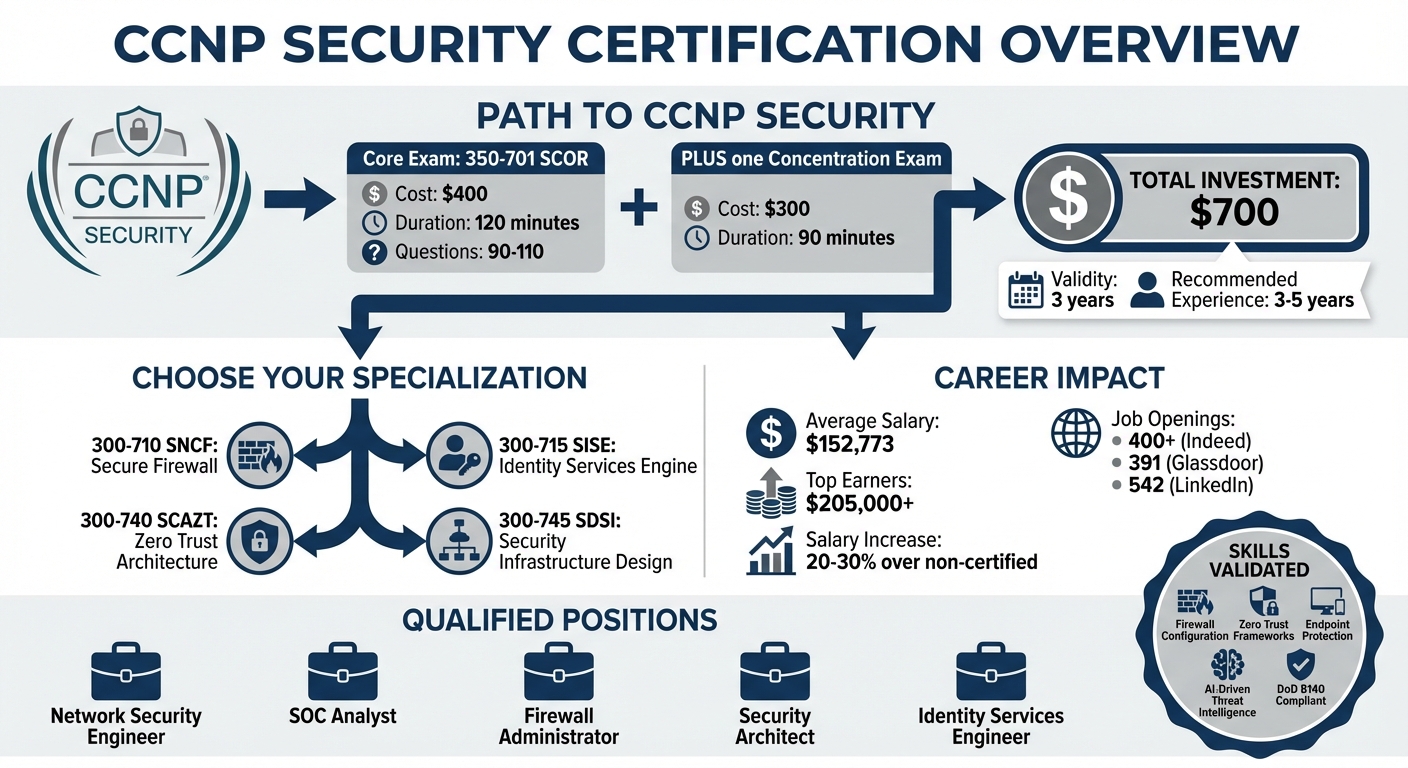
CCNP Security Certification Path: Exams, Costs, and Career Outcomes
CCNP Security Certification: Structure and Skills
Required Core Exam and Optional Concentration Exams
To earn the CCNP Security certification, you’ll need to pass two exams: a mandatory core exam (350-701 SCOR) and one concentration exam of your choice. The core exam costs $400, while each concentration exam is priced at $300, bringing the total investment to around $700. While there are no official prerequisites, Cisco suggests having three to five years of hands-on experience with security solutions to prepare for these professional-level exams.
The 350-701 SCOR core exam is a 120-minute test with 90–110 questions. It focuses on a wide range of security technologies, including network security, cloud security, content security, endpoint protection, secure network access, and visibility enforcement. Successfully passing this exam not only earns you the CCNP Security core credential but also qualifies you to attempt the CCIE Security lab exam, which is ideal for those pursuing expert-level certification.
For the concentration exams, you can choose from several 90-minute options tailored to specific career paths:
- 300-710 SNCF: Focuses on Cisco Secure Firewall, covering policy configurations, AI-driven threat intelligence, and cloud integration.
- 300-715 SISE: Centers on Cisco Identity Services Engine (ISE), including BYOD policies, endpoint compliance, and network access control.
- 300-740 SCAZT: Highlights Zero Trust architectures and Security Service Edge (SSE) for cloud environments.
- 300-745 SDSI: Emphasizes designing complex security infrastructures and adopting emerging practices.
Important Note: Three older concentration exams – 300-720 SESA (Email Security), 300-725 SWSA (Web Security), and 300-730 SVPN (VPN Solutions) – will be retired on August 26, 2026. If you’re interested in these topics, you’ll need to complete the exams before this deadline. Additionally, the 300-735 SAUTO automation exam was retired on February 2, 2026.
With the exam structure outlined, let’s explore the specific skills this certification validates.
Skills Covered by CCNP Security
The CCNP Security certification equips you with the expertise needed to protect critical networks, including those in government and defense sectors. It validates your ability to tackle network security fundamentals, such as designing and managing firewalls, deploying intrusion prevention systems, and configuring secure remote access via VPNs. You’ll also gain skills in cloud security, including managing secure applications and implementing Zero Trust frameworks aligned with federal standards.
A major focus of the certification is endpoint protection and detection. You’ll learn how to secure devices, monitor for threats, and respond to incidents in distributed environments. Additionally, the certification covers identity services management through Cisco ISE, enabling you to control network access and enforce compliance policies for both employees and contractors. You’ll also gain proficiency in using visibility and enforcement tools to monitor network traffic, detect anomalies, and automate responses to security events.
Recent updates to the certification emphasize architectural design over just technical implementation. For instance, the 300-745 SDSI exam teaches you to design scalable security systems and integrate DevSecOps practices and SOAR (Security Orchestration, Automation, and Response) platforms into your architecture. These advanced skills prepare you for roles like Security Architect or Principal Engineer, where you’ll design entire security infrastructures rather than focusing on individual components.
Passing any concentration exam also earns you a Cisco Certified Specialist certification in that specific area, providing an additional credential to demonstrate your expertise. The CCNP Security certification remains valid for three years and can be renewed by completing any professional-level exam or earning 80 Continuing Education credits.
Getting Started with Cisco CCNP – Security

Cleared Cybersecurity Jobs That Match CCNP Security Skills
This section highlights key cleared cybersecurity roles that align with the technical expertise validated by your CCNP Security certification. These roles are designed to meet strict federal standards and often require security clearances.
Top Cleared Roles for CCNP Security Professionals
Earning a CCNP Security certification qualifies you for several high-demand positions in the cleared cybersecurity space.
- Network Security Engineers: These professionals design and implement secure architectures for government networks, configure VPN tunnels to enable secure communication between classified environments, and manage intrusion prevention systems. These roles typically require a Secret or Top Secret clearance.
- Security Operations Center (SOC) Analysts: SOC analysts monitor network traffic, investigate potential security incidents, and respond to threats in real time. Defense contractors and intelligence agencies seek analysts skilled in Cisco network visibility tools.
- Firewall Administrators: These roles involve managing access control policies, creating prefilter rules for classified networks, and ensuring compliance with federal security guidelines.
Other specialized positions include Identity Services Engineers, who deploy Cisco Identity Services Engine (ISE) for network access control, and Security Architects, who design infrastructures with integrated Zero Trust frameworks. These senior roles often require TS/SCI clearances and can offer salaries exceeding $150,000.
The following section breaks down how your CCNP Security skills align with these job responsibilities.
How CCNP Security Skills Match Job Requirements
The technical skills you developed through CCNP Security certification directly align with the responsibilities of these cleared roles. For example, if a job posting mentions expertise with next-generation firewalls, it refers to configuring access control policies and integrating threat intelligence – skills you’ve already mastered. Similarly, requirements for network visibility tools and secure remote access map directly to your experience with Cisco technologies like DMVPN and FlexVPN.
| CCNP Security Skill | Job Responsibility | Relevant Technology |
|---|---|---|
| Firepower NGFW & IPS | Configuring access control policies and prefilter rules for classified environments | Cisco Firepower, FMC |
| Cisco Stealthwatch & Umbrella | Providing network visibility and DNS-layer ransomware protection | Stealthwatch, Umbrella |
| Identity Services (ISE) | Managing secure access for end-user devices and enforcing compliance | Cisco ISE, 802.1X |
| Email/Web Security | Managing email policies and HTTPS decryption for government agencies | ESA, WSA |
| Endpoint Protection | Monitoring devices and responding to threats in distributed environments | AMP for Endpoints, AnyConnect |
As federal agencies shift toward Firepower Threat Defense, traditional ASA firewall roles are evolving, creating demand for professionals with next-generation firewall (NGFW) expertise – precisely what CCNP Security certification prepares you for. Additionally, the increasing emphasis on Zero Trust architectures aligns with the advanced training you’ve completed, especially in the related concentration exams.
sbb-itb-bf7aa6b
How to Prepare for and Earn CCNP Security Certification
To earn your CCNP Security certification, you need to pass the 350-701 SCOR core exam and one concentration exam. While there are no formal prerequisites, Cisco recommends having three to five years of hands-on experience with security solutions before attempting these professional-level exams. Keep in mind that recertification is required every three years.
Preparing for the Core Exam (350-701 SCOR)
The 350-701 SCOR exam is a 120-minute test with 90–110 questions covering six key areas: Security Concepts, Network Security, Securing the Cloud, Content Security, Endpoint Protection and Detection, and Secure Network Access/Visibility. This exam is not only essential for CCNP Security but also for CCIE Security, making it a smart choice for anyone planning long-term growth in the field.
To prepare effectively, combine structured study with practical lab work. Cisco U. offers learning paths with assessments to help you identify and address knowledge gaps. For hands-on practice, set up a virtual lab using tools like Cisco Modeling Labs (CML), GNS3, or Cisco Packet Tracer. Focus on tasks like configuring FlexVPN tunnels, creating Firepower policies, and deploying ISE solutions. Additionally, familiarize yourself with interpreting Python scripts for Cisco Security appliance APIs to tackle automation-related questions.
Plan for a 12–16 week study schedule, dedicating each week to a specific domain. Tools like Anki flashcards can help with memorizing cryptography and protocol details. Aim to consistently score 85% or higher on practice tests before scheduling your exam. During the test, manage your time wisely – spend no more than 60–75 seconds per multiple-choice question to leave time for simulation-based tasks. Results are typically available online within 48 hours, and passing the exam earns you the "Cisco Certified Specialist – Security Core" certification.
Mastering these study techniques not only prepares you for the exam but also builds the technical skills needed for critical security roles. Once you’ve completed the core exam, the next step is to select a concentration exam that aligns with your career goals.
Selecting Your Concentration Exam
Choosing the right concentration exam is crucial for aligning your certification with your career path. For example:
- If you’re a Network Security Engineer focusing on threat detection and Cisco Secure Firewalls, the 300-710 SNCF exam is a great fit. This test now includes AI-driven threat intelligence and Cloud Control management as of the 2026 update.
- For those managing Identity Services Engine (ISE), BYOD lifecycles, and network access policies, the 300-715 SISE exam is ideal.
- Cloud Security Engineers working on Zero Trust and Secure Cloud Access should go for the 300-740 SCAZT exam.
- If you’re aiming for a Senior Architect role, the 300-745 SDSI exam will prepare you with content on architectural design, AI threats, and quantum-safe concepts.
Keep in mind that some older exams have been retired, so always verify the latest exam offerings to ensure you’re focusing on relevant, in-demand skills.
Maintaining Your Certification
Once certified, keeping your CCNP Security credential active is essential to staying on top of evolving security technologies. The certification is valid for three years, and maintaining it ensures you’re prepared for new challenges and opportunities.
You have three options for recertification:
- Pass any professional-level concentration exam.
- Retake the 350-701 SCOR core exam.
- Earn 80 Continuing Education (CE) credits. Activities like attending Cisco Live sessions, completing training courses, or publishing technical content can help you accumulate these credits.
The CE credit option is particularly helpful for busy professionals who may not have time for full exam preparation. Be sure to track your credits in your Cisco certification account to avoid lapses in your credential.
Staying certified not only keeps your skills sharp but also reinforces your value in the ever-changing world of security solutions.
Using CCNP Security to Advance Your Cleared Career
Earning a CCNP Security certification can significantly boost your career, especially in specialized cleared roles. On average, CCNP-certified professionals earn 20% to 30% more than their non-certified counterparts [4], with CCNP Security professionals bringing in an impressive annual salary of $152,773 [1]. But the benefits extend far beyond just financial gains – this certification opens doors to a range of exciting opportunities in the cybersecurity field.
Job Search Methods for Cleared Professionals
Landing the right cleared role requires a focused and strategic approach. Start by targeting job boards like Cleared Cyber Security Jobs, where you can search for positions requiring both your CCNP Security certification and your specific clearance level, such as TS/SCI. Setting up job alerts with keywords like "CCNP Security" and your clearance type ensures you’re among the first to respond to new opportunities. Unlike generic job boards, cleared roles come with strict requirements, so this tailored strategy saves time and effort.
In addition to job boards, aim for major federal contractors such as Booz Allen Hamilton, Leidos, and Lockheed Martin. Many of these companies offer referral bonuses, making networking with their employees a smart move. Attend hiring events and industry conferences geared toward cleared professionals – like INSA, NDIA, GEOINT, and AUSA – to connect directly with recruiters and program managers. Also, optimize your LinkedIn profile by including terms like "Security-Cleared Professional | TS Clearance | CCNP Security" in your headline, but avoid sharing sensitive details on unsecured platforms.
Location matters, too. Cleared roles are concentrated in areas like Northern Virginia, Maryland’s Fort Meade region, Colorado Springs, and Tampa/Orlando. Since many national security jobs require on-site work in secure facilities (SCIFs), you may need to consider relocating if you’re not already in one of these hubs.
Once you’ve secured a role leveraging your CCNP Security certification, you’ll find even more opportunities for growth and advancement.
Career Advancement Paths with CCNP Security
Your CCNP Security certification isn’t just a credential – it’s a launchpad for specialized and leadership positions. This certification qualifies you for roles like Network Security Engineer, Security Consultant, SOC Specialist, Information Security Analyst, Senior Network Architect, and IT Security Manager, among others [4]. It also serves as a stepping stone to the expert-level CCIE Security certification, as passing the 350-701 SCOR core exam fulfills the written exam requirement for CCIE [1][5].
"CCNP Security is not just another certification. It’s a globally recognized standard that proves an IT professional has the ability to secure networks, manage advanced security solutions, and protect data in today’s hostile cyber environment." – Troytec Exams [4]
To broaden your expertise, consider adding complementary certifications. For example, management-focused credentials like CISSP can prepare you for governance and strategy roles, while offensive security certifications such as CEH provide valuable insights into cyberattacks [2]. You can also expand your Cisco knowledge by pursuing concentration exams in areas like automation (300-735 SAUTO) or cloud security (300-740 SCAZT), aligning with the growing demand for automated security solutions and cloud-native technologies.
Career Examples from Cleared Network Engineers
The demand for CCNP Security professionals in the cleared job market is strong. As of early 2026, searches for "CCNP Security" on job platforms yielded over 400 results on Indeed, 391 on Glassdoor, and 542 on LinkedIn [1]. Some job postings even allow advanced certifications like CCNP Security to substitute for required work experience, giving you an edge early in your career [1].
The global cybersecurity talent shortage – estimated at over 3.4 million professionals as of 2024 – further amplifies your value [4]. With your CCNP Security certification and active clearance, you belong to an elite group of candidates that government contractors are eager to hire. This combination not only strengthens your job prospects but also enhances your ability to negotiate better salaries, benefits, and career opportunities.
Conclusion: CCNP Security for Cleared Cybersecurity Careers
CCNP Security can be a game-changer for cleared network engineers, offering an average salary of $152,773 [1] and paving the way to roles like Security Architect, Cloud Security Engineer, and SOC Analyst [3].
This certification aligns with DoD 8140 requirements and qualifies you for the CCIE Security lab exam [1], making it a key credential for cleared professionals aiming to advance their careers.
Industry voices highlight its value:
"The CCNP Security certification is still absolutely worth it if you are looking to advance in your cybersecurity career. The exam updates have made the certification even more future-proof by including AI threats and cloud-centered security concepts." – Graeme Messina, Author, CBT Nuggets [3]
With over 3.4 million cybersecurity jobs currently unfilled worldwide [4], the updated CCNP Security curriculum – featuring AI-driven threats, Zero Trust frameworks, and quantum-safe security [3] – keeps you ahead of the curve. When paired with an active security clearance, this certification sets you apart in a market where government contractors are actively searching for skilled professionals.
At just $700 for the core and concentration exams [1], this certification is a smart investment. Whether you’re transitioning from networking to security or aiming for leadership roles, CCNP Security equips you with the expertise needed to thrive in the ever-evolving cybersecurity landscape.
FAQs
Which CCNP Security concentration exam should I choose for my cleared role?
If you’re aiming for a CCNP Security certification, the best concentration exam depends on your specific role and expertise in cybersecurity. Begin with the 350-701 SCOR core exam, which lays the foundation by covering essential topics like network and cloud security.
From there, pick a concentration exam that matches your professional focus. For example:
- 350-702 SECURE: Ideal for those concentrating on threat detection and protection.
- 350-704 CLCON: A great choice if your work revolves around secure access solutions.
Choose the path that aligns best with your career aspirations and current skill set.
How do I build a CCNP Security lab at home without using classified systems?
To set up a CCNP Security lab at home without relying on classified systems, you can use physical devices like Cisco 3550 switches or 2600 routers. Alternatively, virtualization tools such as GNS3, Cisco VIRL, or EVE-NG are excellent options. These tools allow you to design and configure network topologies that include routers, switches, firewalls, and VPNs, providing hands-on experience with security policies and troubleshooting.
Make sure that all the equipment and software you use comply with legal standards and are non-classified. At the same time, ensure your setup aligns with the requirements of the CCNP Security exam to get the most relevant practice.
Does CCNP Security help me meet DoD 8140 requirements for cleared jobs?
The CCNP Security certification aligns with the DoD 8140 requirements and is officially recognized as a DoD-approved credential. This certification helps professionals meet qualification standards for roles requiring security clearance, making it an important asset for those looking to enter or advance in the cleared job market.