• Skip to primary navigation
  • Skip to main content
Cleared Cyber Security Jobs | CyberSecJobs.com

Cleared Cyber Security Jobs | CyberSecJobs.com

Cleared Cyber Security Jobs

  • Home
  • Search Cleared Cyber Jobs
  • Job Fairs
  • Career Resources

Certifications

CRISC Certification Career Guide for Cleared Risk Professionals

CyberSecJobs Editorial · February 16, 2026 ·

If you’re in cybersecurity with a security clearance, the CRISC certification (Certified in Risk and Information Systems Control) is a powerful way to transition into IT risk management roles. Offered by ISACA, this certification focuses on enterprise IT risk management and is highly valued in cleared environments. Here’s what you need to know:

  • What it Covers: CRISC prepares you to identify, analyze, and manage IT risks while aligning them with business goals. It includes four domains: Governance, Risk Assessment, Risk Response and Reporting, and Technology and Security.
  • Earnings Potential: CRISC-certified professionals earn an average of $151,000 annually, with salaries reaching $165,000+ in senior roles.
  • Exam Details: The exam includes 150 multiple-choice questions, requires a passing score of 450/800, and covers the four domains. You need at least three years of work experience in two of the domains to qualify.
  • Updates: As of November 2025, the exam includes material on AI, machine learning, and data governance.

Whether you’re aiming to boost your salary, enhance your career, or improve your risk management skills in classified settings, CRISC certification is a strong choice for cleared professionals. Keep reading for exam preparation tips, career paths, and how to apply CRISC skills in secure environments.

How to Prepare for the New CRISC Exam 2025: Strategy & Tips

sbb-itb-bf7aa6b

What is CRISC Certification?

The Certified in Risk and Information Systems Control (CRISC) credential, offered by ISACA, highlights expertise in identifying, analyzing, and managing IT risks [6]. This certification has become a benchmark for mid-career professionals in cybersecurity and risk management. Accredited by the American National Standards Institute (ANSI), it’s recognized worldwide by government agencies for adhering to industry-standard risk management practices [5]. It’s designed to equip professionals with the tools needed to tackle practical, real-world risk management challenges.

For professionals in cleared environments, CRISC bridges the gap between technical risk and actionable business insights, ensuring alignment with organizational goals [7].

"Being able to communicate in a language the business understands and connecting the dots with the organization’s goals and objectives is crucial to being successful in getting the resources you need to do the job properly",
explains Matthew Henshaw, Coordinator of Information Technology at Annapolis Valley Regional Centre for Education [7].

The exam itself consists of 150 multiple-choice questions, completed in 4 hours. A passing score of 450 on a scale of 200–800 is required, along with at least three years of relevant experience in two of the CRISC domains [4][6]. Candidates have five years from the exam date to apply for the official certification [4][5].

The 4 CRISC Domains

The CRISC exam is divided into four key domains, each critical for professionals working in government and cleared cybersecurity roles:

  • Domain 1: Governance (26%) focuses on organizational strategy, risk appetite, and frameworks like the Risk Management Framework (RMF). In government settings, this involves aligning security practices with mandates such as FISMA and NIST RMF [7].
  • Domain 2: Risk Assessment (22%) addresses threat modeling, vulnerability analysis, and risk scenarios. This is especially vital for safeguarding classified systems and understanding their impact on national security [2][10].
  • Domain 3: Risk Response and Reporting (32%) emphasizes the design and implementation of controls, as well as monitoring their effectiveness. Cleared professionals often apply this by managing NIST SP 800-53 controls and reporting system status to Authorizing Officials (AOs) [7].
  • Domain 4: Technology and Security (20%) covers security principles, data privacy, and disaster recovery. This domain ensures the protection of Controlled Unclassified Information (CUI) and the resilience of critical functions [3].
CRISC Domain Weight Application in Government Roles
Domain 1: Governance 26% Aligning with NIST RMF and adhering to FISMA requirements.
Domain 2: Risk Assessment 22% Threat modeling for classified systems and impact analysis.
Domain 3: Risk Response & Reporting 32% Managing NIST SP 800-53 controls and audit preparations.
Domain 4: Technology & Security 20% Ensuring data privacy and disaster recovery for sensitive systems.

These domains collectively provide professionals with the skills to address both strategic and operational risks in classified environments.

Why CRISC Matters for Cleared Cybersecurity Professionals

CRISC certification is particularly relevant for professionals working within government frameworks, as it ties directly to the Risk Management Framework (RMF) and NIST guidelines. These frameworks are essential for maintaining the Authority to Operate (ATO) in cleared environments, where adherence to governance and compliance standards is mandatory [2][7]. CRISC helps bridge the gap between technical cybersecurity measures and strategic decision-making, enabling professionals to communicate risks effectively to non-technical stakeholders and senior leadership [6][7].

Starting November 3, 2025, the CRISC exam will include updated material on risks associated with Artificial Intelligence (AI) and Machine Learning (ML). This ensures that certified professionals are prepared to adapt governance strategies for emerging technologies [3].

"The updated CRISC exam… provides comprehensive coverage of the current aspects of ML and AI, giving security professionals the knowledge they need to adapt frameworks, risk registers and compliance layers to meet modern demands",
notes Steven Lawrence, a security professional [3].

With this expanded focus, CRISC-certified professionals are well-positioned to build frameworks that address new threats, ensuring compliance with evolving regulations [3].

Eligibility and Exam Requirements

CRISC Prerequisites

To earn the CRISC certification, you need at least three years of professional experience in IT risk management and information systems control. This experience must be within the 10 years prior to your application or within five years after passing the exam [11][12]. Importantly, your work must cover at least two of the four CRISC domains. No degree or certification can replace this hands-on requirement [11].

For professionals with security clearances, this experience often aligns naturally with their roles. For instance, if you’ve worked as an Information System Security Officer (ISSO) or an Information System Security Manager (ISSM), your familiarity with the Risk Management Framework (RMF) likely overlaps with CRISC domains. Tasks like Security Assessment and Authorization (A&A) align with Domain 2 (Risk Assessment), while implementing controls ties to Domain 4 (Technology and Security) [2].

However, verifying experience in classified environments can be tricky. ISACA requires an independent verifier – such as a supervisor, manager, colleague, or client – who can confirm your work. Human Resources staff and family members are not eligible to serve as verifiers [11]. While classified details don’t need to be disclosed, the verifier must attest to the nature of your tasks and how they align with specific CRISC domains.

You can take the CRISC exam even if you haven’t yet met the full experience requirement. ISACA allows a five-year window after passing the exam to gain and submit the necessary verified experience [4][12]. Once your experience is verified, you’ll be on track to earn the certification.

Exam Format and Structure

The CRISC exam evaluates your expertise across its four domains, with a clear structure and specific time and fee requirements. Scores range from 200 to 800, and you’ll need at least 450 to pass. Results are typically sent within 10 business days [6].

The exam is weighted across the domains as follows:

  • Governance: 26%
  • Risk Assessment: 22%
  • Risk Response and Reporting: 32%
  • Technology and Security: 20% [2]

To manage your time effectively, aim to spend about 1.5 minutes on each question [12].

You can take the exam at authorized PSI testing centers or opt for remote online proctoring, making it accessible even for professionals in secure or remote locations [1]. The registration fee is $575 for ISACA members and $760 for non-members, with a $50 application fee required upon certification. Maintaining your certification involves an annual fee of $45 for members or $85 for non-members [4][1]. If needed, candidates can attempt the exam up to four times in a 12-month period [6].

"The CRISC is designed for IT risk, control and compliance practitioners, business analysts, project managers and other IT and business professionals who have three years of risk management and information system control experience within the past ten years", explains Lisa Cook, GRC Professional Practices Principal at ISACA [12].

This structure ensures that professionals, even those in high-security roles, can efficiently demonstrate their skills and knowledge.

Benefits of CRISC Certification for Cleared Professionals

CRISC certification isn’t just about boosting your paycheck – it’s about sharpening the skills needed to manage risk effectively in classified environments. Below, we’ll explore how this credential impacts financial outcomes, risk management expertise, and career advancement for cleared professionals.

Salary and Career Advancement

CRISC-certified professionals enjoy impressive salaries, with an average base of $148,000 per year as of December 2025 [13]. At top defense contractors like Booz Allen Hamilton, salaries for these professionals range from $147,900 to $165,000 [13][9].

On average, CRISC-certified individuals earn 10% to 15% more than their non-certified counterparts [15]. In high-cost regions or executive roles, salaries can even surpass $204,000 [15]. With only about 46,000 certified professionals worldwide [15][9], this scarcity makes CRISC holders highly sought-after for senior risk positions.

The certification also accelerates career progression. Over half (52%) of CRISC holders report noticeable performance improvements on the job after earning the credential [18]. It’s a recognized differentiator in Governance, Risk, and Compliance (GRC) leadership roles, often paving the way for a seat at the executive table.

"If your career trajectory involves translating technical risk into business decisions, CRISC belongs on your certification roadmap",

  • Ken Sahs, Training Camp [15].

While the financial perks are appealing, the real value lies in the enhanced ability to manage risk strategically.

Improved Risk Management Skills for Cleared Work

CRISC certification emphasizes translating technical vulnerabilities into clear, actionable business terms. This is especially critical in cleared environments, where communicating risks to non-technical stakeholders is a daily challenge. The certification equips professionals to assess and explain risks in terms of likelihood, impact, and residual exposure [9].

For cleared professionals, these skills are essential when managing third-party security and compliance in government or classified settings. CRISC training also includes building Key Risk Indicator (KRI) dashboards that align with board-level expectations, shifting focus from reactive troubleshooting to proactive resilience planning [9].

"Organizations prefer candidates with a CRISC certification as it signifies a commitment to quality work methods and skills that help improve business performance",

  • John Davies, Cyber Security Governance & Assurance Specialist [17].

Additionally, the certification prepares professionals for emerging challenges, such as AI risk assessment, data governance, and ethical considerations – key areas for tackling evolving threats in classified systems [1].

Comparison: CRISC-Certified vs. Non-Certified Professionals

The advantages of CRISC certification become even clearer when comparing certified and non-certified professionals:

Feature CRISC-Certified Professional Non-Certified Professional
Average Salary $147,000 – $165,000 [15][9] 10-15% lower [15]
Advancement Rate Faster path to leadership/management [15][16] Standard technical career growth [9]
Risk Expertise Enterprise-level governance & business impact [9] Often limited to technical severity [9]
Employer Demand High in GRC, Banking, and Government [15][9] General IT/Security demand [9]

The Bureau of Labor Statistics projects 29% job growth for Information Security Analysts – roles often filled by CRISC-certified professionals – through 2034, with a median salary of $124,910 [6]. Additionally, tech occupations are expected to grow at twice the national average over the next decade, with median salaries about 130% higher than those in other fields [14].

How to Prepare for CRISC Certification

Study Materials and Resources

To start, the ISACA Review Manual is a must-have. It covers all four domains of the CRISC exam and is available in both digital and print formats. If you like the convenience of quick searches and instant access, the digital version is for you. Prefer flipping through physical pages? The print version has you covered.

Another helpful resource is the CRISC Questions, Answers & Explanations (QAE) Database. This tool includes between 833 and 983 practice questions, each with detailed explanations. A 12-month subscription costs around $399 and is a great way to pinpoint areas where you might need extra practice.

For a more interactive experience, ISACA’s self-paced Online Review Course offers video lessons, case studies, and downloadable aids. These resources are perfect for professionals juggling busy schedules, as they let you study in your own time.

Need advice or have questions? The ISACA Engage Community is an online forum where members can connect with experts from around the world. Plus, ISACA provides a free 10-question quiz to help you assess your starting point before diving into more in-depth materials.

Study Timeline and Schedule

Once you have your materials, a solid study plan is key. Most people spend between 120 and 150 hours preparing for the CRISC exam, typically over three to six months. Setting daily goals can help you avoid cramming and burnout.

One popular strategy is the 100-day study plan. Here’s how it works: dedicate 90 minutes a day to cover four pages of the review manual and answer 20 practice questions. Since the exam content is weighted, you’ll want to focus your time accordingly:

  • Risk Response and Reporting: 32%
  • Governance: 26%
  • IT Risk Assessment: 22%
  • Information Technology and Security: 20%

"CRISC is an exam that appears to test you on ‘which is the better decision’ rather than ‘which is the best technology’."

  • Louis Cremen, Cyber Security Trainer [19]

Before your test date, take at least one full-length mock exam under timed conditions. This helps you get comfortable with the exam format and builds the stamina you’ll need on test day. During the final week, focus on reviewing ISACA’s governance-focused methodology and completing full-length practice tests.

If you’re balancing a packed schedule, ISACA offers a remotely proctored exam option. You can take the test from home under strict monitoring. Alternatively, exams are available at PSI testing centers, and you can schedule them as soon as 48 hours after payment.

This structured approach not only prepares you for the exam but also ensures you’re ready to apply CRISC knowledge in high-security roles.

Using Cleared Cyber Security Jobs for Certification Support
Cleared Cyber Security Jobs

As you prepare for the exam, don’t overlook career resources that can help you land CRISC-related roles. Cleared Cyber Security Jobs is a platform tailored for professionals with active security clearances. You can set up job alerts for CRISC-specific positions within government agencies or defense contractors, saving you time by filtering out irrelevant listings.

The platform also hosts job fairs, giving you the chance to meet hiring managers face-to-face. These events are a great way to discuss how your CRISC certification can address their risk management needs.

Career Paths for CRISC-Certified Cleared Professionals
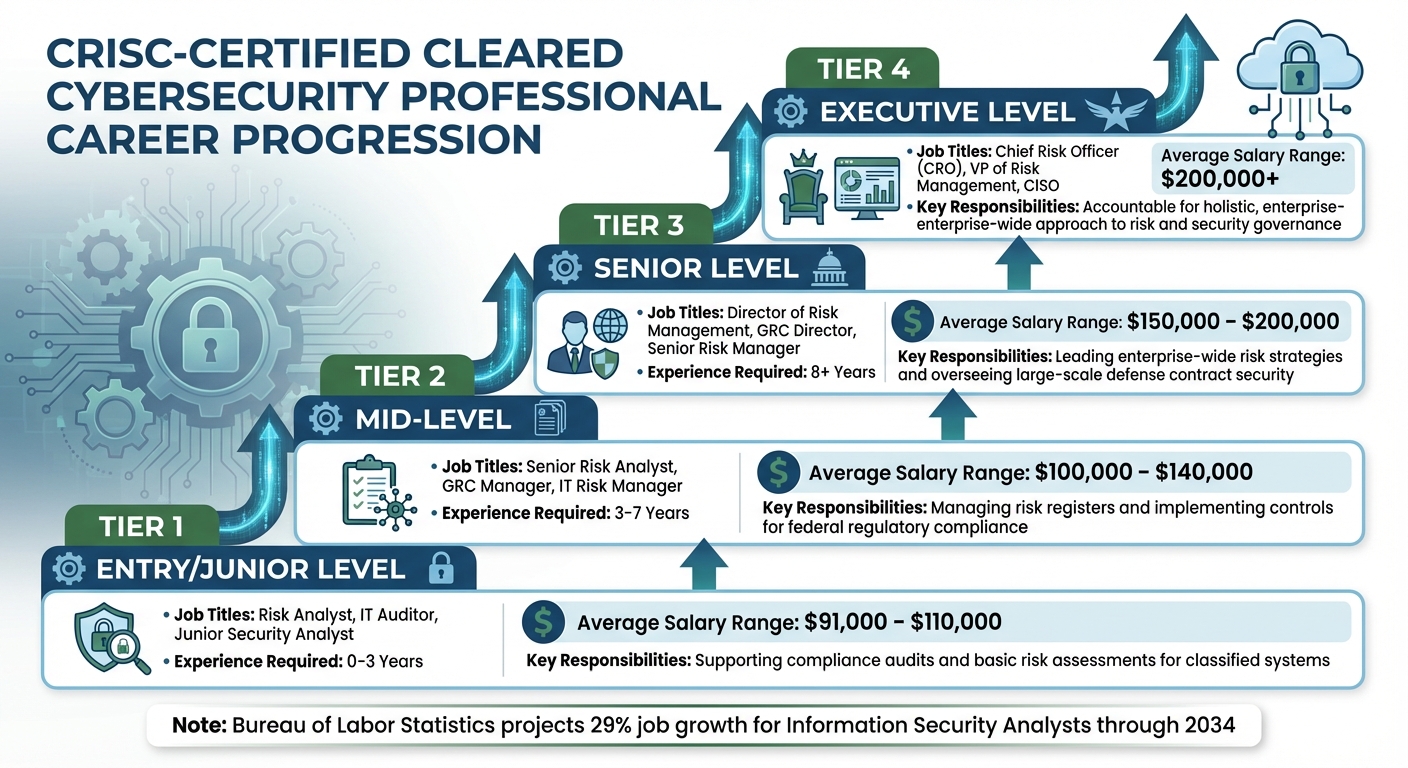
CRISC Career Progression Path for Cleared Cybersecurity Professionals

CRISC Career Progression Path for Cleared Cybersecurity Professionals

Common Job Roles for CRISC Professionals

Earning a CRISC certification opens doors to a variety of roles for cleared professionals, including IT Risk Manager, GRC Analyst/Manager, Information Security Manager, IT Auditor, Data Protection Officer, Compliance Auditor, Security Engineer, Cybersecurity Risk Analyst, Third-Party Risk Manager, and Cloud Security Risk Specialist. These positions focus on safeguarding classified systems and ensuring the security of mission-critical operations[6][8].

For instance, an IT Risk Manager working with defense contractors doesn’t just evaluate general IT risks – they also assess threats to classified information. Their work ensures that security measures align with both organizational objectives and federal compliance standards. These roles provide various entry points, allowing professionals to expand their responsibilities and expertise over time in the field of risk management.

Career Progression with CRISC

The career path for CRISC-certified professionals often starts with entry-level positions like Risk Analyst or IT Auditor, where the focus is on supporting compliance efforts and conducting initial risk assessments for classified systems[8]. As they gain experience, professionals move into mid-level roles such as Senior Risk Analyst, GRC Manager, or IT Risk Manager, where responsibilities include managing risk registers and implementing controls to meet federal compliance standards[8].

At the senior level, roles like Director of Risk Management or GRC Director involve leading enterprise-wide risk strategies, particularly for large-scale defense contracts[8]. For those with over a decade of experience, executive roles such as Chief Risk Officer (CRO), VP of Risk Management, or CISO become attainable. These positions demand a comprehensive, enterprise-wide focus on risk and security governance, especially in classified and mission-critical environments[8].

"CRISC certification positions you to bridge this gap between technical implementation and business risk assessment." – Rob Witcher, CEO, Destination Certification[8]

The demand for professionals in this field is growing rapidly. The Bureau of Labor Statistics anticipates a 29% growth rate for Information Security Analysts between 2024 and 2034[6]. Globally, there are over 30,000 CRISC-certified professionals[6], with an average annual salary exceeding $151,000[6]. This highlights the strong financial and career growth opportunities available to cleared professionals with this certification.

CRISC Career Progression Table

Career Stage Typical Job Titles Experience Required Average Salary Range Relevance to Cleared Environments
Entry/Junior Risk Analyst, IT Auditor, Junior Security Analyst 0-3 Years $91,000 – $110,000 Supporting compliance audits and basic risk assessments for classified systems.
Mid-Level Senior Risk Analyst, GRC Manager, IT Risk Manager 3-7 Years $100,000 – $140,000 Managing risk registers and implementing controls for federal regulatory compliance.
Senior Director of Risk Management, GRC Director, Senior Risk Manager 8+ Years $150,000 – $200,000 Leading enterprise-wide risk strategies and overseeing large-scale defense contract security.
Executive Chief Risk Officer (CRO), VP of Risk Management, CISO 10+ Years $200,000+ Accountable for a holistic, enterprise-wide approach to risk and security governance.

Applying CRISC Skills in Cleared Environments

Managing Risk in Classified Systems

CRISC-certified professionals rely on structured frameworks to address risks that could compromise national security. At the core of their work is the NIST Risk Management Framework (RMF), particularly in how CRISC Domain 2 (Risk Assessment) aligns with the RMF’s "Categorize" and "Select" steps. These steps involve determining the potential impact of classified data loss. To evaluate threats, professionals turn to STRIDE threat modeling – a method that identifies risks like Spoofing, Tampering, Repudiation, Information Disclosure, Denial of Service, and Elevation of Privilege. This helps them understand how adversaries might exploit vulnerabilities in secure networks.

Adversary profiling is another key tool. It examines threat actors based on their capability, intent, stealth, and persistence. For example, countermeasures for a nation-state actor targeting defense systems differ significantly from those for an insider threat. By analyzing these factors, professionals can design tailored defense strategies. When assessing classified systems, they carefully distinguish between technical vulnerabilities, procedural gaps, and organizational weaknesses.

To make risk management actionable, professionals develop "what-if" scenarios that connect specific threats to classified assets. These scenarios translate technical vulnerabilities into insights that authorizing officials can use to make informed decisions[8]. This approach highlights how CRISC-certified individuals turn technical assessments into strategic actions, particularly in high-security environments.

Implementing Compliance Controls

Beyond risk assessments, CRISC-certified professionals are skilled at establishing strong compliance measures within cleared environments. CRISC Domain 1 plays a key role in the "Prepare" and "Categorize" phases, while Domain 3 is critical for the "Implement", "Authorize", and "Monitor" stages. These efforts ensure alignment with NIST SP 800-53 controls, which were updated on August 27, 2025[20]. Staying current with these updates, including those driven by Executive Order 14306, is essential.

To maintain compliance, professionals engage in continuous monitoring, which helps sustain an Authority to Operate (ATO) for classified systems. They use Key Risk Indicators (KRIs) and Key Control Indicators (KCIs) to manage risks in near real-time – a priority for federal agencies. Risk registers are another crucial tool, tracking "inherent" risks versus "residual" risks for systems handling Controlled Unclassified Information (CUI) or higher classifications. Meanwhile, the Three Lines of Defense model ensures clear accountability across operational management, risk/compliance functions, and internal audits.

When third-party vendors require access to sensitive data, CRISC professionals evaluate whether those vendors’ security practices align with the organization’s risk tolerance. They also create Security, Privacy, and Cybersecurity Supply Chain Risk Management Plans in line with NIST SP 800-18r2 guidance. This ensures that compliance controls not only protect classified assets but also meet federal regulatory standards effectively.

Conclusion

The CRISC certification brings three key advantages: access to leadership opportunities, higher earning potential, and improved risk management expertise. On average, CRISC-certified professionals earn between $150,000 and $165,000 annually, with senior roles often surpassing $180,000 [9]. Beyond salary, CRISC equips professionals with the ability to communicate technical risks in business terms, bridging the gap between IT vulnerabilities and their broader business impact [9]. This skill can significantly accelerate career growth into senior risk management roles.

"CRISC’s greatest real-world strength lies in bridging the gap between security operations and executive strategy. It often becomes the credential that earns professionals a seat at decision-making tables." – Expert Takeaway, Programs.com [9]

These benefits are particularly valuable in cleared environments, where enterprise IT risk management is critical to meeting strict regulatory requirements. With the demand for Information Security Analysts expected to grow by 29% from 2024 to 2034 [6], CRISC-certified professionals are well-prepared to address this rising need.

Cleared Cyber Security Jobs offers a dedicated platform for showcasing your CRISC certification. It connects you with employers who prioritize security clearance and risk management expertise. You can upload your resume, set up job alerts, and access career resources tailored to the cleared community – all completely free.

FAQs

Does CRISC meet DoD 8570/8140 requirements?

Yes, the CRISC certification aligns with the DoD 8570/8140 requirements. It is officially recognized within the Department of Defense’s cyber workforce framework and qualifies for over 85% of the approved work roles listed in the DoD 8140 Cyber Workforce Qualification Provider Marketplace. This recognition makes CRISC an important credential for professionals seeking cleared positions that adhere to these standards.

How do I verify CRISC experience without sharing classified details?

To validate your CRISC experience, you’ll need to fill out a comprehensive work experience form. Make sure to clearly describe your roles and responsibilities within the relevant domains. Be careful not to include any sensitive or classified information – this ensures that verifiers can evaluate your qualifications without exposing restricted details.

Which CRISC domain matters most for RMF/ATO work?

The Governance domain, which makes up 26% of the CRISC exam, is the most relevant for RMF/ATO work. This area emphasizes organizational strategy, policies, standards, and the impact of IT risk on business objectives. Its focus aligns directly with the demands of RMF/ATO processes, making it a key area of expertise for professionals in these roles.
Related Blog Posts

  • CISM Certification Career Guide for Cleared Security Managers
  • CISA Certification Career Guide for Cleared IT Auditors
  • GSEC Certification Career Guide for Cleared Security Essentials
  • CySA Plus Certification Career Guide for Cleared SOC Analysts

Related Guides

  • CAP Certification Career Guide for Cleared Authorization Pros
  • CGRC Certification Career Guide for Cleared GRC Analysts
  • CASP Plus Certification Career Guide for Cleared Security Architects
  • Cybersecurity Salary Guide 2026
  • TS/SCI Salary Premium: Real 2026 Numbers

GCP Security Certification for Cleared Cloud Architects

CyberSecJobs Editorial · February 15, 2026 ·

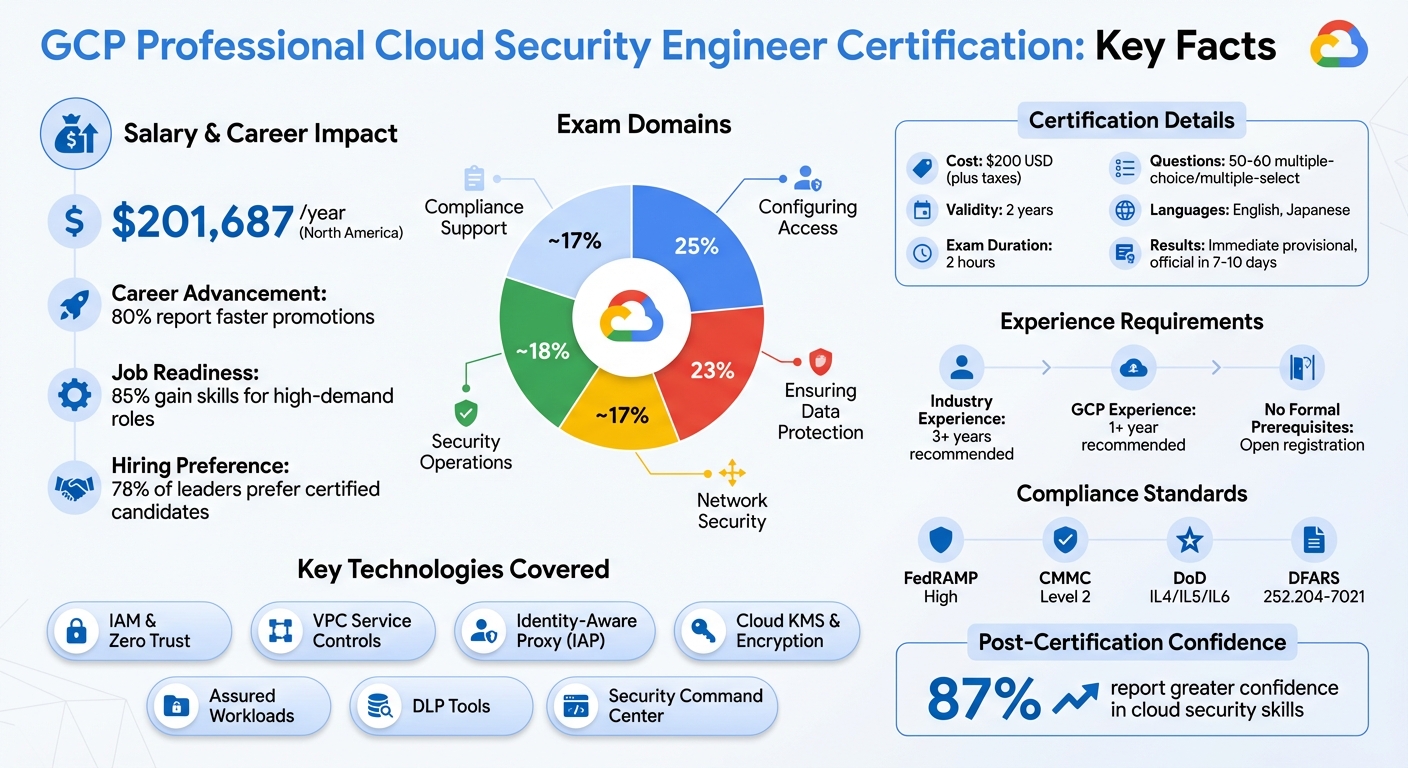
The Google Cloud Professional Cloud Security Engineer Certification is a key credential for cloud architects managing classified data in government and defense sectors. It validates expertise in securing workloads on Google Cloud using tools like Zero Trust, Identity-Aware Proxy (IAP), and VPC Service Controls. With an average salary of $201,687/year in North America, this certification offers significant career growth opportunities, especially for professionals with security clearances.

Key Details:

  • Focus Areas: Access configuration, data protection, network security, compliance, and operations management.
  • Cost: $200 USD (plus taxes), valid for two years.
  • Recommended Experience: 3+ years in the industry, with 1+ year on Google Cloud.
  • Skills Tested: IAM, encryption, VPC Service Controls, Assured Workloads, and more.

This certification is highly relevant for cleared professionals working on Top Secret and Secret missions, aligning with compliance standards like FedRAMP and CMMC Level 2. It ensures readiness for high-stakes roles in securing sensitive government systems.

GCP Professional Cloud Security Engineer Certification Overview: Costs, Salary, and Key Stats

GCP Professional Cloud Security Engineer Certification Overview: Costs, Salary, and Key Stats

How I passed the GCP Professional Cloud Security Certification

sbb-itb-bf7aa6b

What Is the Google Cloud Professional Cloud Security Engineer Certification?

Google Cloud

This certification confirms your ability to secure Google Cloud workloads while adhering to industry standards and best practices [1][8]. It highlights your expertise in designing secure solutions using Google’s security technologies and enforcing regulatory controls essential for high-security environments. Google describes the role as:

"A Cloud Security Engineer allows organizations to design and implement secure workloads and infrastructure on Google Cloud. Through an understanding of security best practices and industry requirements, this individual designs, develops, and manages a secure solution by using Google security technologies." [1]

The certification has adapted to address modern security priorities, such as securing AI workloads, protecting the software supply chain, and automating security processes. These areas are becoming increasingly relevant for government and defense sectors [1]. It focuses on key security domains essential for safeguarding sensitive and classified data.

What the Certification Covers

The certification is built around five core domains that align with the needs of cleared environments. These include:

  • Configuring Cloud Identity, IAM, and access controls
  • Securing network communications with VPC security and firewalls
  • Protecting data using encryption and Data Loss Prevention (DLP) tools
  • Managing security operations through logging and incident response
  • Supporting compliance with regulatory frameworks [1][8]

For cleared cloud architects managing classified data, the exam tests your knowledge of tools like Assured Workloads for compliant deployments, VPC Service Controls for establishing security perimeters, and Sensitive Data Protection tools for discovering and redacting sensitive information [12]. You’ll also need to demonstrate proficiency with Cloud HSM, Cloud External Key Manager, and Confidential Computing to safeguard data at rest, in transit, and in use [12].

The certification also validates your understanding of digital sovereignty and data residency requirements. Using Sovereign Controls by Partners and configuring data residency services, you’ll address the strict location requirements of federal workloads. These skills are critical for meeting standards like FedRAMP and DoD Impact Levels, which govern cleared cloud environments [12].

Core Skills Tested by the Certification

The exam emphasizes practical applications of security across Google Cloud’s technology stack. In identity and access management, you’ll configure service accounts, implement role-based access control (RBAC), and manage resource hierarchies in line with the principle of least privilege [11][1]. For network security, you’ll design isolated perimeters using VPC peering, Shared VPC, firewall rules, and Identity-Aware Proxy (IAP) – essential for securing government applications [11][10].

When it comes to data protection, you’ll work with tools like Customer-Managed Encryption Keys (CMEK), Customer-Supplied Encryption Keys (CSEK), and envelope encryption through Cloud KMS [11][1]. You’ll also use the DLP API to safeguard personally identifiable information (PII) and comply with government data security mandates. In security operations, the focus is on configuring log sinks, audit logs, and automated security scanning in CI/CD pipelines to enable real-time monitoring and rapid threat response [11][8].

The certification also covers the shared responsibility model and aligning cloud infrastructure with federal defense standards [11][1]. According to Google Cloud, 87% of certified professionals report greater confidence in their cloud security skills after earning this credential [10].

Senior Cloud Architect Natalie Godec shares: "I would definitely recommend the Google Cloud certifications to others, specifically because of the learning paths that come with the preparation for them. There is a treasure trove of knowledge in those preparatory courses, videos, labs that you will take" [9].

Prerequisites and Required Experience

Google doesn’t impose any formal prerequisites for registering for the Professional Cloud Security Engineer exam [1][3]. You can sign up and take the test without needing to verify prior experience or hold any other certifications. That said, thorough preparation is key. The exam fee is $200 USD (plus applicable taxes), and the content assumes you already have a solid understanding of cloud security fundamentals [1][3].

Who Should Pursue This Certification

This certification is designed for professionals with substantial hands-on experience in cloud environments, ideally at least one year of experience specifically in designing and managing solutions on Google Cloud [1][10]. It’s particularly suited for cloud architects who want to deepen their security expertise, especially those looking to go beyond general infrastructure design into areas like architecting zero-trust networks with Identity-Aware Proxy (IAP) and VPC Service Controls [3].

Security analysts and engineers transitioning from traditional on-premises environments will also benefit, as the certification helps bridge the gap between conventional security models and cloud-native frameworks [3]. Additionally, cloud engineers and administrators managing infrastructure will find it valuable, as the exam validates skills like configuring access controls, setting up resource hierarchies, and enforcing compliance requirements [1]. For compliance and audit professionals, the certification is particularly relevant, as it focuses on mapping Google Cloud Platform (GCP) controls to standards such as PCI-DSS, HIPAA, and GDPR [3].

According to Google Cloud data, 78% of leaders from organizations using Google Cloud prefer hiring professionals with cloud certifications, and 80% of learners say earning a certification has accelerated their career progression [9][2]. For cloud architects aiming for high-security roles in government or defense sectors, these stats highlight the competitive edge certifications can provide.

With the target audience in mind, the next step is to focus on building the necessary skills and a solid preparation plan.

Required Knowledge and How to Prepare

If you already have foundational experience, focus on strengthening your expertise through hands-on practice and official training resources. To succeed in the exam, you’ll need a strong grasp of identity and access management (IAM), resource hierarchy design, network security configuration, and threat monitoring [1]. Foundational skills like basic command-line usage, familiarity with Linux, and the ability to read Python or JavaScript code are also crucial [10]. Experience in deploying and managing applications will further bolster your readiness [10].

Beyond the basics, you’ll need to be comfortable with advanced topics such as securing AI workloads, protecting software supply chains, and managing containerized environments like Kubernetes [1][10]. To get started, explore Google’s official "Professional Cloud Security Engineer" learning path on Google Cloud Skills Boost [1][2]. If you’re new to Google Cloud, foundational courses like "Google Cloud Fundamentals: Core Infrastructure" and "Security in Google Cloud" are excellent starting points before diving into specialized security topics [8].

For hands-on practice, work on configuring IAM roles, setting up VPC peering, and securing Kubernetes clusters within GCP [10]. Use the official exam guide to pinpoint areas where you may need additional study, such as VPC Service Controls, Cloud KMS, and Cloud Data Loss Prevention (DLP) [1][3]. This focused preparation ensures you’re equipped to meet the demands of high-security environments, particularly in sectors like government and defense. Keep in mind, the certification is valid for two years, after which you’ll need to recertify by passing the exam again [3][8].

Exam Format and How to Prepare

This section dives into the exam logistics and offers key strategies to help you confidently prepare for certification.

Exam Structure and Format

The exam costs $200 USD and includes 50–60 multiple-choice and multiple-select questions to be completed in 2 hours. You can take it either online or onsite, with language options in English and Japanese.

Once you finish, you’ll receive immediate provisional results, and official confirmation follows within 7–10 days. If you don’t pass, a detailed section-by-section score report will be available in your Candidate Portal to help identify areas for improvement. The certification remains valid for two years, after which you’ll need to recertify by retaking the exam. This structured format ensures candidates are well-prepared to handle the complexities of securing critical government and defense systems.

Study Resources and Training Materials

Start your preparation with the "Professional Cloud Security Engineer" learning path on Google Cloud Skills Boost. It offers on-demand courses and hands-on labs tailored to the exam. For a more in-depth approach, explore the 14-course "Security Engineer Professional Certificate" on Coursera, which covers all exam domains comprehensively. Additionally, Qwiklabs provides practical exercises for tasks like configuring VPC Service Controls, setting up IAM roles, and using Cloud Data Loss Prevention tools.

The official exam guide serves as a roadmap, helping you pinpoint gaps in areas like Packet Mirroring or VPC Service Controls. Supplement this with Google Cloud documentation and case studies to see real-world applications of security practices. Joining the Google Cloud Community or a local Google Developer Group can also be valuable. These groups often host study sessions and provide opportunities to connect with others preparing for the exam.

Exam Preparation Tips

Set your exam date early to establish a disciplined study routine. While practicing, focus not just on the correct answers but also on understanding why the incorrect options are wrong. This approach builds a stronger grasp of the concepts, which is crucial during the actual exam. Pay special attention to high-weight domains like "Configuring Access" (25%) and "Ensuring Data Protection" (23%), as they make up nearly half of the exam.

Practical experience is just as important as theoretical knowledge. Use sandbox environments to practice setting up custom VPCs, configuring DLP jobs, and working with the Security Command Center. A helpful technique is summarizing each Google Cloud product’s purpose in four words or less – this can make it easier to recall key features quickly during the exam.

Career Benefits for Cleared Cloud Architects

Growing Need for Cloud Security in Cleared Positions

The DFARS 252.204-7021 clause now requires specific cybersecurity certifications for contract eligibility [7][6]. This has created an immediate need for cloud architects skilled in handling workloads under CMMC Level 2 and FedRAMP High standards. In May 2024, Google Public Sector expanded its FedRAMP High offerings by authorizing over 100 additional cloud services [13]. This move has significantly broadened the landscape of secure environments, increasing demand for architects with expertise in cloud security.

Government agencies are also embracing software-defined community clouds like Assured Workloads, which rely on logical segmentation and software-based guardrails. For example, in April 2024, the U.S. Air Force began using Vertex AI to modernize aircraft maintenance processes, integrating AI into classified missions. This shift highlights the growing need for professionals adept at managing Top Secret and Secret cloud authorizations [5]. These developments emphasize the importance of certifications that validate advanced cloud security skills, especially in high-stakes environments.

How the Certification Sets You Apart

Given these evolving requirements, earning the certification not only aligns with regulatory demands but also enhances your marketability in the competitive cleared job market. The rigorous preparation for the certification strengthens your technical expertise, translating into tangible career advantages. For instance, the Professional Cloud Security Engineer certification boasts the highest average annual salary in North America at $201,687, with senior positions often exceeding $200,000 [4][3]. Beyond financial benefits, 85% of Google Cloud learners report gaining the skills needed for high-demand roles through certifications, and 80% say certifications accelerate promotions [2].

This certification proves your ability to implement zero-trust architectures using tools like BeyondCorp, Identity-Aware Proxy, and VPC Service Controls – key technologies for securing high-stakes government environments. It also demonstrates your capability to manage Google Distributed Cloud Hosted environments, essential for Top Secret and Secret missions within the U.S. Intelligence Community and the Department of Defense. In November 2025, Google Public Sector achieved CMMC Level 2 certification, verified by a third-party assessment organization. This milestone further positions certified professionals as trusted partners for DoD systems handling Controlled Unclassified Information [6].

As AI continues to play a role in sensitive public sector projects – ranging from cancer detection to predictive maintenance – this certification ensures you have the skills to secure the data pipelines powering these models. By combining compliance expertise, hands-on security knowledge, and readiness for emerging technologies, this credential sets you apart in a field where cleared professionals with cloud security skills are in high demand.

Using GCP Security Skills in Government and Defense Work

Protecting Classified and Sensitive Data

If you’re working in government or defense, your expertise in Google Cloud Platform (GCP) security plays a direct role in safeguarding critical information. For example, handling Controlled Unclassified Information (CUI) often involves configuring Assured Workloads to ensure data stays within U.S. borders, meeting the strict requirements of FedRAMP High and DoD IL4/IL5 [15][14]. This setup includes implementing guardrails to control where data is stored and processed, ensuring compliance with regulatory standards.

For higher-security missions, such as those involving Top Secret and Secret data under DoD IL6, you’ll work with Google Distributed Cloud (GDC) Hosted. This isolated environment operates without public internet access, requiring advanced configurations like FIPS 140-2 or 140-3 validated encryption to secure data both at rest and in transit. Access is restricted to federally vetted U.S. personnel, reflecting the stringent security demands [14][18]. Notably, Google became the first hyperscaler to achieve a DoD IL5 Provisional Authorization for a software-defined community cloud, making professionals with GCP certifications key players in these high-security operations [14].

Your certification also prepares you for specialized tasks, such as ensuring U-NNPI compliance (Unclassified Naval Nuclear Propulsion Information). This requires implementing 17 additional security controls beyond the standard DoD IL5 framework [14]. For example, using Cloud Logging to retain audit logs for at least 90 days helps meet DFARS 252.204-7012 obligations, though extending this to six months is recommended for heightened security [16]. Additionally, Google’s commitment to notifying customers of data incidents within 72 hours for properly configured Assured Workloads underscores its proactive approach to security [16]. These measures are crucial not only for protecting sensitive data but also for supporting mission-critical applications.

Securing Mission-Critical Applications

Your GCP security skills extend beyond data protection to ensure that mission-critical applications remain secure and reliable. Defense and intelligence operations often demand systems that can withstand the most rigorous security requirements. By leveraging tools like VPC Service Controls, you’ll establish security perimeters that manage data flow independently of Identity and Access Management, adding an extra layer of security [19]. For workloads under FedRAMP High and DoD IL4/IL5, configuring regional load balancers and Cloud Armor policies ensures traffic remains within jurisdictional boundaries [15].

A real-world example of GCP’s impact is the U.S. Air Force Rapid Sustainment Office’s use of Google Cloud in April 2024. By automating manual processes, they improved aircraft maintenance efficiency, showcasing how GCP security expertise supports operational readiness [5]. Similarly, the Defense Innovation Unit has adopted Google Cloud for developing AI models, such as augmented reality microscopes, to deliver precise and secure diagnostics [5]. Even in humanitarian efforts, Google Distributed Cloud Hosted facilitates language translation in over 200 languages using Vertex AI, all within secure environments [5].

"GDC Hosted is an air-gapped cloud solution built specifically for stringent security requirements, allowing U.S. intelligence and DoD agencies to host, control, and manage their infrastructure and services in a highly secure environment." – Leigh Palmer, VP, Google Public Sector [5]

Another critical skill is configuring Confidential Computing, which processes data in hardware-isolated Trusted Execution Environments (TEE). This ensures data remains secure even during processing, a vital capability for AI/ML workloads analyzing sensitive information in air-gapped or highly regulated settings [17]. As agencies increasingly modernize with advanced analytics, these configurations are becoming indispensable. By mastering them, you’ll not only protect vital operations but also position yourself as a strong candidate for high-demand roles requiring security clearances.

Using Your Certification on Cleared Cyber Security Jobs

Cleared Cyber Security Jobs

How to Highlight Your Certification

Your GCP Professional Cloud Security Engineer certification deserves a prominent spot on your resume, especially considering that 98% of open cleared jobs at major federal contractors like GovCIO are IT-related [21]. Include it in your professional summary or technical skills section to ensure it stands out. On Cleared Cyber Security Jobs, manually add "Google Cloud Platform" and "Professional Cloud Security Engineer" to your Skills Cloud for better visibility. Uploading your resume also activates IntelliSearch™, which pairs your credentials with relevant cleared positions when your certification is listed.

To strengthen your application, attach your official certificate directly to your resume. Additionally, opt into the Google Cloud Skills Directory via your Credly account settings, making your verified credential searchable by employers looking for specific certifications. When describing your GCP security experience, focus on measurable achievements. For instance, instead of general statements, use examples like: "Reduced system vulnerabilities by 35% through proactive threat monitoring." Metrics like these demonstrate real value to potential employers.

Finding Jobs That Match Your Skills

Once your certification is highlighted, the next step is to target roles that align with your expertise. Use the search filters on Cleared Cyber Security Jobs to find positions requiring Google Cloud Platform security skills. Job titles like Cloud Security Analyst – focused on cyber defense and threat monitoring in cloud environments – or Cloud Security Subject Matter Expert (SME) – which involves high-level expertise for Federal Strategic Cyber Programs – are great starting points [23]. Salary ranges for GCP-related cloud engineering roles typically fall between $80,000 and $128,000 [22].

To improve your chances of being discovered by employers, use keywords such as "GCP Security", "Cloud Security Engineer", and "Google Cloud Platform" in your job search. Since 44% of employees at major federal IT contractors hold public trust or higher clearances [21], combining your GCP certification with your clearance makes you a highly attractive candidate. You can also set up job alerts to stay updated on new opportunities that match your specific skill set.

Connecting with Hiring Managers

After identifying roles that fit, focus on building connections with hiring managers to elevate your chances. Attend events like the Cleared Careers Virtual Hiring Event, where you can engage directly with recruiters from defense and intelligence sectors [20]. These events provide a direct line to decision-makers actively looking for candidates with your qualifications. If you’re transitioning from military service, plan to attend job fairs and engage with hiring managers at least a year before your End of Active Service (EAS) [21].

"Jobs like network engineers, systems engineers, administrators, help desk, cyber, AWS, cloud security. Those are some newer trending positions at GovCIO that we’re seeing a lot of." – Tammy Muncy, Recruitment Director, National Security Services Sector, GovCIO [21]

Make your profile searchable on Cleared Cyber Security Jobs so pre-screened employers can easily find you. With 85% of Google Cloud learners reporting that cloud certifications equip them with the skills needed for in-demand roles [2], your certification signals readiness to tackle critical projects. Taking these proactive steps ensures hiring managers see you as a candidate who can contribute immediately to their mission-critical objectives in government and defense.

Conclusion

The Google Cloud Professional Cloud Security Engineer certification is an excellent step forward for cloud architects working in government and defense sectors. With 80% of participants reporting faster promotions and 85% confirming it equips them with skills for high-demand roles [2], this certification offers measurable career benefits. It demonstrates your ability to safeguard Controlled Unclassified Information (CUI) and meet CMMC compliance standards – essential for Department of Defense (DoD) contracts starting November 10, 2025, when DFARS 252.204-7021 takes effect [6][7].

Proficiency in areas like Identity and Access Management (IAM), VPC Service Controls, and Assured Workloads directly contributes to critical defense operations. Google Public Sector’s CMMC Level 2 certification in November 2025, verified by a third-party assessment, underscores its readiness to support DoD initiatives [6]. Ron Bushar, Managing Director & Chief Security Officer at Google Public Sector, highlighted this milestone:

"This CMMC Level 2 certification is a key enabler for our partnership with the DoD. It ensures our teams can operate and collaborate within the defense ecosystem fully supporting the new DoD requirements" [6].

This certification not only enhances operational readiness but also provides direct career advantages. At a cost of $200 (plus taxes), it’s a worthwhile investment considering the returns. Certified Cloud Security Engineers in North America earn an average salary of $201,687, making it one of the most lucrative certifications in the field [3][4]. Combined with an active clearance, it positions you as a standout professional in a highly competitive industry.

FAQs

Is this certification worth it if I already have a security clearance?

Yes, holding this certification alongside a security clearance adds significant value. It enhances your understanding of Google Cloud security technologies, making you a stronger candidate for sought-after roles in the cleared cybersecurity field. Combining cloud security expertise with a clearance can open doors to career opportunities in government and defense sectors.

What hands-on GCP skills should I practice most before the exam?

To excel in Google Cloud Platform (GCP) security, focus on key tasks like creating and managing custom security roles. This allows for fine-tuned access control, ensuring users have just the right permissions they need. Dive into configuring service accounts and binding roles to efficiently handle identities and permissions across your projects.

Additionally, get hands-on with Kubernetes Engine by setting up private clusters and deploying applications securely. This will help you understand critical aspects of identity management, network security, and container security, all of which are essential for mastering GCP and acing the exam.

How does this certification help with FedRAMP, CMMC, and DoD Impact Levels?

The GCP Security Certification highlights a professional’s skill in setting up cloud environments that comply with federal security standards like FedRAMP, CMMC, and DoD Impact Levels. This certification proves expertise in aligning cloud architectures with stringent requirements such as FedRAMP High, DoD IL2-IL6, and the DoD Cloud SRG, demonstrating the ability to build secure and compliant cloud solutions tailored for government and defense needs.

Related Blog Posts

  • Classified Cloud Security Jobs – AWS GovCloud and Azure Government Specialization
  • GSEC Certification Career Guide for Cleared Security Essentials
  • CCSP Certification Career Guide for Cleared Cloud Security
  • CCSK Certification Career Guide for Cleared Cloud Knowledge

Related Guides

  • Azure Security Engineer Certification for Cleared Professionals
  • AWS Security Specialty Certification for Cleared Cloud Engineers
  • CCSK Certification Career Guide for Cleared Cloud Knowledge
  • Cybersecurity Salary Guide 2026
  • TS/SCI Salary Premium: Real 2026 Numbers

Azure Security Engineer Certification for Cleared Professionals

CyberSecJobs Editorial · February 15, 2026 ·

The Microsoft Certified: Azure Security Engineer Associate (AZ-500) certification is a must-have for professionals in security-cleared roles. It validates expertise in securing cloud and hybrid environments, meeting strict compliance like DoD 8570 requirements, and protecting sensitive government data. With 56% of organizations using Azure and 95% of Fortune 500 companies relying on it, this certification is highly relevant.

Key Highlights:

  • Exam Cost: $165
  • Passing Score: 700/1000
  • Renewal: Free online every 12 months

Skills Covered:

  • Identity and Access Management: Multi-Factor Authentication, Conditional Access, Privileged Identity Management.
  • Network Security: Azure Firewall, VPNs, Network Security Groups.
  • Threat Detection: Microsoft Defender for Cloud, Sentinel.
  • Data Protection: Key Vault, Transparent Data Encryption.

The AZ-500 is ideal for cleared professionals aiming to secure critical infrastructures and advance their careers in roles like Cloud Security Engineer or Security Operations Analyst.

AZ-500 Full Course | Microsoft Azure Security Technologies Complete Course

Microsoft Azure

sbb-itb-bf7aa6b

What is the Azure Security Engineer Certification (AZ-500)?

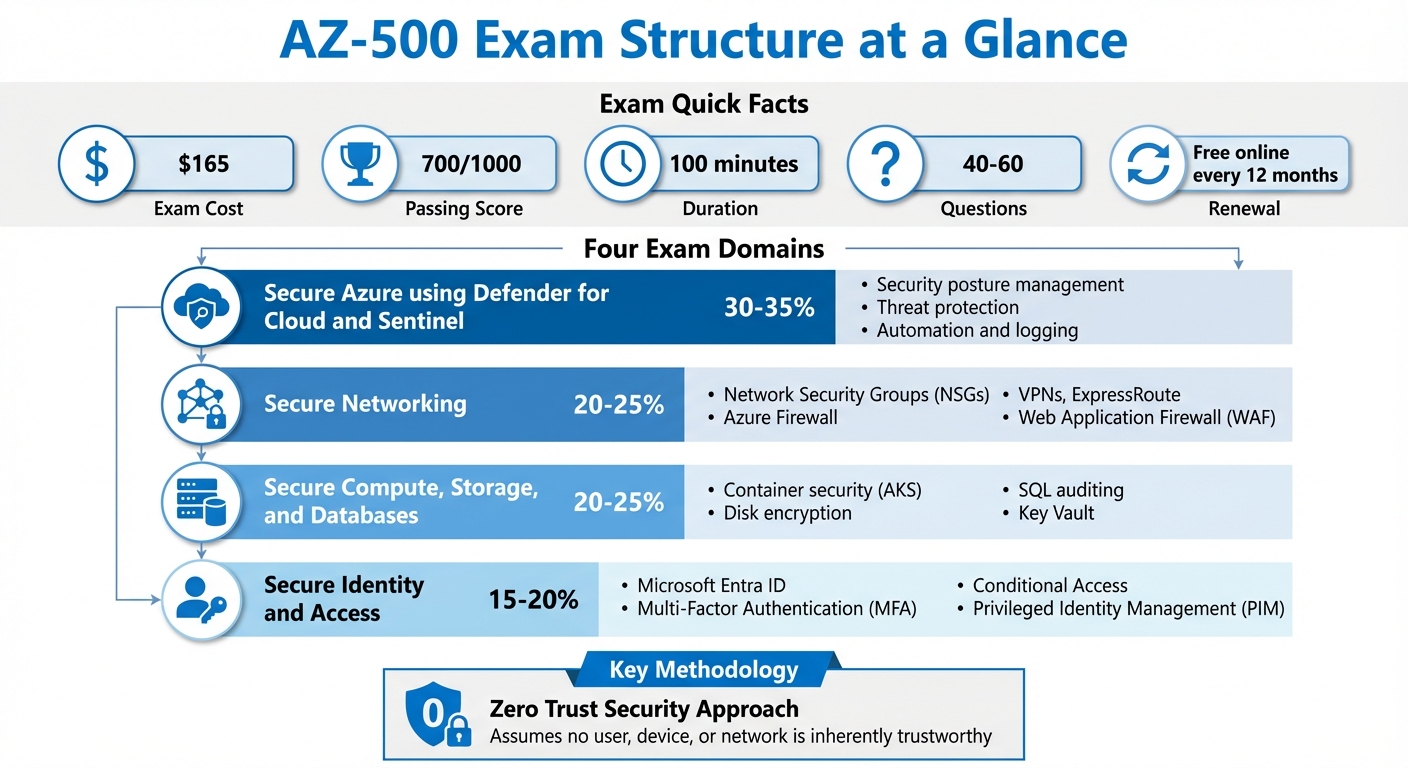
AZ-500 Azure Security Engineer Certification Exam Domains and Weightings

AZ-500 Azure Security Engineer Certification Exam Domains and Weightings

The Microsoft Certified: Azure Security Engineer Associate certification is earned by passing the AZ-500 exam. This credential demonstrates your ability to implement, manage, and monitor security controls across Azure, multi-cloud, and hybrid environments, ensuring a strong security framework [1].

Within Microsoft’s certification hierarchy, the AZ-500 bridges the gap between entry-level certifications like the AZ-900 and advanced credentials such as the SC-100 [5]. It’s tailored for professionals tasked with meeting rigorous security and compliance requirements. For those in cleared cyber security jobs, this certification validates expertise in safeguarding sensitive government data and critical infrastructure.

"As the Azure security engineer, you implement, manage, and monitor security for resources in Azure, multi-cloud, and hybrid environments as part of an end-to-end infrastructure." – Microsoft [1]

The 100-minute exam includes 40–60 questions in formats like multiple-choice, drag-and-drop, and case studies, testing your practical skills. According to Wayne Hoggett, Senior Azure Training Architect at Pluralsight, "While technically an associate level exam, AZ-500 is one of the more difficult associate-level Microsoft certification exams" [5].

Main Topics Covered in AZ-500

The exam focuses on four key skill areas, each weighted based on its real-world relevance. Starting January 2026, the most significant focus will be on security operations using Microsoft Defender for Cloud and Microsoft Sentinel, which make up 30–35% of the test [2].

Skill Domain Weighting Key Focus Areas
Secure identity and access 15–20% Tools like Microsoft Entra ID, Multi-Factor Authentication (MFA), Conditional Access, and Privileged Identity Management (PIM)
Secure networking 20–25% Includes Network Security Groups (NSGs), Azure Firewall, VPNs, ExpressRoute, Private Links, and Web Application Firewall (WAF)
Secure compute, storage, and databases 20–25% Covers container security (Azure Kubernetes Service), disk encryption, SQL auditing, and Key Vault
Secure Azure using Defender for Cloud and Sentinel 30–35% Focuses on security posture management, threat protection, automation, and logging

A major emphasis of the AZ-500 is the Zero Trust Security approach, which assumes no user, device, or network is inherently trustworthy. Anthony Bartolo from Microsoft states, "The Zero Trust Security approach, which assumes that all users, devices, and networks are untrusted and require constant verification, is one of the most critical security methodologies in the industry today" [4]. This strategy is essential for securing modern, high-stakes environments.

The exam also tests your ability to manage security across multi-cloud platforms like AWS and Google Cloud Platform (GCP) using Microsoft Defender for Cloud. Additionally, you’ll need to demonstrate how to align infrastructure with the Microsoft Cloud Security Benchmark (MCSB) and other regulatory frameworks, which are often critical in cleared cybersecurity roles.

Prerequisites and Required Experience

While there are no formal prerequisites for the AZ-500, Microsoft recommends at least one year of hands-on experience with Azure administration and a solid understanding of compute, networking, and storage services [1]. Familiarity with foundational certifications like AZ-900 and practical experience with AZ-104 is also advised [3][5]. Without this background, the exam’s technical depth can be challenging.

Key action verbs like "Implement", "Manage", "Configure", and "Monitor" frequently appear in the exam and highlight the importance of practical experience [5]. You should be adept at tasks such as configuring Microsoft Entra ID, managing network security groups, working with Key Vault, and responding to incidents using Microsoft Sentinel. For cleared professionals, experience in hybrid environments is especially critical, as many government agencies are transitioning from on-premises to cloud-based solutions. This expertise not only prepares you for the exam but also strengthens your ability to protect sensitive government data effectively.

Skills Validated by AZ-500 for Cleared Cybersecurity Jobs

The AZ-500 certification confirms technical skills that are directly aligned with the security needs of cleared government roles. These are hands-on abilities designed to safeguard sensitive federal data and critical infrastructure.

Identity and Access Management (IAM) is a cornerstone of cleared security work. The certification evaluates your ability to implement the principle of least privilege through tools like Azure Role-Based Access Control (RBAC) and Microsoft Entra Privileged Identity Management (PIM) [2]. It also covers configuring Just-In-Time (JIT) access and Conditional Access policies to enforce strict "need-to-know" standards [2][8]. As Jeff Porch, VP of Educational Services at Training Camp, puts it:

"I don’t teach from a textbook. I teach what happens in the SOC when the alert fires" [7].

This real-world focus is essential for roles requiring swift, accurate responses to security incidents. These identity controls work hand-in-hand with network defenses to secure sensitive systems.

Network security skills are equally critical. The exam ensures you can secure hybrid and cloud-only networks using tools like Network Security Groups (NSGs), Azure Firewall, and Web Application Firewalls (WAF) [2]. It also tests your ability to implement encryption for ExpressRoute and VPN connections [2]. These skills are crucial in cleared roles to prevent misconfigurations that could lead to data breaches. Beyond network security, the certification also evaluates your ability to manage cloud posture and protect data effectively.

Proficiency in Cloud Security Posture Management (CSPM) is validated using Microsoft Defender for Cloud, while data protection is assessed through Transparent Data Encryption (TDE) and Azure Key Vault. The certification also emphasizes threat detection and response using Microsoft Sentinel [2][8][9]. These tools are essential for Security Operations Center (SOC) roles, where constant monitoring and quick incident response are non-negotiable. Additionally, the AZ-500 meets DoD 8570 requirements, making it a recognized credential for cleared cybersecurity professionals [7].

Rounding out the skill set is container and compute security. The exam tests your ability to secure Azure Kubernetes Service (AKS) through network isolation, authentication, and activity monitoring [2][9]. This expertise is becoming increasingly important as government agencies adopt containerized and hybrid infrastructures.

How to Earn the AZ-500 Certification

Preparing for the AZ-500 certification involves focusing on four key domains, with a strong emphasis on securing Azure environments using tools like Microsoft Defender for Cloud and Sentinel. The exam consists of 40 to 60 questions, with a passing score of 700 out of 1,000 points. You’ll have 100 minutes to complete it, making time management crucial. For professionals working in sensitive sectors, this certification directly supports the protection of critical data and infrastructure.

Study Materials and Preparation Methods

Microsoft provides a free learning path titled "Secure cloud resources with Microsoft security technologies", which serves as the official resource for covering all exam domains. This self-paced program is an excellent starting point for your preparation [1]. However, hands-on experience is equally important. The official GitHub repository, AZ500-AzureSecurityTechnologies, includes 11 lab modules that cover practical exercises on topics like Role-Based Access Control (RBAC), Azure Firewall, ACR/AKS security, Key Vault, and Microsoft Sentinel [10].

When preparing, pay close attention to action verbs in the exam objectives, such as "Secure", "Implement", "Manage," and "Configure," as these indicate the practical skills you’ll be tested on [5]. For objectives involving "Plan" or "Enable", focus on understanding prerequisites and setup requirements. If the objective uses "Recommend", make sure you can evaluate the pros and cons of various Azure services [5].

To evaluate your readiness, Microsoft offers free practice assessments that highlight areas needing improvement [1]. Familiarize yourself with the exam interface using the Exam Sandbox, which provides a preview of interactive question types like drag-and-drop, hot area, and case studies [1]. Additionally, platforms like Pluralsight (use the code LEARNTECH50 for a 50% discount) and Coursera offer structured video courses and additional lab exercises to reinforce your knowledge [5].

Registering and Taking the Exam

Once prepared, you can register for the exam through the Microsoft Learn certification page. Select "Schedule exam" and choose Pearson VUE as the delivery provider [12]. Use a personal Microsoft Account (MSA) for registration instead of a work account. This ensures your certification records remain accessible even if you change employers [1].

The exam costs $165 USD and can be scheduled up to 90 days in advance. You also have the option to schedule two Microsoft certification exams at once [1]. Make sure your Microsoft Learn profile name matches the government-issued ID you’ll present on test day [12]. Exams can be taken at a local test center or online with remote proctoring. If you choose the online format, complete the Pearson VUE system check in advance to ensure compatibility with your device and network [12].

If you don’t pass on your first attempt, you can retake the exam after 24 hours. However, after a second failure, you’ll need to wait 14 days before trying again [1]. Since incorrect answers don’t incur penalties, it’s best to answer every question, even if you’re unsure [5]. If you need disability accommodations or extra time, submit your request to Microsoft before scheduling the exam to ensure everything is set up properly [12].

The certification is valid for 12 months, but you can renew it for free by passing an online assessment on Microsoft Learn. This eliminates the need to retake the full proctored exam [1].

Using AZ-500 to Advance Your Cleared Cybersecurity Career

The AZ-500 certification is a powerful way to build on your technical skills and take your cleared cybersecurity career to the next level. This certification opens doors to sought-after roles like Cloud Security Engineer, Systems and Network Administrator, and Technical Lead. With around 52,172 job openings for Cyber Security Engineers, the specialized knowledge you gain through AZ-500 directly applies to managing cloud infrastructure in cleared environments[6].

Adding AZ-500 to Your Cleared Cybersecurity Jobs Profile

One simple but impactful step after earning your AZ-500 certification is updating your Cleared Cyber Security Jobs profile. Make sure hiring managers can see your expertise by sharing your official digital badge from the Microsoft Certification Dashboard on platforms like LinkedIn. This provides a verifiable showcase of your skills[3]. As Sandra Marin from Microsoft puts it:

"It often takes less than a minute to update your LinkedIn profile and share your achievements, highlight your skills, and help boost your career potential"[3].

In the "Skills and Endorsements" section of your profile, include relevant keywords from the AZ-500 skills outline. Terms like "Microsoft Entra ID", "Azure Sentinel", "Network Security Groups", "Azure Firewall", and "Privileged Identity Management" can make your profile stand out to recruiters. Also, take advantage of the free renewal assessment on Microsoft Learn, which becomes available six months before your certification expires. This not only keeps your certification current but also shows your commitment to staying updated with cloud technologies[3]. Together, these steps ensure your profile aligns with the expectations of cleared cybersecurity roles.

Matching Certification Skills to Job Requirements

The skills covered in the AZ-500 exam align closely with what employers look for in cleared cybersecurity roles. Tailor your resume to reflect the exam’s key domains: "Secure identity and access", "Secure networking", "Secure compute, storage, and databases", and "Secure Azure using Microsoft Defender for Cloud and Microsoft Sentinel." Use action-oriented verbs like "Implement", "Manage", and "Monitor" to help your resume pass automated applicant tracking systems[2].

Emphasize your experience with tools and concepts like MFA, RBAC, Azure Firewall, NSGs, and SQL database auditing, as these are central to many cleared job descriptions. Highlight your proficiency with Microsoft security tools, including Microsoft Entra ID, Microsoft Defender for Cloud, and Microsoft Sentinel, since these are frequently requested in job postings[1]. As organizations adopt Zero Trust strategies and face challenges from advancements in AI, your skills in threat protection and vulnerability management are increasingly in demand[11].

Wrapping Up

The AZ-500 certification proves you have the skills to implement security controls, manage identity and access, and safeguard cloud infrastructure – key abilities for cybersecurity roles requiring security clearances. With this credential, you’re well-prepared for sought-after positions like Cloud Security Engineer or Security Operations Analyst.

What’s Next?

  • Explore the Microsoft Learn curriculum, which covers all four exam domains.
  • Practice using the Exam Sandbox and Practice Assessment to get comfortable with the question format.
  • Schedule your exam when ready.

Once you pass, make sure to update your professional profiles with skills highlighted in the exam outline, such as Microsoft Entra ID, Azure Sentinel, and Microsoft Defender for Cloud. These keywords can help align your profile with job requirements and boost your visibility to recruiters. Keep in mind that the certification is valid for 12 months, but you can renew it for free through an online assessment on Microsoft Learn.

Earning the AZ-500 is a smart move that can open doors to advanced roles and long-term career growth in secure environments.

FAQs

Is AZ-500 enough to qualify for DoD 8570 roles?

No, the AZ-500 certification by itself does not fulfill the requirements for Department of Defense (DoD) 8570 roles. These roles generally demand specific baseline certifications, such as Security+ CE, CISSP, or other approved credentials listed by the DoD. To ensure you meet the qualifications for your position, it’s essential to review the official DoD certification requirements.

How hard is the AZ-500 if I only have AZ-900-level knowledge?

The AZ-500 certification sits at an intermediate level, meaning jumping in with just AZ-900 knowledge might feel like a steep climb. To tackle it successfully, you’ll need to deepen your understanding of security-focused topics and get plenty of hands-on practice. Set aside dedicated time for studying and real-world application to close the knowledge gap and gear up for the challenge.

What hands-on labs should I do before taking AZ-500?

To get ready for the AZ-500 exam, dive into hands-on labs that focus on essential Azure security topics. Spend time practicing tasks like managing identity and access using Role-Based Access Control (RBAC), setting up network security groups, configuring the Azure Firewall, securing Azure SQL databases, and handling security policies.

Resources like Microsoft Learn and official study guides provide practical exercises that can help strengthen your skills in areas such as security controls, identity management, network security, and operations. These tools are a great way to build confidence and expertise before tackling the exam.

Related Blog Posts

  • Classified Cloud Security Jobs – AWS GovCloud and Azure Government Specialization
  • Security Plus Certification Career Guide for Cleared Entry Level
  • CCSP Certification Career Guide for Cleared Cloud Security
  • AWS Security Specialty Certification for Cleared Cloud Engineers

Related Guides

  • GCP Security Certification for Cleared Cloud Architects
  • AWS Security Specialty Certification for Cleared Cloud Engineers
  • CCSK Certification Career Guide for Cleared Cloud Knowledge
  • Cybersecurity Salary Guide 2026
  • TS/SCI Salary Premium: Real 2026 Numbers

AWS Security Specialty Certification for Cleared Cloud Engineers

CyberSecJobs Editorial · February 14, 2026 ·

The AWS Certified Security – Specialty certification is a must-have for cloud engineers working with classified or sensitive data. It validates expertise in AWS security, compliance, and incident response – skills in high demand for government and defense projects. With job postings requiring this certification increasing by 73% between 2021 and 2022, and average salaries projected to hit $158,000 annually by 2026, it’s a career booster for cleared professionals.

Key highlights:

  • Exam Overview: 65 questions, 170 minutes, $300 fee (50% discount for current AWS-certified professionals).
  • Core Domains: Infrastructure Security, Data Protection, IAM, Threat Detection, Logging & Monitoring, Governance.
  • Prerequisites: 5+ years of IT security experience, 2+ years securing AWS workloads.
  • Job Impact: Positions like Cloud Security Engineer and Senior Security Architect offer salaries up to $220,000.

This certification equips you to secure classified workloads, enforce compliance, and handle advanced AWS tools like GuardDuty, KMS, and Security Hub. It’s a practical investment for cleared engineers aiming to excel in high-stakes environments.

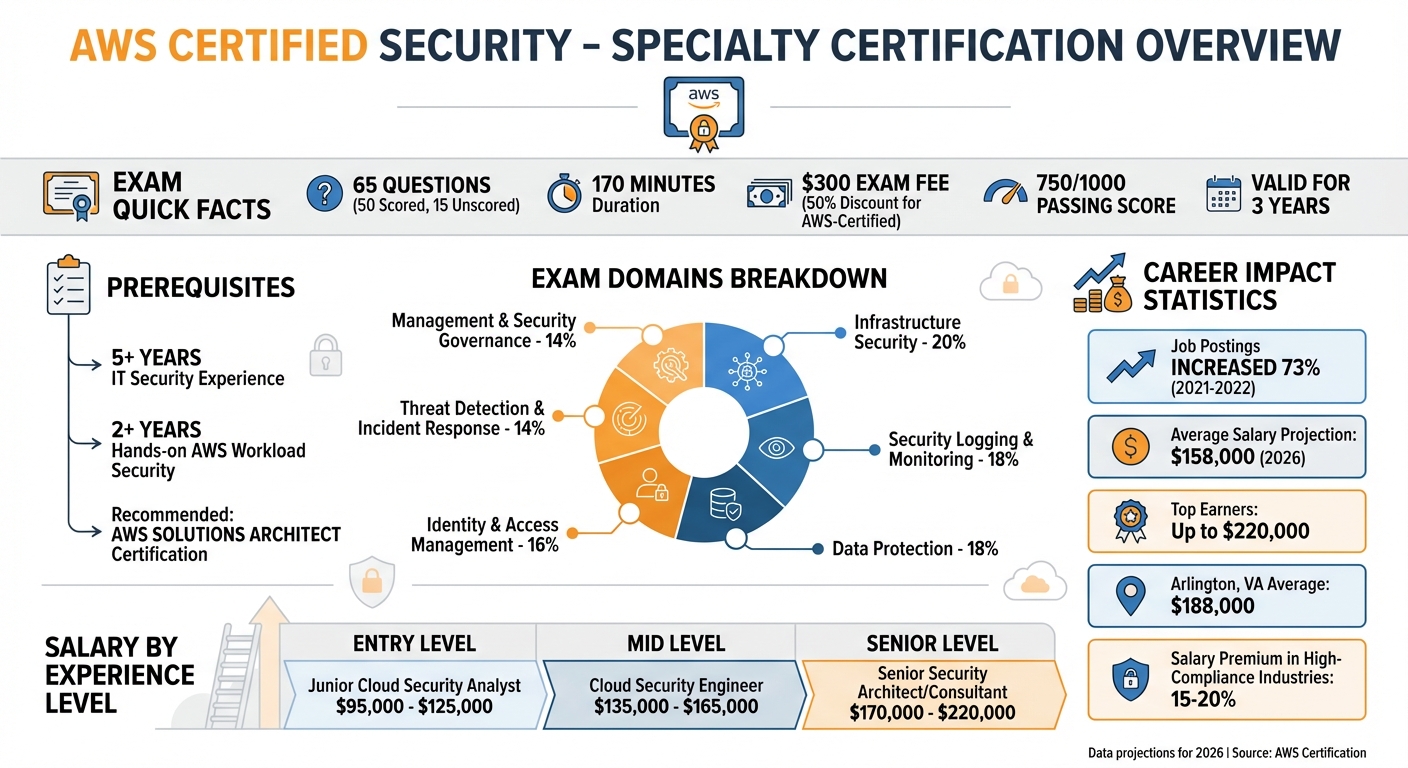
AWS Security Specialty Certification: Exam Details, Salary Projections, and Career Impact 2026

AWS Security Specialty Certification: Exam Details, Salary Projections, and Career Impact 2026

AWS Certified Security Specialty Exam (SCS-C02) Training Course

AWS

sbb-itb-bf7aa6b

What Is the AWS Certified Security – Specialty Certification?

The AWS Certified Security – Specialty certification validates your expertise in designing and implementing security solutions within the AWS Cloud. It focuses on advanced security practices, including encryption methods and compliance frameworks tailored for sensitive environments like government operations [1][2].

The SCS-C02 exam includes 65 questions (50 of which are scored), has a time limit of 170 minutes, and requires a minimum score of 750 out of 1,000 to pass. The exam fee is $300, but active AWS certification holders receive a 50% discount [1][5]. Candidates are expected to have five years of IT security experience and two years of hands-on experience securing AWS workloads [1][2]. Once achieved, the certification is valid for three years, after which recertification is required by passing the latest version of the exam [1][5]. These rigorous requirements highlight its importance, especially for professionals handling sensitive workloads.

Why Cleared Cloud Engineers Need This Certification

Cleared professionals often work in environments where security is paramount, and any lapse could have serious consequences. This certification equips them with the expertise to safeguard classified or sensitive workloads, aligning with the strict compliance and security standards required in government and defense projects [3][5].

The exam emphasizes compliance and governance using tools like AWS Config and Security Hub, which help enforce frameworks like CIS AWS Foundations and PCI DSS [3]. For projects that demand FIPS 140-2 Level 3 compliance, the certification covers AWS CloudHSM, a service that provides dedicated hardware security modules [3].

Additionally, it prepares candidates to respond to security incidents effectively. For example, you’ll learn to maintain data immutability with S3 Object Lock and Glacier Vault Lock, ensuring WORM (Write Once, Read Many) compliance for sensitive data [3]. By combining technical skills with compliance expertise, this certification empowers cleared engineers to handle the unique demands of government and defense projects.

Core Skills Covered

The certification’s exam domains mirror real-world security priorities, ensuring that the skills you gain are directly applicable to securing sensitive workloads. The exam is divided into six key domains:

Domain Weight Key Services and Topics
Infrastructure Security 20% AWS WAF, Shield, VPC, Security Groups, NACLs
Security Logging & Monitoring 18% CloudTrail, CloudWatch, VPC Flow Logs, Inspector
Data Protection 18% KMS, CloudHSM, S3 Encryption, Secrets Manager
Identity & Access Management 16% IAM Policies, Roles, Federation, Cognito
Threat Detection & Incident Response 14% GuardDuty, Security Hub, Detective
Management & Security Governance 14% AWS Organizations, SCPs, Config

Incident Response training includes tools like Amazon GuardDuty, Security Hub, and Detective to detect and address compromised resources [3]. You’ll also explore automation techniques, such as using Amazon EventBridge to trigger AWS Lambda functions for security remediation [3].

Logging and Monitoring focuses on setting up CloudTrail for auditing, CloudWatch for real-time alerts, and VPC Flow Logs for analyzing network traffic [3][7]. In Infrastructure Security, you’ll learn to design robust edge security with AWS WAF and Shield, as well as implement network segmentation using Security Groups and NACLs [3].

Identity Management covers complex authorization tasks, including creating IAM policies, managing roles, and enabling secure access to AWS resources through federation and SAML 2.0 integration with on-premises Active Directory [3][4][7].

Finally, Data Protection emphasizes mastering AWS KMS for encryption key management, CloudHSM for hardware-based security, and S3 Object Lock for preserving data integrity. For instance, you’ll learn to use S3 Object Lock in "Compliance" mode to ensure critical data remains untouchable, even by root users [3].

Certification Requirements and Exam Details

Prerequisites and Experience Requirements

You don’t need any prior AWS certifications to sign up for this exam [5]. That said, AWS strongly recommends candidates bring a wealth of practical experience to the table: five or more years of IT security experience focused on designing and implementing security solutions, alongside at least two years of hands-on experience securing AWS workloads [1][2][5].

To succeed, you’ll need a solid grasp of the AWS shared responsibility model, data encryption techniques, data classifications, and secure internet protocols [1][5]. Additionally, hands-on familiarity with key AWS services like IAM, CloudTrail, KMS, CloudWatch, GuardDuty, Security Hub, Macie, AWS Config, and WAF is essential [5]. While not mandatory, many candidates choose to first earn the AWS Certified Solutions Architect – Associate or Professional certifications to strengthen their cloud knowledge base [1][5]. This foundational expertise is especially valuable for tackling the complex demands of securing classified cloud environments.

Exam Format and Scoring

Preparation doesn’t stop at experience – it’s also about knowing the exam’s format inside and out. Referred to as SCS-C02, the exam includes 65 questions presented in multiple choice and multiple response formats [1][5]. However, only 50 questions count toward your final score, as 15 are unscored trial questions. Since these trial questions aren’t identified, every question deserves your full attention.

To pass, you’ll need a scaled score of 750 [5]. AWS uses a compensatory scoring method, meaning your overall performance across all domains determines your result [5]. This approach makes understanding the exam structure key for professionals working in high-security environments.

The test is available at Pearson VUE centers or through online proctoring, and it’s offered in several languages, including English, Japanese, Korean, Portuguese, Simplified Chinese, and Spanish [1][8]. After completing the exam, you’ll receive a detailed breakdown of your performance by domain, helping you identify areas to focus on if you need to retake it [5].

Benefits for Cleared Cloud Engineers

Cleared cloud engineers who master essential security domains unlock a range of career and technical advantages.

Job Demand and Salary Impact

Achieving the AWS Certified Security – Specialty certification can lead to some of the most lucrative positions in the cleared cybersecurity field. By 2026, professionals holding this certification are projected to earn an average base salary of $158,000 annually in the United States, with top earners in major tech hubs surpassing $200,000 per year [9]. In key defense and government contracting areas like Arlington, VA, average salaries can climb to $188,000 [9].

In high-compliance industries such as defense, fintech, and healthcare, cleared professionals often enjoy a 15% to 20% salary premium. This is because employers in these sectors value both expertise and the assurance that comes with it – mistakes in these fields can have enormous costs [9]. Additionally, this certification demonstrates the ability to implement advanced security measures, such as Service Control Policies across multiple accounts. This expertise can result in a 20% to 30% salary boost over those with only basic cloud knowledge [9].

Experience Level Job Role Estimated Salary Range (2026)
Entry Level Junior Cloud Security Analyst $95,000 – $125,000
Mid Level Cloud Security Engineer $135,000 – $165,000
Senior Level Senior Security Architect/Consultant $170,000 – $220,000

In addition to competitive pay, the certification hones technical skills critical for working in classified environments.

Technical Skills for Classified Work

This certification develops the expertise needed to secure classified and sensitive workloads effectively. For example, it provides advanced knowledge of data protection tools like AWS KMS and CloudHSM, ensuring compliance with FIPS 140-2 Level 3 and safeguarding data both at rest and in transit.

It also emphasizes continuous monitoring and auditing capabilities. You’ll learn to maintain detailed audit trails and detect threats in real time. Using tools like AWS Lambda and Amazon EventBridge, you can build automated workflows to immediately isolate compromised resources – an essential skill in environments where delays in response are unacceptable.

The training further covers designing secure network architectures. By leveraging VPCs, Network Access Control Lists, and private endpoints, you’ll be able to isolate sensitive workloads from public internet access while meeting stringent regulatory requirements. These skills are indispensable for maintaining security in high-stakes, classified settings.

How to Prepare for the Exam

Preparing for the AWS Certified Security – Specialty exam takes a mix of structured study, hands-on practice, and disciplined time management. Here’s how you can set yourself up for success.

Study Materials and Resources

Begin with the AWS Certified Security – Specialty Exam Guide and the Official Practice Question Set available on AWS Skill Builder [1]. These resources detail the exam’s scope and familiarize you with the types of questions you’ll encounter. AWS Skill Builder also offers an "Exam Prep Plan" featuring digital courses, AWS Builder Labs, AWS Cloud Quest, and AWS Jam for hands-on practice [1].

For additional preparation, platforms like A Cloud Guru (now part of Pluralsight) provide certification courses, quizzes, and an Exam Simulator that replicates the test environment [4]. This simulator is especially useful for practicing time management – try to answer 10 questions every 20 minutes [6].

Key AWS whitepapers to review include the "AWS Security Incident Response Guide", "KMS Best Practices", and "DDoS Best Practices" [4]. You can also access free sessions on AWS Training Live on Twitch, led by AWS experts [1]. If you’ve previously passed an AWS certification, take advantage of the 50% discount voucher for your next exam, bringing the cost down to $150 USD [1].

Exam Domain Weighting Services to Review for Exam Prep
Infrastructure Security 20% VPC, Security Groups, NACLs, WAF, Shield
Data Protection 18% KMS, CloudHSM, S3 Encryption, Secrets Manager
Logging and Monitoring 18% CloudWatch, CloudTrail, Config, Inspector
Identity and Access Management 16% IAM, Cognito, Organizations, Directory Service
Threat Detection and Incident Response 14% GuardDuty, Security Hub, Detective
Management and Security Governance 14% Organizations, SCPs, Trusted Advisor

Armed with these resources, it’s time to dive into practical application.

Hands-On Practice with AWS

"There’s no replacement for [hands-on experience]. We’re humans, and we learn by doing."
– Faye Ellis, Principal Training Architect, A Cloud Guru [4]

Relying solely on theory won’t cut it for this exam. Use the AWS Free Tier to practice with core security services like IAM, KMS, CloudTrail, and GuardDuty [3][4]. For services beyond the Free Tier, budget around $10.00 per month for practice exercises [10].

Set up at least three AWS accounts and use AWS Organizations to create a master account. This setup lets you practice cross-account IAM roles and resource sharing – skills essential for managing multi-account environments [10]. For encryption exercises, invest in a Customer Managed Key (CMK) in KMS, which costs about $1.00 per month [10].

You can also launch EC2 instances to practice enabling VPC Flow Logs, sending logs to CloudWatch, and setting alarms for rejected traffic on specific ports like port 22 [10]. Test S3 bucket policies and VPC endpoints by restricting bucket access to a specific VPC endpoint, then simulate failure scenarios using the CLI [10][11]. Additionally, experiment with Permission Boundaries and Attribute-Based Access Control (ABAC) by tagging users and designing policies that align access permissions with resource tags [10].

Once you’ve built your practical skills, it’s time to organize your study plan.

Creating a Study Schedule

Balancing work and exam prep can be challenging, especially for professionals. A three-month study plan works well for those with prior AWS experience.

  • Month 1: Focus on Identity and Infrastructure. Learn IAM policy evaluation, VPC security, and edge security tools like WAF, Shield, and CloudFront.
  • Month 2: Dive into Data Protection and Monitoring. Concentrate on KMS key policies, S3 security configurations, and services like CloudTrail and CloudWatch Logs.
  • Month 3: Cover Incident Response and Governance. Study services like GuardDuty, Security Hub, and AWS Organizations [6].

Use the final two weeks for practice exams from Whizlabs or AWS Skill Builder to fine-tune your timing and readiness [6]. Follow AWS’s 4-Step Plan: review the exam guide, fill knowledge gaps with courses, practice with flashcards and questions, and take the official pretest to gauge your preparedness [1]. When answering questions, prioritize the most secure solution unless the question explicitly asks for the "simplest" or "most economical" option [6].

To retain what you learn, review new material at intervals: after 10 minutes, 24 hours, one week, and one month. This approach can help you retain up to 90% of the information [4].

Using the Certification in Classified Environments

This section explores how to apply your certification skills to tackle the challenges of classified environments. With your AWS Certified Security – Specialty knowledge, you’ll be equipped to protect the nation’s most sensitive data. This certification confirms your expertise in managing specialized data classifications and AWS protection tools, which are critical for handling workloads across Unclassified, Sensitive, Secret, and Top Secret levels.

Securing Classified Workloads on AWS

For over a decade, AWS has been the go-to cloud service provider for U.S. government workloads, supporting the full spectrum of data classifications [12]. Your training enables you to enforce compliance with standards like DNI ICD 503 and NIST SP 800-53.

In classified environments, AWS handles the physical infrastructure’s security while you focus on applying OS and application STIGs. Using pre-approved CloudFormation templates, you can secure security groups, network ACLs, and deploy STIG-hardened machine images.

AWS Environment DoD Impact Level Classification Level
US East / West Regions IL 2 Unclassified / Public
AWS GovCloud (US) IL 2, 4, 5 CUI / Sensitive
AWS Secret Region IL 6 Secret
AWS Top Secret Cloud N/A (ICD 503) Top Secret

The AWS Top Secret Cloud is supported 24/7 by cleared U.S. citizens [12]. In October 2025, AWS expanded its Secret-level capacity by launching the Secret-West Region [16]. For example, the Naval Information Warfare Center (NIWC) Pacific used AWS in 2024 to create a compliant DevSecOps environment, accelerating classified research and development [16].

"By removing the undifferentiated heavy lifting of the underlying IT infrastructure, national security customers are able to focus on keeping the United States secure."

  • AWS Top Secret Cloud Documentation [12]

You can also streamline your compliance efforts by leveraging AWS FedRAMP and DoD provisional authorizations to reduce the burden of System Security Plans (SSP). Concentrate on shared and customer-specific controls, and automate compliance by enforcing programmatic policies. AWS Service Catalog templates allow you to lock down security settings, ensuring application owners cannot modify critical configurations like network ACLs.

Next, we’ll look at connecting AWS services with on-premises classified networks to complete your security strategy.

Connecting AWS with Classified Networks

Integrating AWS with on-premises classified infrastructure requires precise connectivity solutions. Your certification expertise in secure protocols and AWS networking is essential when using AWS Direct Connect. This dedicated, high-bandwidth connection bypasses the public internet, meeting strict requirements for Secret and Top Secret data transmission.

For workloads at Impact Levels 4 (IL4) and 5 (IL5), deploy the Landing Zone Accelerator (LZA) on AWS to align with DISA SCCA requirements [14]. While physical isolation was once the standard, the DoD Security Requirements Guide now allows logical separation for IL5 workloads if you demonstrate robust virtual separation controls and dedicated tenancy [15].

To enforce data handling standards, use resource tags (e.g., Classification: Secret) along with AWS Organizations tag policies. AWS Config can continuously monitor resources and flag any deviations from your security baseline. Always ensure cryptographic protection for sensitive government data by using FIPS 140-3 validated endpoints [13].

For ITAR-regulated or highly sensitive data, restrict access to "US Persons" as defined by federal regulations. Maintain a centralized data catalog that maps data locations, sensitivity levels, and applied controls – such as encryption, retention, and access restrictions. This ensures compliance while managing multi-tenant systems effectively. Alternate solutions may also be approved during the Provisional Authorization (PA) process [15].

Finding Jobs with Your Certification on Cleared Cyber Security Jobs

Cleared Cyber Security Jobs

Put your technical skills to work by targeting high-demand roles in cleared cybersecurity. With an AWS Certified Security – Specialty credential, you’re positioned for some of the most sought-after positions in the field. The key is making sure the right employers see it. Cleared Cyber Security Jobs connects you with a resume database that defense and intelligence contractors actively use to search through over 1.6 million qualified candidates.

Highlighting Your Certification on Resumes

Make your AWS Certified Security – Specialty credential stand out – especially alongside your clearance level. Recruiters often skim the first few lines of a resume for critical qualifications, so include this information in your professional summary or contact section. For instance, instead of burying it later in your resume, lead with something like: "TS/SCI cleared Cloud Security Engineer with AWS Certified Security – Specialty and 7 years securing classified workloads." [17][18]

Consider adding a Technical Skills section to your resume where "AWS Certified Security – Specialty" is prominently listed. Use the STAR method (Situation, Task, Action, Result) to quantify your achievements. For example, instead of writing "Managed AWS security", try: "Reduced system vulnerabilities by 35% through proactive threat monitoring using AWS Security Hub." This approach not only appeals to human recruiters but also improves your visibility in Applicant Tracking Systems (ATS) [17][18].

"Your security-cleared resume is not a biography or a mere list of qualifications. It’s an ad designed to help you land that coveted cleared job interview." – Ashley Jones, Editor, ClearedJobs.Net [18]

Keep your resume concise – limit it to one or two pages by removing outdated roles (older than 10 years) and focusing on your most relevant certifications [18][19]. Stick to simple formatting without graphics or unusual fonts to avoid issues with electronic scanning systems. Lastly, ensure your certification is active, as it’s valid for three years, so you remain competitive in the cleared job market.

Using Job Search Tools and Filters

Once your resume is polished, take advantage of job search tools to zero in on the right cleared cybersecurity positions. Cleared Cyber Security Jobs offers advanced filters to help you narrow results by clearance level (e.g., Secret, Top Secret, TS/SCI), polygraph requirements (CI or Full Scope), and work environment (on-site, remote, or hybrid). Use Boolean search operators to refine your search further – try something like "AWS" AND "GuardDuty" to find positions requiring specific tools. You can also set up automated alerts with keywords like "AWS Security Engineer" or "Cloud Architect" to receive regular updates on relevant openings.

The platform’s IntelliSearch™ feature matches the details of your security-focused resume to suitable positions, while the polygraph filter quickly highlights high-level roles that often come with premium pay for AWS expertise. By saving search filters, you can monitor multiple criteria at once, ensuring you don’t miss opportunities that align with your certification and clearance level. As of October 2024, the AWS Certified Security – Specialty is among the top-paying technical certifications in the U.S. [1], making these targeted tools especially valuable for boosting your earning potential.

Conclusion

The AWS Certified Security – Specialty is a key credential for cloud engineers working on classified projects. It confirms your ability to secure sensitive workloads, implement advanced encryption techniques, and navigate the critical tradeoffs required in high-stakes government settings. With demand increasing for experts who combine cloud skills with national security expertise, this certification holds significant value.

It also positions you as a trusted professional in managing complex data classifications across air-gapped systems and multi-level security setups, such as the Amazon Dedicated Cloud (ADC) [20]. As of October 2024, this certification ranks among the highest-paying technical credentials in the United States [1], underlining the essential role you play in safeguarding classified data and supporting intelligence missions. Beyond validating your technical skills, it sets you apart for top-tier cleared roles.

"This certification can build your credibility and position you as a trusted advisor to your stakeholders and customers." – AWS [1]

To connect with opportunities that align with your expertise, Cleared Cyber Security Jobs offers a focused platform. It features advanced filters for clearance levels, polygraph requirements, and work environments, helping you target roles like Cloud Security Engineer or DevSecOps within defense and intelligence sectors.

Whether you’re securing classified systems, designing incident response strategies, or architecting multi-level security frameworks, the AWS Certified Security – Specialty credential opens doors to some of the most challenging and rewarding careers in cleared cybersecurity.

FAQs

Is this certification worth it if I already have a clearance?

Earning the AWS Security Specialty certification is absolutely worth it, even if you already have a security clearance. This certification highlights your advanced skills in AWS security, adds credibility to your expertise, and opens doors to more opportunities in cloud security roles. It’s especially valuable when working with sensitive or classified cloud environments, helping you stand out in a competitive field.

Which AWS services should I practice most for SCS-C02?

When diving into AWS security, there are a few critical areas to master, especially if you’re preparing for the SCS-C02 exam or aiming to implement AWS security best practices.

Start with Identity and Access Management (IAM). This service is at the heart of controlling who can access your AWS resources and what actions they can take. Understanding how to configure IAM policies, roles, and permissions is essential for maintaining a secure environment.

Next, focus on data encryption. AWS offers multiple options for encrypting data at rest and in transit, such as using AWS Key Management Service (KMS) or enabling encryption for services like S3, RDS, and EBS. Knowing when and how to apply encryption ensures your sensitive data stays protected.

Don’t overlook security controls tailored for AWS environments. These include setting up security groups, network ACLs, and leveraging AWS Web Application Firewall (WAF) to guard against common threats.

Equally important are logging and monitoring strategies. Tools like Amazon CloudWatch and AWS CloudTrail help you track activity and detect anomalies. Combined with services like AWS Config, you can maintain compliance and quickly identify misconfigurations.

Finally, sharpen your skills in vulnerability management and incident detection tools. AWS Inspector, GuardDuty, and Security Hub are powerful resources for identifying vulnerabilities and responding to potential incidents.

By focusing on these areas, you’ll not only prepare for the exam but also gain a deeper understanding of how to secure AWS environments effectively.

How do I get hands-on experience without risking high AWS costs?

To get hands-on practice with AWS security while keeping costs low, take advantage of the AWS Free Tier. This allows you to experiment with services like EC2, S3, and CloudTrail without incurring charges. Just remember to shut down any resources when you’re done to prevent unexpected fees.

Another great option is to explore free AWS hands-on labs offered by various learning platforms. These labs don’t require a credit card and provide practical exercises in a controlled, risk-free environment. They’re a great way to build your skills and prepare for the AWS Security Specialty certification.

Related Blog Posts

  • Classified Cloud Security Jobs – AWS GovCloud and Azure Government Specialization
  • Security Plus Certification Career Guide for Cleared Entry Level
  • CCSP Certification Career Guide for Cleared Cloud Security
  • CCSK Certification Career Guide for Cleared Cloud Knowledge

Related Guides

  • GCP Security Certification for Cleared Cloud Architects
  • Azure Security Engineer Certification for Cleared Professionals
  • CCSK Certification Career Guide for Cleared Cloud Knowledge
  • Cybersecurity Salary Guide 2026
  • TS/SCI Salary Premium: Real 2026 Numbers

CCSK Certification Career Guide for Cleared Cloud Knowledge

CyberSecJobs Editorial · February 14, 2026 ·

Looking to advance your career in cloud security? The Certificate of Cloud Security Knowledge (CCSK) is a vendor-neutral certification by the Cloud Security Alliance (CSA) that validates your expertise in securing cloud environments. Its latest version, CCSK v5, released in July 2024, covers 12 domains including Zero Trust, AI security, and DevSecOps. Here’s why it’s worth considering:

  • Exam Details: 60 open-book multiple-choice questions, $445 fee, 80% required to pass, and two attempts allowed within two years.
  • Career Impact: Ideal for roles like Cloud Security Engineer and Cloud Architect. It also counts as one year toward CCSP certification requirements.
  • Cleared Professionals: Meets federal compliance standards (e.g., FedRAMP, NIST SP 800-53) and aligns with U.S. cybersecurity initiatives.
  • Study Resources: Free CCSK v5 Prep Kit, sample questions, and optional hands-on labs with the CCSK Plus course ($1,695).

Whether transitioning from military to civilian roles or enhancing your cloud security credentials, CCSK equips you to tackle multi-cloud environments and secure classified projects. Ready to take the next step? Start with the free prep kit and position yourself for top-tier cloud security roles.

CSA’s CCSK v5: The Essential Cloud Security Training & Certificate

sbb-itb-bf7aa6b

Career Benefits of CCSK for Cleared Professionals

CCSK vs CCSP vs CCZT Certification Comparison Chart

CCSK vs CCSP vs CCZT Certification Comparison Chart

Recognition and Career Growth

The CCSK certification builds credibility in the fast-paced world of cloud adoption, unlocking opportunities for roles like Cloud Security Engineer, Cybersecurity Consultant, Cloud Architect, and Cloud Advisor. This is especially relevant as federal agencies move sensitive workloads to secure cloud platforms [3].

Additionally, CCSK sets the stage for pursuing advanced certifications such as CCSP, CCZT, and CCAK [3]. Notably, earning the CCSK fulfills one year of the experience requirement for the CCSP, which typically demands five years of IT experience [7].

"Within a year of earning my CCSK, I was able to negotiate my way into an exciting new role with bigger benefits and compensation at a virtualization company where I support a cloud security product."
– Michael Benavidez, Technical Writer, Securitas [9]

You can also showcase your CCSK achievement with a digital badge on your resume or cleared job profiles, making your skills visible to recruiters and hiring managers. Plus, the certification contributes to continuing professional education (CPE) credits for other IT credentials [3].

This recognition positions professionals to blend cloud and cybersecurity expertise, enabling them to handle high-stakes projects with confidence.

Combining Cloud and Cybersecurity Skills

The CCSK v5 curriculum is tailored to address federal priorities, emphasizing Zero Trust architecture across its 12 domains to align with government mandates for secure systems [3]. It also includes training on DevSecOps, CI/CD pipelines, and automation – skills critical for managing classified projects that require secure and rapid deployment [3].

Another standout feature is its focus on AI and Generative AI security, replacing outdated IoT content with actionable strategies for safeguarding AI systems within cloud environments. Additional topics include serverless computing, data lakes, and cloud telemetry [3].

For those seeking hands-on learning, the CCSK Plus option offers practical labs simulating secure cloud migrations. This instructor-led course, priced at $1,695, helps participants build applied skills that are highly valued by cleared employers [8].

CCSK vs. Other Certifications

Comparing CCSK with other certifications helps professionals make informed decisions about their career paths. Here’s a quick breakdown of how it stacks up:

Feature CCSK CCSP CCZT
Focus Foundational Cloud Security Broad Information Security Zero Trust Strategy & Implementation
Experience Required None 5 years IT/Security experience None
Exam Format Open-book, Online Proctored, Closed-book Online
Exam Cost $445 Varies Included in $1,250 bundle with CCSK
Maintenance None required $135/year + 90 CPEs every 3 years Varies
Average Salary $121,932 $148,009 –
Best For Entry to Mid-level Cloud Roles Senior/Architect Roles Specialized Zero Trust Roles

The CCSK stands out for its open-book exam format and lack of experience requirements, making it an accessible choice for professionals starting or transitioning into cloud security. Its vendor-neutral framework ensures the skills are applicable across major cloud platforms, a critical factor for cleared environments.

"The CCSK covers the basics of strategic and tactical cloud security skills. The material for this certificate is vendor-neutral, meaning the skills should apply to any career path within cloud security."
– Coursera Staff [6]

How to Get the CCSK Certification

Study Resources and Exam Preparation

Start your CCSK journey with the free CCSK v5 Prep Kit, which includes a Study Guide, Knowledge Guide, sample questions, and the foundational "Security Guidance v5" document [11][13]. This kit is your go-to resource, covering everything you need for the exam.

For extra help, use the CCSK Orb chatbot, which provides topic-specific insights as you study [10][12]. If you prefer structured learning, consider the self-paced online course (15.5 hours) or the CCSK Plus course, which includes hands-on labs that simulate secure cloud migrations – especially useful for those working in secure environments [10].

Focus your preparation on the 12 domains of the v5 curriculum. Pay close attention to areas like Cloud Workload Security (11.67% of the exam), Infrastructure & Networking (10%), and Application Security (10%) [4]. The updated curriculum highlights critical topics such as Zero Trust strategy, Artificial Intelligence security, and serverless computing – key skills for professionals working in classified cloud projects [3].

"Obtaining the CCSK certificate was one of the best decisions I’ve made for my professional growth. Studying for the certificate not only deepened my technical knowledge but also improved my ability to communicate security concepts to non-technical stakeholders."
– Salvador Guarino Jr., CISO, PwC Philippines [14]

If you’re a U.S. Veteran, the GI Bill can fully cover your CCSK exam fees [5], making this an excellent opportunity for those with a military background. Once you’ve completed your preparation, you’ll be ready to schedule your exam.

Exam Details and Registration

Here’s what you need to know about the CCSK exam: The cost is $445, which includes two attempts valid for two years from the purchase date [3]. To register, create an account on the Cloud Security Alliance (CSA) platform and purchase an exam token [4].

The exam consists of 60 multiple-choice or true/false questions, with a time limit of 120 minutes [3]. To pass, you’ll need a score of at least 80%, though the average passing rate is currently 62% [4]. While there are no formal work experience requirements, having a basic understanding of firewalls, encryption, and Identity and Access Management (IAM) is recommended [4].

The test is open-book and taken online, so you can use study materials during the exam [3]. Before you begin, ensure you have a reliable internet connection and a quiet space for the two-hour test period [4]. Organize your notes and the Security Guidance v5 document in advance for quick reference during tricky governance or compliance questions [3]. Once you’ve registered, you’re ready to put your preparation into action.

Tips for Passing the Exam

To make the most of the open-book format, create an efficient reference system. Prepare an acronym list and bookmark important sections of the Security Guidance v5 document for easy access [3]. Since you can use these materials during the test, focus on understanding concepts rather than memorizing details.

Practice with the sample questions provided in the Prep Kit to get a feel for the exam’s phrasing and difficulty level [11]. Dedicate extra time to mastering new v5 topics like Artificial Intelligence (GenAI), Zero Trust strategy, and Data Lakes [3]. The CSA’s "Top Threats to Cloud Computing" series is another excellent resource for understanding the current threat landscape [4].

Prioritize domains with the highest exam weighting: Cloud Workload Security, Infrastructure & Networking, and Application Security together make up almost a third of the test [4]. Manage your time carefully – each question should take about two minutes on average [3]. If you’re unsure of an answer, flag it and move on, then revisit flagged questions with your reference materials before time runs out.

Using CCSK to Find Cleared Cloud Jobs

Your CCSK certification can be a powerful tool for landing cleared cloud security roles. By combining specialized job search strategies with the skills and knowledge you’ve gained, you can position yourself as a top candidate in the field.

Finding Jobs on Cleared Cyber Security Jobs

Cleared Cyber Security Jobs

Cleared Cyber Security Jobs is a platform designed to help professionals like you find roles that align with your CCSK certification. Start with the IntelliSearch feature to filter jobs using keywords such as "CCSK", "cloud security", or "Zero Trust." This allows you to focus on positions directly related to your expertise. For more precise results, use the Boolean Job Search tool. For example, you can search for "cloud AND security AND TS/SCI" to target positions that match your clearance level.

Uploading your resume is another key step – it increases your visibility to employers actively seeking CCSK-certified professionals. You can also set up job alerts to receive notifications about new opportunities. As of February 2026, there are 152 cloud security positions listed on the platform [15]. Additionally, the Skills Cloud feature highlights your CCSK credential alongside your clearance status, making it easier for recruiters to identify your qualifications at a glance.

Making Your CCSK Credential Stand Out

Once you’ve identified potential roles, ensure your resume places your CCSK certification in a prominent position. List your CCSK credential alongside your clearance to immediately catch the attention of employers. Take advantage of the digital badge provided by the Cloud Security Alliance – it’s a quick way for recruiters to verify your expertise. Add this badge to your resume and professional profiles for added credibility [4].

When detailing your experience, reference specific CCSK domains and quantify your achievements. For example, you might highlight how you reduced cloud vulnerabilities by 40% using Zero Trust principles or maintained 99.9% uptime for classified cloud systems [16]. Tailor your resume to each job description. If a position emphasizes Identity & Access Management, emphasize your CCSK training in that particular area [16].

What Employers Look For

It’s also important to understand what employers value in CCSK-certified professionals. Employers on Cleared Cyber Security Jobs often seek candidates with demonstrated expertise in areas like Zero Trust, DevSecOps, and Artificial Intelligence security. The CCSK certification stands out because of its challenging requirements – an average passing rate of 62% and a minimum score of 80% – which prove your mastery of vendor-neutral cloud security principles [4].

During interviews, be ready to discuss how your CCSK knowledge applies to practical challenges. For instance, explain how Zero Trust architecture or Cloud Telemetry could solve specific security issues in classified environments [3]. Use the platform’s Expressed Interest feature to show enthusiasm for particular roles, and the Following Companies tool to keep track of organizations that frequently hire for cloud security positions.

Feature Category Job Seeker Tools Employer/Recruiter Tools
Search & Discovery IntelliSearch, Boolean Job Search, Job Alerts Candidate Search, Skills Cloud Filtering
Profile Optimization Resume Upload, Skills Cloud, Digital Badges Profile Views, Pulse Networking
Engagement Expressed Interest, Following Companies Group Management, Direct Messaging
Visibility Active Clearance Status, Certification Listing Verified Professional Profiles

Conclusion: Moving Forward with CCSK

Earning the CCSK certification does more than validate your expertise – it positions you for sought-after cloud security roles in government and defense. As a vendor-neutral credential, the CCSK equips you with the knowledge to tackle complex security challenges in cleared environments, making it a solid foundation for advancing in this field [3].

Start your journey with the free CCSK v5 Prep Kit [1]. Once certified, highlight your digital badge on your resume and professional profiles to grab the attention of recruiters [3]. Use this certification as a springboard to boost your career in cleared cloud security.

Take the next step by uploading your resume to Cleared Cyber Security Jobs, setting up job alerts, and showcasing your CCSK certification alongside your security clearance. This combination makes you an ideal candidate for employers in the cleared space.

The CCSK also lays the groundwork for pursuing advanced certifications like the CCSP, CCZT, or CCAK, which can lead to senior-level opportunities [2]. Stay active in the cloud security field by participating in CSA working groups and webinars to keep your skills sharp and your network strong [3]. Investing in the CCSK today is a step toward securing your future in cleared cloud security roles.

FAQs

Is CCSK worth it for cleared jobs?

The CCSK certification holds significant value for cleared cybersecurity roles. As a globally recognized credential, it showcases expertise in cloud security, which is increasingly important in today’s tech landscape. Earning this certification can help professionals access new opportunities and qualify for higher-level positions in cloud-focused environments.

How hard is the CCSK v5 exam?

The CCSK v5 exam is no walk in the park. With 173 questions, it dives deep into modern cloud security concepts and best practices. To succeed, you’ll need to dedicate serious time to studying and truly understand the material. Preparation and consistent practice are key to tackling this challenge effectively.

What should I study first for CCSK v5?

To begin your journey with the CCSK v5 curriculum, focus on its foundational domains. These include Cloud Computing Concepts and Architectures, Cloud Governance, Risk, Audit, and Compliance, and Identity and Access Management. These areas lay the groundwork for understanding cloud security principles and form the core knowledge required for the certification.

Related Blog Posts

  • Classified Cloud Security Jobs – AWS GovCloud and Azure Government Specialization
  • GSEC Certification Career Guide for Cleared Security Essentials
  • Security Plus Certification Career Guide for Cleared Entry Level
  • CCSP Certification Career Guide for Cleared Cloud Security

Related Guides

  • GCP Security Certification for Cleared Cloud Architects
  • Azure Security Engineer Certification for Cleared Professionals
  • AWS Security Specialty Certification for Cleared Cloud Engineers
  • Cybersecurity Salary Guide 2026
  • TS/SCI Salary Premium: Real 2026 Numbers
  • « Go to Previous Page
  • Go to page 1
  • Interim pages omitted …
  • Go to page 24
  • Go to page 25
  • Go to page 26
  • Go to page 27
  • Go to page 28
  • Interim pages omitted …
  • Go to page 32
  • Go to Next Page »
  • Facebook
  • Instagram
  • LinkedIn
  • Twitter
  • YouTube

Cleared Cyber Security Jobs | CyberSecJobs.com

  • Contact
  • About
  • Privacy Policy