

The CIA hires cyber analysts to protect classified information and gather intelligence on adversaries. These professionals work in roles like Cyber Operations Officers, Cyber Targeters, and Digital Forensics Engineers. Responsibilities include monitoring threats, analyzing adversary behavior, and briefing policymakers. Key skills include programming (Python, Bash), network analysis, and proficiency in languages like Russian or Chinese. Applicants need at least a bachelor’s degree, a minimum 3.0 GPA, and must pass a rigorous Top Secret/SCI clearance process, including background checks, polygraph tests, and drug screenings. The hiring process can take 6–12 months, requiring strict discretion throughout.
| Phase | Duration | Activities |
|---|---|---|
| Screening | ~2 weeks | Resume and qualifications review |
| Interviews | 2–4 weeks | Panel interviews |
| HR Process | 1–4 weeks | Conditional offer, form submission |
| Security & Medical | 6–12+ months | Background checks, polygraph, medical exams |
| Final Approval | 1–2 weeks | Final review and orientation scheduling |
To apply, submit your application through the CIA’s MyLINK portal while in the U.S., and prepare a detailed 10-year history of residences, employment, and education. Avoid discussing your application online, as discretion is critical. This guide provides a roadmap for navigating the process and starting a career in national security.
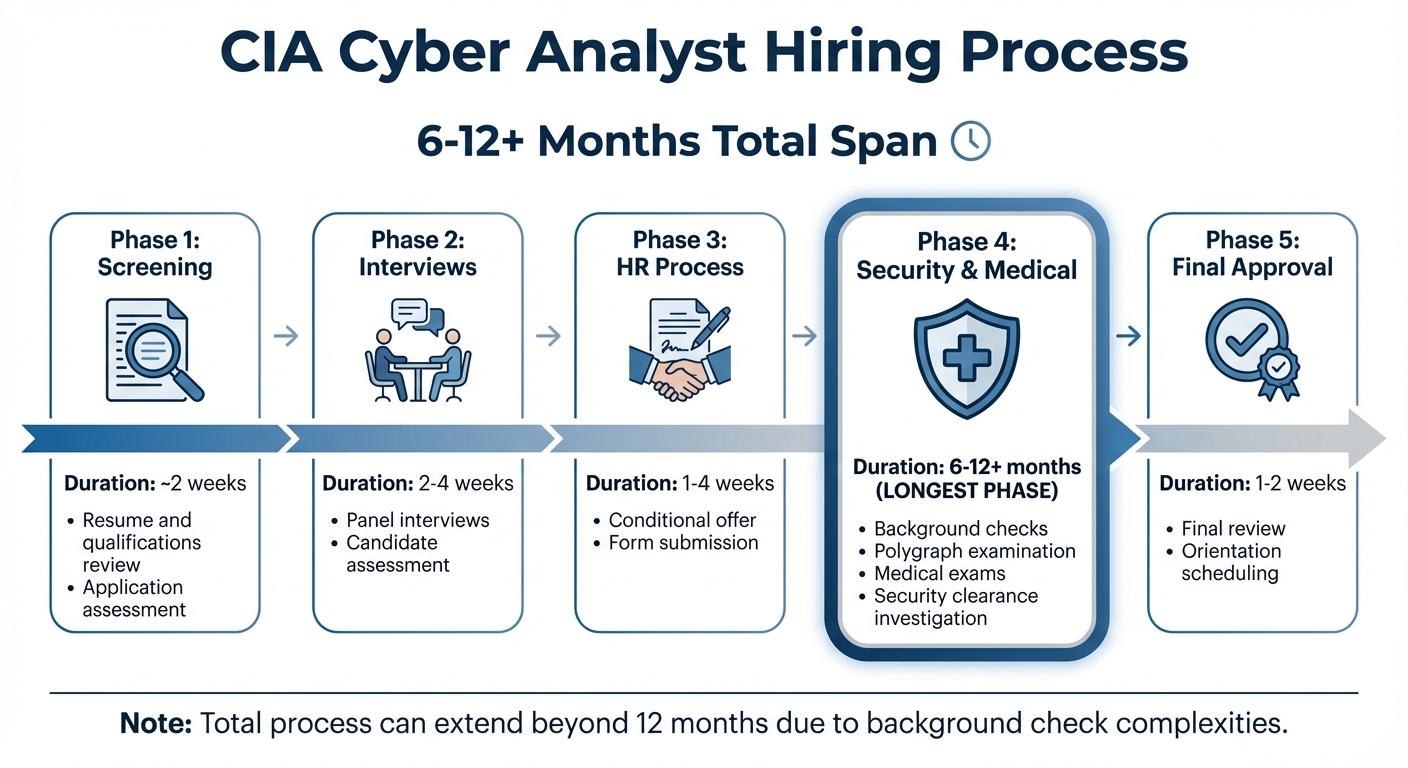
CIA Cyber Analyst Hiring Process Timeline: 6-12+ Month Journey
Inside CIA Targeting and OSINT: Intelligence Operations
sbb-itb-bf7aa6b
What CIA Cyber Analysts Do
CIA cyber analysts combine intelligence work with cybersecurity strategies. Their primary goal is to extract intelligence from adversary networks to identify and counter cyber threats [1]. This role demands a blend of offensive and defensive tactics – analyzing how foreign adversaries operate while also reinforcing national cybersecurity frameworks.
The responsibilities within this field can vary widely based on the specific role. For example, Cyber Operations Officers focus on using advanced tools to gather intelligence, while Cyber Targeters specialize in analyzing social networks. Digital Forensics Engineers use scripting languages like Python and Bash to recover critical data, and Data Analysis Officers rely on applied mathematics and SQL for interpreting massive datasets [1]. These varied roles emphasize the depth and breadth of expertise required in the CIA’s cyber domain.
Core Job Responsibilities
On a daily basis, cyber analysts work to monitor, assess, and mitigate cyber threats targeting U.S. interests. Their tasks include identifying patterns in adversary behavior, tracking foreign intelligence activities, and briefing policymakers on emerging risks. This proactive approach to threat management is essential for national security. Collaboration is key, as analysts work closely across different agency departments under the shared principle of "one team, supporting one mission" [3].
"The use of Artificial Intelligence (AI) technologies allows officers to analyze and interpret complex data needed to support CIA’s mission" [5].
Required Skills and Technical Tools
To fulfill their duties, CIA cyber analysts need a strong technical foundation across several domains. Their expertise includes network analysis, using TCP/IP protocols, and working with Linux-based systems. They also leverage Security Information and Event Management (SIEM) platforms like Splunk for monitoring and managing incidents [1]. Programming skills in Python and Bash are critical for automating tasks and creating custom tools for data recovery. Below is an overview of the required technical skills and tools:
| Required Technical Skills | Technical Tools |
|---|---|
| Reverse Engineering | Forensic Software & Recovery Systems |
| Programming and Scripting | Python, Bash, SQL |
| Network Monitoring | TCP/IP protocols, Linux systems |
| Event Management | Splunk (SIEM) |
Additionally, proficiency in languages such as Arabic, Chinese, Dari, Korean, Persian, or Russian enhances an analyst’s ability to assess foreign threats more effectively [4].
Job Requirements and Qualifications
Education and Work Experience
To be considered for a role at the CIA, applicants must hold at least a bachelor’s degree, though having a master’s degree in a relevant field can significantly enhance your application. Degrees in Computer Science, Cybersecurity, Engineering, Digital Forensics, Telecommunications, or Information Assurance are particularly aligned with the agency’s needs. For roles like Cyber Operations Officer or Cyber Targeter, a degree in a STEM field is often a must.
That said, technical degrees aren’t the only pathway. Fields like International Relations, Foreign Affairs, or Security Studies can also strengthen your application, particularly for positions focused on intelligence analysis. The BYU Economics Department highlights this requirement:
A bachelor’s degree or a master’s degree in a subject related to one of the analyst fields… is required. Applicants need to have a minimum 3.0 GPA to apply [6].
Relevant professional experience – such as work in digital forensics, network security, data analytics, or military intelligence – can either complement or, in some cases, substitute for formal education. The key is a strong academic background combined with expertise in areas critical to the CIA’s mission.
Security Clearance Requirements
In addition to meeting educational and experience requirements, securing a Top Secret/SCI clearance is mandatory for all CIA cyber analyst roles. This clearance process is among the most thorough in the federal government, involving an extensive background check. Investigators will conduct interviews with your personal and professional references, and you’ll also need to complete a polygraph test, as well as physical and psychological evaluations [3].
Your background is reviewed against 13 Adjudicative Criteria, which assess factors like potential conflicts of interest, susceptibility to coercion, and your ability to protect sensitive information. The CIA enforces strict drug policies: applicants must not have used marijuana or THC products within 90 days of applying, and any other illegal drug use or prescription drug misuse must have occurred no less than one year before applying [3].
The agency is clear about the importance of honesty during the application process:
Lack of candor, or dishonesty, which includes omitting, underreporting, or inconsistently reporting information at any time during the hiring process is contrary to what we value… and is the top reason we withdraw an offer of employment [3].
Additionally, male applicants between the ages of 18 and 25 need to be registered with the Selective Service to be considered for employment [3].
How to Apply for CIA Cyber Analyst Jobs
Application and Initial Screening
Once you’ve confirmed you meet the job requirements, the next step is submitting your application through the CIA’s MyLINK portal. Here, you can upload your resume and indicate interest in up to four positions. Keep in mind, you must be physically in the United States when submitting your application, or it will be disqualified [3].
The initial screening process typically takes about two weeks, during which recruiters assess your qualifications against the agency’s needs [7]. If you’ve used AI tools to create your resume, be upfront about how they were used, as AI assistance is not permitted for writing samples or assessments [3]. From the outset, the CIA places a strong emphasis on honesty and transparency.
If your application passes this stage, you’ll move on to the next phase: an extensive background investigation and clearance process.
Background Investigation and Clearance Vetting
Once you receive a conditional job offer, you’ll have five days to accept it and about two weeks to complete the required forms [7]. This kicks off the detailed security and medical evaluations, which can take anywhere from 6 to 12 months – or even longer [7] [8].
The background check is thorough, involving interviews with people who know you, such as neighbors, colleagues, and supervisors, to assess your character and trustworthiness [3]. You’ll also have to complete a polygraph test, along with physical and psychological evaluations conducted by the agency’s security professionals [3]. Starting in 2026, the outdated e-QIP system has been replaced by eApp, a digital platform for submitting the SF-86 form [8]. However, the wait time for a polygraph appointment remains a significant bottleneck for Intelligence Community positions [8].
Financial reviews are another key component of this process. To avoid potential issues, consider reviewing your credit history and resolving any delinquencies before applying. Financial problems are a common reason for clearance denials, so it’s better to disclose any concerns upfront, along with evidence of how you’ve addressed them.
By understanding these steps, you’ll be better prepared to navigate this complex process and stay on track.
Expected Timeline and Application Tips
The hiring process for a CIA Cyber Analyst position – from the initial application to onboarding – can take anywhere from 6 to 12 months or more [7] [8]. Here’s a general timeline to help you plan:
| Phase | Estimated Duration | Key Activities |
|---|---|---|
| Screening | ~2 weeks | HR review of your resume and qualifications [7] |
| Interviews | 2–4 weeks | Panel interviews to assess technical and professional skills [7] |
| HR Process | 1–4 weeks | Conditional offer extended; completion of agency forms and documentation [7] |
| Security & Medical | 6–12+ months | Background checks, polygraph, medical/psychological exams, and drug tests [7] [8] |
| Final Approval | 1–2 weeks | Final review by hiring authorities and scheduling for orientation [7] |
To streamline your application process, avoid discussing your application online. This includes not following the CIA on social media, liking their posts, or sharing updates about your status [3]. Prepare a detailed 10-year history of your residences, employment, education, and foreign contacts before accessing the eApp system to ensure accuracy [8]. Promptly respond to any communications from the agency, as delays can negatively impact your application [3]. Lastly, if you’re a male applicant aged 18 to 25, make sure you’re registered with the Selective Service, as this is a mandatory requirement for employment consideration [3].
Interview and Onboarding Preparation
How to Prepare for CIA Interviews
CIA interviews are designed to evaluate not only your technical skills but also how well you align with the agency’s mission. You’ll encounter questions about global events that impact U.S. national security, so staying up-to-date on these topics is crucial [2]. The agency values candidates who can tie their technical expertise to addressing real-world threats.
To prepare, focus on key areas like network security (firewalls, IDS/IPS, VLANs), cryptography (PKI, SSL/TLS, symmetric/asymmetric encryption), and incident response using tools such as Nessus, Nmap, or Wireshark [10]. It’s also important to understand frameworks like the NIST Cybersecurity Framework (Identify, Protect, Detect, Respond, Recover) and ISO/IEC 27001 standards, as these are integral to federal cybersecurity practices [10].
While technical knowledge is essential, honesty is even more important. Use the STAR method (Situation, Task, Action, Result) to craft stories that showcase your teamwork, problem-solving, and decision-making during security incidents [10]. Highlight skills like Python or PowerShell scripting, experience with SIEM tools, and cloud security expertise – these can potentially increase your salary by more than $15,000 [9].
Once you pass the interview, your focus shifts to a detailed onboarding process.
Starting Your CIA Career Successfully
After clearing the interview and security process, you’ll begin an intensive training program that introduces you to CIA policies, procedures, and specialized training tailored to your cyber role [2]. This phase is crucial for understanding how your technical skills fit into the agency’s broader mission. Cyber professionals typically work within the Directorate of Digital Innovation (focused on cybersecurity and IT infrastructure) or the Directorate of Analysis (focused on threat assessments), though your work may support any of the five directorates [2].
Since all CIA positions are based in Washington, DC [3], you’ll need to plan for relocation. Discretion is critical – avoid following the CIA on social media, liking their posts, or sharing anything about your employment [3]. For those in certain roles, such as those requiring undercover work, this discretion extends to family members [2]. During your first months, it’s important to respond promptly to inquiries and attend all appointments, as the agency will closely monitor your reliability and professionalism during onboarding [3].
Conclusion
A career as a CIA cyber analyst demands a mix of technical expertise, integrity, and unwavering patience. The agency’s rigorous clearance process includes an in-depth background investigation, a polygraph interview, and physical and psychological assessments [3]. Above all, honesty is non-negotiable. As the CIA emphasizes:
Lack of candor, or dishonesty… is the top reason we withdraw an offer of employment [3].
Even minor inconsistencies in your application can immediately disqualify you.
It’s also crucial to maintain discretion. Avoid following the CIA on social media or discussing your application publicly [3]. The agency makes it clear:
refraining from mentioning the submission of a resume or receiving an invitation to apply for employment with the CIA on social media [1].
This not only safeguards your privacy but also protects the agency’s operations.
The hiring process can be lengthy due to the extensive security checks, so patience is key [3]. If you aren’t selected, remember that you’ll need to wait 12 months before reapplying [2]. Throughout the process, make sure to respond quickly to communications and attend all scheduled appointments – your reliability is being evaluated at every step [2].
Use these insights, paired with our tailored resources, to confidently navigate the challenges of the application process. For professionals with security clearances looking to advance their careers, Cleared Cyber Security Jobs offers specialized guidance to help you succeed in this demanding but rewarding journey.
FAQs
What can I do to speed up the CIA clearance timeline?
To speed up the CIA clearance process, make sure your background investigation is complete and accurate. Any omissions or dishonesty can slow things down. Stay within the U.S. during this time, respond quickly to document requests, and complete all required paperwork ahead of time. Be ready for polygraph tests, as well as medical and psychological evaluations. Keeping communication clear and paying close attention to details can help you avoid unnecessary delays.
Will past drug use or debt automatically disqualify me?
The CIA doesn’t automatically disqualify candidates for past drug use or debt, but these factors can influence your security clearance and overall eligibility. A comprehensive background investigation is conducted to evaluate your character, trustworthiness, and loyalty. How you handle the process – especially your honesty and accountability – plays a key role in the assessment.
Do I need a cyber degree, or can experience and certs qualify me?
A specialized degree in cybersecurity isn’t always a must-have for landing a CIA cyber analyst role. Instead, experience, certifications, and practical skills can carry just as much weight. Credentials like CISSP or CEH, combined with relevant work experience, can significantly boost your application. The CIA places a high value on strong analytical skills and hands-on expertise, meaning candidates with solid experience and professional certifications can still qualify, even without a focused academic background.