

Looking to work at CYBERCOM? Here’s what you need to know:
- Location: CYBERCOM operates out of Fort Meade, Maryland, with 133 cyber teams defending DoD networks.
- Clearance Levels: Roles require security clearances like Secret, Top Secret (TS), or TS/SCI, often with polygraphs. Higher clearances offer salaries up to $230,000+.
- Key Skills: Proficiency in network defense, threat analysis, scripting (Python/PowerShell), and tools like Splunk, Wireshark, and cloud platforms (AWS/Azure).
- Certifications: Security+, CISSP, CEH, and GIAC are commonly required, with costs ranging from $400 to $1,200.
- Application Process: Apply via USAJOBS.gov, ensure your resume highlights active clearances, and prepare for in-depth technical and behavioral interviews.
- Demand: With 26% of U.S. cybersecurity roles unfilled and salaries 20%-40% higher than the private sector, opportunities abound.
This guide covers everything from clearance requirements to resume tips, ensuring you’re prepared to land a role at CYBERCOM.
The Life of an Air Force Defensive Cyber Warfare Operator – Chief’s Corner #28
sbb-itb-bf7aa6b
Security Clearance Requirements at CYBERCOM
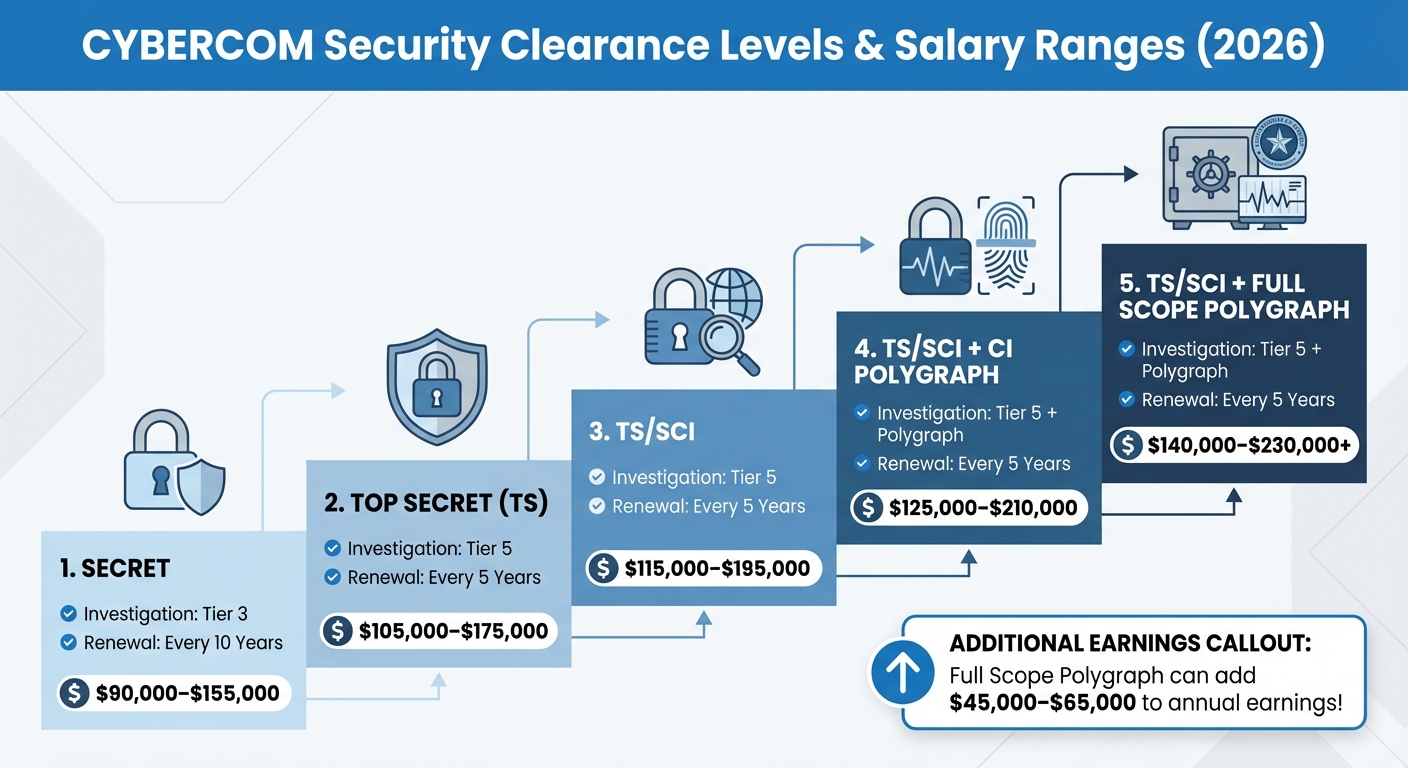
CYBERCOM Security Clearance Levels and Salary Ranges 2026
Clearance Levels Explained
CYBERCOM roles demand one of three main clearance levels, each granting access to increasingly sensitive information. For many entry-level government contractor positions, Secret clearance is the starting point. It requires a Tier 3 investigation and must be renewed every 10 years [5].
For roles involving critical national security information, Top Secret (TS) clearance is necessary. This level involves a more rigorous Tier 5 investigation, with renewals required every 5 years [5].
An additional layer, TS/SCI, is available for those with TS clearance. It provides access to intelligence managed under formal control systems [1][5]. Many CYBERCOM and NSA positions also require a Counterintelligence (CI) Polygraph or a Full Scope Polygraph (FSP). The FSP, which includes both counterintelligence and lifestyle questions, tends to narrow the candidate pool but often comes with higher salary offers [3].
| Clearance Level | Investigation Tier | Renewal Period | 2026 Salary Range |
|---|---|---|---|
| Secret | Tier 3 | 10 Years | $90,000–$155,000 |
| Top Secret | Tier 5 | 5 Years | $105,000–$175,000 |
| TS/SCI | Tier 5 | 5 Years | $115,000–$195,000 |
| TS/SCI + CI Poly | Tier 5 + Poly | 5 Years | $125,000–$210,000 |
| TS/SCI + Full Scope | Tier 5 + Poly | 5 Years | $140,000–$230,000+ |
Next, let’s look at what it takes to qualify for these clearances.
Eligibility Requirements
To apply for any Department of Defense (DoD) security clearance, U.S. citizenship is mandatory [4][5]. Applicants must complete the SF‑86 questionnaire through the eApp platform, which uses logic-based questions and built-in error checks to streamline the process [7]. The Defense Counterintelligence and Security Agency (DCSA) handles the majority of federal background checks, using 13 adjudicative guidelines to evaluate candidates [7].
One major factor in clearance approval is financial stability. In fact, financial issues are the top reason for clearance denials or revocations [6][7]. Applicants should gather 10 years of records, including details on residences, foreign contacts, employment, and education. It’s a good idea to pull your credit report early and address any delinquencies – having a repayment plan in place can help mitigate concerns during the review process.
The timeline for investigations varies, typically taking between 6 and 18 months. However, candidates with current clearances are often prioritized [2][5].
Understanding these requirements is key as you prepare for a CYBERCOM application.
How to Maintain Your Clearance
Under the Trusted Workforce 2.0 initiative, the process for maintaining clearance has shifted to Continuous Vetting, which monitors records in real time and eliminates the need for periodic reinvestigations [7]. This system also improves clearance reciprocity across agencies through a "clear once, trusted everywhere" approach.
Adjudicators may review public online activity, including social media and platforms like GitHub, to identify potential vulnerabilities [7]. To protect your clearance, follow strict guidelines regarding foreign contacts, financial management, and the handling of sensitive information. Before your investigation begins, secure your social media privacy settings and be transparent when filling out the SF‑86. Falsifying information is a serious disqualifier, so it’s better to provide context for any potential red flags.
For TS/SCI positions at CYBERCOM, work is typically conducted on-site in a Sensitive Compartmented Information Facility (SCIF). Personal devices like phones and recording equipment are prohibited in these secure environments [8].
Required Qualifications and Experience
CYBERCOM cyber analyst roles demand a mix of technical expertise, intelligence analysis, and strong communication skills. With the U.S. Bureau of Labor Statistics projecting a 33% growth in cybersecurity jobs through 2030 [10], it’s clear that these skills are in high demand. Here’s a closer look at what CYBERCOM seeks in its candidates.
Technical Skills Required
CYBERCOM analysts rely on an all-source intelligence approach, integrating HUMINT (Human Intelligence), SIGINT (Signals Intelligence), GEOINT (Geospatial Intelligence), and OSINT (Open-Source Intelligence) to build comprehensive threat assessments. This method helps identify adversaries’ strengths, weaknesses, and operational patterns.
Proficiency in network defense is critical. Analysts should be skilled with SIEM platforms like Splunk, ArcSight, or QRadar, as well as intrusion detection and prevention systems (IDS/IPS). Expertise in network protocols, packet analysis tools like Wireshark, and log analysis is also essential. Familiarity with the MITRE ATT&CK framework enables analysts to understand the Tactics, Techniques, and Procedures (TTPs) used by threat actors, moving beyond simple indicators of compromise.
Scripting and automation skills in Python or PowerShell are a must. These capabilities allow analysts to streamline tasks, create custom security tools, and manage large datasets efficiently. Additionally, as government agencies increasingly adopt cloud platforms, expertise in securing environments like Microsoft Azure or AWS is highly valued – potentially boosting salaries by over $15,000 [9]. Knowledge of DevSecOps principles and integrating security into the software development lifecycle is becoming standard practice.
| Skill Category | Essential Technical Skills | Relevant Tools/Frameworks |
|---|---|---|
| Intelligence | All-source analysis, TTP identification | HUMINT, SIGINT, OSINT, MITRE ATT&CK |
| Defense | Intrusion detection, Network monitoring | SIEM, IDS/IPS, Firewalls, Wireshark |
| Analysis | Scripting, Malware analysis, Forensics | Python, PowerShell, SQL, Forensics tools |
| Infrastructure | Cloud security, OS administration | Azure, AWS, Windows, Linux, VMs |
| Compliance | Risk management, Regulatory guidelines | NIST, ISO, GDPR, HIPAA |
Knowledge of cybersecurity frameworks such as NIST, ISO, and CIS is expected, especially for roles involving compliance and risk management. For incident response positions, skills in digital forensics and malware analysis are invaluable, helping to minimize damage during active threats.
Relevant Professional Backgrounds
Candidates with Computer Network Defense (CND) experience are highly sought after, particularly those who have worked in protection, detection, response, and sustainment roles within Computer Incident Response teams [4]. Military cyber units, government contractor roles, or private sector cybersecurity positions provide the kind of hands-on experience CYBERCOM values.
Experience in network traffic analysis, forensics, SOC operations, and frameworks like the Cyber Kill Chain or Intelligence Driven Defense demonstrates readiness for CYBERCOM’s fast-paced environment [4]. Highlighting expertise with Unix/Linux command line tools, Netflow analysis, and scripting languages on your resume can further strengthen your application.
Interpersonal Skills That Matter
Technical skills alone aren’t enough – communication and teamwork are equally vital. As noted in an NSSFed job posting, the ideal candidate is a "motivated self-starter with strong written and verbal communication skills, and the ability to create complex technical reports on analytic findings" [4]. Analysts must regularly brief senior leadership, work with legal teams, and coordinate with national-level agencies, making clear communication a priority.
"The most important skill an individual on a threat analyst team can have is the ability and inclination to continue learning and evolving their competencies." – Flashpoint [10]
Adaptability and a team-oriented mindset are also crucial. According to the U.S. Air Force, successful candidates exhibit "adaptability, a team mentality, leadership potential and a strong dedication to contribute to the Air Force’s mission" [11]. During high-pressure scenarios, creative problem-solving and the ability to stay calm while collaborating across diverse teams are essential. Be sure to showcase examples of leadership, teamwork, and adaptability in your application [11].
Job Responsibilities and Daily Duties
CYBERCOM cyber analysts work tirelessly to safeguard federal networks from advanced threats around the clock. As one Leidos team member explained, "Our team provides mission critical, 24/7 operational support to the customer’s mission of protecting federal networked systems and services from cyber threats impacting national security." [12] This role isn’t your standard 9-to-5 job – many positions involve rotating shifts, including daytime, evening, and overnight hours, ensuring constant vigilance. [12] These duties build upon the technical and interpersonal skills discussed earlier.
Threat Detection and Analysis
Cyber analysts are on the front lines, monitoring networks for unusual activity, identifying new threats, and profiling Advanced Persistent Threats (APTs). Using frameworks like MITRE ATT&CK, they assess adversary tactics and evaluate Indicators of Compromise (IOCs) and Indicators of Behavior (IOBs) to generate actionable intelligence. Their work extends to cloud environments, analyzing threats aimed at platforms like AWS, Azure, O365, and containerized systems. To streamline operations, they often design automated tools that feed threat data directly into security controls, cutting down response times and reducing manual tasks. Mastery of query languages such as SPL (Splunk) or KQL (Kusto) is vital for efficiently searching through vast datasets. [12]
Incident Response and Mitigation
In addition to detecting threats, analysts play a critical role in responding to incidents. They support "Hunt" missions and Defensive Cyber Operations by providing Indications & Warnings and key pivot points to guide investigations and containment strategies. Their expertise in models like the Cyber Kill Chain and the Diamond Model of Intrusion Analysis helps them understand the progression of attacks and prioritize responses effectively. Analysts also produce intelligence reports tailored to strategic, operational, and tactical levels, ensuring that everyone from military commanders to senior leaders is informed about emerging threats and their potential impact on national security. Clear communication is crucial here, as they must translate complex technical findings into actionable recommendations. [12]
Working with CYBERCOM Teams
Collaboration is at the heart of CYBERCOM’s mission. Analysts frequently partner with network administrators, computer systems analysts, and intelligence teams to ensure robust network security and document recovery processes. [13][14] They provide critical advice to military commanders on force protection and deliver real-time threat alerts to aid operational decision-making. [16]
"Intelligence is one of the best and most important weapons at our disposal." [16]
How to Write Your Resume for CYBERCOM
When crafting your resume for CYBERCOM, it’s crucial to emphasize your cybersecurity skills and experience in a way that stands out to hiring managers and navigates Applicant Tracking Systems (ATS). With recruiters spending less than a minute reviewing applications, every detail matters [23]. Make sure your security clearance, technical expertise, and relevant accomplishments are front and center.
Where to List Your Security Clearance
Your active security clearance is a major asset, so don’t bury it in your resume. Highlight it near the top of the first page, either in your professional summary or directly below your contact information [17][19]. Use specific terms like TS/SCI, CI Poly, or Full Scope Poly instead of vague descriptions like "top-level clearance" [19].
"List your active clearance level (e.g., Secret, Top Secret, TS/SCI) near the top of your resume – ideally in your professional summary or contact section. Make it easy for hiring managers and recruiters to see immediately." – LaunchCode [17]
Include details such as the issuing agency (e.g., Department of Defense) and the date your clearance was granted or renewed [19]. If you hold Special Access Program (SAP) or Need-to-Know (NTK) clearances, mention these too, but avoid revealing classified project specifics [19]. To improve ATS compatibility, weave keywords like "security clearance", "TS/SCI", and "polygraph" throughout your resume [17][19][21].
Once your clearance is highlighted, shift focus to showcasing your work history.
How to Present Your Experience
Organize your work history in reverse chronological order, concentrating on the past decade of relevant roles [24][21]. Start each bullet point with strong action verbs like "Detected", "Investigated", "Hardened", or "Mitigated" to convey initiative and responsibility [21]. Use measurable results to demonstrate your impact.
For example, instead of saying "Improved threat detection", opt for something like, "Reduced Mean Time to Detect (MTTD) from 8 hours to 45 minutes by optimizing SIEM workflows and implementing automated playbooks" [22]. Pair your clearance with quantifiable achievements, such as, "Maintained TS/SCI while managing secure networks for 5,000+ users with 99.9% uptime" [17].
Provide context about your work environment, such as the size of the organization, the number of endpoints you managed, or whether you worked in a 24/7 Security Operations Center (SOC) [21]. Tailor your language to reflect the terminology used in the CYBERCOM job posting. For instance, if the listing mentions "Microsoft Sentinel", use that exact term instead of "Azure Sentinel" [22][21].
"An analyst who lists some tools is telling me they know how to navigate and operate the tool, but do they know why they were doing it… a security analyst who talks about functions they’ve performed suggests they understand the process – the work beyond the tools." – Peter Gregory, Senior Director for Cybersecurity, GCI Communication Corp [25]
Focus more on your role in security processes than simply listing tools. Highlight tasks like "analyzing and triaging alerts" or "performing risk analysis." Employers can train you on new tools, but they value a solid understanding of core security principles [25].
Finally, round out your resume by emphasizing your certifications and technical training.
Including Certifications and Training
Certifications are critical in cybersecurity, so make them easy to find. Dedicate a section near the top of your resume for certifications rather than tucking them into a general skills list [22][23].
"Certifications are non-negotiable in cybersecurity. Security+, CySA+, or CISSP should be in a dedicated section, not hidden in your skills list." – WriteCV Guide [22]
List certifications by their full name along with the date obtained. If you’re working toward a certification like CISSP or CEH, include it with an expected completion date to ensure it’s visible to recruiters [20].
Organize your technical skills into categories like SIEM/SOAR, Cloud Security, Scripting/Languages, and Vulnerability Management. This helps hiring managers quickly identify your expertise [22][21]. Also, demonstrate knowledge of frameworks relevant to government roles, such as NIST 800-53, MITRE ATT&CK, and DISA STIGs [21][9]. If you lack professional experience, consider adding a "Projects" section to showcase home labs, Capture the Flag (CTF) competitions, or tools you’ve used in training [18][23].
Stick to an ATS-friendly format: use a clean, single-column layout, standard fonts like Calibri or Arial (10–12 pt), and clear section headings [22][21]. Save your resume as a PDF unless the job posting specifies otherwise [21][23]. Keep in mind that ATS systems for cybersecurity roles often evaluate resumes based on Keywords (40%), Security Metrics (25%), and Structure/Formatting (35%) [22].
Certifications for CYBERCOM Cyber Analysts
Certifications are a must-have for CYBERCOM roles, as outlined in DoD Directive 8570.01-M and DoD 8140. These credentials prove you have the technical know-how and practical skills to handle critical tasks like incident response, defensive operations, and offensive security.
Most Requested Certifications
One of the most common starting points is CompTIA Security+, a foundational certification required for many DoD 8140 roles. With more than 700,000 holders globally [27], it’s priced between $404 and $425 and covers core security principles. For those advancing to intermediate positions, CompTIA CySA+ (also $404) focuses on incident detection and response, making it ideal for Cyber Defense Analysts.
If you’re aiming for senior-level jobs like Security Manager or Senior Security Engineer, the CISSP is the gold standard. It costs $749 and is frequently listed in cybersecurity job postings. Cleared professionals with a CISSP often earn between $150,000 and $180,000. Keep in mind that while five years of experience are required, a four-year degree can waive one year of this prerequisite.
For roles emphasizing offensive tactics, the Certified Ethical Hacker (CEH) is highly regarded. Approved under DoD 8570, its cost ranges from $950 to $1,199. The latest version, CEH v13, even includes AI-focused material to address modern threats. Additionally, GIAC certifications like GCIH (around $999) and GSEC are popular choices for hands-on roles in incident response and cyber defense.
Once you’ve identified the certifications that align with your career goals, the next step is understanding how to earn and maintain them.
Getting and Renewing Certifications
Start by selecting the certification that matches your target role. Review the official exam objectives to identify areas where you may need additional study. Resources like self-study guides, eLearning platforms such as CompTIA CertMaster, or in-person training can help you prepare. Gaining practical experience through virtual labs, Capture the Flag (CTF) events, or personal lab setups is equally important.
Most certifications have a three-year expiration period and require renewal through continuing education or reexamination to stay relevant in the fast-changing cybersecurity landscape. Don’t forget to check with your employer – about 40% of cybersecurity professionals report that their companies cover the costs of exams, training, and renewal fees [26].
The CYBERCOM Hiring Process
The hiring process at CYBERCOM is thorough and requires patience and careful attention to each step. From submitting your application through federal platforms to completing security onboarding, every stage demands preparation and precision.
How to Apply
Most CYBERCOM job postings are found on USAJOBS.gov, the federal government’s employment website. To get started, you’ll need to create a profile and upload a resume formatted to meet federal standards. This typically involves a detailed chronological format that includes information like supervisor contact details and the number of hours worked per week for each role.
For security clearance applications, the federal government now uses the eApp platform under the Trusted Workforce 2.0 framework [7]. To save time, gather 10 years of residential, employment, and foreign contact history before starting your eApp submission. This preparation can significantly reduce processing delays. If you already hold a security clearance from another agency, reciprocity transfers are supposed to take between 30 and 75 days. However, delays of 90 to 150 days are common [7]. Even with these delays, having an active clearance gives you a strong advantage.
| Clearance Level | Average Processing Time | Key Factors |
|---|---|---|
| Secret (Tier 3) | 60 to 150 days | Completeness, foreign contacts, backlog [7] |
| Top Secret (Tier 5) | 120 to 240 days | Complexity of background, travel, foreign ties [7] |
| TS/SCI with Polygraph | 180 to 365+ days | Polygraph appointment waitlist [7] |
| Interim Secret | 10 to 30 days | Initial automated checks [7] |
Once your application is submitted, you’ll need to prepare for a rigorous interview process.
Interview Preparation Tips
CYBERCOM interviews are designed to evaluate both your technical expertise and your ability to operate in classified environments. Expect technical questions that test your experience with tools like SIEM platforms (e.g., Splunk, Microsoft Sentinel), EDR tools, and threat intelligence platforms such as Recorded Future or ThreatConnect [28][30]. Additionally, you’ll need to demonstrate strong communication skills, especially your ability to explain complex technical threats in terms that non-technical stakeholders can understand. Using analogies instead of technical jargon is key here [28][29].
To tackle behavioral questions, use the STAR method (Situation, Task, Action, Result). Be prepared to discuss high-pressure incidents and walk through the incident response lifecycle: identification, containment, eradication, recovery, and lessons learned [29]. For scenario-based questions, such as dealing with an "unknown threat actor", focus on immediate isolation of affected systems followed by forensic analysis [28].
Another critical step is reviewing your digital footprint. Hiring managers and adjudicators often examine public-facing online activities, including GitHub contributions, professional forums, and social media profiles, to assess your operational security (OPSEC) awareness [7]. Before applying, audit your social media privacy settings and professional networking profiles to ensure they reflect sound judgment and avoid any vulnerabilities that could be exploited [7].
"Falsification on the SF-86, even on a minor point, is often the most easily preventable yet fatal mistake. Candor is paramount" [7].
Onboarding and Initial Training
If you pass the interview and your clearance is approved, the onboarding process begins. New hires are briefed into classified programs and required to sign non-disclosure agreements (NDAs) [7]. Training often takes place at specialized facilities like the DC3 Cyber Training Academy [31]. Depending on your service branch, additional training may occur at locations such as the U.S. Army’s Cyber Center of Excellence (CCoE), the Navy’s Center for Information Warfare Training (CIWT), or the Air Force’s Cyberspace Technical Center of Excellence (CyTCoE) [31].
Once hired, you’ll be monitored under Continuous Vetting (CV). This system replaces periodic reinvestigations with real-time monitoring of criminal, financial, and travel records [7]. To maintain your clearance, you’ll need to self-report significant life events, such as arrests, large debts, or foreign contacts, to your Security Officer. The Defense Counterintelligence and Security Agency (DCSA), which handles over 95% of federal background investigations, oversees these continuous checks [7].
Using Cleared Cyber Security Jobs to Find CYBERCOM Positions
For cyber professionals looking to contribute directly to CYBERCOM’s mission, this platform provides tailored tools and resources to simplify the search for positions in the cleared cybersecurity field.
Job Search Tools and Filters
Cleared Cyber Security Jobs offers advanced filters designed for professionals with security clearances seeking CYBERCOM roles. You can narrow down opportunities by job title, location – such as Fort Meade, MD (CYBERCOM headquarters), or Augusta, GA, a key hub for U.S. Cyber Command [1][32] – and by work type (Remote, Hybrid, or On-site) [32]. The platform also features automated job alerts that align with your skills, career goals, and clearance level [32]. When setting up your profile, make sure to highlight your highest clearance level – having a Full Scope Polygraph (FSP) can increase annual earnings by $45,000–$65,000 over your career [1]. By joining the platform’s talent community, you’ll gain access to notifications about CYBERCOM-related events, including tech talks, open houses, and even hackathons tailored for the defense and intelligence sectors [32]. These tools streamline your job search and connect you directly with opportunities to engage with recruiters at specialized events.
Attending Job Fairs
Cleared Cyber Security Jobs also organizes job fairs where cleared professionals can meet CYBERCOM recruiters and defense contractors face-to-face. These events are a direct channel to discuss roles and showcase your expertise. Meeting hiring managers at these fairs can speed up the hiring process, as they are well-versed in the specific requirements of cleared cyber analyst positions. With cybersecurity roles expected to grow by 35% over the next decade [15] and 26% of positions projected to remain unfilled by 2026 [1], attending these fairs gives you a competitive edge in securing interviews. Beyond these events, the platform offers additional resources to help refine your career strategy.
Career Resources Available
The platform also provides tailored career guides for cleared professionals. These include detailed tips for clearance interviews, insights into salary premiums, and pathways to entry-level certifications [1]. An interactive Career Path Finder offers personalized job recommendations based on your experience and clearance level [1]. For salary benchmarking, the Cybersecurity Salary Guide is a valuable tool – it shows that in Augusta, GA, the average cleared salary is $108,000, which adjusts to $122,700 when factoring in the area’s lower cost of living [1]. Additionally, certifications like CISSP or C|EH can boost your salary by 10% to 15% [15]. These resources equip you with the knowledge to navigate the cleared cybersecurity job market effectively.
Conclusion
This guide has covered the key steps needed to land a cyber analyst role at CYBERCOM, emphasizing that success requires more than just technical expertise. A combination of the right security clearance, targeted certifications, and a strategic job search is essential. With 26% of cybersecurity roles projected to remain unfilled by 2026 and demand expected to grow by 29% through 2034, the field offers strong opportunities for those who meet these rigorous criteria [13][1]. Notably, obtaining a Full Scope Polygraph can increase annual earnings by $45,000–$65,000, significantly enhancing long-term income potential [1].
Start by securing foundational certifications like Security+, which align with DoD standards, and consider applying in high-demand areas such as Augusta, GA [2][1].
To streamline your job search, leverage platforms tailored to cleared professionals. Upload your resume to sites like Cleared Cyber Security Jobs, set up alerts based on clearance and location, and attend industry events to connect with CYBERCOM recruiters and top defense contractors [2].
Build a practical portfolio that highlights your skills in threat detection and incident response using tools like Splunk, Wireshark, and ACAS [2][33]. Showcase your abilities through home labs, GitHub projects, and other hands-on work. Keep in mind, many roles require on-site work in secure environments [1]. Position yourself strategically to stand out in this competitive but rewarding field.
FAQs
Can I apply to CYBERCOM without an active clearance?
To apply for roles at CYBERCOM, having an active security clearance is a must. This requirement applies to nearly all positions within CYBERCOM and other similar cybersecurity roles that require clearance.
What can delay a TS/SCI or polygraph the most?
The primary reason for delays in getting a TS/SCI clearance or polygraph is examiner availability and scheduling problems. With a limited number of examiners and various logistical hurdles, the process often takes longer than expected. On top of that, delays may increase if multiple polygraph sessions are required or if initial attempts result in failures, adding further complications to scheduling. These issues are the most frequent roadblocks in the clearance process.
What should I build to prove I can do the job?
To stand out as a cyber analyst at CYBERCOM, create a technical portfolio that demonstrates your ability to spot, analyze, and address cyber threats. Emphasize expertise in areas such as network defense, forensic investigations, and incident response. Include examples of hands-on experience with tools like Intrusion Detection Systems (IDS), Security Information and Event Management (SIEM) platforms, and Endpoint Detection and Response (EDR) solutions. Additionally, earning certifications such as CompTIA Security+ or CISSP can showcase your knowledge and dedication to meeting cybersecurity standards.