

CISA cyber analysts protect critical systems and networks, playing a key role in national security. To qualify, you need a security clearance (Secret or Top Secret), relevant certifications (like CISSP or CEH), and technical expertise. The job offers strong growth prospects, with salaries starting at $65,000 and reaching over $200,000 for senior roles.
- Clearance Levels: Secret (renew every 10 years) or Top Secret (renew every 5 years).
- Certifications: CompTIA Security+, CISSP, CEH, and others.
- Responsibilities: Threat monitoring, incident response, and vulnerability management.
- Application Process: Use USAJobs.gov with a detailed federal-style resume.
- Career Growth: Salaries increase with experience, certifications, and specialized skills like cloud security or AI.
CISA also supports professional development, funds certifications, and offers clear career advancement paths. Prepare by gaining hands-on experience with tools like Splunk, Python, and Kali Linux. Tailor your resume, network at hiring events, and stay updated on federal cybersecurity priorities.
1% Cybersecurity Jobs DHS & CISA
sbb-itb-bf7aa6b
Security Clearance Requirements for CISA Cyber Analysts
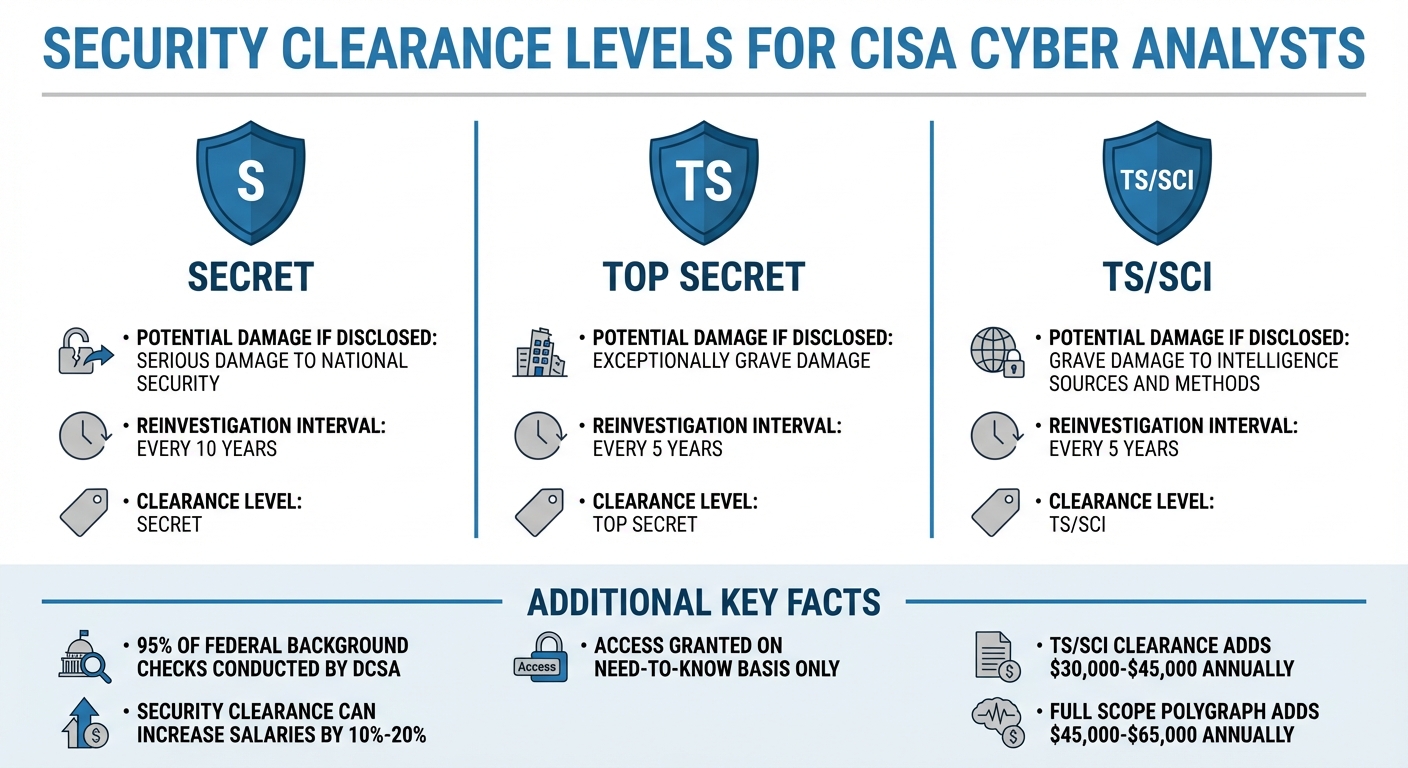
CISA Security Clearance Levels and Requirements Comparison
This section dives into the security clearance levels and background checks essential for CISA cyber analyst roles, following the introduction’s overview.
CISA cyber analysts typically need either a Secret or Top Secret clearance, depending on the role’s sensitivity and the systems involved. These clearance levels align with the potential national security risks posed by unauthorized information disclosure. A Secret clearance is required when disclosure could cause serious damage, while a Top Secret clearance is necessary for information that could result in exceptionally grave damage [1][2].
Federal background investigations are conducted to ensure employees are reliable, trustworthy, and loyal to the United States [1]. For CISA cyber analysts, this is particularly important because the role involves defending classified networks like SIPRNet, analyzing sensitive threat intelligence, and securing critical national infrastructure. As stated in Executive Order 10450, "The scope of the investigation shall be determined… according to the degree of adverse effect the occupant of the position sought to be filled could bring about… on the national security" [1].
| Clearance Level | Potential Damage if Disclosed | Reinvestigation Interval |
|---|---|---|
| Secret | Serious damage to national security | Every 10 years [1][2] |
| Top Secret | Exceptionally grave damage | Every 5 years [1][2] |
| TS/SCI | Grave damage to intelligence sources and methods | Every 5 years [1] |
It’s important to note that holding a clearance doesn’t grant unrestricted access to classified information. Access is strictly limited to a need-to-know basis [1][3], ensuring risks are reduced even within the cleared community.
Most federal background checks – around 95% – are conducted by the Defense Counterintelligence and Security Agency (DCSA) across more than 100 federal agencies [3]. Additionally, having a security clearance may increase salaries by 10%–20% [2], making the process not only a career necessity but also a financial advantage.
These clearance requirements lay the groundwork for understanding the broader qualifications and responsibilities that will be discussed in the upcoming sections.
Required Qualifications and Certifications
CISA assesses cyber analyst candidates based on a mix of education and professional experience [5]. A bachelor’s degree in fields like computer science or cybersecurity lays a solid technical foundation. This academic background ensures familiarity with key areas such as network architecture, security protocols, and threat analysis – essential for protecting federal systems effectively.
Professional certifications can significantly boost your technical profile. Some widely recognized certifications include CompTIA Security+, Certified Information Systems Security Professional (CISSP), Certified Ethical Hacker (CEH), and Certified Information Security Manager (CISM). The ISACA Certified Information Systems Auditor (CISA) certification, particularly valuable for compliance roles, requires five years of work experience. The certification costs $575.00 for ISACA members or $760.00 for non-members, with an additional $50.00 application fee. Interestingly, 70% of certified professionals report improved performance at work, and 22% experience a salary increase [6].
CISA also supports ongoing professional development by funding certifications after hiring [5]. This allows you to start with foundational qualifications and advance your expertise while on the job. Additionally, U.S. citizenship is a mandatory requirement for all positions [5]. Below are some certifications that can help enhance your professional and technical capabilities.
Top Certifications for Cyber Analysts
Although CISA provides funding for certifications post-hire, arriving with established credentials shows initiative and technical skill. Here’s a breakdown of key certifications:
- CompTIA Security+: Ideal for beginners, this certification covers network security, threat management, and basic cryptography.
- CISSP: Designed for experienced professionals, it focuses on managing security programs across various domains.
- CEH: Specializes in ethical hacking and penetration testing, including the use of AI to detect threats [4].
- CISM: Highlights information security governance and risk management, making it valuable for analysts bridging technical teams and leadership.
- ISACA CISA: Focuses on IT auditing and governance, making it a strong choice for roles emphasizing compliance and control evaluations [6].
Each certification addresses specific areas of cybersecurity. The best choice depends on whether your interests lie in hands-on threat detection, designing security systems, or navigating governance and compliance challenges.
What CISA Cyber Analysts Do
CISA cyber analysts are the frontline defenders of federal networks and critical infrastructure, working tirelessly to counter evolving cyber threats. Their responsibilities revolve around three key areas: threat monitoring, incident response, and vulnerability management. These elements form the backbone of efforts to keep government systems secure. On any given day, they might be investigating anomalies, tracking advanced persistent threats, or analyzing potential vulnerabilities.
This role demands unwavering attention. Anthony Messina, a Security Analyst, provides a glimpse into his typical day:
"My workday typically involves me logging into my organization’s security information and event management system to hunt through volumes of alerts from various endpoints and detection sources." [7]
Instead of waiting for alarms to sound, these analysts take a proactive stance, actively searching for warning signs that could escalate into full-blown attacks.
David Pickett, a Senior Cybersecurity Analyst, highlights the dynamic nature of the job:
"Threat hunting is about 90 percent of my days. I wake up in the morning and I’m like, ‘What is going to be the best attack of the day? What are they going to throw at us today?’" [8]
To uncover potential breaches, analysts scrutinize network activity for unusual patterns, investigate unauthorized devices, and monitor suspicious application behaviors. They rely on tools like VirusTotal, Maltego, and Shodan to gather threat intelligence and follow established frameworks such as MITRE ATT&CK and NIST SP 800-53 to guide their investigations.
When an incident occurs, the focus shifts to containment and resolution. Analysts follow a structured process that includes detection, analysis, containment, eradication, and recovery. They document every step meticulously, conduct root cause analyses, and implement measures to prevent future occurrences. This often involves scripting in Python or PowerShell, managing workflows with platforms like ServiceNow and JIRA, and collaborating across agencies. Amy Moses, another Security Analyst, sums up the mission:
"You’re out there protecting other people and fighting off the bad guys." [8]
Daily Tasks and Responsibilities
CISA cyber analysts tackle a range of challenges through three primary duties:
- Threat monitoring and analysis: Analysts examine network traffic and logs to identify anomalies, such as rogue devices or unauthorized software installations. They correlate events across systems to distinguish actual threats from false positives.
- Incident response: When a breach is detected, analysts act quickly to contain the threat, cut off the attacker’s access, and restore systems. They create detailed reports, document every action, and develop recovery plans to bolster defenses for the future.
- Vulnerability management: Analysts perform asset discovery, run scans (both credentialed and non-credentialed), and prioritize vulnerabilities using the Common Vulnerability Scoring System (CVSS). By addressing the most critical weaknesses first, they reduce the risk of exploitation. Their work often involves tools like Kali Linux for security testing, Amazon AWS/S3 for cloud operations, and Jupyter Notebooks for data analysis – requiring a high level of technical expertise.
CISA cyber analysts are not just problem-solvers; they are protectors, working behind the scenes to safeguard critical systems and ensure the nation’s cybersecurity remains resilient. Their dedication and technical skills are vital in the face of ever-changing threats.
How to Apply for CISA Cyber Analyst Positions
If you’re aiming for a cyber analyst role at CISA, understanding the federal application process is key. Unlike private sector applications, federal hiring follows a unique system centered around USAJobs, the official employment site for U.S. government positions. Here’s how to get started.
First, create a detailed account on www.usajobs.gov. This profile will serve as the foundation for all your federal applications, so make sure it’s complete. Include your contact details, work history, and education information. Once your profile is set, use the keyword search to find positions under "Cybersecurity and Infrastructure Security Agency." Each job posting will outline specific requirements and grade levels, so read them carefully to understand the qualifications, duties, and evaluation criteria.
Once you find a role that aligns with your experience, prepare a federal-style resume and gather any necessary documents. For example, federal employees need to upload their SF-50 form, while others might need to provide transcripts, certifications, or proof of their security clearance. Submit all materials through the application portal to complete your application.
Writing Your Resume for Cleared Positions
Federal resumes are more detailed than those used in the private sector. They should include exact employment dates, supervisor contact information, hours worked per week, and salary details. These specifics are essential to meet federal HR standards.
Tailor your resume to the job posting by using the exact title listed in the announcement. For instance, if the job is titled "Cyber Defense Analyst", include that precise title in your resume. This ensures your application passes through Applicant Tracking System (ATS) filters.
Highlight your technical expertise by listing the tools and technologies you’ve worked with, and include measurable achievements. For example, mention the number of incidents you handled, vulnerabilities you fixed, or systems you secured. Be sure to include your security clearance details – such as the level, granting agency, and investigation date – and certifications relevant to the role. Certifications like C|EH or CISSP can even boost your earning potential by 10% to 15% [4].
Preparing for CISA Interviews
CISA interviews typically combine behavioral and technical questions. Before your interview, research CISA’s mission and its role in safeguarding critical infrastructure and coordinating cybersecurity efforts across federal agencies. Familiarize yourself with recent CISA advisories, alerts, and initiatives to demonstrate your understanding of the agency’s priorities.
For behavioral questions, use the STAR method (Situation, Task, Action, Result) to structure your responses. Expect questions about scenarios like identifying critical vulnerabilities or managing security incidents under pressure. These questions assess both your technical skills and your ability to communicate, collaborate, and solve problems effectively.
On the technical side, be ready to discuss topics such as threat hunting, incident response, and frameworks like MITRE ATT&CK or NIST SP 800-53. Share examples of your hands-on experience with security tools and scripting languages, emphasizing how you’ve applied these skills in practical settings.
Once you’ve completed the interview, you’ll be ready to explore strategies for strengthening your candidacy, which we’ll cover in the next section.
How to Improve Your Chances of Getting Hired
Make yourself stand out as the perfect candidate by focusing on networking, targeted job searches, and sharpening your skills.
Showcase practical experience with tools like SIEM platforms (e.g., Splunk or Graylog), intrusion detection systems (e.g., Snort or Suricata), and vulnerability scanners (e.g., Nessus or Qualys) [9][10]. Highlight your knowledge of Python automation, which could save up to 15 hours a week [9]. Additionally, cloud security expertise is highly sought after and can lead to better salary opportunities [10]. Kimberley Tyler-Smith, Senior Hiring Manager, emphasizes:
"The best resumes are tailored to the specific job requirements and showcase the candidate’s relevant skills and experience" [9].
Customizing your resume this way not only makes it more effective but also creates a solid foundation for successful networking.
Keep an eye on CISA’s hiring events page and register for their one-stop hiring events, which often include early interview opportunities [11]. Recent graduates can reach out to StudentCareers@cisa.dhs.gov, while veterans and military spouses can connect with Veterans@cisa.dhs.gov for tailored support [11]. Be ready for virtual assessments, as CISA uses HireVue, an on-demand interview tool, for certain positions [11].
Using Cleared Cyber Security Jobs to Find CISA Opportunities

Pair your targeted resume and networking efforts with tools that simplify your job search. Cleared Cyber Security Jobs is a great resource for finding CISA positions and other roles requiring security clearances. Its search filters let you refine results by clearance level, location, and agency, saving you from sorting through irrelevant listings.
You can also upload your resume to the platform’s database, allowing employers to find you directly. Set up job alerts to stay informed about new CISA cyber analyst openings, giving you the chance to apply early. Since federal job postings often close once they hit a certain number of applicants, acting quickly can make a big difference. The platform also offers career resources specifically for cleared professionals, such as tips on certifications and resume writing for federal jobs.
Building Your Network in the Cleared Community
Tailoring your application is important, but connecting with others in the field can also boost your chances. Attend CISA-hosted job fairs and hiring events to meet recruiters in person and show your enthusiasm for their mission. As CISA explains:
"participate in a variety of job fairs and hiring events, including hosting one-stop hiring events where pre-qualified candidates can be interviewed and even receive tentative job offers on the spot" [11].
Networking with current and former CISA employees through professional associations or federal cybersecurity conferences can give you valuable insights into the agency’s hiring process, workplace culture, and upcoming opportunities. Referrals from employees often carry significant weight, signaling both your skills and your fit for the team. You can also join online communities focused on cleared cybersecurity work, where members share job leads, interview advice, and tips for navigating the federal hiring system.
Salary and Career Advancement at CISA
CISA cyber analyst roles follow the GS pay scale, starting at GS-9 for entry-level positions and reaching up to GS-15 or even the Senior Executive Service (SES) for leadership roles. For context, a GS-14 (Step 5) position in Washington, D.C. earns a base salary of $163,104. Once you factor in the 33.94% locality adjustment and federal benefits, total compensation approaches $221,000 [12]. These numbers highlight how factors like location and security clearance can significantly impact earnings.
Geographic location plays a big role in pay. For example, $145,000 in the D.C. area translates to the equivalent of about $118,000 in San Antonio or $112,000 in Huntsville when adjusted for cost-of-living differences [12]. Additionally, security clearances can boost earnings considerably. A TS/SCI clearance often adds $30,000 to $45,000 annually, while a Full Scope Polygraph can add another $45,000 to $65,000 [12].
When it comes to career growth, CISA offers a clear progression path. Entry-level analysts typically start at the GS-9 to GS-11 level, earning between $65,000 and $100,000 during their first two years. After gaining 2–5 years of experience, many move to GS-12 or GS-13 roles, with salaries ranging from $90,000 to $140,000. Around the five-year mark, professionals often hit what’s known as the "5-Year Clearance Cliff." At this point, their accumulated knowledge and program-specific clearances lead to sharper salary increases. Senior technical and leadership roles at the GS-14 or GS-15 level can offer salaries between $150,000 and $220,000 for those with 10–15 years of experience [12].
Specialized skills can significantly increase pay. For instance, expertise in Zero Trust Architecture is highly sought after, with senior roles in this area earning between $185,000 and $250,000 due to federal priorities. Similarly, professionals with cloud security expertise in GovCloud environments or skills in OT/ICS security are in demand as federal spending shifts toward these areas. Additionally, with 10% of cybersecurity job listings now mentioning AI, professionals with AI/ML security expertise can earn an extra $20,000 to $40,000 on top of standard salaries [12].
Certifications also play a key role in boosting earnings. A CISSP certification, for example, can increase salaries by $15,000 to $25,000. For those aiming for executive roles, the Certified Chief Information Security Officer (C|CISO) certification can help qualify candidates for senior positions with salaries over $200,000. Other specialized certifications can add an estimated 10% to 15% to overall compensation [12][4]. These credentials not only enhance technical skills but also speed up career advancement within CISA.
Final Thoughts on CISA Cyber Analyst Careers
Landing a role as a CISA cyber analyst takes thoughtful preparation. You’ll need the right security clearance, essential certifications, and practical experience that shows you understand the full scope of cyber threats. Combining technical know-how with strong investigative instincts sets the stage for making an impact now and building a solid career for the future.
Interestingly, experience doesn’t have to come from conventional tech roles. A varied professional background can actually be a strength. As Matthew Psencik, Director of Endpoint Security at Tanium, points out:
"I’ve also found that this additional skill set allows people from less technical backgrounds to shine. Some of the best analysts I know come from backgrounds that have nothing to do with tech" [13].
What truly makes a difference is cultivating an investigative approach and honing practical skills. Hands-on practice with tools like Splunk, Elastic, and Arkime can help you build the expertise needed for these roles.
CISA positions are also financially rewarding. Salaries start at an average of $141,000 for specialists and can exceed $200,000 for senior roles, especially with specialized clearances and locality adjustments [5][4]. Career paths are well-defined, whether your goal is to become a technical expert or step into leadership roles like Chief Information Security Officer (CISO).
Platforms like Cleared Cyber Security Jobs are tailored for professionals with security clearances, offering tools like job search filters, resume uploads, and custom job alerts. These features connect you directly with employers, cutting through the clutter of general job boards.
To strengthen your candidacy, focus on building core skills and earning certifications. Joining professional groups such as ISSA or ISC2 can provide valuable networking opportunities. Setting up a personal lab to simulate real-world scenarios can also help you stand out. With the average cost of a data breach projected to hit $4.9 million in 2024, the demand for skilled cyber analysts at agencies like CISA is only growing [5]. By combining clearance, certifications, and hands-on experience, you’ll position yourself for success and longevity in this field.
FAQs
Can I apply to CISA without an active security clearance?
No, you can’t apply to CISA without holding an active security clearance. Almost all positions list a current clearance as a minimum requirement for eligibility. Make sure to check the exact clearance level required for the specific role you’re targeting before submitting your application.
Which CISA cyber analyst specialties pay the most?
CISA cyber analyst positions, such as Threat Operations Analysts and Incident Response Analysts, offer annual salaries ranging from $80,000 to $200,000. Those with advanced experience or higher security clearance levels may earn even more.
What’s the fastest way to build hands-on experience for CISA roles?
The fastest route to gaining practical experience for CISA roles is through cybersecurity training and hands-on labs that mimic real-world situations. Programs like the Federal Cyber Defense Skilling Academy and CISA Learning offer virtual courses on key topics such as incident detection, malware analysis, and ethical hacking. These resources are designed to build the specific, practical skills needed for CISA cyber analyst positions.