

Want to join the FBI as a Cyber Analyst? Here’s what you need to know:
- Role Overview: FBI Cyber Analysts protect national security by analyzing threats like malware, cyberattacks, and espionage. These positions require strong technical and analytical skills.
- Qualifications: A bachelor’s degree in computer science, IT, or related fields with a minimum 3.0 GPA is required. Certifications like CISSP, CEH, or CompTIA Security+ can strengthen your application.
- Clearance: Applicants must obtain Top Secret clearance with SCI access, involving a thorough background check, polygraph, and continuous vetting.
- Application Process: Jobs are listed on USAJobs. The hiring process includes multiple testing phases, interviews, and can take 6-18 months.
- Career Growth: Opportunities include roles in specialized teams like the Cyber Action Team, or advancing to senior analyst or Special Agent positions.
Key Takeaway: The path to becoming an FBI Cyber Analyst is challenging but rewarding, with opportunities to make a real impact on national security.
Life on an FBI Cyber Squad: An Insider’s Look into Technical Career Paths at the FBI
sbb-itb-bf7aa6b
Security Clearance Requirements
FBI cyber analyst roles come with a critical requirement: Top Secret clearance with Sensitive Compartmented Information (SCI) access. Mishandling this level of classified information could severely jeopardize national security [4]. This clearance allows unescorted access to FBI facilities and highly sensitive intelligence. Interestingly, out of the approximately 4.3 million Americans holding security clearances, nearly 85% work under the Department of Defense [5][6].
Top Secret and SCI Clearance Levels
The FBI uses three main clearance levels, each tied to the potential damage caused by unauthorized disclosure:
- Confidential: Protects information that could cause "damage" if disclosed. Requires reinvestigation every 15 years.
- Secret: Covers information that could cause "serious damage" and is reinvestigated every 10 years.
- Top Secret: Reserved for information that could cause "grave damage." This level requires a thorough background investigation spanning the last 10 years, with reinvestigation every five years [4].
SCI, while not a separate clearance, refers to intelligence-related methods and sources. It’s typically granted to those with Top Secret clearance after completing the rigorous Single Scope Background Investigation. As FBI.gov explains, "A Top Secret clearance may be granted to those persons who have a ‘need-to-know’ national security information, classified up to the Top Secret level, and who need unescorted access to FBI facilities" [4].
With the clearance levels outlined, the next step is understanding how to navigate the complex process of obtaining a Top Secret clearance.
How the Clearance Process Works
The clearance process kicks off only after you receive and accept a conditional job offer from the FBI – this isn’t something you can start on your own [7][9]. After accepting the offer, you’ll complete the SF-86 form through the "eApp" portal, detailing your personal history over the past decade. From there, the process includes digital fingerprinting, criminal background checks, and a Tier 5 (Single Scope) investigation. This investigation involves in-person interviews with people like your neighbors, coworkers, and personal references. Additionally, a counterintelligence-scope polygraph examines areas such as criminal activity, drug use, and espionage [7][8].
The FBI aims to process Top Secret clearances within 6 to 9 months. However, positions requiring polygraphs often face delays, extending the timeline to anywhere from 180 days to over a year due to appointment backlogs [4][7]. Your case file is reviewed against 13 Adjudicative Guidelines using a "whole-person concept", which evaluates your overall eligibility. Once granted, your clearance is maintained through Continuous Vetting, a system that monitors criminal records, financial activity, and travel in real time [7].
What Can Disqualify You from Getting Clearance
Even with a thorough clearance process, certain factors can result in denial.
One of the most common issues is financial irresponsibility. This includes significant credit problems, defaulted loans, unpaid taxes, or overdue child support [7][9]. Despite state-level legalization, marijuana use remains a federal disqualifier [7][9].
Errors or omissions on the SF-86 form are another major pitfall. As Kevin James puts it, "Falsification on the SF-86, even on a minor point, is often the most easily preventable yet fatal mistake. Candor is paramount" [7]. Even small inconsistencies can lead to denial under the "Personal Conduct" guideline. The U.S. Intelligence Community stresses, "Your character, conduct and discretion must be above reproach and you must have unquestioned loyalty to the United States" [8].
Additional disqualifiers include:
- Felony convictions
- Ties to organizations seeking to overthrow the U.S. government
- Failure to register with the Selective Service System (for eligible males)
- Close relationships with foreign nationals or foreign business dealings
- Refusing a drug test or failing the polygraph exam [7][8][9]
For cybersecurity positions, adjudicators are increasingly scrutinizing digital footprints. This includes GitHub contributions, forum activity, and social media posts, looking for signs of poor judgment [7].
Meeting these stringent requirements is a pivotal step in becoming an FBI cyber analyst.
Required Qualifications and Skills
FBI cyber analyst roles demand specific education and technical expertise to meet the agency’s high standards.
Education and Experience Requirements
To qualify for these roles, candidates must hold a bachelor’s degree or higher from an accredited U.S. institution in fields like computer science, engineering, information systems, mathematics, operations research, statistics, or related areas [1][2]. Applicants must also maintain a 3.0 cumulative GPA throughout the application process [11]. As the FBI Jacksonville Field Office puts it:
"In today’s complex world, a degree in criminal justice doesn’t meet any of our hiring needs" [11].
Alternatively, candidates may qualify with 24 to 30 credit hours in the approved fields [1][2]. For Digital Forensic Examiner positions, at least 24 credit hours in computer science, engineering, digital forensics, or IT are required. Another pathway is having four years of full-time professional experience in digital forensics [14].
| Role | Minimum Education | Preferred Degree Fields |
|---|---|---|
| Computer Scientist | Bachelor’s Degree | Computer Science, Engineering, Information Science [1] |
| IT Specialist | Bachelor’s Degree | Computer Science, Information Systems [2] |
| Digital Forensic Examiner | Bachelor’s (24+ tech credits) | Digital Forensics, IT, Engineering, Math [2] |
| Data Analyst | Bachelor’s Degree | Statistics, Data Science, Mathematics [1][12] |
In addition to academic qualifications, certifications play a key role in demonstrating expertise.
Certifications the FBI Values
Industry-recognized certifications can significantly strengthen a candidate’s profile, especially for specialized roles like Digital Forensic Examiner [14]. Key certifications for cybersecurity positions include:
- CompTIA Security+
- Certified Ethical Hacker (CEH)
- Certified Information Systems Security Professional (CISSP) [2][15]
Networking specialists benefit from certifications like Cisco Certified Network Associate (CCNA) or advanced credentials such as CCNP Security [13]. For those in forensic accounting, certifications like Certified Public Accountant (CPA), Certified Fraud Examiner (CFE), and Certified in Financial Forensics (CFF) are highly valued [14]. Newly hired forensic accountants also undergo a five-week Forensic Accountant Core Training Session at the FBI Academy in Quantico, Virginia [14].
Camila Rojas, a Forensic Examiner and Cryptanalyst at the FBI, highlighted the importance of FBI-provided training:
"My proudest achievement with the Bureau would be my first court testimony… It was a combination of hard work and also the great training that the FBI offered" [14].
These certifications and training opportunities ensure professionals are well-prepared for their roles.
Technical and Professional Skills
Beyond education and certifications, FBI cyber analysts must excel in both technical and professional skills. On the technical side, expertise in digital forensics, network security, system integration, and encryption is critical [1][2]. Analysts are tasked with combating malware, investigating computer intrusions, and tracking international cyber threats [1]. They also handle evidence from diverse sources, including mobile devices, drones, and security cameras [2].
Strong communication skills are equally important. Analysts write detailed technical reports and deliver presentations to law enforcement partners and private organizations [2][3]. As FBI Jobs explains:
"Our technology careers are the backbone of many key functions relating to security, system capabilities, and the investigative work at the FBI" [2].
Key professional skills include critical thinking, attention to detail, and the ability to simplify complex technical ideas for non-technical audiences [2].
| Skill Category | Essential Technical Skills | Essential Professional Skills |
|---|---|---|
| Cyber Defense | Malware analysis, encryption, network security | Critical thinking, problem-solving |
| Forensics | Digital evidence preservation, mobile/drone forensics | Attention to detail, reporting |
| Data Analysis | Data mining, vulnerability assessment, risk management | Logical reasoning, trend identification |
| Operations | System integration, architectural design, troubleshooting | Collaboration, interpersonal ability |
With cybersecurity jobs projected to grow by 33% through 2033, meeting these qualifications can give candidates a competitive edge in pursuing FBI roles [2].
How to Apply for FBI Cyber Analyst Jobs
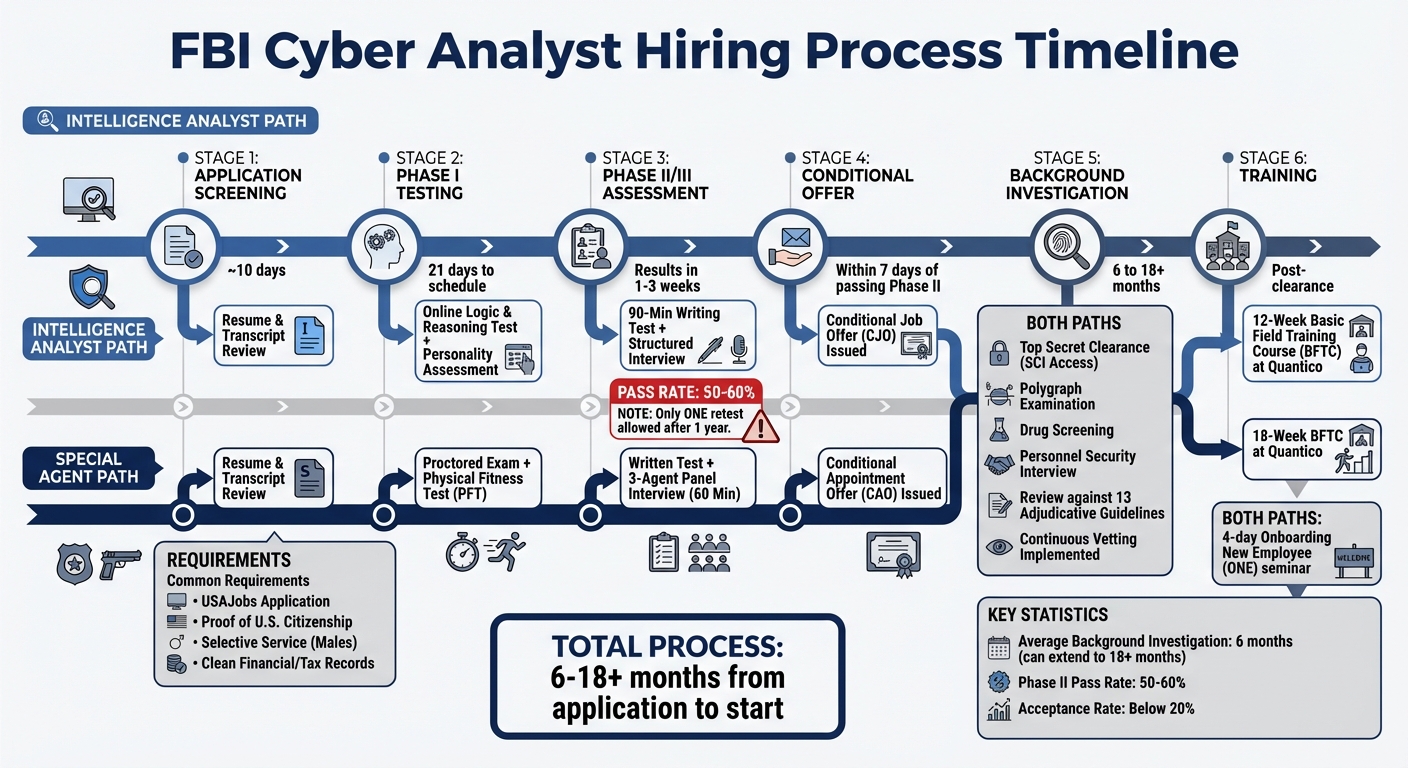
FBI Cyber Analyst Hiring Process Timeline and Requirements
Getting through the FBI’s application process takes time and careful preparation, as the hiring process can stretch beyond a year [16]. Knowing the steps involved can help you stay on track and meet key deadlines.
Applying Through USAJobs
All FBI cyber analyst job openings are listed exclusively on USAJobs, the federal government’s official job site. Crafting a federal resume is different from creating a standard one – you’ll need to include detailed information about your education, work experience, and security clearance eligibility. Along with your application, you must provide proof of U.S. citizenship, Selective Service registration (for male applicants), and confirm your compliance with student loan obligations, federal and state taxes, and any court-ordered child support [10].
Once your application is submitted, the FBI typically takes about 10 days to determine if you meet the minimum qualifications [16]. If you pass this step, you’ll receive an invitation to Phase I testing, which you must schedule and complete within 21 days [16]. Before applying, it’s critical to ensure you meet the FBI’s suitability standards, which include adherence to the FBI drug policy and a clean record with no felony convictions – failing to meet these standards results in immediate disqualification [10]. From there, candidates move through a structured series of tests and interviews.
The FBI Hiring Process Timeline
After the application and initial testing, the hiring process continues in clearly defined stages. The FBI has separate hiring tracks for Intelligence Analysts and Special Agents with a cyber focus, and each track has its own set of tests and timelines.
For Intelligence Analysts, the process includes:
- A Phase I online test that evaluates logic-based reasoning and personality traits.
- A Phase II timed writing test, which simulates reviewing intelligence reports.
- A Phase III structured interview to gauge communication abilities [3, 19].
Special Agent candidates follow a different path:
- A proctored Phase I exam.
- A Physical Fitness Test (PFT).
- A Phase II written assessment and structured interview, conducted by a panel of three agents [16].
"The average background investigation takes approximately six months, but can take 18 months or more depending on where you have lived, worked, and traveled." – FBIJOBS [16]
If you successfully complete these steps, you’ll receive either a Conditional Job Offer (CJO) as an Intelligence Analyst or a Conditional Appointment Offer (CAO) as a Special Agent. These offers are typically issued within seven days of passing Phase II [3, 19]. However, the offer is contingent on passing a detailed background investigation, which includes a polygraph test, drug screening, and a personnel security interview. While this process usually takes about six months, it can extend to 18 months or longer in some cases [3, 19].
Here’s a quick breakdown of the key hiring stages for cyber analyst roles:
| Hiring Stage | Intelligence Analyst Path | Special Agent Cyber Path | Typical Timeline |
|---|---|---|---|
| Application Screening | Resume and transcript review | Resume and transcript review | ~10 days [16] |
| Phase I Testing | Online logic and reasoning | Proctored exam + PFT | 21 days to schedule [16] |
| Phase II/III | Writing test + structured interview | Written test + 3-agent interview | Results in 1–3 weeks [16] |
| Conditional Offer | CJO issued | CAO issued | Within 7 days [3, 19] |
| Background Check | Polygraph, drug test, security interview | Polygraph, drug test, medical review | 6 to 18+ months [3, 19] |
| Training | 12-week BFTC at Quantico | 18-week BFTC at Quantico | Post-clearance [3, 19] |
Once cleared, Intelligence Analysts attend a 12-week Basic Field Training Course (BFTC) at the FBI Academy in Quantico, while Special Agents undergo an 18-week training program [3, 19]. Intelligence Analyst candidates must also agree to a mobility agreement, which allows the FBI to assign them to headquarters or any field office as needed [3]. Additionally, all new hires participate in a four-day Onboarding New Employee (ONE) seminar at Quantico during their first week to get acquainted with the FBI’s mission and culture [3].
How to Prepare for FBI Interviews
After navigating the rigorous qualification and clearance steps, preparing for the FBI interview is your final hurdle toward becoming a cyber analyst. The interview process is designed to test both your technical expertise and your behavioral readiness. With a reported pass rate of 50% to 60% for the Phase 2 assessment and only one retest opportunity allowed (a year after the original interview), thorough preparation is non-negotiable [17].
Preparing for Technical Tests
The 90-minute writing assessment challenges you to analyze a scenario and craft a concise, objective report that integrates multiple data points [17]. Your task is to identify relevant details while discarding irrelevant ones, all while maintaining a formal tone devoid of personal opinions or speculation [17]. Since there’s no spellcheck, practice writing reports manually to ensure your grammar, spelling, and punctuation are flawless [17].
"Your writing will be evaluated based on clarity, grammar, structure, coherence, and your ability to distinguish between relevant and irrelevant details – skills that are crucial in real-world FBI reports." – JobTestPrep [17]
For cyber-focused roles, hone your ability to tackle scenario-based problems like analyzing malware alerts, studying network traffic patterns, and setting up firewall rules [18]. Simulating a malware attack response can help you refine your triaging and threat mitigation skills [18]. If you’re aiming for a security engineering role, ensure you’re comfortable with Python and adept at conducting root cause analyses for incident investigations [18].
Once you’ve mastered technical reporting and problem-solving, the next step is preparing for the live panel interview to showcase your behavioral qualifications.
Showing You’re Ready for Clearance Work
Beyond technical know-how, you’ll need to demonstrate that you’re prepared to work in a high-security clearance environment. The 60-minute structured panel interview, a pivotal component of the FBI Phase 2 assessment, is conducted by three Special Agents who evaluate you on eight key competencies: Collaboration, Communication, Flexibility and Adaptability, Initiative, Interpersonal Ability, Leadership, Organization and Planning, and Problem Solving and Judgment [17]. Use the STAR method (Situation, Task, Action, Result) to prepare examples that highlight how you’ve handled ethical dilemmas, resolved conflicts, and performed under pressure [17].
Additionally, get ready for the Personnel Security Interview by organizing a detailed timeline of your employment history, foreign travel, and financial background [16]. Tailor your responses to emphasize your dedication to public service and alignment with the FBI’s mission, steering away from any focus on corporate interests [3].
"The FBI Phase 2 interview is known to be one of the most challenging parts of the hiring process. It’s a high-pressure, in-person panel interview conducted by three Special Agents trained to assess your behavioral competencies under stress." – JobTestPrep [17]
Career Advancement Opportunities
Becoming an FBI cyber analyst opens the door to a variety of career growth paths. Most cyber-related roles follow the General Schedule (GS) pay scale. Entry-level positions typically start at GS-7 or GS-9, mid-level roles are at GS-11 or GS-12, and senior positions can reach GS-13 [1]. For instance, Data Analysts progress from GS-7/9 to GS-13, with median salaries ranging from $107,000 to $113,000 [1][2]. These opportunities reward not only technical skills but also leadership and strategic abilities, paving the way for specialized team roles.
Moving Up to Senior Analyst Positions
Advancing in this field often requires focusing on specific areas of expertise. Intelligence Analysts, for example, can specialize in one of five key functions: Threat Analysis, Collection Management, Domain Analysis, Targeting Analysis, or Reports Management [3]. Each area demands unique skills, such as evaluating real-time threats or distributing raw intelligence to the right teams. To support career growth, the FBI’s Data Analytics Support Hub (DASH) provides mentorship and an annual training stipend for data analysts and scientists [1].
Some professionals may choose to transition into tactical roles, such as Staff Operations Specialist or Tactical Specialist, where they provide direct support during field investigations [3]. Alternatively, career paths can lead to becoming a Special Agent, where responsibilities include investigating cyber threats firsthand and testifying in court. However, applicants for Special Agent roles must meet the age requirement of 23 to 36 years old [2][3].
Working on FBI Cyber Action Teams
For those drawn to fast-paced environments, joining the Cyber Action Team (CAT) is a prestigious option. This elite group is deployed nationwide within hours of a significant cyber incident, offering both investigative and technical expertise on-site [19]. The FBI also maintains dedicated cyber squads in all 56 field offices, ensuring comprehensive coverage across the country [19].
Beyond CAT, opportunities exist with CyWatch, the FBI’s 24/7 operations center that monitors and coordinates responses to cyber incidents in real time [19]. Analysts interested in international collaboration can serve as Cyber Assistant Law Enforcement Attachés at U.S. embassies, working with global partners to address transnational threats [19]. Another option is joining the National Cyber Investigative Joint Task Force (NCIJTF), a collaborative effort involving over 30 co-located agencies from law enforcement and the intelligence community [19]. Participating in these specialized teams not only advances your career but also strengthens your role in the FBI’s cybersecurity mission.
"It allows you to touch on… multiple cases on your particular squad, so you’re not limited or relegated to a single case or two cases. At the same time, there’s really never a dull moment." – Jagdeep Singh Narula, Intelligence Analyst, FBI [3]
Conclusion
Becoming an FBI cyber analyst is no small feat – it requires dedication, preparation, and a commitment to excellence. To qualify, you’ll need to meet stringent eligibility criteria: U.S. citizenship, a spotless record, and adherence to the FBI’s drug policies [2]. Academically, a bachelor’s degree in a STEM field like computer science or information technology lays the groundwork, followed by a rigorous multi-phase selection process designed to test your analytical thinking, writing ability, and other key skills [3].
The path to joining the FBI is lengthy, often taking up to a year. With an acceptance rate below 20%, the process includes securing Top Secret clearance through an exhaustive background investigation after receiving a Conditional Offer [2][3]. Once cleared, you’ll undergo specialized training at the FBI Academy to prepare for the challenges ahead.
Inside the Bureau, the career possibilities are both diverse and impactful. From roles in Threat Analysis and Collection Management to joining elite groups like the Cyber Action Team or even transitioning into Special Agent positions, the opportunities are vast [3][19]. But beyond the variety, the work carries a profound sense of purpose. As FBI Intelligence Analyst Jagdeep Singh Narula explains:
"It’s about helping Americans stay safe. So that, you know, it gives me a lot of fulfillment knowing that my work actually matters" [3].
This sentiment underscores the meaningful nature of the role, where every effort contributes to protecting the nation.
FAQs
Can I apply if I don’t already have a Top Secret/SCI clearance?
Yes, you can apply for cyber analyst roles at the FBI even if you don’t already have a Top Secret/SCI clearance. If you’re offered the job, the FBI will start the security clearance process as part of your hiring procedure.
How strict is the FBI on past marijuana use, debt, or foreign contacts?
The FBI enforces strict guidelines when it comes to past marijuana use, financial responsibilities, and foreign associations. Applicants must not have used marijuana in any form within one year prior to applying. Financial concerns, such as defaulting on student loans or failing to pay child support, can lead to disqualification. Additionally, foreign connections, whether through family ties or financial interests, undergo thorough scrutiny. These factors can affect security clearance if they are not fully disclosed or adequately addressed during the background investigation.
What can I do now to improve my chances before applying?
If you’re aiming for a role as an FBI cyber analyst, it’s all about honing the right skills, earning relevant certifications, and deepening your knowledge. Start by familiarizing yourself with the FBI’s mission and its focus on combating cyber threats.
To stand out, consider earning cybersecurity certifications like CompTIA Security+ or Certified Information Systems Security Professional (CISSP). These can demonstrate your technical expertise. Sharpen your skills in threat analysis and ensure you stay current on the latest security practices and trends in the industry.
Finally, prepare thoroughly for FBI assessments and tailor your application to meet their specific requirements. The better aligned you are with their expectations, the stronger your chances will be.