• Skip to primary navigation
  • Skip to main content
Cleared Cyber Security Jobs | CyberSecJobs.com

Cleared Cyber Security Jobs | CyberSecJobs.com

Cleared Cyber Security Jobs

  • Home
  • Search Cleared Cyber Jobs
  • Job Fairs
  • Career Resources

Career Paths

Cloud Security Engineer Career Path for Cleared Professionals

CyberSecJobs Editorial · March 13, 2026 ·

Cloud security engineers play a key role in safeguarding sensitive data and networks, especially in government and defense sectors. For professionals with security clearances, this field offers lucrative opportunities, with salaries ranging from $95,000 to $230,000+ depending on experience. Here’s what you need to know:

  • Core Skills: Identity and Access Management (IAM), network security, vulnerability management, and data encryption.
  • Clearance-Specific Knowledge: Familiarity with Risk Management Framework (RMF), FedRAMP compliance, and operational security (OPSEC).
  • Certifications: Start with CCSK or CompTIA Security+ for foundational knowledge, then advance to CCSP, AWS Security Specialty, or Azure Security Engineer Associate for specialized expertise.
  • Career Progression: Entry-level roles focus on monitoring and incident response, mid-level positions involve secure system design, and senior roles emphasize leadership or advanced technical oversight.

With government agencies rapidly adopting cloud technologies, cleared cloud security engineers are in high demand. This career path combines technical mastery with the ability to navigate strict federal compliance standards, making it ideal for those seeking impactful work in national security.
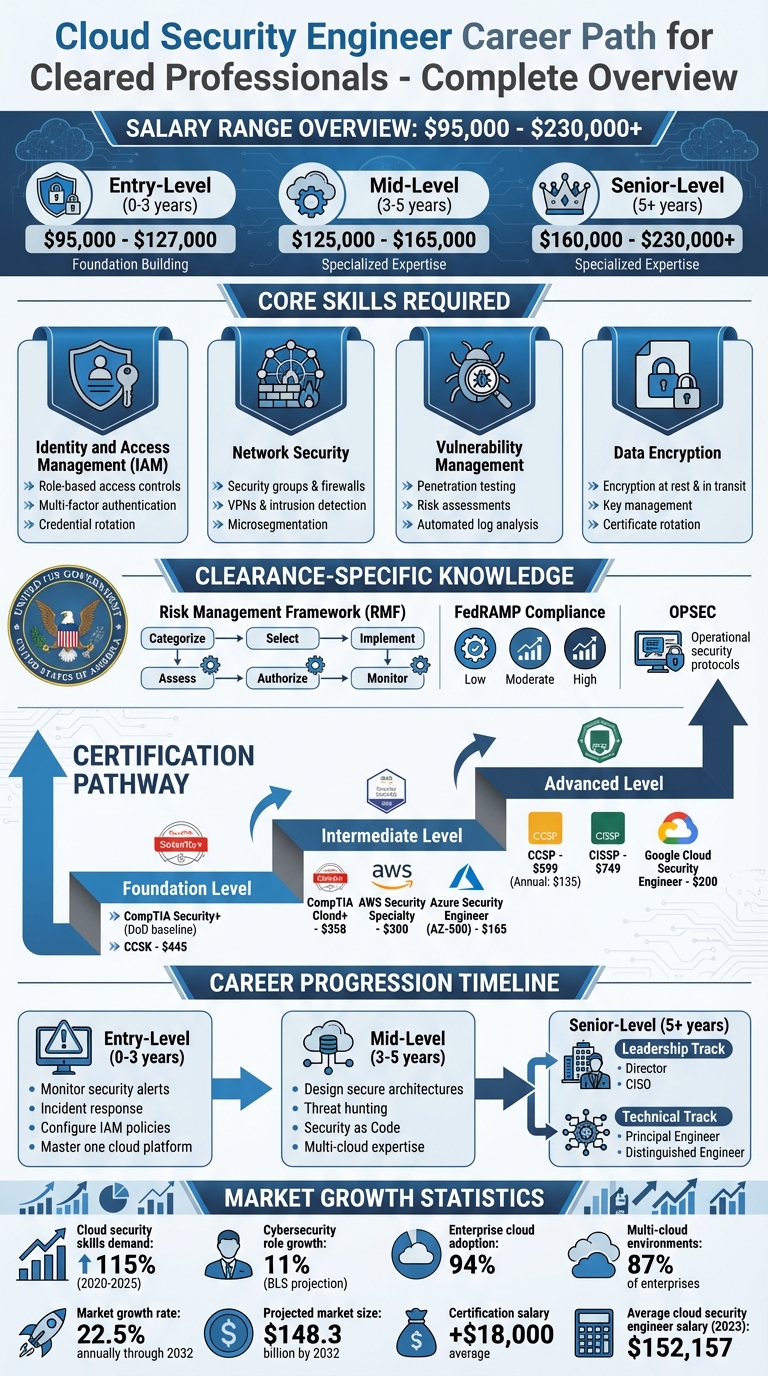
Cloud Security Engineer Career Path: Skills, Certifications, and Salary Progression

Cloud Security Engineer Career Path: Skills, Certifications, and Salary Progression

Become a Cloud Security Engineer in 2025 | THE Beginner ROADMAP (AWS & PWNED LABS)

sbb-itb-bf7aa6b

Required Skills for Cleared Cloud Security Engineers

Cleared cloud security roles demand a high level of technical expertise, combined with a deep understanding of federal compliance standards. Between 2020 and 2025, the demand for cloud technology skills surged by 115% [6]. Engineers working in classified settings must not only master commercial cloud platforms but also navigate the unique security protocols that protect national security workloads.

Core Technical Skills

Identity and Access Management (IAM) is at the heart of cloud security. With the shift away from physical offices and on-premises servers, identity has become the primary security boundary [4]. Engineers must apply the principle of least privilege effectively, managing both human users and the exponentially larger number of machine identities [4][5][6]. This includes configuring role-based access controls, enabling multi-factor authentication, and automating credential rotation across AWS, Azure, and Google Cloud Platform (GCP).

Network security in cloud environments requires expertise in setting up security groups, firewalls, private endpoints, virtual private networks (VPNs), and intrusion detection systems [5][6]. Unlike traditional perimeter-focused security, cloud security relies on software-defined networking and microsegmentation. Engineers must design systems that can isolate threats and revoke credentials instantly using event-driven automation [4].

Vulnerability management has shifted from reactive responses to proactive security engineering [4]. Regular audits, penetration testing, and risk assessments are key to identifying vulnerabilities before deployment. Engineers skilled in scripting languages like Python or PowerShell can automate log analysis and respond swiftly to suspicious activity [4][5].

Data encryption – both for stored data and data in transit – is non-negotiable [8][11]. Engineers must know how to manage encryption keys, rotate certificates, and implement encryption controls that meet federal standards. As of late 2023, cloud security engineers in the U.S. earned an average annual salary of $152,157, with top earners making over $205,000 [5]. These technical skills form the backbone of the expertise required for classified environments.

Clearance-Specific Skills

Working in classified environments involves proficiency in the Risk Management Framework (RMF), which includes six steps: Categorize, Select, Implement, Assess, Authorize, and Monitor [8][10]. Engineers need to select and implement security controls from NIST SP 800-53, ensuring compliance with federal standards like session timeouts and encryption key lengths [10].

A deep understanding of FedRAMP standards is also critical. Engineers must manage impact levels (Low, Moderate, and High), secure Provisional Authority to Operate (P-ATO) through the Joint Authorization Board (JAB) or an Agency ATO, and work with accredited Third Party Assessment Organizations (3PAOs) [9][10][12]. Unlike commercial roles, self-attestation is not allowed under FedRAMP, which requires independent validation [10]. Engineers often deal with extensive documentation, like System Security Plans (SSP), which can exceed 300 pages [10].

"FedRAMP is a compliance regime, not just a set of best practices. It demands proof, oversight, and continuous diligence." – TrustCloud [10]

For Moderate and High impact levels, ensuring that data resides in the U.S. and is accessible only to U.S. persons is essential [10]. This requires familiarity with government-specific cloud services like AWS GovCloud and Microsoft Azure Government [7]. Continuous monitoring has replaced periodic reviews, with monthly vulnerability scans and real-time reporting now standard [10][12]. These skills are vital for meeting the stringent requirements of federal compliance.

Additionally, engineers in classified roles must maintain strict operational security (OPSEC). This involves adhering to digital hygiene practices and being cautious about public-facing activities such as GitHub contributions, forum discussions, and social media posts, all of which could have national security implications [7]. Under Continuous Vetting, engineers are required to report significant life events to their Facility Security Officer (FSO) [7]. Thorough documentation is also crucial, as activities like collaborating with international researchers, attending conferences, or contributing to open-source projects are closely scrutinized during the vetting process [7].

Certifications for Cleared Cloud Security Positions

Certifications play a key role in proving your technical expertise to employers and often fulfill Department of Defense (DoD) requirements for information assurance jobs. Did you know that 70% of employers require industry certifications for cybersecurity roles? On top of that, earning one can boost your salary by an average of $18,000 in the U.S. [16]. For professionals with security clearances, certifications not only demonstrate your skills but also open doors to high-impact roles that demand both technical knowledge and compliance with strict standards.

Vendor-Neutral Certifications

If you’re just starting with cloud security, the Certificate of Cloud Security Knowledge (CCSK) is a great first step. Priced at $445 (including two exam attempts), this certification covers 12 key areas, from Cloud Governance to Incident Response [13]. The latest version, CCSK v5, now focuses on topics like Artificial Intelligence and Zero Trust strategies, phasing out older subjects like IoT [13]. The exam is open-book, includes 60 questions, and takes two hours to complete [13].

"The CCSK certificate is highly regarded as the benchmark for cloud security expertise. It provides a comprehensive and unbiased understanding of how to effectively secure data in the cloud." – Cloud Security Alliance [13]

For experienced professionals, the Certified Cloud Security Professional (CCSP) is a top-tier choice. At $599 (plus a $135 annual maintenance fee), this certification dives into enterprise-level cloud architecture, design, operations, and service orchestration [16][19]. The exam includes 125-150 questions and takes 3-4 hours [14][18]. If you already hold a CISSP, you’re automatically eligible for the CCSP [18]. Approved under DoDM 8140.03, the CCSP is especially valuable for cleared positions [14].

Other great vendor-neutral options include:

  • CompTIA Cloud+: Focuses on planning and automating secure cloud environments. Cost: $358 [16].
  • GIAC Cloud Security Automation (GCSA): Centers on DevSecOps and open-source tools. Cost: $949 [16].
  • Certified Cloud Security Engineer (CCSE): Combines vendor-neutral concepts with hands-on skills for AWS, Azure, and GCP. This certification is particularly relevant since 87% of enterprises use multi-cloud environments [17].

Cloud Platform Certifications

Platform-specific certifications are just as important, especially when working with the most widely used cloud providers in government settings.

The AWS Certified Security – Specialty (SCS-C02) is tailored for securing AWS environments. It covers areas like incident response, logging, monitoring, IAM, and data protection [20][22]. The certification costs $300, includes 65 questions, and requires a score of at least 750 out of 1,000 to pass [20][22]. Demand for this certification is growing fast – job postings requiring it increased by 73% between October 2021 and September 2022 – and professionals holding it earn an average annual salary of $203,597 [20][22].

If your focus is on Microsoft environments, the Microsoft Certified: Azure Security Engineer Associate (AZ-500) is a solid option. At $165, it emphasizes implementing security controls, managing identity and access, and securing data in both cloud and hybrid setups [22]. The certification is valid for one year and is highly valued in government roles [22].

For Google Cloud experts, the Google Professional Cloud Security Engineer certification is worth considering. It costs $200 and tests your ability to design and manage secure infrastructure on GCP, with a focus on multi-cloud strategies and Kubernetes security [15][19][22]. Although GCP expertise is less common, it commands higher salaries due to the scarcity of skilled professionals [22]. Most candidates benefit from having 1-2 years of practical experience before attempting this exam [22].

Baseline and DoD Certifications

To meet DoD baseline requirements, CompTIA Security+ CE is the standard entry-level certification [21]. For roles like SOC Analyst or Incident Responder, the CompTIA CySA+ (around $392) fulfills CSSP Analyst requirements [21].

"CySA+ satisfies DoD 8570 baseline requirements for CSSP Analyst roles, which opens up government contracting jobs – the most reliable place to get a job." – CloudJobs Insights [21]

For senior-level positions, the CISSP is a must-have. At $749, it’s a gateway to management and architect roles, often with salaries exceeding $150,000 [21]. With Trusted Workforce 2.0 streamlining clearance maintenance through real-time checks, keeping your certifications up to date is more important than ever [7]. Your choice of certification should align with the cloud provider your target agency uses – AWS Security Specialty for AWS environments or AZ-500 for Microsoft-heavy organizations [21][22].

These certifications are essential for building a successful career in cleared cloud security, ensuring you’re prepared to meet the demands of government roles.

Career Path and Experience Levels

The cleared cloud security field offers a structured career progression with clear opportunities for salary growth. Entry-level professionals typically earn between $95,000–$127,000, mid-level engineers see salaries of $125,000–$165,000, and senior roles can command $160,000–$230,000+ [3][23]. With the U.S. Bureau of Labor Statistics predicting 11% growth in cybersecurity roles – outpacing many other fields – and around 94% of enterprises now relying on cloud services, the demand for skilled professionals is rapidly increasing [23][24]. Holding a security clearance can further accelerate career advancement in these defined roles. Let’s break down the journey from entry-level to senior positions.

Entry-Level Positions (0-3 Years)

In the early stages of your career, the focus is on building technical skills and gaining hands-on experience. Key responsibilities include monitoring security alerts, investigating potential threats, and resolving incidents by following established protocols. You’ll also work on configuring IAM (Identity and Access Management) policies, implementing network controls, and ensuring compliance with security standards.

At this stage, mastering one major cloud platform – most commonly AWS – is essential. Developing scripting skills in languages like Python or Go is equally important, as these are used to automate security tasks and create custom detection rules.

"Cloud security spans across just about every domain in security. Cloud engineers are deploying tools in those domains, working with internal and external clients." – Joe South, Infosec Instructor [23]

As your technical foundation strengthens, your role will naturally evolve to include more proactive responsibilities, such as designing secure systems and managing risks.

Mid-Level Positions (3-5 Years)

Mid-level roles mark a shift from reactive tasks to proactive security design and implementation. At this stage, you’ll take on responsibilities like designing secure architectures, implementing network segmentation, and conducting security assessments across multiple cloud platforms. Your work will likely include advanced tasks such as threat hunting, malware analysis, and digital forensics, requiring a deeper level of technical expertise.

One emerging trend at this level is Security as Code, which emphasizes automation over manual configurations. You’ll use tools like Infrastructure as Code (IaC) to automate compliance checks and security processes, making your work more efficient and scalable.

With these expanded responsibilities, mid-level roles serve as a critical bridge to senior leadership positions.

Senior-Level Positions (5+ Years)

Senior roles combine technical expertise with strategic oversight. As a senior professional, you’ll guide risk mitigation efforts for complex challenges while acting as a subject matter expert (SME). Key responsibilities include advanced threat modeling, managing relationships with high-level stakeholders, and leading enterprise-wide initiatives such as implementing Zero Trust frameworks.

At this stage, you can choose between two main career tracks: leadership roles like Director or Chief Information Security Officer (CISO), or technical roles such as Principal or Distinguished Engineer. Leadership positions focus on team management and organizational strategy, while technical roles emphasize long-term scalability and security-first design.

Mentorship also becomes a key aspect of senior roles. You’ll help develop junior talent and influence organizational security policies, ensuring your expertise benefits the broader team.

"Accomplishments, no matter how impressive, have limited impact if they go unnoticed." – Bianca Dunlap, Learning and Development Program Manager, AWS Security [1]

Using Your Security Clearance to Find Cloud Security Jobs

Your security clearance can give you a real edge when applying for specialized cloud security roles. By aligning your clearance level with the right opportunities, you can streamline your job search and focus on roles that match your skills, certifications, and clearance status.

How Clearance Levels Align with Roles

Different clearance levels open doors to specific types of cloud security work. For example, Secret clearance qualifies you for roles involving less sensitive systems, often with defense contractors or federal agencies managing day-to-day infrastructure projects. Meanwhile, Top Secret clearance is needed for positions tied to intelligence agencies, advanced defense programs, or national security initiatives where cloud systems handle highly sensitive data. If you hold a TS/SCI clearance, you’ll be eligible for the most sensitive roles, such as supporting intelligence community cloud migrations, working on special access programs, or managing compartmented information systems.

The nature of the work also changes with the clearance level. Secret-cleared roles might focus on implementing security measures for general government cloud platforms. In contrast, TS/SCI positions often involve designing secure architectures for classified environments or managing security for intelligence workloads. Location can also play a big role – just in the Washington, D.C. area, there are over 200 cloud security engineer positions requiring clearance, especially near government hubs and contractor offices [25]. Once you understand how your clearance fits into these roles, you can start focusing on where to find them.

Finding Jobs on Cleared Cyber Security Jobs
Cleared Cyber Security Jobs

Leverage your clearance to target roles directly through platforms like Cleared Cyber Security Jobs. This site simplifies your search by listing positions specifically for candidates with active clearances. Start by creating a profile and uploading your resume, making sure to highlight your cloud certifications and clearance level prominently. Use search filters to narrow down roles based on your clearance type, salary expectations, and preferred cloud platforms like AWS, Azure, or Google Cloud.

Set up job alerts with keywords such as "cloud security engineer", "AWS security", or "cloud architect", combined with your clearance level. These alerts will notify you as soon as new roles matching your qualifications are posted. The platform also hosts job fairs where you can meet hiring managers from government agencies and defense contractors. These events are a great way to showcase your technical skills and discuss roles in person – something that goes beyond what’s on your resume.

Since Cleared Cyber Security Jobs works exclusively with direct-hire employers rather than staffing firms, you’ll connect directly with organizations looking for cloud security talent. This approach not only speeds up the hiring process but also ensures you get a clearer picture of the role requirements, especially for positions that demand specific cloud platform expertise or Department of Defense (DoD) certifications.

Advancing Your Cloud Security Career

For professionals with security clearances, staying on top of your game in cloud security means committing to continuous learning. Cloud providers roll out new security features and services almost weekly, so it’s crucial to regularly review your platform’s official security updates. Focusing on mastering these updates first will give you a solid foundation before you expand your expertise to include multi-cloud environments [3].

Once you’re confident with the technical side, it’s time to broaden your horizons through networking. Engaging with peers and mentors in niche communities, such as the fwd:cloudsec Slack group or CloudSecDocs, can significantly boost your career trajectory [3]. For those working in classified environments, connecting with others who share similar challenges can be especially helpful. Beau Guidry, Global Field Operations Manager at AWS, offers this advice:

"Flex your network! Find a mentor to help you navigate the process and understand how your skills can translate to an AWS role" [2].

To align with industry trends, focus on areas like "security as code" and aim for advanced certifications such as AWS Security Specialty, CCSP, or CKS to showcase your expertise. The cloud security market is expected to grow at an annual rate of 22.5% through 2032, potentially reaching $148.3 billion [26]. With more organizations adopting tools like Terraform and Pulumi, there’s a growing demand for cloud-native skills, particularly in container security, Kubernetes, and zero-trust architectures [3].

Building a public portfolio is another way to stand out. Contribute to open-source cloud security projects or publish technical blog posts on platforms like GitHub. This not only showcases your skills but also gives recruiters and hiring managers a tangible sense of your capabilities – something a resume can’t always capture. Free training resources are also a great way to explore emerging areas like cloud penetration testing or AI-driven threat detection [26][23]. As Joe South, Senior Cloud Engineer, puts it:

"Every person you look up to in a specific field at one point knew nothing and was a beginner. You, too, can change your life starting from nothing" [23].

Taking these steps not only enhances your technical abilities but also prepares you for leadership opportunities. Practice discussing your cleared experience in at least 10 mock interviews focused on leadership and behavioral scenarios [2]. This preparation will help you clearly demonstrate how your background can contribute to impactful cloud security solutions. By aligning your goals with the public sector’s push for digital transformation and national security innovation, you’ll position yourself for a career that’s both fulfilling and forward-moving.

Conclusion

Building a career as a cleared cloud security engineer requires a blend of technical know-how, industry-recognized certifications, and the ability to leverage your security clearance for unique opportunities. With median annual salaries hovering around $122,500 and the potential to earn over $160,000 at the high end [24], the financial incentives reflect the specialized skills and responsibilities involved.

A security clearance unlocks access to roles that are vital to supporting national security efforts. As Beau Guidry, Global Field Operations Manager at AWS, puts it:

"I think purpose and impact are absolutely essential to job satisfaction and I think it’s a real attraction to cleared individuals looking for work with AWS" [2].

This combination of purpose-driven work and the fast-paced evolution of cloud technology makes this career path both impactful and rewarding.

To stay competitive, focus on sharpening your skills in areas like DevSecOps integration, zero-trust architecture, and multi-cloud strategies. Earning certifications such as AWS Security Specialty, CCSP, or CKS demonstrates your dedication to staying at the forefront of the field. Additionally, showcasing your expertise through open-source projects or technical writing can make you stand out to employers.

For veterans, tools like the Military Skills Translator can help align military experience – such as secure communications or information assurance – with civilian cloud security roles [2]. The ability to remain calm under pressure, developed through military service, is a strength that directly applies to the high-stakes nature of cloud security.

FAQs

Which clearance level do I need for cloud security engineer roles?

The clearance level needed for cloud security engineer roles depends on the specific job and employer. Typical levels include Secret, Top Secret, and TS/SCI. Positions supporting defense or intelligence agencies often require Top Secret or TS/SCI clearances, as these allow access to highly sensitive information. The exact clearance level is determined by the security needs of the job and the agency or project it supports.

What projects can I share publicly without risking OPSEC or my clearance?

When sharing projects, focus on those that demonstrate your ability to tackle key cloud security challenges. Examples include detecting cloud misconfigurations, securing identities and permissions, monitoring logs for anomalies, investigating security incidents, and enforcing security controls in active cloud environments. These types of projects not only showcase hands-on expertise but also highlight your practical knowledge of cloud security practices.

Just remember to prioritize OPSEC (operational security) and safeguard any sensitive information or clearance-related details while presenting your work.

How do I move from Security+ to a cloud security role fast?

To move efficiently from Security+ to a cloud security role, start by diving into the major cloud platforms – AWS, Azure, or GCP – and familiarize yourself with infrastructure-as-code tools like Terraform or CloudFormation. Earning certifications such as the AWS Certified Security Specialty, Azure Security Engineer (AZ-500), or CCSP will also strengthen your credentials. Pair this with practical, hands-on experience in cloud security and automation to build on your Security+ foundation. With focused effort, you can aim to achieve this transition in 12 to 18 months.
Related Blog Posts

  • Classified Cloud Security Jobs – AWS GovCloud and Azure Government Specialization
  • GCP Security Certification for Cleared Cloud Architects
  • Cisco CCIE Security Career Guide for Cleared Expert Engineers
  • Security Architect Career Path for Cleared Professionals

Related Guides

  • Endpoint Security Engineer Career Path for Cleared Professionals
  • Application Security Engineer Career Path for Cleared Professionals
  • Security Architect Career Path for Cleared Professionals
  • TS/SCI Salary Premium: Real 2026 Numbers
  • Security Clearance Interview: What to Expect

Security Architect Career Path for Cleared Professionals

CyberSecJobs Editorial · March 12, 2026 ·

Cleared Security Architects are in high demand due to the growing complexity of cybersecurity threats and the stringent requirements of federal systems. These professionals design secure frameworks for classified environments, ensuring compliance with regulations like CMMC 2.0 and DoD Directive 8140. With cybercrime expected to cost $10.76 trillion annually by 2026, organizations need skilled architects to protect critical systems.

Key Takeaways:

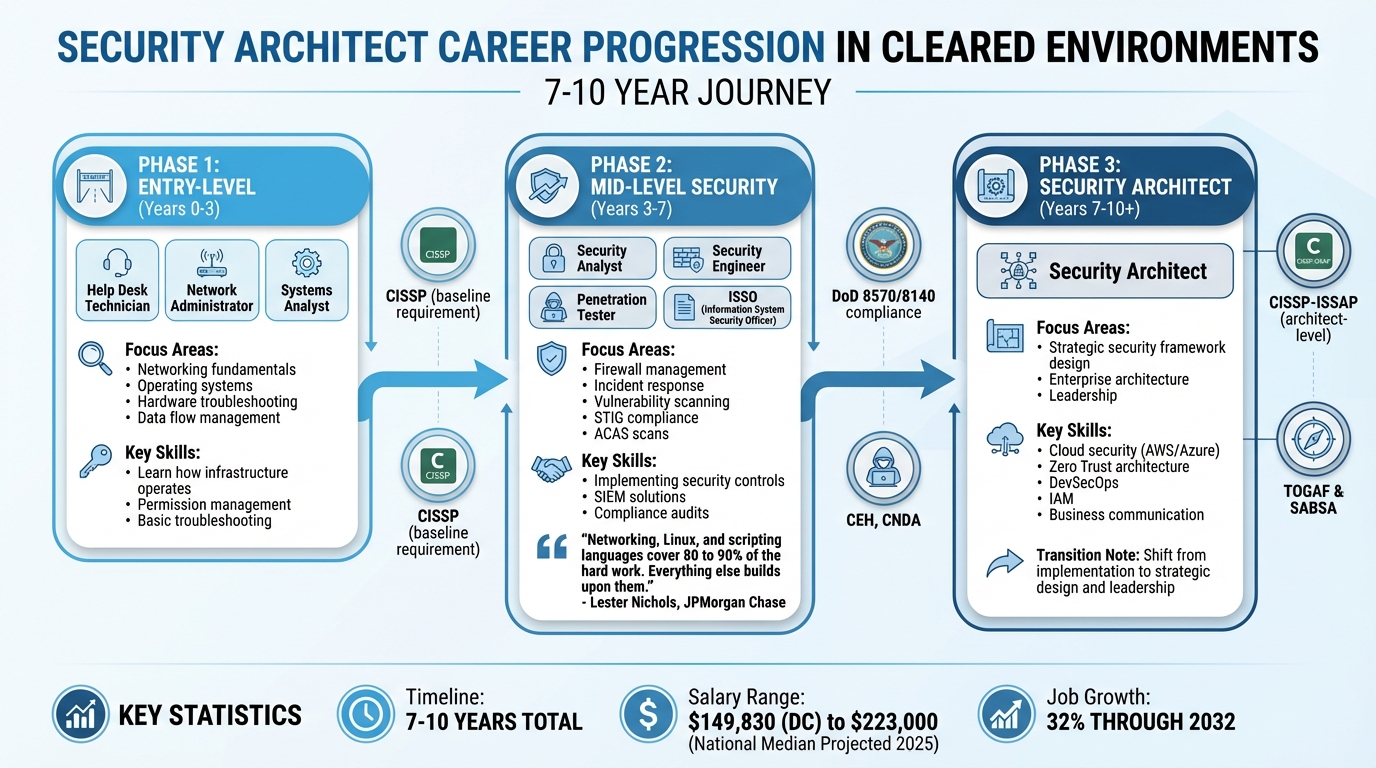
  • High Demand: Cybersecurity roles, including Security Architects, are projected to grow by 32% through 2032.
  • Salary Premiums: TS/SCI clearance holders earn an average of $131,907 annually, with Full Scope Polygraph professionals earning $148,314 on average.
  • Path to Success: A career typically spans 7–10 years, starting in IT roles like Network Administrator or Security Engineer, with certifications like CISSP and ISSAP being essential.
  • Core Skills: Expertise in cloud platforms, Zero Trust architecture, compliance frameworks, and advanced networking is critical.

Security Architects bridge technical expertise and strategic planning, making them indispensable in safeguarding national security systems.

What Does a Security Architect Do? (The Real Security Architect Job Description)

sbb-itb-bf7aa6b

What Security Architects Do in Cleared Organizations

Security Architects working in cleared environments play a crucial role in blending technical design, regulatory compliance, and mission-critical protection. Unlike commercial roles, their focus is on systems tied to national security, where even minor flaws can jeopardize intelligence operations or defense strategies. This requires them to merge advanced security practices with the strict requirements of federal frameworks and the complexities of handling classified data. Their work forms the backbone of the responsibilities detailed below.

They also act as translators, turning complex threat scenarios into terms that government and military leaders can understand. This helps bridge the gap between technical implementation and executive decision-making, ensuring security investments align with broader mission goals [3].

Main Responsibilities of a Security Architect

Security Architects create the core security framework that defends classified systems throughout their lifecycle – from initial design to full deployment. This includes evaluating and integrating new technologies like cloud platforms and Zero Trust models, all while adhering to federal regulations. For instance, during cloud migrations, they ensure configurations meet FedRAMP standards, confirming that both service providers and internal systems comply with federal data protection requirements [3].

They also ensure that emerging technologies align with mission objectives and regulatory policies [3][5]. As AI-driven security tools like Claude Code Security become more common, architects carefully assess their recommendations while maintaining ultimate control over security decisions [5].

The evolution of security challenges, as reflected in recent updates to the OWASP Top 10, has shifted the focus from isolated code fixes to comprehensive architectural strategies [5]. Today, cleared architects embed security principles directly into infrastructure, using tools like Service Mesh with Istio Ambient to enforce mutual TLS and Zero Trust across entire platforms, rather than just individual applications [5].

Why Defense and Government Organizations Need Security Architects

Security Architects do more than design technical solutions – they address the high stakes of national defense and the stringent demands of regulatory compliance. Unlike commercial organizations, defense contractors and government agencies deal with security issues where failures can have far-reaching consequences for national security.

The need for skilled professionals in this field is growing rapidly. The U.S. Bureau of Labor Statistics projects a 29% increase in information security analyst roles, including architecture-specific positions, between 2024 and 2034 [4]. In Virginia, a key hub for cleared work, employment for these roles is expected to rise by 45.4% through 2028 [6].

Compensation reflects the expertise and clearance requirements these roles demand. In the Washington, D.C. area, Security Architects earn an average of $149,830 annually, which is 16% higher than the national average. Nationwide, the median total pay for these professionals is projected to reach $223,000 by late 2025 [4][6]. These figures highlight how the responsibility of safeguarding classified systems translates into exceptional career opportunities for cleared professionals.

Education and Certifications You’ll Need

Breaking into a career as a cleared Security Architect requires a solid mix of education and professional certifications. In federal and defense sectors, these qualifications are often non-negotiable for mid- and senior-level roles. A degree lays the groundwork in areas like network security, digital forensics, and system administration, while certifications prove your ability to apply that knowledge in classified, high-stakes environments. Here’s a closer look at the education and certifications essential for this career path.

Degrees That Help You Get Started

A bachelor’s degree in Computer Science, Information Technology, or Cybersecurity is typically the first step. Around 40% of Security Architects hold a bachelor’s degree, while 60% go on to earn a master’s degree [2].

For those aiming at senior roles, a Master’s in Cybersecurity or an MBA can provide a competitive edge. These advanced degrees help you transition from hands-on technical work to strategic planning and policy development. They may even substitute for some years of experience, fast-tracking you into leadership positions where you’re shaping security frameworks rather than just implementing them [2].

But education alone isn’t enough. Certifications are critical for proving your skills and navigating the complexities of classified environments.

Certifications for Cleared Security Architects

The CISSP (Certified Information Systems Security Professional) is often the baseline requirement for senior-level security roles in cleared environments. Covering eight major security domains, it’s a must-have for those pursuing architect-level positions. Once you’ve earned the CISSP, the CISSP-ISSAP (Information Systems Security Architecture Professional) takes things further by validating your expertise in enterprise-level security design [2][8].

For cleared professionals, compliance with Department of Defense 8570/8140 requirements is essential. Specifically, certifications targeting the Information Assurance System Architects and Engineers (IASAE) levels are necessary for system design roles [7]. Framework certifications like TOGAF and SABSA are also highly valued, as they equip you with enterprise architecture methodologies. Additionally, specialized credentials like CEH (Certified Ethical Hacker) and CNDA (Certified Network Defense Architect) highlight your ability to understand and counter adversary tactics – skills that defense contractors prize [7][8].

"In many cleared jobs, before you get the job, they’re going to make you take their own exam to show that you know the technology. So, on your certification journey, it’s important to not only acquire the knowledge, but also acquire the skills." – Kevin King, Director of Learning, EC-Council [7]

Certifications like the CISSP-ISSAP require regular renewal – usually every three years – through continuing education credits [7][8]. Letting these certifications lapse can create career roadblocks, especially when applying for promotions or new roles in cleared environments. Often, there’s only a short window to renew before losing eligibility for certain positions [7].

These qualifications not only enhance your technical expertise but also ensure you meet the rigorous demands of national security systems. Staying on top of renewals keeps you competitive and ready to tackle the ever-changing challenges in cybersecurity.

How to Move into a Security Architect Position

Security Architect Career Path Timeline: From Entry-Level to Leadership

Security Architect Career Path Timeline: From Entry-Level to Leadership

Becoming a Security Architect is no quick leap – it’s a journey that typically spans 7 to 10 years, progressing through various IT and cybersecurity roles [9]. Interestingly, the path doesn’t usually begin in security. Instead, it starts in general IT, where you gain a deep understanding of how infrastructure operates – knowledge that’s critical before you can effectively protect it. Building on foundational education and certifications, each step along the way equips you with the skills needed for this advanced role.

Starting Positions and Mid-Level Roles

The first few years of your career might see you in roles such as Help Desk Technician, Network Administrator, or Systems Analyst. These positions are all about learning the basics – how data flows through networks, managing permissions, and troubleshooting issues. Mastering networking, operating systems, and hardware during this phase lays the groundwork for more specialized security work.

As you gain experience, you’ll transition into mid-level security roles like Security Analyst, Security Engineer, or Penetration Tester. These roles are where you shift from general IT to hands-on security tasks. You’ll work on managing firewalls, responding to incidents, scanning for vulnerabilities, and implementing security controls. If you’re in a cleared environment, you could take on roles like Information System Security Officer (ISSO), working on STIG compliance or conducting ACAS scans. These environments bring unique challenges, particularly in safeguarding systems tied to national security.

The leap from Security Engineer to Security Architect is a big one. While engineers focus on implementing solutions, architects are responsible for designing the broader security strategy. This requires not just technical expertise but also strategic thinking and leadership. Projects like implementing SIEM solutions or conducting compliance audits offer opportunities to showcase your ability to design comprehensive security frameworks.

"Networking, Linux, and scripting languages cover 80 to 90% of the hard work. Everything else builds upon them." – Lester Nichols, Director of Security Architecture, JPMorgan Chase & Co. [9]

Once you’ve established yourself in mid-level roles, the next step is to refine your technical expertise and develop leadership skills.

Building Specialized Skills

As you progress, focus on strengthening key technical areas. Deepen your knowledge of networking, including ports and services, and become proficient in Linux, which underpins many security tools. Learn scripting languages like Python, PowerShell, or Bash, as these are invaluable for automation and problem-solving.

In mid-level roles, it’s also important to broaden your skill set. Dive into areas like cloud security (on platforms like AWS or Azure), Zero Trust architecture, identity and access management, and DevSecOps. If you’re a software developer, focus on secure coding practices and API security to transition into Application Security. The trick is not to specialize too early – explore related fields to build a well-rounded skill set.

Maintaining a home lab is a fantastic way to experiment with new technologies and stay sharp. Dedicate 4–6 weekends a year to refreshing your skills and exploring emerging trends. This not only keeps you current but also shows initiative.

Lastly, work on your communication skills. Being able to translate complex technical concepts into clear, actionable business risks is a critical part of stepping into a leadership role like Security Architect.

Skills You Need to Succeed

To excel as a Security Architect, you’ll need a blend of technical expertise, communication savvy, and leadership abilities. Success in this role involves mastering network security, encryption, cloud platforms, and compliance frameworks, while also being able to communicate effectively, think strategically, and guide teams.

Technical Knowledge and Security Frameworks

A strong technical foundation is non-negotiable. This includes expertise in network security tools like firewalls, VPNs, and IDS/IPS systems, as well as Identity and Access Management (IAM) and Public Key Infrastructure (PKI). Familiarity with encryption standards such as AES, RSA, and TLS/SSL is also essential. In cleared environments, you’ll often work with frameworks like the DoD Risk Management Framework (RMF), Security Technical Implementation Guides (STIGs), and tools like eMASS for managing authorization packages. Additionally, hands-on experience with NIST SP 800-53 is crucial for implementing security and privacy controls in federal systems.

As cloud platforms dominate, expertise in secure environments like AWS GovCloud and Microsoft Azure Government is increasingly important. Understanding cloud-native tools like AWS KMS and Azure Key Vault, as well as mastering at least one major cloud platform, is vital. The principles you learn will often apply across platforms [10]. Beyond cloud, knowledge of Zero Trust Architecture (ZTA) – covering identity, device, network, and data layers – is critical, as is integrating security into DevSecOps pipelines using tools for SAST, DAST, and container security.

Enterprise architecture frameworks, such as SABSA and TOGAF, help align security initiatives with broader business objectives [2]. Tools like MITRE ATT&CK enhance your ability to model threats and understand adversary tactics. Certifications like ISSAP (Information Systems Security Architecture Professional), in addition to CISSP, can further validate your expertise in security architecture [2]. Beyond technical mastery, translating these concepts into actionable business strategies is just as important.

Business and Communication Abilities

Technical skills will get you far, but business and communication abilities are what set advanced professionals apart. Security Architects often act as "security ambassadors", bridging the gap between technical systems and business objectives [2]. This means translating complex threats into terms that executives and non-technical stakeholders can easily grasp [11][3].

"Every day I wear multiple hats for my organization. … This can be tactical, strategic and technical." – Pranshu Bajpai, Security Architect, Motorola [13]

You’ll need to explain the value of security initiatives – like adopting Zero Trust – to decision-makers, including CFOs [3]. Leading cross-functional teams on projects that involve IT, compliance, and operations will sharpen your ability to engage stakeholders effectively [3]. Mentoring junior staff is another way to develop leadership skills while preparing for the strategic demands of the role [12][2]. Clear documentation is equally important; you’ll need to produce reports and proposals that resonate with both technical teams and business leaders [11].

Understanding how your organization creates value – and balancing security needs with usability and cost – is a key part of the job [12]. With 92% of organizations reporting gaps in cybersecurity skills [2], professionals who combine technical depth with business insight stand out in the cleared community.

How Your Security Clearance Helps Your Career

Having an active security clearance can be a game-changer for your career. It opens the door to specialized roles, boosts earning potential, and provides job stability that’s hard to match – even for those with strong technical skills. Knowing how to leverage these benefits can give you an edge in the competitive cybersecurity job market.

Job Opportunities for Cleared Security Architects

An active clearance grants you access to roles that are off-limits to most professionals. Defense contractors and government agencies are especially eager to hire Security Architects with clearances to design secure systems for classified operations. For instance, as government IT modernization efforts ramp up, particularly with the shift to Zero Trust Architecture, there’s a growing need for cleared professionals who can transition outdated systems to secure cloud environments. Similarly, the implementation of CMMC 2.0 by late 2025 has created demand for architects skilled in designing systems that meet Level 3 requirements for Defense Industrial Base contractors. These jobs not only require technical know-how but also the ability to work in classified settings and enforce strict security protocols. The rigorous clearance process limits competition, creating a niche job market with fewer candidates vying for these roles [1].

These positions don’t just offer unique challenges – they also come with higher paychecks.

Pay and Benefits for Cleared Professionals

The exclusivity of cleared roles comes with impressive financial perks. Your clearance level directly impacts your salary, with TS/SCI clearance holders earning significantly more. Add a Full Scope Polygraph (FSP), and the national average salary jumps to $148,314. In high-demand areas like Washington, D.C., TS/SCI FSP holders can earn over $206,143 annually. Principal Security Architects who pair their clearances with certifications like CISSP (to meet DoDD 8140 Level III standards) and cloud expertise typically see salaries ranging from $150,000 to over $206,143. Another advantage? Recruitment is faster for candidates with polygraph clearances – sometimes taking hours instead of weeks – making job stability in this field almost unparalleled [1].

As cybersecurity needs continue to grow, your clearance remains a powerful tool for landing top-tier roles and commanding premium salaries.

Your Next Steps to Becoming a Cleared Security Architect

Stepping into a Security Architect role requires a well-thought-out plan. Start by earning a CISSP certification, which lays the groundwork for broad security knowledge. From there, pursue specialized credentials like ISSAP or SABSA, and round out your expertise with vendor-specific cloud security certifications for platforms like AWS GovCloud or Azure Government environments [2]. This blend of general and specialized knowledge is exactly what cleared organizations are looking for.

While certifications are essential, hands-on experience is just as important. Security Architect roles generally call for 5–10 years of experience in IT and cybersecurity [2]. If you’re currently working as a Security Engineer or Analyst, focus on projects that showcase your ability to think strategically. Examples include designing security frameworks, restructuring networks, or conducting compliance audits [2]. These experiences not only sharpen your expertise but also demonstrate your readiness for a more strategic role. And don’t forget – your active clearance gives you a competitive edge in this field.

The demand for information security professionals is skyrocketing. Jobs in this sector are expected to grow by 32% through 2032, and 92% of organizations report a gap in cybersecurity skills [2]. With your clearance already setting you apart, combining technical skills with an architectural mindset will make you a standout candidate.

Once your certifications and experience align, take advantage of resources like Cleared Cyber Security Jobs to propel your career forward. This platform offers tailored tools such as job alerts, career resources, and job fairs specifically for cleared professionals. Upload your resume, set up alerts for Security Architect roles, and connect with employers who value your unique qualifications. The path from engineer to architect is within reach – now it’s time to make your move.

FAQs

Do I need a TS/SCI to become a Security Architect?

For senior Security Architect roles, especially those dealing with classified or sensitive government systems, a TS/SCI clearance is frequently a must-have. That said, it’s not always a requirement for entry-level roles or positions that handle less critical systems. The specific clearance needed often depends on the organization’s needs and the responsibilities tied to the role.

Which certifications matter most for DoD 8140 architecture roles?

Certifications play a crucial role in DoD 8140 architecture roles. Key certifications include CISSP and IASAE (Levels I-III), which are highly regarded for advanced security expertise. Additionally, widely recognized certifications like CISM, Security+, CCSP, and specialized Microsoft certifications are often essential. The exact certifications required can differ depending on the specific responsibilities of the role.

How do I show “architect-level” experience without the title?

Highlighting your skills, responsibilities, and achievements effectively is key when aiming for a Security Architect role. Focus on showcasing your ability to design secure systems, implement robust controls, and lead security initiatives. Even if you haven’t held the formal title, emphasize your leadership and technical expertise through relevant experiences.

Make sure to include hands-on experience with frameworks like DoD RMF or Zero Trust. Certifications such as CISSP or TOGAF are also worth mentioning, as they demonstrate your qualifications and commitment to the field. Use measurable results from past projects to illustrate your impact – think along the lines of reducing vulnerabilities, improving compliance rates, or successfully deploying secure infrastructure.

Tailor your resume to align with these responsibilities. For example, highlight accomplishments like leading a team in implementing multi-factor authentication, designing network segmentation strategies, or conducting risk assessments that enhanced organizational security. By doing so, you’ll present yourself as a strong candidate, even without the official title of Security Architect.

Related Blog Posts

  • Zero Trust Cleared Positions – The $200K Architect Skill Set
  • CCSP Certification Career Guide for Cleared Cloud Security
  • Cisco CCIE Security Career Guide for Cleared Expert Engineers
  • Threat Intelligence Analyst Career Path for Cleared Professionals

Related Guides

  • Endpoint Security Engineer Career Path for Cleared Professionals
  • Application Security Engineer Career Path for Cleared Professionals
  • Cloud Security Engineer Career Path for Cleared Professionals
  • TS/SCI Salary Premium: Real 2026 Numbers
  • Security Clearance Interview: What to Expect

Security Engineer Career Path for Cleared Professionals

CyberSecJobs Editorial · March 12, 2026 ·

Security engineers in cleared environments play a critical role in protecting classified information and national defense systems. These roles require active security clearances, specialized certifications, and technical expertise in areas like network security, cloud platforms, and compliance with federal standards. Key employers include Lockheed Martin, Northrop Grumman, and Booz Allen Hamilton, with positions concentrated in regions like Northern Virginia and Maryland.

Key Takeaways:

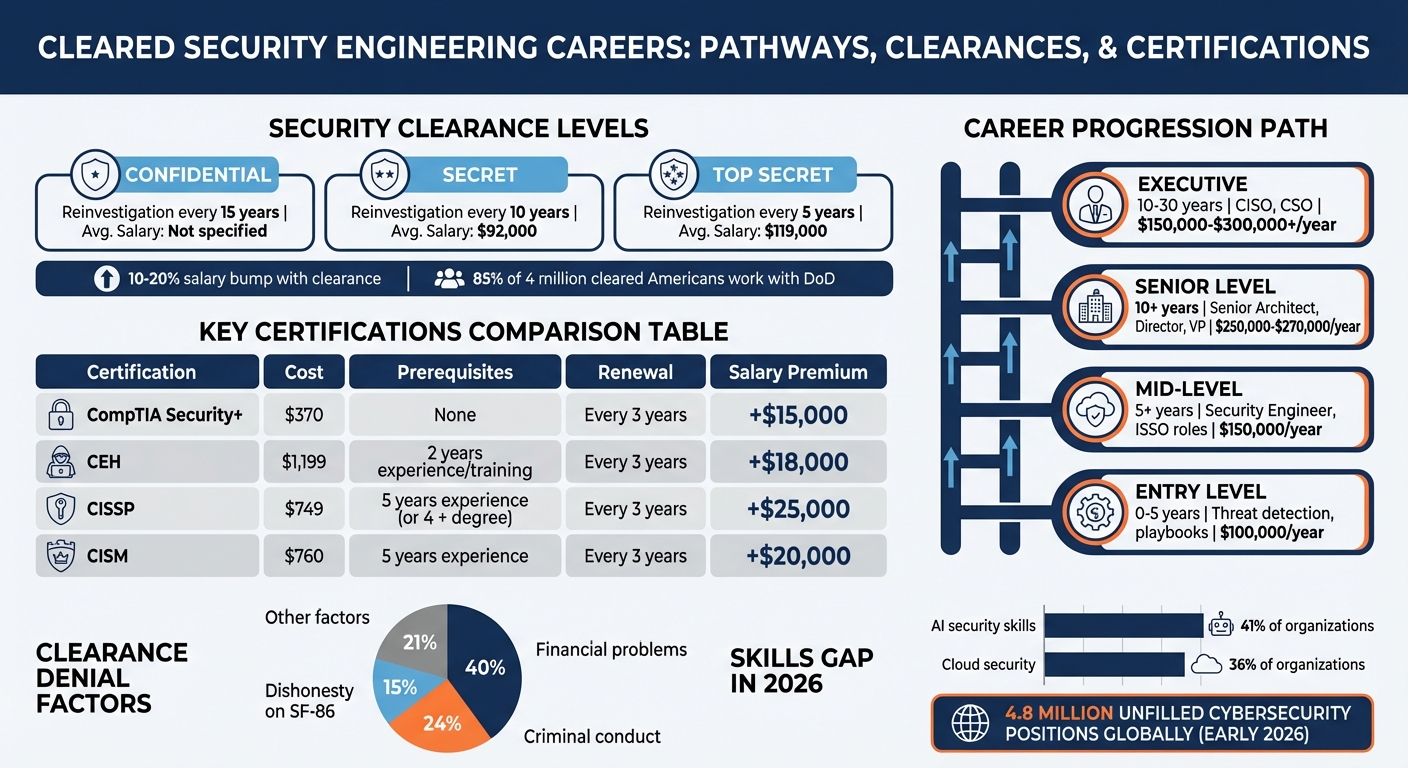
  • Clearance Levels: Secret and Top Secret clearances significantly impact job opportunities and earning potential, with Top Secret holders earning up to $119,000 annually.
  • Certifications: Industry-recognized certifications like Security+, CISSP, and CEH are often mandatory and can increase salaries by $15,000–$25,000.
  • Skills in Demand: Expertise in tools like Splunk, AWS GovCloud, and Zero Trust architecture is essential, alongside proficiency in programming languages like Python and PowerShell.
  • Challenges: Continuous Vetting (CV) requires professionals to report life changes promptly, and financial issues remain a top reason for clearance denial.
  • Career Progression: Entry-level roles start at $100,000/year, advancing to senior positions with salaries exceeding $250,000.

Whether transitioning from military service or advancing in your current role, focusing on certifications, technical skills, and clearance management is key to thriving in this field.

Security Clearance Levels and Certifications for Cleared Security Engineers

Security Clearance Levels and Certifications for Cleared Security Engineers

How to Get $100,000+/yr Government Security Clearance for Free (Full Guide Without the Military)

sbb-itb-bf7aa6b

What Security Engineers Do in Cleared Environments

In cleared environments, security engineers take on the critical task of safeguarding classified networks and systems that support national defense operations. Unlike their counterparts in commercial sectors, these professionals often work with air-gapped networks like SIPRNet and manage specialized government cloud platforms such as AWS GovCloud and Microsoft Azure Government [3]. Their primary focus is on defending information vital to national security, adhering strictly to federal standards and compliance protocols.

On a typical day, these engineers design secure system architectures, implement protective measures, and monitor network activity using tools like Splunk, firewalls, and IDS/IPS. They also conduct forensic investigations, analyze breaches, and ensure compliance with federal guidelines – all while managing risks tied to sensitive threat intelligence.

Core Responsibilities in Cleared Roles

Security engineers in these roles handle a wide range of tasks, including securing and auditing accredited systems, testing operating systems, and developing backup strategies to maintain infrastructure availability [1][3]. They perform risk assessments to identify vulnerabilities and implement security measures tailored to government requirements. Acting as a bridge between agencies, contractors, and internal teams, they ensure seamless collaboration [1].

Incident response in cleared environments comes with heightened complexity. Engineers must follow strict federal standards for documenting and reporting cyber events [2][3]. The "need-to-know" principle governs access to classified information, ensuring that engineers only interact with data relevant to their specific responsibilities [3].

In addition to their technical duties, these roles come with operational challenges unique to cleared environments.

Challenges Specific to Cleared Environments

Security engineers in cleared roles must navigate a range of challenges. For instance, adherence to the Trusted Workforce 2.0 (TW 2.0) framework is mandatory. This framework replaces periodic reinvestigations with Continuous Vetting (CV), requiring professionals to immediately report significant life events – such as arrests, financial changes, or new foreign contacts – to their Facility Security Officer (FSO) [3].

Adjudicators also review public-facing online activities, such as GitHub contributions, gaming forums, and professional networks, to assess compliance with operational security standards [3]. One of the most pressing concerns is financial management, as financial issues remain the top reason for clearance denial or revocation in 2026. Maintaining sound personal finances is, therefore, a critical aspect of working in these roles [3].

Required Qualifications and Certifications

Educational Requirements

For most cleared security engineer positions, a bachelor’s degree in computer science, information technology, or cybersecurity is the standard starting point [4]. Each field brings unique strengths to the table:

  • Computer science focuses on programming and algorithms, essential for creating security tools.
  • Information technology (IT) emphasizes network infrastructure and database management.
  • Cybersecurity programs dive into network defense, ethical hacking, and digital forensics.

"A degree in computer science, information technology, or cybersecurity is often the first step. This provides a solid foundation in essential concepts and technical skills."

  • ITU Online IT Training [4]

While 88% of cybersecurity job postings require at least a bachelor’s degree [8], the industry increasingly values hands-on certifications and bootcamps to complement formal education. Degrees provide the theoretical framework, while certifications validate real-world skills and meet government standards.

Key Certifications for Cleared Professionals

Certifications are essential for cleared roles, with the DoD 8570/8140 framework categorizing positions into Technical (IAT), Management (IAM), and System Architecture and Engineering (IASAE) levels. Before pursuing a certification, identify the required DoD 8570 level for your target role [7].

Here are some of the most sought-after certifications:

  • CompTIA Security+: Often the entry-level certification, this vendor-neutral credential costs around $370. It’s widely accepted for government and defense contractor roles.
  • CISSP (Certified Information Systems Security Professional): Regarded as the gold standard for senior positions, this certification focuses on security architecture and risk management. It costs approximately $749 and can boost your salary by an average of $25,000 [6].
  • CEH (Certified Ethical Hacker): Priced at about $1,199, this certification demonstrates offensive security expertise, showing you can identify and counter vulnerabilities [7].
  • CISM (Certified Information Systems Manager): Aimed at those in management roles, this certification costs around $760 and is tailored for enterprise-level security leadership.

"Certifications such as CISSP (Certified Information Systems Security Professional) are often mandatory for roles that involve the protection of sensitive information."

  • ITU Online IT Training [4]

The table below summarizes key certifications:

Certification Cost Prerequisites Renewal Salary Premium
CompTIA Security+ $370 None Every 3 years +$15,000
CEH $1,199 2 years experience/training Every 3 years +$18,000
CISSP $749 5 years experience (or 4 + degree) Every 3 years +$25,000
CISM $760 5 years experience Every 3 years +$20,000

Hands-on lab experience is increasingly critical, as many cleared employers now conduct technical entrance exams [7].

Security Clearance Requirements

A security clearance is not something you can obtain on your own – a federal agency or authorized cleared contractor must sponsor you for a position requiring access [4, 10]. As of 2026, the outdated e-QIP system has been replaced by eApp, a modernized platform for SF-86 submissions with real-time error checking [3].

There are three clearance levels:

  • Confidential: Access to information that could cause damage to national security; reinvestigation every 15 years.
  • Secret: Access to information that could cause serious damage; reinvestigation every 10 years.
  • Top Secret: Access to information that could cause grave damage; reinvestigation every five years [5].

"A security clearance is like a background check… it ensures your ability to securely access, manage, and protect classified information."

  • Coursera Editorial Team [5]

Holding a clearance can lead to a 10% to 20% salary bump, depending on the role. For example, Secret clearance holders earn around $92,000 annually, while Top Secret clearance holders average about $119,000. Additionally, 85% of the four million Americans with security clearances work with the Department of Defense [6, 10].

Factors That Impact Clearance Approval

Several issues can lead to clearance denials:

  • Financial problems: Responsible for 40% of denials. Address any major credit delinquencies before applying.
  • Criminal conduct: Accounts for 24% of denials.
  • Dishonesty: Falsifying information on the SF-86 makes up 15% of denials [4, 10].

Automatic disqualifiers include:

  • Non-U.S. citizenship
  • Dishonorable military discharge
  • Current illegal drug use
  • Previous clearance revocation
  • Being judged mentally incapacitated [5]

Proactively disclose any potential issues, as honesty is crucial. Falsifying information can be far more damaging than the issues themselves [4, 10].

Continuous Vetting (CV)

The traditional periodic reinvestigation system has been replaced by Continuous Vetting (CV), which monitors criminal, financial, and travel records in real time [4, 10]. Under CV, you must report arrests, major debts, or foreign travel within 72 hours to maintain compliance. Investigators also review public social media activity, so ensure your privacy settings are updated and review past posts before applying [4, 10].

Meeting clearance requirements not only fulfills government standards but also enhances your job prospects and earning potential in cleared roles.

Skills and Experience Needed for Success

Technical Skills for Cleared Professionals

Cleared security engineers need a strong foundation in advanced IT skills. Key areas of expertise include network protection – such as using firewalls, intrusion detection and prevention systems (IDS/IPS), and securing cloud platforms like AWS GovCloud and Microsoft Azure Government [3][9][11]. These skills are critical for effectively managing threats in Security Operations Centers (SOCs), where real-time responses are essential.

Proficiency in Zero Trust architecture and automation tools like Python, Bash, or PowerShell is also crucial for addressing modern security challenges at scale [3][9][11]. Staying ahead of emerging threats requires knowledge of cutting-edge technologies like quantum cryptography and AI/ML security [10][11].

"Textbook theory will only take you so far in a real-world security incident."

  • Steve Petryschuk, Director and Technology Evangelist, Auvik [11]

Practical experience is just as important as theoretical knowledge. You can sharpen your skills through Capture The Flag (CTF) competitions, red/blue team exercises, and certifications like OSCP for offensive security [9][11]. Strong communication abilities are equally vital – you’ll often need to break down complex technical issues for non-technical stakeholders [11].

While technical proficiency is a must, hands-on operational experience can set you apart as a top candidate.

How Military Experience Helps

Military experience provides a solid foundation for cleared security engineering roles, offering both technical expertise and a disciplined mindset. Veterans often have direct experience defending mission-critical systems against Advanced Persistent Threats (APTs), which translates seamlessly into civilian threat intelligence and enterprise security work [16]. For instance, if you’ve configured and protected military networks – like satellite communication links or secure data lines – you already have a head start in network security engineering [16].

The discipline instilled through military service is another major advantage. A commitment to high ethical standards and a strong motivation to safeguard systems and data align perfectly with civilian security engineering roles [14]. Your familiarity with structured incident response protocols mirrors the requirements of SOCs, and your experience with ongoing risk evaluation makes you well-suited for Governance, Risk, and Compliance (GRC) roles [16].

"Anybody who has worked in the operations centre in a warship, in a military unit or in an RAF station will have the experience and transferable skills needed for dealing with cyber security incidents."

  • IBM Research [14]

Your understanding of Operational Security (OPSEC) and the "need-to-know" principle is another key asset. Handling sensitive information securely and avoiding unnecessary risks is second nature for veterans [13][14]. Employers also value the leadership and teamwork skills developed during military service, which contribute to veterans being promoted faster and staying with their employers longer than their non-veteran counterparts – 8.3% longer, on average [10][15].

When transitioning to civilian roles, it’s important to translate military jargon into terms civilian employers understand. For example, instead of listing "35N Signals Intelligence Analyst", describe yourself as a Cybersecurity and Data Professional [10][12]. Highlight your experience in operations centers, as these roles directly relate to threat monitoring and cyber operations management [14]. With 69.1% of veterans holding a bachelor’s degree or higher as of 2023, your combination of education and practical experience positions you to excel as a cleared security engineer [10].

Career Progression for Security Engineers in Cleared Roles

Typical Career Path

A career as a cleared security engineer generally follows four stages, each offering distinct responsibilities and salary brackets.

At the entry level (0–5 years), you’ll focus on threat detection using established playbooks, earning an average of $100,000 annually [18]. As you gain experience, you’ll transition into mid-level roles (5+ years), such as Security Engineer or Information Security Architect, where the focus shifts to designing and implementing security systems. In cleared environments, you might also step into roles like Information Systems Security Officer (ISSO), managing compliance with frameworks like the Risk Management Framework (RMF). These roles typically offer salaries around $150,000 [18].

With 10+ years of experience, you’ll move into senior-level positions like Senior Security Architect, Director, or Vice President. In these roles, you’ll lead teams and drive organizational security strategies, earning between $250,000 and $270,000 [18].

At the executive leadership level (10–30 years), roles such as Chief Information Security Officer (CISO) or Chief Security Officer (CSO) become attainable. Salaries range from $150,000 to $300,000, with compensation often exceeding this range in larger organizations [18].

Your clearance level plays a critical role in career progression. Advanced roles in areas like cloud security, forensics, or vulnerability research often require upgrading from a Secret (Tier 3) to a Top Secret/SCI (Tier 5) clearance. While obtaining a Secret clearance typically takes 60 to 150 days, a Top Secret clearance can take 120 to 240 days. If your role requires a polygraph, the process may extend to 180–365+ days due to appointment backlogs [3].

By understanding these stages and requirements, you can take strategic steps to accelerate your career growth.

How to Advance Your Career

To move up the career ladder, focus on specializing in high-demand areas like AI security, cloud environments, or Governance, Risk, and Compliance (GRC). As of 2026, 41% of organizations cite AI skills as their largest gap, followed by cloud security at 36% [17].

Earning advanced certifications can showcase your expertise and readiness for higher-level roles. Certifications like CISSP or ISSAP, which are platform-agnostic, are particularly valuable for positions focused on design and strategy [18]. Beyond certifications, building a public profile can set you apart. Speak at security conferences, contribute to open-source projects, or participate in bug bounty programs. Networking is also key – many senior roles are filled through connections rather than public postings. Joining professional organizations like ISACA, ISSA, or ISC2 can help you expand your network [17].

Consider roles in startups or cybersecurity vendors to accelerate your career. Startups often value technical skills and adaptability over rigid experience requirements [18]. Alternatively, high-paying positions in cybersecurity vendors – such as sales engineering, product management, or marketing – offer opportunities to combine technical expertise with business acumen [17].

Finally, maintain your digital hygiene to protect your clearance. Keep in mind that your clearance becomes inactive 24 months after leaving a sponsoring position, so plan your career moves carefully to avoid gaps [3]. With 4.8 million unfilled cybersecurity positions globally as of early 2026, the demand for cleared professionals continues to grow [17].

Job Search Strategies for Cleared Security Engineers

As you progress in your cleared cybersecurity career, it’s crucial to use focused job search strategies and refine your resume to stand out in this competitive field.

Using Cleared Cyber Security Jobs Effectively

Cleared Cyber Security Jobs

Landing the right cleared role takes more than uploading a resume and waiting for responses. Start by completing your profile entirely and logging in weekly to refresh your "last active" date. This keeps your profile visible to recruiters who prioritize active candidates in their searches [19][20]. Recruiters often see your profile details – like key skills and preferred work locations – before even looking at your resume. Appearing in those initial search results is key.

To refine your search, use Boolean logic. For example, search for terms like "Security Engineer" OR "Cybersecurity Engineer" and apply filters like Zip Code and mileage radius to find relevant roles [19][20]. Also, select all clearance levels you qualify for. For instance, if you hold a Top Secret clearance, include "Secret" in your filters to expand your options [19][20].

Setting up Job Agents or Job Alerts can save time by notifying you about new roles that match your clearance and keyword preferences [20][21]. Additionally, participating in Cleared Job Fairs – both virtual and in-person – offers a direct line to hiring managers and recruiters [20][21]. If privacy is a concern, make use of features like "Anonymous" mode to showcase your skills while keeping your identity hidden, or use the "Block Employer" option to prevent your current employer from viewing your profile [19][20].

Once your online profile is optimized, the next step is creating a resume that highlights your cleared experience effectively.

Tailoring Your Resume for Cleared Roles

Think of your resume as an advertisement for your skills – it’s meant to secure an interview, not provide your life story [22].

"Your security-cleared resume is not a biography or a mere list of qualifications. It’s an ad designed to help you land that coveted cleared job interview and move to the next stage of the hiring process." – Ashley Jones, Editor, ClearedJobs.Net [22]

Start with the essentials: list your clearance level (e.g., TS/SCI), location (city and state), one email address, and one phone number at the top [22][24]. Follow this with a professional summary – two to three lines highlighting your certifications, years of experience, and technical skills. Avoid subjective phrases like "results-oriented team player", which add little value [22].

"Keep subjective self-descriptions out of your summary section. I’m looking at you, Results-Oriented Team Players." – Bill Branstetter, 9th Way Insignia [22]

Structure your accomplishments using the STAR method (Situation, Task, Action, Result), and include measurable outcomes. For example:

"Assumed management of a failing contract. Within 90 days implemented new procedures that improved team efficiency by 35%, resolved all overdue items, and led the team to a successful contract re-award." – ClearedJobs.Net [22]

Metrics like "reduced security risks by 20%" or "mitigated 50+ vulnerabilities" clearly show your value in a cleared environment [22][25].

Operational security (OPSEC) is non-negotiable. While you should list your clearance level on cleared job boards, avoid mentioning classified project names, colleague names, office sizes, or budget details [22][24]. Keep your resume clean and ATS-friendly by avoiding graphics, shading, or fancy fonts [22]. If you’re working on a certification, include the expected completion date to show progress [25]. Lastly, tailor your resume for each job application instead of relying on a one-size-fits-all version [23].

Conclusion

Building a career in cleared security engineering takes a mix of technical know-how, careful planning, ongoing certifications, and diligent clearance management. Your security clearance is a powerful tool, opening the door to sought-after roles with major employers like CACI, Lockheed Martin, and Booz Allen Hamilton. With Continuous Vetting in place, it’s crucial to report significant life changes to your Security Officer right away to maintain your clearance status [3].

The demand for specialized technical skills in the cleared sector remains strong, especially in areas like AI/ML and cloud engineering. Pairing strategic planning with skill development and utilizing focused job search tools can make all the difference in landing the right role.

"For those that are saying, ‘I only have a Secret,’ let me tell you, at Katmai, 75% of our open positions require a Secret clearance. You have a number of job opportunities available to you." – Taylor Hayes, Talent Acquisition Assistant Manager, Katmai Government Services [26]

This guide emphasizes that staying ahead in cleared cybersecurity roles depends on constant learning and proactive clearance upkeep. Whether you’re just stepping into the field or aiming for senior leadership, tools like Cleared Cyber Security Jobs can help. From job alerts and detailed employer profiles to virtual and in-person job fairs, these resources connect you directly with hiring managers. They also help you track industry trends, fine-tune your resume for cleared roles, and set yourself up for long-term success in this competitive field.

Thriving in cleared cybersecurity requires preparation, persistence, and keeping both your technical skills and clearance credentials up to date.

FAQs

Can I get a security clearance on my own?

No, you can’t get a security clearance by yourself. It requires sponsorship from an employer or a government agency. The process involves an in-depth background check and rigorous vetting to determine if you’re eligible to access classified information.

Which certification should I get first for a cleared security engineer role?

The CISSP (Certified Information Systems Security Professional) is often considered the top choice for those pursuing cleared security engineering roles. It’s highly regarded and frequently listed as a requirement in the industry. While other certifications, such as CEH (Certified Ethical Hacker), can be helpful depending on your career path, the CISSP is typically the go-to starting point for cleared professionals.

How do I keep my clearance active if I change jobs?

To keep your security clearance active when switching jobs, it’s crucial to ensure it continues to be used. Generally, a clearance becomes inactive after roughly two years of non-use unless you’re part of a continuous evaluation program. Taking on part-time roles, such as a cleared escort or security guard, can help maintain it. Additionally, leaving your current position on good terms and staying updated on your clearance status can make job transitions smoother.

Related Blog Posts

  • Classified Cloud Security Jobs – AWS GovCloud and Azure Government Specialization
  • GCP Security Certification for Cleared Cloud Architects
  • Cisco CCIE Security Career Guide for Cleared Expert Engineers
  • Threat Intelligence Analyst Career Path for Cleared Professionals

Related Guides

  • Endpoint Security Engineer Career Path for Cleared Professionals
  • Application Security Engineer Career Path for Cleared Professionals
  • Cloud Security Engineer Career Path for Cleared Professionals
  • TS/SCI Salary Premium: Real 2026 Numbers
  • Security Clearance Interview: What to Expect

Vulnerability Analyst Career Path for Cleared Professionals

CyberSecJobs Editorial · March 11, 2026 ·

Cleared vulnerability analysts are critical for protecting government systems and classified networks. They identify security gaps, test controls, and ensure compliance with strict federal standards like NIST 800-53 and RMF. With a Secret or Top Secret clearance, you can access classified projects immediately, making you a sought-after candidate. Here’s a quick breakdown of what this career involves and how to excel:

  • Daily Tasks: Scanning for vulnerabilities using tools like Nessus and Qualys, fixing security flaws, and ensuring compliance for systems’ Authorization to Operate (ATO).
  • Skills Needed: Proficiency in tools (e.g., Nessus, Qualys), analytical thinking, and clear communication with stakeholders.
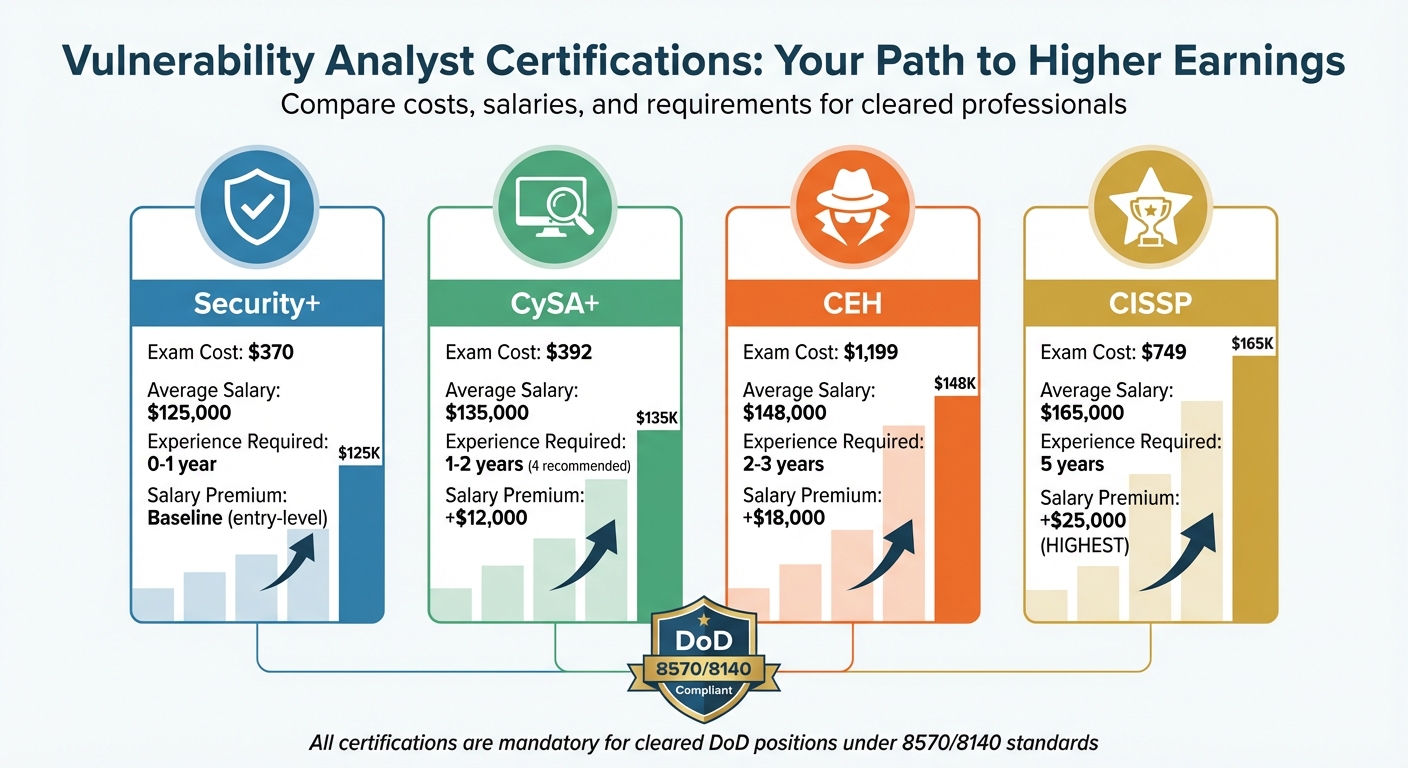
  • Certifications: Start with Security+ and aim for advanced credentials like CEH, CySA+, or CISSP to boost your salary by $12,000–$25,000 annually.
  • Job Market: Focus on regions like Washington, D.C., San Antonio, and Colorado Springs. Use platforms for cleared professionals and attend cybersecurity job fairs to connect with employers.

With cybersecurity spending expected to exceed $200 billion by 2026, demand for cleared vulnerability analysts remains high. Whether you aim for leadership roles or technical specialization, this career offers competitive pay, growth opportunities, and the chance to work on impactful projects.

Vulnerability Management Analyst Career Path: What are Vulnerability Management Analyst Jobs?

sbb-itb-bf7aa6b

What Cleared Vulnerability Analysts Do

Cleared vulnerability analysts focus on identifying and addressing security gaps in classified networks and government systems. Your role directly supports the infrastructure tied to national security. Day-to-day responsibilities include scanning for exploitable flaws, testing security measures, and ensuring systems comply with federal standards like NIST 800-53 and the Risk Management Framework (RMF).

Finding and Fixing System Weaknesses

A key part of your job is spotting vulnerabilities before they can be exploited. Using tools like Nessus and Qualys, you’ll run automated scans and then manually verify the results to rule out false positives. This involves assessing configurations, patch levels, and access controls. When a critical vulnerability is found, you’ll document its risk level, suggest remediation steps, and monitor the resolution process. Collaboration is essential – you’ll work closely with system administrators and application owners to ensure patches don’t disrupt mission-critical operations. Once vulnerabilities are addressed, you’ll conduct thorough assessments to confirm that security controls are functioning as intended.

Running Security Assessments and Audits

Government systems require regular evaluations to maintain their Authorization to Operate (ATO). As part of this process, you’ll perform security assessments – often quarterly or annually – to ensure compliance with Department of Defense (DoD) security guidelines and agency-specific standards. These assessments involve reviewing system architectures, testing controls, and compiling findings into formal reports. Evaluating a single system can take weeks, requiring detailed reviews of firewalls, user access, and other components. The goal is to translate technical data into actionable insights that align with agency frameworks.

Sharing Results with Government Stakeholders

Once assessments are complete, you’ll present your findings in a way that decision-makers can act on. This includes preparing detailed reports that explain vulnerabilities in terms of their impact on the mission, rather than just technical severity. You’ll often brief senior leaders, recommend budget adjustments for security improvements, and participate in Plan of Action and Milestones (POA&M) meetings. Clear communication is critical to ensure your findings drive informed decisions about security investments and operational priorities.

Skills and Tools You Need

To thrive as a cleared vulnerability analyst, you need both technical expertise and the ability to communicate effectively. Your work will involve using specialized tools and collaborating with teams across various security clearance levels. Mastering these tools lays the groundwork for the analytical and communication skills essential to this role.

Using Nessus and Qualys

Tenable Nessus is a go-to tool for vulnerability scanning. It boasts a library of over 315,000 plugins that address more than 116,000 CVEs, making it a powerful resource for identifying software flaws, missing patches, and misconfigurations[1]. Pricing typically falls between $4,790 and $6,790 annually, depending on your role[1]. To get the most out of Nessus, always conduct credentialed scans – these go beyond surface-level checks to provide a deeper understanding of system vulnerabilities.

Qualys VMDR offers a cloud-based solution for vulnerability management, detection, and response. With threat intelligence sourced from over 25 feeds, it can detect new vulnerabilities in as little as four hours[3]. Its pricing ranges from $128 to $542 per month, depending on your agency’s needs[2]. A key feature for cleared environments is its integration of patch management and automated reporting. As Rhoda Smart, a Cyber Security Engineer, puts it:

Qualys VMDR… helps simplify the whole vulnerability management cycle – ranging from the prioritization and remediation, down to asset discovery and assessment[2].

In addition to Nessus and Qualys, you’ll likely use tools like Nmap for network discovery, Burp Suite for web application testing, and Wireshark for packet analysis. Many analysts are also adopting risk-based prioritization methods, such as Tenable’s VPR and Qualys’s TruRisk, which evaluate vulnerabilities based on their real-world exploitability. Staying updated with CISA’s Known Exploited Vulnerabilities (KEV) catalog is equally important, as it highlights active threats.

Analytical Thinking and Problem-Solving

Analyzing scan results is about more than just identifying vulnerabilities – it’s about understanding their context. You’ll need to separate real threats from false positives and assess how vulnerabilities interact within complex systems. This requires a mindset of constant inquiry. Jeff Warling, Concierge Services Manager at Arctic Wolf, emphasizes this approach:

Never stop asking questions… Never lose your drive to serve people and to solve the mystery in front of you[5].

The stakes are high. In 2020, around 80% of cyberattacks exploited vulnerabilities that had been reported at least three years earlier[5]. Your job is to determine whether a vulnerability can be exploited in its current environment, evaluate existing controls, and recommend fixes that align with operational needs.

Working with Teams and Communicating Clearly

Technical know-how is only part of the equation. You’ll also need to translate complex vulnerability data into actionable insights for a range of stakeholders, including system administrators, application owners, and security leaders. Each group has different priorities and technical expertise, so tailoring your communication is key.

Clear communication goes both ways. Active listening helps you understand operational challenges, allowing you to propose realistic solutions that teams are more likely to adopt[4]. Additionally, you’ll play a role in fostering a security-first mindset within your organization by creating and delivering security awareness training[4]. For professionals in cleared environments, blending technical skills with effective communication is essential to success in this field.

Certifications for Cleared Vulnerability Analysts

Vulnerability Analyst Certifications: Cost, Salary Impact, and Requirements Comparison

Vulnerability Analyst Certifications: Cost, Salary Impact, and Requirements Comparison

Certifications play a critical role in proving your expertise, especially in a cleared environment. Under DoD 8570/8140 standards, they are more than just a bonus – they’re mandatory. Even with extensive experience, lacking the right credentials can disqualify you from most federal and defense contract positions[7][8]. While CompTIA Security+ is often the starting point, advanced roles in vulnerability analysis require certifications like CySA+, CEH, or CISSP.

For instance, CISSP-certified professionals earn an average of $165,000 annually, which includes a $25,000 salary boost – the highest in the field[7]. Similarly, CEH certification can increase your base pay by $18,000, while CySA+ adds $12,000 to your earnings[7]. These numbers highlight how much cleared employers value certified technical skills.

Certified Ethical Hacker (CEH)

The CEH certification is all about learning to think like an attacker. It equips you with the skills to identify vulnerabilities before they can be exploited. This includes training in offensive security techniques, web application security, social engineering, and hands-on vulnerability assessment[7][10]. It’s particularly valuable for complementing defensive tools like Nessus and Qualys.

The CEH exam costs $1,199 and requires 2–3 years of experience. On average, CEH-certified professionals earn $148,000 per year[7]. This certification is ideal if you want to develop a proactive approach to identifying and mitigating security risks.

CompTIA Cybersecurity Analyst (CySA+)

CompTIA Cybersecurity Analyst

CySA+ is designed for professionals focused on vulnerability management and incident response[8][9]. Costing $392, this certification emphasizes behavioral analytics and continuous security monitoring to detect threats[8][9]. According to CompTIA:

The premier certification for cyber professionals tasked with incident detection, prevention, and response through continuous security monitoring[8].

The current version, CS0-003, features up to 85 questions with a 165-minute time limit. To pass, you’ll need a score of 750 out of 900[8]. One area to focus on is the "Reporting and Communication" domain, which accounts for 17% of the exam and aligns with the stakeholder communication skills critical to vulnerability analysts[8].

CySA+ holders earn an average salary of $135,000. While 1–2 years of experience is recommended, having four years under your belt is even better for tackling this certification effectively[7].

Certified Information Systems Security Professional (CISSP)

CISSP

CISSP is considered the gold standard for advancing into senior-level cleared positions. This certification, priced at $749, covers eight key security domains, including risk management, cryptography, and legal compliance[7][10]. It’s tailored for strategic roles that involve managing entire security programs rather than focusing on day-to-day technical tasks[10].

To qualify for CISSP, you’ll need at least five years of professional experience, making it a long-term career goal rather than an entry-level certification[7]. CISSP-certified professionals earn an average of $165,000 annually, opening doors to management and architecture roles that often require higher clearance levels[7]. This certification not only validates your technical leadership but also aligns with the responsibilities of high-clearance positions.

Certification Exam Cost Avg. Salary Experience Required Salary Premium
Security+ $370 $125,000 0–1 year Baseline
CySA+ $392 $135,000 1–2 years (4 recommended) +$12,000
CEH $1,199 $148,000 2–3 years +$18,000
CISSP $749 $165,000 5 years +$25,000

These certifications not only boost your earning potential but also position you to take full advantage of your clearance as you progress in your vulnerability analyst career.

Using Your Security Clearance to Get Started

Why Security Clearances Matter

Having a security clearance gives you a distinct edge in the job market. Federal agencies and defense contractors often prioritize candidates with active clearances because it allows them to jump straight into classified work without delays.

An active clearance is essential for roles involving classified systems. For example, vulnerability analysts working on sensitive defense networks, intelligence systems, or government infrastructure need clearance to access secure facilities. This means you can be assigned to critical projects right away, which can fast-track your career. Employers value this readiness, making your clearance a key asset during your job hunt.

Job Search Tips for Cleared Professionals

Use your clearance to tap into exclusive job opportunities. Start by focusing on platforms designed specifically for cleared professionals. For instance, Cleared Cyber Security Jobs connects you directly with employers looking for candidates who already hold active clearances, ensuring your qualifications are front and center.

When applying, make sure to prominently feature your clearance level and adjudication date on your resume. This helps employers quickly confirm your eligibility for classified projects.

Geography can also play a big role in your search. Look at regions with a high concentration of federal agencies and defense contractors. The Washington D.C. metro area (including Northern Virginia and Maryland) is a major hub. Other areas to consider include San Antonio, Texas; Colorado Springs, Colorado; and San Diego, California. Setting up regional job alerts can help you stay ahead of new openings.

Lastly, expand your search beyond the title "Vulnerability Analyst." Many cleared roles use alternative titles like Security Assessment Analyst, Cyber Defense Analyst, or Information Assurance Specialist. These positions often require similar skills, so broadening your search terms can uncover more opportunities.

Building Your Professional Network

Networking can reveal opportunities that formal job applications often miss. For cleared vulnerability analysts, building the right connections doesn’t just open doors – it links you to classified projects and provides insider information about upcoming contracts.

Attending Cybersecurity Job Fairs

Cybersecurity job fairs tailored for cleared professionals give you a direct line to hiring managers who understand the value of your clearance. These events allow you to skip the automated resume filters and make a personal impression. Statistics show that roughly 1 in 10 attendees receive offers at these fairs, and that number jumps to 1 in 3 at polygraph-specific events [12].

To maximize your chances, pre-register about a week before the event. This gives recruiters time to review your resume and potentially schedule interviews ahead of time. When meeting recruiters, prepare a concise 10-30 second pitch that highlights your clearance level, technical skills (like experience with Nessus or Qualys), and certifications.

Cleared Cyber Security Jobs hosts both in-person and virtual hiring events throughout the year, connecting professionals like you with defense contractors and federal agencies. As Bryan Acton, Military & Veterans Program Leader at Peraton, advises:

Engage your peers and get an employee referral. That’s something I can’t give you as a recruiter. [11]

Peers at these events can provide valuable insights into work environments and contracts. To expand your reach even further, consider joining professional groups and online forums.

Joining Professional Groups and Online Forums

Professional organizations are a great way to stay informed about cybersecurity trends while growing your network. Groups like ISSA (Information Systems Security Association) and (ISC)² focus on cybersecurity professionals, often hosting local chapter meetings where you can connect with other cleared individuals and recruiters.

For more localized networking, consider attending Security BSides events, such as BSidesDC, BSidesNoVa, or BSidesLV. These community-driven conferences focus on technical cybersecurity topics and are often smaller and more approachable than larger industry events. Regional groups like CyberTexas also support cleared professionals with hiring events and career services.

Online platforms designed for cleared professionals can also boost your visibility. Recruiters often review profiles on these platforms before diving into full resumes. Listening to industry podcasts like Security Cleared Jobs: Who’s Hiring & How can provide additional insights from hiring managers and recruiters. After meeting someone new, follow up via LinkedIn or email within 24 hours to maintain the connection. These relationships can be a springboard to the next steps in your career.

Steps to Become a Vulnerability Analyst

Once you’ve secured your certifications and clearance, it’s time to focus on developing hands-on skills, crafting a standout resume, and landing the right role. A career in vulnerability analysis requires a mix of technical know-how, practical experience, and a resume tailored to the unique demands of cleared positions. Here’s how to move forward.

Building Skills and Gaining Experience

To excel, you’ll need a strong foundation in programming and operating systems. Proficiency in key programming languages and essential scanning tools is critical for vulnerability analysis work [13]. Make sure you’re comfortable working with Windows and Unix/Linux operating systems, as well as familiar with security frameworks like NIST, ISO 27001/27002, HIPAA, and SOX [13]. Additionally, mastering tools such as Nessus, ACAS, RETINA, and Nmap will be crucial – these are frequently mentioned in job postings for cleared professionals.

Most employers look for two to three years of relevant experience before hiring [13]. You can build this experience by freelancing for small businesses or setting up home labs to practice identifying vulnerabilities like buffer overflows, XSS attacks, and SQL injection. According to projections, employment for information security analysts is expected to grow by 31% from 2021 to 2029, making this a promising field [13].

While larger companies may prefer candidates with a bachelor’s degree in computer science or cybersecurity, smaller organizations and contractors often focus on certifications and proven skills [13]. Earning certifications like CEH (Certified Ethical Hacker) or CISSP (Certified Information Systems Security Professional) can validate your expertise and broaden your opportunities.

Writing a Resume for Cleared Positions

Your security clearance should be front and center on your resume. For example, include details like "TS/SCI with CI Polygraph (Active)" or "Eligibility: Secret Eligible – Last Investigation March 2022" as the very first line – not hidden in a skills section [14].

Federal contractors and agencies often use Applicant Tracking Systems (ATS) to scan resumes for specific keywords. If a job posting mentions tools like "Nessus", terms like "FISMA", or projects such as "NGEN", ensure those exact words appear on your resume [14]. Avoid substituting terms – stick to the language used in the job listing to avoid being filtered out [14]. Highlight measurable achievements, like "Reduced system latency by 47% through refactored Python scripts" or "Managed COMSEC inventory across 3 secure sites with zero compliance issues" [14].

Keep your resume straightforward and chronological. Avoid fancy designs or graphics that could confuse ATS software [14]. Make sure to include both the month and year (mm/yyyy) for employment dates to avoid raising red flags during the hiring process [14]. As Three Cords Talent emphasizes:

Your resume isn’t just a document – it’s a clearance-friendly sales tool [14].

Once your resume showcases your clearance and technical accomplishments, you’re ready to explore direct-hire opportunities.

Finding Jobs on Cleared Cyber Security Jobs

Cleared Cyber Security Jobs

Platforms like Cleared Cyber Security Jobs are designed to connect security-cleared professionals directly with employers in the cybersecurity field. The platform allows you to filter job searches by clearance levels, such as TS/SCI, Secret, or Top Secret, making it easy to find roles that align with your qualifications.

Uploading your resume to the platform ensures recruiters can discover you – even when you’re not actively job hunting. You can also set up job alerts to receive notifications about new vulnerability analyst positions that match your skills and clearance level. Since the platform exclusively partners with direct-hire employers, you’ll avoid staffing firms and connect directly with agencies or contractors looking for your expertise.

Additionally, participating in job fairs hosted by the platform can give you the chance to meet hiring managers face-to-face, bypassing automated screening systems and making a stronger impression.

Growing Your Career as a Vulnerability Analyst

As a vulnerability analyst, your career can evolve in two main directions: stepping into leadership roles or diving deeper into technical expertise. The path you choose depends on your strengths and long-term goals. Here’s how you can build on your current experience to take your career to the next level.

Moving into Senior and Management Positions

Your experience in vulnerability analysis can serve as a springboard into senior or management roles. Senior analysts often take on responsibilities like managing projects, mentoring junior team members, and acting as technical experts within their organizations. Positions such as Vulnerability Management Team Lead involve overseeing assessments, coordinating remediation efforts, and ensuring the team meets its objectives.

For those aiming higher, roles like Cybersecurity Manager or Director of Vulnerability Assessment come with broader responsibilities. These positions focus on presenting risk metrics to stakeholders, managing budgets, and ensuring security strategies align with organizational goals. Building leadership skills early is key – take the initiative to lead cross-functional projects or present your findings in team meetings. These experiences can prepare you for the challenges of management.

On the other hand, if leadership isn’t your focus, you might prefer advancing your technical skills by exploring specialized areas like threat hunting or incident response.

Specializing in Threat Hunting or Incident Response

For those who thrive on hands-on work, specializing in technical areas can be a rewarding path. Threat hunters use their understanding of vulnerabilities to identify subtle signs of compromise that automated systems might overlook. By anticipating how attackers exploit weaknesses, they play a crucial role in proactive defense.

Incident response specialists, meanwhile, focus on managing active security breaches. This involves forensic analysis to understand the scope of an attack and coordinating efforts to mitigate damage. Your background in vulnerability analysis equips you with the skills to tackle these challenges effectively. Roles in threat hunting or incident response are particularly sought after in government and defense sectors, offering opportunities to make a significant impact.

Whether you choose leadership or technical specialization, the skills you’ve developed as a vulnerability analyst provide a strong foundation for future growth.

Conclusion

Your role in protecting critical networks plays a vital part in national security. A career as a cleared vulnerability analyst not only offers financial stability and competitive pay but also opens the door to significant career growth. With global cybersecurity spending predicted to surpass $200 billion by 2026 and the industry growing at an annual rate of 9.4% through 2028, the demand for skilled professionals in this field is only increasing [4]. Currently, the national average salary for vulnerability analysts is approximately $128,000, with senior positions reaching as high as $170,000 [15]. This upward trend underscores the importance of continuously sharpening your skills and earning relevant credentials.

Having an active clearance gives you a competitive edge, especially when applying for roles with defense contractors or government agencies in key regions like Washington D.C. While these positions often have higher entry barriers, they usually come with better compensation and the chance to work on projects that truly matter – like safeguarding critical infrastructure.

"The role of vulnerability assessment analyst pays well, and is expected to continue to be in demand. Further the career offers an opportunity to positively impact an organization and growth opportunities." – Salesforce Trailhead [6]

To maximize your potential, combine the advantage of your clearance with a strong technical foundation. Certifications such as CEH, CySA+, and CISSP are essential, and mastering tools like Nessus and Qualys is crucial – around 70% of roles list proficiency in these tools as a requirement [4]. Additionally, honing your ability to explain complex risks to non-technical audiences can set you apart, especially as you move into more senior roles.

Whether you aim to step into leadership or deepen your technical expertise, your skills remain indispensable. The work you do not only strengthens organizational security but also positions you as a key player in shaping security policies and strategies.

FAQs

Can I start this job with only a Secret clearance?

Yes, having a Secret clearance is usually sufficient to start working as a vulnerability analyst. Many job postings list a Secret clearance or higher as a requirement, though certain roles might call for a Top Secret clearance instead. Always double-check the job description to ensure you meet the specific clearance level needed for the position.

What should I learn first: Nessus, Qualys, or RMF?

To kick things off, dive into learning vulnerability assessment tools like Nessus and Qualys. These tools are crucial for spotting weaknesses in systems and networks, giving you hands-on, practical skills that are key to the role. On the other hand, RMF (Risk Management Framework) deals with managing risks through policies and ensuring compliance, which is a more advanced area. By mastering vulnerability tools first, you’ll create a solid foundation that makes tackling RMF processes much smoother and more effective down the line.

How do I prove experience if I’ve only done home labs?

Home labs can be an excellent way to showcase your skills, especially if you’re just starting out and don’t have much formal work experience. By documenting your projects, you can provide concrete examples of your abilities. Be sure to include details like the tools you used (e.g., Nessus or Qualys), the techniques you practiced, and the results you achieved. Consider creating a portfolio that highlights your hands-on work. This can be a powerful addition to your resume and a great talking point during interviews, demonstrating your practical understanding of cybersecurity and your ability to solve problems effectively.

Related Blog Posts

  • Top 10 Cyber Security Jobs for Cleared Professionals
  • CySA Plus Certification Career Guide for Cleared SOC Analysts
  • Cisco CCIE Security Career Guide for Cleared Expert Engineers
  • Threat Intelligence Analyst Career Path for Cleared Professionals

Related Guides

  • Purple Team Specialist Career Path for Cleared Professionals
  • Red Team Operator Career Path for Cleared Professionals
  • Penetration Tester Career Path for Cleared Offensive Security
  • TS/SCI Salary Premium: Real 2026 Numbers
  • Security Clearance Interview: What to Expect

Purple Team Specialist Career Path for Cleared Professionals

CyberSecJobs Editorial · March 11, 2026 ·

Looking to advance your career in cybersecurity? Purple Team Specialists bridge the gap between offensive (Red Team) and defensive (Blue Team) roles, ensuring simulated attacks lead to stronger security measures. These roles are especially critical in cleared environments like government agencies and defense contractors, where protecting classified data from advanced threats is paramount.

Key Highlights:

  • Role Overview: Combines attack simulation with improving detection and response systems.
  • Salary Range: $110,000–$180,000 annually, with up to an 18% premium over other roles.
  • Skills Needed: Offensive techniques (e.g., lateral movement, exploit chaining), defensive practices (e.g., SIEM tuning, log analysis), and tools like MITRE ATT&CK, Cobalt Strike, and Splunk.
  • Certifications: GIAC Purple Teaming (GPT), OSCP, CySA+, and CISSP for leadership roles.
  • Demand: 64% of organizations report skill shortages in this area, with increased demand expected by 2026.

If you’re a cleared professional with experience in cybersecurity, transitioning to this role can offer job security, higher pay, and a chance to tackle advanced threats head-on.

Purple Team Specialist Career Path: Skills, Certifications, and Salary Progression

Purple Team Specialist Career Path: Skills, Certifications, and Salary Progression

What’s a Purple Team and Skills Needed to be a Purple Teamer

sbb-itb-bf7aa6b

What is a Purple Team Specialist?

A Purple Team Specialist is a cybersecurity expert who bridges the gap between offensive (Red Team) and defensive (Blue Team) strategies, creating a feedback loop that strengthens an organization’s security posture. Unlike traditional roles that often work separately, this position requires collaboration and a dual skill set. As Mike Parkin, Senior Technical Engineer at Vulcan Cyber, explains:

"Rather than working against each other competitively, they cooperate. The Red Team explains what they’re doing, and the Blue Team shares where they did or didn’t see the attack as it happened." [6]

Their goal? To turn simulated attacks into actionable defensive improvements. JF Malvik of Malvik Security sums it up well:

"Purple teaming transforms security from a guessing game into an engineering discipline." [2]

Let’s break down what Purple Team Specialists do and why they’re crucial, particularly in environments handling classified information.

Core Responsibilities

Purple Team Specialists juggle offensive and defensive tasks, ensuring both teams work in sync. They design and execute attack simulations that mimic real-world threats – like ransomware or advanced persistent threats (APTs) – and collaborate with Security Operations Centers (SOCs) to refine detection and response systems. This includes fine-tuning tools like SIEM, SOAR, and EDR/XDR to ensure alerts trigger when they should.

When an attack simulation goes undetected, these specialists dig into the reasons. Was it a logging gap, where no data was captured? Or a detection gap, where data existed but no alert was raised? Identifying these gaps is a critical part of their role.

They also use adversary emulation tools like CALDERA and Atomic Red Team to automate test cases, validating defensive measures. Additionally, they simplify complex offensive techniques into actionable insights, often visualizing improvements with tools like VECTR.

This blend of skills is especially important in high-stakes settings, where attackers are continuously evolving their tactics.

Why Purple Teaming Matters in Cleared Environments

For organizations such as government agencies, defense contractors, and others handling classified data, purple teaming tackles challenges that compliance-based approaches often miss. These environments face advanced threats from nation-state actors using cutting-edge techniques, far beyond what standard security audits can catch. While annual penetration tests provide static insights, adversaries evolve constantly – especially in dynamic cloud-based systems.

Purple teaming introduces a process of continuous validation that adapts to modern threats. By conducting quarterly exercises, organizations can significantly improve their detection capabilities, reducing Mean Time to Detect (MTTD) by 40–60% within the first year [5]. As Jared Atkinson, a leader in detection engineering, points out:

"Traditional approaches often deliver a false sense of detection coverage; modern cybersecurity cannot function with either team in isolation." [4]

The shift toward purple team operations is gaining momentum, with 88% of organizations expected to adopt this approach by 2026 [5]. For cleared professionals, this method aligns with NIST and government standards, enabling active, ongoing validation of security controls. It moves organizations beyond mere compliance, building real resilience against advanced threats.

Required Skills and Certifications

To excel as a Purple Team Specialist, you need a strong mix of technical expertise and certifications, particularly in environments that require security clearances. Your skillset should cover both offensive and defensive strategies, bridging the gap between these two critical areas of cybersecurity.

Technical Skills

On the offensive side, you’ll need to master techniques like lateral movement, privilege escalation, and exploit chaining. Tools such as Cobalt Strike, Metasploit, and Sliver C2 are essential for simulating advanced threat scenarios. But being effective in this role also means excelling in defensive architecture and engineering. This includes fine-tuning SIEM platforms, analyzing logs, and configuring endpoint detection systems like CrowdStrike or Microsoft Defender.

A strong grasp of detection engineering is key. You’ll need to write detection logic and automate Sigma rule deployment using CI/CD pipelines. Familiarity with the MITRE ATT&CK framework is non-negotiable, as it helps map attack techniques to defensive gaps. Knowledge of frameworks like NIST, OWASP, and D3FEND further strengthens your ability to identify and mitigate vulnerabilities.

Proficiency in scripting and automation sets you apart. Skills in Python, PowerShell, and Bash allow you to automate tasks, simulate adversarial behavior, and integrate continuous testing into your workflows. Understanding telemetry and logging is another critical area – whether it’s Windows Event Logs, Sysmon (using configurations like sysmon-modular), or Event Tracing for Windows (ETW), you need to validate telemetry before creating detection rules.

Modern threats demand expertise in areas like identity-based attacks, including OAuth abuse and MFA fatigue, as well as cloud and container security, which involves defending against escape techniques in these environments.

Key Certifications

Certifications play a crucial role in building credibility and validating your skills as a Purple Team Specialist. The following certifications are particularly relevant:

  • GIAC Purple Teaming (GPT) and MITRE ATT&CK Defender (MAD) focus on purple team methodologies and threat-informed defense [10][1].
  • Offensive certifications like OSCP (Offensive Security Certified Professional) demonstrate hands-on penetration testing skills [9].
  • Alternatives such as Certified Ethical Hacker (CEH) and GIAC Penetration Tester (GPEN) provide additional offensive credentials, while Certified Red Team Professional (CRTP) specializes in Active Directory exploitation [9].
  • On the defensive side, CompTIA Cybersecurity Analyst (CySA+) covers detection and response, while GIAC Certified Incident Handler (GCIH) and GIAC Certified Forensic Analyst (GCFA) enhance forensics capabilities [9][1].
  • For leadership or cleared roles, CISSP (Certified Information Systems Security Professional) is often required and highly respected [9][4].

Combining certifications from both offensive and defensive domains creates a well-rounded skillset. For example, pairing OSCP with CySA+ establishes a strong foundation, while adding GPT or MAD highlights your expertise in purple teaming. As Nick Villa, a GPEN-certified professional, explains:

"Being able to and knowing how to exploit a vulnerability not only looks good for you, but the impact it has on the business is extremely valuable" [10].

Purple team roles often come with an 18% salary premium compared to traditional single-discipline security positions [3]. While technical skills and certifications are crucial, soft skills are equally important for success in this field.

Soft Skills

Technical knowledge alone isn’t enough to bridge the gap between offensive and defensive teams. Strong communication skills are essential. You’ll need to translate complex attack techniques into actionable defensive measures and articulate business risks to leadership. Tracy Wallace, Director of Content Development at INE Security, puts it this way:

"Purple teams teach you to think systematically about security challenges, communicate across disciplines, and adapt to new situations" [3].

A collaborative mindset is vital. Instead of perpetuating the traditional “Red vs. Blue” divide, you’ll act as a bridge, fostering cooperation and shared learning. This means thinking holistically about security – understanding how individual vulnerabilities fit into the broader attack surface [6][4].

Adaptability is another critical trait. The threat landscape is always changing, and staying ahead requires continuous learning. With 90% of cybersecurity leaders citing skills gaps on their teams [3], the ability to remain calm and effective during high-pressure situations, such as incident response or breach simulations, sets top specialists apart. Finally, strong documentation and reporting skills ensure that your work leads to actionable improvements rather than being lost in forgotten reports.

Experience and Prerequisites for Cleared Professionals

Professional Experience

Purple Team Specialist roles demand significant prior experience – they’re not entry-level positions. Typically, you’ll need 3 to 5 years of hands-on work in cybersecurity to qualify [4]. Employers look for candidates with deep expertise in either offensive or defensive security disciplines. For example, a background as a SOC Analyst, Incident Responder, Threat Hunter, or Security Engineer equips you with skills like SIEM monitoring, log analysis, and forensics. On the offensive side, roles such as Penetration Tester, Red Team Operator, or Adversary Emulation Specialist develop the attacker mindset critical for purple teaming. Professionals with experience in Detection Research, Engineering, or Threat Intelligence are also well-prepared for this transition [4].

You’ll also need a thorough understanding of Advanced Persistent Threats (APT) and Tactics, Techniques, and Procedures (TTP). This expertise comes from years of exposure to real-world threats and is reflected in the compensation. Mid-level Purple Team Engineers typically earn between $115,000 and $145,000 annually, while senior-level roles can command salaries exceeding $200,000 [6]. For cleared professionals, these technical qualifications are paired with stringent security clearance requirements.

Security Clearance Requirements

Beyond technical expertise, U.S. citizenship is a must for cleared Purple Team roles [11]. An active security clearance is also required, usually at the Secret (Tier 3) or Top Secret (Tier 5) level. Many high-stakes positions – especially those involving sensitive defense systems or work in a Sensitive Compartmented Information Facility (SCIF) – require Top Secret/Sensitive Compartmented Information (TS/SCI) eligibility [11][12]. Some roles in the Intelligence Community may also require a polygraph exam, which can extend the onboarding process.

The time it takes to obtain a clearance varies. A Secret clearance can take 60–150 days, while a Top Secret clearance may require 120–240 days. For TS/SCI with a polygraph, the timeline can extend to 180–365+ days [11]. Importantly, you’ll need sponsorship from a federal agency or a cleared contractor to apply for a clearance, which often comes after receiving a conditional job offer.

Once you have a clearance, maintaining it requires ongoing vigilance. The government now employs Continuous Vetting, an automated system that monitors criminal, financial, and travel records in real time, replacing the older periodic reinvestigation process [11]. You’re also required to self-report any "adverse events", such as arrests, significant debt, or foreign contacts, to your Facility Security Officer (FSO) to maintain trust. Additionally, adjudicators increasingly assess your online presence, including contributions on platforms like GitHub, social media activity, and participation in gaming communities, to evaluate your operational security awareness. Before starting the clearance process, you’ll need to prepare a detailed 10-year history of your residences, employment, education, and foreign contacts to avoid potential "Personal Conduct" concerns [11].

How to Transition into a Purple Team Specialist Role

Building Your Offensive and Defensive Skills

Developing purple team expertise requires a structured approach where you simulate attacks, detect them, refine your techniques, and improve detection capabilities. This continuous feedback loop is key to mastering the role [2]. A great starting point is creating a personal lab environment. Use tools like Proxmox or VMware to set up a lab with enough resources to mimic a real-world Active Directory environment. Tools like BadBlood can help populate the directory, while Sysmon (with the sysmon-modular configuration) enables full telemetry. Pair this setup with a SIEM solution like Elastic Stack or Splunk for comprehensive monitoring [2].

To streamline your learning, follow this 30-day roadmap:

  • Week 1: Build your lab infrastructure and ensure that logs are flowing correctly.
  • Week 2: Execute five techniques from Atomic Red Team (e.g., T1059 for command-line execution) and create three Sigma detection rules based on your findings.
  • Week 3: Use MITRE Caldera to design a chained attack sequence, covering stages like Initial Access, Discovery, and Lateral Movement. Document any detection gaps you encounter.
  • Week 4: Create a Git repository for your Sigma rules and commit to testing two or three new techniques each week [2].

This hands-on approach fosters the "translator" mindset that is essential for bridging offensive and defensive strategies in purple teaming [4][6].

To further enhance your skills, consider using Breach and Attack Simulation (BAS) platforms. These tools automate much of the offensive work, allowing you to focus on testing and improving your defensive measures without manually executing each attack [14]. Once you’ve built a strong technical foundation, you’ll be ready to explore job opportunities and expand your professional network.

Using Job Boards and Networking

After sharpening your technical abilities, the next step is to leverage job boards and networking to land a purple team role. Platforms like Cleared Cyber Security Jobs cater specifically to professionals with active security clearances. Uploading your resume to their database increases your visibility, as many cleared positions are filled through direct outreach rather than public postings. Use the platform’s filters to refine job searches by clearance level (e.g., Secret, Top Secret, TS/SCI), location, and keywords like "detection engineering" or "adversary emulation." Setting up job alerts ensures you won’t miss new opportunities.

Attending job fairs hosted on these platforms is another effective way to connect with hiring managers. These events are tailored for cleared professionals, allowing direct interaction with employers rather than staffing agencies. Discussions often cover specifics like SCIF environments and polygraph requirements, which are common in cleared roles. Networking within the cleared community can also uncover unadvertised positions and provide valuable referrals from those already working in purple team roles. Once you start securing interviews, a finely tuned resume will help you stand out.

Optimizing Your Resume

Your resume should clearly showcase your dual expertise in offensive and defensive strategies, as well as your active clearance. Place your clearance level (e.g., Secret, Top Secret, TS/SCI) prominently at the top of your resume, as this is a key factor for cleared hiring managers.

Focus on highlighting collaborative experiences rather than isolated red or blue team roles. For example, instead of listing skills like "penetration testing" or "SIEM monitoring" separately, emphasize roles that involved "joint analysis", "detection engineering", or "cross-functional validation exercises" [8][6]. Data supports the impact of these approaches – weekly purple team exercises can reduce threat response times by 40%, and collaborative testing has been shown to increase ransomware detection rates from 52% to 88% [4][13].

Include certifications that demonstrate your balanced skill set, such as SANS SEC599 or detection engineering courses from Malvik Security. Mention specific tools and frameworks you’ve worked with – like MITRE ATT&CK, Atomic Red Team, Caldera, Sigma rules, VECTR, and BAS platforms – to showcase hands-on expertise [2][8]. This combination of technical skills and collaborative experience will make your resume stand out in the competitive field of purple teaming.

Tools and Platforms for Purple Team Operations

Threat Emulation and Detection Tools

Purple team operations heavily depend on tools that simulate realistic attacks and validate both offensive and defensive strategies. Among these, adversary emulation frameworks and command-and-control (C2) tools are particularly crucial. Atomic Red Team, for instance, offers a library of small, focused tests aligned with the MITRE ATT&CK framework, making it ideal for testing specific security controls. On the other hand, MITRE Caldera automates multi-stage attack chains using agents and plugins, allowing for more comprehensive simulations of adversary behavior. While Atomic Red Team is perfect for testing individual detections, Caldera shines when simulating complex, chained attack sequences.

For environments centered on Windows, PurpleSharp generates realistic attack telemetry using .NET executables, supporting 47 different MITRE ATT&CK techniques [15]. When it comes to C2 frameworks, Cobalt Strike is a leading tool for simulating long-term embedded threats with flexible communication channels. If you’re looking for an open-source alternative, Sliver C2 provides cross-platform implant capabilities to mimic realistic C2 behavior. Additionally, Metasploit remains a standard tool for simulating various attack vectors and exploiting vulnerabilities.

Detection tools play an equally important role. Sysmon, when configured with optimized detection settings (e.g., sysmon-modular), captures detailed host-level telemetry, which is essential for detecting advanced techniques such as LSASS memory dumping. For example, Sysmon Event ID 10 logs LSASS access, which can be a key data point for detection. Before creating detection rules, ensure your SIEM system captures the necessary telemetry. These tools not only simulate adversary actions but also supply critical data for broader monitoring and analysis.

SIEM and BAS Platforms

To complement emulation tools, SIEM (Security Information and Event Management) and BAS (Breach and Attack Simulation) platforms provide real-time data analysis and attack visualization. SIEM platforms, like the ELK Stack (Elasticsearch, Logstash, Kibana), consolidate telemetry from both red and blue teams, offering a unified view to identify gaps and visualize attack data. Splunk offers similar capabilities and even provides a six-month free license for lab environments, with up to 10 GB of daily indexing [7]. For those seeking a free alternative, Wazuh is another reliable option for log aggregation and alert validation.

BAS platforms take things further by automating the execution of tactics, techniques, and procedures. SCYTHE, for example, enables continuous validation with features like campaign customization, auto-pausing for real-time analysis, and integrated reporting. This automation allows teams to focus on improving defenses rather than managing manual tests. For tracking campaign outcomes, VECTR is particularly effective. It logs detected versus missed activities and generates MITRE ATT&CK heatmaps to highlight detection trends over time. Pairing VECTR with DeTTECT can also help assess the quality of your data sources and visibility across specific tactics, ensuring a more robust defense strategy.

Career Growth and Advancement Opportunities

Pathways to Senior Roles

Purple Team Specialists often climb the career ladder faster than professionals focused solely on offensive or defensive security. Why? Organizations place a premium on their well-rounded expertise in both areas. The typical career path starts with hands-on technical roles and progresses to strategic positions. At this stage, you’ll find yourself managing tabletop exercises, overseeing collaboration between Red and Blue teams, and presenting technical findings in a way that aligns with business risks for leadership teams [4][6].

Some common roles along this journey include Detection Engineer, Security Validation Engineer, Purple Team Lead, Cybersecurity Strategist, and ultimately titles like Director of Cybersecurity or Chief Information Security Officer (CISO) [4]. Increasingly, these positions emphasize a "Cyber Strategist" approach, blending technical execution with risk management. This dual focus makes Purple Team professionals indispensable for building stronger organizational defenses.

To prepare for senior roles, it’s critical to develop leadership skills rooted in measurable outcomes. Tools like VECTR can help you track and showcase improvements in detection coverage over time, providing tangible evidence of your contributions. Senior-level roles also demand proficiency in coding languages such as Python, PowerShell, Golang, or Node.js for automating attack simulations and fine-tuning detections [6]. Advanced certifications like CISSP, CISM, or CGEIT can further strengthen your resume, especially for roles in cleared environments where certifications like CISSP are often required for top-tier positions [17][16].

"The most bulletproof careers are built on adaptability rather than narrow expertise. Purple teamers represent exactly that kind of versatility… they are not only keeping their positions – they’re actually advancing, thriving, and proving that they possess strong earning power." – Tracy Wallace, Director of Content Development, INE Security [3]

This adaptability and skillset often lead to greater financial rewards.

Salary Insights

In addition to expanded responsibilities, career progression in this field often comes with a significant pay boost. Purple Team Specialists earn roughly 18% more than traditional security roles [3]. Entry-level positions start at a higher salary range ($80,000–$100,000) compared to junior SOC analysts or penetration testers, who typically earn between $60,000 and $86,000. This difference reflects the prior experience required in at least one security discipline [4].

Security clearance can further amplify earnings. Professionals with a Top Secret/SCI clearance earn, on average, 40.6% more than those with a Secret clearance. Adding a Full Scope Polygraph (FSP) pushes average salaries to $148,314 – a 58.2% increase over the baseline for Secret clearance holders [17]. In high-cost areas like Washington, D.C., top earners with TS/SCI FSP clearance can exceed $206,143 annually [17].

Experience Level Typical Roles Salary Range
Entry-Level (0-2 years) Purple Team Associate, Junior Detection Engineer $80,000 – $100,000 [4]
Mid-Level (3-5 years) Purple Team Engineer, Detection Engineer $115,000 – $145,000 [4]
Senior (8-10+ years) Purple Team Lead, Cyber Strategist, Director $140,000 – $200,000+ [4]
Specialized Senior Senior Security Architect, Principal Engineer $130,000 – $208,000 [4][6]

Real-world job postings illustrate this earning potential. For example, in June 2026, Meta advertised an Offensive Security Engineer (Purple Team) position in Washington, D.C., offering $117,000–$137,000. Meanwhile, Kroll listed remote-capable Purple Team Specialist roles with salaries ranging from $100,000 to $140,000 [3]. These examples highlight the strong financial incentives for cleared professionals in this field.

Conclusion

Purple Team Specialists hold a critical position in cleared cybersecurity, bridging the divide between identifying vulnerabilities and implementing effective solutions. In environments where operational readiness takes precedence over simple compliance, these experts create a dynamic feedback loop that turns security challenges into measurable progress. This method strengthens protection for mission-critical systems in tangible ways [4].

For those looking to step into this dual-discipline role, the path is clear: focus on honing both offensive and defensive skills through hands-on labs and targeted certifications. Familiarity with frameworks like MITRE ATT&CK is essential for speaking the common language of cybersecurity. The financial rewards reflect the importance of this skill set, with mid-level roles offering salaries between $115,000 and $145,000, and senior positions exceeding $200,000 [4].

"The most bulletproof careers are built on adaptability rather than narrow expertise. Purple teams teach you to think systematically about security challenges, communicate across disciplines, and adapt to new situations." – Tracy Wallace, Director of Content Development, INE Security [3]

The demand for Purple Team Specialists in cleared environments is on the rise as defense contractors and government agencies recognize that 64% of organizations cite skills gaps – not a lack of personnel – as their top security challenge [3]. By mastering attack emulation, crafting detection rules, and effectively communicating findings to leadership, you’re preparing for a career that evolves alongside the ever-changing threat landscape.

Start with a dedicated lab, conduct initial atomic tests, and track your progress. The cleared cybersecurity jobs field urgently needs professionals who can turn simulated attacks into actionable defenses, and the opportunities for those with these skills are only growing.

FAQs

How do I prove purple team skills without prior purple team job titles?

To showcase your purple team skills, it’s essential to demonstrate expertise in both offensive (red team) and defensive (blue team) practices. Hands-on experience is key – this could include building detection labs or conducting adversary emulation to simulate real-world threats.

Familiarity with tools like SIEM platforms and frameworks such as MITRE ATT&CK is crucial. These tools help bridge the gap between detecting threats and understanding attacker behavior. Certifications such as CEH, CISSP, or OSCP can add credibility to your skill set, signaling your technical knowledge and commitment to professional growth.

Additionally, active participation in purple team exercises or collaborative projects can highlight your ability to merge offensive and defensive strategies effectively. These activities not only showcase your technical skills but also your ability to work in a team-oriented environment to strengthen an organization’s security posture.

What’s the fastest path from SOC or pentest roles into purple teaming?

The fastest path to getting into purple teaming is by blending offensive and defensive cybersecurity skills, earning certifications such as CEH, OSCP, or CISSP, and building practical experience. Begin with roles like security analyst or penetration tester, and actively engage in purple team exercises and labs. These activities help you refine and demonstrate your ability to emulate adversaries while improving threat detection skills.

What clearance level is most common for purple team roles?

The most frequent clearance levels for purple team roles often include TS/SCI or equivalent, based on the organization’s requirements. Though the exact clearance level can differ, these roles typically demand a security clearance that matches the organization’s operational needs and the sensitivity of the tasks at hand.

Related Blog Posts

  • Red Team Cleared Positions vs Blue Team – Career Trajectories for Offensive and Defensive Paths
  • Incident Response Analyst Career Path for Cleared Professionals
  • Threat Intelligence Analyst Career Path for Cleared Professionals
  • Red Team Operator Career Path for Cleared Professionals

Related Guides

  • Vulnerability Analyst Career Path for Cleared Professionals
  • Red Team Operator Career Path for Cleared Professionals
  • Penetration Tester Career Path for Cleared Offensive Security
  • TS/SCI Salary Premium: Real 2026 Numbers
  • Security Clearance Interview: What to Expect
  • « Go to Previous Page
  • Go to page 1
  • Go to page 2
  • Go to page 3
  • Go to page 4
  • Go to page 5
  • Go to page 6
  • Interim pages omitted …
  • Go to page 10
  • Go to Next Page »
  • Facebook
  • Instagram
  • LinkedIn
  • Twitter
  • YouTube

Cleared Cyber Security Jobs | CyberSecJobs.com

  • Contact
  • About
  • Privacy Policy