

Cleared vulnerability analysts are critical for protecting government systems and classified networks. They identify security gaps, test controls, and ensure compliance with strict federal standards like NIST 800-53 and RMF. With a Secret or Top Secret clearance, you can access classified projects immediately, making you a sought-after candidate. Here’s a quick breakdown of what this career involves and how to excel:
- Daily Tasks: Scanning for vulnerabilities using tools like Nessus and Qualys, fixing security flaws, and ensuring compliance for systems’ Authorization to Operate (ATO).
- Skills Needed: Proficiency in tools (e.g., Nessus, Qualys), analytical thinking, and clear communication with stakeholders.
- Certifications: Start with Security+ and aim for advanced credentials like CEH, CySA+, or CISSP to boost your salary by $12,000–$25,000 annually.
- Job Market: Focus on regions like Washington, D.C., San Antonio, and Colorado Springs. Use platforms for cleared professionals and attend cybersecurity job fairs to connect with employers.
With cybersecurity spending expected to exceed $200 billion by 2026, demand for cleared vulnerability analysts remains high. Whether you aim for leadership roles or technical specialization, this career offers competitive pay, growth opportunities, and the chance to work on impactful projects.
Vulnerability Management Analyst Career Path: What are Vulnerability Management Analyst Jobs?
sbb-itb-bf7aa6b
What Cleared Vulnerability Analysts Do
Cleared vulnerability analysts focus on identifying and addressing security gaps in classified networks and government systems. Your role directly supports the infrastructure tied to national security. Day-to-day responsibilities include scanning for exploitable flaws, testing security measures, and ensuring systems comply with federal standards like NIST 800-53 and the Risk Management Framework (RMF).
Finding and Fixing System Weaknesses
A key part of your job is spotting vulnerabilities before they can be exploited. Using tools like Nessus and Qualys, you’ll run automated scans and then manually verify the results to rule out false positives. This involves assessing configurations, patch levels, and access controls. When a critical vulnerability is found, you’ll document its risk level, suggest remediation steps, and monitor the resolution process. Collaboration is essential – you’ll work closely with system administrators and application owners to ensure patches don’t disrupt mission-critical operations. Once vulnerabilities are addressed, you’ll conduct thorough assessments to confirm that security controls are functioning as intended.
Running Security Assessments and Audits
Government systems require regular evaluations to maintain their Authorization to Operate (ATO). As part of this process, you’ll perform security assessments – often quarterly or annually – to ensure compliance with Department of Defense (DoD) security guidelines and agency-specific standards. These assessments involve reviewing system architectures, testing controls, and compiling findings into formal reports. Evaluating a single system can take weeks, requiring detailed reviews of firewalls, user access, and other components. The goal is to translate technical data into actionable insights that align with agency frameworks.
Sharing Results with Government Stakeholders
Once assessments are complete, you’ll present your findings in a way that decision-makers can act on. This includes preparing detailed reports that explain vulnerabilities in terms of their impact on the mission, rather than just technical severity. You’ll often brief senior leaders, recommend budget adjustments for security improvements, and participate in Plan of Action and Milestones (POA&M) meetings. Clear communication is critical to ensure your findings drive informed decisions about security investments and operational priorities.
Skills and Tools You Need
To thrive as a cleared vulnerability analyst, you need both technical expertise and the ability to communicate effectively. Your work will involve using specialized tools and collaborating with teams across various security clearance levels. Mastering these tools lays the groundwork for the analytical and communication skills essential to this role.
Using Nessus and Qualys
Tenable Nessus is a go-to tool for vulnerability scanning. It boasts a library of over 315,000 plugins that address more than 116,000 CVEs, making it a powerful resource for identifying software flaws, missing patches, and misconfigurations[1]. Pricing typically falls between $4,790 and $6,790 annually, depending on your role[1]. To get the most out of Nessus, always conduct credentialed scans – these go beyond surface-level checks to provide a deeper understanding of system vulnerabilities.
Qualys VMDR offers a cloud-based solution for vulnerability management, detection, and response. With threat intelligence sourced from over 25 feeds, it can detect new vulnerabilities in as little as four hours[3]. Its pricing ranges from $128 to $542 per month, depending on your agency’s needs[2]. A key feature for cleared environments is its integration of patch management and automated reporting. As Rhoda Smart, a Cyber Security Engineer, puts it:
Qualys VMDR… helps simplify the whole vulnerability management cycle – ranging from the prioritization and remediation, down to asset discovery and assessment[2].
In addition to Nessus and Qualys, you’ll likely use tools like Nmap for network discovery, Burp Suite for web application testing, and Wireshark for packet analysis. Many analysts are also adopting risk-based prioritization methods, such as Tenable’s VPR and Qualys’s TruRisk, which evaluate vulnerabilities based on their real-world exploitability. Staying updated with CISA’s Known Exploited Vulnerabilities (KEV) catalog is equally important, as it highlights active threats.
Analytical Thinking and Problem-Solving
Analyzing scan results is about more than just identifying vulnerabilities – it’s about understanding their context. You’ll need to separate real threats from false positives and assess how vulnerabilities interact within complex systems. This requires a mindset of constant inquiry. Jeff Warling, Concierge Services Manager at Arctic Wolf, emphasizes this approach:
Never stop asking questions… Never lose your drive to serve people and to solve the mystery in front of you[5].
The stakes are high. In 2020, around 80% of cyberattacks exploited vulnerabilities that had been reported at least three years earlier[5]. Your job is to determine whether a vulnerability can be exploited in its current environment, evaluate existing controls, and recommend fixes that align with operational needs.
Working with Teams and Communicating Clearly
Technical know-how is only part of the equation. You’ll also need to translate complex vulnerability data into actionable insights for a range of stakeholders, including system administrators, application owners, and security leaders. Each group has different priorities and technical expertise, so tailoring your communication is key.
Clear communication goes both ways. Active listening helps you understand operational challenges, allowing you to propose realistic solutions that teams are more likely to adopt[4]. Additionally, you’ll play a role in fostering a security-first mindset within your organization by creating and delivering security awareness training[4]. For professionals in cleared environments, blending technical skills with effective communication is essential to success in this field.
Certifications for Cleared Vulnerability Analysts
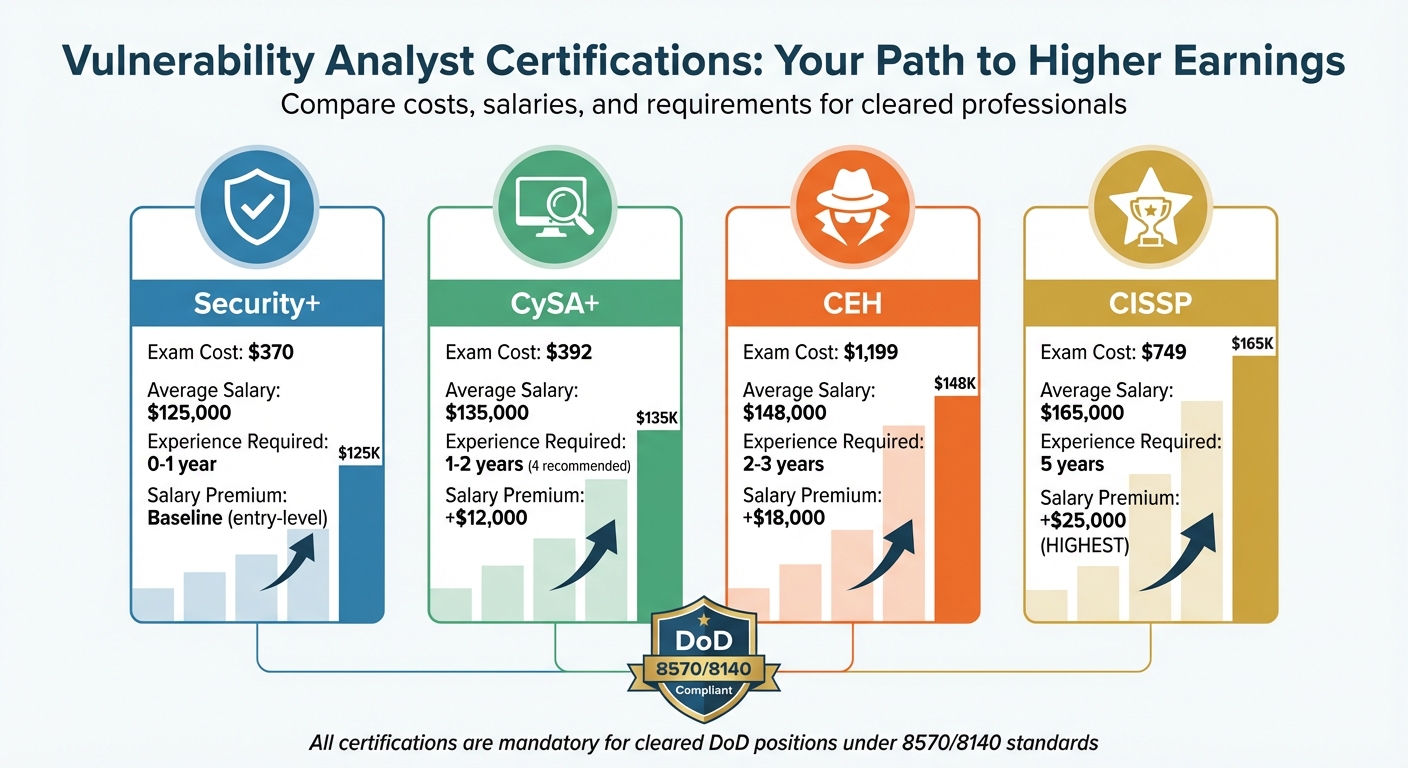
Vulnerability Analyst Certifications: Cost, Salary Impact, and Requirements Comparison
Certifications play a critical role in proving your expertise, especially in a cleared environment. Under DoD 8570/8140 standards, they are more than just a bonus – they’re mandatory. Even with extensive experience, lacking the right credentials can disqualify you from most federal and defense contract positions[7][8]. While CompTIA Security+ is often the starting point, advanced roles in vulnerability analysis require certifications like CySA+, CEH, or CISSP.
For instance, CISSP-certified professionals earn an average of $165,000 annually, which includes a $25,000 salary boost – the highest in the field[7]. Similarly, CEH certification can increase your base pay by $18,000, while CySA+ adds $12,000 to your earnings[7]. These numbers highlight how much cleared employers value certified technical skills.
Certified Ethical Hacker (CEH)
The CEH certification is all about learning to think like an attacker. It equips you with the skills to identify vulnerabilities before they can be exploited. This includes training in offensive security techniques, web application security, social engineering, and hands-on vulnerability assessment[7][10]. It’s particularly valuable for complementing defensive tools like Nessus and Qualys.
The CEH exam costs $1,199 and requires 2–3 years of experience. On average, CEH-certified professionals earn $148,000 per year[7]. This certification is ideal if you want to develop a proactive approach to identifying and mitigating security risks.
CompTIA Cybersecurity Analyst (CySA+)
CySA+ is designed for professionals focused on vulnerability management and incident response[8][9]. Costing $392, this certification emphasizes behavioral analytics and continuous security monitoring to detect threats[8][9]. According to CompTIA:
The premier certification for cyber professionals tasked with incident detection, prevention, and response through continuous security monitoring[8].
The current version, CS0-003, features up to 85 questions with a 165-minute time limit. To pass, you’ll need a score of 750 out of 900[8]. One area to focus on is the "Reporting and Communication" domain, which accounts for 17% of the exam and aligns with the stakeholder communication skills critical to vulnerability analysts[8].
CySA+ holders earn an average salary of $135,000. While 1–2 years of experience is recommended, having four years under your belt is even better for tackling this certification effectively[7].
Certified Information Systems Security Professional (CISSP)
CISSP is considered the gold standard for advancing into senior-level cleared positions. This certification, priced at $749, covers eight key security domains, including risk management, cryptography, and legal compliance[7][10]. It’s tailored for strategic roles that involve managing entire security programs rather than focusing on day-to-day technical tasks[10].
To qualify for CISSP, you’ll need at least five years of professional experience, making it a long-term career goal rather than an entry-level certification[7]. CISSP-certified professionals earn an average of $165,000 annually, opening doors to management and architecture roles that often require higher clearance levels[7]. This certification not only validates your technical leadership but also aligns with the responsibilities of high-clearance positions.
| Certification | Exam Cost | Avg. Salary | Experience Required | Salary Premium |
|---|---|---|---|---|
| Security+ | $370 | $125,000 | 0–1 year | Baseline |
| CySA+ | $392 | $135,000 | 1–2 years (4 recommended) | +$12,000 |
| CEH | $1,199 | $148,000 | 2–3 years | +$18,000 |
| CISSP | $749 | $165,000 | 5 years | +$25,000 |
These certifications not only boost your earning potential but also position you to take full advantage of your clearance as you progress in your vulnerability analyst career.
Using Your Security Clearance to Get Started
Why Security Clearances Matter
Having a security clearance gives you a distinct edge in the job market. Federal agencies and defense contractors often prioritize candidates with active clearances because it allows them to jump straight into classified work without delays.
An active clearance is essential for roles involving classified systems. For example, vulnerability analysts working on sensitive defense networks, intelligence systems, or government infrastructure need clearance to access secure facilities. This means you can be assigned to critical projects right away, which can fast-track your career. Employers value this readiness, making your clearance a key asset during your job hunt.
Job Search Tips for Cleared Professionals
Use your clearance to tap into exclusive job opportunities. Start by focusing on platforms designed specifically for cleared professionals. For instance, Cleared Cyber Security Jobs connects you directly with employers looking for candidates who already hold active clearances, ensuring your qualifications are front and center.
When applying, make sure to prominently feature your clearance level and adjudication date on your resume. This helps employers quickly confirm your eligibility for classified projects.
Geography can also play a big role in your search. Look at regions with a high concentration of federal agencies and defense contractors. The Washington D.C. metro area (including Northern Virginia and Maryland) is a major hub. Other areas to consider include San Antonio, Texas; Colorado Springs, Colorado; and San Diego, California. Setting up regional job alerts can help you stay ahead of new openings.
Lastly, expand your search beyond the title "Vulnerability Analyst." Many cleared roles use alternative titles like Security Assessment Analyst, Cyber Defense Analyst, or Information Assurance Specialist. These positions often require similar skills, so broadening your search terms can uncover more opportunities.
Building Your Professional Network
Networking can reveal opportunities that formal job applications often miss. For cleared vulnerability analysts, building the right connections doesn’t just open doors – it links you to classified projects and provides insider information about upcoming contracts.
Attending Cybersecurity Job Fairs
Cybersecurity job fairs tailored for cleared professionals give you a direct line to hiring managers who understand the value of your clearance. These events allow you to skip the automated resume filters and make a personal impression. Statistics show that roughly 1 in 10 attendees receive offers at these fairs, and that number jumps to 1 in 3 at polygraph-specific events [12].
To maximize your chances, pre-register about a week before the event. This gives recruiters time to review your resume and potentially schedule interviews ahead of time. When meeting recruiters, prepare a concise 10-30 second pitch that highlights your clearance level, technical skills (like experience with Nessus or Qualys), and certifications.
Cleared Cyber Security Jobs hosts both in-person and virtual hiring events throughout the year, connecting professionals like you with defense contractors and federal agencies. As Bryan Acton, Military & Veterans Program Leader at Peraton, advises:
Engage your peers and get an employee referral. That’s something I can’t give you as a recruiter. [11]
Peers at these events can provide valuable insights into work environments and contracts. To expand your reach even further, consider joining professional groups and online forums.
Joining Professional Groups and Online Forums
Professional organizations are a great way to stay informed about cybersecurity trends while growing your network. Groups like ISSA (Information Systems Security Association) and (ISC)² focus on cybersecurity professionals, often hosting local chapter meetings where you can connect with other cleared individuals and recruiters.
For more localized networking, consider attending Security BSides events, such as BSidesDC, BSidesNoVa, or BSidesLV. These community-driven conferences focus on technical cybersecurity topics and are often smaller and more approachable than larger industry events. Regional groups like CyberTexas also support cleared professionals with hiring events and career services.
Online platforms designed for cleared professionals can also boost your visibility. Recruiters often review profiles on these platforms before diving into full resumes. Listening to industry podcasts like Security Cleared Jobs: Who’s Hiring & How can provide additional insights from hiring managers and recruiters. After meeting someone new, follow up via LinkedIn or email within 24 hours to maintain the connection. These relationships can be a springboard to the next steps in your career.
Steps to Become a Vulnerability Analyst
Once you’ve secured your certifications and clearance, it’s time to focus on developing hands-on skills, crafting a standout resume, and landing the right role. A career in vulnerability analysis requires a mix of technical know-how, practical experience, and a resume tailored to the unique demands of cleared positions. Here’s how to move forward.
Building Skills and Gaining Experience
To excel, you’ll need a strong foundation in programming and operating systems. Proficiency in key programming languages and essential scanning tools is critical for vulnerability analysis work [13]. Make sure you’re comfortable working with Windows and Unix/Linux operating systems, as well as familiar with security frameworks like NIST, ISO 27001/27002, HIPAA, and SOX [13]. Additionally, mastering tools such as Nessus, ACAS, RETINA, and Nmap will be crucial – these are frequently mentioned in job postings for cleared professionals.
Most employers look for two to three years of relevant experience before hiring [13]. You can build this experience by freelancing for small businesses or setting up home labs to practice identifying vulnerabilities like buffer overflows, XSS attacks, and SQL injection. According to projections, employment for information security analysts is expected to grow by 31% from 2021 to 2029, making this a promising field [13].
While larger companies may prefer candidates with a bachelor’s degree in computer science or cybersecurity, smaller organizations and contractors often focus on certifications and proven skills [13]. Earning certifications like CEH (Certified Ethical Hacker) or CISSP (Certified Information Systems Security Professional) can validate your expertise and broaden your opportunities.
Writing a Resume for Cleared Positions
Your security clearance should be front and center on your resume. For example, include details like "TS/SCI with CI Polygraph (Active)" or "Eligibility: Secret Eligible – Last Investigation March 2022" as the very first line – not hidden in a skills section [14].
Federal contractors and agencies often use Applicant Tracking Systems (ATS) to scan resumes for specific keywords. If a job posting mentions tools like "Nessus", terms like "FISMA", or projects such as "NGEN", ensure those exact words appear on your resume [14]. Avoid substituting terms – stick to the language used in the job listing to avoid being filtered out [14]. Highlight measurable achievements, like "Reduced system latency by 47% through refactored Python scripts" or "Managed COMSEC inventory across 3 secure sites with zero compliance issues" [14].
Keep your resume straightforward and chronological. Avoid fancy designs or graphics that could confuse ATS software [14]. Make sure to include both the month and year (mm/yyyy) for employment dates to avoid raising red flags during the hiring process [14]. As Three Cords Talent emphasizes:
Your resume isn’t just a document – it’s a clearance-friendly sales tool [14].
Once your resume showcases your clearance and technical accomplishments, you’re ready to explore direct-hire opportunities.
Finding Jobs on Cleared Cyber Security Jobs
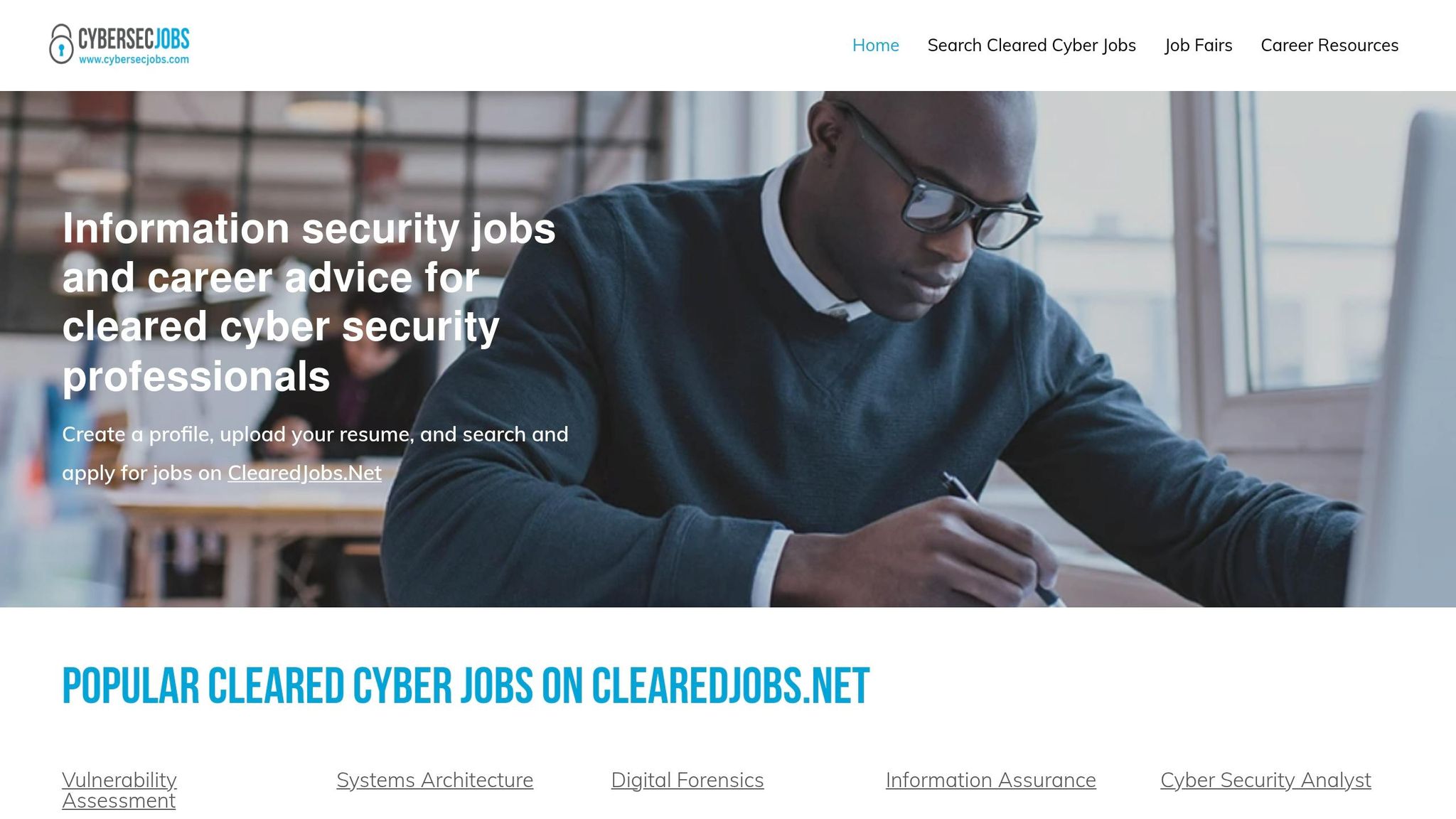
Platforms like Cleared Cyber Security Jobs are designed to connect security-cleared professionals directly with employers in the cybersecurity field. The platform allows you to filter job searches by clearance levels, such as TS/SCI, Secret, or Top Secret, making it easy to find roles that align with your qualifications.
Uploading your resume to the platform ensures recruiters can discover you – even when you’re not actively job hunting. You can also set up job alerts to receive notifications about new vulnerability analyst positions that match your skills and clearance level. Since the platform exclusively partners with direct-hire employers, you’ll avoid staffing firms and connect directly with agencies or contractors looking for your expertise.
Additionally, participating in job fairs hosted by the platform can give you the chance to meet hiring managers face-to-face, bypassing automated screening systems and making a stronger impression.
Growing Your Career as a Vulnerability Analyst
As a vulnerability analyst, your career can evolve in two main directions: stepping into leadership roles or diving deeper into technical expertise. The path you choose depends on your strengths and long-term goals. Here’s how you can build on your current experience to take your career to the next level.
Moving into Senior and Management Positions
Your experience in vulnerability analysis can serve as a springboard into senior or management roles. Senior analysts often take on responsibilities like managing projects, mentoring junior team members, and acting as technical experts within their organizations. Positions such as Vulnerability Management Team Lead involve overseeing assessments, coordinating remediation efforts, and ensuring the team meets its objectives.
For those aiming higher, roles like Cybersecurity Manager or Director of Vulnerability Assessment come with broader responsibilities. These positions focus on presenting risk metrics to stakeholders, managing budgets, and ensuring security strategies align with organizational goals. Building leadership skills early is key – take the initiative to lead cross-functional projects or present your findings in team meetings. These experiences can prepare you for the challenges of management.
On the other hand, if leadership isn’t your focus, you might prefer advancing your technical skills by exploring specialized areas like threat hunting or incident response.
Specializing in Threat Hunting or Incident Response
For those who thrive on hands-on work, specializing in technical areas can be a rewarding path. Threat hunters use their understanding of vulnerabilities to identify subtle signs of compromise that automated systems might overlook. By anticipating how attackers exploit weaknesses, they play a crucial role in proactive defense.
Incident response specialists, meanwhile, focus on managing active security breaches. This involves forensic analysis to understand the scope of an attack and coordinating efforts to mitigate damage. Your background in vulnerability analysis equips you with the skills to tackle these challenges effectively. Roles in threat hunting or incident response are particularly sought after in government and defense sectors, offering opportunities to make a significant impact.
Whether you choose leadership or technical specialization, the skills you’ve developed as a vulnerability analyst provide a strong foundation for future growth.
Conclusion
Your role in protecting critical networks plays a vital part in national security. A career as a cleared vulnerability analyst not only offers financial stability and competitive pay but also opens the door to significant career growth. With global cybersecurity spending predicted to surpass $200 billion by 2026 and the industry growing at an annual rate of 9.4% through 2028, the demand for skilled professionals in this field is only increasing [4]. Currently, the national average salary for vulnerability analysts is approximately $128,000, with senior positions reaching as high as $170,000 [15]. This upward trend underscores the importance of continuously sharpening your skills and earning relevant credentials.
Having an active clearance gives you a competitive edge, especially when applying for roles with defense contractors or government agencies in key regions like Washington D.C. While these positions often have higher entry barriers, they usually come with better compensation and the chance to work on projects that truly matter – like safeguarding critical infrastructure.
"The role of vulnerability assessment analyst pays well, and is expected to continue to be in demand. Further the career offers an opportunity to positively impact an organization and growth opportunities." – Salesforce Trailhead [6]
To maximize your potential, combine the advantage of your clearance with a strong technical foundation. Certifications such as CEH, CySA+, and CISSP are essential, and mastering tools like Nessus and Qualys is crucial – around 70% of roles list proficiency in these tools as a requirement [4]. Additionally, honing your ability to explain complex risks to non-technical audiences can set you apart, especially as you move into more senior roles.
Whether you aim to step into leadership or deepen your technical expertise, your skills remain indispensable. The work you do not only strengthens organizational security but also positions you as a key player in shaping security policies and strategies.
FAQs
Can I start this job with only a Secret clearance?
Yes, having a Secret clearance is usually sufficient to start working as a vulnerability analyst. Many job postings list a Secret clearance or higher as a requirement, though certain roles might call for a Top Secret clearance instead. Always double-check the job description to ensure you meet the specific clearance level needed for the position.
What should I learn first: Nessus, Qualys, or RMF?
To kick things off, dive into learning vulnerability assessment tools like Nessus and Qualys. These tools are crucial for spotting weaknesses in systems and networks, giving you hands-on, practical skills that are key to the role. On the other hand, RMF (Risk Management Framework) deals with managing risks through policies and ensuring compliance, which is a more advanced area. By mastering vulnerability tools first, you’ll create a solid foundation that makes tackling RMF processes much smoother and more effective down the line.
How do I prove experience if I’ve only done home labs?
Home labs can be an excellent way to showcase your skills, especially if you’re just starting out and don’t have much formal work experience. By documenting your projects, you can provide concrete examples of your abilities. Be sure to include details like the tools you used (e.g., Nessus or Qualys), the techniques you practiced, and the results you achieved. Consider creating a portfolio that highlights your hands-on work. This can be a powerful addition to your resume and a great talking point during interviews, demonstrating your practical understanding of cybersecurity and your ability to solve problems effectively.