• Skip to primary navigation
  • Skip to main content
Cleared Cyber Security Jobs | CyberSecJobs.com

Cleared Cyber Security Jobs | CyberSecJobs.com

Cleared Cyber Security Jobs

  • Home
  • Search Cleared Cyber Jobs
  • Job Fairs
  • Career Resources

Certifications

GWAPT Certification Career Guide for Cleared Web App Testers

CyberSecJobs Editorial · February 6, 2026 ·

The GIAC Web Application Penetration Tester (GWAPT) certification is a hands-on credential designed for professionals responsible for securing web applications, especially in high-security environments like government and defense systems. It focuses on manual penetration testing techniques and validates critical skills such as SQL Injection, XSS, and session management. Recognized by the U.S. Department of Defense, GWAPT is a powerful tool for advancing your career in cybersecurity.

Key Highlights:

  • Certification Details: 82–115 questions, 2–3 hours, 71% passing score, includes a practical CyberLive lab.
  • Skills Tested: Manual testing of vulnerabilities (e.g., SQL Injection, CSRF), authentication attacks, and session management.
  • Preparation: SANS SEC542 course, practice tests, hands-on labs (e.g., OWASP Juice Shop, DVWA).
  • Cost: $999 exam fee; SANS training ranges from $5,000–$9,800.
  • Career Impact: Average salaries of $102,000–$199,614; qualifies for roles like Penetration Tester, Cyber Security Engineer.

If you’re a cleared professional aiming to bolster your expertise in web application security, GWAPT can help you stand out with validated, practical skills.
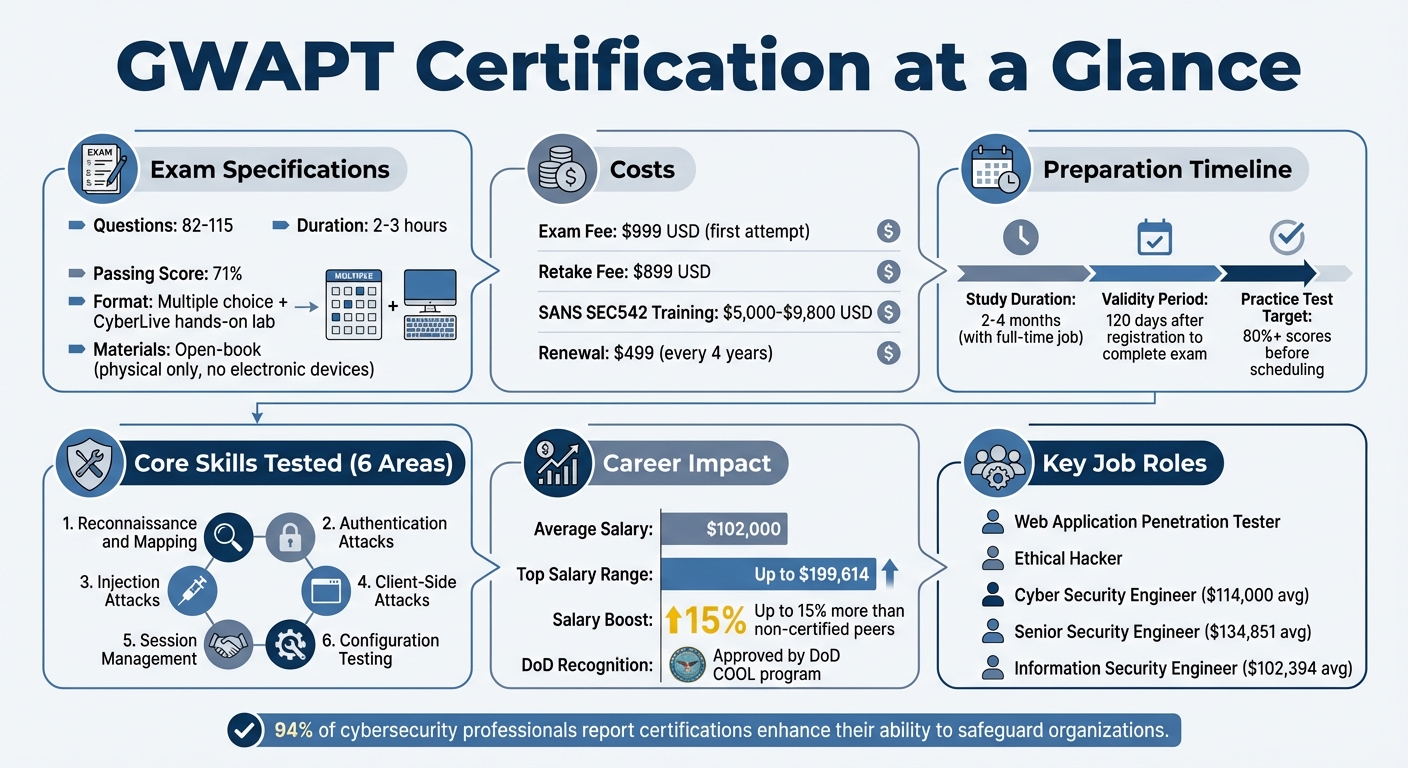
GWAPT Certification Quick Reference Guide: Exam Details, Costs, and Career Outcomes

GWAPT Certification Quick Reference Guide: Exam Details, Costs, and Career Outcomes

Ultimate Guide to GIAC GWAPT Certification (2025) | Exam Format, Prep Tips & Study Resources

sbb-itb-bf7aa6b

What the GWAPT Certification Covers

The GWAPT exam consists of 82–115 questions and takes about 2–3 hours to complete. To pass, you’ll need a minimum score of 71% [4]. It’s not just a standard multiple-choice test – there’s also a CyberLive lab, where you’ll tackle real-world security challenges using virtual machines [4].

Core GWAPT Topics

The exam focuses on six key areas of web application security, ensuring you’re equipped to handle a wide range of vulnerabilities and threats.

  • Reconnaissance and Mapping: Learn to map the attack surface by conducting port scans, identifying services, spidering, and creating application flow charts.
  • Authentication Attacks: Test your ability to uncover weaknesses like user enumeration, bypassing multi-factor authentication (MFA), and exploiting flawed login mechanisms.
  • Injection Attacks: Demonstrate skills in identifying and exploiting vulnerabilities such as SQL injection, command injection, Local/Remote File Inclusion (LFI/RFI), and XML External Entity (XXE) attacks.
  • Client-Side Attacks: Focus on exploiting vulnerabilities like Cross-Site Scripting (XSS) and Cross-Site Request Forgery (CSRF).
  • Session Management: Assess your knowledge in analyzing SSL/TLS, exploiting session states, and hijacking session tokens.
  • Configuration Testing: Showcase your ability to audit both web application and server configurations for flaws in design or implementation.

To excel in these areas, you’ll need a strong grasp of web technologies, including HTTP/HTTPS protocols, AJAX, JavaScript, and server-side frameworks like Django or Node.js [4].

Hands-On Skills and Tools

Practical skills with industry-standard tools are a crucial part of the exam, especially in the CyberLive lab.

You’ll work extensively with Burp Suite Professional, the primary web proxy tool for penetration testing. Familiarity with other tools like OWASP ZAP, SQLmap, Nikto, and cURL is also essential [4].

Since the exam is open-book but prohibits electronic devices, it’s highly recommended to prepare a physical index of tools, commands, and techniques for quick reference. Additionally, a solid understanding of the Linux command line will be beneficial [4].

How to Get GWAPT Certified

Preparation and Study Plan

The GWAPT certification doesn’t require formal prerequisites, but having a strong grasp of certain technical skills is essential. GIAC suggests being familiar with the Linux command line (especially Kali Linux), networking basics like the OSI model, and web technologies such as HTTP/HTTPS protocols.

The SANS SEC542: Web App Penetration Testing and Ethical Hacking course is the main training path that aligns closely with the exam content. To prepare effectively, read the course materials multiple times to solidify your understanding. Pair this with hands-on practice by revisiting training labs and working in environments like OWASP Juice Shop, DVWA, and TryHackMe.

If you’re managing a full-time job, expect to dedicate about two to four months for preparation. During this time, take the two GIAC practice exams under realistic conditions – timed and using only physical notes. Aim for scores in the 80s before scheduling the actual test. Since the exam is open-book but electronic devices are not allowed, create a detailed, alphabetized physical index of your study materials. Include a section specifically for tool commands and syntax to quickly reference during the test.

Once your study plan is set, you can move on to registering and understanding the exam process.

Training and Exam Details

When you’re ready, register for the exam through the GIAC website. After your payment is processed, you’ll have 120 days to complete the test. The exam fee is $999 USD for one attempt, and retakes cost $899 USD. If you opt for the full SANS SEC542 training package, expect costs to range from $5,000 to $9,800 USD, which typically covers textbooks and the certification exam.

The exam itself is web-based and proctored, with two options: remote proctoring via ProctorU or onsite proctoring at PearsonVUE centers. Physical materials are allowed during the test, so having a well-organized index is crucial for navigating the 2–3 hour time limit. Plan to spend around 1.5 minutes per question, allocating an hour for the CyberLive lab. This structured approach ensures you’re prepared for the rigorous demands of certification in sensitive, high-stakes environments.

GWAPT Study Resources and Tools

Study Resources

The SANS SEC542: Web App Penetration Testing and Ethical Hacking course is the cornerstone of preparation for the GWAPT certification. It focuses on manual testing techniques that align with the certification’s objectives. To deepen your understanding and practical skills, additional resources can be incredibly useful. For example, the PortSwigger Web Security Academy offers free, interactive labs that cover vulnerabilities such as SQL injection, XSS, and CSRF. This makes it a fantastic supplement to your formal training.

For hands-on practice, platforms like OWASP Juice Shop, DVWA (Damn Vulnerable Web Application), WebGoat, Mutillidae, and Metasploitable provide safe environments to simulate attacks and refine your skills. Additionally, the OWASP Web Security Testing Guide (WSTG) is an excellent methodology reference, especially for areas like authentication, session management, and injection flaws.

To assess your readiness, take advantage of GIAC practice tests. These mock exams mirror the testing engine and help pinpoint areas that need improvement. Aim for practice test scores in the 80s before scheduling your proctored exam. Once your study plan is solid, shift focus to mastering the tools essential for web application testing.

Web App Testing Tools

Knowing how to effectively use key tools is just as important as understanding the theory. Burp Suite and OWASP ZAP are must-haves for intercepting and analyzing HTTP(S) traffic, fuzzing inputs, and testing application logic. While Burp Suite Professional is the industry standard, OWASP ZAP is a strong open-source alternative.

For automating SQL injection detection and exploitation, SQLmap is indispensable. Nmap is your go-to tool for reconnaissance tasks like port scanning and identifying services, while Nikto helps uncover web server misconfigurations and outdated software. Tools like cURL allow you to craft and analyze HTTP requests directly from the command line.

When it comes to authentication attacks, THC Hydra is effective for brute-forcing login mechanisms. Tools like John the Ripper and Hashcat are great for cracking encrypted passwords. For directory discovery and testing application logic, fuzzing tools such as Ffuf and Wfuzz are essential.

Since the exam is open-book but prohibits electronic devices, preparing a physical index of your course materials is vital. Include a dedicated section for tool commands and syntax to streamline your reference process during the exam. This preparation not only supports the CyberLive lab portion but also reinforces practical skills that are crucial for your career. Practice these tools in lab environments until you can perform common tasks confidently without needing constant guidance from your notes.

Career Benefits of GWAPT for Cleared Professionals

How GWAPT Validates Your Skills

The GWAPT certification sets you apart by requiring hands-on problem-solving through its CyberLive testing format. This approach ensures that you can demonstrate your skills in a virtual lab using actual code and tools, going well beyond theory-based certifications [1][4]. For cleared professionals working in high-stakes environments, this practical experience is a game-changer, as it shows you can handle real-world challenges where errors aren’t an option.

Adding to its credibility, the GWAPT certification is recognized by the U.S. Department of Defense through the DoD COOL program, making it especially valuable for government and defense contracting roles [4]. Hiring managers in cleared environments know that holding this certification means you’ve proven your ability to manually identify and exploit vulnerabilities that automated tools often overlook [4][7].

"The GWAPT certification validates a practitioner’s ability to better secure organizations through penetration testing and a thorough understanding of web application security issues." – GIAC [1]

This level of validation translates directly into career perks. Financially, GWAPT-certified professionals can earn up to 15% more than their non-certified peers. On average, salaries hover around $102,000, with top-tier roles reaching as high as $199,614 [4][5][7]. Additionally, a significant 94% of cybersecurity professionals report that certifications like GWAPT have enhanced their ability to safeguard their organizations [3].

Job Opportunities and Career Growth

The GWAPT certification doesn’t just boost your earnings; it also opens doors to specialized career paths. With this credential, you’re qualified for roles like Web Application Penetration Tester, Ethical Hacker, Cyber Security Engineer, and Information Security Engineer [2][4][5][8]. Many certified professionals move into advanced positions such as Security-by-Design or DevSecOps, where they integrate security testing into the development process in cleared environments [4][7].

The certification also positions you for leadership roles. As of April 2025, salaries for GWAPT-related positions reflect the demand for this expertise: Senior Security Engineers earn an average of $134,851, Cyber Security Analysts make around $114,000, and Information Security Engineers take home approximately $102,394 [8]. These figures highlight the value cleared employers place on verified web application security skills, especially in high-security settings.

To streamline your job search, consider using platforms like Cleared Cyber Security Jobs. This site connects you directly with employers looking for GWAPT-certified talent. It allows you to filter roles that require or prefer your certification and even set up alerts for new opportunities. Since the platform focuses exclusively on direct-hire roles for U.S. citizens with active security clearances, you’ll be competing in a highly targeted talent pool where your GWAPT credential stands out.

To further enhance your career prospects, update your professional profiles to emphasize your expertise in identifying OWASP Top 10 vulnerabilities and performing manual exploitations. These are skills that cleared employers actively seek [4][7]. If you’ve participated in SANS SEC542 Capture the Flag events during your training, make sure to include those achievements – they can serve as impressive talking points during interviews for high-security roles [4][7].

Conclusion

The GWAPT certification offers web application testers working in high-security environments a way to showcase their expertise in securing critical systems. To make the most of this credential, focus on thorough preparation and ongoing learning.

Consider enrolling in the SANS SEC542 training course to align your skills with the GWAPT exam requirements. Cleared professionals might qualify for funding options like the DoD COOL program or SANS Cyber Academy scholarships, which can help manage the financial investment [4][6].

Be sure to create a physical index and practice extensively with tools like OWASP Juice Shop and DVWA to refine your manual exploitation techniques. Aim for practice test scores in the 80s before committing to your exam date [1][4].

After earning your certification, update your professional profiles, such as those on Cleared Cyber Security Jobs, to highlight your GWAPT achievement. Use job alerts to find roles where this certification is a requirement, and be ready to discuss your hands-on experience with tools like Burp Suite Pro or SQLmap during interviews [4].

To keep your certification current, follow the renewal guidelines: earn 36 CPE credits or retake the exam every four years, with the retake costing around $499 [4]. Staying up to date with your certification ensures your skills remain sharp and relevant in the ever-changing landscape of web application security.

FAQs

What skills do I need to pass the GWAPT certification exam?

To earn the GWAPT (GIAC Web Application Penetration Tester) certification, you need a solid understanding of web application security vulnerabilities and penetration testing methods. This means being able to identify and exploit vulnerabilities such as SQL injection, cross-site scripting (XSS), cross-site request forgery (CSRF), and weaknesses in authentication mechanisms. You’ll also need to be skilled in reconnaissance, mapping web applications, and using various testing tools effectively.

This certification focuses heavily on practical, hands-on skills. You should be comfortable conducting penetration tests, analyzing security configurations, and addressing vulnerabilities. A strong grasp of web exploits, along with experience using tools and techniques common in penetration testing, will put you on the right track to succeed.

How does earning the GWAPT certification benefit your career and salary potential?

The GWAPT (GIAC Web Application Penetration Tester) certification is a sought-after credential in the cybersecurity world, especially for professionals working in security-sensitive environments. It showcases a deep understanding of web application vulnerabilities and the skills needed to identify and address them effectively. This expertise makes GWAPT-certified individuals appealing candidates for roles in penetration testing, security consulting, and cybersecurity management.

When it comes to earnings, professionals with a GWAPT certification in the United States average about $108,000 annually, highlighting the strong demand for this qualification. Beyond the paycheck, it can also open doors to more secure positions and higher-paying, specialized career paths. For those looking to advance in cybersecurity, obtaining the GWAPT certification is a strategic move that can significantly impact both career trajectory and financial growth.

What are the best resources and strategies to prepare for the GWAPT certification exam?

To gear up for the GWAPT (GIAC Web Application Penetration Tester) exam, a balanced approach combining hands-on practice, theoretical learning, and specialized resources is key. Begin by reviewing the official GIAC exam objectives, which outline essential areas such as web application vulnerabilities, authentication attacks, session management, SQL injection, and cross-site scripting. This step will help you understand what to focus on.

Practice exams are a must-have tool. They not only help you get used to the question format but also give you a sense of the exam’s difficulty. Look for resources that mimic the test environment and provide detailed feedback to pinpoint areas for improvement. On top of that, sharpening your skills with tools widely used in web application testing – like vulnerability scanners and penetration testing frameworks – can make a big difference.

To round out your preparation, blend practice tests with hands-on tool experience and, if necessary, formal training programs. Simulated environments offering real-world scenarios are especially helpful for building confidence and applying your knowledge in practical situations.
Related Blog Posts

  • CEH Certified Ethical Hacker Career Guide for Cleared Pen Testers
  • OSCP Certification Career Guide for Cleared Offensive Security
  • OSCE Certification Career Guide for Advanced Cleared Pen Testers
  • GPEN Certification Career Guide for Cleared Penetration Testers

Related Guides

  • CRTL Certification Career Guide for Cleared Red Team Leads
  • CRTO Certification Career Guide for Cleared Red Team Operators
  • CRTP Certification Career Guide for Cleared Red Team Professionals
  • Cybersecurity Salary Guide 2026
  • TS/SCI Salary Premium: Real 2026 Numbers

GPEN Certification Career Guide for Cleared Penetration Testers

CyberSecJobs Editorial · February 6, 2026 ·

The GIAC Penetration Tester (GPEN) certification is a sought-after credential for cybersecurity professionals, especially those in cleared roles. It validates expertise in penetration testing, covering areas like Active Directory attacks, cloud security, and legal considerations. GPEN is recognized by the U.S. Department of Defense (DoD) under the 8570 framework for CND Analyst roles, making it a strong qualification for government and defense careers.

Key highlights:

  • Average Salary: $117,000/year in the U.S.
  • Exam: 82 questions, 3 hours, passing score 73%.
  • Cost: $949–$1,699 (with training); $879 for retakes.
  • Renewal: Every 4 years with 36 CPE credits or exam retake.
  • Training: SANS SEC560 is recommended.

The certification emphasizes hands-on skills through a "CyberLive" lab component, ensuring practical expertise. It’s ideal for roles like penetration tester, red team operator, or security consultant in government and defense sectors. If you’re aiming to advance in cleared cybersecurity, GPEN can help you stand out.

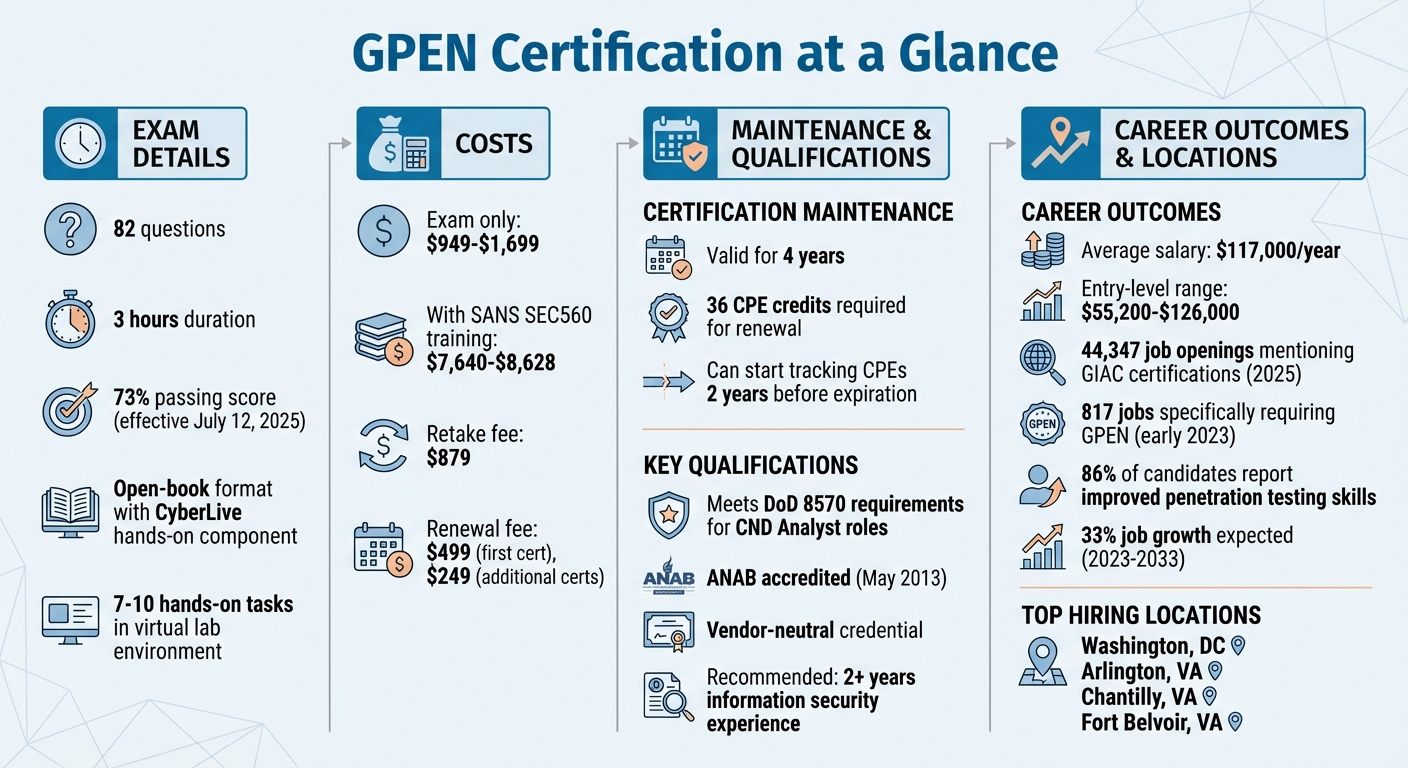
GPEN Certification Quick Facts: Costs, Exam Details, and Career Outcomes

GPEN Certification Quick Facts: Costs, Exam Details, and Career Outcomes

What is GPEN Certification?

GPEN Certification Overview

The GIAC Penetration Tester (GPEN) certification is a vendor-neutral credential designed to validate a professional’s ability to conduct penetration tests using established methodologies. Unlike certifications that focus exclusively on exploitation techniques, GPEN ensures candidates understand both the technical and non-technical aspects of penetration testing, such as project planning, scoping, and legal considerations.

The certification covers essential areas like test planning, reconnaissance (gathering target information and identifying potential data leaks), scanning (including port, operating system, and service version detection), exploitation (executing attacks, data exfiltration, and pivoting), and advanced attack techniques. These advanced skills include targeting Active Directory, Azure/Entra ID, and modern authentication protocols. Proficiency with tools such as the Metasploit Framework, PowerShell, and Windows Command Line is also tested, which is particularly critical for roles in government and defense. The exam places a strong emphasis on modern infrastructure challenges, including Active Directory attacks (like Kerberos exploitation and domain escalation), Azure application security, and cloud authentication protocols such as single sign-on. This makes it highly relevant for hybrid IT environments commonly used by federal agencies and Department of Defense (DoD) contractors [5][3].

Now, let’s break down the exam details that assess these skills.

Exam Format and Requirements

The GPEN exam consists of 82 questions, and candidates have 3 hours to complete it. A passing score of 73% is required, effective July 12, 2025 [5]. Exam fees range from $949 to $1,699, depending on whether it is bundled with SANS SEC560 training. Retakes cost approximately $879 [3].

This open-book, proctored exam includes a CyberLive hands-on component conducted in a virtual lab environment, ensuring candidates can apply their knowledge in practical scenarios. While GIAC does not mandate specific prerequisites, it recommends candidates have at least two years of experience in information security, as GPEN is considered an advanced-level certification [3].

Why GPEN Matters for Cleared Professionals

GPEN’s comprehensive framework makes it particularly valuable for cleared professionals. It meets DoD 8570 requirements for the CND Analyst category [3], making it a preferred qualification for roles with Department of Defense contractors, military installations, and federal agencies. As of early 2023, there were approximately 817 job openings in the U.S. requiring GPEN certification [2].

The certification’s focus on methodological precision and compliance aligns with the high standards of cleared environments. It equips testers to systematically identify, plan, and document vulnerabilities. Additionally, GPEN’s ANAB (ANSI National Accreditation Board) accreditation, earned in May 2013 [3], and its practical CyberLive component provide hiring managers in defense and intelligence sectors with confidence that certified professionals can handle real-world penetration testing tasks on sensitive systems.

How to Obtain the GPEN Certification

Step 1: Evaluate Your Skills and Choose Training

Before diving into the GPEN certification process, take a moment to evaluate your current skill set. Are you comfortable with TCP/IP networking basics? Can you confidently navigate both Windows and Linux command-line environments? These are critical skills you’ll need before moving forward [3][7].

For those looking for structured preparation, the SANS SEC560: Enterprise Penetration Testing course is the go-to resource. This course is specifically designed to prepare you for the GPEN exam and costs between $7,640 and $8,628 when bundled with the exam attempt [3][7][8]. If you’re employed in a cleared role, your organization might cover these costs through tuition assistance or professional development budgets. If you’re self-funding, you can purchase the exam separately for $999 to $1,699 and explore alternative study methods, though the structured SANS training often leads to better outcomes [3][6][7].

To improve your chances of success, brush up on skills like basic scripting in Python, PowerShell, or Ruby. Familiarity with web application security concepts and tools such as SQL and Wireshark will also prove invaluable [3]. If you’re not confident in these areas, consider gaining hands-on experience in a lab environment before committing to the exam.

Once you’re confident in your skills and have selected your training resources, you can move on to registration and focused preparation.

Step 2: Register and Prepare for the Exam

After solidifying your foundation, the next step is to register for the GPEN exam through the GIAC website. This registration activates a 120-day exam window, giving you a clear timeline for preparation [1][5].

Your exam fee includes two practice tests, which are excellent tools for identifying strengths and weaknesses. Take the first test early in your study period to pinpoint areas needing improvement. Use the second test closer to your exam date to gauge your readiness [1][3]. Since GIAC exams are open-book, creating a well-organized index of your study materials is crucial. Building your own index – not borrowing someone else’s – will help you internalize the material and locate key concepts, commands, and methodologies quickly during the exam [3][8].

Focus your preparation on high-priority topics like Active Directory attacks (including Kerberos and domain escalation), Azure AD integration, password hash exploitation, and the Metasploit Framework [3][6]. The exam also includes 7 to 10 hands-on tasks in a virtual machine environment. To prepare for these, practice extensively with tools like Nmap, Burp Suite, and PowerShell in lab settings [1][3].

By systematically addressing these objectives, you’ll be well-prepared for the exam.

Step 3: Take and Pass the Exam

When you’re ready to take the exam, you can choose between remote proctoring through ProctorU or onsite testing [4][5]. If you opt for remote proctoring, ensure your computer meets the necessary technical requirements well in advance.

During the exam, rely on your indexed materials to quickly locate essential commands and methodologies. Carefully analyze each scenario, identify the objectives, and execute tasks in the lab environment.

If you don’t pass on your first attempt, don’t worry – a retake costs approximately $879 [3]. Use the feedback from your practice tests and refine your focus on high-priority objectives and lab scenarios to improve your performance on the next attempt.

Maintaining Your GPEN Certification

Renewal Requirements

Your GPEN certification is valid for four years, after which it needs to be renewed. To keep it active, you’ll need to accumulate 36 Continuing Professional Education (CPE) credits during the four-year period [9][10]. You can begin tracking these credits as early as two years before your certification expires [10][12].

Renewal can be completed in one of two ways: by submitting the required 36 CPE credits or by retaking the latest version of the GPEN exam [10][12]. The renewal fee is $499 for your first certification. If you’re renewing additional GIAC certifications within the same two-year period, the cost drops to $249 for each [10][12]. Once renewed, your certification will be extended by another four years from its original expiration date. To avoid delays, submit your CPE documentation at least 30 days before your certification expires [12].

Earning CPE credits isn’t complicated. For instance, completing a single SANS training course often provides the full 36 credits needed for renewal [10]. Other options include:

  • Community activities: Attend SANS webcasts or listen to cybersecurity podcasts to earn up to 12 CPEs [10][11].
  • Professional experience: Claim up to 12 CPEs for relevant technical work by submitting your resume [10][11].
  • Conferences: Events like BlackHat, RSA, and ShmooCon can earn you up to 18 CPEs [11].

When logging your CPEs in the GIAC dashboard, you’ll need to explain how each activity supports your renewal. Be aware that all submissions are subject to audit, and providing false information could lead to the revocation of your certifications [12].

Continuing Skill Development

To maintain your edge as a certified GPEN professional, regular hands-on practice is key – especially if your role involves security clearance. Focus on core skills such as intermediate-level Metasploit configuration, advanced password attacks, and exploiting vulnerabilities in Azure environments [1]. Activities like SANS NetWars are great for honing your techniques while also earning extra CPE credits [1][11].

When you renew, you’ll gain access to updated digital courseware, including digital books, audio files, and lab materials [10][12]. If you prefer physical books, you can order hardcopy courseware for $199 plus shipping (as of June 18, 2025) [10][12]. Start tracking your CPE credits as soon as you’re certified to avoid last-minute stress and ensure you stay ahead in your field.

sbb-itb-bf7aa6b

Using GPEN Certification in Cleared Cybersecurity Careers

Career Opportunities for GPEN-Certified Professionals

Earning your GPEN certification can lead to exciting opportunities in classified cybersecurity roles where technical expertise and methodical approaches are crucial. This certification is particularly aligned with government and defense sectors, making it a strong asset for professionals in these fields.

Some of the key roles for GPEN-certified individuals include Penetration Tester, Red Team Operator, Ethical Hacker, Cybersecurity Test Engineer, Security Consultant, and Incident Responder. In these positions, you’ll be responsible for tasks like conducting penetration tests, simulating adversary tactics for Department of Defense (DoD) clients, and ensuring compliance with NIST 800-53 controls. Additional responsibilities may include cracking password hashes, performing Kerberos attacks on Active Directory, and identifying vulnerabilities in cloud platforms such as Azure.

Salaries for these roles average around $117,000 per year [3]. Entry-level cybersecurity test engineers with clearances can expect salaries ranging from $55,200 to $126,000 [13]. Demand for cleared professionals is especially high in areas such as Washington, DC, Arlington, VA, Chantilly, VA, and Fort Belvoir, VA [3]. Importantly, the GPEN certification meets DoD 8570 requirements for CND Analyst roles [3]. As of 2025, approximately 44,347 job openings mention GIAC certifications, highlighting the demand for credentialed professionals [14]. With its ANAB accreditation and vendor-neutral framework, the GPEN certification is adaptable across various government agencies [3]. These roles not only come with competitive pay but also provide a clear path for advancing your career in cybersecurity.

Finding Jobs with Cleared Cyber Security Jobs

Cleared Cyber Security Jobs

Now that you know the career potential of the GPEN certification, the next step is finding the right opportunities. Cleared Cyber Security Jobs is a specialized platform designed for professionals like you – those with GPEN certification and active security clearances.

This platform connects you directly with employers looking for candidates with your expertise, cutting out staffing firms and making the hiring process more direct. By uploading your resume, you can gain instant visibility with hiring managers seeking GPEN-certified professionals.

The site’s advanced search filters allow you to narrow down positions based on specific criteria, such as GPEN certification requirements, clearance levels (e.g., Secret or Top Secret/SCI), and geographic focus on cleared hubs. You can even set up job alerts to stay informed about new openings that match your qualifications.

In addition to job listings, Cleared Cyber Security Jobs offers career resources and hosts job fairs tailored to security-cleared professionals. Since the platform requires U.S. citizenship and an active clearance, you’ll only see opportunities where your GPEN certification and clearance status are in demand. This focused approach helps you streamline your job search and connect with roles that truly value your skills.

All About GPEN | GIAC Certified Penetration Tester | Course, Study, Exam Experience

GIAC

Conclusion

The GPEN certification stands out as a valuable credential for penetration testers aiming to excel in defense and government cybersecurity roles. With penetration testing careers expected to grow by 33% between 2023 and 2033, and the market expanding by 24% by 2026 [15], there’s no better time to pursue this certification. It not only validates critical hands-on skills through the CyberLive testing component but also meets DoD 8570 requirements for CND Analyst roles [3]. Additionally, it showcases your expertise in modern attack methods targeting Active Directory and Azure environments, offering a solid foundation for immediate career advancement and long-term growth.

Achieving the GPEN requires dedication. Start by evaluating your current skill set, choosing the right training – such as SANS SEC560 – and staying current with ongoing professional development to maintain your credential. This effort ensures you remain competitive for cleared contracts and other high-demand opportunities.

The rewards are tangible. GPEN-certified professionals earn an average annual salary of around $118,000, and 86% of candidates report significant improvements in their penetration testing skills after certification [15]. This qualification opens doors to roles like penetration tester, red team operator, and security consultant in sought-after locations such as Washington, DC; Arlington, VA; and Fort Belvoir, VA [3].

To maximize the benefits of your certification, finding the right job is key. Cleared Cyber Security Jobs connects GPEN-certified professionals with employers actively seeking security-cleared talent. The platform focuses exclusively on roles where both your clearance and certification are highly valued. By setting up job alerts and uploading your resume, you gain immediate visibility with hiring managers in the cleared community.

Take the next step in your cybersecurity career by earning your GPEN certification and leveraging Cleared Cyber Security Jobs to secure roles that recognize and reward your specialized skills in the cleared sector.

FAQs

What key skills are assessed in the GPEN certification exam?

The GPEN certification exam focuses on the core skills needed for successful penetration testing. These include planning and scoping tests, gathering intelligence through reconnaissance, conducting in-depth scans, exploiting discovered vulnerabilities, and using post-exploitation techniques like pivoting to extend access.

The exam also delves into areas such as password attacks, web application testing, and mastering essential tools and techniques commonly applied in penetration testing. This comprehensive approach ensures candidates are prepared for the challenges they may face in cybersecurity roles, particularly in high-security environments.

What are the career benefits of earning a GPEN certification for cleared cybersecurity professionals?

Earning the GPEN certification is a powerful way for cleared cybersecurity professionals to validate their expertise in penetration testing and offensive security. This credential highlights skills in key areas such as reconnaissance, vulnerability assessment, and exploit execution – essential capabilities for operating in high-security environments.

For those holding security clearances, the GPEN does more than just confirm technical knowledge. It strengthens professional credibility and creates opportunities for advanced roles in penetration testing and cybersecurity defense. By mastering recognized, industry-standard methodologies, certified professionals gain a competitive edge in the cleared cybersecurity field.

How can I effectively prepare for the GPEN certification exam?

Preparing for the GPEN certification exam requires a clear strategy that combines understanding the exam’s structure, studying relevant materials, and honing practical skills. Begin by carefully reviewing the exam syllabus to get a solid grasp of the key topics, such as penetration test planning, reconnaissance, exploitation techniques, and web application attacks. This will help you focus your efforts on areas that matter most.

Consider enrolling in an official training course like SEC560, which offers structured guidance tailored to the exam objectives. Pair this with additional resources like books and practice exams to familiarize yourself with the types of questions you’ll encounter and their level of difficulty.

Hands-on experience is just as important. Spend time practicing in virtual labs or simulated environments to sharpen your technical skills and gain confidence in applying what you’ve learned. Mock tests can also play a crucial role in assessing your readiness. They help pinpoint weak areas and ensure you’re comfortable managing the time constraints of the actual exam.

By combining consistent study, practical exercises, and self-assessment, you’ll build the knowledge and confidence needed to tackle the GPEN certification successfully.

Related Blog Posts

  • CISA Certification Career Guide for Cleared IT Auditors
  • CEH Certified Ethical Hacker Career Guide for Cleared Pen Testers
  • OSCP Certification Career Guide for Cleared Offensive Security
  • OSCE Certification Career Guide for Advanced Cleared Pen Testers

Related Guides

  • CRTL Certification Career Guide for Cleared Red Team Leads
  • CRTO Certification Career Guide for Cleared Red Team Operators
  • CRTP Certification Career Guide for Cleared Red Team Professionals
  • Cybersecurity Salary Guide 2026
  • TS/SCI Salary Premium: Real 2026 Numbers

OSCE Certification Career Guide for Advanced Cleared Pen Testers

CyberSecJobs Editorial · February 5, 2026 ·

The OSCE³ certification is a top-tier credential for advanced penetration testers, especially those in U.S. government or defense roles. It requires passing three challenging 48-hour exams: OSWE (web application testing), OSEP (bypassing hardened defenses), and OSED (Windows exploit development). This certification demonstrates expertise in areas like custom exploit creation, advanced evasion techniques, and vulnerability analysis, making it highly sought after in cybersecurity.

Key Takeaways:

  • Certifications Required: OSWE, OSEP, OSED.
  • Cost: Learn One Subscription ($2,749/year) or Course + Cert Bundle ($1,749 for 90 days).
  • Skills Needed: Proficiency in networking, scripting (Python, Bash), and advanced exploitation techniques.
  • Exam Format: 48-hour proctored sessions with a 24-hour reporting phase.
  • Career Benefits: Opens doors to roles like Red Team Lead, Vulnerability Researcher, and Senior Exploit Developer, with salaries often exceeding $150,000 annually.

With ransomware attacks up 30% in early 2026 and AI-driven threats growing, this certification positions you for senior roles in advanced penetration testing and exploit development, especially within the cleared sector. For preparation, focus on OffSec’s courses (WEB-300, PEN-300, EXP-301), hands-on practice in labs, and strong documentation skills. Balancing certification prep with cleared work commitments is crucial; plan exams during leave or less demanding work periods.

The OSCE³ not only validates your expertise but also significantly boosts career opportunities and earning potential in the cybersecurity field.

I Became OffSec Certified Expert (OSCE3)!

OffSec

OSCE Certification Requirements and Prerequisites

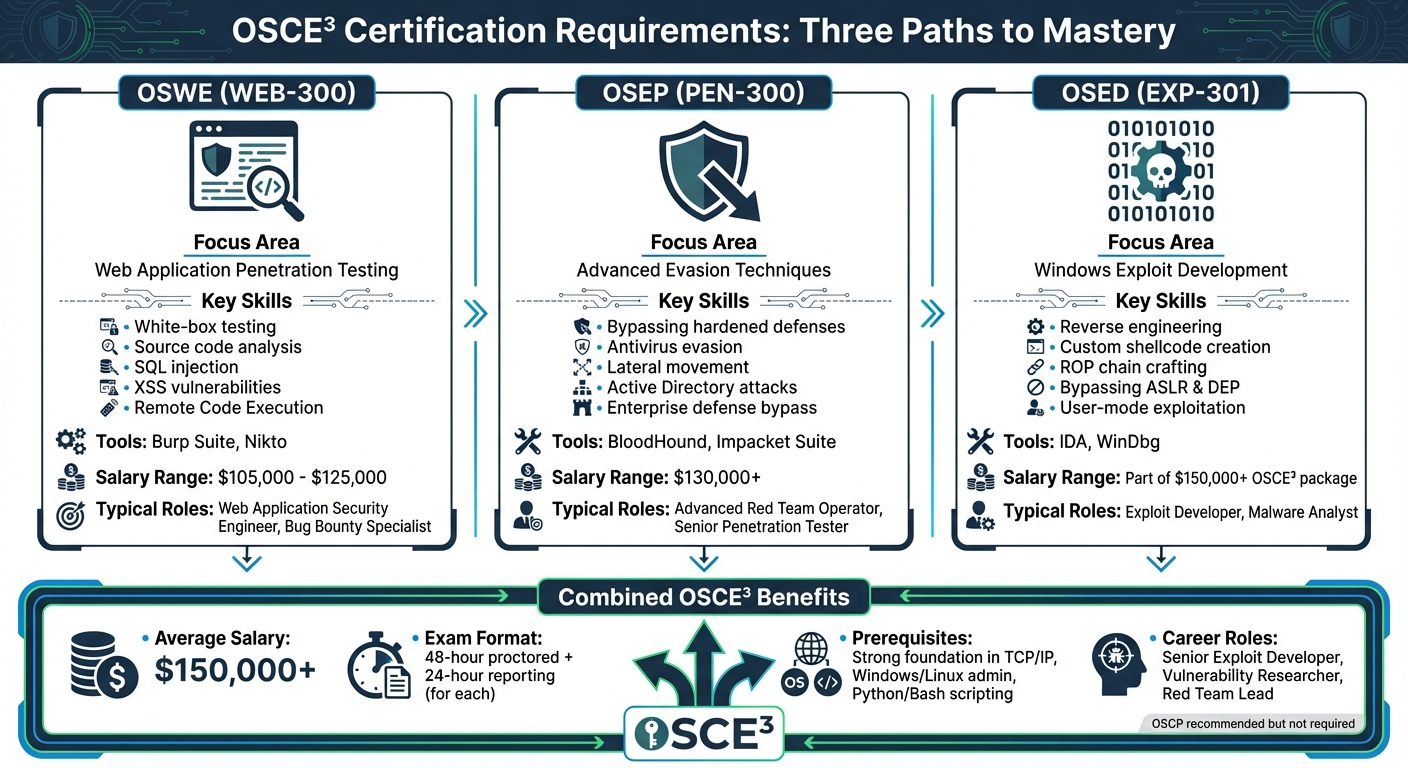
OSCE³ Certification Requirements: Three Paths to Advanced Penetration Testing Mastery

OSCE³ Certification Requirements: Three Paths to Advanced Penetration Testing Mastery

To earn the OSCE³ certification, you must complete three advanced certifications: OSWE, OSEP, and OSED. Once these are achieved, you’ll automatically receive a printed certificate, wallet card, and challenge coin – no additional exams required [4].

"Earning all three of the following certifications automatically grants you the new OSCE³ certification… No additional exam will be required once you have obtained the other three standalone certifications." – OffSec Support [4]

Here’s a closer look at the certifications and the skills they focus on.

Required Certifications and Skills

Each certification hones in on a specific area of offensive security:

  • OSWE (WEB-300): Specializes in white-box web application penetration testing. You’ll need to analyze large codebases and identify vulnerabilities like SQL injection, XSS, and Remote Code Execution [1].
  • OSEP (PEN-300): Focuses on advanced evasion techniques for bypassing hardened defenses, including antivirus evasion and lateral movement within networks [1].
  • OSED (EXP-301): Centers on Windows user-mode exploit development. This includes reverse engineering with tools like IDA and WinDbg, and crafting ROP chains to bypass protections such as ASLR and DEP [1].

While the OSCP certification isn’t a formal prerequisite, it’s often considered the starting point for this advanced learning path [4]. To succeed, you’ll need a strong foundation in TCP/IP networking, Windows and Linux administration, and scripting skills in Bash or Python [7]. For OSWE, the ability to read and analyze web application code is critical, while OSED demands proficiency in C and Assembly. Each certification exam consists of a challenging 48-hour proctored session, followed by a 24-hour reporting phase [1].

Certification Course Code Focus Area
OSWE WEB-300 Web application penetration testing and code analysis
OSEP PEN-300 Evasion techniques and lateral movement
OSED EXP-301 Exploit development and mitigation bypass

Considerations for Cleared Professionals

While government security clearance isn’t required for OSCE³, cleared professionals should keep a few logistical factors in mind. The exams are proctored, requiring a reliable internet connection and the use of specific proctoring software [9]. If you work in a restricted environment like a SCIF, it’s best to schedule your exam outside of work hours.

The OSEP course is particularly relevant for professionals in environments with mature security functions, such as government or defense sectors. It mirrors the challenges of breaching hardened systems, often protected by enterprise-grade defenses [3]. Cleared professionals may find it helpful to schedule the 48-hour exams during leave periods to avoid conflicts with job responsibilities. Additionally, your experience with advanced security functions and tools like EDR systems can be a strong advantage when tackling the OSEP exam.

How to Prepare for OSCE Certification

Getting ready for OSCE³ means tackling three distinct exams – OSWE, OSEP, and OSED – each requiring its own set of skills. The PEN-300 course alone offers over 615 hours of content, so having a structured, long-term plan is crucial, especially if you’re balancing it with a demanding work schedule [11]. Instead of memorizing tools, focus on building repeatable methodologies to handle the 48-hour exam effectively. Below, we’ll look at how each training path aligns with the requirements of the OSCE³ exams.

Recommended Courses and Training Paths

OffSec provides three main courses that correspond directly to the OSCE³ exams:

  • WEB-300: Prepares you for the OSWE certification by focusing on web application testing. It covers source code analysis, chaining vulnerabilities, and tools like Burp Suite and Nikto.
  • PEN-300: Helps you earn the OSEP certification by teaching advanced evasion techniques, lateral movement, antivirus bypassing, and Active Directory attacks.
  • EXP-301: Focuses on Windows exploit development for the OSED certification. It includes training on tools like WinDbg and IDA, creating custom shellcode, and bypassing protections like ASLR and DEP.

For pricing details, refer to the subscription table in the Introduction. The Learn One subscription is particularly helpful for those with unpredictable schedules, offering extended access to accommodate high-pressure work periods or deployments.

Study Tips for Cleared Pen Testers

Once you’ve selected your training path, refine your study habits to maximize efficiency. Strong documentation skills are critical, as your exam report must be detailed enough for a technically skilled reader to replicate every step of your attacks. Practice documenting commands, custom scripts, and console outputs during your lab sessions. Keeping a "Failure Log" can also help you learn from unsuccessful exploits.

Set specific goals for each study session. For instance, focus on mastering a particular privilege escalation method within 20 minutes. The Pomodoro Technique – working in 25-minute sprints – can help maintain focus during extended study periods. Additionally, organize a searchable knowledge base to quickly reference syntax or commands during the high-pressure exam.

Use the final challenge labs in each course to test your readiness. These labs are designed to reflect the complexity of the actual exams. If you have experience working in cleared environments with hardened systems and enterprise-grade defenses, you already have a strong foundation that will serve you well during the exams. Keep in mind that certain tools are prohibited during exams, such as AI chatbots like ChatGPT, automated tools like SQLmap (restricted in OSWE but allowed in OSEP), and commercial tools like Cobalt Strike [10][5].

Managing Certification Prep with Cleared Work Commitments

Balancing certification prep with cleared assignments requires careful planning. The 48-hour proctored exams demand a stable internet connection and cannot be taken in restricted environments. Schedule your exam attempts during planned leave or less demanding work periods when you’re not required at a secure facility. Use the 24/7 lab access to study during evenings or weekends when secure facility restrictions don’t apply.

If your employer offers workforce development programs, ask about Learn Enterprise subscriptions. These provide structured training for teams, along with multiple exam attempts [1][6]. Additionally, communicate your certification goals with your supervisor – they may be able to offer dedicated study time or flexible scheduling to support your preparation.

sbb-itb-bf7aa6b

Tools and Resources for OSCE Preparation

Recommended Penetration Testing Tools

Once you’ve mapped out your study plan, the next step is gathering the right tools for your OSCE³ preparation. Your toolkit should cover five essential areas: reconnaissance, Active Directory exploitation, web application testing, privilege escalation, and post-exploitation.

For reconnaissance, tools like AutoRecon, RustScan, and Feroxbuster (or Gobuster) are excellent for discovery and scanning tasks [14]. When it comes to Active Directory exploitation, BloodHound can help visualize relationships, while the Impacket Suite pairs well with tools like Kerbrute, Rubeus, and PowerView for enumeration and Kerberos-related tasks [14].

Web application testing benefits from Burp Suite as a strong proxy tool, along with SQLmap for injection vulnerabilities, and Nikto or WPScan for specialized scanning [14]. For privilege escalation, PEASS-ng tools like LinPEAS and WinPEAS are invaluable for identifying escalation paths on Linux and Windows systems. Finally, in post-exploitation, tools such as Mimikatz for credential dumping, Evil-WinRM for remote management, and CrackMapExec for network assessments are highly effective.

While these tools are powerful, focus on manual exploitation techniques and custom scripts using languages like Python, Bash, PowerShell, or C# to strengthen your skills [7][13].

Study Platforms and Labs

To sharpen your skills, hands-on practice is crucial. The OffSec Proving Grounds Practice platform offers access to over 200 lab environments, featuring more than 250 hours of content designed to mimic real-world attack scenarios [12][15]. This platform costs $19 per month or $199 annually, providing unlimited access – perfect for deep-dive exploitation practice [12][17]. For maximum security, prioritize "Private Machines" during your sessions [12].

The OffSec Learning Library is another excellent resource, offering 14 certifications, over 125 learning paths, and more than 750 labs, totaling an impressive 7,500 hours of content [16]. For each OSCE³ exam, you’ll find dedicated labs tailored to specific techniques: WEB-300 for OSWE, EXP-301 for OSED, and PEN-300 for OSEP [2].

If you’re on a tight budget, consider the OffSec Proving Grounds Play option, which provides free access to over 50 community-generated Linux labs. However, note the daily three-hour usage limit [12][15]. To ensure smooth access during your preparation, practice using both in-browser Kali Linux and VPN-based connections with OpenVPN [15][18].

Outside of structured labs, engaging with the broader security community can provide additional insights and practical tips.

Community and Networking Resources

The journey to OSCE³ certification isn’t just about tools and labs; it’s also about learning from others who’ve been through the process. Peer insights and community support can offer valuable guidance, especially for tackling the challenging 48-hour exam format.

OffSec provides a dedicated community for Proving Grounds users, where you can troubleshoot and collaborate with others working on the same machines [12]. Additionally, GitHub repositories like verylazytech/OSCP-Resources serve as treasure troves of roadmaps, cheatsheets, and practice box recommendations, encouraging collaboration [19].

"This guide is a community-driven effort. Feel free to suggest improvements or share your insights via pull requests." – verylazytech [19]

Platforms like Twitter/X are another way to connect with certified OSCE³ professionals. For instance, Nourrisson Julien (OSCE³) actively invites discussions and shares advice:

"If you wish to contact me to discuss anything you can DM me on twitter… @0x_woofy" [8]

Reading blogs and write-ups from successful OSCE³ holders can also provide practical tips for managing the intense exam format. Beyond informal networking, consider formal mentorship programs or mastermind groups available through professional development platforms. These resources can help refine your approach and boost your confidence as you prepare for advanced certifications [20].

Career Benefits of OSCE Certification for Cleared Professionals

Earning the OSCE³ certification can significantly enhance your cybersecurity career, especially in roles requiring advanced offensive security skills. This credential demonstrates expertise in areas like custom exploit development, advanced evasion techniques, and white-box source code analysis [1]. It positions you for senior-level roles that demand specialized knowledge, while also opening doors to higher compensation levels.

Job Opportunities on Cleared Cyber Security Jobs

With an OSCE³ certification, you gain access to specialized positions such as Vulnerability Researcher, Malware Analyst, Application Security Researcher, and Secure Code Reviewer [1]. These roles are highly sought after by major cleared employers running advanced offensive security programs [25]. The platform’s veteran-founded approach allows you to connect directly with these employers – no staffing firms involved. You can upload your resume, set alerts for OSCE³-specific jobs, and even participate in job fairs tailored to cleared professionals.

The value of certifications in hiring cannot be overstated. A staggering 91% of hiring managers prefer certified candidates [23]. With OSCE³ credentials, you stand out in a competitive applicant pool, gaining access to roles that not only expand your career options but also offer impressive financial rewards.

Salary Expectations and Role Comparisons

The financial benefits of OSCE³ certification are undeniable. Professionals with this credential typically earn $150,000+, which is a significant jump compared to the average salary of $103,000 for OSCP-certified professionals [24][25].

Certification Average U.S. Salary Typical Cleared Roles
OSWE $105,000 – $125,000 Web Application Security Engineer, Bug Bounty Specialist [21]
OSEP $130,000+ Advanced Red Team Operator, Senior Penetration Tester [21]
OSCE³ $150,000+ Senior Exploit Developer, Vulnerability Researcher, Red Team Lead [24]

At top cleared employers, salaries are even more competitive. For instance, Booz Allen Hamilton offers an average salary of $138,188 for OffSec-certified professionals, while Leidos averages around $135,000 – and these figures are based on OSCP holders [25]. With OSCE³ certification, you can command even higher pay for roles requiring advanced exploit development and leadership in red team operations.

Staying Competitive in the Cleared Cybersecurity Industry

The cybersecurity landscape evolves rapidly, and staying competitive means continuously upgrading your skills. The OSCE³ certification ensures you remain ahead of the curve, equipping you to tackle sophisticated threats and navigate advancements in defensive technologies. Your ability to bypass modern defenses and perform detailed source code analysis makes you an asset for leadership roles in high-demand areas [23].

"The OSCE³ is a symbol of determination, knowledge, and skill… distinguishing you as a top-tier offensive security professional." – OffSec Team [1]

Beyond immediate opportunities, OSCE³ certification lays the groundwork for long-term career growth. It prepares you for roles like Red Team Lead, Principal Security Researcher, or Offensive Security Architect. In a field where 65% of global practitioners agree certifications are the best way to demonstrate knowledge [22], this credential not only proves your expertise but also shows you can handle real-world challenges under pressure. This is a critical quality for cleared employers tasked with protecting sensitive government systems and critical national infrastructure.

Conclusion

The OSCE³ certification represents the pinnacle of offensive security credentials for cleared professionals. By mastering the advanced disciplines of OSWE, OSEP, and OSED, you join an elite group of experts who possess skills that few can claim [1][3]. This certification not only distinguishes you but also positions you as a leader in advanced offensive security.

Achieving the OSCE³ requires dedication and effort. It validates your expertise and opens doors to high-impact roles like Senior Exploit Developer, Vulnerability Researcher, and Red Team Lead. In a field where over 90% of security leaders prioritize investing in employee certifications [26], this credential can drive significant career growth and financial rewards.

The journey begins with one of the three required 300-level courses: WEB-300, PEN-300, or EXP-301. With the Learn One subscription, you gain flexible lab access and multiple exam attempts, making it easier to balance preparation with your professional commitments. Prioritize methodical enumeration, practice in realistic lab settings, and sharpen your documentation skills to meet the exam’s rigorous reporting standards.

Your OSCE³ isn’t just a badge of honor – it’s a pathway to exclusive opportunities. Maximize its value by connecting with cleared employers through Cleared Cyber Security Jobs. Upload your resume, set alerts for OSCE³-specific roles, and participate in job fairs tailored for cleared professionals. This ensures direct access to top-tier positions that recognize and reward your advanced qualifications.

With information security analyst roles projected to grow by 29% through 2034 [27], the OSCE³ certification equips you to stay ahead in the ever-evolving cybersecurity landscape. Start your journey today and secure your place among the leaders in cleared offensive security.

FAQs

What advantages does the OSCE³ certification offer for security-cleared penetration testers?

Earning the OSCE³ certification highlights a high level of skill in offensive security techniques, setting cleared professionals apart in the competitive world of cybersecurity. It proves your ability to tackle intricate challenges, enhancing both your credibility and technical reputation.

For cleared penetration testers, this certification offers more than just a credential – it can lead to opportunities for upper-level roles, improve job flexibility, and increase acknowledgment within the specialized cleared cybersecurity sector. It’s a powerful tool for career growth and staying ahead in an ever-changing industry.

How can cleared professionals prepare for the OSCE³ exam while managing their work responsibilities?

Balancing preparation for the OSCE³ exam with a hectic work schedule might seem daunting, but it’s entirely doable with some thoughtful planning. Start by crafting a structured study plan that breaks your preparation into clear, bite-sized goals. Tackling one topic or skill at a time can help you stay focused and avoid feeling swamped.

Fit study sessions into your daily routine by using early mornings, lunch breaks, or evenings. Short, consistent study periods work better than marathon sessions – regular practice keeps the material fresh without overwhelming you. Focus on quality over quantity by prioritizing hands-on exercises and labs that mirror real-world scenarios. These practical activities can make a big difference in understanding and retention.

Above all, stay disciplined but flexible. Life happens, and work demands can shift, so don’t hesitate to adjust your plan when needed. The key is steady, focused effort – not last-minute cramming. By keeping a balanced approach, you can confidently prepare for the OSCE³ while staying on top of your professional responsibilities.

What key skills and tools do I need to succeed in the OSCE³ exams?

To succeed in the OSCE³ exams, you’ll need a solid grasp of advanced penetration testing techniques. This means being skilled in areas like exploiting web applications, crafting shellcode, bypassing security features such as ASLR and DEP, and building ROP chains. These techniques are essential for navigating the complex scenarios you’ll face during the certification process.

Familiarity with tools like Kali Linux and other specialized penetration testing utilities is also crucial. Practical, hands-on experience with these tools will allow you to apply your skills effectively when it matters most. Spend time honing your problem-solving skills and working through real-world scenarios to prepare yourself for the challenges ahead.

Related Blog Posts

  • Cleared Cybersecurity Career Assessment – Your Success Scorecard and Action Plan
  • CISA Certification Career Guide for Cleared IT Auditors
  • CEH Certified Ethical Hacker Career Guide for Cleared Pen Testers
  • OSCP Certification Career Guide for Cleared Offensive Security

Related Guides

  • CRTL Certification Career Guide for Cleared Red Team Leads
  • CRTO Certification Career Guide for Cleared Red Team Operators
  • CRTP Certification Career Guide for Cleared Red Team Professionals
  • Cybersecurity Salary Guide 2026
  • TS/SCI Salary Premium: Real 2026 Numbers

OSCP Certification Career Guide for Cleared Offensive Security

CyberSecJobs Editorial · February 5, 2026 ·

The Offensive Security Certified Professional (OSCP) certification is a top credential for professionals in cybersecurity, especially those with security clearances. It demonstrates advanced penetration testing skills through a rigorous 24-hour exam, making it ideal for roles like penetration tester or red team operator.

Key takeaways:

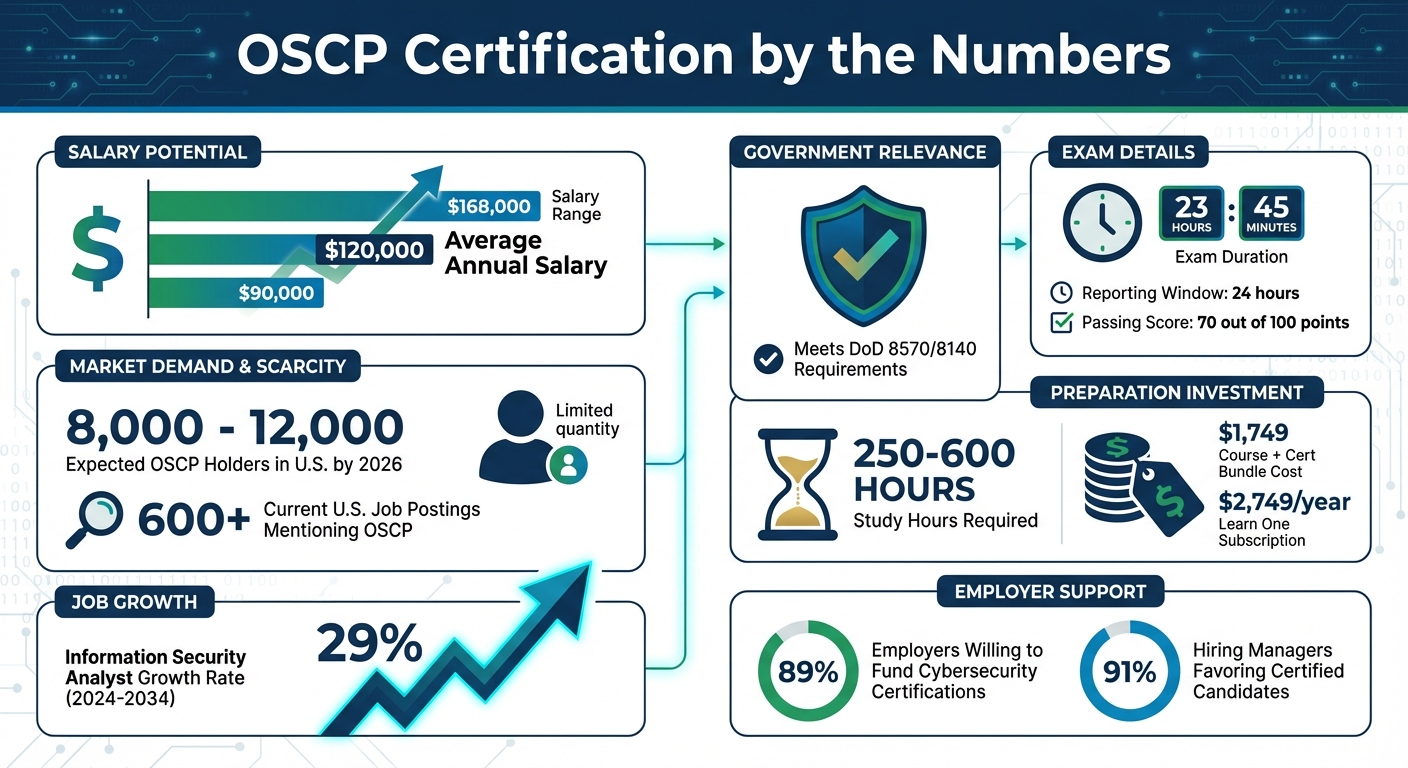
  • Salary Potential: OSCP-certified professionals in the U.S. earn between $90,000 and $168,000, with an average of $120,000 annually.
  • Demand: By 2026, only 8,000 to 12,000 OSCP holders are expected in the U.S., making it a highly sought-after qualification.
  • Job Growth: Information Security Analyst roles are projected to grow by 29% (2024–2034).
  • Government Relevance: Meets DoD 8570/8140 requirements, making it valuable for defense and government jobs.

Preparation involves completing the PEN-200 (PWK) course, practicing hands-on labs, and mastering tools like Nmap, Burp Suite, and Hydra. The certification also opens doors to advanced certifications like OSEP, OSWE, and OSED for career progression.

Professionals with OSCP can find high-paying, cleared roles by leveraging platforms like Cleared Cyber Security Jobs and networking through industry events.

OSCP Certification Career Statistics: Salary, Demand, and Growth Projections

OSCP Certification Career Statistics: Salary, Demand, and Growth Projections

OSCP Certification Overview for Cleared Professionals

What is OSCP?

The Offensive Security Certified Professional (OSCP) is a hands-on certification designed to demonstrate your ability to conduct penetration testing on live systems. Unlike traditional multiple-choice exams, the OSCP requires candidates to breach real machines during a 23-hour, 45-minute exam, followed by a 24-hour window to submit a professional penetration test report [1]. To pass, you need to score at least 70 out of 100 points, which involves gaining initial access, escalating privileges on standalone systems, and compromising an Active Directory (AD) environment [1].

The AD component is particularly relevant for professionals working in government agencies or defense settings. It reflects real-world internal network environments where attackers often start with compromised credentials and move laterally across domain systems. The certification emphasizes essential offensive security skills, including information gathering, vulnerability analysis, privilege escalation on Windows and Linux, and exploiting Active Directory.

The OSCP certification has two renewal paths: the OSCP+, which requires renewal every three years, and the original OSCP, which remains valid indefinitely [1]. However, the certification comes with strict guidelines: no commercial vulnerability scanners like Nessus, no use of AI tools or chatbots, and limited reliance on automated tools such as Metasploit.

This structure closely mimics the challenges faced in government and defense security roles, making it highly relevant for professionals in these fields.

Why OSCP Matters for Cleared Offensive Security Jobs

The OSCP’s rigorous format sets it apart as a key differentiator for security-cleared professionals in a competitive market. With only 8,000 to 12,000 OSCP holders in the United States [3], earning this certification places you in an exclusive group capable of demonstrating technical expertise in realistic scenarios. It’s also gaining traction under DoD 8570/8140 mandates, further solidifying its value for government and defense contractor roles [3].

The hands-on nature of the certification validates critical skills, including exploitation techniques, detailed reporting, and actionable analysis – qualities that cleared employers prioritize. Currently, over 600 U.S. job postings specifically mention the OSCP, with many government and defense roles offering salaries between $95,000 and $120,000 annually [3]. As highlighted by Programs.com:

If CISSP is the manager’s cert, OSCP is the hacker’s cert. Anyone who wants to be taken seriously in offensive security should pursue it. [3]

With the Bureau of Labor Statistics forecasting a 29% growth rate for information security analysts through 2034 [1], the OSCP is a strategic investment for advancing your career in cleared offensive security positions.

OSCP Guide – Full Free Course

How to Prepare for the OSCP Exam

Getting ready for the OSCP exam does more than just prepare you for the test – it also enhances your qualifications for demanding security roles.

Penetration Testing with Kali Linux (PWK) Course and Labs

Kali Linux

The PEN-200 (PWK) course is the official training program from OffSec, offering 282 hours of instruction spread across more than 20 modules [5][9]. This curriculum dives into essential topics like basic enumeration, exploiting Active Directory, privilege escalation on both Windows and Linux, and identifying web application vulnerabilities like XSS and SQL injection. Each module includes hands-on labs designed to help you practice these techniques in a controlled environment.

What sets this course apart are the 9 challenge labs. These labs combine various skills in scenarios that mimic real-world network breaches. Three of these labs are specifically designed to help you prepare for the OSCP exam by simulating its format [9][11]. These aren’t your typical CTF-style challenges – they replicate organizational networks with machine dependencies, credential reuse, and lateral movement, making them a great way to practice realistic attack scenarios [10].

To make the learning process smoother, OffSec provides a structured path that maps specific lab machines to the course modules. This approach is especially helpful for beginners tackling complex network setups [10]. Data shows a strong link between the number of lab machines you successfully compromise and your likelihood of passing the exam. Candidates who complete over 50 machines tend to have much higher success rates [6][10].

The Course + Cert Bundle costs $1,749, which includes 90 days of lab access and one exam attempt [5][9]. If you need more time or access to additional foundational courses like PEN-103, the Learn One Subscription is available for $2,749 per year and includes a full year of lab access plus two exam attempts [5][9].

While the PWK course builds a strong foundation, you’ll also need to refine your skills with a carefully selected toolkit to handle the exam’s unique challenges.

Tools You Need for OSCP Preparation

Choosing the right tools and understanding how to use them effectively is critical, especially since the exam comes with strict limitations. For example, commercial vulnerability scanners like Nessus and automated tools such as SQLmap are not allowed [2][6]. While Metasploit is permitted during lab practice, its use in the exam is limited to just one target machine [2].

Your go-to tools should include Nmap for reconnaissance, Burp Suite Free Edition for web application testing, and directory enumeration tools like Gobuster or Ffuf [6][7]. For password attacks, you’ll want to become proficient with tools such as Hydra, John the Ripper, and Hashcat. Privilege escalation tools like LinPEAS and WinPEAS are essential for identifying local vulnerabilities, while Netcat and MSFvenom are vital for creating payloads and setting up reverse shells [7].

The key here is not just knowing how to use these tools but also understanding the underlying techniques. Avoid over-relying on automation – make sure you can adapt and fine-tune exploit commands for specific targets [6].

Practice Labs and Hands-On Training

Practical experience is just as important as theoretical knowledge when it comes to OSCP preparation. OffSec Proving Grounds offers two options: PG Play, which is free and allows 3 hours of daily access to VulnHub community machines, and PG Practice, which costs $19 per month or $199 per year and includes OffSec-designed machines and retired OSCP exam labs [7][8].

A good starting point is free VulnHub VMs, such as the Kioptrix series, which are beginner-friendly [7]. As you progress, you can move on to premium platforms. The PortSwigger Web Security Academy is another excellent resource for honing your web exploitation skills [7].

For a structured 90-day prep plan, consider this approach:

  • Spend the first 30 days rooting easy VulnHub boxes.
  • Use the next 30 days to tackle medium-difficulty boxes and explore PG Play.
  • Dedicate the final 30 days to mock exams and labs focused on Active Directory [7].

Consistency is key, with most candidates investing 200–300 hours of study time to feel fully prepared [6].

sbb-itb-bf7aa6b

Finding Cleared Jobs with Your OSCP Certification

With your OSCP certification in hand, it’s time to focus on finding the right career path. As mentioned earlier, there are over 600 U.S. job postings specifically seeking OSCP-certified professionals. That puts you in a strong position as you step into the job market.

Common Job Roles for OSCP-Certified Professionals

If you’re aiming for a Penetration Tester role, your OSCP skills are a perfect match. These jobs involve simulating cyberattacks to uncover weaknesses in government networks and systems [12]. You’ll perform authorized exploitation, document vulnerabilities, and recommend fixes – essentially what you mastered during your OSCP exam.

For those interested in Vulnerability Analyst positions, the focus shifts to identifying and assessing system flaws [12]. Your OSCP certification proves you can go beyond automated tools, manually verifying and exploiting vulnerabilities, which adds value to your expertise.

Jobs in cleared environments for OSCP-certified professionals often come with competitive salaries. Knowing the clearance requirements for these roles will help narrow your search.

Clearance Requirements and Job Examples

Many positions require a Secret clearance, while more sensitive roles demand Top Secret/SCI. For example, penetration testers working with classified networks typically need either Secret or TS/SCI clearances [12]. Vulnerability analysts may start with Public Trust or Secret clearances, depending on the agency.

Your OSCP training gives you a strong edge here. The hands-on experience from the exam – like 24-hour reporting and Active Directory (AD) exploitation – aligns closely with what employers in these roles are looking for. Many job postings now highlight skills like Kerberoasting and lateral movement, which are thoroughly covered in the updated OSCP curriculum [3]. Be sure to emphasize your 24-hour reporting experience, as this is a critical skill valued by cleared employers [3].

Using Cleared Cyber Security Jobs to Find OSCP Roles

Cleared Cyber Security Jobs

The Cleared Cyber Security Jobs platform offers tools tailored for security-cleared professionals. By uploading your resume, you can connect directly with government agencies and defense contractors. The platform avoids staffing firms, ensuring you’re dealing directly with hiring managers.

Set up job alerts using "OSCP" as a keyword to stay updated on new openings. You can refine your search by clearance level (Secret, TS, TS/SCI), job type (penetration tester, vulnerability analyst), and location. Some employers on the platform even provide full or partial tuition reimbursement for OSCP certification [3]. If you haven’t taken the exam yet, ask about this perk during interviews – it could save you the $1,749 course fee.

Additionally, the platform’s career resources section offers guides specifically for cleared professionals. These resources can help you position your OSCP certification alongside your clearance status, giving you a strong advantage in the job market. With relatively few OSCP holders, your certification becomes a standout credential in this niche field.

Advancing Your Career After OSCP

Earning your OSCP certification is just the beginning – it’s a launchpad for diving deeper into offensive security and pursuing advanced certifications that open doors to elite roles in the field [17].

Advanced Certifications Beyond OSCP

The OSCP lays the groundwork for OffSec’s advanced certifications, with the OSCE³ (OffSec Certified Expert³) being the ultimate achievement in their certification path. This title is automatically awarded upon completing three advanced certifications: OSEP, OSWE, and OSED [13][15]. Each certification focuses on a specialized area of offensive security and requires completing the corresponding advanced course.

"Having an OSCE³ certification proves you’re not just a penetration tester – you’re among the most advanced offensive security professionals in the world." – OffSec [13]

Here’s a breakdown of the advanced certifications:

  • OSEP (OffSec Experienced Pentester): This certification delves into advanced evasion techniques, bypassing antivirus, and navigating hardened environments. It’s perfect for those aiming for senior red team roles or tackling network penetration in highly secure corporate systems [13][14].
  • OSWE (OffSec Web Expert): Focused on white-box web application exploitation and source code analysis, this certification is ideal for roles in application security, bug bounty hunting, or DevSecOps. With web applications becoming central to modern environments, this skill set is increasingly relevant [14][17].
  • OSED (OffSec Exploit Developer): This path emphasizes Windows user-mode exploit development, including bypassing protections like ASLR and DEP. It’s a must for those pursuing careers in exploit development or advanced security research [13][15].

For professionals working in the cleared space, OffSec offers the Learn One subscription at $2,749 per year, which includes access to one 300-level course, a year of lab access, and two exam attempts – making it an efficient way to progress through the OSCE³ track [13].

Other certifications worth exploring include the Certified Red Team Professional (CRTP), which focuses on Active Directory and stealth tactics in Windows environments [16]. For those considering leadership roles, the CISSP certification provides a balance of technical knowledge and security management skills, making it a strong choice for transitioning into managerial positions [16].

Certification Focus Area Ideal Career Path Pricing
OSEP Advanced Evasion & Hardened Systems Red Team Operator, Senior Pentester Included in Learn One ($2,749/year) [13]
OSWE Web App & Source Code Analysis AppSec Researcher, DevSecOps Included in Learn One ($2,749/year) [13]
OSED Windows Exploit Development Exploit Developer, Security Researcher Included in Learn One ($2,749/year) [13]
CRTP Active Directory & Windows Environments Red Team Specialist Varies [16]
CISSP Security Management & Governance Security Manager, Architect Varies [16]

Continuing Education and Networking in the Cleared Community

To stay competitive post-OSCP, continuous learning and networking are essential. Free resources like PortSwigger Academy (for web security) and BloodHound Community Edition (for Active Directory tactics) can help you build on your OSCP skills [18][21]. Platforms such as Hack The Box and TryHackMe offer increasingly challenging scenarios to refine your abilities [17]. For a more structured option, the OffSec Proving Grounds Practice subscription ($199/year) provides access to over 200 lab environments for ongoing skill development [19].

Networking is equally important, especially in the cleared community where referrals often outweigh job postings [18]. Engage with peers and industry experts through the OffSec Discord, which offers instructor-led office hours and walkthroughs [21]. Attending events like Security BSides, OWASP Chapter meetups, and DEF CON Groups can also connect you with hiring managers and keep you updated on industry trends.

Sharing your journey on platforms like Medium or LinkedIn demonstrates your technical writing skills and helps build your personal brand [18]. After each certification attempt, take time to review your performance and identify areas for improvement [21][18].

"Technical reporting may be the most transferable skill from the PEN-200 into real-world engagements." – Kieran Croucher, SpecterOps [21]

It’s also worth noting that 89% of employers are willing to fund cybersecurity certifications for their employees [20]. When interviewing for roles, ask about tuition reimbursement for advanced certifications – it could save you thousands while accelerating your career. With the demand for Information Security Analysts expected to grow by 29% between 2024 and 2034 [1], investing in your education now positions you for long-term success in offensive security.

Conclusion

The OSCP certification showcases your ability to penetrate live systems and create detailed professional reports, placing you among a group highly sought after by employers [3]. The rigorous 24-hour exam tests skills like enumeration, exploitation, and privilege escalation – practical abilities that align directly with offensive security roles offering an average annual salary of about $120,000 [3].

"OSCP alumni walk into jobs with credibility. They don’t need to prove they know what a reverse shell is." – Offensive Security 2026 Guide [3]

To succeed, dedicate 250–600 focused study hours over three to six months. Pay special attention to Active Directory attacks and fine-tuning your reporting skills, as these are common stumbling blocks for many candidates [3]. Build your foundation with the PEN-200 course and enhance your preparation using platforms like Hack The Box and OffSec Proving Grounds. If you’re considering tuition reimbursement, many defense contractors offer partial or full coverage – be sure to inquire during interviews [3]. Thorough preparation now sets you up for a smooth transition into high-demand security roles.

Once certified, prominently list "OSCP" on your resume to improve ATS visibility [22]. On Cleared Cyber Security Jobs, highlight how your OSCP aligns with DoD 8140/8570 requirements and take advantage of job alerts to connect with employers actively seeking hands-on expertise [23].

With 91% of hiring managers favoring candidates with certifications [5] and the growing demand for offensive security professionals reinforcing its value [4], the OSCP opens pathways to roles in red team operations, penetration testing, and even leadership. Pursue advanced certifications and actively network to further solidify your standing – the OSCP is just the beginning of your journey into elite offensive security work.

FAQs

Why is the OSCP certification important for careers in government and defense cybersecurity?

The OSCP certification holds a strong reputation in government and defense cybersecurity circles. Why? Because it demonstrates your ability to spot and ethically exploit vulnerabilities in actual systems. This hands-on skillset is crucial for tackling the intricate challenges tied to national security and defense.

What sets this certification apart is its emphasis on practical problem-solving and persistence – traits that are essential in offensive security roles. Employers in these sectors appreciate the OSCP because it prioritizes real-world skills over just theoretical understanding, making it a powerful tool for advancing your career in cleared cybersecurity positions.

What makes the OSCP exam’s hands-on approach unique compared to other cybersecurity certifications?

The OSCP exam is unique in its emphasis on practical skills over theoretical knowledge. Rather than tackling multiple-choice questions, candidates must find, exploit, and document vulnerabilities in a live lab setting. This hands-on format ensures that participants showcase their ability to handle real penetration testing tasks, aligning perfectly with the demands of offensive security roles.

What are the best advanced certifications to consider after earning the OSCP?

After achieving the OSCP, you might want to level up your expertise by exploring certifications that focus on more specialized areas of offensive security. Some excellent options include:

  • OSCE: Perfect for diving into advanced exploitation techniques.
  • GPEN: Focuses on honing penetration testing skills.
  • CRTP: Offers a deeper understanding of Active Directory security.

If you’re looking to broaden your cybersecurity knowledge beyond offensive security, consider the CISSP, which is widely recognized and can open doors to senior-level roles.

These certifications are well-respected in the industry and can help you carve out a niche or advance to higher-level positions in offensive security.

Related Blog Posts

  • OT Security Clearance Jobs – The Critical Infrastructure Opportunity
  • Cleared Resume OPSEC Guidelines – What NSA Says You Can and Can’t Say
  • Cleared Cybersecurity Career Assessment – Your Success Scorecard and Action Plan
  • CEH Certified Ethical Hacker Career Guide for Cleared Pen Testers


Related Guides

  • CRTL Certification Career Guide for Cleared Red Team Leads
  • CRTO Certification Career Guide for Cleared Red Team Operators
  • CRTP Certification Career Guide for Cleared Red Team Professionals
  • Cybersecurity Salary Guide 2026
  • TS/SCI Salary Premium: Real 2026 Numbers

CEH Certified Ethical Hacker Career Guide for Cleared Pen Testers

CyberSecJobs Editorial · February 4, 2026 ·

The Certified Ethical Hacker (CEH) certification is a must-have for cybersecurity professionals with security clearances aiming for penetration testing roles in government and defense sectors. Here’s why it matters:

  • What It Proves: CEH certifies your ability to think like a hacker, identifying vulnerabilities before they can be exploited.
  • Key Features: Covers 550+ attack techniques, 4,000+ tools, and AI-based ethical hacking methods.
  • Job Relevance: Recognized under DoD 8140, aligning with 28 Defense Cyber Workforce Framework (DCWF) roles like Cyber Defense Analyst (511) and Vulnerability Assessment Analyst (541).
  • Salary Potential: CEH-certified professionals earn $90,000–$130,000 annually in cybersecurity hotspots like Washington, D.C., with top salaries reaching $180,000.

Certification Details:

  • Exam Cost: $950–$1,199 (optional hands-on Practical exam: $550).
  • Training: $1,899–$4,500 (includes exam voucher).
  • Eligibility: Complete official training or verify two years of experience in InfoSec.

With CEH, you gain skills in reconnaissance, scanning, system hacking, and more – essential for assessing and securing military and government networks. Employers like Booz Allen Hamilton and Leidos actively seek CEH-certified professionals for high-paying, cleared roles. Ready to advance your career? Let’s dive into the details.

Skills and Knowledge from CEH Training

Core Skills Developed Through CEH

CEH training equips you with expertise in Reconnaissance, Scanning & Enumeration, Vulnerability Analysis, Gaining Access, and Maintaining Access/Covering Tracks – a structured methodology that mirrors the strategies attackers use. This mindset helps you approach challenges from an adversary’s perspective.

You’ll practice using 4,000+ tools across 221 labs within the iLabs Cyber Range [3]. These include industry staples like Nmap for port scanning, Metasploit for exploitation, Wireshark for packet analysis, and Burp Suite for testing web applications. The latest version (v13) covers over 550 attack techniques, addressing threats like SQL injection, Cross-Site Scripting (XSS), buffer overflows, and privilege escalation [3].

Skill Category Specific Technical Skills & Tools
Reconnaissance Footprinting, OSINT, DNS/Whois lookup, Google Hacking Database (GHDB)
Scanning Port scanning (Nmap, Hping), Host discovery, Service version discovery
System Hacking Password cracking, Buffer overflows, Privilege escalation, Steganography
Web/App Hacking SQL Injection, XSS, Web API hacking, Webhook exploitation
Network Defense Evasion Bypassing IDS/Firewalls, Honeypot detection, Log clearing
Advanced Threats Malware analysis (Static/Dynamic), Ransomware, Fileless malware
Infrastructure Cloud security (Containers, Docker, Kubernetes), IoT/OT hacking

These skills are directly applicable to real-world scenarios in secured environments.

CEH v13 also integrates AI-powered tools for automated threat hunting and OSINT gathering, streamlining these processes. You’ll gain expertise in specialized areas like Cloud security (AWS, Azure, Google Cloud), IoT, and Operational Technology (OT) systems – critical for roles in government and military settings.

"The CEH gave me a more advanced training on these tools [Kali Linux, Wireshark] and many more." – Iskren-Yankon, Chief Expert Information Security Officer, Ministry of Agriculture, Food and Forestry [4]

How CEH Skills Apply to Cleared Pen Testing Roles

The technical skills developed through CEH training are directly relevant to the unique demands of cleared environments. The five-phase methodology you learn not only forms the foundation of the training but also mirrors the daily tasks you’ll encounter in these roles.

In cleared settings, you’ll use these skills to assess military and government networks, ensuring vulnerabilities are identified and mitigated before adversaries can exploit them. Tasks include conducting OSINT to map attack surfaces, scanning for vulnerable services, analyzing findings using CVSS scoring, and executing controlled exploits to demonstrate risks.

You’ll also simulate advanced persistent threats (APTs) targeting government systems, practicing techniques like log clearing to cover tracks and exploiting minor misconfigurations for full system access. These are critical skills for security assessments. According to EC-Council, 97% of certified professionals found CEH labs to closely replicate real-world cyber threats, and 93% reported their skills significantly enhanced their organization’s security posture [1].

"CEH was my first confidence booster and helped land me a job on a Red team in the government sector." – Farzan Karimi, Engineering Manager, Android Offensive Security, Google [4]

For those aiming for high-pressure roles, the optional CEH Practical exam is a valuable addition. This six-hour test challenges you to solve 20 real-world scenarios using the iLabs Cyber Range [4]. It’s a chance to prove your skills under time constraints – a crucial trait for cleared penetration testing positions. The certification aligns with 28 Defense Cyber Workforce Framework (DCWF) job roles, including Cyber Defense Analyst (511), Vulnerability Assessment Analyst (541), and Incident Responder (531) [1].

Is CEH v13 Really Worth It in 2025?

CEH Certification Requirements and Costs

CEH Certification Cost Breakdown and Requirements for Cleared Professionals

CEH Certification Cost Breakdown and Requirements for Cleared Professionals

Eligibility and Prerequisites

To qualify for the CEH exam, you have two main options. The first is completing official training through an EC-Council Accredited Training Center (ATC) or their online portal. This route doesn’t require prior work experience and also waives the application fee. The second option is experience-based, which requires two years of verified work experience in Information Security [7].

If you’re pursuing the experience-based path, relevant areas include Reconnaissance, System Hacking, Network and Perimeter Hacking, Web Application Hacking, or Cloud Computing. For this route, there’s a $100 non-refundable application fee. During the verification process, EC-Council will contact your listed supervisors or references, which typically takes 5–10 business days [7].

"The CEH program requires the candidate to have two years of work experience in an Information Security role and should be able to provide a proof during the application process unless the candidate attends official training." – EC-Council [7]

These prerequisites set the stage for the exam details and associated costs outlined below.

Exam Format and Cost Breakdown

Here’s what you need to know about the CEH exam format and the financial investment involved.

The exam includes 125 multiple-choice questions to be completed within 4 hours [5]. Passing scores vary between 60% and 85%, depending on the difficulty of the specific test version. You can purchase the exam voucher for $1,199 through Pearson VUE or opt for online proctoring at a reduced cost of $950. If you want to take the optional CEH Practical exam, which features 20 hands-on challenges over 6 hours, it will cost an additional $550 [7].

Official training packages range from $1,899 to $4,500. These typically include the exam voucher and cover the application fee. After certification, you’ll need to pay an annual membership fee of around $80 and earn 120 Continuing Professional Education (CPE) credits every three years to maintain your credential. Retaking the exam, if necessary, costs between $300 and $500 per attempt [5].

Expense Category Cost (USD) Notes
Application Fee (Experience Path) $100 Non-refundable; waived with training
Exam Voucher (Direct) $1,199 Pearson VUE testing center
Exam Voucher (Online) $950 Remote proctoring
CEH Practical Exam $550 Optional hands-on test
Annual Membership ~$80 Required for ongoing credential upkeep
Official Training Packages $1,899–$4,500 Includes voucher and training materials
sbb-itb-bf7aa6b

Career Opportunities for CEH-Certified Cleared Professionals

Let’s dive into how CEH-certified professionals with security clearances can tap into a wealth of opportunities in the cybersecurity field, particularly within government and defense sectors.

Job Opportunities in Cleared Cybersecurity

The U.S. Department of Defense (DoD) recognizes the CEH certification as a critical qualification under DoD Directive 8140 (previously known as 8570). This recognition opens the door to a variety of roles within government agencies and defense contractors, including positions like Vulnerability Assessment Analyst (Role 541) and Red Team specialist roles focused on offensive security operations [1]. These jobs require not only technical skills but also a strong grasp of ethical hacking principles tailored for secure environments.

For instance, in February 2026, major defense contractors such as Booz Allen Hamilton advertised multiple penetration testing positions in locations like Herndon, VA, and Melbourne, FL. These roles required security clearances ranging from Public Trust to TS/SCI with Polygraph [8]. Other companies, including Peraton in Arlington, VA, GDIT at Fort Belvoir, VA, and Leidos in Springfield, VA, also sought professionals with Top Secret or TS/SCI clearances [8]. The salaries for these positions range from $100,000 to $200,000, with the national average sitting at $112,000 [1][8].

Your CEH certification doesn’t just limit you to penetration testing. It also qualifies you for roles like Cyber Defense Incident Responder, Warning Analyst, or Research & Development Specialist [1]. The demand for CEH-certified professionals is strong – 92% of hiring managers prefer candidates with this certification for ethical hacking roles, and over half of certified professionals report receiving promotions after earning their CEH [1].

This demand creates a clear path for career advancement, especially when combined with tools like Cleared Cyber Security Jobs to refine your job search.

Using Cleared Cyber Security Jobs for Career Growth

Cleared Cyber Security Jobs is a powerful resource for professionals with CEH certification and security clearances. The platform offers tools to simplify your job search for penetration testing and other cybersecurity roles. With advanced filters, you can search by clearance level, location, or even specific DCWF work role codes like 541 for Vulnerability Assessment Analyst. This precision helps you zero in on opportunities that match your skills and certifications.

By uploading your resume, you can connect directly with employers – bypassing staffing agencies – who are actively seeking cleared penetration testers. You can also set up job alerts to stay updated on new openings that align with your CEH certification and clearance level. Additionally, the platform hosts job fairs, giving you the chance to meet hiring managers from defense contractors and government agencies in person. Best of all, these services are free for U.S. citizens with active security clearances.

This combination of certification, demand, and targeted job search tools positions CEH-certified professionals for success in the cleared cybersecurity space.

Advancing Your Career with CEH

Key Takeaways

Earning the CEH certification can give cleared professionals a clear advantage in the penetration testing job market. With 92% of hiring managers favoring candidates who hold this credential for ethical hacking roles, it positions you ahead of other applicants [1]. CEH’s compliance with DoD 8140 and its alignment with 28 DCWF roles further boosts your appeal. Over half of professionals reported receiving promotions after obtaining their CEH, and 95% pursued it specifically to advance their careers [1]. In Washington, D.C. – a hub for cleared positions – CEH-certified professionals earn an average salary of $117,000 [9].

This certification demonstrates your ability to think like an attacker, a skill that shifts you from reactive defense tasks to offensive security operations. By pairing CEH with tools like Cleared Cyber Security Jobs, you can filter job opportunities by clearance level and DCWF work role codes, helping you find roles that perfectly align with your credentials. Take advantage of these benefits by following a few actionable steps.

Next Steps for Cleared Professionals

To capitalize on the career boost CEH offers, here’s how to move forward in your cybersecurity journey:

  • Budgeting for Certification: Allocate $950–$1,199 for the exam and $2,000–$3,500 for training [2][6]. If you have prior experience, plan for 2–3 months of preparation; otherwise, expect to spend 3–5 months [2].
  • Targeting Employers: Focus on defense contractors like Lockheed Martin, Raytheon, and General Dynamics, which prioritize candidates with active clearances and CEH credentials [9]. Use Cleared Cyber Security Jobs to set up tailored job alerts based on your clearance level and DCWF work role codes. This ensures you’re notified of openings that align with your qualifications. Upload your resume to connect directly with hiring managers, bypassing intermediaries like staffing agencies.
  • Proving Hands-On Skills: Take the CEH Practical exam to demonstrate your ability to apply knowledge in real-world scenarios. Employers increasingly value this practical validation over certifications that rely solely on theoretical knowledge [1][2].

Once certified, remember that CEH is valid for three years and requires continuing education credits to stay active [2]. Keeping your certification current ensures your skills remain relevant, especially as the latest v13 certification incorporates AI-driven ethical hacking techniques [9][2].

"Knowledge I gained from the CEH program gave me the confidence I needed to step into a role as a security engineer and penetration tester." – Roy Davis, Security Engineer, Zoom [1]

FAQs

What career paths can the CEH certification unlock for security-cleared professionals?

The Certified Ethical Hacker (CEH) certification is a gateway to numerous cybersecurity roles, especially for professionals with security clearances. It equips individuals for positions like ethical hacker, penetration tester, and cybersecurity analyst – roles centered on uncovering and fixing vulnerabilities before they can be exploited.

This certification is especially sought after in government, military, and private sectors. It’s particularly valuable for jobs requiring advanced offensive security skills, such as penetration testing, vulnerability assessment, and security audits. For cleared professionals, holding a CEH showcases their ability to identify and counter threats, making it a strong credential for advancing in defense and government-focused cybersecurity careers.

How does the CEH certification meet DoD 8140 requirements for cyber workforce roles?

The Certified Ethical Hacker (CEH) certification is officially acknowledged under DoD 8140 (previously known as DoD 8570) as a qualifying credential for several critical cybersecurity roles. These include positions like Cyber Defense Analyst, Vulnerability Assessment Analyst, and Research & Development Specialist within the Department of Defense’s cyber workforce.

This recognition underscores the CEH certification’s alignment with the competencies needed to handle essential cybersecurity tasks. For professionals in the cleared cybersecurity community, holding a CEH credential demonstrates expertise and readiness for DoD-specific roles, making it a strong asset for career advancement.

What are the costs and prerequisites for earning the CEH certification?

The cost of the Certified Ethical Hacker (CEH) certification exam ranges from $550 to $1,199, depending on the exam format you select. If you decide to include training, the total cost can climb to $3,499, based on the program type you choose.

To be eligible for the exam, you’ll need two years of experience in information security or must have completed an official EC-Council training program. Your application will also need to meet specific criteria, including verified work experience or proof of training completion. Make sure to carefully review all requirements before submitting your application.

Related Blog Posts

  • Top 10 Cyber Security Jobs for Cleared Professionals
  • Cyber Security Skills Gap Analyzer
  • Cleared Cybersecurity Career Assessment – Your Success Scorecard and Action Plan
  • CISA Certification Career Guide for Cleared IT Auditors


Related Guides

  • CRTL Certification Career Guide for Cleared Red Team Leads
  • CRTO Certification Career Guide for Cleared Red Team Operators
  • CRTP Certification Career Guide for Cleared Red Team Professionals
  • Cybersecurity Salary Guide 2026
  • TS/SCI Salary Premium: Real 2026 Numbers
  • « Go to Previous Page
  • Go to page 1
  • Interim pages omitted …
  • Go to page 10
  • Go to page 11
  • Go to page 12
  • Go to page 13
  • Go to page 14
  • Go to Next Page »
  • Facebook
  • Instagram
  • LinkedIn
  • Twitter
  • YouTube

Cleared Cyber Security Jobs | CyberSecJobs.com

  • Contact
  • About
  • Privacy Policy