

The Certified Red Team Lead (CRTL) certification from ZeroPoint Security is designed for professionals in government and defense sectors who hold security clearances. It validates advanced skills in offensive security, focusing on bypassing modern Windows defenses like Endpoint Detection and Response (EDR), Attack Surface Reduction (ASR), and Windows Defender Application Control (WDAC). Candidates must demonstrate expertise in custom tool creation (C++/C#), advanced defense evasion, and leading red team operations in highly secure environments.
Key Details:
- Cost: $399 (includes course and exam).
- Exam Duration: 72 hours of active lab time, flexible over 8 days.
- Prerequisites: CRTO certification, security clearance (Secret or Top Secret), and knowledge of Active Directory exploitation.
- Skills Tested: C2 infrastructure, process injection, EDR evasion, and security control bypass techniques.
- Career Impact: Opens doors to leadership roles with salaries ranging from $160,000 to $200,000+.
This certification is ideal for cleared professionals ready to advance from operator roles to leadership positions in red teaming.
Exam Prep Guide Certified Red Team Operator (CRTO)
sbb-itb-bf7aa6b
What is the CRTL Certification?
The Certified Red Team Lead (CRTL) certification is awarded to individuals who complete Zero-Point Security’s "Red Team Ops II" (RTO-2) course and pass its rigorous exam [1][2]. This certification demonstrates expertise in bypassing modern Windows endpoint defenses, especially when standard techniques fall short [2][3].
Building on the foundational skills from the Certified Red Team Operator (CRTO) certification, the CRTL focuses on advanced Operations Security (OPSEC) and defense evasion techniques. Instead of revisiting basic Active Directory attack methods, it challenges candidates to operate stealthily in highly secured environments like those found in government and defense networks. These environments are fortified with Endpoint Detection and Response (EDR) systems, Attack Surface Reduction (ASR) rules, and Windows Defender Application Control (WDAC) [2].
Andres Roldan, VP of Hacking at Fluid Attacks, highlights the certification’s focus:
"RTO-2 was born to compliment RTO on the OPSEC realm… focusing on advanced OPSEC tactics, including bypassing modern enterprise Windows endpoint controls" [2].
To earn the certification, candidates must develop custom offensive tools using C++ and C#. These tools are designed to evade signature-based and behavior-based detections, leveraging advanced techniques like API unhooking, indirect syscalls, and process injection. Mastery of these methods sets apart a red team leader from a standard operator [2][5].
Key Features of the CRTL
The CRTL certification tests your ability to execute red team operations in simulated Active Directory environments that replicate the security measures of high-security networks. To pass, candidates must capture all required flags in the exam. Earlier versions of the exam required capturing 4 out of 4 flags within a 5-day lab, while newer versions demand 5 out of 6 flags within 8 days, with a total lab runtime of 72 hours [1][2][4]. This all-or-nothing approach ensures candidates demonstrate both technical depth and persistence under pressure.
The certification evaluates skills across six core domains:
| Skill Category | Core Skills |
|---|---|
| C2 Infrastructure | Building secure on-premise command and control systems, configuring HTTP/DNS redirectors, and managing SSL certificates for Beacons |
| Tooling Development | Writing custom loaders and using Windows and NT APIs via C++ and C#, including P/Invoke and D/Invoke techniques |
| Process Injection | Techniques like APC injection, section mapping, and utilizing undocumented ntdll.dll functions for remote process code injection |
| Defense Evasion | Methods such as bypassing Event Tracing for Windows (ETW), PPID spoofing, command line spoofing, and thread stack spoofing |
| Security Controls | Identifying and exploiting weaknesses in ASR and WDAC implementations |
| EDR Evasion | Techniques like API unhooking, indirect syscalls, and unregistering kernel callbacks |
The exam environment is intentionally designed with unexpected challenges not covered directly in the course material. Candidates must perform independent research into topics like EDR bypasses, YARA rules, and whitepapers. As Ibad Altaf, a penetration tester, explains:
"This section [EDR evasion] requires a lot of research about the EDR itself, reading up the yara rules, reading blogs, articles, as well as whitepapers and coming up with your own methods to bypass EDR detections" [5].
Unlike certifications that focus on rote memorization, the CRTL emphasizes problem-solving and tool customization. A reviewer from six-two.dev shared their experience:
"The exam was very fun and I learned about one new tool. Personally I liked it much more than the CRTO exam, since it required some thinking and not just copying commands from the course material" [1].
These advanced skills provide a pathway to career growth, as they not only validate technical expertise but also prepare candidates for leadership roles in high-security environments.
Why CRTL Matters for Cleared Professionals
For professionals working in government and defense sectors, the CRTL certification equips them with the skills to lead red team operations against advanced threats. With Active Directory in use by over 90% of Fortune 1000 companies [6], the techniques learned – such as bypassing ASR, WDAC, and Protected Processes – are essential for operating in secured environments [2].
The certification transitions candidates from technical operators to research-driven leaders capable of overcoming specific security challenges in EDR-protected Active Directory forests [5]. It teaches how to set up complex command and control (C2) infrastructures with multiple redirectors, implement safeguards to prevent payload misuse, and maintain stealth during extended engagements [5].
Ben S. from infosecnoodle captures the certification’s value:
"RTO2 teaches you how to perform successful attacks in hardened network environments, going up against modern EDR solutions and blue teams" [4].
For professionals leading red team exercises in classified systems, the CRTL emphasizes using legitimate Windows features over traditional exploits. This approach is particularly effective in fully patched environments, where abusing built-in functionalities while staying undetected often determines the success of an operation.
Eligibility and Prerequisites for the CRTL Certification
Security Clearance Requirements
If you’re aiming for a role in government or defense sectors, having an active security clearance is non-negotiable. To qualify as a Cleared Red Team Lead, you must hold a Secret or Top Secret clearance [7]. These clearances are issued through a National Security Eligibility Determination, which evaluates whether granting you access to classified information aligns with U.S. national security interests [7].
The process to obtain a clearance is thorough and time-consuming. Typically, it takes 9 to 12 months to complete [8]. The U.S. Department of State’s Diplomatic Security Service handles over 38,000 vetting actions annually [7]. During this process, you’ll need to disclose details like criminal history, financial issues, or foreign contacts [9]. Failing to provide full transparency can result in immediate disqualification.
Prior Certifications and Experience
A strong technical background is just as essential as security clearance. Candidates must have successfully completed the CRTO exam, as the skills it covers serve as the foundation for the CRTL certification. According to Andres Roldan, RTO-2 builds on these red team skills, so a solid understanding of the basics is a must [2].
To qualify for the CRTL, you need to demonstrate expertise in Active Directory (AD) exploitation, including techniques like Kerberos attacks (Golden/Silver tickets and constrained delegation), lateral movement, privilege escalation, and the use of trusted tools like Cobalt Strike C2 [2][3]. Cyber Security Researcher Brahim Chebli highlights the importance of this background:
"This background [in red teaming and malware development] played a crucial role in passing the exam, as CRTL doesn’t cover basics, especially AD attacks, lateral movements, and using Cobalt Strike C2" [3].
Programming knowledge is another key requirement. You’ll need proficiency in C# and C++ to create custom offensive tools and interact with Windows APIs. Familiarity with Visual Studio for compiling and debugging is critical, as the exam may involve troubleshooting tools in restricted environments [2][10]. If you lack experience in malware development, consider completing Maldev Academy before attempting RTO-2 [5].
This certification is designed for those with established red team expertise, preparing candidates for leadership roles in highly secure environments. Once you’ve met these prerequisites, the next step is diving into the exam’s format and structure.
CRTL Certification Exam: Format and Structure
Exam Overview
The CRTL exam is a fully hands-on practical test, conducted in a hardened, multi-forest Active Directory environment [2][4]. It offers 72 hours of active lab time, which you can use flexibly over several days. The timer only runs when the lab is active, so you can pause the environment to rest or do additional research without wasting time [2][11][4].
This exam follows a flag-based structure rather than traditional questions. To pass, you typically need to capture all 4 flags [2][11][4]. However, recent updates for 2024 suggest that the format may now require 5 out of 6 flags to be captured within an 8-day window [1]. Unlike other certifications that sometimes allow partial credit, CRTL demands full completion of the required flags.
The exam is hosted on the Cyber Ranges platform (formerly Snaplabs) and accessed via a web browser using Apache Guacamole [11][4]. You’ll need to be familiar with Visual Studio and C#/C++ development, as modifying or compiling custom tools is often necessary [11][4]. While you’re given 72 hours, many candidates complete it in 11 to 30 hours of active time [2][4]. This hands-on format sets the tone for the unique scoring process, which is covered next.
Scoring and Post-Exam Process
Once you’ve completed the challenges, the scoring process offers immediate feedback. Flags are entered into an automated system that verifies them in real time [2][4]. Unlike many other advanced security certifications, there’s no written report requirement. As Roldan explains:
"You don’t need to write a report, just enter the flags" [2].
The certification badge is typically issued 5 days after the exam starts or once the exam window closes [2][11][4]. Ben S. from infosecnoodle praises this streamlined approach:
"One of the great things about Zero-Point Security exams is that you pretty much know when you’ve passed because it’s entirely flag-based. If you get all the flags, you pass" [4].
To avoid losing lab time, make sure to refresh the exam dashboard every 30 minutes. This prevents the environment from shutting down due to inactivity [11]. Staying mindful of this ensures you can make the most of your allocated time.
How to Prepare for the CRTL Certification Exam
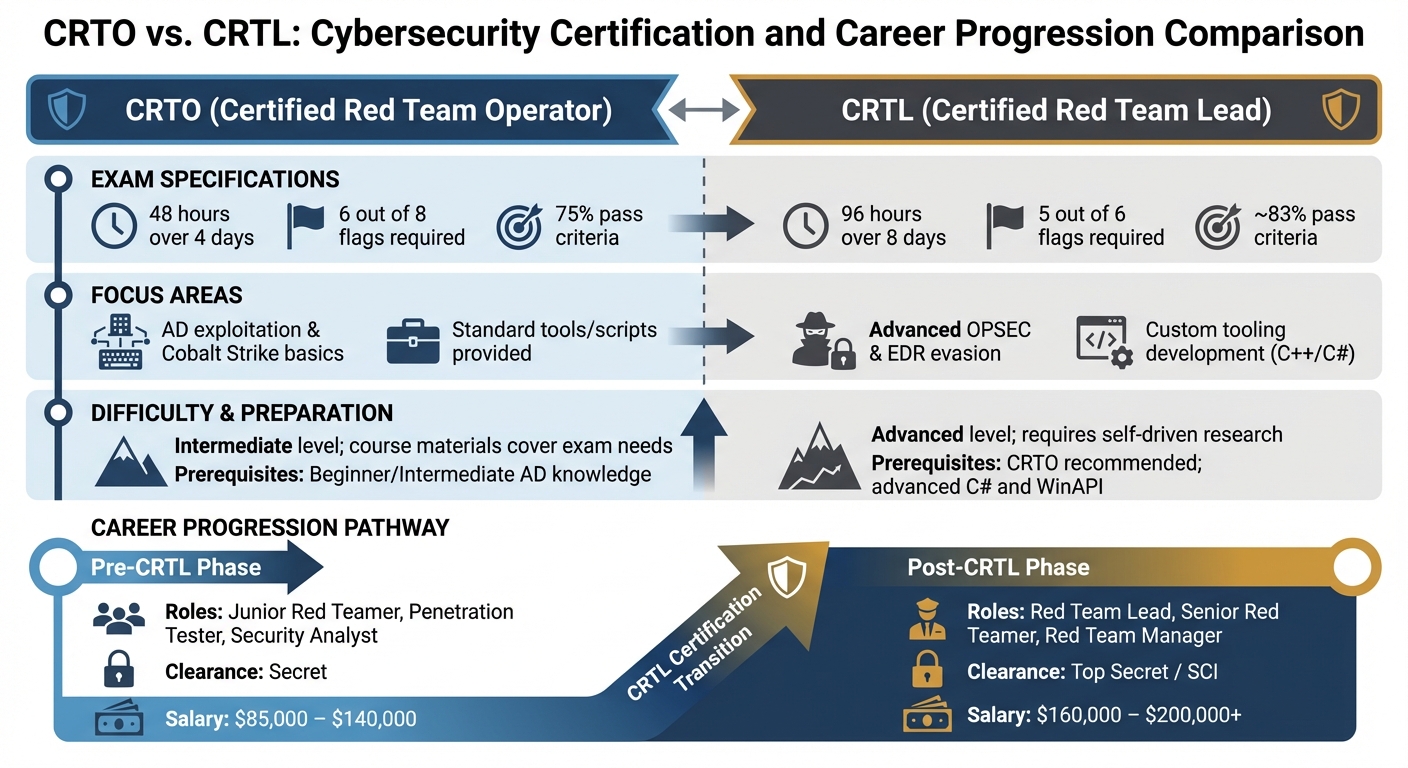
CRTO vs CRTL Certification Comparison: Exam Format, Requirements, and Career Progression
Key Skills to Master
The CRTL exam pushes you to excel in defense evasion within a hardened enterprise environment. You’ll need to bypass tools like Elastic EDR and Windows Defender, where typical techniques won’t cut it.
A solid grasp of offensive tooling is non-negotiable. You’ll need to work with C++ and C# in Visual Studio to create custom tools and interact with Windows APIs using P/Invoke and D/Invoke. This isn’t about running pre-built scripts – it’s about compiling, debugging, and tailoring offensive tools. Mastering process injection methods, such as injecting into remote processes, leveraging undocumented ntdll.dll functions, and using Asynchronous Procedure Call (APC) dispatching, is essential.
You’ll also need to outsmart Windows security measures. This includes bypassing Attack Surface Reduction (ASR) rules, Windows Defender Application Control (WDAC), and Protected Processes (PPL). In-memory evasion techniques like thread stack spoofing and sleep masks will help you maintain access without detection.
Finally, building resilient C2 (Command and Control) infrastructure is critical. This involves configuring Apache redirect rules, managing SSL certificates, and implementing failover strategies for beacons – all while maintaining operational security in a closely monitored setting.
To refine these skills, focus on targeted training and hands-on labs.
Recommended Resources and Labs
The Red Team Ops II (RTO-2) course by Zero-Point Security is your go-to resource. It costs around £399.00 (approximately $490) and includes both the course and exam voucher. For an additional £425.00 (about $523), you can access 40 hours of lab time in the Cyber Ranges (formerly Snaplabs) environment. The course dives into seven core areas: C2 Infrastructure, Windows APIs, Process Injection, Defense Evasion, ASR, WDAC, and EDR Evasion.
That said, RTO-2 alone won’t guarantee success. As Ben S. from infosecnoodle explains:
"I think relying solely on the content from RTO2 simply isn’t enough to achieve a passing score – it requires some extra effort."
To fill in the gaps, Maldev Academy is an excellent option for learning malware development and advanced process injection techniques. For free resources, check out Raphael Mudge’s YouTube playlists on Red Team Operations with Cobalt Strike and In-memory Evasion. These videos offer valuable insights into Cobalt Strike’s advanced features.
Additional labs, like the Certified Evasion Techniques Professional (CETP) and Advanced Red Team Lab (CRTE) from Altered Security, focus on bypassing modern defenses. These labs typically cost between $299 and $499 and provide 30–35 days of access. Joining the Zero-Point Security Discord community can also be helpful, as it connects you with other red teamers and keeps you updated on evasion techniques.
For practice outside paid labs, set up a local Windows VM with Visual Studio. Use this environment to experiment with custom loaders, C2 malleable profiles, and artifact kits. This approach lets you refine your skills without burning through your lab hours. Most candidates dedicate three weeks to three months to prepare.
Understanding how the CRTL exam differs from CRTO can further shape your preparation strategy.
CRTL vs CRTO: Key Differences
| Feature | CRTO (Certified Red Team Operator) | CRTL (Certified Red Team Lead) |
|---|---|---|
| Duration | 48 hours over 4 days | 96 hours over 8 days |
| Flags Required | 6 out of 8 flags | 5 out of 6 flags |
| Pass Criteria | 75% of flags | ~83% of flags |
| Primary Focus | AD exploitation & Cobalt Strike basics | Advanced OPSEC & EDR evasion |
| Tooling | Standard tools/scripts provided | Custom tooling development (C++/C#) |
| Difficulty | Intermediate; materials cover exam needs | Advanced; requires self-driven research |
| Prerequisites | Beginner/Intermediate AD knowledge | CRTO recommended; advanced C# and WinAPI |
The CRTL exam’s extended 8-day window is a major advantage. It allows you to take breaks and revisit problems with fresh eyes. As one reviewer from six-two.dev noted:
"The exam was very fun and I learned about one new tool. Personally I liked it much more than the CRTO exam, since it required some thinking and not just copying commands."
The leap from CRTO to CRTL is all about moving from basic Active Directory exploitation to advanced evasion techniques. CRTL assumes you’ve already mastered the foundational skills and are ready to tackle highly secured enterprise environments.
Career Benefits of the CRTL Certification
Advancement to Leadership Roles
The CRTL certification opens doors to advanced positions like Red Team Lead and Senior Red Team Researcher, particularly in secure, cleared environments. While certifications like the CRTO focus on foundational Active Directory attack techniques, the CRTL demonstrates your ability to lead complex engagements in highly secure and hardened settings.
Jack Barradell-Johns from Pen Test Partners shared that the certification evaluates skills that "are accurate to those used in real-world Red Team engagements and should be approachable for those who conduct this kind of testing without the need for weeks of revision" [13]. This alignment with practical, real-world challenges makes CRTL-certified professionals strong candidates for leadership roles. These roles often involve guiding teams through intricate adversary emulation exercises across industries such as government, defense, and finance.
Beyond leadership opportunities, these skills can significantly boost your professional value and marketability.
Salary and Job Market Advantages
Working in cleared environments requires advanced expertise, and the compensation reflects that. Lead red teamers and managers can earn between $160,000 and $200,000 or more, while entry-level positions typically offer $85,000 to $110,000 [12]. Additionally, holding a Top Secret or Secret clearance alongside your CRTL certification can increase your salary by 15–30% [12].
The demand for skilled offensive security experts continues to rise due to a growing talent shortage. Remote red teaming has further expanded opportunities, enabling professionals to secure high-paying roles in cities like Washington, D.C., Austin, and Seattle – regardless of their physical location. Companies are also investing in hybrid roles that integrate offensive and defensive expertise, such as in purple teaming initiatives.
Earning the CRTL certification enhances your visibility on cleared job platforms. Recognized as an "Expert" credential in the red teaming field, it sets you apart from those with intermediate qualifications, making you a standout candidate for specialized roles.
Pre-CRTL vs Post-CRTL Career Paths
The CRTL certification marks a clear turning point in career progression, as reflected in both roles and salaries.
| Career Phase | Roles | Clearance Level | Salary |
|---|---|---|---|
| Pre-CRTL | Junior Red Teamer, Penetration Tester, Security Analyst | Secret | $85,000 – $140,000 |
| Post-CRTL | Red Team Lead, Senior Red Teamer, Red Team Manager | Top Secret / SCI | $160,000 – $200,000+ |
Before earning the CRTL, professionals typically focus on tasks like Active Directory enumeration, pivoting, and lateral movement using standard frameworks. However, after certification, expectations shift significantly. CRTL-certified individuals are tasked with customizing tools to bypass modern detection systems, unhooking advanced endpoint protections, and creating tailored implementations that simulate attacks on highly secure enterprise networks. This evolution highlights the transformative impact of the CRTL certification for those aiming to move beyond technical roles into leadership and strategic positions.
Conclusion: Is CRTL Certification Right for You?
The CRTL certification marks a key step forward for cleared professionals aiming to progress from basic penetration testing to advanced red team leadership. If you’ve already mastered tools like Cobalt Strike, techniques like Kerberos, and lateral movement through CRTO, and you’re prepared to tackle advanced EDR evasion and custom tool development in C++/C#, this certification could align perfectly with your career ambitions. Its flag-based exam format is designed to test the persistence and technical expertise required for real-world leadership roles, making it a solid benchmark for advanced skills.
The financial investment is reasonable – about $500 for the course and exam bundle, plus $425 for lab access – and the potential career rewards are substantial. With demand for red team professionals expected to grow by 32% between 2023 and 2028, and the average U.S. data breach costing $9.44 million in 2023 [14], the need for experts capable of simulating sophisticated attacks is only increasing. In the cleared sector, where there are approximately five open cybersecurity positions for every qualified candidate [14], the CRTL certification stands out as a trusted signal of your technical readiness for high-stakes environments.
"In the cleared space, IT certifications are a must to meet the requirements for specific contracts… experience alone doesn’t cut it." – Greg Stuart, Owner and Editor, vDestination.com [15]
Before diving in, take a hard look at your current skill set. The certification demands independent research and hands-on experience beyond the course material. If you’re not yet confident in areas like malware development or offensive tooling, consider additional training to fill those gaps. But if you’re ready for the challenge and already working in – or aspiring to – a cleared red team role, the CRTL certification can set you apart from mid-level professionals and open doors to leadership positions with salaries ranging from $180,000 to over $250,000 annually [14].
This certification goes beyond just passing an exam. It’s about proving your ability to lead operations in environments where adversary emulation plays a critical role in national security and organizational defense. If that mission matches your career goals, the CRTL certification is a strong choice.
FAQs
Do I need an active Secret or Top Secret clearance before enrolling?
Yes, having an active Secret or Top Secret clearance is usually a prerequisite for enrolling in the Certified Red Team Lead (CRTL) certification. This program is tailored specifically for professionals who hold security clearances.
How much C# and C++ do I need to pass the CRTL exam?
To tackle the CRTL exam confidently, it’s important to have at least a basic grasp of C# and C++. These programming languages play a central role in the exam, so understanding their core concepts can make a big difference in how you approach and solve problems during the test.
What should I practice if I’m weak on EDR evasion and OPSEC?
To sharpen your skills in evading Endpoint Detection and Response (EDR) systems and improving operational security (OPSEC), concentrate on techniques that help you bypass modern security measures while keeping a low profile. Key methods to explore include disabling telemetry, process injection, API unhooking, and techniques for avoiding detection by Windows Defender.
Practical, hands-on experience is crucial. Resources like the Red Team Vade Mecum and the Adversary Emulation Guide can provide valuable guidance for simulating real-world scenarios and refining your strategies for maintaining stealth and effectiveness.