

The GIAC Penetration Tester (GPEN) certification is a sought-after credential for cybersecurity professionals, especially those in cleared roles. It validates expertise in penetration testing, covering areas like Active Directory attacks, cloud security, and legal considerations. GPEN is recognized by the U.S. Department of Defense (DoD) under the 8570 framework for CND Analyst roles, making it a strong qualification for government and defense careers.
Key highlights:
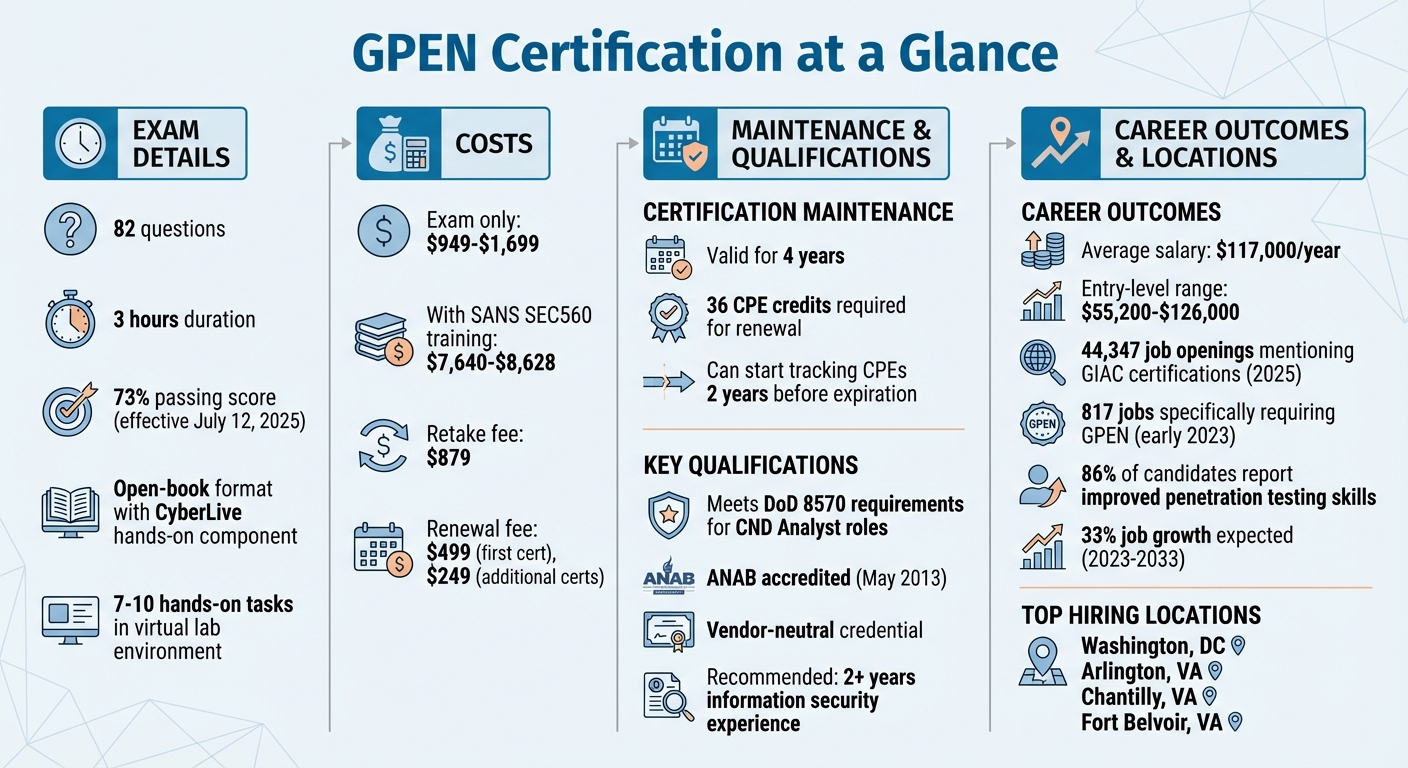
- Average Salary: $117,000/year in the U.S.
- Exam: 82 questions, 3 hours, passing score 73%.
- Cost: $949–$1,699 (with training); $879 for retakes.
- Renewal: Every 4 years with 36 CPE credits or exam retake.
- Training: SANS SEC560 is recommended.
The certification emphasizes hands-on skills through a "CyberLive" lab component, ensuring practical expertise. It’s ideal for roles like penetration tester, red team operator, or security consultant in government and defense sectors. If you’re aiming to advance in cleared cybersecurity, GPEN can help you stand out.
GPEN Certification Quick Facts: Costs, Exam Details, and Career Outcomes
What is GPEN Certification?
GPEN Certification Overview
The GIAC Penetration Tester (GPEN) certification is a vendor-neutral credential designed to validate a professional’s ability to conduct penetration tests using established methodologies. Unlike certifications that focus exclusively on exploitation techniques, GPEN ensures candidates understand both the technical and non-technical aspects of penetration testing, such as project planning, scoping, and legal considerations.
The certification covers essential areas like test planning, reconnaissance (gathering target information and identifying potential data leaks), scanning (including port, operating system, and service version detection), exploitation (executing attacks, data exfiltration, and pivoting), and advanced attack techniques. These advanced skills include targeting Active Directory, Azure/Entra ID, and modern authentication protocols. Proficiency with tools such as the Metasploit Framework, PowerShell, and Windows Command Line is also tested, which is particularly critical for roles in government and defense. The exam places a strong emphasis on modern infrastructure challenges, including Active Directory attacks (like Kerberos exploitation and domain escalation), Azure application security, and cloud authentication protocols such as single sign-on. This makes it highly relevant for hybrid IT environments commonly used by federal agencies and Department of Defense (DoD) contractors [5][3].
Now, let’s break down the exam details that assess these skills.
Exam Format and Requirements
The GPEN exam consists of 82 questions, and candidates have 3 hours to complete it. A passing score of 73% is required, effective July 12, 2025 [5]. Exam fees range from $949 to $1,699, depending on whether it is bundled with SANS SEC560 training. Retakes cost approximately $879 [3].
This open-book, proctored exam includes a CyberLive hands-on component conducted in a virtual lab environment, ensuring candidates can apply their knowledge in practical scenarios. While GIAC does not mandate specific prerequisites, it recommends candidates have at least two years of experience in information security, as GPEN is considered an advanced-level certification [3].
Why GPEN Matters for Cleared Professionals
GPEN’s comprehensive framework makes it particularly valuable for cleared professionals. It meets DoD 8570 requirements for the CND Analyst category [3], making it a preferred qualification for roles with Department of Defense contractors, military installations, and federal agencies. As of early 2023, there were approximately 817 job openings in the U.S. requiring GPEN certification [2].
The certification’s focus on methodological precision and compliance aligns with the high standards of cleared environments. It equips testers to systematically identify, plan, and document vulnerabilities. Additionally, GPEN’s ANAB (ANSI National Accreditation Board) accreditation, earned in May 2013 [3], and its practical CyberLive component provide hiring managers in defense and intelligence sectors with confidence that certified professionals can handle real-world penetration testing tasks on sensitive systems.
How to Obtain the GPEN Certification
Step 1: Evaluate Your Skills and Choose Training
Before diving into the GPEN certification process, take a moment to evaluate your current skill set. Are you comfortable with TCP/IP networking basics? Can you confidently navigate both Windows and Linux command-line environments? These are critical skills you’ll need before moving forward [3][7].
For those looking for structured preparation, the SANS SEC560: Enterprise Penetration Testing course is the go-to resource. This course is specifically designed to prepare you for the GPEN exam and costs between $7,640 and $8,628 when bundled with the exam attempt [3][7][8]. If you’re employed in a cleared role, your organization might cover these costs through tuition assistance or professional development budgets. If you’re self-funding, you can purchase the exam separately for $999 to $1,699 and explore alternative study methods, though the structured SANS training often leads to better outcomes [3][6][7].
To improve your chances of success, brush up on skills like basic scripting in Python, PowerShell, or Ruby. Familiarity with web application security concepts and tools such as SQL and Wireshark will also prove invaluable [3]. If you’re not confident in these areas, consider gaining hands-on experience in a lab environment before committing to the exam.
Once you’re confident in your skills and have selected your training resources, you can move on to registration and focused preparation.
Step 2: Register and Prepare for the Exam
After solidifying your foundation, the next step is to register for the GPEN exam through the GIAC website. This registration activates a 120-day exam window, giving you a clear timeline for preparation [1][5].
Your exam fee includes two practice tests, which are excellent tools for identifying strengths and weaknesses. Take the first test early in your study period to pinpoint areas needing improvement. Use the second test closer to your exam date to gauge your readiness [1][3]. Since GIAC exams are open-book, creating a well-organized index of your study materials is crucial. Building your own index – not borrowing someone else’s – will help you internalize the material and locate key concepts, commands, and methodologies quickly during the exam [3][8].
Focus your preparation on high-priority topics like Active Directory attacks (including Kerberos and domain escalation), Azure AD integration, password hash exploitation, and the Metasploit Framework [3][6]. The exam also includes 7 to 10 hands-on tasks in a virtual machine environment. To prepare for these, practice extensively with tools like Nmap, Burp Suite, and PowerShell in lab settings [1][3].
By systematically addressing these objectives, you’ll be well-prepared for the exam.
Step 3: Take and Pass the Exam
When you’re ready to take the exam, you can choose between remote proctoring through ProctorU or onsite testing [4][5]. If you opt for remote proctoring, ensure your computer meets the necessary technical requirements well in advance.
During the exam, rely on your indexed materials to quickly locate essential commands and methodologies. Carefully analyze each scenario, identify the objectives, and execute tasks in the lab environment.
If you don’t pass on your first attempt, don’t worry – a retake costs approximately $879 [3]. Use the feedback from your practice tests and refine your focus on high-priority objectives and lab scenarios to improve your performance on the next attempt.
Maintaining Your GPEN Certification
Renewal Requirements
Your GPEN certification is valid for four years, after which it needs to be renewed. To keep it active, you’ll need to accumulate 36 Continuing Professional Education (CPE) credits during the four-year period [9][10]. You can begin tracking these credits as early as two years before your certification expires [10][12].
Renewal can be completed in one of two ways: by submitting the required 36 CPE credits or by retaking the latest version of the GPEN exam [10][12]. The renewal fee is $499 for your first certification. If you’re renewing additional GIAC certifications within the same two-year period, the cost drops to $249 for each [10][12]. Once renewed, your certification will be extended by another four years from its original expiration date. To avoid delays, submit your CPE documentation at least 30 days before your certification expires [12].
Earning CPE credits isn’t complicated. For instance, completing a single SANS training course often provides the full 36 credits needed for renewal [10]. Other options include:
- Community activities: Attend SANS webcasts or listen to cybersecurity podcasts to earn up to 12 CPEs [10][11].
- Professional experience: Claim up to 12 CPEs for relevant technical work by submitting your resume [10][11].
- Conferences: Events like BlackHat, RSA, and ShmooCon can earn you up to 18 CPEs [11].
When logging your CPEs in the GIAC dashboard, you’ll need to explain how each activity supports your renewal. Be aware that all submissions are subject to audit, and providing false information could lead to the revocation of your certifications [12].
Continuing Skill Development
To maintain your edge as a certified GPEN professional, regular hands-on practice is key – especially if your role involves security clearance. Focus on core skills such as intermediate-level Metasploit configuration, advanced password attacks, and exploiting vulnerabilities in Azure environments [1]. Activities like SANS NetWars are great for honing your techniques while also earning extra CPE credits [1][11].
When you renew, you’ll gain access to updated digital courseware, including digital books, audio files, and lab materials [10][12]. If you prefer physical books, you can order hardcopy courseware for $199 plus shipping (as of June 18, 2025) [10][12]. Start tracking your CPE credits as soon as you’re certified to avoid last-minute stress and ensure you stay ahead in your field.
sbb-itb-bf7aa6b
Using GPEN Certification in Cleared Cybersecurity Careers
Career Opportunities for GPEN-Certified Professionals
Earning your GPEN certification can lead to exciting opportunities in classified cybersecurity roles where technical expertise and methodical approaches are crucial. This certification is particularly aligned with government and defense sectors, making it a strong asset for professionals in these fields.
Some of the key roles for GPEN-certified individuals include Penetration Tester, Red Team Operator, Ethical Hacker, Cybersecurity Test Engineer, Security Consultant, and Incident Responder. In these positions, you’ll be responsible for tasks like conducting penetration tests, simulating adversary tactics for Department of Defense (DoD) clients, and ensuring compliance with NIST 800-53 controls. Additional responsibilities may include cracking password hashes, performing Kerberos attacks on Active Directory, and identifying vulnerabilities in cloud platforms such as Azure.
Salaries for these roles average around $117,000 per year [3]. Entry-level cybersecurity test engineers with clearances can expect salaries ranging from $55,200 to $126,000 [13]. Demand for cleared professionals is especially high in areas such as Washington, DC, Arlington, VA, Chantilly, VA, and Fort Belvoir, VA [3]. Importantly, the GPEN certification meets DoD 8570 requirements for CND Analyst roles [3]. As of 2025, approximately 44,347 job openings mention GIAC certifications, highlighting the demand for credentialed professionals [14]. With its ANAB accreditation and vendor-neutral framework, the GPEN certification is adaptable across various government agencies [3]. These roles not only come with competitive pay but also provide a clear path for advancing your career in cybersecurity.
Finding Jobs with Cleared Cyber Security Jobs

Now that you know the career potential of the GPEN certification, the next step is finding the right opportunities. Cleared Cyber Security Jobs is a specialized platform designed for professionals like you – those with GPEN certification and active security clearances.
This platform connects you directly with employers looking for candidates with your expertise, cutting out staffing firms and making the hiring process more direct. By uploading your resume, you can gain instant visibility with hiring managers seeking GPEN-certified professionals.
The site’s advanced search filters allow you to narrow down positions based on specific criteria, such as GPEN certification requirements, clearance levels (e.g., Secret or Top Secret/SCI), and geographic focus on cleared hubs. You can even set up job alerts to stay informed about new openings that match your qualifications.
In addition to job listings, Cleared Cyber Security Jobs offers career resources and hosts job fairs tailored to security-cleared professionals. Since the platform requires U.S. citizenship and an active clearance, you’ll only see opportunities where your GPEN certification and clearance status are in demand. This focused approach helps you streamline your job search and connect with roles that truly value your skills.
All About GPEN | GIAC Certified Penetration Tester | Course, Study, Exam Experience
Conclusion
The GPEN certification stands out as a valuable credential for penetration testers aiming to excel in defense and government cybersecurity roles. With penetration testing careers expected to grow by 33% between 2023 and 2033, and the market expanding by 24% by 2026 [15], there’s no better time to pursue this certification. It not only validates critical hands-on skills through the CyberLive testing component but also meets DoD 8570 requirements for CND Analyst roles [3]. Additionally, it showcases your expertise in modern attack methods targeting Active Directory and Azure environments, offering a solid foundation for immediate career advancement and long-term growth.
Achieving the GPEN requires dedication. Start by evaluating your current skill set, choosing the right training – such as SANS SEC560 – and staying current with ongoing professional development to maintain your credential. This effort ensures you remain competitive for cleared contracts and other high-demand opportunities.
The rewards are tangible. GPEN-certified professionals earn an average annual salary of around $118,000, and 86% of candidates report significant improvements in their penetration testing skills after certification [15]. This qualification opens doors to roles like penetration tester, red team operator, and security consultant in sought-after locations such as Washington, DC; Arlington, VA; and Fort Belvoir, VA [3].
To maximize the benefits of your certification, finding the right job is key. Cleared Cyber Security Jobs connects GPEN-certified professionals with employers actively seeking security-cleared talent. The platform focuses exclusively on roles where both your clearance and certification are highly valued. By setting up job alerts and uploading your resume, you gain immediate visibility with hiring managers in the cleared community.
Take the next step in your cybersecurity career by earning your GPEN certification and leveraging Cleared Cyber Security Jobs to secure roles that recognize and reward your specialized skills in the cleared sector.
FAQs
What key skills are assessed in the GPEN certification exam?
The GPEN certification exam focuses on the core skills needed for successful penetration testing. These include planning and scoping tests, gathering intelligence through reconnaissance, conducting in-depth scans, exploiting discovered vulnerabilities, and using post-exploitation techniques like pivoting to extend access.
The exam also delves into areas such as password attacks, web application testing, and mastering essential tools and techniques commonly applied in penetration testing. This comprehensive approach ensures candidates are prepared for the challenges they may face in cybersecurity roles, particularly in high-security environments.
What are the career benefits of earning a GPEN certification for cleared cybersecurity professionals?
Earning the GPEN certification is a powerful way for cleared cybersecurity professionals to validate their expertise in penetration testing and offensive security. This credential highlights skills in key areas such as reconnaissance, vulnerability assessment, and exploit execution – essential capabilities for operating in high-security environments.
For those holding security clearances, the GPEN does more than just confirm technical knowledge. It strengthens professional credibility and creates opportunities for advanced roles in penetration testing and cybersecurity defense. By mastering recognized, industry-standard methodologies, certified professionals gain a competitive edge in the cleared cybersecurity field.
How can I effectively prepare for the GPEN certification exam?
Preparing for the GPEN certification exam requires a clear strategy that combines understanding the exam’s structure, studying relevant materials, and honing practical skills. Begin by carefully reviewing the exam syllabus to get a solid grasp of the key topics, such as penetration test planning, reconnaissance, exploitation techniques, and web application attacks. This will help you focus your efforts on areas that matter most.
Consider enrolling in an official training course like SEC560, which offers structured guidance tailored to the exam objectives. Pair this with additional resources like books and practice exams to familiarize yourself with the types of questions you’ll encounter and their level of difficulty.
Hands-on experience is just as important. Spend time practicing in virtual labs or simulated environments to sharpen your technical skills and gain confidence in applying what you’ve learned. Mock tests can also play a crucial role in assessing your readiness. They help pinpoint weak areas and ensure you’re comfortable managing the time constraints of the actual exam.
By combining consistent study, practical exercises, and self-assessment, you’ll build the knowledge and confidence needed to tackle the GPEN certification successfully.