

Want to boost your career in cybersecurity? The Cisco CCNA Security certification is a powerful tool for cleared professionals aiming to secure high-demand roles in defense and federal sectors. With over 540,000 unfilled cybersecurity positions in North America and a global shortage of 4.7 million professionals, this certification can set you apart. Here’s what you need to know:
- Why It Matters: Proves your ability to secure networks and manage vulnerabilities. Recognized by the Department of Defense and aligns with the latest technologies, including AI and machine learning.
- Earnings Potential: CCNA-certified professionals earn 20–30% more, with salaries ranging from $60,000 to $120,000.
- Accessibility: No prerequisites required. Military personnel can use programs like "COOL Bucks" or GI Bill reimbursement to cover the $300 exam fee.
- Career Growth: Opens doors to roles like ISSO and Cyber Threat Intelligence Analyst, with paths to advanced certifications like CCNP Security.
Whether you’re transitioning into cybersecurity or aiming for leadership roles, this certification is a smart step forward.
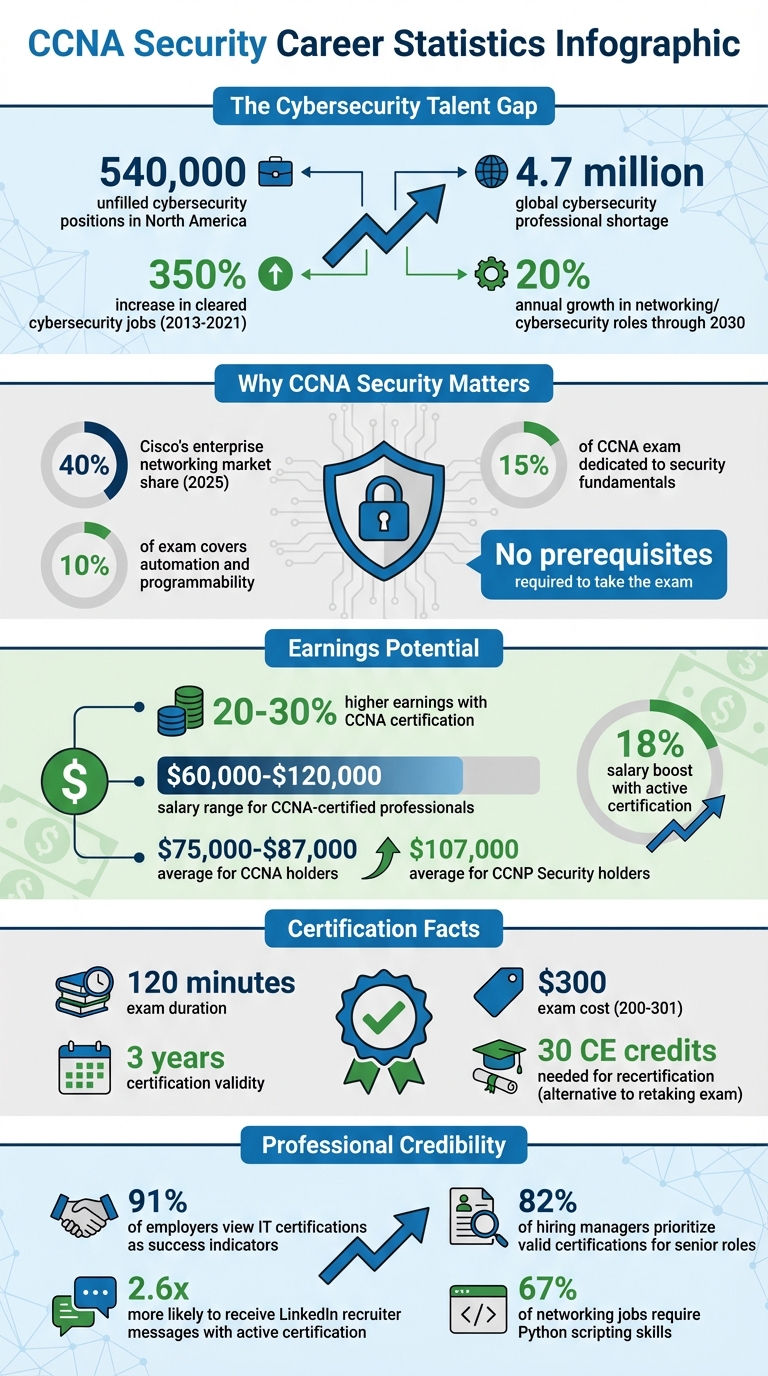
CCNA Security Certification Career Benefits and Statistics for Cleared Professionals
Cisco Security Workbook and Lab Guide – Free [CCNA Security]
What Is the Cisco CCNA Security Certification?
The Cisco CCNA Security certification showcases your ability to secure network infrastructures and handle cybersecurity threats effectively. In 2020, Cisco merged its associate-level tracks into the CCNA (200-301), integrating key security principles with essential networking topics [4]. Although the standalone CCNA Security track is no longer available, security concepts remain crucial for professionals tasked with protecting government networks. This certification demonstrates skills like configuring firewalls, implementing VPNs, and managing secure access controls – key capabilities for safeguarding classified systems [3]. These foundational skills pave the way for diving into the exam’s specifics and requirements.
Certification Scope and Core Topics
The current CCNA dedicates 15% of its curriculum to security fundamentals, covering areas like VPN technologies, Access Control Lists (ACLs), wireless security, and secure access management [4]. For professionals aiming for specialized security roles, these topics are a stepping stone toward advanced certifications such as CCNP Security or CyberOps [4] [9]. Key technical competencies include configuring Cisco ASA firewalls, setting up site-to-site and remote access VPNs, and managing Authentication, Authorization, and Accounting (AAA) systems. These skills align with Department of Defense (DOD) requirements for protecting government infrastructure, focusing on threat mitigation and secure access [3].
The CCNA also addresses automation and programmability (10% of the exam), reflecting the growing importance of software-defined networking in secure environments [4]. This includes using tools like APIs, Python, and Ansible to automate security configurations – skills highly sought after in cleared cybersecurity roles [6] [9]. With Cisco commanding nearly 40% of the enterprise networking market share as of 2025, these vendor-specific skills remain indispensable for federal agencies and defense contractors [4].
Prerequisites and Requirements
The CCNA (200-301) has no formal prerequisites, making it accessible to those transitioning into network security roles [4]. Previously, candidates for the CCNA Security track needed certifications like CCENT, CCNA Routing and Switching, or CCIE [3] [8]. To earn the certification, you must pass the 200-301 exam and agree to Cisco’s Career Certifications Confidentiality Agreement and Candidate Conduct Policy [3]. Cleared professionals should also confirm that their certification satisfies the DOD 8140/8570 framework for their specific job roles [3].
Service members can take the exam at Pearson VUE centers on military bases and use "COOL Bucks" (Credentialing Opportunities On-Line) to cover exam fees [3]. Allocate around 10–12 hours per week for 3–4 months to prepare, and use tools like Cisco Packet Tracer, GNS3, or EVE-NG to practice real-world network configurations [4]. Kevin Brown, a Cybersecurity Analyst, highlights the importance of certifications:
"Certifications give you instant credibility. People always want to know who they’re talking to. They want to know if you’re qualified." [7]
Exam Cost and Format
The CCNA (200-301) exam costs approximately $300, and military personnel can often use programs like "COOL Bucks" to cover the fee [3] [4]. The exam lasts 120 minutes and features multiple-choice questions, drag-and-drop exercises, and hands-on lab simulations designed to test your ability to configure secure networks in practical scenarios [4]. Security-related topics make up 15% of the exam [4].
The certification is valid for three years, after which you can recertify by passing a new associate-level exam, a professional-level exam like CCNP Security (350-701 SCOR, $400), or by earning Continuing Education (CE) credits [3] [7] [9]. Keeping your certification up to date ensures you stay ahead of technological advancements and remain competitive for advanced cybersecurity roles. Cleared professionals should consult their Education Service Officer to confirm eligibility for voucher reimbursements or promotion points [3].
Cleared Jobs That Require CCNA Security
Common Cleared Job Roles
CCNA Security credentials play a key role in meeting the growing demands of today’s cleared cybersecurity positions. Professionals holding these certifications are essential for maintaining cybersecurity standards in government and defense sectors. For instance, a March 2026 posting for a Network Engineer in Orlando, FL, required candidates to have an active security clearance, a CCNA certification, and expertise in applying STIGs while supporting RMF/DIACAP processes [11].
Cleared positions are increasingly looking for candidates who can combine networking expertise with cybersecurity skills. Employers often prioritize familiarity with tools such as the Assured Compliance Assessment Solution (ACAS), Nessus, and the Host Based Security System (HBSS). Many of these roles also require knowledge of RMF processes, NIST regulations, and NIST SP 800-53 standards. Gaining experience in these areas can open doors to a variety of opportunities and help professionals advance their cleared careers.
Industries Hiring CCNA-Certified Cleared Professionals
Several industries actively seek professionals with CCNA Security credentials and security clearances. These include the U.S. Department of Defense, Intelligence Community, federal agencies, and defense contractors. The skills outlined earlier directly align with the needs of these sectors. For example, organizations like the Air Force, Navy, and the Defense Information Systems Agency (DISA) regularly hire for roles in network administration and security. These positions often require Secret or Top Secret clearances and focus on safeguarding the network infrastructures that support critical military operations.
In the Intelligence Community, cleared roles – often requiring TS/SCI clearance with a polygraph – demand network security expertise to protect highly sensitive information. Federal civilian agencies, such as the Department of Commerce, and defense contractors working on government programs also seek cleared network engineers. Highlighting your experience with compliance standards when applying for these roles can significantly strengthen your application.
How to Use CCNA Security in Your Cleared Job Search
Adding CCNA Security to Your Resume and Profile
Your CCNA Security certification can be a powerful asset in landing a cleared job. To make the most of it, ensure it’s prominently displayed in your resume header. Pair it with your clearance level for maximum impact – for instance, "John Doe, CCNA Security, Active Secret Clearance." This way, recruiters can immediately spot your qualifications.
"Your security-cleared resume is not a biography or a mere list of qualifications. It’s an ad designed to help you land that coveted cleared job interview." – Ashley Jones, Editor, ClearedJobs.Net [12]
At the top of your resume, include a professional summary that highlights both your certification and experience. For example: "Network Security Specialist with CCNA Security and 5+ years of experience securing DoD communications infrastructure." This summary sets the tone for your expertise. When detailing your work history, use the STAR method to quantify your accomplishments. For example: "Reduced network vulnerabilities by 35% through proactive Cisco ASA firewall monitoring" [12][13].
If you’re still working toward your CCNA Security certification, list it as "CCNA Security (In-Progress)" along with your expected completion date. According to CyberSecJobs.com, including certifications in progress can make a big difference, especially if they’re a hard requirement for the role [13]. Tailor your resume for each job by incorporating specific technical terms from the posting, such as "Cisco ASA", "VPN", "network security", or "NIST-compliant." This not only aligns your skills with the job but also helps you get through Applicant Tracking Systems (ATS) [13][14].
Once your resume is polished, the next step is to refine your job search strategy.
Finding CCNA Security Jobs on Cleared Cyber Security Jobs
When searching for jobs, use phrase searches on Cleared Cyber Security Jobs. For precise results, place "CCNA Security" in quotation marks. To broaden your search, try Boolean operators like "CCNA Security" OR "Network Security Engineer." You can then narrow the results using "AND" to filter by clearance level or location. This focused approach can help you navigate the competitive hiring landscape for cleared professionals [15].
After crafting an effective search query – such as "CCNA Security" AND "Secret" – save it as a Job Agent. This feature will send you email alerts whenever a matching position is posted. For location-based searches, use a Zip Code with a mileage radius instead of city names. This ensures you capture jobs at nearby military installations that might be listed under different suburbs [15]. Additionally, logging in weekly keeps your profile active and visible to recruiters, as employers often prioritize candidates with recent activity [15].
sbb-itb-bf7aa6b
Career Growth with CCNA Security in Cleared Cybersecurity
Moving to Advanced Cisco Certifications
Earning your CCNA Security is just the beginning – it sets you up for a clear path to advanced Cisco certifications. The next step? The CCNP Security, which costs $700 in total. This includes $400 for the core 350-701 SCOR exam and $300 for one concentration exam [18]. With this professional-level certification, you can specialize in high-demand areas like Cisco Firepower (SNCF), Identity Services Engine (SISE), or VPN technologies (SVPN) [6]. These specializations align perfectly with the requirements of many cleared contracts, making you a strong candidate for senior engineering roles.
On average, CCNP Security holders earn $107,000 annually, up from the $75,000–$87,000 range typical for CCNA-certified professionals [18]. This certification also shifts your role toward solving more strategic and complex problems. For those with even greater ambitions, the CCIE Security represents the pinnacle of technical certifications in the industry. Achieving it involves passing a $400 written exam and an intense eight-hour hands-on lab exam, which costs between $1,600 and $1,900 [18].
"Certifications give you instant credibility." – Kevin Brown, Cybersecurity Analyst [18]
Before advancing to professional or expert certifications, it’s crucial to have strong networking fundamentals [18]. Passing a CCNP exam not only renews your CCNA certification but also moves you closer to expert-level credentials [17]. Beyond the technical benefits, these certifications can also pave the way to leadership opportunities.
Advancing to Leadership Positions
As you climb the career ladder, your CCNA Security remains a key building block for success in cleared cybersecurity. While it validates your technical expertise, it also opens doors to leadership roles by demonstrating your ability to enforce security policies and oversee monitoring efforts [6]. Becoming the "go-to person" for security-related challenges in your organization enhances your visibility, which can lead to management opportunities [18]. Notably, 91% of employers consider IT certifications a reliable indicator of employee success [18].
With a CCNA Security as your foundation, you could advance into roles like Cybersecurity Architect (earning $96,383–$124,947), Information Security Manager ($139,577–$167,911), or even Chief Information Security Officer ($219,741–$276,993) [16]. To reach these high-level positions, you might want to pair your CCNA with management-focused certifications like CISM or CISSP, which costs about $749 [16]. This combination of technical expertise and strategic skills positions you to lead Security Operations Center (SOC) teams and shape enterprise-wide security strategies [16].
The cleared cybersecurity sector has seen explosive growth, with a 350% increase in jobs between 2013 and 2021 [18]. Despite this growth, 53% of organizations report a 10% gap in staffing, highlighting the demand for certified professionals. Your CCNA Security could be the springboard that transforms you from a technical expert into a strategic leader [18].
Keeping Your CCNA Security Certification Current
Recertification Requirements and Timeline
Your CCNA certification stays valid for three years, with no extensions allowed [19][20]. To renew it, you have a few options: retake the CCNA (200-301) exam for $300, pass a professional concentration exam ($300), complete a technology core exam like CCNP Security Core 350-701 ($400), or earn 30 Continuing Education (CE) credits within the three-year period [10][20]. Attending Cisco Live events can earn you 10–15 credits per event while also exposing you to trending technologies like automation and SD-WAN [19]. Combining exam prep with continuing education can even speed up career promotions by 40% [19].
To stay on top of your recertification, set quarterly reminders to check the Cisco Certification Tracking System for updates and credit opportunities [19]. While Cisco does send email reminders at key intervals – two years, one year, 90, 60, and 30 days before expiration – it’s smart to plan at least six months ahead to avoid a last-minute scramble [19]. Letting your certification expire means you’ll need to start over and retake the full exam process [20].
Keeping your certification active isn’t just about convenience – it’s about value. An active certification can boost your salary by 18%, while an expired one might reduce its relevance by 12%. Additionally, professionals with active certifications are 2.6 times more likely to receive recruiter messages on LinkedIn, especially during periods of technological change [19]. Staying updated with cybersecurity trends ensures your recertification efforts directly support your career growth.
Staying Updated with Cybersecurity Changes
Recertification is important, but keeping up with industry trends is equally essential to stay competitive. For instance, automation concepts now make up 20% of the current CCNA exam, and 67% of networking job postings highlight Python scripting as a key skill [19]. With automation and AI-driven networks becoming more prominent, credits related to automation topics are now 35% more in demand compared to traditional routing subjects [19].
To avoid burnout, aim to dedicate just 30 minutes a week to training modules or study groups to steadily earn your credits [19]. Cisco also offers training badges in specialized areas like zero-trust architecture, which can quickly demonstrate your expertise in emerging technologies [19]. These micro-credentials can help you stand out, especially since 82% of hiring managers prioritize candidates with valid certifications for senior-level roles [19].
"Your expertise is like a smartphone – regular updates keep it running smoothly in our fast-paced digital world." – Editorial Team, CCNA-Classes [19]
Engaging with professional communities like the Cisco Learning Network forums is another great way to stay informed about exam updates and troubleshoot complex challenges [19]. For professionals working in roles tied to DoD 8570/8140 standards, maintaining an active certification isn’t just helpful – it’s often a job requirement [21]. An active certification proves your skills are up-to-date, while letting it lapse could mean starting over from scratch [21].
Conclusion and Next Steps
Key Points to Remember
Earning this certification is a game-changer for security-cleared professionals aiming to advance in government and defense sectors. The CCNA certification confirms your expertise in securing Cisco networks, building robust security systems, and countering threats effectively [1][3]. It’s highly regarded by prominent agencies like the National Security Agency (NSA) and the Committee on National Security Systems (CNSS) [22], making it a valuable credential for federal roles in fields like Computer Engineering and Information Technology Management [3]. Given Cisco’s stronghold in the market [4], this certification opens doors to lucrative opportunities with competitive salaries.
But it doesn’t stop there. The CCNA is also a stepping stone to pursuing advanced certifications [4][5][6]. The current CCNA (200-301) exam, updated as of August 2024, now covers topics like AI, machine learning, and cloud management – skills that are increasingly critical. With networking roles tied to cybersecurity expected to grow by 20% annually through 2030 [4][2], and a global shortage of 4.7 million cybersecurity professionals [2], your certification places you in a prime position for success.
With these advantages in mind, you’re well-equipped to take the next step in your cybersecurity career.
What to Do Next
Here’s how to turn your certification into actionable career growth:
- Search for Cleared Roles: Visit Cleared Cyber Security Jobs to explore positions tailored for security-cleared professionals. Upload your resume, set up job alerts, and use filters to find roles that specifically require or prefer CCNA certification. Highlight your credential prominently in your profile to stand out.
- Schedule Your Exam: If you haven’t taken the CCNA (200-301) exam yet, book it through Pearson VUE for $300 [4]. Use practical simulation tools to prepare for the hands-on components [4][5].
- Plan for Recertification: If you’re already certified, mark your calendar six months before your certification’s three-year expiration date. Decide whether to retake the exam or pursue a more advanced certification to maintain your edge.
- Stay Current: Dedicate 30 minutes a day to learning about automation and AI-driven networking trends. This will ensure your skills remain relevant in a fast-changing industry.
FAQs
Is CCNA still worth it if CCNA Security was retired?
Yes, the CCNA certification is still highly relevant, even with the retirement of CCNA Security. The updated CCNA now includes a wider scope of networking fundamentals, which also integrates security concepts. This makes it an excellent choice for professionals aiming for roles like network engineers or cybersecurity specialists. Globally recognized, it confirms critical skills and ensures that individuals are equipped to handle modern networking and security challenges, especially within Cisco-based environments.
Which cleared roles does CCNA help me qualify for?
The CCNA certification opens doors to roles such as Network Security Specialist, Security Administrator, and Network Security Support Engineer. These positions are centered around creating secure network infrastructures, detecting potential threats, and resolving vulnerabilities effectively.
How do I make CCNA stand out on a cleared resume?
To help your CCNA certification shine on a cybersecurity resume, focus on emphasizing your technical skills, certifications, and accomplishments in a clear and organized way. Start by placing your certifications prominently near the top of your resume, ensuring they grab attention immediately. Include a brief, impactful summary of your professional experience, and customize your resume to match the specific job description by incorporating relevant keywords.
Make sure to highlight your expertise in network security, your proficiency with Cisco technologies, and how your CCNA aligns with your security clearance. This combination can effectively underscore your qualifications for roles requiring clearance and technical expertise.