

Looking to advance your career as a firewall engineer? The Palo Alto Networks Certified Network Security Engineer (PCNSE) certification is a powerful credential that validates your expertise with Palo Alto’s cutting-edge security solutions like Next-Generation Firewalls, Panorama, and Prisma Access. This certification is especially valuable for cleared professionals working in government or defense roles, where advanced network security skills are often mandatory.
Here’s what you need to know:
- Certification Update: As of July 31, 2025, the PCNSE exam has been replaced by the "Next-Generation Firewall (NGFW) Engineer" certification. The new $250 exam must be taken in person at Pearson VUE test centers.
- Salary Potential: PCNSE-certified professionals earn an average base salary of $107,000 annually, with senior roles reaching $147,395 or more.
- Exam Details: The exam includes 70–80 questions, takes 80–90 minutes, and costs $175. A passing score is about 70% (scaled to 860/1000). Certification is valid for two years.
- Preparation Tips: A 4-month study plan, hands-on lab experience, and resources like the PCNSE Study Guide, CBT Nuggets courses, and Palo Alto’s Beacon Platform are key to success.
- Career Opportunities: Certification opens doors to roles like Network Security Engineer, Senior Cyber Security Engineer, and Network Architect, with salaries ranging from $107,000 to $162,135 or more.
This guide explores the certification’s benefits, preparation strategies, and career paths, helping you excel in network security and achieve professional growth.
Tutorial: How To Prepare for the PCNSE
PCNSE Exam Structure and Content
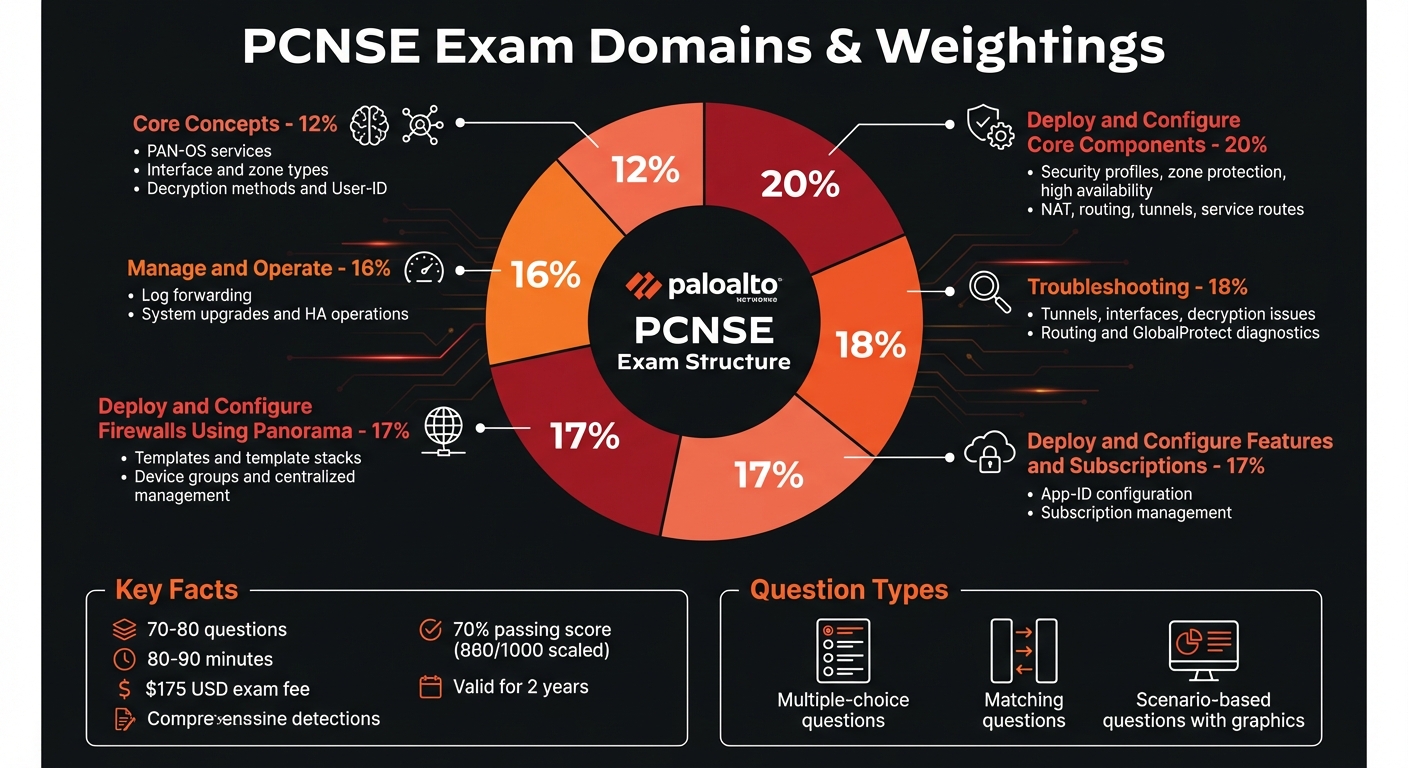
PCNSE Certification Exam Domains and Weightings Breakdown
Exam Format and Requirements
The PCNSE exam includes 70–80 questions, which you’ll need to complete within 80–90 minutes [8]. Administered by Pearson VUE, the test can be taken in-person or through online proctoring. To pass, you’ll need a score of about 70%, which translates to a scaled score of 860 on a range from 300 to 1,000. The registration fee for the exam is $175 USD [8].
Palo Alto Networks suggests that candidates have 3 to 5 years of experience in networking or network security, along with 6 to 12 months of hands-on experience using their technologies [9]. If you don’t pass on your first try, you’ll need to wait 15 days before retaking it, and 30 days for a third attempt. Once earned, the certification is valid for two years.
The exam is divided into specific domains, each focusing on critical technical skills.
Exam Domains and Weightings
The PCNSE exam is broken into six key domains, each with a specific weighting to reflect its importance:
- Deploy and Configure Core Components (20%): Covers topics like security profiles, zone protection, high availability, NAT, routing, tunnels, and service routes.
- Troubleshooting (18%): Focuses on diagnosing and resolving issues with tunnels, interfaces, decryption, routing, and GlobalProtect.
- Deploy and Configure Features and Subscriptions (17%): Tests your ability to configure App-ID and manage subscriptions.
- Deploy and Configure Firewalls Using Panorama (17%): Involves using Panorama for firewall configurations, including templates, template stacks, and device groups.
- Manage and Operate (16%): Evaluates skills like log forwarding, system upgrades, and high availability operations.
- Core Concepts (12%): Includes topics such as PAN-OS services, interface and zone types, decryption methods, User-ID enforcement, and understanding the difference between management and data plane functions [8].
Question Types and Technical Skills Tested
The exam includes various question formats, such as multiple-choice, matching, and scenario-based questions. Many of these incorporate graphics to simulate real-world scenarios [9]. The focus isn’t on memorization – you’ll need to demonstrate how to apply Palo Alto’s security architecture in practical situations.
For example, you might encounter questions that require you to:
- Differentiate between management and data plane functions.
- Implement App-ID strategies.
- Apply SSL decryption techniques.
- Manage firewall configurations using Panorama.
Additionally, the test assesses your ability to use CLI commands like "show session all" and "debug dataplane" for advanced troubleshooting. To prepare effectively, it’s a good idea to build a lab environment with virtual firewalls. This allows you to practice configurations, NAT policies, and Panorama management in a hands-on setting.
How to Prepare for the PCNSE Exam
If you’re gearing up for the PCNSE exam, having a clear strategy can make all the difference. Here’s a detailed approach to help you balance theoretical knowledge with hands-on practice.
4-Month Preparation Timeline
A four-month plan can help you systematically cover all PCNSE blueprint objectives [2]. Here’s how to break it down:
- Month 1: Start with the basics. Use the official PCNSE Study Guide and exam blueprint to build a strong foundation in Zero Trust architecture and PAN-OS fundamentals.
- Month 2: Move on to deployment and configuration. Practice setting up NAT, security policies, App-ID, User-ID, and High Availability clusters. Spend extra time mastering these configurations.
- Month 3: Focus on Panorama and advanced features. Practice centralized management using template stacks and device groups. Dive into GlobalProtect VPN and SSL decryption, as Panorama is crucial for managing larger environments.
- Month 4: Wrap up with troubleshooting and review. Use CLI diagnostics and log analysis to resolve issues in simulated scenarios. Take practice exams to refine your timing and identify weak spots [2][5].
This timeline ensures you cover all the essentials while keeping your preparation organized.
Study Resources and Training Materials
To tackle the PCNSE exam, you’ll need the right resources. Start with the official PCNSE Study Guide and Exam Blueprint to understand the exam’s scope and technical requirements [3][11]. The Palo Alto Networks Beacon Platform is another great resource, offering free training videos and materials.
For more structured learning, consider these courses:
- EDU-210: Firewall Essentials: Configuration and Management
- EDU-220: Panorama: Managing Firewalls at Scale
- EDU-330: Firewall: Troubleshooting
Additionally, CBT Nuggets provides a 15-hour video course led by Keith Barker, featuring 113 videos [2]. Engage with the LIVEcommunity forum and groups like PANgurus and the Indeni Community for insights from experienced professionals. Don’t forget to consult the PAN-OS Admin Guide and official documentation – they’re invaluable throughout your preparation [10].
These resources will help you build a strong knowledge base and prepare for hands-on practice.
Hands-On Lab Experience
Practical experience is essential for the PCNSE exam. Set up a simulated environment using VM-Series virtual firewalls on platforms like VMware Workstation, ESXi, AWS, or Azure to mimic real-world networks [3].
Focus on advanced, scenario-based configurations. For example, misconfigure GlobalProtect certificates or force HA failovers to sharpen your troubleshooting skills [3][12]. Use Panorama to push pre-rules and post-rules across multiple virtual firewalls, which will deepen your understanding of policy management and overrides. Additionally, practice binding User-ID agents to Active Directory to reinforce zero-trust principles – a key aspect of the exam [3].
This hands-on approach will not only enhance your technical skills but also boost your confidence for exam day.
sbb-itb-bf7aa6b
Career Opportunities with PCNSE Certification
Job Roles for PCNSE-Certified Engineers
Earning a PCNSE certification opens doors to specialized, higher-paying positions. For example, Network Security Engineers handle critical tasks like policy updates and software upgrades. Meanwhile, Senior Cyber Security Engineers focus on designing and deploying Palo Alto Next-Generation Firewalls tailored to meet specific business and security requirements. These roles can command salaries of around $153,865 annually [6][4].
For professionals with security clearances, the opportunities become even more targeted. Cyber Security SMEs working at Secret or Top Secret levels are responsible for high-level tasks, such as installing, configuring, and operating firewall products [14]. Similarly, IDS/IPS Security Engineers with TS/SCI clearances focus on intrusion detection and prevention within the Palo Alto ecosystem [13]. Top-tier roles like Network Architects average salaries of $162,135, and Senior Security Consultants typically earn about $147,395 [6][1].
To excel in these roles, a strong grasp of routing protocols like OSPF, EIGRP, and BGP is crucial. These skills help optimize traffic and ensure network stability, especially in government contracts [14]. As more government agencies adopt cloud-based solutions, expertise in deploying firewalls within hybrid and public cloud environments is increasingly sought after [4].
Salary Impact and Compensation
PCNSE certification doesn’t just expand job opportunities – it also has a noticeable impact on earnings. Certified professionals report an average base salary of around $107,000 annually as of January 2026, often complemented by bonuses averaging $9,912 [6][15]. In North America, this figure rises to approximately $126,573 [15]. Certification can lead to salary increases of $20,000 to $40,000 per year [7].
"The PCNSE validates the specific, high-demand skill set required for that upper tier. It signals to recruiters that you can handle complex Layer 7 security policies, not just basic routing" [7].
PCNSE-certified specialists typically earn between $135,000 and $160,000 or more, whereas generalist network engineers often make between $110,000 and $130,000 [7]. In Washington, D.C., a hub for cleared professionals, the average salary is about $132,000, with top earners reaching up to $172,000 [17]. For those who master Panorama and move into architectural roles, salaries can exceed $200,000 [7]. Additionally, 93% of PCNSE-certified professionals report feeling "extremely good" or "somewhat good" about their job security [15].
Why Cleared Employers Value PCNSE
The value of PCNSE certification extends beyond salaries, particularly for those in clearance-specific roles. It aligns with government and defense compliance requirements and often serves as a key qualification for contractor positions [7][18].
Palo Alto Networks is widely regarded as a standard among government agencies and large enterprises. Holding a PCNSE certification demonstrates your ability to implement advanced Layer 7 security policies, SSL decryption, and App-ID strategies – skills far beyond basic routing [7]. For roles involving sensitive infrastructure, the certification signifies expertise in managing complex and confidential systems [16].
Large-scale deployments are common in government work, making proficiency in Panorama a critical asset. PCNSE certification validates your ability to manage multiple firewalls efficiently using template stacks and device groups [16][3]. Combining a security clearance with PCNSE certification gives you access to roles with less competition and higher pay [17][18]. Interestingly, 33% of PCNSE holders reported changing employers within a year, primarily to secure better compensation [15].
Next Steps After PCNSE Certification
Additional Certifications to Consider
Earning the PCNSE certification is a stepping stone toward more specialized expertise. As of July 31, 2025, Palo Alto Networks transitioned from the traditional PCNSE exam to a role-based certification framework, designed to validate skills tailored to specific job roles [21][22]. You can now choose from three focused tracks: Network Security, Cloud Security, or Security Operations.
If your work involves cloud environments, the Cloud Security Professional certification (formerly PCCSE) is a great option. It demonstrates your ability to secure workloads and identities in hybrid and multi-cloud setups. The $175 exam covers topics like Cortex Cloud, runtime security, and cloud-native application protection. For those stepping into autonomous SOC roles, certifications like XSIAM Engineer or XDR Engineer are worth exploring. These focus on AI-driven security operations and automated incident response – skills in high demand as cybercrime costs are projected to hit $12 trillion globally [19].
Professionals managing Zero Trust architectures should consider certifications like Security Service Edge (SSE) Engineer or SD-WAN Engineer, which are crucial for Prisma Access deployments and network modernization. Meanwhile, if automation excites you, the Palo Alto Networks Certified Security Automation Engineer (PCSAE) covers orchestration using tools like Cortex XSOAR and is priced at $175.
| Certification Track | Certification | Focus Area | Exam Cost |
|---|---|---|---|
| Network Security | SSE Engineer | Prisma Access, SASE, Zero Trust | $175 |
| Cloud Security | Cloud Security Professional | CSPM, runtime security | $175 |
| Security Operations | XSIAM Engineer | AI-driven SOC, data ingestion | $175 |
| Automation | PCSAE | Cortex XSOAR orchestration | $175 |
Once you’ve identified your next certification, consider enrolling in formal training to build the expertise needed for success.
Training and Education Options
Formal training bridges the gap between exam preparation and practical, hands-on expertise. Classroom sessions offer structured learning and access to advanced labs, while online live courses provide the same instructor-led experience with the convenience of remote participation. These sessions can be intensive, often lasting up to 12 hours per day. For ongoing learning, self-paced digital courses provide flexibility alongside official vendor content.
For engineers aiming to enhance their operational skills, the Firewall: Troubleshooting (EDU-330) course is highly recommended.
"Datacipher’s NGFW Engineer program filled in the gaps between what I knew and what I needed to lead complex deployments. The labs were enterprise-grade, and the instructor insights on automation and Panorama were invaluable" [19].
Although many advanced certifications don’t require prerequisites, it’s advisable to have 6–12 months of hands-on experience with products like Prisma Cloud or Cortex before attempting specialist exams.
Keeping Skills Current
PCNSE certification is valid for 24 months, after which you’ll need to retake the latest version of the exam to maintain your credentials [24]. This ensures you’re always up to date with the newest PAN-OS features and security advancements. Since 2005, Palo Alto Networks has trained over 100,000 learners [23]. Additionally, 91% of cybersecurity professionals agree that continuous skill updates are essential to counter evolving threats [20].
To stay sharp, join the Palo Alto Networks Live Community for access to technical boards, engineering blogs, and real-world troubleshooting discussions. Podcasts like PANCast™ and Threat Vector also offer valuable insights into emerging security trends and threat intelligence. Keeping up with PAN-OS updates not only ensures your certification remains valid but also strengthens your position as a skilled cybersecurity professional.
Conclusion
This guide has provided a thorough roadmap to help you advance your career with the PCNSE certification. More than just a line on your resume, this certification is a strategic step toward establishing yourself as a skilled firewall engineer. By mastering the exam structure, leveraging effective preparation strategies, and exploring the career opportunities it unlocks, you’re setting yourself up for long-term professional growth. The certification underscores your ability to design and manage security systems, elevating your role from technician to a trusted security strategist.
"The PCNSE certification is not just a validation of skill; it is a demonstration of readiness" – CertLibrary
With certified professionals earning an average salary of $107,000 annually and senior roles reaching up to $147,395 [1][6], the financial benefits are undeniable. But the real advantage lies in the career flexibility and credibility it brings, enhancing both your professional reputation and your influence within technical teams.
The two-year validity of the certification ensures you stay aligned with the latest developments in security technologies and emerging threats [1]. Additionally, Palo Alto Networks’ role-based framework opens the door to specialized career tracks in areas like cloud security, security operations, and network expertise [21][22]. Whether you’re focused on securing hybrid infrastructures, implementing Zero Trust models, or managing complex enterprise deployments, PCNSE lays a strong foundation for success.
FAQs
Which Palo Alto certification replaces PCNSE after July 31, 2025?
After July 31, 2025, the PCNSE certification will transition to Palo Alto Networks’ new role-based certification framework. This revamped approach emphasizes hands-on, job-specific skills tailored to real-world roles. The updated framework introduces certifications for positions like Network Security Generalist, Network Security Analyst, and Next-Generation Firewall Engineer. The goal is to align these certifications more closely with the changing demands of the industry and the responsibilities of modern job roles.
What lab setup is best for PCNSE-style hands-on practice?
To get hands-on experience for the PCNSE exam, consider setting up a virtual lab using platforms like VMware, VirtualBox, or EVE-NG. These platforms allow you to host Palo Alto VM-Series firewalls, giving you the chance to practice essential tasks like configuring firewalls, setting up policies, managing VPNs, and exploring various security features.
Additionally, Palo Alto Networks provides online and remote lab resources that can further enhance your training. A virtual lab environment offers scalable scenarios that closely mimic real-world setups, helping you prepare effectively for the PCNSE exam requirements.
How does PCNSE help cleared engineers land higher-paying roles?
The PCNSE certification demonstrates an engineer’s ability to effectively manage and troubleshoot Palo Alto Networks’ advanced security solutions. This expertise is in high demand, as organizations place significant value on professionals with specialized skills in network security. As a result, certified individuals often enjoy enhanced job prospects and higher salaries. Many employers offer a "specialist premium" for this niche expertise, making the PCNSE a powerful credential for advancing careers in roles that require advanced network security knowledge.