

Fortinet NSE certifications are a structured way to validate cybersecurity skills for cleared professionals. The program offers eight levels, from basic awareness (NSE 1–2) to expert-level credentials (NSE 8), and aligns with federal standards like NICE. Updated in October 2025, the program now focuses on job-specific roles rather than just product knowledge. Here’s what you need to know:
- Levels Overview:
- NSE 1–3: Entry-level certifications covering cybersecurity basics and Fortinet products.
- NSE 4–5: Mid-level certifications for configuring and managing Fortinet tools, with salaries of $110,000–$135,000.
- NSE 6–7: Advanced certifications for designing and troubleshooting security systems.
- NSE 8: The highest level, for experts managing complex infrastructures, with salaries exceeding $160,000.
- Why It Matters:
- Aligns with federal job requirements and industry frameworks.
- Certifications like NSE 4–8 can lead to salary increases (15% or more).
- Accepted for earning CPE credits for certifications like CISSP or CompTIA Security+.
- Exam Details:
- Foundational levels (NSE 1–3) are free and self-paced.
- Advanced levels require proctored exams and hands-on labs via Pearson VUE.
- Career Impact:
- Certified professionals are in demand, with 91% of organizations seeking certified talent.
- NSE certifications improve job prospects, faster career growth, and higher salaries.
Start with the free NSE 1–3 courses, then progress to higher levels for advanced roles in network security. Certification tracks include Secure Networking, SASE, Cloud Security, and Security Operations, catering to various career paths in cleared cybersecurity.
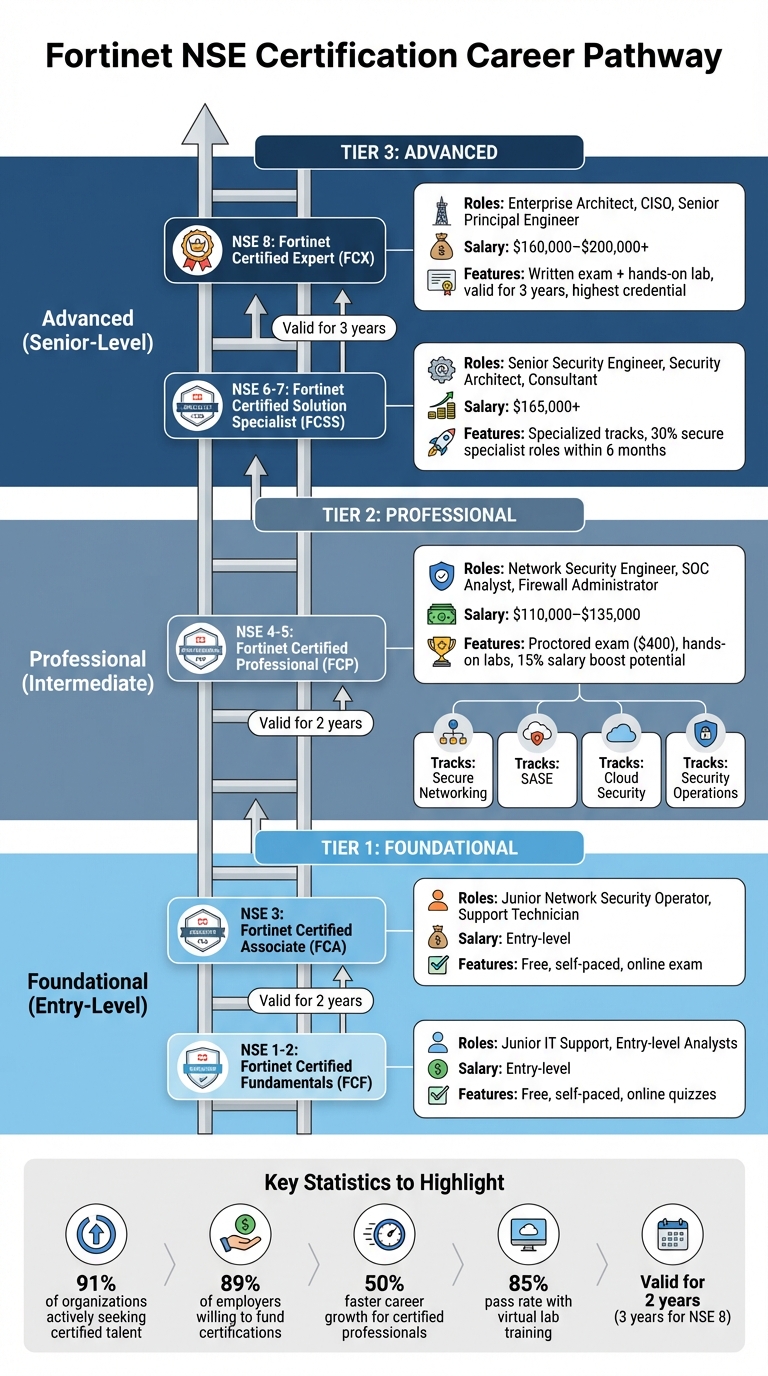
Fortinet NSE Certification Levels: Career Paths and Salary Ranges
Fortinet Training & NSE Certification Updates – Deep Dive
sbb-itb-bf7aa6b
NSE Certification Levels and Career Applications
This section explains how the various NSE certification levels align with specific roles in cleared cybersecurity environments. The NSE program is divided into three career tiers, each tailored to different positions within the cybersecurity field. Knowing how each level fits into the broader career framework can help you select the right certification for your current role and future aspirations.
NSE 1–3: Foundational Knowledge for Entry-Level Roles
For those starting their journey in cleared cybersecurity, the first tier lays the groundwork. NSE 1–2 (Fortinet Certified Fundamentals) introduces basic cybersecurity concepts and raises awareness about network security. These certifications are particularly suited for junior IT support staff, entry-level analysts, and non-technical personnel transitioning into cleared cybersecurity roles [1][6].
NSE 3 (Fortinet Certified Associate) builds on this by validating operational skills with FortiGate devices. It’s designed for junior network security operators and support technicians handling daily tasks in smaller cleared environments [6]. Training for NSE 1–3 is offered online, self-paced, and includes quiz-based assessments [2].
Once this foundation is established, the next tier focuses on more advanced technical skills.
NSE 4–5: Technical Expertise for Intermediate Roles
This tier is ideal for cleared professionals managing classified network infrastructure. NSE 4 certification covers the configuration, installation, and management of FortiGate devices [1][7]. The exam costs $400 USD and requires practical technical knowledge [10].
NSE 5 certifications validate expertise in tools like FortiManager and FortiAnalyzer [6][10]. Clearing NSE 4 and one NSE 5 exam earns the Fortinet Certified Professional (FCP) designation, which can lead to an estimated 15% salary boost [4]. Certified professionals in this tier typically earn between $110,000 and $135,000 annually as of 2025 [10]. Specialization tracks such as Secure Networking, SASE, Cloud Security, and Security Operations prepare candidates to address specific challenges in cleared environments [6].
For those aiming to move into senior roles, the advanced certifications in the next tier provide the necessary credentials.
NSE 6–8: Advanced Credentials for Senior-Level Roles
This tier is tailored for professionals managing complex infrastructures and designing advanced security solutions. NSE 6 focuses on specialized areas like FortiMail, FortiWeb, Secure SD-WAN, and OT security, making it ideal for senior engineers [6][7].
NSE 7 targets security architects and senior engineers, emphasizing the design, deployment, and troubleshooting of large-scale security systems [1][6]. Completing NSE 6 and NSE 7 within the same track earns the Fortinet Certified Solution Specialist (FCSS) designation. Notably, 30% of FCSS-certified professionals secure specialist roles within six months [4].
At the top of the program is NSE 8 (Fortinet Certified Expert), which requires a written exam and a hands-on practical assessment. This certification demonstrates mastery in designing and troubleshooting complex network security systems [1][6]. NSE 8-certified professionals earn between $160,000 and $200,000+ annually [10]. Unlike lower-level certifications, NSE 8 is valid for three years [6]. It’s particularly suited for roles like Principal Architect, CISO, or senior consulting positions, where advanced technical expertise is essential for enterprise-level defense strategies.
| NSE Level | Certification Title | Typical Cleared Job Roles | Average Salary Range |
|---|---|---|---|
| 1–2 | Fortinet Certified Fundamentals (FCF) | Junior IT Support, Entry-level Analysts | Entry-level |
| 3 | Fortinet Certified Associate (FCA) | Junior Network Security Operator, Support Technician | Entry-level |
| 4–5 | Fortinet Certified Professional (FCP) | Network Security Engineer, SOC Analyst, Firewall Administrator | $110,000–$135,000 [10] |
| 6–7 | Fortinet Certified Solution Specialist (FCSS) | Senior Security Engineer, Security Architect, Consultant | |
| 8 | Fortinet Certified Expert (FCX) | Enterprise Architect, CISO, Senior Principal Engineer | $160,000–$200,000+ [10] |
Skills Gained Through NSE Certifications
Core Technical Skills
NSE certifications are designed to build precise technical skills for managing network security. At the NSE 4 level, professionals develop expertise in FortiGate configuration and management, covering areas like firewall policies, NAT, IPsec/SSL VPNs, routing, High Availability (HA), and security profiles such as Antivirus, Web Filter, DNS, and Application Control [1][10].
For those pursuing NSE 5 certifications, the focus shifts to centralized management and analytics. This includes mastering tools like FortiManager for synchronizing configurations across multiple devices and FortiAnalyzer for monitoring, reporting, and incident correlation through FortiSIEM. These tools are essential for maintaining visibility across large-scale infrastructures [1][10].
The skill set deepens significantly at the NSE 6–8 levels. NSE 6 focuses on advanced areas such as Secure SD-WAN, Zero Trust Network Access (ZTNA), Public Cloud security (AWS, Azure, GCP), OT security, and automation using REST APIs [1][10]. Moving to NSE 7 and 8, professionals gain the ability to design, configure, and troubleshoot complex, multi-product security systems. These advanced skills are often required for roles like enterprise architects or CISOs, where strategic oversight and comprehensive security designs are critical [1][2]. Notably, professionals with NSE 7 or higher certifications have been shown to respond to breaches twice as quickly [4].
These technical capabilities align seamlessly with the evolving needs of cybersecurity professionals in high-security environments.
Job Role Alignment
Each NSE certification level is tailored to specific cybersecurity roles. For example, Network Security Engineers often hold NSE 4 certifications, enabling them to manage FortiGate deployments and enforce security policies within classified networks [1][7]. SOC Analysts, on the other hand, benefit from NSE 5 certifications, which equip them to use FortiAnalyzer and FortiSIEM for real-time monitoring and event correlation [1][11].
For more advanced roles, Security Architects and senior consultants typically pursue NSE 7 certifications, which validate their ability to design large-scale firewall configurations, secure hybrid cloud infrastructures, and troubleshoot advanced systems [1][7]. At the highest level, NSE 8-certified professionals take on roles like Enterprise Architect or CISO, where they oversee the design of intricate security frameworks and lead strategic defense efforts for National Security Systems [1][2].
| NSE Level | Core Technical Skills | Aligned Cleared Roles |
|---|---|---|
| NSE 4 (Professional) | FortiGate configuration, VPNs, Firewall policies | Network Security Engineer, Firewall Administrator |
| NSE 5 (Professional) | Centralized management, SIEM, EDR, Analytics | SOC Analyst, Security Analyst, Systems Administrator |
| NSE 6 (Specialist) | SD-WAN, FortiMail, FortiWeb, OT Security | Email Security Specialist, Web App Firewall Expert |
| NSE 7 (Specialist) | Advanced troubleshooting, Cloud Security, Architecture | Security Architect, Cloud Security Engineer, Consultant |
| NSE 8 (Expert) | Complex design, multi-product integration | Enterprise Architect, CISO, Senior Security Lead |
Using NSE Certifications to Advance Your Cleared Cyber Career
Finding Career Opportunities on Cleared Cyber Security Jobs
Cleared Cyber Security Jobs provides a direct link between NSE-certified professionals and employers who actively seek these qualifications. By uploading your resume and setting up job alerts based on your NSE level, clearance, and technical expertise, you can streamline your job search. Make sure to feature your NSE certifications prominently – using Credly digital badges can give employers instant, verified proof of your skills [12][2].
The platform’s search tools allow you to refine opportunities by clearance level, location, and specific technical skills, such as FortiGate administration or FortiAnalyzer knowledge. Since only direct-hire employers post jobs here – no staffing agencies – you’ll connect directly with hiring managers at defense contractors, federal agencies, and other cleared organizations. This is a significant advantage, especially considering that 89% of employers are willing to fund cybersecurity certifications for their employees [13]. Many roles even include certification sponsorship as part of professional development packages.
When applying, go beyond listing your certifications. Detail how your NSE training translates into real-world accomplishments, like configuring firewalls, deploying VPNs, or implementing security policies. If you’re a veteran, take advantage of the Fortinet Veterans Program "Battlecard" to adapt your military experience into industry-standard cybersecurity terms [14].
With this direct employer access, your NSE certifications become even more impactful, especially given the growing demand for certified professionals in the cleared cybersecurity field.
Industry Demand for NSE-Certified Talent
The cleared cybersecurity sector is experiencing a sharp demand for NSE-certified professionals, creating strong career opportunities. The shortage of certified talent is significant, with 91% of organizations actively looking to fill IT security roles with certified individuals [12]. Security leaders emphasize the importance of certifications, with 60% stating they enhance skills and knowledge, and 55% noting that certified practitioners perform tasks more effectively than their non-certified counterparts [13].
Certified professionals also enjoy faster career growth – nearly 50% faster than their non-certified peers – and higher salaries. For example, Network Security Engineers holding NSE 4-5 certifications earn an average of $120,000-$125,000 annually, while Security Architects with FCSS credentials can command $165,000 or more [10].
"Security leaders generally view certifications as strong indicators of cybersecurity expertise. In fact, 91% of respondents prefer to hire candidates with certifications." – Rob Rashotte, Vice President of Global Training & Technical Field Enablement, Fortinet [13]
The urgency for skilled professionals is underscored by the fact that nearly 90% of enterprises experienced a cyber breach in 2024, with 63% taking over a month to recover [13]. This has created a critical need for experts capable of designing, deploying, and managing complex security frameworks – precisely the expertise validated by NSE certifications. Moreover, NSE training aligns with the National Initiative for Cybersecurity Education (NICE) Workforce Framework, a standard often used for hiring in federal and cleared roles [13].
To maximize your career prospects, consider stacking multiple NSE certifications. For instance, combining NSE 4 and NSE 5 demonstrates both hands-on configuration skills and centralized analytics expertise, which are frequently required for leadership roles [12][9]. Keep in mind that most Fortinet certifications are valid for two years (three years for FCX), so staying current with recertifications is essential to meet government compliance and maintain your competitive edge in this fast-paced industry [6][12].
Certification Roadmap and Preparation Tips
Step-by-Step Certification Pathway
To navigate the NSE certification journey, follow this structured approach, which progresses from basic cybersecurity knowledge to expert-level expertise. Each level corresponds to role-based certifications such as FCF, FCA, FCP, FCSS, and FCX [6].
Start with Fundamentals (NSE 1–2) by completing the "Introduction to the Threat Landscape" course, then choose between "Getting Started in Cybersecurity" or "Technical Introduction to Cybersecurity" [2]. These courses are self-paced, include online quizzes, and do not require a proctored exam. Once completed, move on to the Associate level (NSE 3) by taking the "FortiGate Operator" course and passing the NSE 3 online exam [2].
For the Professional level (NSE 4–5), you’ll need to pass the NSE 4 (FortiOS Administrator) exam and one elective NSE 5 exam within your selected track – options include Secure Networking, SASE, Cloud Security, or Security Operations [2]. The Solution Specialist level (NSE 6–7) involves passing one NSE 6 exam and one NSE 7 exam within the same technical track [2]. Finally, the Expert level (NSE 8) requires a written exam and a hands-on lab assessment, testing your comprehensive knowledge of networking and security [2].
Most certifications are valid for two years, except for the FCX (NSE 8), which lasts three years [2]. Be careful to stick to a single track for electives, as mixing tracks can invalidate your designation [2]. This step-by-step pathway ensures clarity and builds the expertise needed for advanced cybersecurity roles.
Next, let’s dive into the tools and strategies that can help you prepare effectively.
Preparation Resources and Strategies
Fortinet offers all self-paced theoretical NSE courses free of charge through the Fortinet Training Institute at training.fortinet.com [2]. This includes foundational NSE 1–3 courses and theoretical materials for NSE 4–8. For hands-on experience, you can purchase on-demand lab access, which has been shown to boost exam success rates – virtual labs are linked to an 85% pass rate and are a strong predictor of success for NSE 6 exams [4].
Allocate 20–40 hours of study time per certification level [4]. Start by reviewing the official exam blueprint for each NSE level to familiarize yourself with the domains and topics that carry the most weight [15]. If you hold other certifications, Fortinet training can also earn you ISC² CPE credits (one credit per hour) or count toward renewal requirements for certifications like CompTIA Security⁺, PenTest⁺, and CySA⁺ [2].
Additional resources include CBT Nuggets, which offers Fortinet training for $59.00 USD monthly or $49.91 USD monthly with an annual subscription. Their courses include practice exams and quizzes to reinforce learning [1]. Veterans can take advantage of the Fortinet Veterans Program, which provides tailored support for transitioning into cybersecurity roles [5]. With 89% of organizations preferring certified candidates, consider seeking employer reimbursement for proctored exam fees (NSE 4–8) and lab costs [2].
Keep in mind that the NSE 8 exam will be updated in April 2026. If you plan to test after February 16, 2026, you’ll need to prepare for the revised version [3]. Once certified, upload your credentials to Credly to share digital badges that employers can verify instantly [12].
Conclusion
This guide has shown how Fortinet NSE certifications align with career progression in cleared cybersecurity roles. Now it’s time to chart your path forward.
Fortinet NSE certifications validate your technical skills and help fast-track your career in cybersecurity. With a modular structure – ranging from foundational courses like NSE 1–2 to the expert-level FCX (NSE 8) – you can tailor your certification journey to match specific career goals, such as Security Operations, Cloud Security, or Secure Networking.
Start with the free, self-paced NSE 1–3 courses offered by the Fortinet Training Institute to build a strong foundation. From there, aim for NSE 4 (FortiOS Administrator) as your first proctored exam. This certification qualifies you for mid-level roles with competitive salaries [10][8]. Advancing to NSE 6–8 will equip you with the high-level skills needed for senior roles, focusing on tasks like architecture design and troubleshooting [10].
Once certified, make the most of your achievements by uploading your Credly digital badges, earning ISC² CPE credits (one credit per training hour), and staying ahead with proactive recertifications. Since most NSE certifications are valid for two years, planning your recertification timeline early is crucial to maintaining active status [12][2]. These steps will position you to capitalize on new opportunities as they arise.
FAQs
Which NSE level should I start with for my cleared role?
To get started, consider beginning with NSE 1 or NSE 2. These levels focus on the fundamentals of network security, making them a great starting point for anyone looking to build a strong base. They’re especially useful for developing the core skills required in roles that demand security clearance.
How do I choose the right NSE track (Secure Networking, SASE, Cloud, SecOps)?
Choosing the right NSE track depends on your role, career aspirations, and the skills you aim to develop. Here’s a quick breakdown:
- Secure Networking: Ideal for those involved in network security design and implementation.
- Cloud: Focuses on securing cloud-based environments and solutions.
- SASE: Tailored for secure access and edge security needs.
- SecOps: Centers on incident response and security operations.
Each track aligns with specific roles and expertise, making it easier to build the skills that can propel your career forward.
How long does it take to progress from NSE 4 to NSE 7 or NSE 8?
Advancing from NSE 4 to NSE 7 or NSE 8 depends heavily on your experience level and how much time you dedicate to preparation. For most, the process can take anywhere from several months to over a year. This timeline includes building the required skills, gaining practical experience, and successfully passing the necessary exams. The pace of progression ultimately varies based on individual effort and commitment to studying and hands-on practice.