Cybersecurity Salary Guide 2026:
What Cleared Professionals Actually Earn
Every salary guide gives you the same recycled BLS median. This one gives you the numbers that actually matter — by clearance level, contract vehicle, and SCIF location.
The Salary Landscape — Why Most Salary Data Is Wrong
Every “cybersecurity salary” article on the internet gives you the same recycled BLS number: $120,360 median for information security analysts. Then they slap on a stock photo of someone in a hoodie and call it a day.
That number is useless to you.
If you hold a security clearance and work in cybersecurity, you’re operating in a completely different labor market than the guy doing vulnerability scans at a mid-size retailer. Your salary is shaped by forces that generic salary guides don’t even acknowledge: clearance level, polygraph status, contract vehicle, LCAT category, and which three-letter agency’s mission you support.
The commercial market runs from roughly $60K for entry-level SOC analysts at managed security providers to $180K+ for senior security architects at Big Tech. These numbers are well-documented because commercial employers post salaries on job boards and employees share them freely on Levels.fyi and Blind.
The cleared market starts where commercial mid-range ends. A cleared SOC analyst with TS/SCI in the DC metro is pulling $95K-$120K for the same work that pays $65K-$80K at a commercial MSSP. At the senior end, a Zero Trust Architect with TS/SCI and a Full Scope Poly supporting an IC customer in Northern Virginia can clear $220K+ base before bonuses.
The gap exists for a simple reason: supply constraint. About 4.2 million Americans hold active security clearances, and only a fraction of those are cybersecurity professionals. When a defense contractor needs a SIEM engineer with TS/SCI access for a classified program, they can’t hire from the global talent pool. They’re fishing in a very small pond, and they pay accordingly.
→ TS/SCI Salary Premium — The Real Numbers Behind Your Security Clearance
Where This Data Comes From
The salary ranges in this guide are compiled from verified 2026 sources:
- OPM 2026 General Schedule Pay Tables — Salary Table 2026-DCB (DC locality, 33.94%) and Table 2026-CS (Colorado Springs, 20.15%) ✓ OPM.gov
- ZipRecruiter — TS/SCI clearance salary in Washington, DC: average $149,398/year ✓ Oct 2025
- PayScale — Penetration Tester: $67K–$151K range, $102,472 average (366 profiles) ✓ Dec 2025
- Glassdoor — SOC Analyst in Aerospace & Defense: $102,709 median total pay ✓ 2026
- CyberSeek — NICE Framework workforce data funded by NIST and CompTIA
- ClearedJobs.Net — Salary ranges from active cleared cyber job postings
- Defense contractor LCAT rates — Publicly available labor category rates from SEWP, CIO-SP4, and Alliant 3
Cybersecurity Salary by Role — Complete 2026 Breakdown
Below is every major cybersecurity role with salary ranges for 2026. Each range reflects the cleared market. Commercial (non-cleared) roles typically pay 20-30% less than the low end of these ranges.
Defensive / Blue Team Roles
| Role | Entry (0-2 yr) | Mid (3-7 yr) | Senior (8+ yr) | Cleared Premium |
|---|---|---|---|---|
| SOC Analyst — Tier 1 | $55,000–$78,000 | $78,000–$100,000 | N/A (promote out) | +$10,000–$20,000 |
| SOC Analyst — Tier 2/3 | $80,000–$95,000 | $95,000–$125,000 | $125,000–$155,000 | +$20,000–$30,000 |
| Incident Response Analyst | $75,000–$95,000 | $100,000–$135,000 | $135,000–$175,000 | +$20,000–$35,000 |
| Threat Intelligence Analyst | $80,000–$100,000 | $105,000–$140,000 | $140,000–$180,000 | +$25,000–$40,000 |
| Digital Forensics Examiner | $75,000–$90,000 | $95,000–$130,000 | $130,000–$165,000 | +$20,000–$35,000 |
| Malware Analyst / Reverse Engineer | $85,000–$105,000 | $110,000–$150,000 | $150,000–$200,000 | +$25,000–$40,000 |
→ SOC Analyst Career Path for Cleared Professionals · Threat Intelligence Analyst Career Path · Digital Forensics Examiner Career Path
Offensive / Red Team Roles
| Role | Entry (0-2 yr) | Mid (3-7 yr) | Senior (8+ yr) | Cleared Premium |
|---|---|---|---|---|
| Penetration Tester | $67,000–$102,000 | $102,000–$143,000 | $143,000–$190,000 | +$20,000–$35,000 |
| Red Team Operator | $90,000–$115,000 | $120,000–$160,000 | $160,000–$210,000 | +$25,000–$40,000 |
| Vulnerability Researcher | $85,000–$110,000 | $115,000–$155,000 | $155,000–$200,000+ | +$25,000–$40,000 |
→ Penetration Tester Career Path · Red Team Operator Career Path
Engineering & Architecture Roles
| Role | Entry (0-2 yr) | Mid (3-7 yr) | Senior (8+ yr) | Cleared Premium |
|---|---|---|---|---|
| Security Engineer | $85,000–$105,000 | $110,000–$150,000 | $150,000–$200,000 | +$20,000–$35,000 |
| Cloud Security Architect | $100,000–$125,000 | $130,000–$175,000 | $175,000–$240,000 | +$25,000–$40,000 |
| Zero Trust Architect | N/A (mid+ role) | $140,000–$180,000 | $185,000–$250,000 | +$30,000–$45,000 |
| AI Security Engineer | $95,000–$120,000 | $125,000–$170,000 | $175,000–$230,000+ | +$25,000–$40,000 |
→ Zero Trust Architect — The $200K Skill Set · AWS Security Specialty for Cleared Engineers
GRC, Management & Leadership
| Role | Entry (0-2 yr) | Mid (3-7 yr) | Senior (8+ yr) | Cleared Premium |
|---|---|---|---|---|
| GRC / Compliance Analyst | $65,000–$85,000 | $90,000–$125,000 | $125,000–$165,000 | +$15,000–$25,000 |
| Security Manager | N/A | $120,000–$160,000 | $160,000–$210,000 | +$20,000–$35,000 |
| CISO / Deputy CISO | N/A | N/A | $200,000–$400,000+ | Varies widely |
→ CISM for Cleared Security Managers · CRISC for Cleared Risk Professionals
A note on CISO salaries: The range is deliberately wide. A CISO at a small defense contractor might make $180K. A CISO at a prime supporting a major IC program could exceed $350K with bonuses. Agency CISOs on the GS/SES scale max around $230K base but often transition to contractor side for significantly more.
Visual: Mid-Career Salary Ranges by Role
Cybersecurity Salary by Clearance Level
This is the section you won’t find anywhere else. Every other salary guide treats cybersecurity as one market. It’s not. Your clearance level is the single biggest salary variable after years of experience — and unlike experience, you can change it faster than you think.
Why the premium exists: It’s pure supply and demand. There are roughly 4.2 million Americans with active security clearances (per the most recent ODNI annual report). Of those, about 1.3 million hold Top Secret or higher. The subset with TS/SCI plus a current polygraph who also have cybersecurity skills? That’s an incredibly small pool.
Defense contractors set their bids based on LCAT (Labor Category) rates tied to specific clearance requirements. When a contract requires a “Cybersecurity Engineer III, TS/SCI w/ CI Poly,” the contractor is billing the government $180-$250/hour for that seat. They’re paying you 40-55% of that bill rate.
→ TS/SCI Salary Premium Deep Dive · Why Your Polygraph Is Worth $40K
The Clearance Premium Compounds
Here’s what catches most people off guard: the clearance premium isn’t a flat bonus — it’s a multiplier that compounds across your career. A 10-year veteran with TS/SCI + FSP who has been hopping cleared contracts is earning significantly more than someone with identical skills who stayed in the commercial market. The gap widens every year because each salary negotiation starts from a higher base.
→ Upgrade Secret to Top Secret — Is It Worth the Risk?
Cybersecurity Salary by Location
The DC/Northern Virginia corridor dominates cleared cybersecurity employment, but it’s not always the best deal when you factor in what it costs to live there.
DC / Northern Virginia
NSA · CIA · NGA · DIA · NRO + every prime
Colorado Springs
Space Force · NORAD · Schriever SFB
San Antonio
NSA Texas · 24th AF · DISA
Huntsville, AL
Redstone Arsenal · MDA · FBI ops center
Tampa / MacDill
CENTCOM · SOCOM · DISA
Remote (Cleared Hybrid)
Limited — most require SCIF access
→ NSA San Antonio — The Best Kept Secret · DC Salary Survival Guide · Location Comparison Deep Dive
Remote Work Reality for Cleared Professionals
Let’s be blunt: fully remote cleared cyber work is rare and getting rarer. Most cleared positions require SCIF access for at least part of your work. The post-COVID remote experiment largely ended for classified programs by mid-2024.
What you can find:
- Hybrid (2-3 days SCIF, 2-3 days home) — Increasingly common for roles that split between classified and unclassified work
- Unclassified portions remote — Some roles let you do reporting, training, and admin from home
- GRC/compliance — The most remote-friendly cleared specialty, since much of the work involves unclassified policy and documentation
If fully remote work is your priority, you’ll likely take a 10-15% pay cut compared to equivalent on-site roles.
→ Remote Cleared Jobs — The Reality for TS/SCI Holders
Cybersecurity Salary by Certification
Certifications matter in the cleared world — arguably more than in commercial cybersecurity. Many government contracts require specific certifications for specific LCAT positions (thanks to DoD 8140). No cert = you literally can’t sit in the seat, regardless of your skills.
→ CISSP Career Guide · Security+ Guide · OSCP Guide · CEH Guide · CISSP vs CASP+ ROI Debate
Cybersecurity Salary by Experience Level
| Experience | Cleared Salary Range | What Defines This Level |
|---|---|---|
| 0–2 years | $65,000–$100,000 | SOC Tier 1, jr analyst roles. Security+ required. Learning the mission. |
| 2–5 years | $90,000–$140,000 | Independent contributor. CISSP eligible. Starting to specialize. |
| 5–10 years | $120,000–$185,000 | Senior technical roles. Lead/architect positions. Clearance is a core asset. |
| 10–15 years | $150,000–$220,000 | Technical lead, program-level SME, or management track. |
| 15+ years | $180,000–$300,000+ | Senior leadership, practice lead, or deep technical niche. |
The 5-Year Clearance Cliff
Something happens around year 5 in the cleared world that doesn’t happen in commercial cybersecurity: your clearance becomes your primary asset.
In the first few years, you’re getting paid a premium because you happen to have a clearance AND cybersecurity skills. By year 5, you’ve accumulated mission-specific knowledge, program familiarity, and relationships that are impossible to replicate. You know how things actually work inside the SCIF. You’ve survived a contract recompete. You’ve been read into programs.
→ Cleared Career Planning — Build Your 5-Year Roadmap
GS Scale vs. Contractor — The Real Comparison
The GS-vs-contractor question is the oldest debate in cleared cybersecurity. Here’s the actual math for 2026, using the DC locality adjustment (33.94% per OPM 2026 Salary Table DCB):
| GS Grade (Step 5, DC) | Federal Base | Contractor Equivalent | Delta |
|---|---|---|---|
| GS-9 | $80,041 | $78,000–$95,000 | -$2K–+$15K |
| GS-11 | $96,843 | $95,000–$115,000 | -$2K–+$18K |
| GS-12 | $116,071 | $115,000–$145,000 | -$1K–+$29K |
| GS-13 | $138,024 | $140,000–$175,000 | +$2K–+$37K |
| GS-14 | $163,104 | $165,000–$205,000 | +$2K–+$42K |
| GS-15 | $191,850 | $190,000–$240,000 | -$2K–+$48K |
| SES | $200,000–$230,700 | $225,000–$310,000+ | +$25K–$79K+ |
But wait — it’s not that simple.
Total Compensation: GS-14 Example
🏛️ Federal (GS-14 Step 5)
🏢 Contractor Equivalent
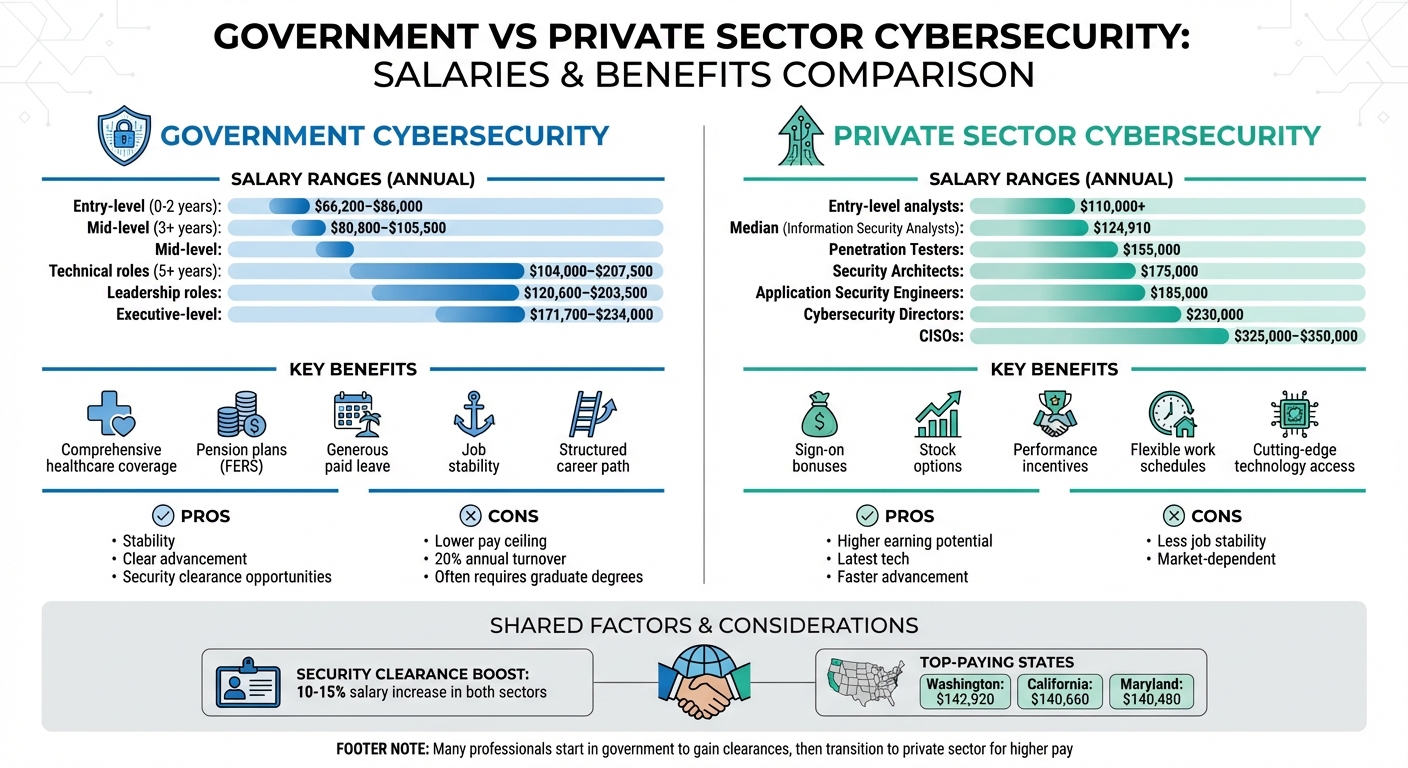
→ GS to Contractor — Timing Your Federal Exit · Gov vs Private Sector Comparison
Negotiation — Getting Paid What You’re Worth
Know Your LCAT Rate
Here’s something most cleared cybersecurity professionals never think to ask: what is my employer billing the government for my seat?
Every position on a government contract has a Labor Category (LCAT) with an associated billing rate. Your employer charges the government $150-$250/hour for your work. You get 40-55% of that as salary. The rest covers overhead (benefits, facilities, management) and profit margin (typically 8-15% on cost-plus contracts).
→ LCAT Categories — Why Your Title Matters Less Than Your Labor Category
The 20% Rule for Contractor Jumps
When you switch contractors, ask for 15-20% more than your current salary. The new employer is paying to avoid the 6-12 month wait to get a new person cleared and read into the program. Your ability to start immediately has quantifiable value.
This is especially powerful during contract recompetes. When a new prime wins the contract, they need incumbent staff to keep the lights on. You have leverage you’ll never have again. Use it.
→ Switching Contractors — The Strategic Jump for 20% More · Contract Recompete — Your 90-Day Survival Plan
Benefits Beyond Base Salary
- Signing bonus: $5K-$20K standard for TS/SCI hires. Push for $15K+ on FSP roles.
- Relocation: $10K-$30K for moves to cleared hubs. Some offer full pack-and-move plus temporary housing.
- Cert reimbursement: Get SANS training covered ($8K+ per course). Free money most people leave on the table.
- Education benefits: Many defense contractors offer $10K-$15K/year in tuition assistance.
- Clearance sponsorship value: If you’re being sponsored for a higher clearance, the employer is investing $15K-$50K in you. That’s leverage.
→ Cleared Job Relocation Package Negotiation
2026 Outlook & Salary Trends
AI Is Changing the Job — Not Killing It
10% of cybersecurity job listings now reference AI skills (CyberSeek 2025 data). But in the cleared world, AI adoption is slower due to classification constraints and accreditation requirements. You can’t just plug ChatGPT into a classified network.
Cleared professionals who can bridge AI and security on classified systems are commanding premiums of $20K-$40K above standard roles. This is an emerging specialization with very low supply.
→ AI Security Clearance Jobs — The Emerging Opportunity
Government Spending: Headwinds and Tailwinds
Federal cybersecurity spending continues to grow — the FY2026 budget requests $13B+ for civilian cyber alone, and DoD cyber spending is estimated at $14B+. However, efficiency emphasis means some contracts are being consolidated or competed more aggressively.
For individual professionals, this is mixed: fewer total contracts may mean fewer positions, but the positions that remain are higher-skill and higher-pay. The days of 500-person “body shop” contracts staffed with warm bodies holding Security+ are ending.
The Emerging High-Pay Specializations
| # | Specialization | Salary Range | Why It’s Hot |
|---|---|---|---|
| 1 | Zero Trust Architecture | $180K–$250K | Every federal agency has a ZT mandate |
| 2 | Cloud Security (GovCloud / IL5-6) | $160K–$240K | DoD cloud migration accelerating |
| 3 | AI/ML Security | $150K–$230K | New field, near-zero cleared talent supply |
| 4 | OT/ICS Security | $140K–$200K | Critical infrastructure national priority |
| 5 | Supply Chain Security | $130K–$190K | CMMC + software supply chain mandates |
→ OT Security Jobs — The Critical Infrastructure Opportunity
💰 Salary Estimator
Get a ballpark range based on your role, clearance, and location.
Frequently Asked Questions
The BLS reports a median of $120,360 for information security analysts, but this significantly understates what cleared professionals earn. Cleared cybersecurity professionals with TS/SCI in the DC metro area average $140,000-$170,000, with Full Scope Polygraph holders commonly exceeding $200,000.
A Secret clearance adds approximately $10,000-$20,000 over non-cleared equivalents. Top Secret adds $20,000-$35,000. TS/SCI adds $30,000-$45,000. TS/SCI with a Full Scope Polygraph adds $45,000-$65,000. These premiums compound over the course of a career.
Zero Trust Architects and Cloud Security Architects with TS/SCI and Full Scope Polygraph are the highest-paid individual contributor roles, earning $200,000-$250,000+. CISOs at defense contractors can exceed $350,000. Among emerging roles, AI Security Engineers with cleared access are commanding $175,000-$230,000+.
In base salary, yes — contractors typically earn 15-40% more than GS equivalents. However, federal employees receive benefits worth 30-40% of their base salary, including the FERS pension, TSP matching, generous leave, and FEHB health insurance that continues into retirement. When accounting for total compensation, the gap narrows significantly, and in some cases federal employment is the better financial choice long-term.
CISSP provides the highest overall ROI, adding $15,000-$25,000 to cleared cybersecurity salaries. It’s required for senior LCAT positions on most defense contracts. For offensive security roles, OSCP adds $10,000-$20,000. Cloud security certifications (AWS Security Specialty, Azure AZ-500) are seeing the fastest-growing premiums at $10,000-$20,000.
DC/Northern Virginia pays the highest raw salaries ($145,000 average for cleared cyber), but after adjusting for cost of living, San Antonio ($118,000 salary with 0.93 COL index = $126,900 adjusted) and Huntsville, AL ($112,000 salary with 0.89 COL = $125,800 adjusted) offer the best purchasing power. Both have growing cleared cyber communities around NSA, DISA, and FBI operations.
Ready to Find Your Next Cleared Cybersecurity Role?
Salary data is only useful if you act on it. If the numbers in this guide tell you you’re underpaid — or if you’re ready to make the jump to a higher-clearance, higher-pay position — start here.
CyberSecJobs.com is the cybersecurity career resource of ClearedJobs.Net, a veteran-owned company serving the security-cleared community since 2001.