

In cybersecurity, the choice between government and private sector jobs often comes down to pay, benefits, and career growth. Here’s what you need to know:
- Government Roles: Salaries range from $57,500 for entry-level to $234,000 for top executives. Security clearances like TS/SCI can boost pay. Benefits include pensions, healthcare, and job stability. However, private companies often lure experienced talent with better pay.
- Private Sector Roles: Salaries start higher, with mid-level roles averaging $155,000 and top positions like CISOs earning $325,000–$350,000. Perks include bonuses, stock options, and access to cutting-edge tools. But job stability can be less predictable.
Key Takeaway: Government jobs offer stability and structured growth, while private sector roles deliver higher earning potential and faster access to advanced technologies. Many professionals start in government to gain clearances, then transition to private roles for better pay.
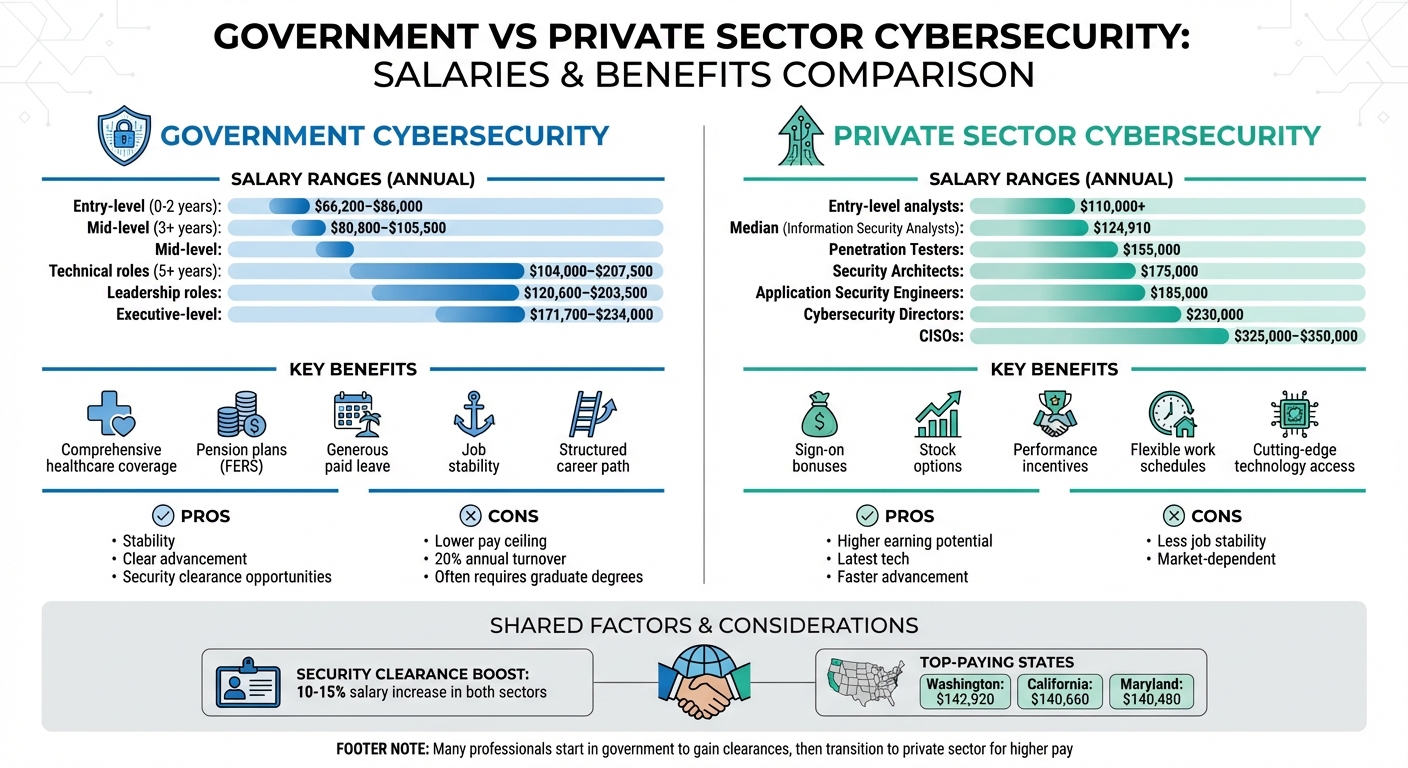
Government vs Private Sector Cybersecurity Salary Comparison Chart
1. Government Cybersecurity Salaries
Base Salary
Federal cybersecurity roles offer salaries ranging from $80,000 to $120,000 for most positions [3]. Entry-level analysts typically start around $57,500 [2], while advanced roles can exceed $134,000 [3].
The Department of Homeland Security outlines salary ranges based on experience and roles:
- Entry-level (0–2 years): $66,200–$86,000
- Mid-level (3+ years): $80,800–$105,500
- Technical roles (5+ years): $104,000–$207,500
- Leadership roles: $120,600–$203,500
- Executive-level positions: $171,700–$234,000
These figures can vary further depending on specific roles and responsibilities.
Impact of Security Clearance
Holding a security clearance – whether it’s Secret, Top Secret, or TS/SCI – can significantly increase base salaries [3]. The higher the clearance level required for the job, the greater the earning potential, as these roles demand specialized trust and expertise.
Geographic Variations
Location plays a major role in determining government cybersecurity pay. Federal agencies adjust salaries based on local labor market conditions. For example, in the Washington, D.C. metro area, salaries receive a 10% supplement. This means an entry-level salary of $66,200 nationally would increase to approximately $72,820 in the D.C. region.
Benefits and Perks
Federal cybersecurity roles come with a robust set of benefits that enhance overall compensation. These include:
- Comprehensive healthcare coverage
- Pension plans under the Federal Employees Retirement System (FERS)
- Generous paid leave policies
These perks often make up for lower base salaries compared to private sector offers. Additionally, the stability of government jobs, combined with a predictable work-life balance, is a significant draw for many professionals considering a career in the public sector.
2. Private Sector Cybersecurity Salaries
Base Salary
If you’re aiming for a higher paycheck, private sector cybersecurity roles offer a clear advantage over government positions. Private sector analysts can pull in over $110,000 annually, compared to the $80,000–$90,000 range for their public sector counterparts [2]. Nationwide, the median salary for information security analysts stands at $124,910 [5].
For specialized roles, the numbers climb even higher. Chief Information Security Officers (CISOs) earn between $325,000 and $350,000 per year, while Cybersecurity Directors average around $230,000 [4]. Other roles like Application Security Engineers bring in roughly $185,000, and Security Architects earn upwards of $175,000 [4]. Even mid-level positions such as Penetration Testers see salaries around $155,000 [4]. Adding certifications or security clearances can further enhance these figures.
Impact of Security Clearance
Holding a security clearance or certifications like CISSP, CISM, or CEH can give your paycheck a boost, typically increasing salaries by 10–15% [2].
Geographic Variations
Where you work matters just as much as what you do. Cybersecurity salaries vary significantly by location. For example, Washington leads with a median salary of $142,920 for information security analysts, closely followed by California at $140,660 and Maryland at $140,480 [5]. Other states like Virginia and New York also offer competitive pay, averaging $132,460 and $131,100, respectively [5]. These differences often reflect the cost of living and the presence of tech hubs or defense contractors in the area.
Benefits and Perks
Private sector compensation goes beyond just the paycheck. Many companies sweeten the deal with sign-on bonuses, stock options, and performance-based incentives. When considering an offer, it’s worth evaluating non-salary perks like flexible work schedules, professional development funds, and remote work opportunities [3]. Additionally, skills in areas like AI, cloud security, and threat hunting are increasingly commanding higher pay premiums [4]. This mix of salary and benefits offers a stark contrast to the more rigid compensation structures in the government sector.
Contracting vs Permanent Jobs in Cybersecurity?
sbb-itb-bf7aa6b
Pros and Cons
When deciding between a career in government or the private sector within cybersecurity, it’s essential to weigh more than just salary figures. Each path comes with its own set of trade-offs that can shape your career trajectory.
Government roles offer a structured path for career advancement, often following frameworks like the Department of Homeland Security’s five-track system. This setup provides a clear route from entry-level positions to executive roles. However, federal positions face challenges, such as a high annual turnover rate of 20% [1]. Additionally, these roles are more likely to require advanced degrees – up to four times more often than private sector jobs – despite offering lower overall compensation [1].
Private sector positions, on the other hand, are known for higher salaries and quicker access to cutting-edge technologies. Companies prioritize candidates with the latest skills, often focusing on infrastructure security, which contrasts with the government’s less technology-intensive roles [1]. However, the private sector comes with less job stability, as employment can be heavily influenced by market fluctuations.
Here’s a breakdown of how these sectors compare across key factors:
| Factor | Government Sector | Private Sector |
|---|---|---|
| Education Requirements | More likely to require graduate degrees (4x)[1] | Undergraduate degrees typically sufficient[1] |
| Skills Emphasis | Less focus on the newest technologies[1] | High demand for cutting-edge skills and tools[1] |
| Job Stability | Structured progression but ~20% annual turnover[1] | Stability varies with market conditions |
| Career Path Clarity | Well-defined five-track system | Flexible, but less structured |
| Senior-Level Compensation | Capped at around $234,000 | Higher earning potential, especially in leadership roles |
While entry-level salaries in both sectors are competitive, the differences become more pronounced as you advance. Government roles provide a predictable, step-by-step progression, while private sector careers reward specialized expertise with significantly higher pay at senior levels. Choosing the right path depends on your long-term goals and priorities.
Conclusion
Deciding between a career in government or the private sector for cybersecurity ultimately comes down to what you value most in your professional journey. Government roles often come with predictable pay scales, well-defined career paths, and job security. On the other hand, private sector positions can offer higher earning potential and exposure to cutting-edge technologies, though they may lack the same level of structured advancement.
Having a security clearance is a game-changer in both sectors, enhancing earning potential and keeping your career options wide open. For those just starting out, government roles can provide structured training and a clear path for growth. Meanwhile, mid-career professionals with an established clearance might find the private sector more aligned with their financial aspirations. Many professionals choose to begin in government roles to obtain a clearance, then transition to higher-paying opportunities in the private sector. This approach allows for flexibility while balancing financial goals and career priorities.
Cleared Cyber Security Jobs helps connect security-cleared professionals with employers that match their clearance level and salary expectations.
FAQs
How does a security clearance affect salaries in cybersecurity?
Having a security clearance can make a noticeable difference in your earning potential within cybersecurity. On average, professionals holding clearances earn 10-20% more than their non-cleared counterparts. This is because employers place a high value on the trust and qualifications that come with a clearance. For those with higher-level clearances, like Top Secret or SCI, the pay bump can be even more pronounced, especially in government and defense-related roles.
Beyond the financial perks, a clearance can also unlock access to exclusive, high-paying positions that are off-limits to those without one. As the demand for cleared cybersecurity professionals continues to grow, salaries in this field have followed suit. By 2023, the average compensation for cleared roles had climbed to approximately $114,956. In this way, a clearance isn’t just a credential – it’s a powerful tool for boosting your career and income in the cybersecurity industry.
What are the key advantages of starting a cybersecurity career in the government sector?
Starting a cybersecurity career in the government sector comes with a host of strong advantages. For starters, salaries can be highly competitive, especially for roles that require security clearances. These positions often include extra pay based on location and clearance level. In some cases, salaries can go as high as $197,200 annually, depending on the job grade and geographic area.
Government jobs also offer extensive benefits that are hard to match. These include solid retirement plans, comprehensive health insurance, generous paid leave, and unmatched job security. In many instances, these perks surpass what’s typically available in the private sector. On top of that, federal roles provide clear pathways for career growth, supported by structured training programs to help professionals continuously develop their skills.
One standout feature of working in the government sector is the chance to contribute to national security and critical infrastructure projects. This kind of work not only offers a deep sense of purpose but also allows you to make a direct impact on public service. With transparent pay scales and well-defined career tracks, government cybersecurity roles are a great fit for those looking for stability, professional growth, and work that truly matters.
How does location impact cybersecurity salaries in government and private sectors?
Location has a big impact on cybersecurity salaries, whether you’re looking at government or private-sector roles. Typically, private-sector jobs pay more – about 20% to 35% higher – than similar positions in the government. In cities with a strong tech presence, like California or New York, salaries are higher because of increased demand and the cost of living. On the flip side, rural areas usually offer lower pay.
Government salaries often take regional factors into account, including cost of living and local market conditions. For instance, cybersecurity professionals in major cities tend to earn significantly more than those in smaller towns or rural areas. Whether you’re eyeing a government role or a private-sector position, it’s important to research local market trends to get a clear picture of your earning potential.
Leave a Reply