

The GIAC Network Forensic Analyst (GNFA) certification is tailored for professionals in cybersecurity, particularly those with security clearances. It validates your ability to analyze network traffic, logs, and metadata to investigate breaches and detect malicious activity. The exam includes 66 questions with a 3-hour limit and features a hands-on CyberLive component, where candidates solve forensic challenges using real tools and virtual machines.
Key Highlights:
- Exam Fee: $999 (retake: $899)
- Passing Score: 70%
- Focus Areas: Protocol analysis, NetFlow, encryption, attack patterns, and log management.
- Preparation: SANS FOR572 training ($8,000–$9,000) and hands-on practice with tools like Wireshark, tcpdump, and Zeek.
- Career Impact: GNFA-certified professionals earn ~16% more, with salaries ranging from $83,000 to $118,000 annually.
This certification opens doors to roles like incident responder, forensic analyst, and SOC personnel, particularly in government and defense sectors. It’s recognized as a top credential in network forensics and is valid for four years, requiring renewal through CPE credits or retaking the exam.
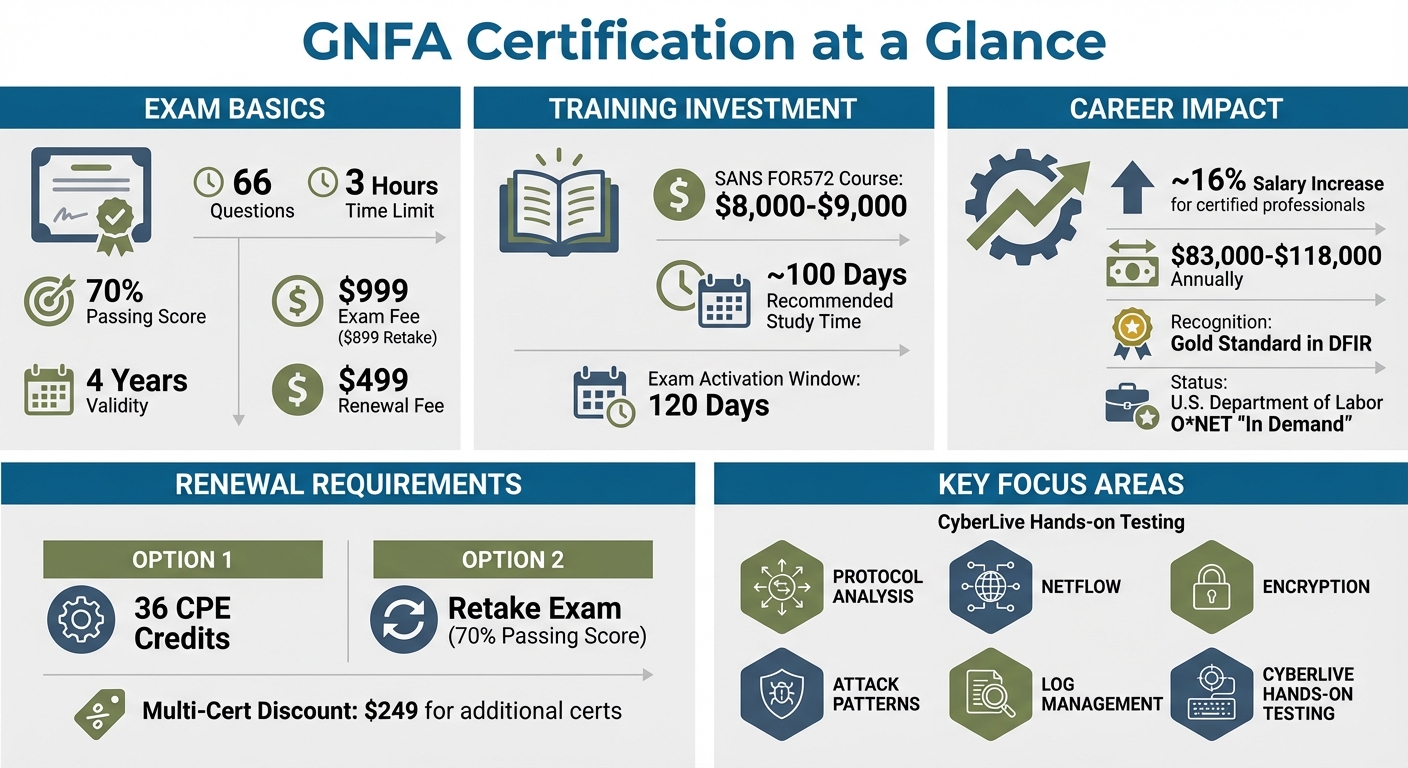
GNFA Certification Quick Reference: Exam Details, Costs, and Career Impact
Comprehensive Guide to GIAC Network Forensic Analyst (GNFA) Certification | Exam Prep & Study Tips
sbb-itb-bf7aa6b
What is the GNFA Certification?
The GNFA certification showcases your ability to dissect and resolve intricate network breaches. It highlights your expertise in analyzing network traffic, logs, and metadata to uncover the specifics of a security incident. What sets the GNFA apart is its use of CyberLive testing – where you interact with real programs, code, and virtual machines to tackle practical scenarios.
Certification Overview and Focus Areas
The GNFA certification assesses your skills in critical areas like network architecture, protocol reverse engineering, NetFlow analysis, encryption and encoding, and attack visualization. You’ll need to demonstrate the ability to analyze logs and traffic patterns to distinguish legitimate activity from malicious threats.
These competencies are vital in high-stakes environments like national security. For instance, when a classified network is breached, a GNFA-certified professional is expected to trace the intruder’s movements, identify compromised data, and uncover how the breach occurred. This includes tasks such as detecting malware command-and-control beaconing, decoding encrypted protocols, and managing log aggregators in complex government systems.
The exam itself consists of 66 questions, with a 3-hour time limit. To pass, candidates must achieve a minimum score of 70% [1][4].
These advanced capabilities often lead to career growth for professionals with security clearances.
Benefits for Cleared Professionals
For those with security clearances, earning the GNFA certification can unlock specialized roles requiring advanced technical expertise. It’s particularly valued in military occupational specialties, federal agencies, and defense contracting companies focused on cybercrime investigations and advanced persistent threat mitigation.
The U.S. Department of Labor’s O*NET database recognizes the GNFA as "in demand", highlighting the increasing necessity of these skills in secure networks.
Professionals with GNFA certification often take on roles such as incident responders, threat hunters, SOC analysts, federal agents, and forensic experts. This certification proves you have the analytical skills needed to investigate state-sponsored attacks or insider threats – capabilities that are indispensable in safeguarding national security.
GNFA Exam Details and Requirements
Exam Format and Scoring
The GNFA exam is designed to test advanced skills through a structured and challenging format. This proctored, web-based exam consists of 66 questions to be completed within 3 hours, with a passing score set at 70%. The initial exam fee is $999 USD, while retakes cost $899 USD [3]. A standout feature is the CyberLive component, which immerses candidates in a virtual lab environment where they tackle forensic challenges using real programs, code, and virtual machines [1]. You can take the exam remotely through ProctorU or at PearsonVUE testing centers [1].
While the exam is open-book, relying solely on printed references won’t guarantee success – it demands strong practical knowledge and an organized reference system [3]. Once your account is activated, you have 120 days to complete the exam. Be aware that missing a scheduled appointment incurs a $175 USD fee [1][3]. These details highlight the preparation needed for the technical domains covered in the exam.
Content Areas Covered
The GNFA exam focuses on eight key technical areas critical to network forensics. These include:
- Common network protocols like TCP, UDP, HTTP, and DNS
- Encryption and encoding methods
- NetFlow analysis
- Network architecture design
- Protocol reverse engineering
- Open-source security proxies
- Event logging strategies
- Wireless network analysis [3]
The CyberLive tasks further test your ability to handle tools like tcpdump and Wireshark under time constraints, ensuring you can apply these skills in high-stakes environments where network breaches require quick and accurate analysis [3].
Prerequisites and Background Knowledge
Although there are no formal prerequisites, a solid foundation in computer forensics, IT, and security is highly recommended [2][3]. Practical work experience, formal education, or self-study in these areas will make a significant difference. Familiarity with network protocols, TCP/IP fundamentals, and forensic tools is essential for navigating the open-book exam [3].
If you plan to attend the related SANS FOR572 training, which costs between $8,000 and $9,000 USD depending on the format, instructors expect you to have prior knowledge of forensic tools [3]. Earning the GNFA certification can also lead to financial rewards – certified professionals typically see a salary increase of about 16% compared to their non-certified counterparts, making the effort and investment worthwhile [3].
How to Prepare for the GNFA Exam
Training Courses and Study Materials
To gear up for the GNFA exam, consider enrolling in SANS FOR572: Advanced Network Forensics. This course, which costs between $8,000 and $9,000 USD depending on whether you choose OnDemand, Live Online, or In-Person formats, provides in-depth training through textbooks and a capstone challenge featuring extensive packet capture files [5][4][3]. As Tony E., a GIAC Advisory Board Member, put it:
Phil Hagen does a really great job of bringing you up from Zero-to-Hero throughout the course [7].
Since the exam is open-book, preparation goes beyond just flipping through course materials during the test. Many successful candidates create a detailed, alphabetized index that links keywords, tools, and protocols to specific textbook pages. This approach saves time and helps you quickly locate crucial information during the exam [5][3]. As DFIR Consultant darkdefender shared:
The course does not focus on Wireshark, it forces you to use other tools so that you’re able to manipulate a pcap for more efficient analysis, which are mostly Linux based [5].
The course and its materials lay a strong foundation, but hands-on practice is equally critical for success.
Tools for Hands-On Practice
Command-line tools are a must-have skill for the GNFA exam. While Wireshark is an essential tool for protocol analysis, you’ll also need to master tcpdump, tshark, editcap, and capinfos to work effectively with large packet captures [5][6]. The SANS FOR572 course provides access to the SIFT Workstation (specifically configured for FOR572), which includes preloaded forensic tools and sample packet captures located in the /cases/for572/sample_pcaps/ directory [6].
Using Linux shell pipes, such as | sort | uniq -c | sort -nr, can help you streamline data analysis [6]. Additionally, learning how to apply Berkeley Packet Filters (BPF) with tcpdump will allow you to isolate specific traffic patterns, such as filtering out known-good IPs to identify anomalies [6]. For NetFlow analysis, tools like nfdump, SiLK, and nfpcapd are invaluable [5]. Other tools to familiarize yourself with include Zeek (formerly Bro), Moloch/Arkime, and the ELK Stack, which are crucial for logging and orchestration tasks [5].
Repetition is key to mastering these tools. Go through all course labs multiple times to reinforce tool syntax and forensic methodologies [5]. Transitioning from Wireshark’s graphical interface to tshark’s script-based analysis (using -T fields and -e) is also important for handling large datasets [6]. This skillset will be critical for the CyberLive tasks, where you’ll need to demonstrate your abilities under time pressure using real tools and virtual machines [1].
Creating a Study Schedule
Once you’ve worked through the study materials and practiced with essential tools, it’s time to organize your study efforts. From the moment your certification attempt is activated, you have 120 days to complete it [1]. Plan to spend about 100 days studying, adjusting based on your experience and availability [7].
If you have a strong networking background – such as CCNA/CCIE certifications or experience with firewalls – you might find the material easier to grasp and require less study time [7]. Regardless of your expertise, creating a detailed index is non-negotiable; it will save you valuable time during the exam [3]. Aim to take your first practice test after covering at least half the material. This will help you identify weaker areas and fine-tune your study plan [7].
For those taking SANS training, note that Live Online courses typically give you four months from the course end date to complete your exam, while OnDemand courses have their own deadlines [8]. Plan your study schedule around these timelines, ensuring you set aside dedicated time for lab work. The CyberLive portion of the exam will test your ability to apply tools and techniques in real-world scenarios, so practical proficiency is essential [3][1].
Maintaining Your GNFA and Advancing Your Career
Renewal Requirements and Process
The GNFA certification remains valid for four years, and staying current is essential to thrive in the competitive cleared cybersecurity field. To renew, you have two options: either earn 36 Continuing Professional Education (CPE) credits or pass the current GNFA exam with at least a 70% score [9][10][11]. You can start the renewal process as early as two years before your certification expires.
The renewal fee is $499 every four years. However, if you hold multiple GIAC certifications, there’s a cost-saving opportunity – renew additional certifications within the same two-year period for just $249 each [10][11]. To make renewal smoother, track your CPEs carefully. For example, you can earn up to 12 additional credits per cycle by documenting fieldwork. Submit all required documentation at least 30 days before your certification expires to ensure timely processing [11][12].
By renewing your GNFA, you not only maintain your credentials but also strengthen your qualifications for advanced roles in the field.
Career Paths and Job Opportunities
Having a GNFA certification paves the way for roles like incident responder, forensic analyst, threat hunter, federal law enforcement agent, and SOC personnel [1][3]. Employers value the certification’s CyberLive component, which showcases your ability to operate under pressure using real forensic tools and virtual machines [1][3]. Highlighting your hands-on experience with tools such as tcpdump, tshark, and Zeek can make your applications stand out for cleared cybersecurity positions. The GNFA is widely acknowledged as the Gold Standard for Digital Forensics and Incident Response (DFIR) roles [3].
In addition to landing these roles, building a strong professional network can significantly boost your career growth.
Building Your Professional Network
Expanding your professional network is just as important as maintaining your certification. Opportunities like participating as a Subject Matter Expert (SME) in GIAC exam development or joining the GIAC Advisory Board allow you to connect with industry peers while earning up to 12 CPEs for community involvement [10][13]. These activities not only enhance your reputation but also establish you as a key player in the cleared cybersecurity community.
For more direct career opportunities, platforms like Cleared Cyber Security Jobs are tailored for GNFA holders. This site connects you with employers seeking network forensics expertise through features like refined job search filters, a resume database, and job fairs. It’s a valuable resource for meeting peers and employers who understand the demands of cleared work environments.
Additionally, showcasing your expertise through publishing research, presenting at conferences, or authoring articles can earn up to 36 CPEs. These activities not only maintain your certification but also position you as a thought leader in the network forensics field [11].
Conclusion
This guide has walked you through the steps to earn the GNFA certification and highlighted how it can benefit cleared network forensics professionals.
The GNFA certification showcases your ability to analyze network forensic artifacts using live tools in a CyberLive environment [1][3]. Unlike exams that focus purely on theory, the GNFA tests your practical skills under pressure, using real-world tools and virtual machines – skills that are essential in high-stakes government and defense roles [1][2].
To prepare, focus on building a solid understanding of TCP/IP protocols and tools like Wireshark, Zeek, and tcpdump [3]. Consider enrolling in SANS FOR572: Advanced Network Forensics to strengthen your knowledge base [3][4]. Since the exam is open-book, create a well-organized, alphabetized index of your study materials, and use GIAC practice tests to get familiar with the exam format [3].
Achieving this certification positions you for roles such as incident responder, threat hunter, forensic analyst, and SOC personnel – all of which offer excellent opportunities for career growth. Recognized as the Gold Standard in Digital Forensics and Incident Response, the GNFA is a credential that opens doors across the cleared cybersecurity field [3].
Keep in mind that the certification is valid for four years. To renew, you’ll need 36 CPE credits or must retake the exam, with a renewal fee of $499 [3]. Once you register with GIAC, you’ll have 120 days to activate your exam [1]. Whether you already have a security clearance or are pursuing one, the GNFA equips you with the credibility and hands-on expertise that cleared employers value.
Use your GNFA certification to step into advanced roles in cleared cybersecurity and make a lasting impact in your field.
FAQs
What skills are assessed in the GNFA CyberLive practical exam?
The GNFA CyberLive practical exam is all about testing your ability to work with network forensic artifacts, make sense of system logs and network metadata, and evaluate network traffic. You’ll also need to showcase your understanding of network architecture, protocols, and even reverse-engineer custom network protocols.
This hands-on exam focuses on real-world challenges tied to cybersecurity and network forensics. It’s especially relevant for professionals operating in sensitive, high-security environments where precision and expertise are critical.
What are the benefits of earning the GNFA certification for professionals with security clearances?
The GNFA certification provides a strong boost for professionals with security clearances by showcasing their expertise in network forensics. It highlights advanced abilities in analyzing network traffic, investigating incidents, and identifying digital evidence – critical skills for roles in cybersecurity and law enforcement.
Achieving this certification can strengthen your professional reputation, increase your chances of landing higher-level roles, and set you apart as a strong candidate for specialized cleared positions. It also arms you with hands-on tools and methods to tackle challenges involved in securing and investigating intricate network environments.
What are the best tools and resources to prepare for the GNFA certification exam?
Preparing for the GIAC Network Forensic Analyst (GNFA) exam calls for a mix of study materials and practical tools to develop both your theoretical understanding and hands-on expertise. One of the most effective ways to get ready is by using practice exams and sample questions. These resources simulate the actual test, helping you become familiar with its format and the level of difficulty. Many of these questions are scenario-based, which sharpens your problem-solving skills.
Official resources from GIAC, like the detailed exam objectives and study guides, are essential for mastering crucial topics such as network protocols, encryption, and forensic analysis tools. On top of that, training courses from the SANS Institute – like Advanced Network Forensics and Analysis – offer invaluable hands-on experience. These courses dive into tools like network traffic analyzers and forensic software, providing the kind of practical knowledge you’ll need to succeed.
By blending practice tests, official study guides, and hands-on training, you’ll set yourself up for success on the GNFA exam and gain the skills needed for a career in network forensics.