

The CHFI (Computer Hacking Forensic Investigator) certification, offered by EC-Council, is a widely recognized credential for professionals handling digital forensics and cyber incident investigations. It equips individuals with the skills to analyze and manage digital evidence in legal scenarios, making it a key qualification for roles in cybersecurity, especially within the U.S. Department of Defense (DoD) and federal agencies.
Key Highlights:
- Exam Details: 150 multiple-choice questions, 4-hour time limit, passing score ranges from 60%-85%.
- DoD Recognition: Approved under DoD Directive 8140 for roles like Forensics Analyst, Cyber Defense Forensics Analyst, and Cyber Crime Investigator.
- Salary Insights: Average earnings for forensic roles range from $84,229 to $115,175 annually, with potential for higher salaries in federal and contractor positions.
- Training Options: Self-paced ($1,699), live online ($2,499), or in-person through authorized partners.
- Advanced Skills: Covers cloud forensics (AWS, Azure, GCP), IoT investigations, and Dark Web analysis.
- Eligibility: Requires EC-Council training or 1–2 years of IT/cybersecurity experience (additional fee for self-study).
This certification not only prepares professionals for critical forensic tasks but also enhances qualifications for high-clearance roles, offering robust career growth and competitive pay in the cybersecurity field.
Eligibility and Prerequisites for CHFI Certification
Eligibility Requirements
To pursue the CHFI certification, candidates need to complete an official EC-Council training program. There are three training options to choose from: iLearn (self-paced online), iWeek (live online instruction), or through an authorized training partner[3]. If you already have 1–2 years of hands-on experience in IT, cybersecurity, or law enforcement, you might qualify via a self-study eligibility application. However, this option includes an additional fee of around $100[4].
For beginners in digital forensics, EC-Council suggests starting with the Digital Forensics Essentials (DFE) course, which costs $299. This introductory course lays the groundwork for understanding the basics before diving into the more advanced CHFI curriculum. Training costs for CHFI typically range from $1,699 for on-demand courses to $2,499 for live online instruction[3].
Security Clearance Considerations
While a security clearance isn’t required to obtain the CHFI certification, having one can significantly boost its value. The CHFI credential is recognized under DoD Directive 8140, qualifying professionals for three key roles within the DoD Cyberspace Workforce Framework: Forensics Analyst (211), Cyber Defense Forensics Analyst (212), and Cyber Crime Investigator (221)[2]. It’s important to check the specific requirements of your assigned DCWF role to determine if CHFI is necessary or recommended.
This federal recognition adds to the certification’s appeal, particularly for those with existing security clearances.
Recommended Background Skills
A strong technical foundation is crucial for excelling in cleared forensic roles. Candidates should be well-versed in operating systems like Windows, Linux, and macOS, including key components such as the Windows Registry, Event Logs, Linux Syslog, and macOS plist files. A good grasp of networking basics and scripting is also essential.
Before attempting the CHFI exam, focus on building core forensic skills, like understanding disk anatomy, file systems, data acquisition, and the legal standards for handling digital evidence. Hands-on practice is critical – set up home labs using Windows and Linux virtual machines, and experiment with tools like FTK Imager, Autopsy, and Wireshark. Additionally, practice calculating and verifying MD5, SHA-1, and SHA-256 hashes on different platforms.
Although not mandatory, certifications like CompTIA Security+ can provide helpful context for those new to cybersecurity. Many professionals also pair the CHFI certification with the Certified Ethical Hacker (CEH) credential to gain a broader understanding of both offensive and defensive aspects of digital investigations.
sbb-itb-bf7aa6b
Preparing for the CHFI Exam in a Cleared Environment
Study Resources and Tools
EC-Council provides three official training options tailored for cleared professionals. The iLearn self-paced program, starting at $1,699, features streaming video content suitable for secure environments. The iWeek instructor-led online training is available for $2,499, while in-person training is offered through authorized partners. Each option includes hands-on labs and evidence files for practical learning. The curriculum dives into specialized topics like Dark Web forensics, IoT forensics, and Cloud forensics across platforms such as AWS, Azure, and GCP. You’ll also work with industry-standard tools like Splunk, DNSQuerySniffer, and the STORM Mobile Security Toolkit, along with Python scripting for digital investigations [3][5].
Before scheduling your exam, take advantage of the official CHFI Assessment tool to pinpoint any gaps in your knowledge. The exam itself includes 150 multiple-choice questions with a 4-hour time limit. Passing scores range from 60% to 78%, though some versions may require up to 85%. Focus your studies on volatile data acquisition, RAM analysis, and countering anti-forensics techniques, such as examining Windows ShellBags, LNK files, and Jump Lists [3][5].
Training Programs for Cleared Professionals
In addition to study resources, specific training programs for cleared professionals can sharpen your readiness. Since CHFI is recognized under DoD Directive 8140, many defense contractors and government agencies sponsor certification training for roles involving incident response or compliance. To take advantage of this, submit pre-approval forms as early as possible.
If you choose Remote Proctoring (RPS) for the exam, ensure your system meets requirements by testing it a week in advance. You’ll also need a quiet, private space that adheres to "clean desk" standards, as secure facilities like SCIFs often don’t meet proctoring criteria. The RPS exam voucher costs around $650 [1].
Time Management and Exam Strategies
Structure your preparation with a 90-day study plan, dedicating 7-10 hours per week. Scheduling your exam 8-10 weeks ahead can help maintain focus and accountability. Use a study tracker to monitor your progress across CHFI domains, and only mark tasks as complete after applying them in a secured environment.
Adopt the "Read-Do-Explain" method: read the material, perform the lab tasks, and explain the process to solidify your understanding. With 150 questions to tackle in 4 hours, practice pacing by working through timed sets of 50 questions. In the final weeks, complete at least two full-length, 4-hour practice exams to build your stamina.
Creating a tool-to-task matrix can also make a big difference. Map forensic tools like FTK Imager (for imaging), Volatility (for memory analysis), and Wireshark (for network capture) to their specific functions. While tool familiarity is essential, remember that the exam heavily emphasizes procedures, chain-of-custody, and legal defensibility [1].
Become a Digital Forensics Investigator with CHFI Course (Computer Hacking Forensic Investigator)
Career Opportunities with CHFI Certification
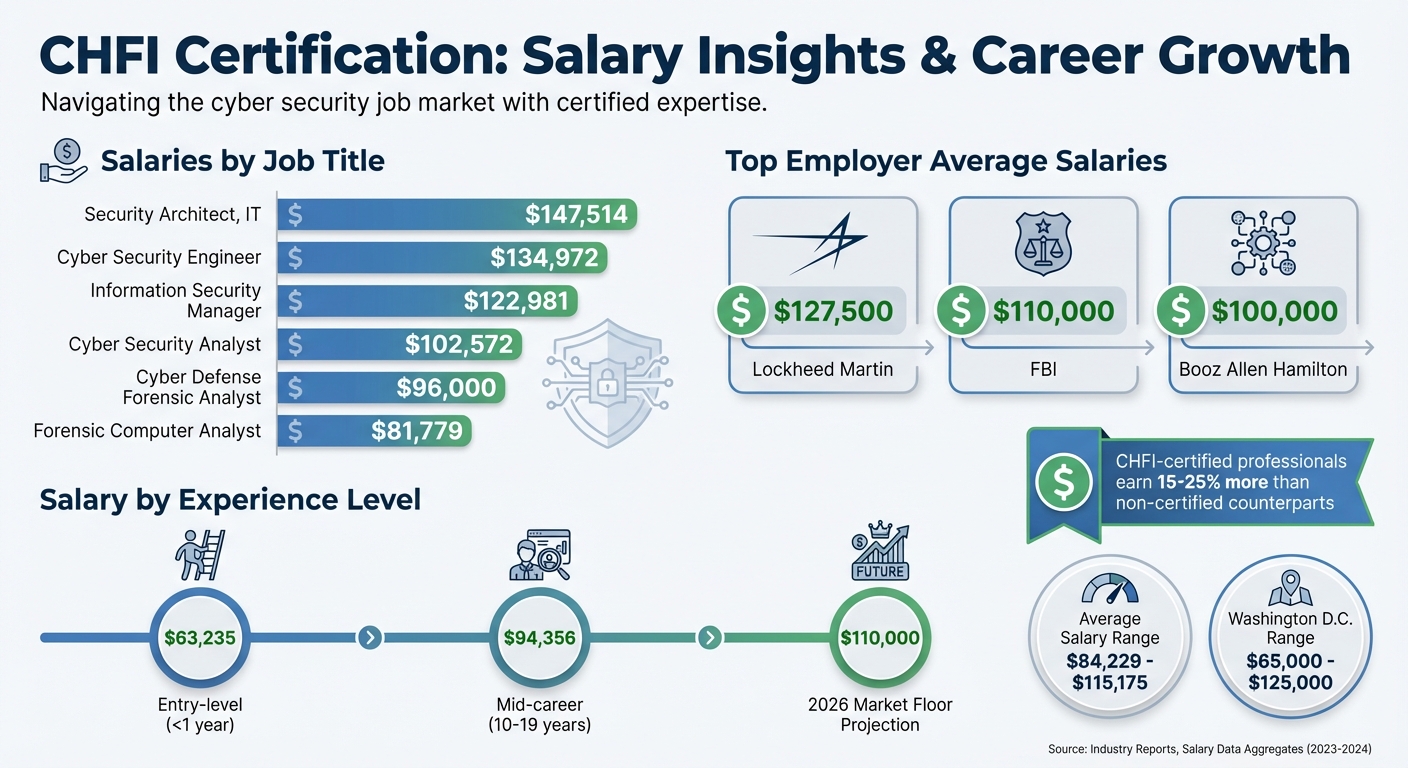
CHFI Certification Career Salaries by Role and Experience Level
Cleared Job Roles that Value CHFI
The CHFI certification opens doors to critical roles within the Department of Defense (DoD), including Forensics Analyst (211), Cyber Defense Forensics Analyst (212), and Cyber Crime Investigator (221) [2]. Beyond these, it’s also highly regarded for positions like Cyber Threat Intelligence Analyst, Incident Responder, Malware Analyst, Tier 2 SOC Analyst, and Security Control Assessor. Leading defense contractors such as Lockheed Martin and Booz Allen Hamilton actively seek CHFI-certified professionals to strengthen their cyber threat response teams [9].
This certification equips professionals with the ability to analyze file systems (e.g., NTFS, ext4, APFS), registry entries, and memory dumps to reconstruct attacker actions – skills that are vital for both legal investigations and internal reviews [7]. Organizations increasingly value forensic readiness to quickly differentiate minor incidents from major cyber threats, making CHFI holders indispensable for both preventive measures and incident response. When paired with incident response expertise, CHFI certification positions you as a standout DFIR (Digital Forensics and Incident Response) specialist [7]. These roles highlight the growing recognition of CHFI across military and federal sectors.
CHFI in DoD and Federal Roles
CHFI certification is firmly rooted in DoD and federal cybersecurity frameworks. It is recognized under DoD Directive 8140 (DoDM 8140.03) as a baseline qualification for the Cyber Security Service Provider (CSSP) Incident Responder role [2][8]. Across military branches, the credential is widely adopted:
- Navy: Applicable to over 100 cybersecurity job roles across 18 occupations, including Cryptologic Technician Networks (CTN) and Digital Forensic Examiners.
- Army: Used for Cyber Operations Specialists and Counterintelligence Agents.
- Marine Corps: Recognized in 79 roles, including Cybersecurity Technicians.
- Air Force: Integrated into 150 cybersecurity positions, such as Cyberspace Warfare Operations [8].
Federal agencies are also expanding their focus to areas like Dark Web forensics, IoT forensics, and Cloud forensics (covering platforms like AWS, Azure, and GCP) [2][3]. If you’re pursuing federal roles, it’s crucial to identify your specific DCWF (DoD Cyber Workforce Framework) code to ensure CHFI meets the required qualification standards [2]. Additionally, federal employees and contractors can save on training costs by using discount codes like "CHFIGOV", reducing the fee from $2,899 to $2,499 [8].
Salary Expectations and Career Growth
The demand for CHFI-certified professionals translates into lucrative salaries and clear pathways for career growth. For example:
- Federal Bureau of Investigation (FBI): Average salary of $110,000 for CHFI holders.
- Lockheed Martin: Average salary of $127,500.
- Booz Allen Hamilton: Average salary of $100,000 [9][10].
By 2026, market data indicates a salary floor of around $110,000 for CHFI-certified roles in the cybersecurity sector [6]. Additionally, certified forensic analysts generally earn 15% to 25% more than their non-certified counterparts [12].
| Job Title | Average Salary |
|---|---|
| Security Architect, IT | $147,514 [10] |
| Cyber Security Engineer | $134,972 [10] |
| Information Security Manager | $122,981 [9] |
| Cyber Security Analyst | $102,572 [10] |
| Cyber Defense Forensic Analyst | $96,000 [9] |
| Forensic Computer Analyst | $81,779 [9] |
The certification not only boosts earning potential but also shortens the hiring process for senior roles, signaling technical expertise to both enterprise and federal employers [6]. Entry-level roles (less than one year of experience) offer starting salaries around $63,235, while professionals with 10–19 years of experience earn a median of $94,356 [9]. In Washington, D.C., a hub for high-clearance roles, CHFI-certified professionals can expect salaries ranging from $65,000 to $125,000 [9].
Moreover, CHFI certification paves the way for specialization in areas like cloud forensics, mobile device analysis, and malware reverse engineering. These fields are experiencing rapid salary growth as businesses increasingly adopt cloud infrastructure [12][11].
Maintaining Your CHFI Certification for Long-Term Career Success
Earning your CHFI certification is a significant step, but maintaining it is just as important for ensuring ongoing success in your career. Keeping your CHFI up to date not only validates your forensic skills but also strengthens your qualifications for high-security roles.
Renewal and Continuing Education Requirements
The CHFI certification remains valid for three years, during which you’ll need to earn 120 ECE credits and pay an annual fee to cover continuing education costs[1]. For professionals working in cleared environments, CHFI is recognized under DoD Directive 8140 (specifically the 8140M release), making it a key qualification for intermediate-level positions in digital forensics and incident response[2].
You can accumulate ECE credits through various professional activities, such as attending conferences, publishing articles, teaching, volunteering, or earning additional certifications. Hosting short training sessions, writing targeted articles, or participating in DFIR conferences are excellent ways to meet these requirements. Additionally, many employers, including defense contractors and federal agencies, provide tuition assistance or funding to help cover these costs.
Combining CHFI with Other Certifications
Pairing CHFI with complementary certifications can amplify your career prospects. For instance, combining CHFI with the Certified Ethical Hacker (CEH) credential offers both offensive and defensive insights, enabling you to reconstruct breach timelines and detect advanced anti-forensic methods[1]. While CHFI equips you for Forensic Analyst roles, adding CEH or Certified Network Defender (CND) can lead to positions like Cyber Defense Analyst or Incident Responder.
If you’re aiming for leadership roles, certifications such as Certified Information Systems Auditor (CISA) or Certified Information Security Manager (CISM) can be valuable additions. These credentials prepare you for responsibilities in risk management and forensic auditing[13]. Many professionals use CHFI as a foundational certification before pursuing specialized credentials like GIAC Certified Forensic Analyst (GCFA).
Networking and Professional Development
Technical skills are essential, but professional development and networking are equally important for career growth. Attending at least one major DFIR conference annually helps you stay informed about the latest tools and techniques, while also offering opportunities to earn ECE credits and grow your professional network[1].
To further refine your expertise, consider creating a tool-to-task matrix. This involves mapping forensic tasks – like memory acquisition or log correlation – to tools such as Volatility, FTK Imager, and Wireshark. This approach not only highlights skill gaps but also guides your future training efforts.
For those seeking career advancement, tracking metrics like "time to scope" and "mean time to contain" from your forensic investigations can showcase your operational impact. Additionally, the ability to present complex forensic findings in clear, concise reports for non-technical stakeholders is a skill that can set you apart in senior-level roles[1][13].
Conclusion
The CHFI certification combines technical forensics expertise with the strategic demands of national security. It equips security-cleared professionals for critical digital forensics roles, recognized under DoD Directive 8140. These roles, including Forensics Analyst, Cyber Defense Forensics Analyst, and Cyber Crime Investigator, offer average salaries between $84,229 and $115,175 annually in the United States[2].
With a curriculum that spans traditional evidence handling, chain-of-custody procedures, and advanced areas like cloud forensics (AWS, Azure, GCP), IoT investigations, and Dark Web analysis, CHFI prepares candidates to meet the rigorous demands of DoD clients[3]. This extensive training ensures cleared professionals are ready to contribute effectively to cyber threat response teams.
The certification’s hands-on approach directly supports secure investigation work, making it a valuable investment for those seeking roles where forensic readiness is a priority[4]. Whether you’re starting a forensics career or transitioning from incident response, CHFI delivers the legal knowledge, technical skills, and DoD-recognized credentials needed to excel in the competitive cybersecurity job market. Digital forensics positions remain among the fastest-growing in the field, making this certification a strategic step forward[14].
FAQs
Is CHFI worth it if I already have a security clearance?
The CHFI certification is definitely worth considering, even if you already have a security clearance. It equips you with specialized skills in digital forensics, which are essential for addressing national security challenges. This certification is formally acknowledged as a crucial qualification for roles in cybercrime investigations and forensic analysis. For professionals in cybersecurity with a clearance, it can significantly enhance your qualifications and open doors to forensic-focused positions.
Can I take the CHFI exam without paying for EC-Council training?
Yes, you can take the CHFI exam without enrolling in EC-Council’s training programs. The certification process supports self-study, allowing candidates to prepare independently. You can also apply for exam eligibility before purchasing an exam voucher, giving you the freedom to choose how you prepare.
How do I prepare for CHFI in a cleared environment (like with remote proctoring rules)?
To get ready for the CHFI exam in a cleared environment with remote proctoring, start by reviewing the EC-Council’s exam policies. Pay close attention to requirements like workspace setup and acceptable forms of ID. Make sure your testing area is secure, quiet, and free from distractions.
Check that your computer and internet connection meet the necessary technical specifications, and test the proctoring software ahead of time to avoid any last-minute issues. On exam day, follow all proctoring rules carefully. Focus your preparation on hands-on labs and study materials to strengthen your practical skills, which are key to success.