

The GIAC Certified Forensic Analyst (GCFA) certification is a must-have for professionals in digital forensics, especially those with security clearance. It validates your ability to handle advanced forensic investigations, including memory forensics, timeline analysis, and detecting anti-forensic techniques. This certification is tailored for roles in government, law enforcement, and defense sectors, where protecting national security is critical.
Key details about the GCFA certification:
- Exam Format: 82 questions, 3 hours, 71% passing score.
- Cost: $999, with a 120-day completion window.
- Focus Areas: Memory forensics, NTFS artifact analysis, timeline reconstruction, and incident response.
- CyberLive Component: Hands-on testing with forensic tools and scenarios.
GCFA certification is highly sought after in the cleared sector, with job roles like Threat Hunter, Incident Responder, and Digital Forensics Specialist often requiring it. Employers value its practical focus, making it ideal for senior-level positions. Average salaries for GCFA-certified professionals range from $106,000 to $130,000 annually.
To succeed, focus on hands-on labs, organize an exam index for quick reference, and practice extensively. The SANS FOR508 course is a recommended resource. This certification not only boosts your skills but also opens doors to advanced roles in the cybersecurity field.
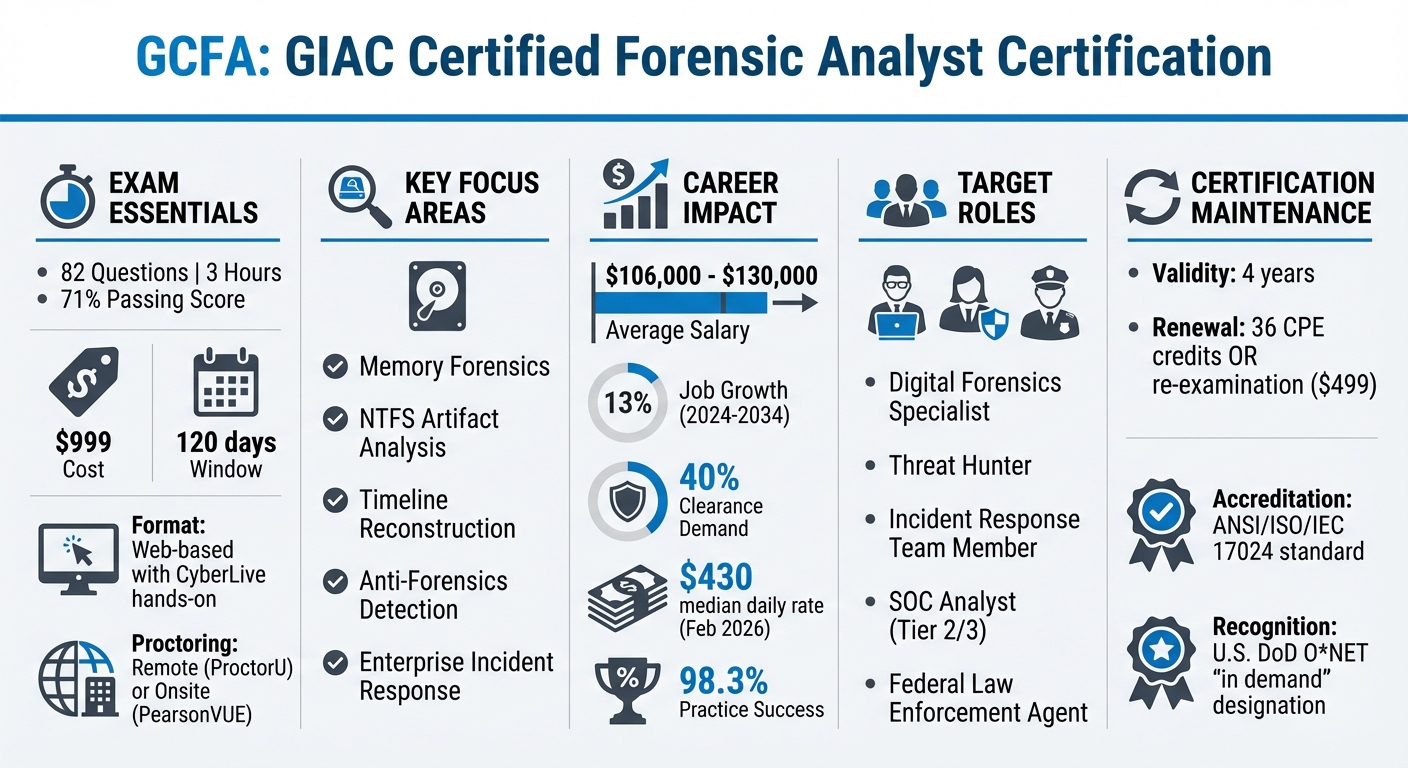
GCFA Certification Quick Reference Guide: Exam Details, Costs, and Career Outcomes
Ultimate Guide to GIAC Certified Forensic Analyst (GCFA) | Exam Domains, Tips & Study Resources
sbb-itb-bf7aa6b
Why GCFA Certification Matters for Cleared Forensic Analysts
This section highlights how the GCFA certification enhances your technical expertise, opens doors to better career opportunities, and strengthens your professional standing.
Advanced Technical Skills in Incident Response and Forensics
Earning the GCFA certification equips you with the skills to tackle the unique challenges faced by government and defense agencies. You’ll gain expertise in memory forensics, allowing you to identify volatile threats like code injection and rootkits. This includes spotting malicious processes, suspicious drivers, and advanced malware designed to evade detection.
Another key focus is timeline analysis, which helps you reconstruct events by examining Windows filesystem timestamps and NTFS artifacts. This technique enables you to pinpoint the sequence of an attack and assess what data may have been compromised during a breach.
The certification also sharpens your ability to detect and counter anti-forensics techniques – methods attackers use to erase or obscure evidence. By mastering the analysis of both memory and disk-resident artifacts, you’ll be prepared to uncover hidden activity, a critical skill when dealing with Advanced Persistent Threats (APTs) in highly secure environments.
These advanced capabilities not only enhance your technical skill set but also open the door to more specialized and senior roles.
More Job Opportunities in the Cleared Sector
GCFA certification significantly boosts your prospects for high-level roles in the cleared sector. As of early 2026, 40% of contract job postings in England requiring GCFA certification also demanded "Security Cleared" status, with another 10% specifying "SC Cleared" requirements [4]. The demand for Information Security Analysts, which includes forensic analysts, is expected to grow by 13% between 2024 and 2034 [5].
Combining GCFA certification with clearance positions you for roles such as Threat Hunter, Incident Response Team Member, and Federal Law Enforcement Agent [1][3]. The certification is officially recognized as aligning with military occupational specialties and holds accreditation from the American National Standards Institute (ANSI) [3].
Additionally, GCFA-certified professionals are highly valued in contract roles, with a median daily rate of $430 as of February 2026 [4]. Employers often seek candidates who hold complementary credentials – 100% of GCFA-related job ads also listed CISSP and Incident Response expertise as required skills [4].
Professional Credibility in the Cleared Community
GCFA certification does more than enhance your skills – it solidifies your reputation within the cleared community. Designated as "in demand" by the U.S. Department of Labor’s O*NET system [3], this certification signals to federal hiring managers that you are specifically trained for their needs. GIAC identifies federal agents and law enforcement professionals as a key audience for the GCFA [1], making it clear to cleared employers that you’re equipped for their operational challenges.
The certification’s CyberLive testing component is a standout feature. By requiring candidates to solve real-world problems using actual tools, code, and virtual machines [1], it demonstrates your readiness to handle complex forensic tasks from day one.
As an advanced-level certification, GCFA typically requires more than two years of professional experience [3][5], signaling to employers that you’re prepared for senior-level responsibilities. The requirement to renew the certification every four years through Continuing Professional Development or re-examination ensures that your skills stay current with evolving threats [3][5]. This ongoing commitment to learning further reinforces your value in the field.
What to Expect on the GCFA Exam
The GCFA exam includes 82 questions, must be completed in 3 hours, and requires a 71% passing score. The exam costs $999 and must be taken within a 120-day window after registration [1][6]. It’s tailored for professionals in forensic roles who need to demonstrate both theoretical understanding and practical skills.
One standout feature of this exam is the CyberLive component. This is a hands-on testing environment where candidates use real forensic tools, virtual machines, and code to solve practical problems. It ensures that participants can apply their knowledge in real-world scenarios, not just answer theoretical questions [1]. Matt Swenson, SVP and Deputy General Manager of Operations and Security Services at the Center for Internet Security, highlights its importance:
"CyberLive is a game changer in the certification world. The virtualized environment emulates the real world, forcing the candidate to demonstrate hands-on practical knowledge that can’t be faked" [9].
Let’s break down the exam’s main content areas and structure.
Exam Content and Focus Areas
The GCFA exam tests your ability to apply forensic techniques to specific scenarios. Here’s a closer look at what it covers:
- Memory Forensics: You’ll identify malicious processes, detect code injections, locate rootkits, and analyze suspicious drivers in Windows memory [6].
- Timeline Analysis: This involves reconstructing attack sequences by collecting and processing Windows filesystem data [1][6].
- NTFS Artifact Analysis: A significant portion of the exam focuses on analyzing Windows file system data, metadata, and filename structures [6].
- Anti-Forensics Detection: You’ll need to spot and counter methods attackers use to conceal their activities [1][2].
- Enterprise Incident Response: This section assesses your ability to scale forensic tools and understand adversary tactics, skills that are crucial for working with secured government and defense networks. You’ll analyze both volatile memory and non-volatile disk evidence to uncover malicious activity [1][6].
Exam Structure and Passing Requirements
The exam can be taken remotely through ProctorU or at an onsite PearsonVUE testing center [2]. It features a web-based format that combines traditional multiple-choice questions with CyberLive challenges, which require you to perform real forensic tasks [2].
This certification is aimed at experienced forensic analysts, incident responders, and threat hunters. While not mandatory, work experience or completing the FOR508 course is highly recommended [2][6][8]. For candidates who received exam access on or after March 18, 2023, a 71% passing score is required. Make sure to confirm your specific requirements in your GIAC account [1][2].
To help you prepare, practice exams are included with most certification purchases. These allow you to familiarize yourself with the CyberLive environment and question formats [1][9]. As of early 2026, preparation platforms reported a 98.3% high score rate among users practicing with updated materials [7].
How to Earn Your GCFA Certification
Getting your GCFA certification doesn’t require formal prerequisites, but having a strong technical background and a clear preparation plan makes all the difference. GIAC designed this certification for professionals in advanced roles like incident response team members, SOC analysts, threat hunters, experienced digital forensic analysts, federal agents, law enforcement officers, red team members, penetration testers, and exploit developers. While there’s no mandatory educational requirement to take the exam, many roles in digital forensics often look for a bachelor’s degree in computer science or a related field.
Prerequisites and Recommended Background
You don’t need prior certifications or formal education to register for the GCFA exam. However, GIAC stresses the importance of hands-on experience, especially for the CyberLive portion of the test. A solid grasp of advanced incident response, digital forensics, memory forensics, timeline analysis, and spotting anti-forensic techniques – like those used in APT intrusions – is highly encouraged.
"Practical work experience can help ensure that you have mastered the skills necessary for certification." – GIAC
Experience with virtual machines and forensic tools is a key advantage. If your job involves regular incident response or forensic investigations, especially in a secured environment, you’ll find that these real-world scenarios can significantly boost your readiness for the exam.
Registration Process and Study Resources
Once you’re ready, the registration process is straightforward. Head to the GIAC website to complete your application, agree to the GIAC Code of Ethics, and pay the $999 exam fee. From the moment you activate your exam, you’ll have 120 days to complete it. Be sure to activate only when you’re prepared to start studying, as the countdown begins immediately.
You can choose between two proctoring options:
- Remote proctoring through ProctorU
- Onsite testing at PearsonVUE centers (requires two forms of ID, including one with a photo and signature)
- Military/DoD testing centers, which accept valid U.S. military IDs
Keep in mind, arriving more than 15 minutes late to your exam results in forfeiture, and rescheduling will cost $175.
The SANS FOR508: Advanced Incident Response, Threat Hunting, and Digital Forensics course is the primary training resource recommended by GIAC. This course includes about 35 hands-on labs and offers various pricing options. Cleared professionals may qualify for reduced rates, and the SANS Work Study Program can lower costs to approximately $2,500. Alternatively, SANS Graduate Certificate Programs, which include the exam, range from $5,500 to $5,700. For additional study materials, platforms like DoD COOL often provide access to resources like O’Reilly Learning Safari Books Online.
Effective Study and Practice Strategies
Since the GCFA exam is open-book – but doesn’t allow electronic devices or internet access – it’s essential to create a detailed, well-organized physical index of your course materials. Alphabetize keywords and include page numbers to quickly locate information during the three-hour test. This index can save you valuable time.
Revisit all labs to sharpen your skills and troubleshoot efficiently. GIAC’s official practice tests are another critical tool – they replicate the test environment and help you pinpoint areas where you need improvement. Allocate about 30 to 40 minutes for the CyberLive sections during the exam to ensure you stay on track.
To excel, focus on understanding normal system behaviors so you can easily spot anomalies. For example, study indicators like Windows Event ID 4624 (successful logon). Familiarize yourself with tools such as Volatility, PowerShell, and command-line interfaces to deepen your technical expertise.
Supplement your preparation with books like The Art of Memory Forensics, Windows Registry Forensics, and File System Forensic Analysis. These resources offer valuable insights into advanced forensic techniques. Remember, your GCFA certification remains valid for four years and can be renewed by earning 36 Continuing Professional Education credits or retaking the exam for $499.
Using GCFA Certification to Find Cleared Jobs
Finding GCFA-Related Jobs on Cleared Cyber Security Jobs
Cleared Cyber Security Jobs makes it easier to search for roles requiring GCFA certification. Start by filtering for "GCFA" and pairing it with terms like "Forensic Analyst" or "Incident Responder" to refine your results. The platform’s advanced filters are designed to help you pinpoint cleared positions that match your expertise.
To stay ahead of the competition, upload your resume and enable job alerts. Employers value candidates with GCFA certification because it proves hands-on skills through the CyberLive testing component. This certification goes beyond theory, requiring candidates to perform practical tasks using real programs and virtual machines [1][2].
The GCFA certification is a strong match for roles such as Digital Forensics Specialists, SOC Analysts (Tier 2/3), Incident Response Team Members, Threat Hunters, and even Federal Agents. Recognized as "in demand" and tied to military occupational specialties, it’s particularly relevant for positions in defense and intelligence sectors [1][11]. Once you’ve applied, how you present your credentials can make all the difference.
Presenting Your GCFA Certification to Employers
Make your GCFA certification stand out by listing it prominently on your resume and LinkedIn profile. Include it in the certifications section and mention it in your professional summary to immediately highlight your qualifications for advanced forensic roles. The certification’s ANAB accreditation under the ISO/IEC 17024 standard further emphasizes its credibility [11].
Highlight the specialized skills you’ve developed through GCFA training, such as Memory Forensics, Timeline Analysis, Threat Hunting, and advanced incident response methods. Tailor your application to match the technical requirements of cleared positions. During interviews, be ready to discuss how you identify unusual system behavior, preserve volatile evidence, and use tools like Volatility and PowerShell to uncover threats.
While presenting your credentials is critical, building a professional network can significantly boost your career opportunities.
Building Your Professional Network with GCFA Certification
Participate in job fairs hosted by Cleared Cyber Security Jobs to connect with hiring managers in the cleared cybersecurity field. Mentioning your GCFA certification early in conversations can establish your technical expertise and readiness to handle complex forensic challenges.
Use networking events to explain how your GCFA training has prepared you to manage forensic investigations and lead incident response efforts. These discussions not only highlight your skills but also demonstrate your value in a competitive job market. Building these connections strengthens your professional presence and aligns with your career advancement goals.
Conclusion
This guide has covered everything from exam specifics to preparation tips, emphasizing how the GCFA certification strengthens your role in cleared cybersecurity. For forensic analysts working in this space, the GCFA certification is a smart career move. It proves your ability to tackle complex incident response challenges – like advanced persistent threats and anti-forensic methods – and showcases your skills through hands-on CyberLive testing [1]. By blending in-depth training with practical testing, this certification enhances your technical capabilities and opens doors to exclusive career opportunities.
With average salaries around $106,000 per year and consulting roles reaching $130,000, the financial benefits make the investment worthwhile [10].
To succeed, focus on the SANS FOR508 course, organize study materials for the open-book exam, and repeatedly practice labs to develop critical muscle memory. A structured and consistent approach makes passing the exam entirely achievable [2].
The cleared sector highly regards the GCFA certification for its vendor-neutral framework and alignment with military occupational specialties. Whether you’re aiming for roles like Digital Forensics Specialist, Tier 3 SOC Analyst, or Threat Hunter, this certification can help you access roles that non-certified professionals can’t reach. Beyond unlocking advanced roles, it lays a foundation for continuous career development.
Remember, certification is just the beginning of your professional journey. Keep your GCFA certification active by earning 36 CPE credits every four years or retaking the exam for $499 [10].
In short, the GCFA certification connects your technical expertise with secure job opportunities. Stay proactive – search for relevant roles and set up job alerts to stay ahead in the competitive field of cleared cybersecurity. Combining your security clearance with a GCFA certification sets you apart for top-tier roles in this industry.
FAQs
What advantages does the GCFA certification offer for security-cleared forensic analysts?
The GCFA certification is a respected credential that highlights advanced skills in digital forensics and incident response. It confirms your expertise in collecting, analyzing, and preserving digital evidence from systems like Windows and Linux – an essential qualification for forensic analysts working with sensitive data.
This certification prepares professionals to handle complex issues, including advanced persistent threats, anti-forensic methods, and memory forensics. It strengthens your professional credibility, opens doors to career advancement, and sets you up for leadership roles in forensic investigations and cyber defense within high-security environments.
For those with security clearances, the GCFA certification demonstrates the ability to tackle sophisticated forensic challenges, making it a valuable asset for career growth and recognition in cybersecurity.
What is the role of CyberLive in enhancing the GCFA certification?
The CyberLive component adds a dynamic layer to the GCFA certification by providing hands-on training that goes beyond theoretical concepts. It immerses candidates in simulated scenarios that mirror actual incidents, giving them the chance to tackle complex forensic cases, uncover advanced threats, and spot anti-forensic techniques used by attackers.
This hands-on approach equips candidates with the skills they need to manage real-world incidents confidently and effectively. It also enhances their preparedness for roles such as incident response, threat hunting, and digital forensic analysis. By including CyberLive, the GCFA certification becomes an even stronger credential for professionals navigating today’s challenging cybersecurity environment.
What are the best strategies to prepare for the GCFA certification exam?
To ace the GCFA certification exam, it’s important to focus on mastering the core concepts, gaining practical skills, and leveraging reliable study tools. Key areas to prioritize include memory forensics, timeline analysis, Windows/NTFS artifacts, incident response, and recognizing malicious activity. You’ll also need a solid understanding of forensic tools like Volatility, Prefetch, and Event Logs.
Hands-on experience plays a major role, as the exam leans heavily on practical, real-world scenarios. Enrolling in official training – such as the SANS FOR508 course – can provide structured guidance. Supplement this with practice exams to boost your confidence and identify areas for improvement.
Since the GCFA exam is open-book, organizing your study materials efficiently is a game-changer. Spend time familiarizing yourself with your resources so you can quickly reference them during the test. By blending focused study, practical practice, and smart preparation strategies, you’ll set yourself up for success.