

The GIAC Certified Incident Handler (GCIH) certification is a respected credential for cybersecurity professionals, especially those in government and defense roles requiring security clearances. It validates your ability to detect, respond to, and resolve security incidents, meeting DoD 8570/8140 compliance standards. The certification involves hands-on CyberLive testing and covers key topics like incident handling frameworks (PICERL), password attacks, and AI-driven threats. With salaries ranging from $70,000 to $150,000, it opens doors to roles such as SOC Analyst, Incident Responder, and Security Architect.
Key points:
- Cost: $999 for the first attempt, $899 for retakes, $499 for renewals every 4 years.
- Exam: 106 questions, 4-hour time limit, passing score of 69%.
- Study Resources: SANS SEC504 course (approx. $7,000) and practice tests ($399 each).
- Compliance: Meets DoD 8570/8140 requirements for IAT Level III and CSSP roles.
- Job Opportunities: Employers like Raytheon, Leidos, and Northrop Grumman actively seek GCIH-certified professionals.
The GCIH equips you with practical skills for high-security environments, ensuring you’re prepared to handle advanced threats and compliance requirements. Whether starting out or advancing your career, this certification is a strong step forward in cybersecurity.
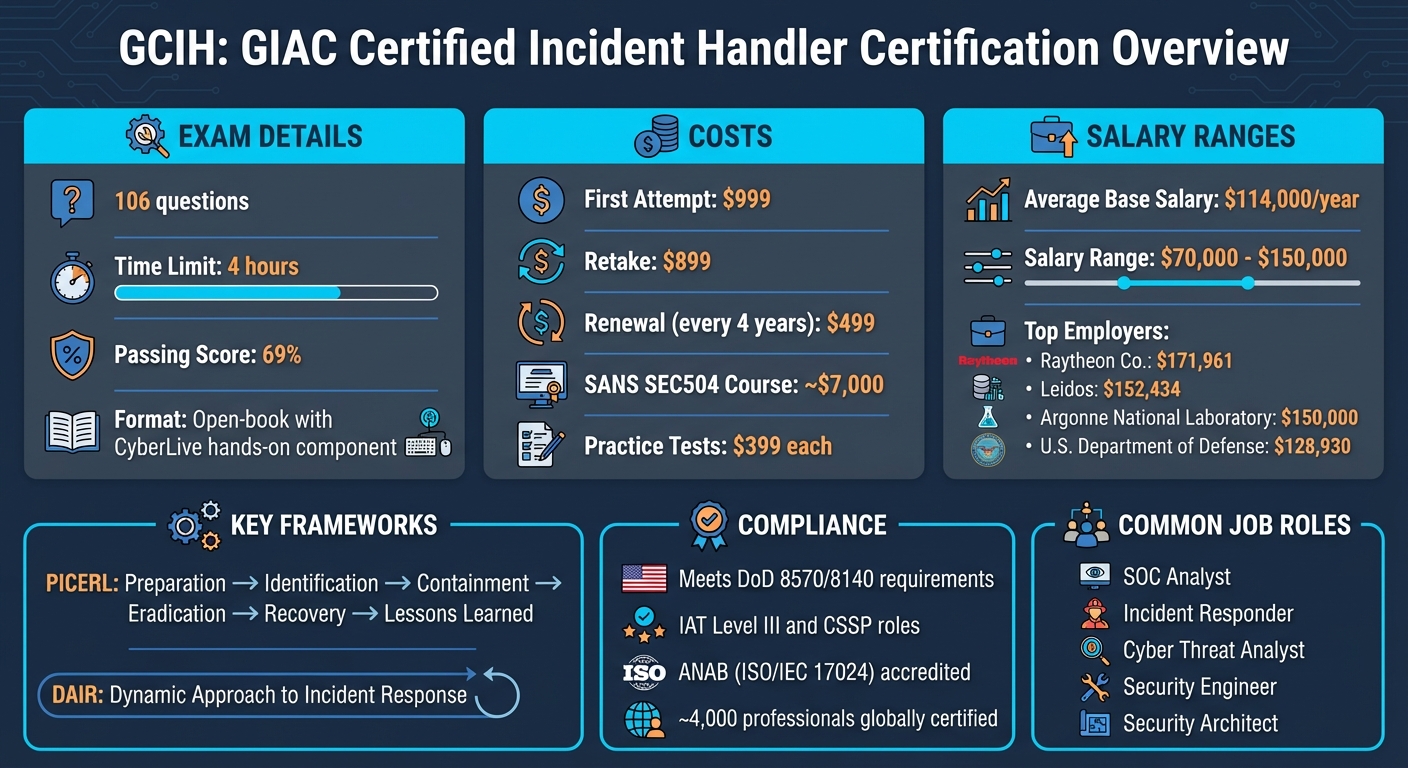
GCIH Certification Quick Reference: Costs, Exam Details, and Salary Ranges
Complete GIAC GCIH Certification Guide Sec504: In-Depth Review & Study Tips + Index Strategies
What is the GCIH Certification?
The GIAC Certified Incident Handler (GCIH) proves your ability to identify, respond to, and resolve computer security incidents using essential defensive techniques. This certification is tied to the SANS SEC504 course (Hacker Tools, Techniques & Incident Handling) and holds ANAB (ISO/IEC 17024) accreditation, meaning it meets internationally recognized standards for certification programs.
One aspect that makes GCIH stand out is its CyberLive testing component, which includes hands-on tasks in a virtual lab environment. You’ll use real tools, code, and virtual machines to tackle challenges like analyzing suspicious network traffic or identifying persistence mechanisms on compromised systems.
"The GIAC Incident Handler (GCIH) certification validates a practitioner’s ability to detect, respond, and resolve computer security incidents using a wide range of essential security skills." – GIAC [1]
The cost for the certification is $999 for the first attempt, with retakes priced at $899. Renewals are required every 4 years and cost $499. With about 4,000 professionals globally holding this credential, it remains a specialized certification that highlights advanced incident response skills for roles in high-security environments. Next, we’ll dive into the exam format and the topics it covers.
Exam Format and Topics Covered
The GCIH exam includes 106 questions to be completed within a 4-hour time limit, with a passing score of 69% for attempts activated on or after May 10, 2025. It’s an open-book exam, allowing candidates to bring printed references. Many test-takers prepare alphabetized indexes to quickly locate commands and tool flags during the test.
The exam is structured around the PICERL framework – Preparation, Identification, Containment, Eradication, Recovery, and Lessons Learned – which ensures a comprehensive approach to incident handling. You’ll also work with the DAIR framework (Dynamic Approach to Incident Response), which focuses on parallel investigations and efficient scoping.
Key topics include:
- Attacking passwords
- Detecting evasive techniques
- Endpoint attack and pivoting
- SMB security
- Web application injection attacks
Recent updates to the exam reflect new challenges, such as "Integrating LLMs with Offensive Operations" and "Malware and AI Assisted Investigations" [1][3]. These additions ensure the certification stays relevant as attackers increasingly adopt AI-powered tools.
The CyberLive portion tests your ability to perform command-line triage using tools like netstat, lsof, and wmic on Windows and Linux systems. You’ll map suspicious activity to executables and identify persistence mechanisms like scheduled tasks or cron jobs. This part of the exam emphasizes distinguishing normal system behavior from malicious anomalies – a skill critical for avoiding unnecessary investigations in classified environments.
Practical Tools and Skills
The GCIH certification ensures you can use common offensive tools defensively. For example:
- Nmap: Helps you understand network discovery and port scanning patterns.
- Metasploit: Teaches you about exploitation modules and payloads.
- Netcat: Prepares you to identify networking backdoors and covert communications.
By mastering these tools, you’ll be better equipped to recognize the "fingerprints" attackers leave behind. For instance, identifying Nmap scanning patterns in network logs can alert you to reconnaissance activity before a breach occurs.
The certification also dives into Tcpdump and Wireshark for analyzing packet captures and spotting malicious traffic. You’ll learn to investigate vulnerabilities like open RDP ports, default credentials, and outdated SSL configurations – issues often exploited in breaches targeting government and defense systems.
"This is not a ‘study and pass’ exam – it’s a performance exam that tests what you can actually do." – FlashGenius [5]
Beyond technical tools, GCIH emphasizes maintaining a proper chain of custody for digital evidence and documenting every step of an investigation. You’ll also learn to treat identity as the new security perimeter in cloud-focused environments. These skills are essential for incident handlers working in roles where compliance with federal standards and evidence handling procedures are critical.
Why GCIH Matters for Cleared Incident Handlers
The GCIH certification is tailored for professionals working within classified networks and high-security government environments. It goes beyond general cybersecurity credentials by validating your ability to operate effectively under the strict rules and constraints of cleared facilities. These environments rely heavily on pre-approved procedures and internal resources during incidents, and the GCIH’s open-book format and CyberLive testing simulate these real-world limitations.
For cleared professionals, the GCIH delivers immediate relevance by focusing on detecting threats that have already bypassed perimeter defenses. You’ll develop expertise in identifying persistence mechanisms – like scheduled tasks and registry modifications – that attackers use to maintain access to sensitive systems. Additionally, it covers critical skills such as recognizing lateral movement patterns and credential theft techniques, which are vital when a single compromised account could jeopardize an entire classified network.
Let’s take a closer look at how compliance requirements and advanced operational skills make the GCIH indispensable for cleared professionals.
DoD 8570/8140 Compliance
The GCIH certification fulfills baseline requirements for IAT Level III roles and several Cyber Security Service Provider (CSSP) positions, including Analyst and Incident Responder roles [7]. Within the updated DoD 8140 framework, it serves as a Foundational Qualification for cyber defense roles as defined by the DoD Cyberspace Workforce Framework (DCWF) [9].
Meeting compliance deadlines is critical for career progression. The foundational qualification deadline for the Cybersecurity Workforce is February 15, 2025, with residential (on-the-job) qualification compliance required by February 15, 2026 [9]. Staying on track with these timelines ensures you remain eligible for career advancement and role retention.
"As our C4 systems become netcentric and more linked with our weapons systems, it is essential that our IA workforce be up to the task of securing our networks." – Mike Knight, Naval NetWar Command [7]
Beyond meeting these baseline requirements, GCIH holders are expected to complete annual Continuing Professional Education (CPE) or equivalent 20-hour requirements [9]. While compliance establishes your eligibility, the advanced skills gained through GCIH training help ensure success in high-security roles.
Skills for Secure Environments
Building on compliance standards, the GCIH equips you with the skills needed to thrive under the tight security controls typical of cleared environments.
Recent updates to the certification reflect the latest threats to classified networks. New exam objectives include detecting AI-driven attacks, incorporating Large Language Models (LLMs) into operations, and using AI tools to enhance malware investigations [8]. These updates address the growing use of AI-powered tactics by adversaries to bypass traditional detection methods in high-value environments.
The GCIH also focuses on skills critical for air-gapped or restricted networks. You’ll learn how to investigate breaches using only the tools and logs available within secure boundaries. This includes mastering endpoint analysis techniques for both Windows and Linux systems, enabling you to piece together events across server, network, and endpoint logs – without relying on automated security platforms that may be disallowed in classified settings.
The CyberLive component tests your ability to perform under pressure. You’ll use command-line tools like netstat, lsof, and wmic to identify suspicious processes and network activity in environments where GUI-based security tools are either unavailable or restricted [8]. This hands-on practice ensures you’re prepared to handle incidents effectively, even in the most constrained operational settings.
How to Get the GCIH Certification
The process to earn the GCIH certification is straightforward, especially for professionals in cleared roles. This certification is a key step for incident handlers aiming to advance their careers. While there are no formal prerequisites for the exam, practical experience is crucial due to its hands-on nature. Here’s a breakdown of what you need to know about eligibility, preparation, and maintaining this certification.
Eligibility and Prerequisites
You don’t need formal education or prior certifications to register for the GCIH exam [4]. Once you pay the registration fee, you’re free to schedule your attempt. However, because the CyberLive component of the exam involves real-world tasks in virtual environments, hands-on experience is critical [1][3].
The certification is aimed at incident handlers, system administrators, and security professionals familiar with network protocols and system security [10][6]. Although GIAC doesn’t require a security clearance for the exam itself, roles that demand the GCIH often require U.S. citizenship and an active Secret or Top Secret clearance. If you’re pursuing this certification for a DoD 8570/8140 position, ensure your clearance is up to date.
Once you’ve confirmed your eligibility, it’s time to dive into preparation and study resources.
Study Resources and Preparation
The SANS SEC504: Hacker Tools, Techniques, and Incident Handling course is the primary resource for GCIH exam preparation. This course covers key topics like reconnaissance, exploitation, and defense strategies [10][11]. The course fee, when bundled with the exam, is about $7,000, but the SANS Work Study program can cut this cost by approximately $5,000 if you’re willing to assist with event moderation [11]. If employer funding isn’t an option, the Work Study program is an excellent alternative.
Since the GCIH exam is open-book, creating a custom, printed index is essential. Electronic devices are not allowed during the test, so organizing your materials on paper is critical [4]. Build your index around attacker methodologies, ports, protocols, and specific tools like Nmap, Metasploit, and Netcat [10][11]. A personalized index tailored to your study approach will be far more effective than generic ones.
Hands-on practice is another crucial part of preparation, especially for the CyberLive sections. Focus on tools like Wireshark for packet analysis, Snort for intrusion detection, Metasploit for exploitation, and Nmap for scanning [10]. GIAC practice tests, available for $399 each, mimic the real exam and help identify areas where you need improvement [4][11].
"Since GIAC will only test your knowledge of the course contents, the only resource you will need are the provided books." – Wyatt Tauber, Security Professional [11]
With your preparation in place, it’s time to understand the registration process and how to keep your certification active.
Registration and Renewal
To register, visit the GIAC website and pay the $999 exam fee [4]. Once approved, you’ll have 120 days from the activation date to complete the exam [1][4]. Missing this deadline means paying $479 for a 45-day extension or forfeiting your attempt entirely, so set a reminder to avoid unnecessary costs.
For exam logistics, you can choose between remote proctoring via ProctorU or in-person testing at PearsonVUE centers. If testing remotely, ensure you have enough desk space for your reference materials and printed index [11].
The GCIH certification is valid for four years, after which you’ll need to renew it [12][6]. There are two options for renewal: accumulate 36 Continuing Professional Education (CPE) credits or retake the current exam [12][4]. You can earn CPEs through SANS training, accredited courses, university programs, publishing related works, cyber ranges, or mentoring activities [4]. The renewal fee is $499, but additional renewals within two years of a full-price renewal are discounted to $249 [4]. To avoid last-minute stress, track your CPEs quarterly. This steady approach aligns with compliance timelines and ensures you’re always prepared for career advancements in cleared roles.
sbb-itb-bf7aa6b
Job Opportunities for GCIH-Certified Cleared Professionals
Earning a GCIH certification opens doors to coveted roles in defense contracting and government sectors. Employers like Raytheon, Leidos, Northrop Grumman, and the U.S. Department of Defense actively recruit GCIH-certified candidates for critical security positions [15]. This certification’s focus on hands-on incident handling and compliance makes it particularly valuable in environments requiring security clearances, where practical expertise is essential. These career opportunities highlight how the GCIH directly supports advancement in cleared roles.
Common Cleared Roles Requiring GCIH
Some of the most in-demand positions for GCIH-certified professionals include Incident Handlers and SOC Analysts at various levels. These roles center on identifying, investigating, and responding to security threats [13]. Cyber Threat Analysts contribute by providing focused threat intelligence and participating in both incident response and threat hunting. Meanwhile, Security Engineers and Incident Response Analysts handle complex investigations while maintaining high security standards [13].
Specialized roles, such as ICS Security Engineers and Cyber Security Software Engineers, also frequently list GCIH as a preferred qualification [13]. Leadership positions, like Cyber Defense SOC Lead at companies such as Mandiant (Google Cloud), often require GCIH certification and the ability to secure a Top Secret/SCI clearance [14]. Most cleared roles demand U.S. citizenship and either Secret or Top Secret clearance, emphasizing the certification’s alignment with high-security environments. These roles not only validate technical skills but also offer clear pathways for career growth in secure, compliance-driven organizations.
Salary Expectations and Market Demand
The strong demand for GCIH-certified professionals translates into competitive salaries. On average, base salaries hover around $114,000 per year, with ranges from $70,000 to $150,000 depending on experience and job type [2][15]. For instance, Information Security Managers can earn up to $148,505, while Cyber Security Engineers average $129,571. Entry-level roles, such as Cyber Security Analysts, typically start near $84,236 and average around $98,320 [15].
Top employers offer even higher compensation for GCIH holders. For example:
- Raytheon Co.: $171,961
- Leidos: $152,434
- Argonne National Laboratory: $150,000
Government agencies, like the U.S. Department of Defense, also offer competitive salaries, averaging $128,930 for GCIH-certified professionals. The ongoing shortage of skilled incident handlers continues to elevate the value of this certification, making it a smart investment for cleared professionals aiming to advance their careers [2].
Using Cleared Cyber Security Jobs to Find GCIH Roles
After earning your GCIH certification, Cleared Cyber Security Jobs can connect you with employers actively seeking professionals with your expertise. The platform’s search tools let you filter job opportunities by entering "GCIH", your clearance level (like TS/SCI or Polygraph), and your preferred location. This focused approach ensures you’re zeroing in on positions where your certification aligns with employer needs. Below, we’ll explore how to locate these roles, fine-tune your resume, and make the most of job fairs.
Finding GCIH-Required Positions
Cleared Cyber Security Jobs leverages Boolean and semantic matching to pair your profile with roles specifically requiring GCIH-certified professionals. Once you upload your cleared profile and resume, the system identifies positions that match your credentials and clearance level. You can also set up job alerts to get notified when new opportunities arise. Some common roles that often call for GCIH certification include Incident Response Analyst, Cyber Threat Analyst, Security Engineer (SOC), and ICS Security Engineer.
Top defense contractors like TEKSYNAP, Lockheed Martin Space, Peraton, General Dynamics IT, Leidos, and Northrop Grumman frequently advertise positions on the platform. If you’re targeting specific regions or companies, consider attending hiring events such as the Virtual Huntsville Hiring Event on February 19, 2026, where employers actively seek cleared incident handlers.
Highlighting GCIH on Your Resume
To make your GCIH certification stand out, tailor your resume to clearly communicate your expertise and clearance level. Highlight the CyberLive component of your certification to demonstrate hands-on skills. Use keywords that recruiters look for, such as GCIH, CyberLive, Incident Handling, PICERL, and DoD 8140. Don’t just list your certification – illustrate how you’ve applied these skills in real scenarios. For instance, you might describe how you used GCIH methodologies to detect and contain a credential-stuffing attack.
Also, emphasize your experience with PICERL and tools like Nmap and Metasploit, but skip explaining their basic functions – recruiters in this field already understand them. When you attend job fairs, your resume is automatically linked to your profile, making it easier for employers to follow up after networking.
Networking at Job Fairs
Job fairs hosted by Cleared Cyber Security Jobs, whether virtual or in-person, offer direct access to recruiters from leading defense contractors like Lockheed Martin, Northrop Grumman, and Peraton. When speaking with recruiters, position your GCIH certification as proof of advanced, practical skills that go beyond entry-level or theoretical qualifications. Upcoming events include the Cleared Careers Hiring Event at UCCS on April 2, 2026, and the Nationwide Virtual Hiring Event on May 12, 2026.
These events provide an excellent opportunity to connect with hiring managers who understand the value of GCIH certification in high-pressure environments requiring quick incident detection and resolution. With only about 4,000 GCIH certification holders globally [2], your credential stands out as a mark of specialized expertise. Use these events to share real-world examples of how you’ve applied your CyberLive-validated skills to solve complex challenges.
Conclusion
The GCIH certification reshapes how you approach incident response, proving your ability to detect, respond to, and resolve incidents in high-pressure, secure environments [3][1]. This hands-on validation sets you apart in a specialized group of cybersecurity professionals [2].
Earning this certification can have a direct impact on your career. For professionals with security clearances, the GCIH not only satisfies DoD 8570/8140 compliance requirements but also demonstrates readiness for advanced roles like SOC analyst, threat hunter, and incident responder [16]. Its focus on modern threats – such as securing cloud credentials and defending against AI-specific attacks on Large Language Models – ensures your skills stay aligned with the constantly evolving threat landscape [3][5].
Whether you’re targeting opportunities with major defense contractors like BAE Systems or pursuing specialized paths in penetration testing and digital forensics [17], the GCIH certification serves as a cornerstone for building a strong cybersecurity career. Mastering frameworks like PICERL and DAIR equips you with repeatable, structured methodologies essential for secure environments, where quick triage and isolation of compromised systems can make all the difference [5].
This certification also opens doors to exciting job opportunities. Platforms like Cleared Cyber Security Jobs connect you with employers who recognize the value of your GCIH expertise. Attending job fairs allows you to network directly with hiring managers who understand your skill set, while maintaining your certification through CPE credits ensures you stay competitive. By investing in the GCIH, you position yourself as a leading expert in incident handling within the cleared community, making you an indispensable asset in defending against today’s cyber threats.
FAQs
Why is the GCIH certification important for professionals with security clearances?
The GCIH certification holds significant importance for professionals with security clearances. It highlights their ability to identify, respond to, and address cybersecurity incidents – essential skills for protecting sensitive or classified information in secure settings.
Achieving this certification not only boosts a professional’s credibility but also demonstrates their readiness to tackle real-world cyber threats. It can pave the way for career growth in incident handling and other cybersecurity roles, especially in organizations where security clearances are a top priority.
How does the GCIH certification help you address AI-driven cyber threats?
The GCIH certification prepares cybersecurity professionals to handle a wide range of cyber threats, including those amplified by AI and machine learning. It focuses on teaching the skills needed to identify, respond to, and mitigate these threats effectively. By diving into attacker techniques and response strategies, this certification ensures that professionals are equipped to tackle modern challenges, such as automated and AI-driven attacks.
Hands-on training is a key part of the GCIH certification. Using tools like Nmap, Metasploit, and Netcat, participants gain practical experience in detecting and neutralizing advanced attack methods. Additionally, the certification emphasizes a structured approach to incident response. This includes every critical phase – preparation, identification, containment, eradication, and recovery – helping professionals stay ready to counter evolving threats and maintain strong defenses in practical, high-stakes situations.
What career opportunities are available for GCIH-certified professionals in secure environments?
Professionals holding a GCIH certification can step into a variety of roles within high-security environments, especially in the fields of incident response and management. These roles are crucial for organizations such as government agencies, the military, and sectors responsible for critical infrastructure. Some common job titles include Incident Response Analyst, Incident Handling Team Lead, and Security Practitioner, where expertise in identifying and mitigating cyber threats is highly sought after.
Beyond these, roles like Security Engineer, Security Architect, and Digital Forensic Analyst are also accessible. These positions focus on areas like proactive defense, conducting forensic investigations, and crafting incident response strategies. The GCIH certification highlights your capability to manage and resolve security incidents, making it a valuable credential for professionals handling sensitive or classified operations.