• Skip to primary navigation
  • Skip to main content
Cleared Cyber Security Jobs | CyberSecJobs.com

Cleared Cyber Security Jobs | CyberSecJobs.com

Cleared Cyber Security Jobs

  • Home
  • Search Cleared Cyber Jobs
  • Job Fairs
  • Career Resources

Job Search

How to Showcase Technical Skills on Cybersecurity Resumes

CyberSecJobs Editorial · January 23, 2026 · Leave a Comment

Your cybersecurity resume must immediately highlight your technical skills and clearance to stand out in a competitive job market. With recruiters spending just 6–12 seconds per resume and many companies using Applicant Tracking Systems (ATS), crafting a clear, results-driven resume is essential. Here’s how:

  • Prioritize Technical Skills: Create a dedicated "Technical Skills" section organized into categories like SIEM Tools, Cloud Security, and Compliance Frameworks. Use exact tool names (e.g., Splunk, Nessus) to pass ATS filters.
  • Show Results: Use metrics to demonstrate impact, such as "Reduced vulnerabilities by 38% using Nessus." Highlight achievements with action verbs and measurable outcomes.
  • Certifications Matter: List certifications (e.g., CISSP, Security+) prominently, including in-progress ones with completion dates. Tailor certifications to job requirements.
  • Leverage Clearance: Place your security clearance (e.g., TS/SCI) at the top of your resume and integrate it into job titles. Mention polygraphs if applicable.
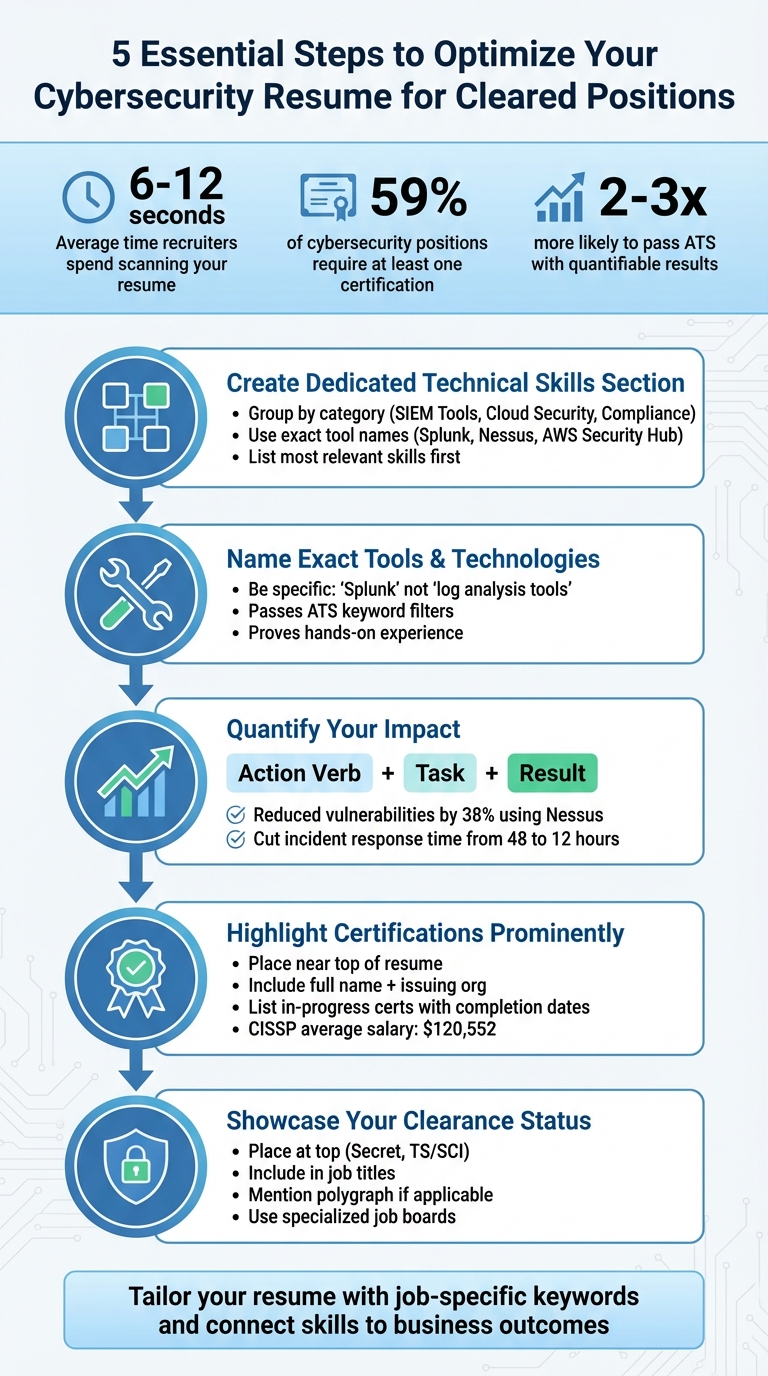
5 Essential Steps to Optimize Your Cybersecurity Resume for Cleared Positions

5 Essential Steps to Optimize Your Cybersecurity Resume for Cleared Positions

The ULTIMATE RESUME GUIDE For CYBERSECURITY In 2026

How to Organize Your Technical Skills

Recruiters typically spend just 6 to 12 seconds scanning a resume during their initial review [7]. That’s barely enough time to skim, let alone read through lengthy paragraphs. If your technical skills are buried in dense text or scattered across your resume, they might get overlooked. To ensure your expertise stands out, dedicate a separate "Technical Skills" section. This should be distinct from soft skills and organized into clear, logical categories.

Group Skills by Category

Organizing your skills into categories transforms a jumbled list into a well-structured snapshot of your expertise. For example, instead of listing everything in one long line – like "Splunk, Python, NIST, AWS Security Hub, penetration testing" – break them down into groups such as Network Security, SIEM Tools, Scripting/Languages, Cloud Security, and Risk & Compliance. This format not only highlights your skills but also shows you understand how to present them effectively within the broader cybersecurity context.

For space efficiency and ATS compatibility, use a comma-separated format within each category. For example: "SIEM Tools: Splunk, IBM QRadar, LogRhythm." While tables can enhance clarity, avoid overly complex layouts or multi-column designs, as older ATS systems may struggle to process them.

Skill Category Example Tools & Technologies
Network Security Firewalls, VPNs, IDS/IPS, Wireshark, Cisco ASA, Fortinet
SIEM Platforms Splunk, IBM QRadar, LogRhythm
Vulnerability Management Nessus, Nmap, Qualys, OpenVAS
Cloud Security AWS Security Hub, Azure Security Center, Google Cloud Platform
Scripting & Languages Python, PowerShell, Bash, Java, C++
Compliance & Frameworks NIST, ISO 27001, GDPR, HIPAA, SOC2

Make sure to align these categories with the skills emphasized in the job description to capture the recruiter’s attention quickly.

List the Most Relevant Skills First

Start with the skills that directly match the job description. This ensures recruiters instantly see how you fit the role. For example, if the job posting highlights "experience with Splunk and threat hunting", make sure those terms are prominently featured at the top of your Technical Skills section.

Use exact keywords from the job listing to align with ATS filters, and keep descriptions concise – stick to one or two words rather than lengthy phrases. This focused strategy not only grabs attention but also sets the stage for showcasing your achievements with specific tools and technologies.

How to List Cybersecurity Tools and Technologies

List Common Industry Tools

When listing tools on your resume, be specific. Employers want to see the exact names of the tools you’ve worked with – not vague descriptions like "vulnerability scanners" or "security monitoring platforms." For example, mention Splunk for SIEM, Nessus for vulnerability scanning, Metasploit for penetration testing, or CrowdStrike for endpoint protection.

Why does specificity matter? Two key reasons:

  1. Applicant Tracking Systems (ATS): Many companies use ATS to scan resumes for keywords that match the job description. If the job posting mentions "Splunk" and your resume only says "log analysis tools", your application might not get past the automated screening.
  2. Hiring Managers and Recruiters: Specific tool names signal that you’re familiar with the platforms used in real-world cybersecurity operations. They don’t just show knowledge of concepts – they prove you’ve worked hands-on with the tools that matter.

"Naming any specific programming or scripting languages you’re familiar with, or data analytic programs you’ve worked with can impress an employer." – Zoë Morris, President, Frank Recruitment Group [2]

For roles requiring security clearance, focus on tools relevant to government and defense work. Highlight platforms that meet DoD 8570 compliance or support the Risk Management Framework (RMF). Additionally, with federal agencies increasingly adopting cloud solutions, expertise in AWS Security Hub, Azure Security Center, and container security tools like Docker and Kubernetes can set you apart [3][6]. Include scripting languages like Python for automation and tool development, and PowerShell for managing Windows environments and responding to incidents [3].

Don’t stop at listing tools – detail your results and accomplishments with them to make your resume stand out.

Explain How You Used Each Tool

Simply listing tools isn’t enough. To make an impact, show how you’ve used them to solve problems or achieve results. Instead of isolating tools in a skills section, integrate them into your work experience bullet points. This transforms a static list into a narrative that highlights your problem-solving abilities.

For instance, rather than just listing "Wireshark" under Network Security, craft a result-driven statement like: "Detected and mitigated 150+ intrusion attempts using Snort and Wireshark, reducing network breach incidents by 40% over six months." This format demonstrates not only your familiarity with the tool but also your ability to apply it effectively to protect an organization.

Use strong action verbs like "Architected," "Mitigated," "Detected," and "Optimized" to emphasize your initiative and ownership [6][8]. If you’re early in your career and lack professional experience, showcase tools you’ve used in personal projects or home labs. For example: "Built a virtualized network with pfSense and ELK stack for log analysis to simulate enterprise security monitoring." This highlights hands-on learning and self-motivation – qualities that resonate with employers [3].

How to Show Technical Skills Through Results

Use Numbers to Show Results

Numbers are a powerful way to turn responsibilities into measurable achievements. Considering that recruiters spend just six seconds scanning resumes, it’s no surprise that resumes with quantifiable results are 2–3 times more likely to make it past Applicant Tracking Systems [9]. In the field of cybersecurity, metrics are especially crucial.

"In cybersecurity, where threats are measured in dollars and downtime, numbers speak louder than buzzwords." – Resumly [9]

To effectively showcase your accomplishments, follow the "Action Verb + Task + Result" formula [10]. Instead of vague descriptions, use clear, data-driven examples like: "Reduced high-risk vulnerabilities by 38% within six months through weekly Nessus scans and automated patching."

Focus on areas that resonate with hiring managers, such as risk reduction, operational efficiency, team enablement, and technology adoption [9]. For instance, you could highlight efficiency improvements: "Cut incident response time from 48 hours to 12 hours by implementing automated threat detection with Splunk." Or, demonstrate reliability: "Maintained 99.9% uptime for secure networks supporting 5,000+ users" [1][9].

If exact numbers aren’t available, use conservative estimates and qualifiers like "approximately" or "over." Just be ready to explain your methodology during interviews [9]. For roles involving classified work, ensure your metrics remain high-level to avoid disclosing sensitive information. Focus on emphasizing your technical contributions and measurable results without breaching confidentiality [1].

By quantifying your achievements, you validate your technical expertise while showing how your work supports broader business objectives.

Connect Skills to Business Goals

Once you’ve presented measurable results, the next step is to tie your technical skills to the company’s strategic goals. While tools and methods highlight your technical abilities, linking those accomplishments to cost savings or compliance initiatives demonstrates your broader value to the organization.

Translate technical tasks into business outcomes. For example: "Reduced policy violations by 27% within three months, ensuring HIPAA compliance and avoiding potential $50,000 in regulatory fines" or "Saved $120,000 annually by automating patch management across 800 endpoints" [9].

For roles requiring security clearances, emphasize how your skills contributed to key objectives like meeting DoD 8570 compliance, improving Risk Management Framework (RMF) audit scores, or enabling mission-critical operations. Use specific metrics to show progress, such as: "Raised ISO 27001 compliance score from 78% to 95% through systematic control implementation" [9].

"Led 12 security workshops that boosted simulation pass rates from 62% to 91% and cut human-error risk by 47%." [9]

Whenever possible, include the timeframe and tools used in your descriptions to add credibility [9]. By connecting your technical achievements to business priorities, you underscore your ability to deliver value that goes beyond the technical realm.

sbb-itb-bf7aa6b

How to List Certifications and Compliance Knowledge

Certifications and compliance expertise are just as important as technical skills and measurable results when it comes to showcasing your readiness for cleared roles.

Certifications

Certifications serve as proof of your skills and can often secure you an interview. In fact, nearly 59% of all cybersecurity positions require at least one certification [5]. That makes this section a key element for cleared roles. Place your certifications prominently – ideally near the top of your resume – especially if they’re required for the role or strengthen your security clearance.

"I prefer when relevant certifications and clearances are near the top of the resume, such as TS/SCI, CISSP, Public Trust, Private Trust, etc. They should be current." – John Boyle, Senior Talent Director, CIBR Warriors [2]

Always include the full name of the certification and the issuing organization. For example, write "Certified Information Systems Security Professional (CISSP) – (ISC)²" instead of just "CISSP." If you’re in the process of earning a certification, list it as "In Progress" and include the expected completion date. This can be critical if the certification is a mandatory requirement for the job.

Tailor your certifications to match the job description. For instance, if the role emphasizes penetration testing, prioritize certifications like CEH or OSCP. For entry-level cleared roles, CompTIA Security+ is a must-have because it satisfies DoD 8570 requirements. Mid-level roles often value certifications like CEH and CISM, while advanced positions may require CISSP, which comes with an average annual salary of $120,552 [13].

Highlight Compliance Framework Experience

After listing your certifications, demonstrate your hands-on experience with compliance frameworks. This not only shows your technical expertise but also your understanding of risk management. Make a clear distinction between regulatory frameworks (e.g., GDPR, HIPAA, FISMA, CMMC) and information security frameworks (e.g., NIST CSF, ISO 27001, SOC 2). For cleared roles, focus on frameworks relevant to government work, such as NIST RMF and CMMC, which will be mandatory for all DoD contractors by 2026 [11].

Be specific about your contributions to each framework. For example, you could write, "Conducted gap analysis for NIST 800-171 compliance, developing 23 corrective action plans that increased compliance from 78% to 95%." If you’ve used GRC tools like Nessus, Qualys, or RSA Archer, include them to highlight your technical proficiency. Use terms like "NIST RMF – Expert" or "ISO 27001 – Advanced" to indicate your level of expertise.

Whenever possible, quantify your results. For instance, implementing privacy compliance procedures can reduce data breach incidents by up to 50% [12]. Highlight achievements such as "Achieved 100% PCI DSS compliance within 6 months" or "Reduced compliance-related fines by 40% over two years" to illustrate the real-world impact of your work.

How to Customize Your Resume for Cleared Cybersecurity Jobs

Cleared cybersecurity jobs require a tailored approach that differs from standard tech roles. Your resume needs to clearly demonstrate that you meet the unique demands of handling classified information and working within sensitive government systems.

Highlight Your Security Clearance

Your security clearance is one of your biggest assets in the cleared job market, so make sure it’s front and center. Place it prominently at the top of your resume, specifying the clearance level (e.g., Secret, Top Secret, TS/SCI). If you’ve undergone a polygraph (either CI or Full-Scope), mention that as well, along with the date of your most recent Periodic Reinvestigation.

"Having an active security clearance tells employers: You’ve passed extensive background checks, you understand secure systems and data protection, [and] you can be trusted with classified or sensitive projects." – LaunchCode [1]

To emphasize your clearance further, include it in job titles and project descriptions. For instance, instead of just listing your role as "Cybersecurity Analyst", you could write "Cybersecurity Analyst (TS/SCI)." This immediately signals that your clearance was integral to your job. However, be mindful of operational security – avoid sharing classified project details on public profiles or inappropriately disclosing sensitive information.

Once your clearance is clearly showcased, focus on platforms that cater to cleared professionals to ensure your resume lands in front of the right recruiters.

Leverage Specialized Job Boards

After emphasizing your clearance, use job boards specifically designed for cleared positions to connect with employers who value your credentials. Platforms like Cybersecjobs.com are excellent for targeting roles where both technical expertise and security clearances are essential. These sites are tailored to match candidates with hiring managers who understand the value of your qualifications.

To ensure your resume stands out, tailor it with keywords that align with cleared job descriptions and applicant tracking systems (ATS). Include terms like "TS/SCI developer", "security clearance", and "polygraph." Additionally, spell out acronyms at least once – such as "Top Secret/Sensitive Compartmented Information (TS/SCI)" – to ensure ATS software picks up on all relevant terms. Mirroring the language used in job descriptions can further highlight your clearance and technical skills.

"A well-crafted resume not only highlights your skills and experience but also sets you apart from other candidates vying for the same roles." – Cybersecjobs.com [4]

Conclusion

Your cybersecurity resume should highlight measurable achievements and showcase your qualifications effectively. Organize your information into clear sections, emphasize quantifiable results, and prominently display certifications to create a resume that stands out – especially for roles requiring security clearance.

Certifications play a crucial role in the cybersecurity field, with nearly 59% of positions requiring at least one professional credential [5]. Make sure to list your current certifications prominently and include any in-progress credentials, along with their expected completion dates.

For cleared positions, your security clearance is just as important as your technical skills. Place your clearance status – such as Secret, Top Secret, or TS/SCI – front and center. Don’t forget to mention polygraph details if applicable, and reiterate this information throughout your work history. Platforms like Cybersecjobs.com can help you connect with employers who value both your technical expertise and clearance credentials.

"A well-crafted resume not only highlights your skills and experience but also sets you apart from other candidates vying for the same roles." – CyberSecJobs [4]

Each section of your resume should reinforce your technical skills and clearance status. Tailor your resume with job-specific keywords and fully spelled-out acronyms to ensure it passes ATS filters. By linking your expertise to measurable outcomes, you can position yourself for success in this fast-growing field. Take the time to refine your resume and unlock opportunities that align with your career goals.

FAQs

What’s the best way to showcase technical skills on a cybersecurity resume?

To make your technical skills stand out on a cybersecurity resume, include a dedicated Skills or Core Competencies section near the top. Use this space to clearly list your most relevant technical abilities, certifications, and tools. This makes it easier for both recruiters and applicant tracking systems (ATS) to spot your qualifications quickly.

Another way to emphasize your skills is by incorporating them into your professional summary. This approach immediately showcases your expertise and aligns your resume with the job description. Be selective – focus on the qualifications that are most relevant to the role you’re targeting. Certifications like CISSP, CEH, or Security+ can add credibility and make your resume leave a stronger impression.

Why should I include specific tools and technologies on my cybersecurity resume?

Including specific tools and technologies on your cybersecurity resume is a smart way to showcase your hands-on experience and expertise with systems that matter in the field. It gives potential employers a clear sense of your capabilities and makes it easier for them to evaluate your qualifications.

For example, listing tools like firewalls, SIEM platforms, or vulnerability scanners signals your ability to tackle practical cybersecurity challenges. These details can give you an edge, particularly when applying for positions that demand cleared professionals who are ready to hit the ground running.

How can I effectively showcase my security clearance on a cybersecurity resume?

To make your security clearance stand out on your cybersecurity resume, place it prominently in your professional summary or near your contact information at the very top. This way, hiring managers can spot it immediately.

You should also weave your clearance level (e.g., Top Secret, TS/SCI) into relevant job titles or project descriptions, especially if those roles required such credentials. If applicable, mention polygraph details to further emphasize your qualifications. However, avoid disclosing any classified or sensitive information – just clearly state your clearance status to showcase your eligibility for sensitive positions.

For cleared professionals, platforms like Cybersecjobs.com can help connect you with employers actively seeking candidates with security clearances like yours.
Related Blog Posts

  • Contract Recompete Job Security – Your 90-Day Survival Action Plan
  • Python Cleared SOC Analyst Skills – The $20K Programming Premium
  • Cleared Resume OPSEC Guidelines – What NSA Says You Can and Can’t Say
  • Top Resume Tips for Cleared Cybersecurity Professionals

Related Guides

  • Cleared Professional LinkedIn Optimization – Building Your Cyber Brand Without OPSEC Violations
  • Cleared Job Application Timing – Why the First 48 Hours Win Positions
  • Cyber Security Job Search Checklist
  • TS/SCI Salary Premium: Real 2026 Numbers
  • Top 10 Cybersecurity Jobs for Cleared Pros

Top Resume Tips for Cleared Cybersecurity Professionals

CyberSecJobs Editorial · January 22, 2026 · Leave a Comment

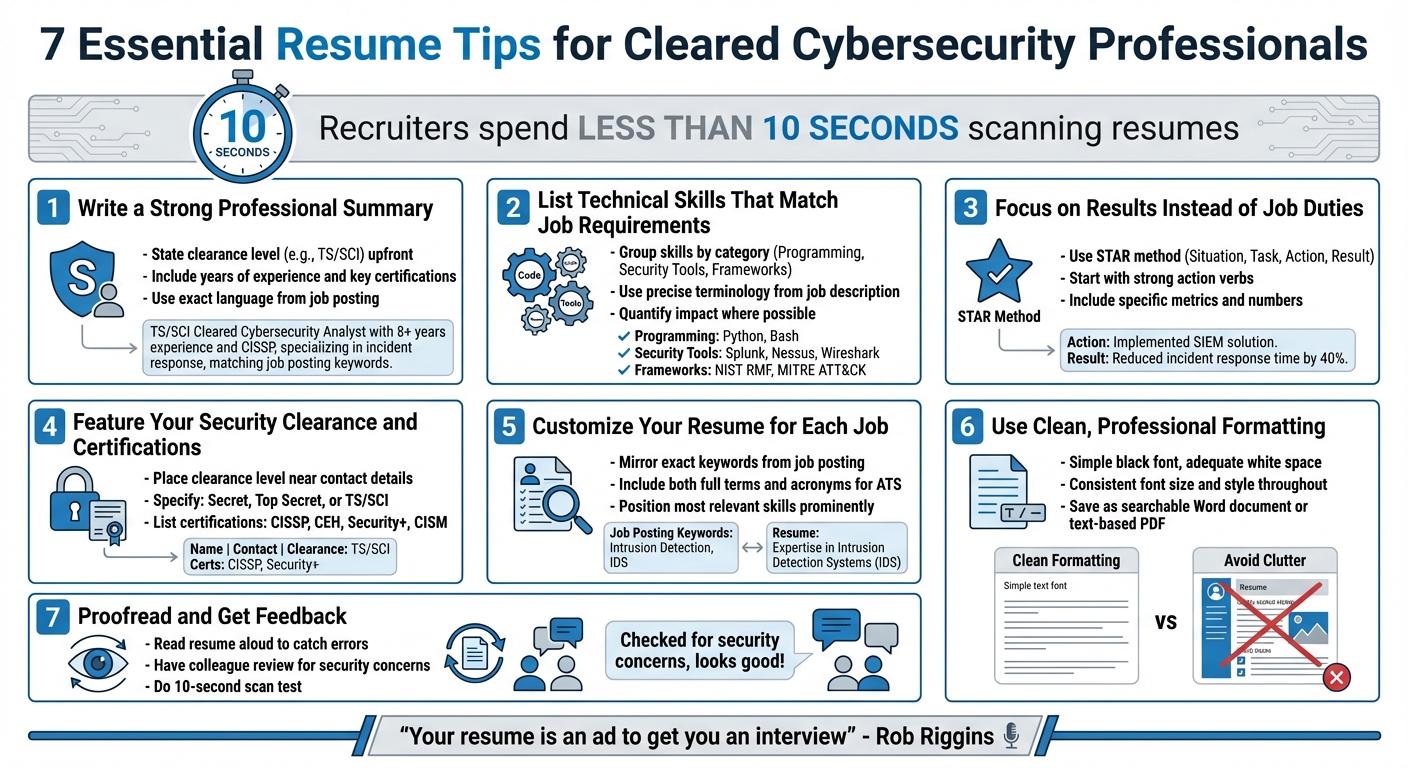
In the competitive world of cleared cybersecurity, your resume is your gateway to high-demand roles. With recruiters spending less than 10 seconds scanning resumes, it’s crucial to make your clearance, skills, and achievements stand out – while also navigating Applicant Tracking Systems (ATS). Here’s how to craft a resume that gets noticed:

  • Highlight your clearance upfront: Clearly state your active clearance level (e.g., "TS/SCI") near your contact details. If eligible for reinstatement, mention it.
  • Tailor your resume for each job: Use the exact keywords and terminology from the job description to pass ATS filters.
  • Focus on measurable achievements: Replace vague job duties with quantifiable results (e.g., "Reduced vulnerabilities by 35%").
  • List relevant technical skills: Include a dedicated skills section, grouping tools, frameworks, and certifications in categories.
  • Keep formatting clean and professional: Use simple fonts, adequate spacing, and ATS-friendly formats like Word or text-based PDFs.
  • Proofread carefully: Typos or grammatical errors can disqualify you. Have a trusted colleague review your resume for clarity and compliance with security guidelines.
7 Essential Resume Tips for Cleared Cybersecurity Professionals

7 Essential Resume Tips for Cleared Cybersecurity Professionals

From Entry-Level to Senior: Cybersecurity and GRC Resume Recommendations | Tips & Tricks

1. Write a Strong Professional Summary

Your professional summary is the first thing employers see on your resume, sitting right below your contact information. It’s your chance to make an immediate impression by clearly stating your clearance, years of experience, and key skills in just 2–3 lines.

Start with your clearance status (e.g., "Active Top Secret/SCI"), followed by your years of experience and technical expertise. For example:
"Active TS/SCI cleared Cybersecurity Analyst with 8+ years in network security, SIEM administration, and incident response. Hold CISSP and CompTIA Security+ certifications."

According to Martha Schneegans, a Senior Technical Recruiter at ManTech, using the exact language from the job posting is essential for getting past Applicant Tracking Systems (ATS) [4]. If the job description mentions "SIEM administration", make sure to use that exact phrase instead of a variation. Precision matters.

Steer clear of vague terms like "expert" or "highly skilled." Instead, back up your claims with specifics. For instance, writing "5+ years with Splunk" is far more effective than saying "extensive SIEM experience." As ClearedJobs.Net advises, your summary should highlight "crisp, clean, jargon-free critical experience and relevant attributes such as certifications" [3].

Finally, ensure the technical skills you mention directly align with the job requirements. Tailoring your summary this way sets a strong foundation for the rest of your resume.

2. List Technical Skills That Match Job Requirements

Including a dedicated technical skills section in your resume makes it easier for recruiters to quickly assess your qualifications and helps Applicant Tracking Systems (ATS) align your resume with the job requirements. To improve readability, group your skills into categories like "Programming Languages", "Security Tools", "Frameworks," and "Operating Systems."

Pay close attention to the exact terminology used in the job posting. For instance, if the listing specifies "vulnerability assessment", use that exact phrase instead of substituting synonyms. ATS systems are designed to look for precise matches, so this level of accuracy is essential to ensure your resume gets through the initial screening.

As of 2026, certain technical skills are particularly sought after in cleared cybersecurity roles. Expertise in AI and LLM security has become highly desirable, especially after AI-driven espionage campaigns were uncovered in September 2025. These incidents revealed that attackers could use AI to execute 80–90% of advanced hacking operations[6]. Additional key skills include proficiency in cloud infrastructure (especially AWS), familiarity with frameworks like RMF and MITRE ATT&CK, and programming languages such as Python and Java.

Where possible, quantify your impact to make your skills stand out. For example, instead of simply saying "SIEM administration", you could write: "Reduced system vulnerabilities by 35% through threat monitoring using LogRhythm." If you’re working toward a certification listed in the job requirements, include it along with the anticipated completion date to show your commitment to professional growth[1].

Be honest and list only the technical skills you can confidently discuss in a technical interview. Hiring managers are quick to identify gaps during screenings[4]. Additionally, spell out acronyms alongside their abbreviations to ensure ATS systems recognize them effectively[7].

3. Focus on Results Instead of Job Duties

Did you know hiring managers typically spend less than 10 seconds scanning a resume before deciding whether to keep reading? [4] That means you need to make every bullet point count by emphasizing measurable accomplishments instead of routine tasks. Think of your resume as a highlight reel of your capabilities, not a day-to-day job description.

To stand out, your achievements should clearly demonstrate tangible results. For example, instead of saying, "Conducted vulnerability assessments", aim for something like, "Identified and mitigated vulnerabilities, reducing system risk by 35%." This approach not only shows what you did but also the impact you made. A helpful way to craft these statements is by using the STAR method: Situation, Task, Action, Result. This structure keeps your points focused and results-driven.

Start each bullet point with a strong action verb like "Directed", "Increased", "Developed", or "Mitigated." Then back it up with specific metrics to highlight your contributions. For instance:

  • "Maintained secure infrastructure for 5,000+ users with 99.9% uptime"
  • "Oversaw the secure deployment of $50M in technical equipment"

While quantifying your work is essential, keep operational security in mind. Avoid disclosing sensitive details like classified project names, exact office sizes, or specific budget figures that could violate security protocols.

"Numbers and metrics help to paint a clear picture of your contributions and demonstrate your value to prospective employers."
– CyberSecJobs

4. Feature Your Security Clearance and Certifications

An active security clearance is a major advantage, saving employers both time and money by eliminating the need for clearance sponsorship [8]. To make an immediate impression, place your clearance level prominently near your contact details [4]. This approach complements the other resume strategies discussed earlier.

Be specific when listing your clearance. Clearly indicate whether it’s Secret, Top Secret, or TS/SCI, and always include the issuing agency, such as the Department of Defense (DoD), Department of Homeland Security (DHS), or National Security Agency (NSA). Employers often prefer candidates already vetted by a particular agency. If your clearance is inactive but within the 24-month eligibility window, label it as "Eligible for Reinstatement" instead of omitting it. This indicates it can be reactivated without requiring a full reinvestigation [8].

Certifications are equally important. Credentials like CISSP, CEH, Security+, and CISM showcase your expertise [1][2]. Create a dedicated "Certifications & Clearances" section on your resume to highlight these qualifications. If you’re working toward a certification, include it with an estimated completion date.

"Including an in-progress certification on your resume could make the difference in a recruiter contacting you or not if it’s a hard requirement of the job."
– CyberSecJobs [1]

sbb-itb-bf7aa6b

5. Customize Your Resume for Each Job

Tailoring your resume to match the requirements of each job is a must. By building on your professional summary and technical skills, you can craft a resume that aligns with what each employer is seeking. This is especially important for cleared cybersecurity roles, which often come with very specific expectations. Remember, recruiters typically spend less than 10 seconds scanning a resume at first glance, so the skills and keywords they’re looking for should stand out immediately [4].

Start by thoroughly reviewing the job description. Pay close attention to the exact language used and replicate those terms in your resume. For example, if the job posting specifies "network security", use that precise phrase [1]. Martha Schneegans, Senior Technical Recruiter at ManTech, underscores the importance of mirroring the job description’s terminology:

"If the job description has the words, tomato, ballerina, and cake decorator, make sure you include those on your resume." [4]

This strategy not only aligns your resume with what the employer wants but also improves its chances of passing through Applicant Tracking Systems (ATS). ATS software scans resumes for specific keywords before they ever reach a recruiter. To increase your odds, include both full terms and acronyms – like "Project Management Professional (PMP)" or "Database Architect (DBA)" – since recruiters may use different formats when searching [4]. Additionally, account for slight variations in phrasing, such as "System Engineer" versus "Systems Engineer" or "Software Development" versus "Software Engineering" [9].

When customizing your resume, position the most relevant technical skills prominently. For instance, if the role emphasizes SIEM solutions or specific firewalls, list those tools at the top of your Technical Skills section [1]. However, be truthful – never include skills you don’t actually have. Falsifying your qualifications can lead to immediate disqualification during the interview process [4].

Finally, save your resume in a format that ensures ATS readability, such as a Word document or a text-based PDF. A clean, well-formatted resume not only makes it easier for ATS to process but also showcases your attention to detail [4].

6. Use Clean, Professional Formatting

The way your resume is formatted can make or break its impact, especially when showcasing your clearance and technical expertise. Stick to a simple, black font – steer clear of decorative styles or colors, as these can interfere with ATS (Applicant Tracking System) scanning. Keep your font size legible and avoid the temptation to cram extra information by shrinking text.

Spacing matters too. Leave enough white space between bullet points and paragraphs to prevent your resume from appearing cluttered. As Rob Riggins puts it:

"If your resume is hard to read with dense paragraphs and tiny type, it will not be read. Your goal is a clean resume, with a simple font and adequate white space." [5]

Consistency is key to maintaining a polished look. Use the same font, size, and style throughout the document. Position essential headings like Summary, Skills, Experience, and Education on the left side to align with natural reading patterns. This structure makes it easier for recruiters to quickly find the information they’re looking for during their initial scan.

Don’t forget the basics: stick to standard margins and save your resume as a searchable Word document to ensure ATS compatibility. A well-organized, cleanly formatted resume not only reflects professionalism but also demonstrates the kind of attention to detail that’s crucial in cleared cybersecurity roles.

7. Proofread and Get Feedback

Even a single typo can hurt your chances of landing an interview. Ashley Jones, Editor at ClearedJobs.Net, emphasizes this point:

"A single typo or grammatical error can make you appear careless or unprofessional."

[10]

Recruiters often skim resumes quickly, so small mistakes can leave a lasting negative impression. That’s why carefully reviewing your resume is critical – not just for professionalism but also for maintaining operational security.

Start by reading your resume aloud. This simple step can help you catch errors that spell-checkers might miss [3]. Double-check essential details, like your contact information – surprisingly, candidates sometimes forget to include their phone number or email address [5]. Also, verify that your security clearance level is accurately and prominently displayed. Recruiters may use systems like JPAS to confirm this information [5].

It’s also a good idea to have a trusted colleague or mentor review your resume. They can spot errors you might have overlooked and flag potential operational security concerns. For instance, they might notice military or government acronyms that could confuse civilian recruiters [4]. They can also identify sensitive details, like classified project names or specific office information, that shouldn’t be included [3][2].

Make sure your technical skills are paired with relevant experience to give them proper context [5]. Finally, ask your reviewer to do a quick "scan test." Have them glance at your resume for 10 seconds and share what immediately stands out. If nothing grabs their attention or the layout feels cluttered, you’ll know where to make changes [4].

Conclusion

Creating a resume is about more than just listing your job history. It’s your first chance to make an impression, so make it count. Start by prominently showcasing your security clearance and emphasizing measurable achievements instead of just listing routine responsibilities. With recruiters spending less than 10 seconds scanning resumes [4], every word you choose has to work hard.

The best resumes feature clean, easy-to-read formatting, are tailored to each job application, and use the exact language found in job postings. Don’t forget to keep technical skills relevant to the role you’re targeting. As Rob Riggins wisely says:

"Your resume is not a biography… It’s an ad to get you an interview" [5].

Beyond crafting a strong resume, maintaining an active online profile is equally important. Some employers with cleared positions look directly at resume databases without ever posting jobs publicly [9]. By uploading your resume and regularly logging in to refresh your profile, you increase your chances of appearing at the top of recruiter searches [9].

Pairing a well-optimized resume with an active presence on platforms like Cleared Cyber Security Jobs (https://cybersecjobs.com) can significantly boost your visibility. This platform offers tools like job alerts, resume databases, and direct connections to employers seeking candidates with your clearance level and specialized skills.

Use these strategies to position yourself as a standout candidate in the competitive world of cleared cybersecurity.

FAQs

What are the best ways to make sure my resume gets through Applicant Tracking Systems (ATS)?

When crafting a resume designed to navigate Applicant Tracking Systems (ATS) effectively, simplicity is key. Opt for a clean, uncluttered format – steer clear of graphics, tables, or images, as these can confuse ATS software. Stick with a basic black font, make good use of white space, and maintain a straightforward layout to ensure it’s easy to read.

Save your resume as a Word document instead of a PDF, since some ATS struggle to process PDFs correctly. Be sure to weave relevant keywords from the job description naturally into your resume, particularly in the skills and experience sections. Lastly, focus on concise accomplishment statements that emphasize your achievements, rather than lengthy lists of responsibilities, to make your qualifications stand out.

What technical skills are most valuable for cybersecurity professionals with security clearance?

For professionals in cybersecurity with security clearance, certain technical skills are in high demand. These include security monitoring, threat detection, and vulnerability management. Familiarity with tools like SIEM (Security Information and Event Management) systems, crafting security alerts, and managing phishing incidents is especially valued. Additionally, having a strong grasp of network security and the ability to develop security awareness materials can help candidates stand out.

Certifications such as CompTIA Security+ and Certified Ethical Hacker (CEH) are often sought after to confirm a candidate’s technical abilities. Beyond technical expertise, employers look for individuals with strong problem-solving abilities, clear communication skills, and a keen attention to detail. These qualities are critical for tackling complex security issues and presenting findings in a way that’s easy to understand. Combining technical know-how with these soft skills is essential for thriving in cybersecurity roles that require clearance.

Why should I customize my resume for each cybersecurity job application?

Customizing your resume for each job application is crucial because it allows you to spotlight the skills, certifications, and experience that directly match the role you’re pursuing. This tailored approach not only grabs the hiring manager’s attention but also helps you navigate applicant tracking systems (ATS), which often screen candidates based on specific keywords.

For professionals in cleared cybersecurity roles, this strategy becomes even more critical. Emphasizing your security clearance and showcasing relevant technical skills can set you apart in a highly competitive field. A well-focused resume demonstrates to employers that you’ve taken the time to understand their needs and position yourself as the right candidate for the job.

Related Blog Posts

  • Contract Recompete Job Security – Your 90-Day Survival Action Plan
  • AI Security Clearance Jobs – Get Ahead of the Emerging Threat Landscape
  • Cleared Resume OPSEC Guidelines – What NSA Says You Can and Can’t Say
  • Cleared Job Application Timing – Why the First 48 Hours Win Positions

Related Guides

  • Stand Out in Your Cyber Security Job Search with T-Format Cover Letters
  • Elevate Your Cyber Security Job Search with a Winning Elevator Speech
  • Cleared Job Application Timing – Why the First 48 Hours Win Positions
  • TS/SCI Salary Premium: Real 2026 Numbers
  • Top 10 Cybersecurity Jobs for Cleared Pros

5 Outfit Tips for Cleared Professionals at Job Fairs

CyberSecJobs Editorial · January 22, 2026 · Leave a Comment

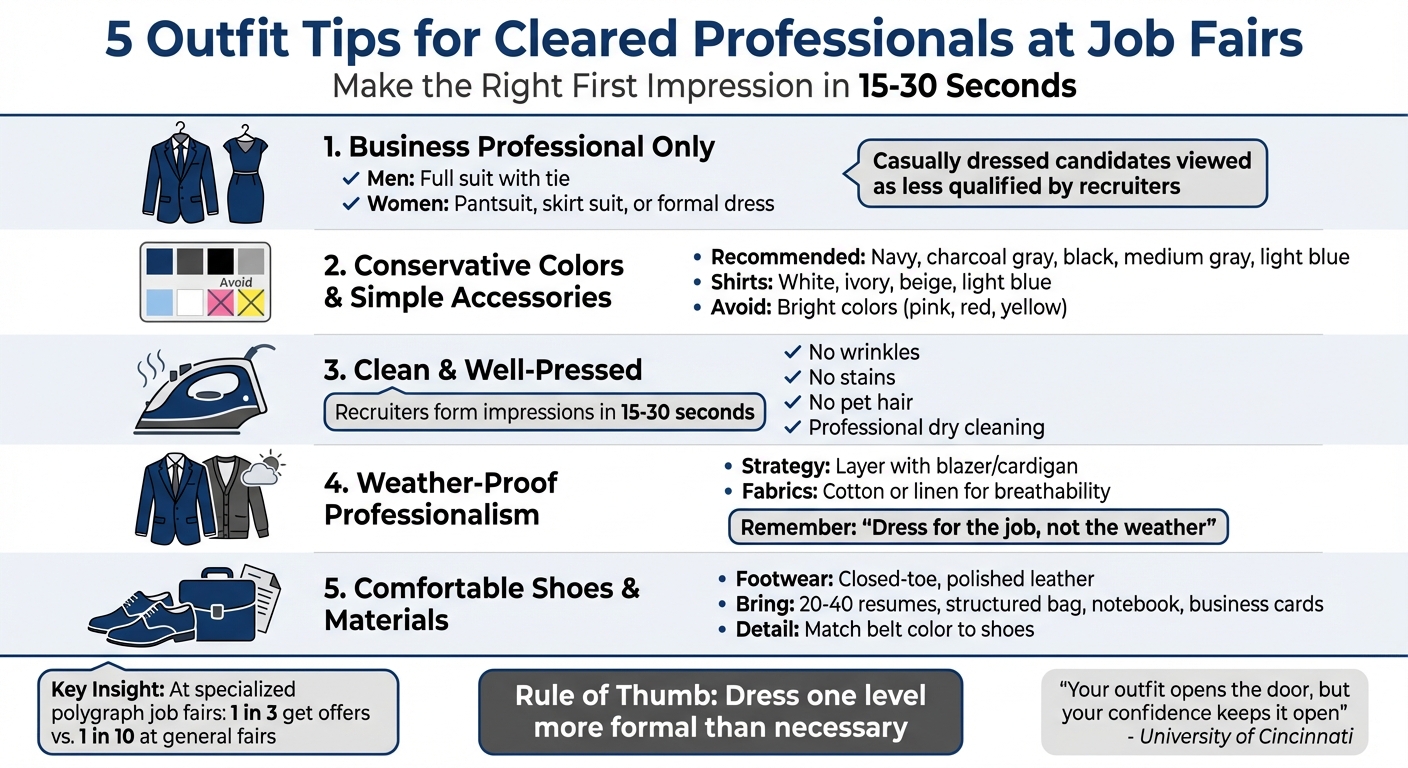
At cleared job fairs, your outfit can make or break your first impression. Recruiters often decide on candidates within seconds, and dressing professionally signals you’re prepared for the high standards of government and defense roles. Here’s a quick rundown of how to dress for success:

  • Business Professional Only: Full suits for men; pantsuits, skirt suits, or formal dresses for women.
  • Stick to Neutral Colors: Navy, gray, black, or beige – avoid bright or casual tones.
  • Clean and Pressed Clothes: Wrinkled or stained outfits suggest poor preparation.
  • Weather-Proof Professionalism: Layer smartly to stay polished, regardless of temperature.
  • Comfortable Shoes and Essentials: Closed-toe shoes and a structured bag for resumes and materials.

Your attire reflects your readiness, professionalism, and understanding of industry expectations. Dress one level more formal than you think is necessary, and you’ll stand out for the right reasons.

5 Essential Outfit Tips for Cleared Job Fair Success

5 Essential Outfit Tips for Cleared Job Fair Success

How to Dress for a Career Fair

1. Wear Business Professional Attire, Not Business Casual

A cleared cybersecurity job fair isn’t just a casual networking event – it’s a formal interview where every interaction counts. For men, this means a full suit with a tie. For women, a pantsuit, skirt suit, or formal dress is expected [3][5]. Leave the khakis and blazers at home; this is your chance to meet the high standards set by the defense and cybersecurity industries.

These fields share the conservative dress norms seen in finance, law, and politics [3]. Wearing a complete suit not only shows you understand these expectations but also signals that you’re detail-oriented and prepared to engage with high-level clients or officials [3].

"Dressing within these norms is a good way to show a potential employer that you understand ‘the game’ and are willing to be a team player." – Career Fair Plus [4]

In a survey of more than 40 recruiters, those dressed casually were almost always viewed as less educated, less qualified, and less professional compared to candidates in formal attire [1].

While the standard is clear, there are some exceptions. For instance, if you’re transitioning from the military, attending in uniform or cammies is perfectly acceptable at cleared job fairs [2]. For everyone else, sticking to strict business professional attire is non-negotiable. A good rule of thumb? Dress one level more formal than you think is necessary [3][5]. It’s always better to be slightly overdressed than to risk looking too casual.

2. Stick to Conservative Colors and Simple Accessories

The way you dress speaks volumes, and the colors and accessories you choose can subtly reinforce your professionalism. When it comes to suits, stick to classic shades like navy, charcoal gray, or black. Medium gray, light blue, and dark brown are also solid options that maintain a professional tone.

For shirts, neutral tones are your best bet. Think white, ivory, natural beige, or light blue – these shades keep the focus on you, not your outfit. Save tan, khaki, and beige for more casual settings, and steer clear of bright colors unless you’re targeting a creative role where boldness is part of the culture.

"Neutral colors like blue, black, gray, or tan look more professional than bright colors like pink, red, and yellow." – Career Fair Plus

Accessories should be understated and purposeful. A simple watch, modest earrings, or a discreet pendant can complete your look without drawing unnecessary attention. For men, matching your leather belt to your shoes is a small detail that makes a big difference. Avoid anything overly flashy, like ornate buckles or visible logos.

3. Keep Your Clothes Clean and Well-Pressed

First impressions matter, and recruiters often form theirs within 15–30 seconds of meeting you[1]. Wrinkled or stained clothing can instantly work against you, no matter how qualified you are. On the flip side, neatly pressed and clean attire signals qualities like preparation, professionalism, and reliability. Unkempt clothing, however, can send the wrong message, making you appear disorganized or unready.

"The prospect dressed in extremely casual clothing struck [recruiters] as being unprepared, irresponsible, less capable, educated and qualified, and possessing poor work habits." – Military.com[1]

To avoid this, plan your outfit well in advance. Make sure it fits perfectly and is free from stains, tears, or even minor details like collar rings or pet hair. These small imperfections can detract from your overall presentation. Employers notice everything – from the shine of your shoes to the way your clothes sit on you. For important events, consider using professional dry cleaning or pressing services to ensure your outfit is flawless.

Your grooming should complement your attire. Keep your hairstyle neat and facial hair, if any, well-trimmed. Be mindful of scents – strong colognes or perfumes can be overwhelming in close quarters. The goal is simple: let your skills and qualifications take center stage, not your fragrance or appearance.

sbb-itb-bf7aa6b

4. Dress for the Job You Want, Not the Weather

Job fairs aren’t just casual meet-and-greets – they’re formal interviews in disguise. This means your outfit should reflect the level of professionalism expected in the cybersecurity field, no matter what the weather outside is doing. Choosing comfort over a polished appearance could send the wrong message about your readiness for the role.

"A job fair is an interview, so look the part. Dress like the professional you are, or seek to be." – ClearedJobs[2]

To navigate fluctuating temperatures while maintaining a professional look, layering is your best friend. Job fair venues can swing from warm conference halls to freezing meeting rooms[5], so a lightweight blazer or cardigan over a polished shirt is a practical yet refined choice. Stick to breathable fabrics like cotton or linen for comfort, and save heavier materials like wool for your formal suit[3]. This way, you can adjust to the environment without compromising your presentation.

Dressing in business professional attire – regardless of the season – signals that you understand the expectations of the industry and are ready to step into the role with confidence and professionalism.

5. Wear Comfortable Shoes and Bring a Way to Carry Materials

After perfecting your outfit, don’t overlook the importance of practical accessories – they can leave just as strong an impression.

Job fairs often mean hours of standing and walking, so your footwear needs to combine style with comfort. For men, polished leather Oxfords or loafers in classic black or brown work well. Women should stick to closed-toe options like flats, low heels, or pumps – steer clear of sandals or open-toe shoes, as they can come across as too casual.

If you’re worried about being on your feet for long periods, consider shoes designed for extended comfort. Look for pairs with features like shock absorption and good arch support. This way, you’ll stay comfortable without sacrificing a polished appearance.

Beyond footwear, make sure to bring the essentials to keep you prepared and professional. Pack 20–40 high-quality copies of your resume, a small portfolio or structured bag, and a notebook with a pen for jotting down important details during conversations [6]. Having your own business cards ready to hand out is another great way to stand out and make follow-ups more personal.

Lastly, don’t forget the small details that tie everything together. Match your shoe color with your belt and trousers – for instance, black shoes with black slacks and a black belt. If you’re wearing flats, ensure your pants are tailored to avoid dragging on the floor. These subtle touches can elevate your overall look and leave a lasting impression.

Conclusion

What you wear to a cleared job fair says more than you might think – it’s not just about style but also about showcasing your qualifications. Dressing professionally eliminates distractions and signals that you understand the conservative expectations of the cleared and government contracting sectors. As the University of Cincinnati puts it, "Your outfit opens the door, but your confidence keeps it open." [5]

Here’s something to consider: at specialized polygraph job fairs, about 1 in 3 attendees walk away with an offer. Compare that to general clearance fairs, where the figure is closer to 1 in 10 [2]. Your attire plays a role in these odds, reflecting your work ethic and your readiness to represent an organization in the cleared community. In these environments, traditional business professional attire signals that you’re prepared to handle the responsibilities of sensitive government work [3].

By applying these five outfit tips, you move beyond just making a good first impression – you create a lasting one. With the right presentation, you’re setting yourself up to make meaningful connections and demonstrate your professional readiness.

Looking to put these insights to work? Head over to Cleared Cyber Security Jobs to explore upcoming job fairs and access tailored career resources for cleared cybersecurity professionals. The platform offers tools to refine your job search, expert advice, and direct connections to employers in the cleared sector – all aimed at helping you secure your next opportunity.

Dress with purpose, exude confidence, and make every conversation count.

FAQs

What’s the difference between business professional and business casual attire for job fairs?

The key distinction between business professional and business casual attire comes down to formality. Business professional outfits are more polished and formal, typically featuring suits, ties, dress shirts, and tailored pieces. This style is best suited for occasions like job fairs, interviews, or situations where making a strong, professional impression is essential.

In contrast, business casual strikes a balance between professional and relaxed. Think dress pants or skirts, blouses, button-down shirts, and sometimes sweaters. However, steer clear of overly casual items like jeans, sneakers, or T-shirts. If you’re unsure, it’s always safer to opt for business professional attire at job fairs – it demonstrates respect and a serious attitude toward the opportunity.

Why should I wear neutral colors and minimal accessories to a cleared job fair?

When attending a cleared job fair, sticking to neutral colors and keeping accessories minimal can help you project a professional and polished appearance. This ensures that the focus remains on what truly matters – your skills, qualifications, and how you carry yourself.

A clean, straightforward outfit not only exudes confidence but also reflects your attention to detail – traits that are highly regarded in the cybersecurity industry. Choosing neutral tones and subtle accessories aligns with the professional expectations of cleared roles, helping you leave a strong and memorable impression.

What should I wear to look professional and stay comfortable at a job fair?

When preparing for a job fair, aim for business casual attire that strikes a balance between professionalism and comfort. Make sure your outfit is clean, well-fitted, and appropriate for the occasion. Since you’ll likely spend a lot of time walking and standing, choose breathable fabrics and comfortable shoes. Dressing just a bit more formally than the typical company dress code can help you leave a polished and professional impression.

Opt for wrinkle-free clothing that suits the season and allows for easy movement. Avoid anything too tight, overly loose, or excessively flashy. If you’re unsure, go with an outfit that radiates confidence and professionalism while keeping you comfortable throughout the event.

Related Blog Posts

  • Contract Recompete Job Security – Your 90-Day Survival Action Plan
  • Cleared Job Red Flags – Warning Signs in Contract Job Postings
  • Cleared Resume OPSEC Guidelines – What NSA Says You Can and Can’t Say
  • Cleared Job Application Timing – Why the First 48 Hours Win Positions

Related Guides

  • Stand Out in Your Cyber Security Job Search with T-Format Cover Letters
  • Cleared Job Application Timing – Why the First 48 Hours Win Positions
  • Cleared Cybersecurity Recruiters – Working the Inside Game for Better Offers
  • TS/SCI Salary Premium: Real 2026 Numbers
  • Top 10 Cybersecurity Jobs for Cleared Pros

Job Search Checklist for Veterans in Cyber Security

CyberSecJobs Editorial · January 21, 2026 · Leave a Comment

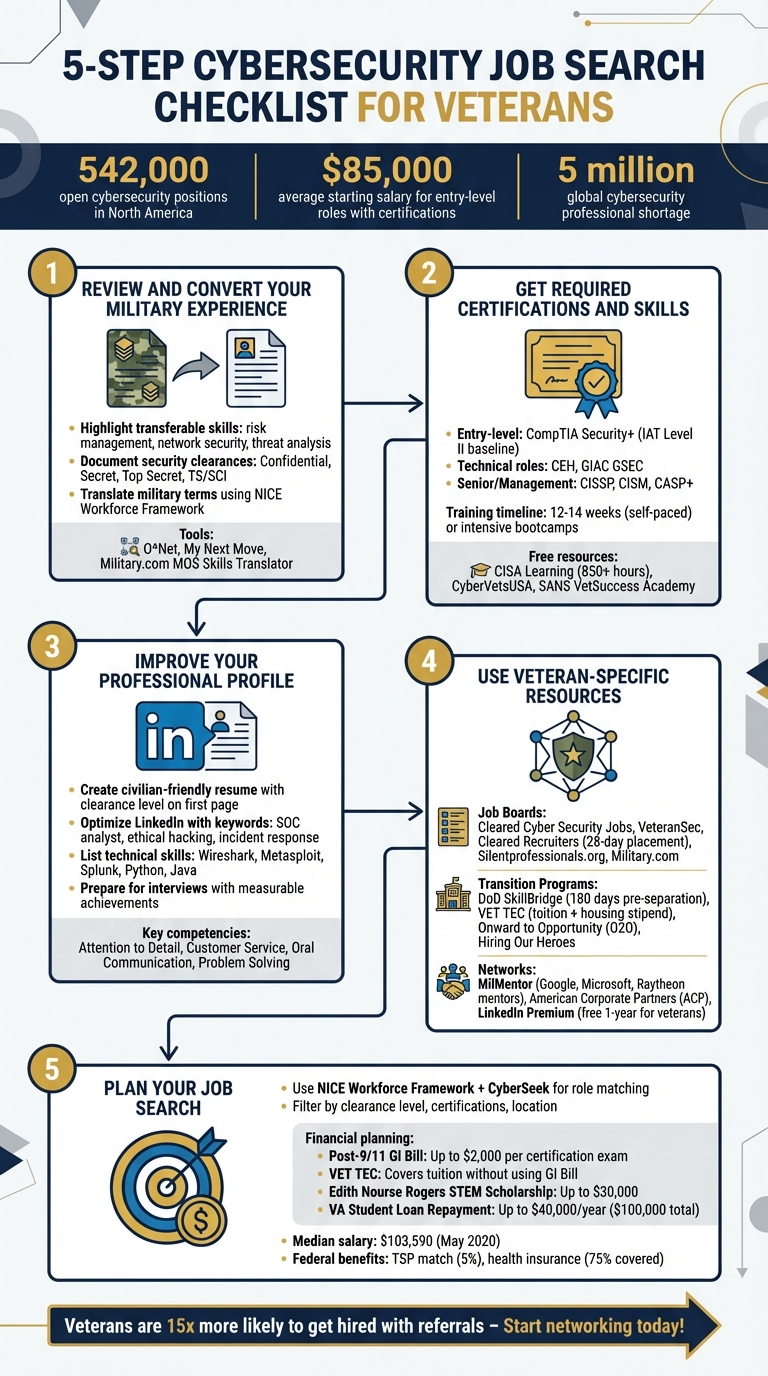
Transitioning from military service to cybersecurity? This guide simplifies the process, helping you leverage your skills, security clearance, and veteran-specific resources to land a role in this high-demand field. With over 542,000 open cybersecurity positions in North America and starting salaries averaging $85,000 for entry-level roles with certifications, now is the perfect time to make your move. Here’s how to get started:

  • Translate Your Experience: Highlight transferable skills like risk management and network security. Use tools like the NICE Workforce Framework to align military tasks with civilian roles.
  • Certifications Matter: Start with certifications like CompTIA Security+ or CEH and explore free or subsidized training programs such as CyberVetsUSA or VET TEC.
  • Build Your Profile: Create a civilian-friendly resume and optimize your LinkedIn profile to showcase your expertise and clearance.
  • Use Veteran Resources: Explore veteran-specific job boards, programs like DoD SkillBridge, and mentorship networks to connect with employers who value your background.
  • Plan Your Finances: Use benefits like the Post-9/11 GI Bill or VET TEC to cover training costs and ensure financial stability during your transition.

This step-by-step approach will help you confidently transition into a cybersecurity career while maximizing the value of your military experience.

5-Step Cybersecurity Job Search Checklist for Veterans

5-Step Cybersecurity Job Search Checklist for Veterans

A Veteran’s Guide to a Cybersecurity Career Transition with Tim Ramirez | The Cybrary Podcast Ep. 75

Step 1: Review and Convert Your Military Experience

Take a close look at your military background. Your service has likely equipped you with skills that are highly desirable in the cybersecurity field. Employers in this industry value qualities like situational awareness, the ability to make sound security decisions, and the capacity to adapt to fast-changing challenges under pressure. In particular, federal cybersecurity roles often prioritize skills such as attention to detail, customer service, oral communication, and problem-solving – areas where veterans naturally excel.

The next step is to identify your transferable skills, highlight any security clearances, and translate military-specific terms into language that civilian employers can easily understand.

Highlight Your Transferable Skills

Pinpoint the skills you acquired during your service that align with cybersecurity roles. These might include risk management, computer networking concepts, understanding cyber threats and vulnerabilities, and recognizing the operational impact of security breaches. If you have experience in Cyber Operations, Signals Intelligence, or IT support, those skills directly translate to civilian cybersecurity positions.

A helpful resource is the NICE Workforce Framework for Cybersecurity, which allows you to match your military tasks with specific civilian roles. Tools like the Cyber Career Pathways Tool can guide you in identifying which of the 52 roles within the NICE Framework best align with your experience. For instance, an Army 17C role often corresponds to Network Security and Defensive Cyber Operations, while Navy Cryptologic Technicians (CTN) are well-suited for Network Defense and Cryptography positions.

When documenting your skills, focus on measurable achievements. For example, instead of a generic description, write something like: "Managed network security for 500+ users across three locations, reducing incidents by 40% within 12 months."

Document Your Security Clearances

If you have an active or recently expired security clearance, it’s a huge advantage when applying for positions with defense or government contractors. Employers value active clearances since they can often be processed within 90 days [4].

Include your clearance level and status on your resume. Be specific about the type, such as Confidential, Secret, Top Secret, or TS/SCI, and note whether the clearance is active or when it expired. When describing work that required a clearance, use metrics to highlight your responsibilities without disclosing classified information. For instance, you could write: "Oversaw equipment valued at over $2 million" [3]. For federal job applications, it’s a good idea to have your DD-214 (Member Copy 4) and, if applicable, an SF-15 (Application for 10-Point Veteran Preference) ready.

Translate Military Terms for Civilian Audiences

To make your resume more accessible to civilian hiring managers, avoid military-specific acronyms and jargon. Terms like "NCOIC", "TDY", or MOS codes may not resonate with someone outside the military. Instead, use plain language to describe your functional roles, such as risk assessment, technical support, process improvement, or project management. For example, replace "NCOIC of logistics" with "Logistics Team Supervisor" [3][5].

You can use tools like O*Net, "My Next Move", or the Military.com MOS Skills Translator to convert military terminology into civilian-friendly language. When listing job titles, focus on functional descriptions rather than rank. For example, instead of using "Captain", write "Operations Manager", or replace "Sergeant" with "Technical Specialist." Similarly, refer to "soldiers" as "team members" or "staff", and describe "weapons/uniforms" as "equipment" or "supplies" [5]. These adjustments ensure your resume is clear and relatable to civilian hiring managers, helping them quickly understand your qualifications and potential.

Step 2: Get Required Certifications and Skills

If you’re a veteran aiming for a cleared cybersecurity role, certifications are non-negotiable. The Department of Defense (DoD) enforces Directive 8140 (formerly 8570), which requires anyone with privileged access to DoD information systems to hold specific certifications for their job classification [6]. Without these credentials, even your military experience won’t qualify you for many federal or contractor positions.

Your military background has already equipped you with the technical know-how and operational discipline needed for cybersecurity. Certifications, however, are what translate those skills into qualifications that civilian employers understand and meet the strict requirements for cleared roles. The next step is to secure the right certifications to bridge the gap between your military and civilian career.

Find the Right Certifications

The first step is identifying certifications that align with your military expertise and civilian career goals. A great starting point is CompTIA Security+, which serves as a baseline certification for many entry-level IAT Level II roles [6]. This credential opens doors to network security and defensive operations, providing a strong foundation for more advanced certifications down the line.

For technical roles, consider certifications like CEH (Certified Ethical Hacker) for analyst positions or CISSP (Certified Information Systems Security Professional) for senior technical or managerial roles. Another excellent option for Level II positions is the GIAC Security Essentials (GSEC) certification. If you’re eyeing management tracks, credentials like CISM (Certified Information Security Manager) or CASP+ (CompTIA Advanced Security Practitioner) are highly regarded for IAM Level II and III roles [6].

Create a Training Schedule

Planning your training is key, especially if you’re transitioning out of the military. If you’re within 180 days of separation, take advantage of the DoD SkillBridge program to gain hands-on experience in civilian cybersecurity roles while still earning your military pay [2]. Most self-paced online courses can be completed in 12 to 14 weeks, while intensive bootcamps offer quicker paths but require full-time dedication. Asynchronous online courses, which let you access materials 24/7, are ideal if you’re still on active duty.

Veterans can also tap into free training resources. For example, CISA Learning (formerly FedVTE) offers over 850 hours of training. Programs like CyberVetsUSA provide 12–14 weeks of training with job placement assistance. Additionally, the SANS VetSuccess Academy offers intensive scholarship-based training tailored to veterans [2].

If you’re within six months of separation, you may also qualify for up to six months of free access to training platforms like CBT Nuggets [2].

Use Military Education Benefits

Don’t forget to leverage your military education benefits. The Post-9/11 GI Bill reimburses up to $2,000 per certification exam. Before enrolling, use the VA’s GI Bill Comparison Tool to ensure your chosen training provider is VA-approved.

The VET TEC program (Veteran Employment Through Technology Education Courses) is another excellent option. It covers tuition and provides housing stipends for high-tech training with approved providers, all without dipping into your GI Bill entitlement [2]. This is especially helpful if you want to save your GI Bill benefits for a degree program later while earning certifications now.

Additionally, explore scholarships tailored for veterans. For instance, the Infosec Accelerate Scholarship offers up to $4,999 [7]. Many military-friendly institutions also grant college credit for your military training and experience, which can significantly reduce the time needed to earn a degree if you decide to pursue one alongside your certifications [1].

Step 3: Improve Your Professional Profile

Once you’ve earned your certifications, it’s time to make yourself visible to potential employers. While your military background is a strong asset, it needs to be translated into terms that resonate with civilian cybersecurity recruiters. This step is all about shaping your resume and online presence to align with what hiring managers are actively looking for.

Write a Civilian Resume

Your resume should clearly highlight your security clearance, technical skills, and measurable achievements. Make sure to list your clearance level (e.g., Secret, Top Secret, TS/SCI) prominently on the first page.

"Having an active security clearance tells employers: You’ve passed extensive background checks, you understand secure systems and data protection, and you can be trusted with classified or sensitive projects." – LaunchCode

Include a dedicated section for technical skills, listing tools like Wireshark, Metasploit, and Splunk, programming languages such as Python and Java, and frameworks like NIST and RMF. Certifications like CompTIA Security+, CISSP, CEH, and CISM should also stand out – they’re highly regarded in the cybersecurity field. Use quantifiable achievements to demonstrate the impact of your work.

When describing your military experience, keep it broad to avoid disclosing classified details. Use industry-relevant terms like "intrusion detection system", "vulnerability assessment", and "incident response" to ensure your resume is optimized for Applicant Tracking Systems. Depending on your background, you might choose a combination resume format to balance your military and technical experience or a chronological format to emphasize your work history.

Once your resume is polished, focus on enhancing your online presence.

Set Up Your LinkedIn Profile

Think of your LinkedIn profile as an extension of your resume. It’s a key tool for increasing your visibility to recruiters. As Andrew Golden, Lead Technical Recruiter at Trellix, notes:

"Everybody from zero years’ experience to 35 years’ experience struggles with this [profile optimization]. You are not alone!"

Optimize your profile with keywords like "SOC analyst", "ethical hacking", and "incident response." Your headline should clearly state your role and expertise, such as "Cybersecurity Analyst | SOC | SIEM | Network Security | Threat Intelligence." Use bullet points in your summary to highlight your technical skills and accomplishments. Make sure your LinkedIn profile aligns with the strengths emphasized in your resume.

Be mindful about sharing your clearance level on LinkedIn. Some contractors prefer candidates not disclose this information, and it could pose a security risk. To boost your visibility, engage with the cybersecurity community by liking, commenting on, and sharing posts from industry leaders. Follow major organizations to stay informed about trends and job openings. When connecting with recruiters, send personalized messages like, "I admire your work in security and would love to connect."

With your resume and online presence in place, the next step is to prepare for interviews with confidence.

Prepare for Interviews

Interview preparation is about combining your technical expertise with the ability to present your military experience in a civilian context. Familiarize yourself with common cybersecurity interview questions and practice explaining your background without revealing classified information. Use specific, measurable examples to showcase your impact – for instance, how you reduced vulnerabilities, handled incidents, or improved security protocols.

Mock interviews can help refine your responses and delivery. Watching tutorials from trusted sources like the National Initiative for Cybersecurity Education can also give you insight into what employers expect. Ensure your social media presence is professional, and avoid linking personal accounts on federal resumes.

For federal roles, such as those with CISA, be prepared to demonstrate key competencies like Attention to Detail, Customer Service, Oral Communication, and Problem Solving. Have important documents like your DD-214 and SF-15 (if applicable) ready. If you’re applying for high-level cleared positions, keep in mind that polygraph exams are often part of the hiring process and can be intentionally stressful – being mentally prepared for this is key.

sbb-itb-bf7aa6b

Step 4: Use Veteran-Specific Resources

Once you’ve polished your professional profile, it’s time to tap into resources designed specifically for veterans. These platforms, programs, and networks are tailored to streamline your cybersecurity job search and connect you with employers who understand and appreciate the unique skills that come with a military background.

Explore Veteran-Focused Job Boards

There are several job boards that cater to veterans entering cybersecurity:

  • Cleared Cyber Security Jobs: This veteran-founded platform connects you with employers who value both your military experience and security clearance. You can upload your resume, set up job alerts, and access resources tailored for individuals with active clearances – all at no cost for U.S. citizens.
  • VeteranSec: This community-driven platform not only offers a job board but also provides mentoring and training opportunities for veterans transitioning into cybersecurity careers [2].
  • Cleared Recruiters: Known for its large database of cleared professionals, this service focuses on filling critical roles within the Intelligence Community and the Department of Defense, often completing placements within 28 days [8].
  • Silentprofessionals.org: This site specializes in curating private security and cybersecurity positions for veterans [2].
  • Military.com: Powered by Monster, this platform includes an MOS translator to help you match your military skills with relevant civilian job opportunities [2].

Leverage Transition Programs

If you’re still on active duty but nearing separation, programs like DoD SkillBridge can be a game-changer. It allows you to gain hands-on civilian work experience while continuing to receive your military pay. For those interested in cybersecurity, programs like CyberVetsUSA and the NPower SkillBridge Cybersecurity Program offer free certifications and intensive training [2].

Other programs worth exploring include:

  • Hiring Our Heroes: This initiative connects veterans with corporate partners for fellowship opportunities, giving you practical experience in civilian roles [10].
  • NS2 Serves: Focused on tech and cybersecurity, this program provides training for high-demand roles [10].
  • VET TEC: If you have at least one day of GI Bill eligibility left, this program covers tuition and provides a housing stipend for high-tech training [11][2].
  • Onward to Opportunity (O2O): This program offers free training and exam vouchers for certifications like CompTIA, PMP, and AWS, helping you break into cybersecurity without financial hurdles [11].

Build Connections Through Veteran Networks

Networking is a powerful tool in any job search, and for veterans, it can be even more impactful. Statistics show that referred candidates are 15 times more likely to get hired than those applying without a referral [10].

Here are some veteran-focused networks to consider:

  • VeteranSec: Beyond job boards, this platform offers workshops and mentoring from veterans who’ve successfully transitioned into cybersecurity [2].
  • FortiVet: This program provides networking opportunities, training, and mentorship specifically for cybersecurity careers [2].
  • MilMentor: A free platform that connects veterans with mentors from companies like Google, Microsoft, and Raytheon, offering on-demand support without waitlists [9][11].
  • American Corporate Partners (ACP): This initiative focuses on long-term mentorship, pairing transitioning service members with experienced professionals [9].
  • LinkedIn Premium: Veterans can claim a free one-year subscription to LinkedIn Premium, giving you access to enhanced networking tools and job search capabilities [2].
  • BSides Conferences: These events are excellent for networking within the cybersecurity community and meeting industry professionals [10].

Step 5: Plan Your Job Search

Organize your job search with a clear strategy that focuses on finding the right roles while ensuring financial stability during your transition.

Set Your Career Goals and Location

To translate your military experience into cybersecurity roles, use tools like the NICE Workforce Framework. This framework breaks the field into specific work roles, outlining tasks and required skills, making it easier to identify where your expertise fits. Additional resources, such as the Cyber Career Pathways Tool and Career Pathways Roadmap, can help match your military skills to civilian cybersecurity positions.

For insights into job demand and salary data, turn to CyberSeek, which provides heat maps showing cybersecurity job concentrations and typical pay ranges by state or city. This tool allows you to compare opportunities by location and role. Similarly, the NICCS Cybersecurity Career Map offers filters for federal positions based on city, state, and salary, helping you pinpoint roles that align with your goals.

If you have an active security clearance, leverage it to target federal jobs or private-sector roles requiring clearance. Existing clearances are usually processed within 90 days, while new ones can take up to 1.5 years [1][4]. Some applicants may qualify for interim clearance within weeks of submitting a complete application [4].

Apply Job Search Filters

Once you’ve defined your career goals, refine your search using specific filters. On platforms like Cleared Cyber Security Jobs, you can filter opportunities based on clearance level (e.g., Secret, Top Secret, TS/SCI), certifications (such as CISSP, Security+, or CEH), and location preferences, including remote work options. For federal positions, websites like Cybercareers.gov or USAJOBS allow you to select "Veterans" under the hiring path filter, giving you access to roles with veterans’ preference.

Use keywords that align with your expertise – terms like "Incident Response", "Cloud Security", "Penetration Testing", or "Risk Management" can help identify roles suited to your skills. If flexibility is a priority, search for positions labeled "Telework-eligible" or "Remote."

Prepare Your Finances

While searching for jobs, it’s essential to plan your finances to cover the transition period. The Post-9/11 GI Bill can help by covering full tuition at public schools and providing a monthly housing allowance (MHA) along with a relocation stipend to ease living expenses during training. For additional support, the Edith Nourse Rogers STEM Scholarship offers up to nine months or $30,000 in benefits for veterans completing a cybersecurity degree [13].

Another option is VET TEC, which covers tuition and housing without using your GI Bill benefits. To ensure financial stability, build a cash reserve to bridge the gap until you receive your first paycheck, especially if you’re waiting for clearance adjudication to finalize.

As of May 2020, the median annual salary for information security analysts was $103,590 [12]. Federal cybersecurity roles not only offer competitive pay but also include benefits like a TSP match of up to 5%, health insurance (with the government covering up to 75% of premiums), and student loan repayment programs. For instance, the VA provides up to $40,000 per year and a total of $100,000 toward student loans [14]. When evaluating job offers, consider these benefits alongside the base salary and inquire about recruitment, relocation, and retention bonuses [14].

Careful financial planning will help ensure a smooth transition from military service to a thriving cybersecurity career.

Conclusion

Shifting from military service to a career in cybersecurity is a logical next step that builds on your existing strengths. Your disciplined approach and security clearance give you a head start in a field that’s currently facing a shortage of nearly 5 million professionals, with over 542,000 vacancies in North America alone [1]. This makes your military expertise a highly valuable asset when paired with the right cybersecurity qualifications.

"Cybersecurity employers also see the same qualities in veterans that so many others do: discipline, dedication, and team orientation." – CybersecurityGuide.org [1]

To make the most of your transition, focus on translating your military experience into civilian terms. Be specific – highlight accomplishments like managing equipment worth over $2 million with zero losses. Concrete examples like this can set you apart.

Finally, invest in certifications that showcase your technical skills. Take advantage of veteran-focused training programs and networking opportunities to speed up your journey into this in-demand field.

FAQs

How can I turn my military experience into skills for a cybersecurity career?

To transfer your military experience into the cybersecurity field, start by pinpointing the tasks you performed that overlap with civilian cyber roles. For instance, positions like Signal Support Systems Specialist or Information Technology Specialist often involve responsibilities such as managing secure communications or maintaining networks. These skills align well with roles like network administrator or systems engineer. When drafting your résumé, swap out military-specific jargon for language that resonates in the civilian workforce. For example, instead of saying "maintained secure satellite communications", you could phrase it as "managed encrypted satellite links and monitored for potential security threats."

Your military training also equips you with key skills highly valued in cybersecurity. Abilities like quick decision-making, situational awareness, and staying calm under pressure are crucial in this field. If you held a security clearance, be sure to feature it prominently, as it’s a significant asset for roles in federal agencies or government contractors.

Here’s a straightforward process to highlight your qualifications:

  • List the duties you performed during your service.
  • Identify how those tasks align with common cybersecurity job titles.
  • Rewrite your accomplishments using civilian terminology and include measurable results (e.g., "reduced network downtime by 15%").
  • Add any relevant certifications and mention your security clearance.

This method allows you to present your military background as a solid stepping stone into a successful cybersecurity career.

What certifications should I focus on to boost my cybersecurity job opportunities as a veteran?

To excel in cleared cybersecurity roles, it’s essential to focus on certifications that match your experience and long-term career objectives. Tools like the NICCS Certification Guide and the NICE Framework can help you pinpoint the most respected credentials in the field. Employers often look for certifications such as CompTIA Security+, Certified Information Systems Security Professional (CISSP), and Certified Ethical Hacker (CEH) when hiring for these positions. Choose certifications that effectively bridge your military background with the cybersecurity skills needed in civilian roles.

What resources are available to help veterans transition into a cybersecurity career?

Veterans have access to a range of resources aimed at easing their transition into cybersecurity careers. For example, the National Initiative for Cybersecurity Careers and Studies (NICCS) provides tools to help translate military experience into civilian cybersecurity roles. This includes advice on using existing security clearances for federal positions and detailed career checklists to guide the process. Similarly, the Cybersecurity and Infrastructure Security Agency (CISA) offers free training programs, certification pathways, and scholarships specifically designed for veterans.

Additional support comes from mentorship networks, credentialing assistance, and employer connections through the National Institute of Standards and Technology (NIST). The U.S. Department of Veterans Affairs also plays a role by showcasing cybersecurity career options and offering specialized training programs tailored to veterans. These resources are crafted to help veterans build the necessary skills, gain certifications, and establish the connections required to thrive in cleared cybersecurity roles.

Related Blog Posts

  • Contract Recompete Job Security – Your 90-Day Survival Action Plan
  • IC to DoD Cybersecurity Transition – Making the Intelligence to Defense Jump
  • Cleared Resume OPSEC Guidelines – What NSA Says You Can and Can’t Say
  • Cleared Cybersecurity Career Assessment – Your Success Scorecard and Action Plan

Related Guides

  • How to Leverage Referrals in Your Cyber Security Job Search
  • Cleared Resume OPSEC Guidelines – What NSA Says You Can and Can’t Say
  • Elevate Your Cyber Security Job Search with a Winning Elevator Speech
  • TS/SCI Salary Premium: Real 2026 Numbers
  • Top 10 Cybersecurity Jobs for Cleared Pros

Cleared Cybersecurity Recruiters – Working the Inside Game for Better Offers

CyberSecJobs Editorial · October 7, 2025 · Leave a Comment

Cleared cybersecurity recruiters specialize in connecting professionals with U.S. security clearances to high-demand roles in government agencies and defense contractors. Their expertise in clearance requirements, salary benchmarks, and exclusive job opportunities can give candidates a major edge in their job search. Here’s how they can help you:

  • Access Hidden Jobs: Many top cleared roles aren’t publicly advertised.
  • Salary Negotiations: Recruiters know market rates and can help you secure better pay.
  • Career Guidance: They provide insights into certifications, skills, and career paths.
  • Clearance Expertise: Recruiters understand clearance levels (e.g., Secret, TS/SCI) and hiring trends.

To make the most of these relationships:

  • Find specialized recruiters on platforms like LinkedIn or at industry events.
  • Highlight your clearance, certifications, and measurable achievements in your outreach.
  • Stay in touch with recruiters through regular updates and feedback.

How to Work With a Recruiter to Land a Job

What Cleared Cybersecurity Recruiters Do

Understanding what recruiters do is essential for making the most of your security clearance. Cleared cybersecurity recruiters act as a bridge between skilled professionals and the agencies or defense contractors that need them. Unlike general tech recruiters, these specialists are well-versed in the complexities of security clearances, ensuring they pair candidates with roles that meet strict clearance requirements. To put it in perspective, over four million Americans hold national security clearances, and 85% of them work with the Department of Defense (DoD) [2].

How Recruiters Focus on Cleared Roles

Cleared cybersecurity recruiters bring in-depth knowledge about clearance levels and hiring trends in government and defense sectors. They’re familiar with distinctions like Secret, Top Secret, and SCI (Sensitive Compartmented Information) clearances – the latter being one of the most stringent, requiring thorough background checks, polygraphs, and ongoing monitoring [1]. This expertise allows them to pre-screen candidates for active clearances, address delays in verification processes, and close talent gaps. They also build strong talent pipelines by collaborating with veteran service organizations, universities, and professional associations [1].

Access to Hidden Job Opportunities

Some of the best cleared cybersecurity jobs never make it to public job boards. Recruiters often have direct connections with hiring managers, giving them access to early-stage openings and urgent staffing needs. They also use advanced Applicant Tracking Systems to verify clearances and track candidates [1]. Beyond job access, recruiters provide valuable insights into salary benchmarks and compensation trends for cleared roles. This gives candidates an edge during negotiations, ensuring they’re well-informed and prepared to secure competitive offers.

Current Market Conditions in Cleared Cybersecurity

This exclusive access aligns perfectly with today’s market conditions. The demand for cleared cybersecurity professionals – particularly those with SCI clearance – is high, while the supply remains limited [1]. For candidates, this creates incredible opportunities. A clearance can increase salaries by 10–20%, depending on the clearance level, role, and agency [2]. Recruiters use their insider knowledge to help candidates negotiate better compensation packages, including signing bonuses and retention perks, while also mapping out clear career progression paths. Their expertise not only opens doors to hidden opportunities but also strengthens candidates’ negotiation power.

Building Relationships with Recruiters

Building strong connections with cleared cybersecurity recruiters can make a huge difference in your career. These professionals often have access to exclusive job openings and insider knowledge that can help you secure higher-paying roles. To make the most of these relationships, approach them with a clear strategy and maintain regular communication. This ensures not just effective outreach but also long-lasting partnerships with recruiters.

Finding the Right Recruiters for Cleared Roles

Start by exploring platforms specifically designed for cleared professionals. For example, Cleared Cyber Security Jobs connects you with recruiters who understand the unique challenges and career paths within the cleared community. Since this platform was founded by veterans, it offers a deeper understanding of the nuances involved in clearance-based roles.

LinkedIn is another excellent resource. Use search terms like "Cleared Cybersecurity Recruiter," "Defense Contractor Recruiter," or "Government Security Recruiter" to find professionals who specialize in your field. Focus on recruiters who regularly post about cleared roles and demonstrate expertise in areas like clearance levels, polygraph requirements, and defense industry trends.

Don’t underestimate the value of in-person networking. Industry events like the RSA Conference, BSides, and AFCEA gatherings, or professional organizations such as (ISC)² chapters, ISACA, and veteran cybersecurity groups, often attract recruiters from top defense contractors like Lockheed Martin, Raytheon, and Booz Allen Hamilton. Meeting recruiters face-to-face at these events allows you to leave a lasting impression and establish connections that go beyond online interactions.

How to Reach Out to Recruiters

Your initial message to a recruiter is crucial – it sets the tone for how they perceive you. A strong subject line could be: "TS/SCI Cleared CISSP with 8 Years DoD Experience Seeking Opportunities."

In your message, lead with the essentials: your clearance level, expiration date, certifications, and years of experience. For instance, you might say: "Active TS/SCI (expires 2027), CISSP-certified with 10 years of DoD cybersecurity experience."

Be sure to highlight specific technical skills that align with current market needs. Mention tools like Splunk, CrowdStrike, or Nessus, and areas of expertise such as zero trust architecture, cloud security, or threat hunting. Whenever possible, include measurable achievements, like: "Led incident response efforts that cut resolution time by 40%" or "Managed security operations for a 15,000-user environment."

Also, clarify your geographic flexibility. Whether you’re open to CONUS/OCONUS assignments or specific locations like the DC Beltway, Colorado Springs, or San Antonio, recruiters need to know your availability for on-site roles or travel to secure facilities.

Wrap up your message with a clear call to action, such as your availability for a brief phone call. This shows respect for their time while signaling your interest in building a professional relationship.

Keeping Strong Recruiter Relationships

Once you’ve made contact, it’s important to nurture these relationships through consistent communication. Staying in touch ensures you remain top-of-mind when new opportunities arise. A good way to do this is by sending quarterly updates to your recruiter network, even if you’re not actively job hunting. Share updates about your clearance status, new certifications, completed projects, or any other relevant advancements in your skill set.

Always respond quickly to recruiter inquiries and be transparent about your current situation and career goals. This responsiveness builds trust and encourages them to keep sending opportunities your way.

Providing honest feedback about job roles, interview experiences, and industry conditions can also strengthen your relationship. Recruiters value candidates who offer insights into company cultures, hiring manager expectations, and the competitive landscape. These exchanges create a two-way street where both parties benefit.

If a recruiter shares an opportunity that isn’t right for you, refer qualified colleagues who might be a better fit. By doing this, you build a reputation as someone who adds value to their network, which can lead to reciprocal benefits when the right role comes along.

Engaging with recruiters on LinkedIn is another effective way to stay visible. Comment on their posts about industry trends, salary insights, or job market updates. This demonstrates your ongoing interest in the cleared cybersecurity field and keeps your name in their minds.

Finally, schedule annual check-in calls with your most trusted recruiter contacts. These conversations provide an opportunity to discuss your career goals, market trends, and potential opportunities in greater depth than email exchanges allow. Many cleared professionals credit these regular touchpoints with helping them land career-making roles.

Presenting Your Value as a Cleared Cybersecurity Candidate

Once you’ve built relationships with recruiters, it’s time to showcase what makes you stand out. In the cleared cybersecurity world, it’s not just about technical know-how. You need to emphasize your security-specific credentials and experience that align with the unique demands of the field.

Writing Your Resume for Cleared Roles

Your resume is your first opportunity to communicate your readiness for a cleared role. Start by clearly listing your security clearance details – this should appear right below your contact information. Include your clearance level, expiration date, and polygraph status (e.g., "Active TS/SCI with CI Polygraph, expires [expiration date]").

Dedicate a section to Security Clearances & Certifications where you highlight key credentials. Include certifications like CISSP, CISM, GCIH, or GSEC, and mention any DoD compliance certifications you’ve earned.

When describing your work experience, focus on measurable outcomes while staying within the bounds of classification. Instead of vague statements like "Implemented security controls for classified network", opt for descriptions that reflect your impact and scope, such as "Designed and implemented enterprise security architecture supporting a large user base across multiple systems."

Quantify your accomplishments wherever possible. For example:

  • "Reduced incident response time by 40%."
  • "Managed cybersecurity operations for a 15,000-user network."

Additionally, highlight your familiarity with frameworks like NIST, RMF, and FedRAMP. You might mention work involving the NIST Cybersecurity Framework, FISMA compliance, DISA STIGs, or FedRAMP processes. Don’t forget to include a Technical Skills section where you distinguish government-specific tools like Splunk Enterprise Security, Tanium, ACAS, eMASS, or Archer GRC. Also, mention secure cloud platforms such as AWS GovCloud or Azure Government.

Finally, remember that your interpersonal skills are just as important as your technical expertise.

Showing Soft Skills and Mission Alignment

In high-security roles, your technical skills alone won’t guarantee success. Recruiters look for candidates who bring strong soft skills and a clear commitment to supporting national security missions. During interviews or conversations, highlight your ability to thrive under pressure and perform in mission-critical environments where reliability is paramount.

Show how you can bridge the gap between technical and non-technical audiences. Share examples of times you explained complex cybersecurity concepts to stakeholders, led briefings, or created user-friendly technical documentation. If you’ve briefed senior officials or managed cross-functional teams, make sure to mention it.

Problem-solving is another area to spotlight. Talk about innovative solutions you’ve developed in secure settings, whether it’s creating custom security tools or designing incident response procedures tailored to sensitive operations. This shows your ability to think creatively within the constraints of high-security environments.

Mission alignment is crucial. Demonstrate your understanding of national security priorities and explain how your work has contributed to safeguarding critical infrastructure, supporting defense initiatives, or countering emerging threats. Instead of generic statements, connect your technical contributions to broader security outcomes.

Collaboration is also key in cleared environments, where you’ll often work with military personnel, government officials, and contractors. Highlight examples of teamwork, such as participating in multi-agency initiatives or working across diverse groups to achieve shared security goals.

Lastly, adaptability and a commitment to ongoing learning are essential in a field where the landscape is constantly changing. Mention any recent training, certifications, or conferences you’ve attended to stay ahead of evolving cybersecurity challenges.

Highlighting Your Experience

Recruiters are particularly interested in candidates with proven experience in secure environments. Showcase leadership roles in incident response, cross-agency projects, or training programs that highlight your readiness for mission-critical operations.

When discussing your experience with classified systems or sensitive data, keep descriptions unclassified but impactful. For instance, you could say you "architected security solutions for multi-level secure networks" or "led vulnerability management programs across multiple secure facilities."

Incident response experience is especially valuable. Discuss your role in major security events, focusing on your leadership, technical expertise, and ability to perform under pressure. If applicable, mention any coordination with law enforcement or intelligence agencies.

Highlight specialized experience, such as managing secure systems or addressing supply chain security challenges. If you’ve mentored or trained colleagues in cybersecurity practices, be sure to include that, as it shows your ability to strengthen internal teams. And if you’ve worked internationally or supported assignments overseas, mention it – this demonstrates flexibility and an ability to navigate diverse environments.

sbb-itb-bf7aa6b

Understanding Compensation and Negotiation in the Cleared Market

The cleared cybersecurity market comes with its own set of rules, especially when it comes to compensation. Unlike traditional tech roles, these positions are shaped by the unique demands of working in a cleared environment. Knowing how to research, negotiate, and assess compensation packages can make a big difference in your earning potential and job satisfaction.

Researching Salary Information

Finding accurate salary information for cleared roles can be tricky since these figures aren’t typically public. This is where recruiters become invaluable. They work with various clients across agencies, contractors, and clearance levels, making them a great source for understanding current market rates.

When speaking with recruiters, ask pointed questions about salary ranges based on your clearance level and experience. They can also clue you in on regional pay differences – high-demand areas often offer better compensation compared to less competitive regions.

Job boards that specialize in cleared positions can also help. Look for roles with similar requirements and note whether the job is a direct hire or a contract position. Contract roles might come with higher hourly rates but often lack the same benefits and job security as direct hire roles.

Government pay scales, such as the General Schedule (GS) and locality adjustments, can serve as useful benchmarks. However, contractor roles often pay higher than government positions, so keep that in mind.

Don’t overlook your professional network within the cleared community. Attending job fairs or industry events can provide informal insights into compensation trends. These conversations can help you better understand the landscape and prepare for effective negotiations.

How to Negotiate Effectively

Your active clearance, certifications, and mission-critical experience are key assets in the cleared job market. These qualifications give you leverage, but timing also plays an important role. For example, government fiscal years, contract renewals, or clearance processing deadlines can make employers more flexible in negotiations.

When negotiating, think beyond just the base salary. Many cleared employers face contractual limits on base pay but might offer other perks like signing bonuses, retention incentives, or accelerated promotion paths.

Remote work is another area to explore. While many cleared roles require on-site work, hybrid models are becoming more common. If you’re open to relocating closer to a facility or accommodating occasional travel, you may have additional room to negotiate.

Professional development opportunities are another bargaining chip. Training, certifications, conference attendance, or tuition reimbursement can add significant long-term value to your career while also signaling the employer’s commitment to your growth.

Instead of presenting a single demand, consider offering multiple options to give employers flexibility while ensuring you gain additional value. Be ready to back up your requests with specific examples of your achievements – whether it’s leading incident response efforts, managing compliance programs, or mentoring colleagues. Highlighting your contributions can make a strong case for your value.

Once you’ve reached an agreement, take time to evaluate the full range of benefits to ensure you’re maximizing your long-term value.

Evaluating the Full Compensation Package

After negotiating, it’s important to assess the complete compensation package, as cleared roles often come with unique benefits. For example, many employers provide clearance maintenance support, which simplifies the renewal process and saves you time and effort.

Health insurance offerings can vary widely. Large defense contractors tend to offer comprehensive plans with reasonable contributions, while smaller firms might balance higher salaries with greater cost-sharing.

Retirement benefits are another key consideration. Many employers offer 401(k) matching, and some even have pension plans, which can significantly impact your financial future.

Professional development budgets can differ by employer, but companies that prioritize retaining cleared talent often allocate generous resources for training, certifications, and attending conferences.

Leave policies in cleared roles often go above and beyond standard commercial packages. Many contractors provide robust vacation options, separate sick leave, and personal days. Additionally, government contractors typically observe federal holidays, giving you extra days off.

Some employers, particularly publicly traded defense contractors, offer stock options or profit-sharing programs. While these benefits may not have the rapid growth potential of tech startups, they provide steady, long-term value.

Location flexibility and travel requirements can also affect your overall compensation. Locality pay adjustments, travel per diems, or remote work stipends can enhance your total earnings. Be sure to factor in commute costs, potential relocation expenses, and how the role impacts your work-life balance.

Lastly, consider whether the position offers opportunities to upgrade your clearance. Higher clearance levels can significantly boost your earning potential over time, making this an important factor in your overall evaluation.

Growing Your Career Long-Term with Recruiters

Recruiters can be powerful allies in shaping your cybersecurity career. Their role goes far beyond helping you land your next job – they provide valuable insights and open doors to opportunities that can shape your trajectory over the years. In the fast-paced cleared market, staying ahead of trends is essential, and building long-term relationships with recruiters can give you an edge. These connections aren’t just about short-term gains; they can help you strategically plan for sustained career growth.

Finding Skill Development Opportunities

Recruiters with expertise in cleared roles have a deep understanding of the skills employers are actively seeking. They collaborate closely with hiring organizations to pinpoint the knowledge, certifications, and abilities that are in high demand [6]. This makes them an excellent resource for identifying training programs and certifications that can genuinely boost your career.

For example, cloud security skills are highly sought after right now, with professionals in this area earning salary premiums of over $15,000 compared to their peers without these skills [3]. Similarly, advancements in AI are driving up demand for cleared talent with expertise in AI/ML security [5]. Recruiters often recommend certifications like the Microsoft Cybersecurity Analyst Professional Certificate or specialized AI/ML security training to help you tap into these lucrative opportunities.

Many recruiters also connect candidates with training and certification programs, including initiatives designed to upskill cleared professionals in emerging technologies [5]. They frequently work with employers willing to invest in your development – covering costs for certifications, courses, and even conferences. This is particularly beneficial for those working in organizations with generous professional development budgets.

Recruiters often use frameworks like NIST/NICE to identify skill gaps and recommend targeted training to bridge them [6]. They can map out how specific certifications or experiences will help you reach your next career milestone, whether that’s stepping into management, specializing in a niche area, or transitioning into a new sector [5].

To make the most of these opportunities, stay proactive. When speaking with recruiters, ask about the skills and certifications that are currently in demand. Some recruiters even offer developmental assessments to help you track your progress and align your skillset with the evolving cybersecurity landscape [4].

Moving Between Sectors

Recruiters specializing in cleared roles can also guide you through transitions between sectors like government, defense, and private industry. Each sector comes with its own unique culture, pay structure, and career pathways, and recruiters can help you navigate these differences effectively [7][8].

They understand the nuances of various contract types and can steer you toward roles that offer better long-term potential. For instance, they can explain how best-value contracts differ from LPTA contracts and what that means for your compensation and job security [7]. This kind of insight is especially useful when you’re considering a move that could impact your earning potential.

Timing plays a critical role in sector transitions, and recruiters can help you align these moves with your clearance renewal cycles [7]. Strategically planning your transition around these cycles can maximize your negotiating power and avoid unnecessary delays or costs. Since cleared professionals typically earn 15-25% more than their non-cleared counterparts, maintaining and leveraging your clearance is a key part of career planning [7].

Recruiters can also advise on certifications that hold the most value in different sectors. For example, CISSP and CISA are often more relevant for government roles, while AWS and Azure certifications might be better suited for private sector positions [7]. They can help you craft a certification strategy that aligns with your career goals and the sector you’re targeting.

Beyond certifications, recruiters prepare you for the cultural shifts that come with moving between sectors. Government roles often emphasize compliance and process, while private sector jobs might focus more on innovation and agility. Recruiters who work across sectors can help you position your experience to meet the expectations of your target audience.

Building a Career Network with Recruiters

Top cleared cybersecurity professionals often view recruiters as long-term career partners [7]. This approach is invaluable, especially since 60-70% of high-level positions in the cleared market never make it to public job boards [7]. By cultivating relationships with multiple recruiters, you gain access to these hidden opportunities.

Maintaining these connections requires consistent communication and a focus on mutual benefit. Keeping recruiters updated on your goals and skills ensures they can match you with roles that align with your aspirations. In return, they can share market insights, such as which teams are expanding, upcoming contract renewals, and industry trends. This knowledge helps you make smarter decisions about skill development, career moves, and salary negotiations.

It’s also wise to build a diverse network of recruiters who specialize in different areas of the cleared market. Some may focus on government agencies, while others work with defense contractors or private sector companies. This variety gives you access to opportunities across the entire cleared ecosystem.

Recruiters often serve as central hubs within the cleared cybersecurity community, connecting you with hiring managers, industry leaders, and other professionals who can become valuable contacts. Sometimes, these introductions prove just as impactful as the job opportunities themselves.

Strong relationships with recruiters are built on trust and respect. Be responsive, keep them informed, and offer referrals when possible. Recruiters who see you as a reliable partner are more likely to prioritize you when exceptional opportunities arise.

Conclusion: Getting Better Opportunities Through Recruiter Relationships

Cleared cybersecurity recruiters can set you up for long-term success in a highly competitive and lucrative field. The cleared market operates on its own unique rules, and recruiters specializing in this space offer access to opportunities you won’t find through traditional hiring channels. Real-world examples highlight just how valuable these relationships can be.

Take, for instance, a federal agency in 2023 that needed an SCI-cleared cloud architect. By leveraging a recruiter’s network of qualified candidates, they filled the role in just 37 days – far faster than the typical hiring process[10]. This illustrates how working with recruiters can help you sidestep lengthy procedures and connect with top-tier roles more efficiently.

Your relationship with recruiters should grow as your career evolves. These professionals stay ahead of market trends, know salary benchmarks, and understand which skills and certifications can increase your earning potential. They’re particularly valuable for navigating transitions between government, defense, and private sector roles. Plus, they often have access to job openings that never make it to public listings.

Platforms like Cleared Cyber Security Jobs can enhance these relationships by offering centralized visibility to recruiters actively searching for cleared talent[9]. But beyond making initial connections, maintaining these relationships is crucial. By staying in touch, providing feedback after interviews, and engaging consistently, you transform recruiters from one-time contacts into long-term career allies.

This approach ensures recruiters will think of you first when exceptional opportunities arise. They can advocate for you, helping you secure not just better salaries but also perks like professional development options, flexible work arrangements, and clear career growth pathways.

The cleared cybersecurity market’s talent shortage means you’re in a strong position to negotiate – especially with the right recruiter on your side. Building these relationships requires effort, but the payoff is undeniable. Whether you aim to increase your compensation, shift industries, or gain specialized skills, cleared cybersecurity recruiters offer connections and insights that are hard to achieve on your own.

FAQs

How can cleared cybersecurity recruiters connect me with exclusive job opportunities?

Cleared cybersecurity recruiters often hold the key to job opportunities you won’t find on public job boards. These positions are usually part of a secure network or specialized database, exclusively available to candidates with active security clearances.

Partnering with a recruiter not only connects you to these hidden roles but also leverages their industry relationships. They can help match your skills and clearance level to the right openings, giving you an edge in landing sought-after positions that might otherwise stay off your radar.

How can I build and maintain strong relationships with cleared cybersecurity recruiters?

Building and maintaining strong connections with cleared cybersecurity recruiters requires consistent professional engagement. Start by attending industry networking events, contributing to relevant discussions, and connecting on platforms like LinkedIn. These actions not only help you establish rapport but also show your genuine interest in the cybersecurity field.

Keep communication open and timely – respond to messages quickly, share feedback when necessary, and be upfront about your career aspirations. By demonstrating professionalism, dependability, and a collaborative attitude, you can build trust and strengthen your relationship with recruiters. Over time, these efforts can lead to better job opportunities and help you grow your career within the cleared cybersecurity market.

How can I use my security clearance and certifications to negotiate a better salary in the cleared cybersecurity field?

Your security clearance and certifications are powerful tools that can enhance your earning potential in the cleared cybersecurity field. When it’s time to negotiate, focus on how these qualifications set you apart and justify higher pay. Make sure to highlight the value you bring – like the cost and time your clearance saves the employer and the specialized expertise your certifications represent.

Timing matters. Bring up salary discussions after you’ve received an offer or during a performance review. A security clearance can boost salaries by 5% to 25% on average, while certifications often lead to a better starting salary and open doors for future raises. Be confident in showing how you add value, and don’t shy away from asking for the compensation you deserve.

Related Blog Posts

  • Contract Recompete Job Security – Your 90-Day Survival Action Plan
  • Cleared Job Red Flags – Warning Signs in Contract Job Postings
  • Switching Cleared Contractors – The Strategic Jump for 20% More Salary
  • Cleared Job Application Timing – Why the First 48 Hours Win Positions

Related Guides

  • How to Showcase Technical Skills on Cybersecurity Resumes
  • Top Resume Tips for Cleared Cybersecurity Professionals
  • How to Leverage Referrals in Your Cyber Security Job Search
  • TS/SCI Salary Premium: Real 2026 Numbers
  • Top 10 Cybersecurity Jobs for Cleared Pros
  • Go to page 1
  • Go to page 2
  • Go to page 3
  • Go to page 4
  • Go to Next Page »
  • Facebook
  • Instagram
  • LinkedIn
  • Twitter
  • YouTube

Cleared Cyber Security Jobs | CyberSecJobs.com

  • Contact
  • About
  • Privacy Policy