

In the competitive world of cleared cybersecurity, your resume is your gateway to high-demand roles. With recruiters spending less than 10 seconds scanning resumes, it’s crucial to make your clearance, skills, and achievements stand out – while also navigating Applicant Tracking Systems (ATS). Here’s how to craft a resume that gets noticed:
- Highlight your clearance upfront: Clearly state your active clearance level (e.g., "TS/SCI") near your contact details. If eligible for reinstatement, mention it.
- Tailor your resume for each job: Use the exact keywords and terminology from the job description to pass ATS filters.
- Focus on measurable achievements: Replace vague job duties with quantifiable results (e.g., "Reduced vulnerabilities by 35%").
- List relevant technical skills: Include a dedicated skills section, grouping tools, frameworks, and certifications in categories.
- Keep formatting clean and professional: Use simple fonts, adequate spacing, and ATS-friendly formats like Word or text-based PDFs.
- Proofread carefully: Typos or grammatical errors can disqualify you. Have a trusted colleague review your resume for clarity and compliance with security guidelines.
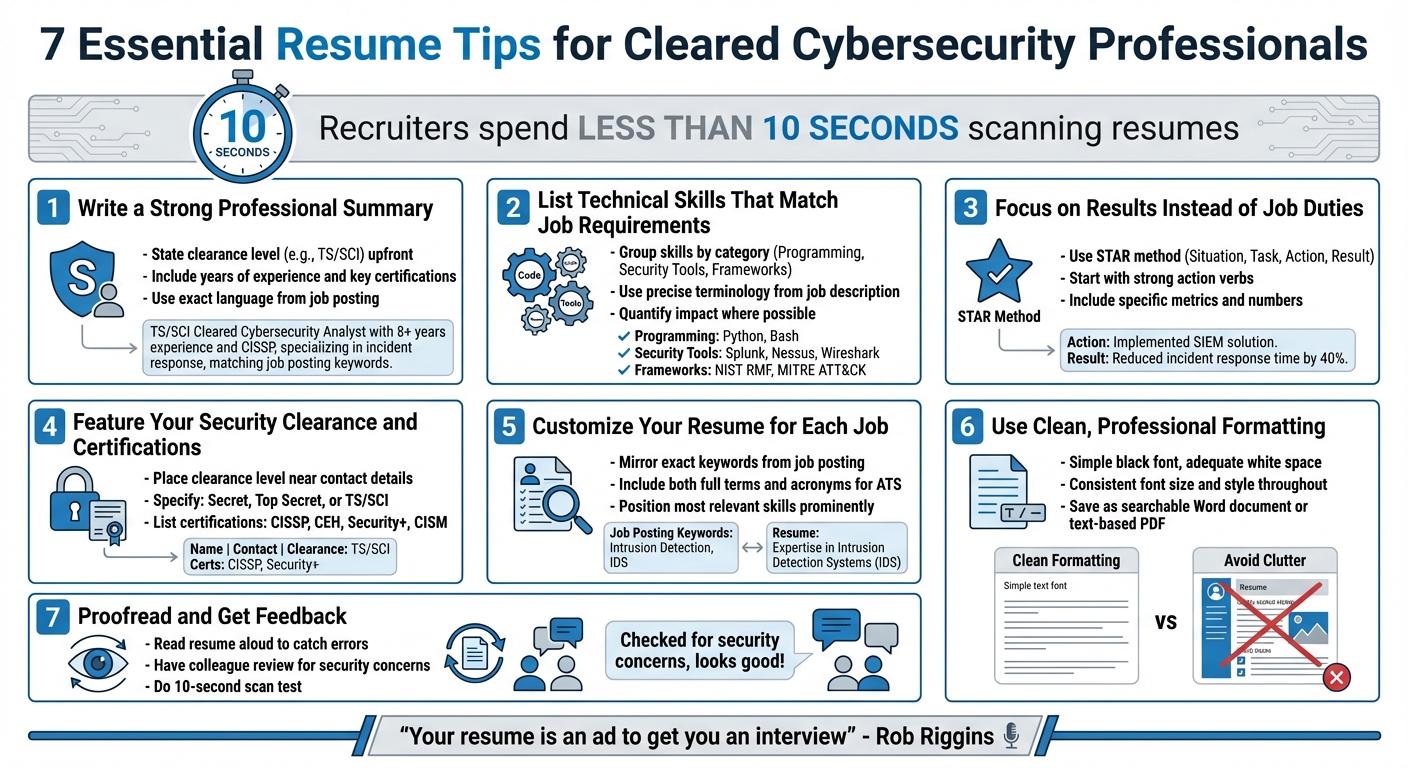
7 Essential Resume Tips for Cleared Cybersecurity Professionals
From Entry-Level to Senior: Cybersecurity and GRC Resume Recommendations | Tips & Tricks
1. Write a Strong Professional Summary
Your professional summary is the first thing employers see on your resume, sitting right below your contact information. It’s your chance to make an immediate impression by clearly stating your clearance, years of experience, and key skills in just 2–3 lines.
Start with your clearance status (e.g., "Active Top Secret/SCI"), followed by your years of experience and technical expertise. For example:
"Active TS/SCI cleared Cybersecurity Analyst with 8+ years in network security, SIEM administration, and incident response. Hold CISSP and CompTIA Security+ certifications."
According to Martha Schneegans, a Senior Technical Recruiter at ManTech, using the exact language from the job posting is essential for getting past Applicant Tracking Systems (ATS) [4]. If the job description mentions "SIEM administration", make sure to use that exact phrase instead of a variation. Precision matters.
Steer clear of vague terms like "expert" or "highly skilled." Instead, back up your claims with specifics. For instance, writing "5+ years with Splunk" is far more effective than saying "extensive SIEM experience." As ClearedJobs.Net advises, your summary should highlight "crisp, clean, jargon-free critical experience and relevant attributes such as certifications" [3].
Finally, ensure the technical skills you mention directly align with the job requirements. Tailoring your summary this way sets a strong foundation for the rest of your resume.
2. List Technical Skills That Match Job Requirements
Including a dedicated technical skills section in your resume makes it easier for recruiters to quickly assess your qualifications and helps Applicant Tracking Systems (ATS) align your resume with the job requirements. To improve readability, group your skills into categories like "Programming Languages", "Security Tools", "Frameworks," and "Operating Systems."
Pay close attention to the exact terminology used in the job posting. For instance, if the listing specifies "vulnerability assessment", use that exact phrase instead of substituting synonyms. ATS systems are designed to look for precise matches, so this level of accuracy is essential to ensure your resume gets through the initial screening.
As of 2026, certain technical skills are particularly sought after in cleared cybersecurity roles. Expertise in AI and LLM security has become highly desirable, especially after AI-driven espionage campaigns were uncovered in September 2025. These incidents revealed that attackers could use AI to execute 80–90% of advanced hacking operations[6]. Additional key skills include proficiency in cloud infrastructure (especially AWS), familiarity with frameworks like RMF and MITRE ATT&CK, and programming languages such as Python and Java.
Where possible, quantify your impact to make your skills stand out. For example, instead of simply saying "SIEM administration", you could write: "Reduced system vulnerabilities by 35% through threat monitoring using LogRhythm." If you’re working toward a certification listed in the job requirements, include it along with the anticipated completion date to show your commitment to professional growth[1].
Be honest and list only the technical skills you can confidently discuss in a technical interview. Hiring managers are quick to identify gaps during screenings[4]. Additionally, spell out acronyms alongside their abbreviations to ensure ATS systems recognize them effectively[7].
3. Focus on Results Instead of Job Duties
Did you know hiring managers typically spend less than 10 seconds scanning a resume before deciding whether to keep reading? [4] That means you need to make every bullet point count by emphasizing measurable accomplishments instead of routine tasks. Think of your resume as a highlight reel of your capabilities, not a day-to-day job description.
To stand out, your achievements should clearly demonstrate tangible results. For example, instead of saying, "Conducted vulnerability assessments", aim for something like, "Identified and mitigated vulnerabilities, reducing system risk by 35%." This approach not only shows what you did but also the impact you made. A helpful way to craft these statements is by using the STAR method: Situation, Task, Action, Result. This structure keeps your points focused and results-driven.
Start each bullet point with a strong action verb like "Directed", "Increased", "Developed", or "Mitigated." Then back it up with specific metrics to highlight your contributions. For instance:
- "Maintained secure infrastructure for 5,000+ users with 99.9% uptime"
- "Oversaw the secure deployment of $50M in technical equipment"
While quantifying your work is essential, keep operational security in mind. Avoid disclosing sensitive details like classified project names, exact office sizes, or specific budget figures that could violate security protocols.
"Numbers and metrics help to paint a clear picture of your contributions and demonstrate your value to prospective employers."
– CyberSecJobs
4. Feature Your Security Clearance and Certifications
An active security clearance is a major advantage, saving employers both time and money by eliminating the need for clearance sponsorship [8]. To make an immediate impression, place your clearance level prominently near your contact details [4]. This approach complements the other resume strategies discussed earlier.
Be specific when listing your clearance. Clearly indicate whether it’s Secret, Top Secret, or TS/SCI, and always include the issuing agency, such as the Department of Defense (DoD), Department of Homeland Security (DHS), or National Security Agency (NSA). Employers often prefer candidates already vetted by a particular agency. If your clearance is inactive but within the 24-month eligibility window, label it as "Eligible for Reinstatement" instead of omitting it. This indicates it can be reactivated without requiring a full reinvestigation [8].
Certifications are equally important. Credentials like CISSP, CEH, Security+, and CISM showcase your expertise [1][2]. Create a dedicated "Certifications & Clearances" section on your resume to highlight these qualifications. If you’re working toward a certification, include it with an estimated completion date.
"Including an in-progress certification on your resume could make the difference in a recruiter contacting you or not if it’s a hard requirement of the job."
– CyberSecJobs [1]
sbb-itb-bf7aa6b
5. Customize Your Resume for Each Job
Tailoring your resume to match the requirements of each job is a must. By building on your professional summary and technical skills, you can craft a resume that aligns with what each employer is seeking. This is especially important for cleared cybersecurity roles, which often come with very specific expectations. Remember, recruiters typically spend less than 10 seconds scanning a resume at first glance, so the skills and keywords they’re looking for should stand out immediately [4].
Start by thoroughly reviewing the job description. Pay close attention to the exact language used and replicate those terms in your resume. For example, if the job posting specifies "network security", use that precise phrase [1]. Martha Schneegans, Senior Technical Recruiter at ManTech, underscores the importance of mirroring the job description’s terminology:
"If the job description has the words, tomato, ballerina, and cake decorator, make sure you include those on your resume." [4]
This strategy not only aligns your resume with what the employer wants but also improves its chances of passing through Applicant Tracking Systems (ATS). ATS software scans resumes for specific keywords before they ever reach a recruiter. To increase your odds, include both full terms and acronyms – like "Project Management Professional (PMP)" or "Database Architect (DBA)" – since recruiters may use different formats when searching [4]. Additionally, account for slight variations in phrasing, such as "System Engineer" versus "Systems Engineer" or "Software Development" versus "Software Engineering" [9].
When customizing your resume, position the most relevant technical skills prominently. For instance, if the role emphasizes SIEM solutions or specific firewalls, list those tools at the top of your Technical Skills section [1]. However, be truthful – never include skills you don’t actually have. Falsifying your qualifications can lead to immediate disqualification during the interview process [4].
Finally, save your resume in a format that ensures ATS readability, such as a Word document or a text-based PDF. A clean, well-formatted resume not only makes it easier for ATS to process but also showcases your attention to detail [4].
6. Use Clean, Professional Formatting
The way your resume is formatted can make or break its impact, especially when showcasing your clearance and technical expertise. Stick to a simple, black font – steer clear of decorative styles or colors, as these can interfere with ATS (Applicant Tracking System) scanning. Keep your font size legible and avoid the temptation to cram extra information by shrinking text.
Spacing matters too. Leave enough white space between bullet points and paragraphs to prevent your resume from appearing cluttered. As Rob Riggins puts it:
"If your resume is hard to read with dense paragraphs and tiny type, it will not be read. Your goal is a clean resume, with a simple font and adequate white space." [5]
Consistency is key to maintaining a polished look. Use the same font, size, and style throughout the document. Position essential headings like Summary, Skills, Experience, and Education on the left side to align with natural reading patterns. This structure makes it easier for recruiters to quickly find the information they’re looking for during their initial scan.
Don’t forget the basics: stick to standard margins and save your resume as a searchable Word document to ensure ATS compatibility. A well-organized, cleanly formatted resume not only reflects professionalism but also demonstrates the kind of attention to detail that’s crucial in cleared cybersecurity roles.
7. Proofread and Get Feedback
Even a single typo can hurt your chances of landing an interview. Ashley Jones, Editor at ClearedJobs.Net, emphasizes this point:
"A single typo or grammatical error can make you appear careless or unprofessional."
Recruiters often skim resumes quickly, so small mistakes can leave a lasting negative impression. That’s why carefully reviewing your resume is critical – not just for professionalism but also for maintaining operational security.
Start by reading your resume aloud. This simple step can help you catch errors that spell-checkers might miss [3]. Double-check essential details, like your contact information – surprisingly, candidates sometimes forget to include their phone number or email address [5]. Also, verify that your security clearance level is accurately and prominently displayed. Recruiters may use systems like JPAS to confirm this information [5].
It’s also a good idea to have a trusted colleague or mentor review your resume. They can spot errors you might have overlooked and flag potential operational security concerns. For instance, they might notice military or government acronyms that could confuse civilian recruiters [4]. They can also identify sensitive details, like classified project names or specific office information, that shouldn’t be included [3][2].
Make sure your technical skills are paired with relevant experience to give them proper context [5]. Finally, ask your reviewer to do a quick "scan test." Have them glance at your resume for 10 seconds and share what immediately stands out. If nothing grabs their attention or the layout feels cluttered, you’ll know where to make changes [4].
Conclusion
Creating a resume is about more than just listing your job history. It’s your first chance to make an impression, so make it count. Start by prominently showcasing your security clearance and emphasizing measurable achievements instead of just listing routine responsibilities. With recruiters spending less than 10 seconds scanning resumes [4], every word you choose has to work hard.
The best resumes feature clean, easy-to-read formatting, are tailored to each job application, and use the exact language found in job postings. Don’t forget to keep technical skills relevant to the role you’re targeting. As Rob Riggins wisely says:
"Your resume is not a biography… It’s an ad to get you an interview" [5].
Beyond crafting a strong resume, maintaining an active online profile is equally important. Some employers with cleared positions look directly at resume databases without ever posting jobs publicly [9]. By uploading your resume and regularly logging in to refresh your profile, you increase your chances of appearing at the top of recruiter searches [9].
Pairing a well-optimized resume with an active presence on platforms like Cleared Cyber Security Jobs (https://cybersecjobs.com) can significantly boost your visibility. This platform offers tools like job alerts, resume databases, and direct connections to employers seeking candidates with your clearance level and specialized skills.
Use these strategies to position yourself as a standout candidate in the competitive world of cleared cybersecurity.
FAQs
What are the best ways to make sure my resume gets through Applicant Tracking Systems (ATS)?
When crafting a resume designed to navigate Applicant Tracking Systems (ATS) effectively, simplicity is key. Opt for a clean, uncluttered format – steer clear of graphics, tables, or images, as these can confuse ATS software. Stick with a basic black font, make good use of white space, and maintain a straightforward layout to ensure it’s easy to read.
Save your resume as a Word document instead of a PDF, since some ATS struggle to process PDFs correctly. Be sure to weave relevant keywords from the job description naturally into your resume, particularly in the skills and experience sections. Lastly, focus on concise accomplishment statements that emphasize your achievements, rather than lengthy lists of responsibilities, to make your qualifications stand out.
What technical skills are most valuable for cybersecurity professionals with security clearance?
For professionals in cybersecurity with security clearance, certain technical skills are in high demand. These include security monitoring, threat detection, and vulnerability management. Familiarity with tools like SIEM (Security Information and Event Management) systems, crafting security alerts, and managing phishing incidents is especially valued. Additionally, having a strong grasp of network security and the ability to develop security awareness materials can help candidates stand out.
Certifications such as CompTIA Security+ and Certified Ethical Hacker (CEH) are often sought after to confirm a candidate’s technical abilities. Beyond technical expertise, employers look for individuals with strong problem-solving abilities, clear communication skills, and a keen attention to detail. These qualities are critical for tackling complex security issues and presenting findings in a way that’s easy to understand. Combining technical know-how with these soft skills is essential for thriving in cybersecurity roles that require clearance.
Why should I customize my resume for each cybersecurity job application?
Customizing your resume for each job application is crucial because it allows you to spotlight the skills, certifications, and experience that directly match the role you’re pursuing. This tailored approach not only grabs the hiring manager’s attention but also helps you navigate applicant tracking systems (ATS), which often screen candidates based on specific keywords.
For professionals in cleared cybersecurity roles, this strategy becomes even more critical. Emphasizing your security clearance and showcasing relevant technical skills can set you apart in a highly competitive field. A well-focused resume demonstrates to employers that you’ve taken the time to understand their needs and position yourself as the right candidate for the job.
Leave a Reply