• Skip to primary navigation
  • Skip to main content
Cleared Cyber Security Jobs | CyberSecJobs.com

Cleared Cyber Security Jobs | CyberSecJobs.com

Cleared Cyber Security Jobs

  • Home
  • Search Cleared Cyber Jobs
  • Job Fairs
  • Career Resources

CyberSecJobs Editorial

BTL1 Certification Career Guide for Cleared Blue Team Level 1

CyberSecJobs Editorial · February 24, 2026 ·

The Blue Team Level 1 (BTL1) certification is a practical, entry-level credential for cybersecurity professionals, especially those in government, defense, and military roles requiring security clearances. It tests your ability to handle security incidents through a 24-hour, task-based exam focusing on six domains: Security Fundamentals, Phishing Analysis, Threat Intelligence, Digital Forensics, SIEM, and Incident Response.

Key Points:

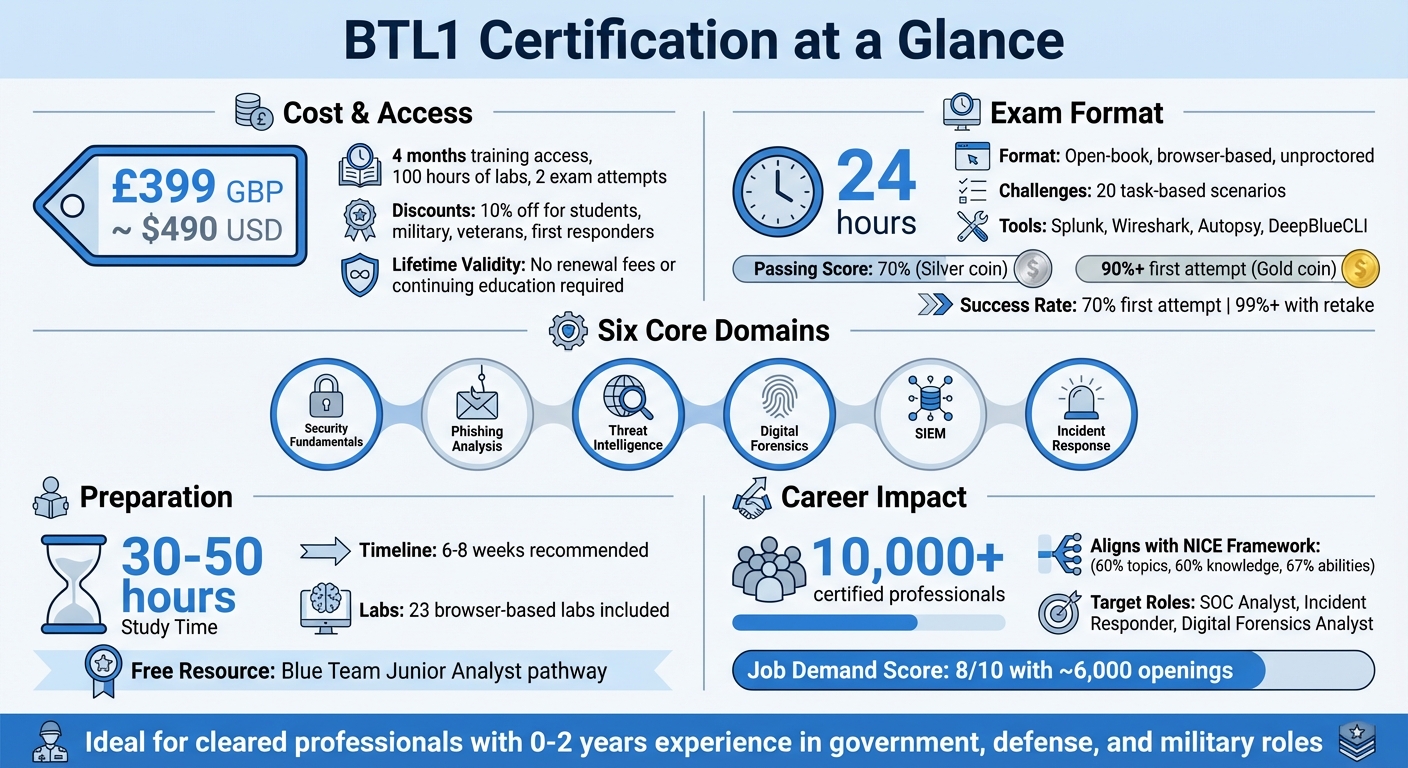
  • Cost: $490 USD (includes training, labs, and 2 exam attempts; discounts available for students, military, and first responders).
  • Format: Open-book, browser-based, unproctored, with 20 challenges using tools like Splunk, Wireshark, and Autopsy.
  • Passing Criteria: 70% for certification; 90%+ on the first attempt earns a gold challenge coin.
  • Preparation: 30–50 hours of study, with access to 100 hours of labs and free resources like the Blue Team Junior Analyst pathway.
  • Lifetime Validity: No renewal fees or continuing education requirements.

BTL1 aligns with the NICE Framework, making it ideal for roles like SOC Analyst or Incident Responder. It’s a one-time investment that directly demonstrates your hands-on skills to employers. With over 10,000 certified professionals and a 99% pass rate with retakes, it’s a strong option for building your cybersecurity career.
BTL1 Certification Quick Reference Guide: Cost, Format, and Key Benefits

BTL1 Certification Quick Reference Guide: Cost, Format, and Key Benefits

BTL1 Exam Structure and Prerequisites

Exam Format

The BTL1 exam is a 24-hour, open-book, browser-based simulation that includes 20 task-based challenges. These challenges are designed to mirror real-world cybersecurity incidents, using industry-standard tools like Splunk, Wireshark, Autopsy, and DeepBlueCLI for tasks such as SIEM, network analysis, forensics, and log review.

The exam is unproctored, meaning you can complete it from home or work, with access to your notes, course materials, and even search engines. However, using AI tools like ChatGPT is strictly prohibited and will result in disqualification. To pass, you’ll need a 70% score, which earns you the silver challenge coin. Achieving a 90% or higher on your first attempt secures the coveted gold challenge coin.

"The exam guides you through a very realistic incident response scenario in which you have to combine mostly your Splunk/Wireshark/Autopsy knowledge." – Synack12, Security Researcher [9]

If you don’t pass on your first try, you’re entitled to one free retake. Additional retake vouchers are available for $123 each, with a mandatory 10-day waiting period between attempts. Encouragingly, over 99% of candidates who use their free retake eventually pass.

A strong understanding of core security concepts is essential to navigate the challenges effectively.

Prerequisites and Required Knowledge

The BTL1 exam has no formal prerequisites, making it ideal for professionals with 0–2 years of experience, including students, career changers, and IT generalists exploring cybersecurity. However, candidates are expected to have a foundational understanding of six key areas: Security Fundamentals, Phishing Analysis, Threat Intelligence, Digital Forensics, SIEM, and Incident Response.

To boost your chances of success, Security Blue Team advises completing all 23 browser-based labs included with your exam purchase. These labs provide 100 hours of hands-on practice with the tools featured in the simulation. Additionally, the Blue Team Junior Analyst (BTJA) pathway, offered for free, serves as a helpful self-assessment tool to measure your readiness.

For optimal results, organize your notes by domain before the exam. A well-prepared, searchable document containing Splunk queries, Wireshark filters, and phishing analysis workflows can save you precious time during the 24-hour window.

sbb-itb-bf7aa6b

How to Prepare for the BTL1 Exam

Study Plan and Core Domains

The BTL1 exam focuses on six key domains, but the real emphasis is on practical, hands-on skills rather than rote memorization. To prepare effectively, aim for 30–50 hours of study spread over 6–8 weeks. This pace allows for consistent practice without overwhelming yourself [1].

Break your preparation into weekly segments. Dedicate one week each to topics like Phishing Analysis, Threat Intelligence, SIEM (Splunk), and Digital Forensics. Reserve two weeks toward the end for integrated incident response scenarios and final reviews. Here’s a suggested timeline to guide your studies:

Study Week Focus Area Key Tools/Tasks
Week 1 Security Fundamentals Basic Splunk syntax
Week 2 Phishing Analysis Header analysis, artifact extraction
Week 3 Threat Intelligence MISP, VirusTotal, WHOIS pivots
Week 4 SIEM (Splunk) Scoping activity, filtering malicious logs
Week 5 Digital Forensics Volatility, KAPE, FTK Imager, Wireshark
Week 6 Incident Response PICERL framework, report writing practice
Week 7-8 Review Redoing challenging labs, refining notes

Completing all 23 browser-based labs is a great way to boost your chances of earning the coveted gold challenge coin. With a solid plan in place, the next step is to leverage the best study resources.

Study Resources

Your exam purchase includes 4 months of on-demand training access and 100 hours of lab time. To start, explore the free Blue Team Junior Analyst (BTJA) pathway. This resource covers OSINT, Digital Forensics, and Threat Hunting, giving you a chance to identify any knowledge gaps before diving into the paid curriculum.

For additional practice, platforms like Blue Team Labs Online (BTLO) offer extra scenarios, including Malicious PowerShell and Phishing Analysis. TryHackMe‘s SOC Level 1 path is another excellent option, helping you sharpen investigative skills through realistic challenges. If you’re undecided about committing to the course, Security Blue Team provides a free limited-access demo, allowing you to preview the structure and content.

Once you’ve built a strong foundation, focus on refining your strategy for acing the exam.

Exam Success Tips

Since the BTL1 exam is open-book, effective note-taking is far more important than memorizing details. Use tools like Notion or Obsidian to create a searchable database organized by domain. Include sections for Splunk search commands (e.g., stats, eval, rex) and Wireshark display filters (e.g., http.request, dns.qry.name). This setup will help you quickly find the information you need during the exam.

"Complete the theory part as quickly as you can… Instead, focus on the labs and make procedural notes." – drsh, Security Professional [7]

Plan your exam day carefully. Schedule breaks for rest, meals, and sleep to stay sharp. In the first two hours, focus on creating a timeline of attacker activity and drafting answers externally to avoid losing work due to browser timeouts. For the forensics section, keep a reference list of Windows Event Log IDs handy to speed up artifact analysis.

BTL1 Pricing and Benefits

Certification Cost

The BTL1 certification is more than just a credential – it’s an investment in your future within the cleared cybersecurity field. The cost is £399 GBP (around $490 USD) and includes everything you need: comprehensive training, lab access, and exam attempts. Specifically, this price gives you 4 months of on-demand access to over 330 lessons, 100 hours of browser-based lab time, and one initial exam attempt with a free retake included. The exam voucher is valid for 12 months, offering flexibility to schedule your exam even after your course access expires [2][5].

If you’re a verified student, military personnel, veteran, or first responder, you can take advantage of a 10% discount on the bundle price [2][5]. Need extra time to prepare? You can extend your training access for £100 GBP (31 days) or £150 GBP (62 days) without affecting the 12-month exam window. If both attempts are unsuccessful, a final attempt is available for £100 GBP, provided you submit a success plan. This fee structure is specific to the certification bundle [10].

For U.S. professionals, it’s worth keeping an eye on currency exchange rates. The all-in-one bundle ensures there are no hidden fees – training materials, lab access, and even physical rewards like your printed certificate and challenge coin are all included.

This upfront cost is designed to deliver value not just during the course but throughout your career.

Lifetime Certification Value

One of the standout benefits of BTL1 is its lifetime validity. Once you earn this certification, there are no renewal fees or continuing education requirements [4][5]. That means the $490 investment is a one-time cost that permanently enhances your resume. Over the past five years, more than 10,000 students have earned this certification, with about 70% passing on their first attempt. For those who use the free retake, the success rate jumps to over 99% [5].

The certification also comes with exclusive physical rewards. Passing the exam earns you a silver challenge coin, but if you score 90% or higher on your first attempt, you’ll receive the prestigious gold coin [2][8].

"The hands-on training gave me everything I needed to gain the coveted gold when I finally took the exam, and the confidence to jump straight into a senior SOC analyst role." – Tom, Tier 2 SOC Analyst [11]

BTL1’s alignment with the NIST NICE Framework for Cyber Defense Analyst roles further enhances its value. It covers 60% of topics, 60% of knowledge, and 67% of ability requirements, making it a strong choice for cleared professionals aiming for government or defense roles [5].

Using BTL1 to Advance Your Cleared Career

Showcasing BTL1 on Resumes and in Interviews

Earning your BTL1 certification highlights your ability to handle practical defensive operations, not just theoretical concepts. To make the most of this credential, emphasize your active clearance level (like Secret or TS/SCI) in your professional summary. In the technical skills section of your resume, list the tools you’ve mastered – such as Splunk, Wireshark, Autopsy, Volatility, KAPE, and MISP – to ensure your resume catches the attention of Applicant Tracking Systems.

When it comes to interviews, the STAR method is your best friend. Use it to describe specific BTL1 lab scenarios where you applied the PICERL process (Preparation, Identification, Containment, Eradication, Recovery, Lessons Learned) to tackle incidents during the 24-hour exam. These examples demonstrate your ability to handle real-world cybersecurity challenges.

Make sure to feature your BTL1 Credly digital badge on LinkedIn and in your email signature for easy skill verification. If you scored 90% or higher on your first attempt, mention earning the Gold Challenge Coin – it’s a standout achievement. To further strengthen your profile, consider publishing 2–3 write-ups of your lab work to showcase your hands-on investigative skills.

"Many students have told us that recruiters are very impressed when candidates discuss the projects and labs they have completed during the interview stage!"

By following these strategies, you’ll position yourself effectively for roles that match your specific expertise.

Finding Cleared Roles with Job Boards

Platforms like Cleared Cyber Security Jobs are tailored for professionals with active security clearances, connecting them with direct-hire employers in cybersecurity. Use job board filters to zero in on roles that align with your BTL1 skills and clearance level. Upload your resume and set up job alerts to stay informed about positions that fit your qualifications.

BTL1’s alignment with the NICE Framework makes it particularly valuable for government and defense roles. When searching for jobs, include keywords like "SOC Analyst", "Incident Response", "Cyber Defense Analyst", or "Digital Forensics" to ensure your applications match the roles seeking these competencies.

After applying, keep an eye on the job market to stay ahead of new opportunities.

Monitoring Job Market Demand

Keep tabs on openings for positions such as Tier 1 and Tier 2 SOC Analysts, Incident Responders, Digital Forensics Analysts, and Threat Intelligence Analysts – roles that align closely with the skills your BTL1 certification validates. Pay attention to job descriptions that mention tools like Splunk, Wireshark, and Volatility.

The certification’s recognition by military, government, and law enforcement sectors highlights the steady demand for BTL1-certified professionals[3]. Set up alerts for job postings that reference the "NICE Framework" or "hands-on defensive operations."

"BTL1 is hands-on and relates directly to our daily work."

How I Passed The Blue Team Level 1 (24-Hour Practical Exam) | Security Blue Team Guide + Tips
Security Blue Team

Conclusion

The BTL1 certification provides a practical, hands-on credential that demonstrates your ability to manage real-world defensive operations through an intense 24-hour incident simulation. With lifetime validity and no renewal fees, it’s a one-time investment tailored for cleared professionals aiming for junior SOC or Incident Response roles.

BTL1’s credibility is underscored by its recognition from military, government, and law enforcement organizations worldwide [1]. Its alignment with the NICE Framework makes it especially relevant for federal and cleared positions. Plus, the open-book exam format mirrors real-world problem-solving, testing your investigative skills as you would use them on the job.

Priced at £399 GBP (about $490 USD), the training bundle includes 100 hours of browser-based labs, two exam attempts, and four months of course access [1][2]. Cleared professionals should explore available discounts before purchasing. Achieving a score of 90% or higher on your first try earns you a physical "Gold" challenge coin – a standout credential for recruiters [1].

This certification is not only affordable but also a standout addition to your resume, recognized as a mark of quality by industry leaders. As Steffan J, Cyber Security Services Manager at Fortra, shared:

"This methodology helps Fortra ensure that our analysts have a consistent education with sufficient hands-on training to competently approach many of the complicated scenarios which they are likely to encounter" [6].

With around 6,000 job openings requiring BTL1-related skills and a demand score of 8/10 [12], now is an excellent time to pursue this credential.

To maximize your success, integrate your BTL1 training into your career strategy. Build searchable notes during your coursework, practice extensively with the labs, and use platforms like Cleared Cyber Security Jobs to connect with employers seeking cleared defensive analysts. Your active clearance and proven hands-on expertise set a solid foundation for career growth.

FAQs

Is BTL1 worth it for cleared jobs?

BTL1 is definitely worth considering for those aiming for cleared cybersecurity jobs. It provides hands-on, practical skills tailored to cybersecurity defense, making it ideal for entry-level SOC analyst roles. By earning this certification, you can showcase your expertise and boost your prospects in the competitive field of cleared cybersecurity positions.

How do I prep if I’m new to SOC work?

If you’re stepping into the world of SOC (Security Operations Center) work, it’s essential to concentrate on developing core cybersecurity skills. Some key areas to focus on include phishing analysis, threat intelligence, SIEM (Security Information and Event Management) investigation, digital forensics, and incident response.

To get started, explore beginner-friendly courses that cover these topics. Pair your learning with practical experience by using virtual machines to simulate real-world scenarios and practicing basic scripting skills, such as Python. Hands-on labs or simulations that mimic SOC workflows can be incredibly helpful in building confidence and understanding.

For those with 0-2 years of experience, the BTL1 program is specifically tailored to your level. Prioritize practical learning to lay a strong foundation for your cybersecurity career.

What should I do during the 24-hour exam?

During the 24-hour BTL1 exam, managing your time effectively and staying organized are key to success. Start by creating a clear timeline of the artifacts you uncover – this will make it easier to reference them when tackling later questions. Before the exam, prepare playbooks for common procedures so you can follow a structured approach without wasting time figuring out each step.

The exam centers on investigating a compromised environment and answering task-specific questions, so maintaining focus is crucial. Avoid using any prohibited AI tools, as this could jeopardize your results. Lastly, ensure you’re well-rested before the exam begins – your ability to concentrate for the full 24 hours will make all the difference.
Related Blog Posts

  • CTIA Certification Career Guide for Cleared Threat Intel Analysts
  • LPT Certification Career Guide for Cleared Pen Test Leads
  • PNPT Certification Career Guide for Cleared Practical Pen Testers
  • CRTO Certification Career Guide for Cleared Red Team Operators

Related Guides

  • BTL2 Certification Career Guide for Cleared Blue Team Level 2
  • CySA Plus Certification Career Guide for Cleared SOC Analysts
  • Security Plus Certification Career Guide for Cleared Entry Level
  • Cybersecurity Salary Guide 2026
  • TS/SCI Salary Premium: Real 2026 Numbers

CRTL Certification Career Guide for Cleared Red Team Leads

CyberSecJobs Editorial · February 23, 2026 ·

The Certified Red Team Lead (CRTL) certification from ZeroPoint Security is designed for professionals in government and defense sectors who hold security clearances. It validates advanced skills in offensive security, focusing on bypassing modern Windows defenses like Endpoint Detection and Response (EDR), Attack Surface Reduction (ASR), and Windows Defender Application Control (WDAC). Candidates must demonstrate expertise in custom tool creation (C++/C#), advanced defense evasion, and leading red team operations in highly secure environments.

Key Details:

  • Cost: $399 (includes course and exam).
  • Exam Duration: 72 hours of active lab time, flexible over 8 days.
  • Prerequisites: CRTO certification, security clearance (Secret or Top Secret), and knowledge of Active Directory exploitation.
  • Skills Tested: C2 infrastructure, process injection, EDR evasion, and security control bypass techniques.
  • Career Impact: Opens doors to leadership roles with salaries ranging from $160,000 to $200,000+.

This certification is ideal for cleared professionals ready to advance from operator roles to leadership positions in red teaming.

Exam Prep Guide Certified Red Team Operator (CRTO)

sbb-itb-bf7aa6b

What is the CRTL Certification?

The Certified Red Team Lead (CRTL) certification is awarded to individuals who complete Zero-Point Security’s "Red Team Ops II" (RTO-2) course and pass its rigorous exam [1][2]. This certification demonstrates expertise in bypassing modern Windows endpoint defenses, especially when standard techniques fall short [2][3].

Building on the foundational skills from the Certified Red Team Operator (CRTO) certification, the CRTL focuses on advanced Operations Security (OPSEC) and defense evasion techniques. Instead of revisiting basic Active Directory attack methods, it challenges candidates to operate stealthily in highly secured environments like those found in government and defense networks. These environments are fortified with Endpoint Detection and Response (EDR) systems, Attack Surface Reduction (ASR) rules, and Windows Defender Application Control (WDAC) [2].

Andres Roldan, VP of Hacking at Fluid Attacks, highlights the certification’s focus:

"RTO-2 was born to compliment RTO on the OPSEC realm… focusing on advanced OPSEC tactics, including bypassing modern enterprise Windows endpoint controls" [2].

To earn the certification, candidates must develop custom offensive tools using C++ and C#. These tools are designed to evade signature-based and behavior-based detections, leveraging advanced techniques like API unhooking, indirect syscalls, and process injection. Mastery of these methods sets apart a red team leader from a standard operator [2][5].

Key Features of the CRTL

The CRTL certification tests your ability to execute red team operations in simulated Active Directory environments that replicate the security measures of high-security networks. To pass, candidates must capture all required flags in the exam. Earlier versions of the exam required capturing 4 out of 4 flags within a 5-day lab, while newer versions demand 5 out of 6 flags within 8 days, with a total lab runtime of 72 hours [1][2][4]. This all-or-nothing approach ensures candidates demonstrate both technical depth and persistence under pressure.

The certification evaluates skills across six core domains:

Skill Category Core Skills
C2 Infrastructure Building secure on-premise command and control systems, configuring HTTP/DNS redirectors, and managing SSL certificates for Beacons
Tooling Development Writing custom loaders and using Windows and NT APIs via C++ and C#, including P/Invoke and D/Invoke techniques
Process Injection Techniques like APC injection, section mapping, and utilizing undocumented ntdll.dll functions for remote process code injection
Defense Evasion Methods such as bypassing Event Tracing for Windows (ETW), PPID spoofing, command line spoofing, and thread stack spoofing
Security Controls Identifying and exploiting weaknesses in ASR and WDAC implementations
EDR Evasion Techniques like API unhooking, indirect syscalls, and unregistering kernel callbacks

The exam environment is intentionally designed with unexpected challenges not covered directly in the course material. Candidates must perform independent research into topics like EDR bypasses, YARA rules, and whitepapers. As Ibad Altaf, a penetration tester, explains:

"This section [EDR evasion] requires a lot of research about the EDR itself, reading up the yara rules, reading blogs, articles, as well as whitepapers and coming up with your own methods to bypass EDR detections" [5].

Unlike certifications that focus on rote memorization, the CRTL emphasizes problem-solving and tool customization. A reviewer from six-two.dev shared their experience:

"The exam was very fun and I learned about one new tool. Personally I liked it much more than the CRTO exam, since it required some thinking and not just copying commands from the course material" [1].

These advanced skills provide a pathway to career growth, as they not only validate technical expertise but also prepare candidates for leadership roles in high-security environments.

Why CRTL Matters for Cleared Professionals

For professionals working in government and defense sectors, the CRTL certification equips them with the skills to lead red team operations against advanced threats. With Active Directory in use by over 90% of Fortune 1000 companies [6], the techniques learned – such as bypassing ASR, WDAC, and Protected Processes – are essential for operating in secured environments [2].

The certification transitions candidates from technical operators to research-driven leaders capable of overcoming specific security challenges in EDR-protected Active Directory forests [5]. It teaches how to set up complex command and control (C2) infrastructures with multiple redirectors, implement safeguards to prevent payload misuse, and maintain stealth during extended engagements [5].

Ben S. from infosecnoodle captures the certification’s value:

"RTO2 teaches you how to perform successful attacks in hardened network environments, going up against modern EDR solutions and blue teams" [4].

For professionals leading red team exercises in classified systems, the CRTL emphasizes using legitimate Windows features over traditional exploits. This approach is particularly effective in fully patched environments, where abusing built-in functionalities while staying undetected often determines the success of an operation.

Eligibility and Prerequisites for the CRTL Certification

Security Clearance Requirements

If you’re aiming for a role in government or defense sectors, having an active security clearance is non-negotiable. To qualify as a Cleared Red Team Lead, you must hold a Secret or Top Secret clearance [7]. These clearances are issued through a National Security Eligibility Determination, which evaluates whether granting you access to classified information aligns with U.S. national security interests [7].

The process to obtain a clearance is thorough and time-consuming. Typically, it takes 9 to 12 months to complete [8]. The U.S. Department of State’s Diplomatic Security Service handles over 38,000 vetting actions annually [7]. During this process, you’ll need to disclose details like criminal history, financial issues, or foreign contacts [9]. Failing to provide full transparency can result in immediate disqualification.

Prior Certifications and Experience

A strong technical background is just as essential as security clearance. Candidates must have successfully completed the CRTO exam, as the skills it covers serve as the foundation for the CRTL certification. According to Andres Roldan, RTO-2 builds on these red team skills, so a solid understanding of the basics is a must [2].

To qualify for the CRTL, you need to demonstrate expertise in Active Directory (AD) exploitation, including techniques like Kerberos attacks (Golden/Silver tickets and constrained delegation), lateral movement, privilege escalation, and the use of trusted tools like Cobalt Strike C2 [2][3]. Cyber Security Researcher Brahim Chebli highlights the importance of this background:

"This background [in red teaming and malware development] played a crucial role in passing the exam, as CRTL doesn’t cover basics, especially AD attacks, lateral movements, and using Cobalt Strike C2" [3].

Programming knowledge is another key requirement. You’ll need proficiency in C# and C++ to create custom offensive tools and interact with Windows APIs. Familiarity with Visual Studio for compiling and debugging is critical, as the exam may involve troubleshooting tools in restricted environments [2][10]. If you lack experience in malware development, consider completing Maldev Academy before attempting RTO-2 [5].

This certification is designed for those with established red team expertise, preparing candidates for leadership roles in highly secure environments. Once you’ve met these prerequisites, the next step is diving into the exam’s format and structure.

CRTL Certification Exam: Format and Structure

Exam Overview

The CRTL exam is a fully hands-on practical test, conducted in a hardened, multi-forest Active Directory environment [2][4]. It offers 72 hours of active lab time, which you can use flexibly over several days. The timer only runs when the lab is active, so you can pause the environment to rest or do additional research without wasting time [2][11][4].

This exam follows a flag-based structure rather than traditional questions. To pass, you typically need to capture all 4 flags [2][11][4]. However, recent updates for 2024 suggest that the format may now require 5 out of 6 flags to be captured within an 8-day window [1]. Unlike other certifications that sometimes allow partial credit, CRTL demands full completion of the required flags.

The exam is hosted on the Cyber Ranges platform (formerly Snaplabs) and accessed via a web browser using Apache Guacamole [11][4]. You’ll need to be familiar with Visual Studio and C#/C++ development, as modifying or compiling custom tools is often necessary [11][4]. While you’re given 72 hours, many candidates complete it in 11 to 30 hours of active time [2][4]. This hands-on format sets the tone for the unique scoring process, which is covered next.

Scoring and Post-Exam Process

Once you’ve completed the challenges, the scoring process offers immediate feedback. Flags are entered into an automated system that verifies them in real time [2][4]. Unlike many other advanced security certifications, there’s no written report requirement. As Roldan explains:

"You don’t need to write a report, just enter the flags" [2].

The certification badge is typically issued 5 days after the exam starts or once the exam window closes [2][11][4]. Ben S. from infosecnoodle praises this streamlined approach:

"One of the great things about Zero-Point Security exams is that you pretty much know when you’ve passed because it’s entirely flag-based. If you get all the flags, you pass" [4].

To avoid losing lab time, make sure to refresh the exam dashboard every 30 minutes. This prevents the environment from shutting down due to inactivity [11]. Staying mindful of this ensures you can make the most of your allocated time.

How to Prepare for the CRTL Certification Exam

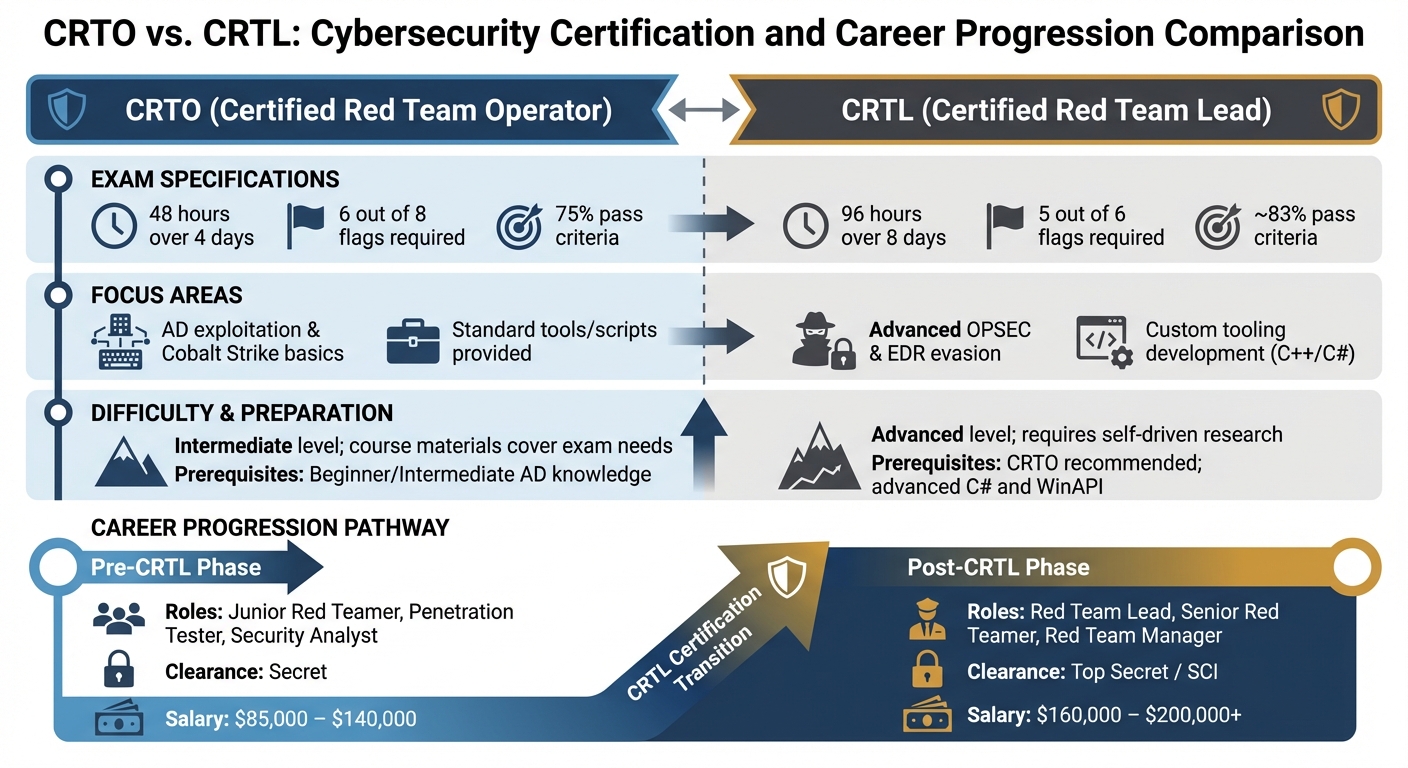
CRTO vs CRTL Certification Comparison: Exam Format, Requirements, and Career Progression

CRTO vs CRTL Certification Comparison: Exam Format, Requirements, and Career Progression

Key Skills to Master

The CRTL exam pushes you to excel in defense evasion within a hardened enterprise environment. You’ll need to bypass tools like Elastic EDR and Windows Defender, where typical techniques won’t cut it.

A solid grasp of offensive tooling is non-negotiable. You’ll need to work with C++ and C# in Visual Studio to create custom tools and interact with Windows APIs using P/Invoke and D/Invoke. This isn’t about running pre-built scripts – it’s about compiling, debugging, and tailoring offensive tools. Mastering process injection methods, such as injecting into remote processes, leveraging undocumented ntdll.dll functions, and using Asynchronous Procedure Call (APC) dispatching, is essential.

You’ll also need to outsmart Windows security measures. This includes bypassing Attack Surface Reduction (ASR) rules, Windows Defender Application Control (WDAC), and Protected Processes (PPL). In-memory evasion techniques like thread stack spoofing and sleep masks will help you maintain access without detection.

Finally, building resilient C2 (Command and Control) infrastructure is critical. This involves configuring Apache redirect rules, managing SSL certificates, and implementing failover strategies for beacons – all while maintaining operational security in a closely monitored setting.

To refine these skills, focus on targeted training and hands-on labs.

Recommended Resources and Labs

The Red Team Ops II (RTO-2) course by Zero-Point Security is your go-to resource. It costs around £399.00 (approximately $490) and includes both the course and exam voucher. For an additional £425.00 (about $523), you can access 40 hours of lab time in the Cyber Ranges (formerly Snaplabs) environment. The course dives into seven core areas: C2 Infrastructure, Windows APIs, Process Injection, Defense Evasion, ASR, WDAC, and EDR Evasion.

That said, RTO-2 alone won’t guarantee success. As Ben S. from infosecnoodle explains:

"I think relying solely on the content from RTO2 simply isn’t enough to achieve a passing score – it requires some extra effort."

To fill in the gaps, Maldev Academy is an excellent option for learning malware development and advanced process injection techniques. For free resources, check out Raphael Mudge’s YouTube playlists on Red Team Operations with Cobalt Strike and In-memory Evasion. These videos offer valuable insights into Cobalt Strike’s advanced features.

Additional labs, like the Certified Evasion Techniques Professional (CETP) and Advanced Red Team Lab (CRTE) from Altered Security, focus on bypassing modern defenses. These labs typically cost between $299 and $499 and provide 30–35 days of access. Joining the Zero-Point Security Discord community can also be helpful, as it connects you with other red teamers and keeps you updated on evasion techniques.

For practice outside paid labs, set up a local Windows VM with Visual Studio. Use this environment to experiment with custom loaders, C2 malleable profiles, and artifact kits. This approach lets you refine your skills without burning through your lab hours. Most candidates dedicate three weeks to three months to prepare.

Understanding how the CRTL exam differs from CRTO can further shape your preparation strategy.

CRTL vs CRTO: Key Differences

Feature CRTO (Certified Red Team Operator) CRTL (Certified Red Team Lead)
Duration 48 hours over 4 days 96 hours over 8 days
Flags Required 6 out of 8 flags 5 out of 6 flags
Pass Criteria 75% of flags ~83% of flags
Primary Focus AD exploitation & Cobalt Strike basics Advanced OPSEC & EDR evasion
Tooling Standard tools/scripts provided Custom tooling development (C++/C#)
Difficulty Intermediate; materials cover exam needs Advanced; requires self-driven research
Prerequisites Beginner/Intermediate AD knowledge CRTO recommended; advanced C# and WinAPI

The CRTL exam’s extended 8-day window is a major advantage. It allows you to take breaks and revisit problems with fresh eyes. As one reviewer from six-two.dev noted:

"The exam was very fun and I learned about one new tool. Personally I liked it much more than the CRTO exam, since it required some thinking and not just copying commands."

The leap from CRTO to CRTL is all about moving from basic Active Directory exploitation to advanced evasion techniques. CRTL assumes you’ve already mastered the foundational skills and are ready to tackle highly secured enterprise environments.

Career Benefits of the CRTL Certification

Advancement to Leadership Roles

The CRTL certification opens doors to advanced positions like Red Team Lead and Senior Red Team Researcher, particularly in secure, cleared environments. While certifications like the CRTO focus on foundational Active Directory attack techniques, the CRTL demonstrates your ability to lead complex engagements in highly secure and hardened settings.

Jack Barradell-Johns from Pen Test Partners shared that the certification evaluates skills that "are accurate to those used in real-world Red Team engagements and should be approachable for those who conduct this kind of testing without the need for weeks of revision" [13]. This alignment with practical, real-world challenges makes CRTL-certified professionals strong candidates for leadership roles. These roles often involve guiding teams through intricate adversary emulation exercises across industries such as government, defense, and finance.

Beyond leadership opportunities, these skills can significantly boost your professional value and marketability.

Salary and Job Market Advantages

Working in cleared environments requires advanced expertise, and the compensation reflects that. Lead red teamers and managers can earn between $160,000 and $200,000 or more, while entry-level positions typically offer $85,000 to $110,000 [12]. Additionally, holding a Top Secret or Secret clearance alongside your CRTL certification can increase your salary by 15–30% [12].

The demand for skilled offensive security experts continues to rise due to a growing talent shortage. Remote red teaming has further expanded opportunities, enabling professionals to secure high-paying roles in cities like Washington, D.C., Austin, and Seattle – regardless of their physical location. Companies are also investing in hybrid roles that integrate offensive and defensive expertise, such as in purple teaming initiatives.

Earning the CRTL certification enhances your visibility on cleared job platforms. Recognized as an "Expert" credential in the red teaming field, it sets you apart from those with intermediate qualifications, making you a standout candidate for specialized roles.

Pre-CRTL vs Post-CRTL Career Paths

The CRTL certification marks a clear turning point in career progression, as reflected in both roles and salaries.

Career Phase Roles Clearance Level Salary
Pre-CRTL Junior Red Teamer, Penetration Tester, Security Analyst Secret $85,000 – $140,000
Post-CRTL Red Team Lead, Senior Red Teamer, Red Team Manager Top Secret / SCI $160,000 – $200,000+

Before earning the CRTL, professionals typically focus on tasks like Active Directory enumeration, pivoting, and lateral movement using standard frameworks. However, after certification, expectations shift significantly. CRTL-certified individuals are tasked with customizing tools to bypass modern detection systems, unhooking advanced endpoint protections, and creating tailored implementations that simulate attacks on highly secure enterprise networks. This evolution highlights the transformative impact of the CRTL certification for those aiming to move beyond technical roles into leadership and strategic positions.

Conclusion: Is CRTL Certification Right for You?

The CRTL certification marks a key step forward for cleared professionals aiming to progress from basic penetration testing to advanced red team leadership. If you’ve already mastered tools like Cobalt Strike, techniques like Kerberos, and lateral movement through CRTO, and you’re prepared to tackle advanced EDR evasion and custom tool development in C++/C#, this certification could align perfectly with your career ambitions. Its flag-based exam format is designed to test the persistence and technical expertise required for real-world leadership roles, making it a solid benchmark for advanced skills.

The financial investment is reasonable – about $500 for the course and exam bundle, plus $425 for lab access – and the potential career rewards are substantial. With demand for red team professionals expected to grow by 32% between 2023 and 2028, and the average U.S. data breach costing $9.44 million in 2023 [14], the need for experts capable of simulating sophisticated attacks is only increasing. In the cleared sector, where there are approximately five open cybersecurity positions for every qualified candidate [14], the CRTL certification stands out as a trusted signal of your technical readiness for high-stakes environments.

"In the cleared space, IT certifications are a must to meet the requirements for specific contracts… experience alone doesn’t cut it." – Greg Stuart, Owner and Editor, vDestination.com [15]

Before diving in, take a hard look at your current skill set. The certification demands independent research and hands-on experience beyond the course material. If you’re not yet confident in areas like malware development or offensive tooling, consider additional training to fill those gaps. But if you’re ready for the challenge and already working in – or aspiring to – a cleared red team role, the CRTL certification can set you apart from mid-level professionals and open doors to leadership positions with salaries ranging from $180,000 to over $250,000 annually [14].

This certification goes beyond just passing an exam. It’s about proving your ability to lead operations in environments where adversary emulation plays a critical role in national security and organizational defense. If that mission matches your career goals, the CRTL certification is a strong choice.

FAQs

Do I need an active Secret or Top Secret clearance before enrolling?

Yes, having an active Secret or Top Secret clearance is usually a prerequisite for enrolling in the Certified Red Team Lead (CRTL) certification. This program is tailored specifically for professionals who hold security clearances.

How much C# and C++ do I need to pass the CRTL exam?

To tackle the CRTL exam confidently, it’s important to have at least a basic grasp of C# and C++. These programming languages play a central role in the exam, so understanding their core concepts can make a big difference in how you approach and solve problems during the test.

What should I practice if I’m weak on EDR evasion and OPSEC?

To sharpen your skills in evading Endpoint Detection and Response (EDR) systems and improving operational security (OPSEC), concentrate on techniques that help you bypass modern security measures while keeping a low profile. Key methods to explore include disabling telemetry, process injection, API unhooking, and techniques for avoiding detection by Windows Defender.

Practical, hands-on experience is crucial. Resources like the Red Team Vade Mecum and the Adversary Emulation Guide can provide valuable guidance for simulating real-world scenarios and refining your strategies for maintaining stealth and effectiveness.

Related Blog Posts

  • CTIA Certification Career Guide for Cleared Threat Intel Analysts
  • LPT Certification Career Guide for Cleared Pen Test Leads
  • CRTP Certification Career Guide for Cleared Red Team Professionals
  • CRTO Certification Career Guide for Cleared Red Team Operators

Related Guides

  • CRTO Certification Career Guide for Cleared Red Team Operators
  • CRTP Certification Career Guide for Cleared Red Team Professionals
  • eCPPT Certification Career Guide for Cleared Professional Pen Testers
  • Cybersecurity Salary Guide 2026
  • TS/SCI Salary Premium: Real 2026 Numbers

CRTO Certification Career Guide for Cleared Red Team Operators

CyberSecJobs Editorial · February 23, 2026 ·

The Certified Red Team Operator (CRTO) certification is a practical, hands-on credential from Zero-Point Security, designed for professionals in offensive cybersecurity, particularly those in government and defense roles. Here’s what you need to know:

  • Focus: Covert operations in Windows and Active Directory environments using Cobalt Strike, covering reconnaissance, credential theft, lateral movement, persistence, and detection evasion.
  • Relevance: Tailored for cleared professionals, it aligns with the needs of government and defense sectors where stealth and precision are critical.
  • Exam: A 48-hour practical test spread over four days, requiring at least 70% to pass. The new format emphasizes performance and stealth, with penalties for triggering defenses.
  • Skills Gained: Active Directory attacks (e.g., Kerberos, ADCS exploitation), OPSEC strategies, and mastering Cobalt Strike for adversary simulation.
  • Career Impact: Recognized by CREST, it helps professionals transition into or excel in cleared red team roles, showcasing expertise in advanced tactics and operational security.

The CRTO certification is a stepping stone for professionals aiming to excel in red teaming, offering practical skills and industry recognition. Whether you’re transitioning from penetration testing or advancing within cleared environments, this credential prepares you for the challenges of modern cybersecurity operations.

Is the CRTO Worth It?

sbb-itb-bf7aa6b

Why CRTO Matters for Cleared Red Team Professionals

Cleared red team roles demand expertise that goes far beyond basic penetration testing. The Certified Red Team Operator (CRTO) certification addresses the specific needs of government and defense sector roles by focusing on adversary simulation rather than just identifying vulnerabilities. While penetration testing often involves short, noisy engagements to uncover as many weaknesses as possible, red teaming requires a covert, long-term approach to evaluate an organization’s detection and response capabilities. In cleared environments, stealth and mission success are non-negotiable.

The certification’s emphasis on Active Directory (AD) and Kerberos attacks is particularly relevant to government agency infrastructures. Techniques like Golden Ticket attacks, Kerberos delegation abuse, and ADCS exploitation are covered, reflecting the tactics used by sophisticated adversaries. Candidates are trained to start with minimal access and navigate through complex environments to meet specific operational goals, mirroring the challenges faced by cleared organizations in combating modern cyber threats.

How CRTO Skills Match Cleared Job Requirements

The CRTO certification directly aligns with the responsibilities of cleared red team operators. It provides hands-on experience with Cobalt Strike, a widely used command-and-control platform favored by professional red teams and real-world adversaries alike. Through this training, candidates learn to execute covert operations in realistic Windows enterprise environments, emphasizing AD-focused techniques that are critical for nearly all cleared engagements.

A key aspect of the certification is its focus on Operational Security (OPSEC). In the updated exam format, 50% of the total score is tied to OPSEC performance[6]. Points are deducted for triggering antivirus systems, being detected by security controls, or creating unnecessary activity on the network. Soham, a Security Consultant at Cognisys Group Labs, highlights this importance:

"If your OPSEC score falls below a certain threshold, failing the exam is inevitable, irrespective of objective completion"[6].

This mirrors real-world cleared operations, where detection can jeopardize an entire mission and expose sensitive methodologies.

The exam itself is a 48-hour practical challenge that evaluates candidates on outcome-based objectives. Participants must achieve goals like gaining domain dominance, establishing persistence, and exfiltrating data – all while avoiding detection. Success requires maintaining access, pivoting through networks effectively, and completing the mission under pressure. This realistic assessment ensures that certified professionals are well-equipped for the challenges of cleared red team roles.

Career Opportunities with CRTO

The skills developed through the CRTO certification open doors to specialized roles in cleared environments. By proving the ability to operate responsibly in sensitive Windows environments with industry-standard tools, the certification provides a competitive edge in the cleared job market. FlashGenius, a security professional, underscores its value:

"CRTO tells employers you can run a Windows/AD operation with Cobalt Strike and achieve objectives responsibly. It’s an excellent ‘first real operator’ certification"[4].

The certification’s CREST recognition further enhances its credibility, particularly for professionals working with U.S. government agencies and international defense organizations[4][6]. Zero-Point Security’s status as a CREST-approved training provider and its involvement in co-authoring official Cobalt Strike training materials add significant weight to the certification in the eyes of hiring managers.

For penetration testers looking to transition into red team roles, CRTO serves as a stepping stone by teaching the evasion techniques and stealth-focused methods that set red teaming apart from traditional security assessments[6]. It demonstrates an understanding of not just finding vulnerabilities, but effectively simulating advanced adversaries – an essential distinction in environments where detecting and responding to sophisticated threats is a top priority.

How to Prepare for the CRTO Certification

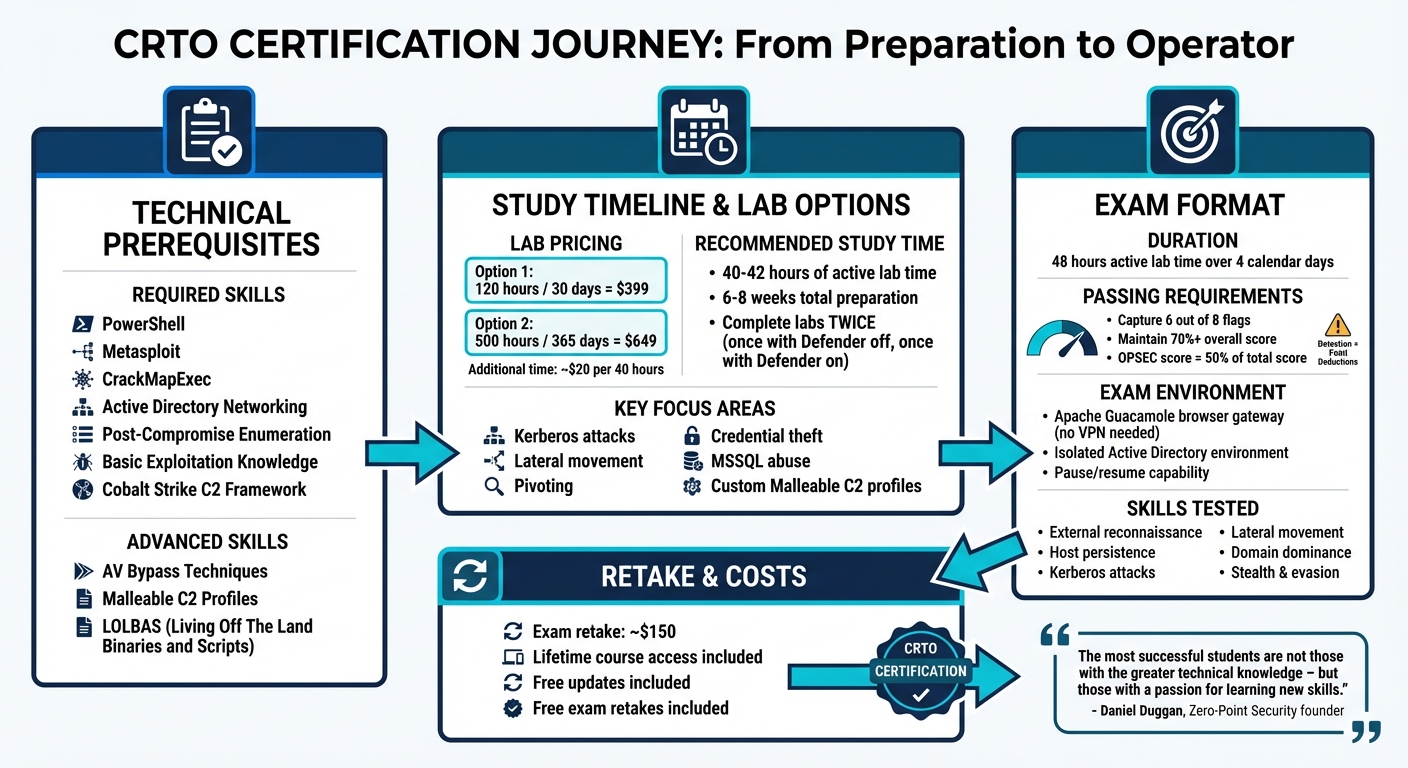
CRTO Certification Path: Prerequisites, Study Timeline, and Exam Format

CRTO Certification Path: Prerequisites, Study Timeline, and Exam Format

Technical Prerequisites for CRTO

To succeed in the CRTO certification, having a solid technical foundation is crucial. You’ll need hands-on experience with tools like PowerShell, Metasploit, CrackMapExec, and a deep understanding of Active Directory networking. Proficiency in post-compromise enumeration and basic exploitation techniques is also essential [7]. Since the certification heavily focuses on the Cobalt Strike C2 framework, you should be comfortable with command-and-control concepts and lateral movement techniques, such as PsExec, WMI, and WinRM [7][8].

While not mandatory, prior exposure to Active Directory attack scenarios – like those covered in Pentester Academy‘s Attacking and Defending Active Directory course – can give you a head start [5].

John J., a Security Researcher, provides a helpful breakdown of the baseline skills:

"You don’t need to have the OSCP certification to take this course… you should probably have a working knowledge or understanding of: PowerShell, Metasploit, CrackMapExec, Active Directory Networking, Post-Compromise Enumeration, [and] Basic Exploitation/Compromise Knowledge." [7]

For the more advanced portions of the certification, you’ll need to be familiar with AV bypass techniques, Malleable C2 profiles, and Living Off The Land Binaries and Scripts (LOLBAS) [7][5]. Once these technical skills are in place, it’s time to focus on effective study strategies to ensure success.

Study Strategies for Cleared Professionals

The CRTO course offers a flexible pay-and-pause lab model, which means lab time is only consumed when you’re actively working [9]. Pricing options include 120 hours/30 days for $399 or 500 hours/365 days for $649, with additional lab time available at approximately $20 per 40 hours [5][11][13]. This setup is particularly helpful for professionals juggling shift work or classified project deadlines.

A great approach is to complete the labs twice: first with Microsoft Defender disabled to understand the techniques, and then with Defender enabled to practice evasion and operational security. With lifetime access and free updates, you can pace your learning over several months [11]. Most students dedicate around 40 to 42 hours of active lab time to prepare for the exam [12].

Concentrate on key topics like Kerberos attacks, lateral movement, pivoting, credential theft, and MSSQL abuse [14]. Pay special attention to mastering custom Malleable C2 profiles using the c2lint validation tool, which is critical for maintaining stealth during the exam [7]. To save time during the test, create a cheat sheet with commonly used Cobalt Strike and PowerShell commands [11]. For additional support, the Zero-Point Security Discord community is an excellent resource for troubleshooting [11].

Daniel Duggan (RastaMouse), the founder of Zero-Point Security, highlights the importance of mindset:

"The most successful students are not those with the greater technical knowledge – but those with a passion for learning new skills." [13]

For seasoned professionals, the External Route option allows you to take the exam without purchasing the full course [13]. The exam itself spans 48 hours of active lab time over four calendar days, offering flexibility to accommodate work schedules [11][14]. By combining these strategies with your technical expertise, you’ll be well-prepared to tackle the CRTO’s demanding 48-hour exam.

CRTO Exam Format and How to Pass

What to Expect in the CRTO Exam

The CRTO exam is a hands-on practical test where your mission is to infiltrate an Active Directory environment using Cobalt Strike [9]. You’ll have 48 hours of active lab time, which can be paused and resumed within a 4-day calendar window. This setup offers much more flexibility compared to traditional 24-hour penetration testing exams [9].

To succeed, you need to locate and capture 6 out of 8 flags hidden in the environment [9]. The exam is accessed through an Apache Guacamole browser gateway, eliminating the need for VPN software or local tool configuration [9]. The entire environment runs in isolation [9].

This exam isn’t your usual CTF-style challenge. The CRTO puts heavy emphasis on OPSEC and stealth tactics. You’ll be assessed on skills like external reconnaissance, host persistence, Kerberos attacks, lateral movement, and achieving domain dominance – all while keeping your detection footprint minimal [9][8]. The scenarios closely align with the 26 training modules from the course, but you’ll need to adapt and think critically to tackle variations [9].

Let’s break down some preparation strategies to help you excel.

Exam Preparation Tips for Cleared Professionals

When you gain access to a system, establish multiple beacons immediately. As John J., a Security Researcher, suggests:

"Work smarter, not harder. The first thing you should be doing when you gain access to a system is pulling all of the relevant information that will help you maintain persistence" [7].

Choose distinct SMB beacon names to avoid conflicts with tools like PsExec during lateral movement [5].

Keep a detailed runbook, documenting every command and its results. This will help you quickly re-establish lost beacons if needed [7][4]. Plan to spend 2–3 hours per pivot or escalation. If you hit a roadblock, take a break and explore alternate Kerberos paths or lateral movement techniques [4]. Be sure to refresh the SnapLabs dashboard regularly to avoid automatic shutdowns that could interrupt complex attack chains [9].

Make use of Artifact and Resource kits to disguise executables effectively, and leverage the ELK stack to monitor logs [9][5]. If retaking the exam becomes necessary, the cost for additional attempts is around $150 [9].

Using CRTO in Cleared Red Team Roles

Applying CRTO Skills in Cleared Environments

The skills gained through the CRTO certification translate seamlessly to operations within cleared environments. With its emphasis on the Cobalt Strike C2 framework, the course offers hands-on experience with a widely-used commercial tool, often associated with advanced threat groups [11][15][17]. A key takeaway is learning to create custom Malleable C2 profiles that replicate the tactics of real-world adversaries, a skill particularly useful in government agency settings [8][1].

The course’s focus on the assume-breach methodology is especially relevant in classified operations. Instead of prioritizing initial access, you’ll concentrate on post-exploitation tasks like internal reconnaissance, lateral movement through segmented networks, and covert data exfiltration [11]. These techniques are critical for navigating complex environments, such as multi-forest Active Directory setups and networks resembling SIPR/NIPR configurations [8][1].

Mastering the ability to bypass modern security measures – like Microsoft Defender Antivirus, AMSI, and AppLocker – is another essential skill in highly regulated environments [11][16]. The CRTO approach prioritizes maintaining access even against advanced defenses. For instance, the course teaches how to utilize Living Off The Land Binaries (LOLBAS), such as MSBuild, to execute payloads using native Microsoft tools, which often comply with application whitelisting policies. As RedTeaming.org explains:

"Because they are Microsoft owned they allow us to bypass AppLocker since they’re allowed to be executed under the normal ‘allow’ criteria" [5].

When reporting findings, map your techniques to the MITRE ATT&CK framework to provide clear and actionable insights.

Finding Cleared Red Team Jobs with CRTO

The technical skills developed through CRTO can position you as a strong candidate for cleared red team roles. On your resume, make sure to highlight your CRTO certification and expertise in areas like Cobalt Strike, Kerberos attacks, DCSync, and advanced persistence techniques [8][16].

In interviews, emphasize your operational security (OPSEC) and stealth capabilities [16][17]. Cleared employers value operators who understand the principle of "Primum non nocere" (first, do no harm), as testing sensitive systems without causing disruption is a top priority [8][10]. Share specific examples from your CRTO exam, such as deploying multiple beacons for redundancy or using pivot listeners to navigate restricted network segments. These examples can showcase your practical experience and strategic thinking [8][2].

To find opportunities, consider using platforms like Cleared Cyber Security Jobs, which offer tools like job search filters, resume uploads, job alerts, and job fairs. These resources can help you connect with red team roles where your CRTO certification is highly respected, advancing your career in cleared offensive security.

Conclusion

The CRTO certification provides red team professionals with a skills-focused credential that demonstrates their ability to conduct full-scale internal operations within Windows and Active Directory environments. Unlike certifications centered on theoretical knowledge, this one proves you can effectively use Cobalt Strike, simulate Advanced Persistent Threats, and maintain operational security under pressure.

Your next steps depend on where you are in your career. If you’re working on building core skills, dedicate 6–8 weeks to a study plan that emphasizes hands-on practice in a fully licensed Cobalt Strike environment. With lifetime course access, labs that don’t expire, and free exam retakes, the platform minimizes financial risks [4]. As FlashGenius puts it:

"If you want a cert that proves you can actually operate in a Windows enterprise like a real operator – not just memorize facts – ZPS is designed for you" [4].

Once you’ve built a solid foundation, focus on applying these strategies in real-world cleared environments. For those who already hold the CRTO certification, leverage your skills in practical operations. Add achievements like bypassing Defender with custom loaders to your resume to highlight your expertise [4]. To take your career further, consider pursuing RTO II (CRTO II), which focuses on advanced techniques like EDR evasion and custom tooling. This step can prepare you for roles such as senior operator or red team lead [4].

The exam’s 48-hour format allows for a steady, marathon-like approach rather than a rushed experience [3]. Use this time to refine your operator runbook, practice sustained OPSEC, and perfect attack chains from reconnaissance to domain dominance.

FAQs

Is CRTO worth it for cleared red team jobs?

The CRTO certification holds strong value for professionals aiming for cleared red team roles. It showcases hands-on skills in red teaming, particularly with tools like Cobalt Strike, and has earned notable recognition within the cybersecurity field. For those specializing in offensive security and adversary tradecraft, this certification serves as a significant credential for career advancement in cleared environments.

What should I know before starting CRTO?

Before diving into the CRTO certification, it’s important to have a solid grasp of red teaming concepts. This includes understanding adversarial tactics, command and control (C2) frameworks like Cobalt Strike, and Active Directory environments. Having experience with penetration testing techniques – such as lateral movement, persistence, and defense evasion – can also give you an edge.

Since the exam involves a 48-hour hands-on challenge, preparation is key. Spend time reviewing study materials, practicing simulated attack scenarios, and sharpening your skills in offensive security fundamentals. This groundwork will boost your confidence and improve your chances of success.

How do I avoid failing the CRTO exam on OPSEC?

To succeed in the CRTO exam, paying close attention to operational security (OPSEC) is critical. Common missteps can jeopardize your efforts, so staying disciplined in your approach is key. Here are some pitfalls to watch out for:

  • Reusing IP addresses: This can make your activities easier to trace and compromise your anonymity.
  • Leaving default certificates unchanged: Default settings are a red flag for defenders and can quickly expose your operations.
  • Overlooking document metadata: Metadata often contains sensitive details that can reveal your methods or identity.

Additionally, focus on cleaning up your environment thoroughly after activities to avoid leaving behind clues. Avoid falling into predictable patterns, as defenders often look for recurring behaviors. Understanding how blue teams detect red team actions is another essential skill to sharpen.

Finally, studying real-world OPSEC failures can provide valuable lessons. These examples can highlight vulnerabilities you might not have considered and help you refine your tactics effectively.

Related Blog Posts

  • CTIA Certification Career Guide for Cleared Threat Intel Analysts
  • PNPT Certification Career Guide for Cleared Practical Pen Testers
  • eJPT Certification Career Guide for Cleared Junior Pen Testers
  • CRTP Certification Career Guide for Cleared Red Team Professionals

Related Guides

  • CRTL Certification Career Guide for Cleared Red Team Leads
  • CRTP Certification Career Guide for Cleared Red Team Professionals
  • eCPPT Certification Career Guide for Cleared Professional Pen Testers
  • Cybersecurity Salary Guide 2026
  • TS/SCI Salary Premium: Real 2026 Numbers

CRTP Certification Career Guide for Cleared Red Team Professionals

CyberSecJobs Editorial · February 22, 2026 ·

The Certified Red Team Professional (CRTP) certification is a hands-on credential tailored for cybersecurity professionals working with government and defense networks. It focuses on exploiting Active Directory (AD) environments using legitimate features and misconfigurations rather than software vulnerabilities. This makes it ideal for cleared red team roles where stealth and precision are critical.

Key Points:

  • Focus: Active Directory security, privilege escalation, and lateral movement.
  • Exam: 24-hour practical test on a patched Windows Server 2022 setup, followed by a 48-hour reporting phase.
  • Skills Gained: PowerShell techniques, AD enumeration, bypassing controls, and advanced persistence methods like Golden Tickets and DCSync.
  • Cost: Lab access starts at $249 for 30 days, with $99 retakes.
  • Preparation: Requires knowledge of AD, PowerShell, and tools like BloodHound. Study timelines range from 1-3 months depending on experience.
  • Relevance: Highly valued in government and defense sectors for roles like Red Team Operator and Adversary Emulator.

CRTP’s emphasis on "Living off the Land" techniques ensures its applicability in environments where third-party tools are restricted. With a three-year validity and free renewal, it’s a cost-effective way to boost your cybersecurity career.

Prerequisites and Preparation for CRTP

Required Skills and Knowledge

You don’t need prior red team experience to take on the CRTP, but a solid understanding of Active Directory and PowerShell is non-negotiable. You should grasp the basics of Windows Active Directory architecture, including domains, forests, and trust relationships. A background in information security or experience in Active Directory administration is also highly recommended.

PowerShell proficiency is particularly important because the certification heavily focuses on offensive PowerShell techniques. These include bypassing controls like AMSI, Script Block Logging, and Constrained Language Mode. Additionally, you’ll need familiarity with tools like BloodHound and PowerView for Active Directory enumeration, as well as an understanding of Kerberos-based attacks (e.g., Kerberoasting and AS-REP roasting). A working knowledge of tools like Mimikatz and expertise in privilege escalation – both local and domain-level – are also essential.

These foundational skills will prepare you for the structured study plan and resources outlined below.

Study Timeline and Resources

Preparation for the CRTP exam requires a well-organized study plan. Depending on your experience with Active Directory, you’ll need anywhere from 1 to 3 months of focused preparation. The lab access options – priced at $499, $379, and $249 for 90-day, 60-day, and 30-day access respectively – allow you to tailor your study timeline to your needs. A typical routine might involve dedicating 2–3 hours on weekdays and supplementing this with longer lab sessions on weekends.

Altered Security’s official course materials include over 14 hours of theoretical content spread across 26 lesson videos and 10 walkthrough objective videos. The lab environment itself features 23 learning objectives and 40 flags to capture, offering plenty of hands-on practice.

Before diving into the official labs, it’s a good idea to strengthen your foundation using TryHackMe rooms such as "Attacktive Directory", "Attacking Kerberos", and "Exploiting Active Directory." Community resources like ired.team, HackTricks, and The Hacker Recipes are also excellent for supplementing your study.

Core Topics Covered in CRTP

The CRTP curriculum is divided into four key modules, each focusing on specific aspects of Active Directory penetration testing:

  • Module I: This module introduces Active Directory enumeration using tools like PowerView and BloodHound. It also covers PowerShell security bypass techniques, including methods to evade AMSI and Constrained Language Mode by leveraging .NET in-memory assembly execution.
  • Module II: The focus here is on privilege escalation and lateral movement. Topics include credential replay, Kerberoasting, and various delegation abuses (unconstrained, constrained, and resource-based). Additionally, persistence techniques such as Golden, Silver, and Diamond tickets are covered in detail.
  • Module III: This module dives into domain dominance and cross-trust attacks. You’ll learn about DCSync, trust key abuse, child-to-parent forest escalation, and exploiting SQL Server database links. It also covers attacks targeting Active Directory Certificate Services (AD CS).
  • Module IV: The final module addresses defensive techniques. You’ll learn how to bypass Microsoft Defender for Endpoint and Microsoft Defender for Identity, understand LAPS and tiered administration (ESAE), and analyze event logs for detection.

"CRTP is focused on weaponizing misconfigurations within an Active Directory environment, rather than hunting for one-off, easily patched software vulnerabilities." – Cyd Tseng, Security Researcher [8]

To succeed in the exam, you’ll need to excel at thorough enumeration and mapping out attack paths through trust relationships, group policies, and machine configurations. It’s also critical to prepare a robust toolkit of scripts and binaries in advance, as the attacker machine provided during the exam does not come preloaded with tools.

sbb-itb-bf7aa6b

CRTP Skills and How They Apply to Cleared Roles

Skills You’ll Gain from CRTP

The CRTP certification provides hands-on experience in red team operations tailored for government and defense networks. You’ll become proficient in Active Directory enumeration using tools like PowerView and BloodHound, which help map domain controllers, user groups, and trust relationships within intricate infrastructures. A key focus is on using LotL (Living-off-the-Land) techniques, leveraging native Windows tools and PowerShell instead of unauthorized exploit code – a critical skill in cleared environments where introducing unapproved software is strictly prohibited.

You’ll also sharpen your defensive evasion abilities, learning how to bypass AMSI, MDE, and Constrained Language Mode, which are common security controls in high-security government systems. For example, you’ll practice executing tools like Mimikatz directly in memory to avoid writing files to disk, minimizing the risk of triggering antivirus alerts in tightly monitored networks. The certification dives deep into lateral movement strategies, such as credential dumping, token impersonation, and exploiting SQL Server links to traverse network segments. For persistence, you’ll explore advanced techniques like Golden Tickets, Silver Tickets, DCShadow, and ACL abuse, mimicking the methods used by advanced persistent threats.

"The certification challenges a student to compromise Active Directory by abusing features and functionalities without relying on patchable exploits." – Andrei Agape, Cybersecurity Consultant [5]

These practical skills not only enhance your technical knowledge but also align perfectly with the demands of cleared red team operations.

Using CRTP Skills in Government and Defense Networks

The expertise gained through CRTP directly supports breach simulations and security assessments in classified environments. With over 90% of Fortune 1000 companies relying on Active Directory as their identity infrastructure backbone [5][6], the techniques you learn are immediately applicable to both enterprise and government networks. The emphasis on exploiting features rather than relying on patchable vulnerabilities is especially useful, as government systems are generally well-maintained and fully patched. This means that misconfigurations and weaknesses in trust relationships often become the primary targets.

In cleared red team roles, you’ll use tools like PowerView and BloodHound to systematically map complex domain trusts, pinpoint high-value targets, and plan exploitation strategies – all while adhering to strict operational security protocols. The assumed breach methodology taught in CRTP reflects real-world scenarios, where operations typically start with a foothold machine. From there, you’ll map trusts, analyze group policies, and uncover attack paths leading to sensitive data. Techniques like Kerberoasting and Golden Tickets are critical for navigating multi-tiered, segmented architectures, which are standard in defense organizations.

The 24-hour CRTP exam provides a realistic test of these skills. You’ll need to compromise five target servers in a fully patched environment [2][1], showcasing your ability to execute highly stealthy and precise attacks [3]. This hands-on experience mirrors the operational requirements of security-cleared assignments, where success often hinges on maintaining discretion and accuracy under pressure.

How to Earn Your CRTP Certification

Enrollment and Exam Details

If you’re ready to take your career to the next level with the CRTP certification, here’s how you can get started. Head to Altered Security’s platform at enterprisesecurity.io and register using your Google account [9]. You’ll have two learning options: on-demand self-paced learning or an instructor-led bootcamp that runs over four consecutive weekends [1][11]. The bootcamp is particularly helpful for professionals with classified work schedules, as it condenses training into weekends without interfering with weekday obligations.

For lab access, you can choose from 30-day ($249), 60-day ($379), or 90-day ($499) packages. The bootcamp, priced at $299, includes 30 days of lab access [1][9][10]. You’ll have up to 90 days after purchase to activate your lab time, allowing you to plan your study schedule around other commitments [9].

The exam itself mirrors the hands-on tasks described earlier. If you don’t pass on your first try, retakes are available for $99 after a mandatory one-month waiting period [9][10]. Once earned, the certification is valid for three years, with a free renewal option through an 8-hour hands-on exam [1][9].

Preparation Tips for Cleared Professionals

For professionals balancing CRTP preparation with demanding work schedules, time management is key. One candidate shared their strategy: dedicating around three hours each evening after work and additional sessions on weekends over two months to complete the course [8]. A steady, consistent routine like this can help you stay on track without feeling overwhelmed.

Before starting the exam, make sure your tools are ready to go. Set up BloodHound locally, prepare PowerShell obfuscation scripts, and have a reporting template ready [5]. Practice transferring files between Windows machines using multiple methods, as some standard techniques might not work during the exam [8]. Be diligent about capturing live screenshots of every command and output – this will save you from needing to re-exploit vulnerabilities when compiling your report [8][5]. Additionally, Altered Security’s Discord channels can be a great resource for connecting with others tackling the same challenges [11][9].

If you’re aiming for roles that value CRTP expertise, platforms like Cleared Cyber Security Jobs can help you find positions in government or defense that emphasize Active Directory security skills. Timing your certification to coincide with a job search can amplify its impact on your career. With the right preparation and strategy, you’ll be well-positioned to make the most of this certification.

Complete Guide to Passing CRTP – My Study Plan, Notes, and Mistakes to Avoid

How CRTP Affects Your Cleared Cybersecurity Career

CRTP vs Other Penetration Testing Certifications Comparison

CRTP vs Other Penetration Testing Certifications Comparison

Job Roles That Require or Prefer CRTP

The CRTP certification can open up opportunities in cleared positions that demand expertise in Active Directory security. Roles like Red Team Operator, Penetration Tester, and Adversary Emulator often align with the skills taught in CRTP training. Many government agencies and defense contractors list this certification as either a requirement or a preferred qualification [4].

"One of the most popular red team certifications, CRTP is listed as job requirement by many organizations." – Altered Security [4]

What sets CRTP apart is its emphasis on "Living Off the Land" techniques, which involve utilizing administrator tools already present within target environments. This approach is particularly critical in cleared roles, where operational security is a top priority. The skills you gain are directly applicable to the enterprise networks used in government and defense sectors. When searching for positions, focus on job descriptions that highlight "Adversary Emulation" or "Active Directory Security", as these are closely tied to the CRTP curriculum [1][4]. These roles not only match the certification’s focus but also provide a clear path for career growth in the cleared cybersecurity space.

Career Growth with CRTP

Earning a CRTP certification can increase your earnings by an average of 10% [15]. Its strong market relevance, rated 4/5 [13], makes it a valuable asset for professionals in the cleared cybersecurity field.

"Knowing AD security sets you up for a Red Teamer/pentester career in a large enterprise – one of the most lucrative careers in the infosec industry." – Pentester Academy [6]

When you’re ready to advance your career, platforms like Cleared Cyber Security Jobs can connect you with employers in government and defense who prioritize Active Directory security expertise. Additionally, CRTP serves as a stepping stone to more advanced certifications like CRTE (Certified Red Team Expert) and PACES (Pentester Academy Certified Enterprise Specialist), offering a clear progression path for professionals aiming to deepen their skills and credentials [6][13].

CRTP Compared to Other Penetration Testing Certifications

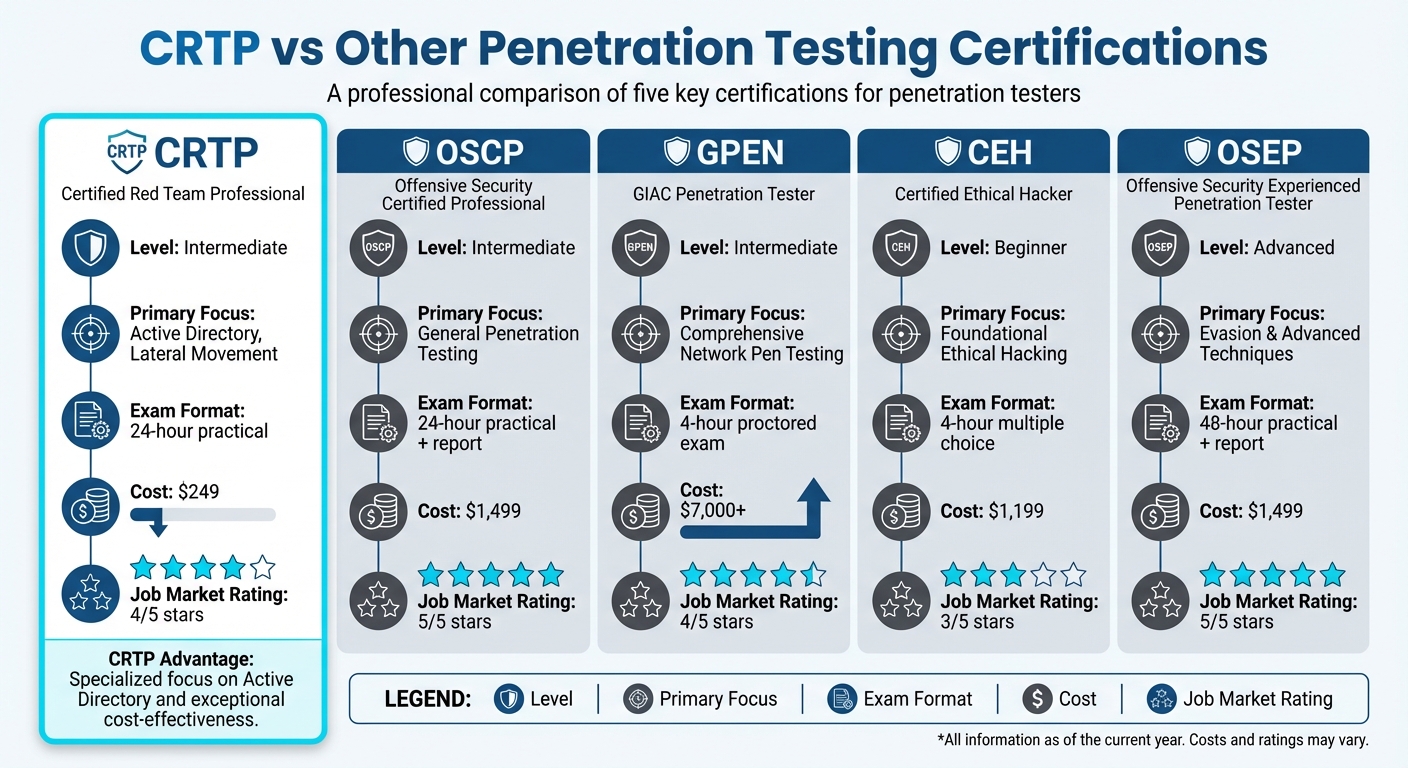
If you’re considering which certification aligns best with your career goals, comparing CRTP to other penetration testing certifications can help clarify its value:

Certification Level Primary Focus Exam Format Cost Job Market Rating
CRTP Intermediate Active Directory, Lateral Movement 24-hour practical $249 4/5
OSCP Intermediate General Penetration Testing 24-hour practical + report $1,499 5/5
GPEN Intermediate Comprehensive Network Pen Testing 4-hour proctored exam $7,000+ 4/5
CEH Beginner Foundational Ethical Hacking 4-hour multiple choice $1,199 3/5
OSEP Advanced Evasion & Advanced Techniques 48-hour practical + report $1,499 5/5

The CRTP stands out for its specialization. While certifications like OSCP cover a broad range of penetration testing topics across various operating systems, CRTP focuses specifically on Windows Active Directory environments [14][1]. These environments are the backbone of most cleared networks, making CRTP particularly relevant. The certification emphasizes exploiting legitimate Active Directory features and misconfigurations rather than relying on known CVEs, mirroring the tactics used by internal threats [10].

Another key aspect of the CRTP exam is its realistic setup. Conducted in a fully patched, modern endpoint security environment, the exam challenges candidates to use stealth and evasion techniques – skills that are indispensable for operating in hardened government networks [10]. With a price of $249 for 30 days of lab access and the exam [1][13], CRTP offers excellent value compared to the significantly higher costs of other certifications. For professionals aiming for red team roles in enterprise settings, CRTP’s focused, hands-on curriculum makes it a compelling choice to advance your career.

Conclusion

Boost your red team career with the CRTP certification – a targeted and budget-friendly option for mastering Active Directory security [6]. This program focuses on practical skills, teaching you how to exploit built-in AD features and misconfigurations rather than chasing vulnerabilities that are easily patched [8][10]. It mirrors the tactics of real-world threat actors operating in secure government networks, ensuring your skills are directly applicable to roles requiring security clearance.

CRTP refines your operational techniques with its "Living Off the Land" approach. You’ll learn to use native Windows tools and PowerShell to bypass modern defenses like AMSI and Windows Defender [4][7]. The certification’s 24-hour hands-on exam, conducted in a fully patched Windows Server 2022 environment [1], offers a realistic test of the challenges you’ll face in the field.

To get started, plan your study timeline based on your experience level: beginners should consider three months of lab access, intermediate learners two months, and experts one month [1]. Focus heavily on enumeration to identify attack paths through trusts, group policies, and privilege relationships [8]. As you prepare, create a concise PowerShell cheatsheet – it will be a valuable time-saver during the exam [8][16].

Once certified, you’ll have a strong foundation for roles like red team operator and penetration tester, especially with government agencies and defense contractors that recognize CRTP as a requirement [4]. The certification is valid for three years, includes free renewal, and paves the way for advanced credentials like CRTE and CRTM [12]. When you’re ready to put your skills to work, Cleared Cyber Security Jobs can connect you with employers seeking Active Directory expertise in secure environments.

Choose the course that aligns with your schedule, dive into hands-on lab work, and build the skills needed for government and defense networks.

FAQs

Is CRTP worth it for cleared red team roles?

The CRTP certification holds strong relevance for professionals in cleared red team roles. It provides practical, hands-on training focused on Active Directory exploitation – an essential skill for red team operations in secure environments. By sharpening technical abilities and supporting career growth in cybersecurity, this certification becomes a valuable tool for advancing within the field of cleared red team positions.

How should I prep for the CRTP exam with limited time?

If you’re short on time but aiming to ace the CRTP exam, focus on the essentials. Prioritize Active Directory enumeration, privilege escalation, and domain persistence – these topics are at the heart of the exam. Make sure you’re familiar with the exam’s practical, hands-on format, which emphasizes exploitation techniques and maintaining stealth.

To make the most of your preparation, dive into a lab environment where you can practice these skills in real-world scenarios. Condensed study materials and summarized notes can be game-changers, helping you review efficiently. With targeted practice and a strategic approach, you can boost your chances of passing the CRTP exam on your first try.

What tools should I have ready before exam day?

Before exam day, take the time to get comfortable with the tools available in the lab environment since the CRTP exam is entirely hands-on. Pay special attention to tools designed for Active Directory exploitation, privilege escalation, and security bypass techniques. Key tools to focus on include Mimikatz and Rubeus.

Make sure to download these tools ahead of time from the lab or course materials. Additionally, prepare well-organized notes or scripts for frequently used attack methods. Having these ready will help you save time and maintain efficiency during the exam.

Related Blog Posts

  • OSCE Certification Career Guide for Advanced Cleared Pen Testers
  • CTIA Certification Career Guide for Cleared Threat Intel Analysts
  • PNPT Certification Career Guide for Cleared Practical Pen Testers
  • eJPT Certification Career Guide for Cleared Junior Pen Testers

Related Guides

  • CRTL Certification Career Guide for Cleared Red Team Leads
  • CRTO Certification Career Guide for Cleared Red Team Operators
  • eCPPT Certification Career Guide for Cleared Professional Pen Testers
  • Cybersecurity Salary Guide 2026
  • TS/SCI Salary Premium: Real 2026 Numbers

eCPPT Certification Career Guide for Cleared Professional Pen Testers

CyberSecJobs Editorial · February 22, 2026 ·

The eCPPT (eLearnSecurity Certified Professional Penetration Tester) is a hands-on certification tailored for cybersecurity professionals, particularly those in U.S. government and defense roles. It focuses on practical skills like Active Directory penetration testing, privilege escalation, and network pivoting – key abilities for navigating complex, secure environments. Unlike traditional certifications, the eCPPT emphasizes real-world scenarios through a 24-hour simulated penetration test.

Key Takeaways:

  • Who is it for? Professionals with at least 2 years of experience in offensive security, system administration, or security engineering.
  • Exam Focus: Active Directory (30%), exploitation/post-exploitation (25%), web application testing (15%), and more.
  • Format: 24-hour practical test using a restricted Kali Linux instance, with auto-graded results.
  • Cost: $200–$400 for the exam voucher; bundles with training range from $249–$599.
  • Renewal: Requires 36 CPE credits over 3 years; renewal fees are $99 if completed on time.

This certification is especially relevant for cleared penetration testers, as it aligns with the skills required for working in segmented networks and meeting strict documentation standards. It also serves as a stepping stone to higher-paying roles, with salaries for penetration testers ranging from $75,000 to $143,000 or more, depending on experience and location.

Preparation Tips:

  • Use INE’s Penetration Testing Professional (PTP) learning path for structured training.
  • Practice extensively in labs, focusing on Active Directory attacks, privilege escalation, and pivoting techniques.
  • Save offline resources like wordlists, scripts, and notes to simulate the exam’s restricted environment.

The eCPPT is a strong choice for cleared professionals looking to advance their careers in penetration testing or red team operations.

The Ultimate 2025 eCPPT Certification Guide | Hands-On Pentesting, AD Labs & Exam Success

sbb-itb-bf7aa6b

What is eCPPT Certification?

eCPPT Certification Training Domains and Exam Weight Distribution

eCPPT Certification Training Domains and Exam Weight Distribution

The eCPPT (Certified Professional Penetration Tester) is a hands-on certification designed to showcase practical offensive security skills. Unlike traditional certifications that rely on multiple-choice exams, the eCPPT requires candidates to perform simulated, real-world penetration tests. It’s tailored for professionals with at least two years of experience in offensive security, system administration, or security engineering, proving their ability to execute real attacks [1].

The certification remains valid for three years and follows a structured training and testing approach.

eCPPT Training Modules

The eCPPT certification is supported by the Penetration Testing Professional (PTP) learning path, which focuses on six essential domains. These domains are weighted based on their relevance to real-world scenarios. For instance, Active Directory penetration testing carries the most weight at 30% of the exam score, reflecting its importance in modern corporate setups. Exploitation and post-exploitation techniques make up 25%, while web application testing and initial access each account for 15% [1] [4].

Domain Weight Key Skills
Active Directory Pentesting 30% Techniques like Kerberoasting, AS-REP roasting, lateral movement (Pass-the-Hash/Ticket), and gaining Domain Admin access
Exploitation & Post-Exploitation 25% Privilege escalation, dumping and cracking hashes, finding unsecured credentials
Web Application Pentesting 15% Identifying SQL injection, XSS, command injection, brute-forcing login forms, and extracting data
Initial Access 15% Methods such as username enumeration, password spraying, and brute-forcing remote services
Information Gathering 10% Host discovery, port scanning, and service enumeration
Exploit Development 5% Modifying exploit code and analyzing memory corruption (e.g., stack/buffer overflows)

These modules emphasize practice, helping candidates develop "muscle memory" for common attack techniques. Topics like network pivoting, credential abuse, and lateral movement are thoroughly covered, which are especially crucial for navigating segmented networks or restricted environments [4].

Exam Format and Hands-On Testing

The eCPPT exam builds on the training modules, placing candidates in a realistic 24-hour penetration test against a simulated corporate network [4]. Using an in-browser Kali Linux instance with restricted internet access, candidates rely on their offline resources, such as notes, wordlists, and custom scripts. This setup replicates the challenges of secure, offline networks often seen in high-security environments, testing a participant’s ability to adapt under pressure.

In 2024–2025, INE introduced an updated, auto-graded exam system that delivers results within hours instead of weeks [4]. The exam includes 45 multiple-choice questions directly linked to the practical tasks performed during the lab. Instead of submitting a traditional penetration test report, candidates are evaluated on their technical execution in real time. If a candidate doesn’t pass on the first try, most vouchers include a free retake within 14 days, as long as both attempts are within the voucher’s 180-day validity period [4].

The exam cost ranges from $200 to $400 for a standalone voucher. Bundles that include three months of INE Premium access typically range from $249 to $599. To maintain the certification, candidates need to earn 36 continuing professional education (CPE) credits over three years. Renewal fees are $99 if completed before expiration or $199 during a 90-day grace period [4].

Why eCPPT Matters for Cleared Penetration Testers

The eCPPT certification sets you apart in cleared penetration testing roles by focusing on practical, hands-on skills rather than rote memorization. It assesses your ability to simulate real-world attacks on enterprise networks – systems commonly used by government agencies and defense contractors. This makes the certification directly relevant to the challenges faced in cleared roles, where understanding and navigating complex infrastructure is critical.

How eCPPT Meets Cleared Job Requirements

Cleared penetration testing jobs demand expertise in handling segmented networks and exploiting Active Directory systems, both of which are core components of the eCPPT curriculum. The certification dives deep into areas like Kerberos abuse, lateral movement techniques, and achieving Domain Admin access – skills essential for working with federal networks [1][4].

The exam emphasizes practical post-exploitation skills, including:

  • Privilege escalation
  • Credential abuse
  • Navigating restricted network segments

These competencies are crucial for tasks like assessing segmented defense networks or performing internal red team operations. The hands-on nature of the eCPPT exam mirrors the conditions penetration testers face in real scenarios.

"The certification exam assesses and validates that the individual has the knowledge, skills, and abilities required to fulfill the role of a modern Penetration Tester." – INE [1]

Additionally, the certification ensures that candidates master clear and actionable reporting, meeting the rigorous documentation standards required in federal environments [2].

Career Benefits for Cleared Professionals

The eCPPT certification enhances your career prospects in the cleared job market by validating skills that directly translate to higher earning potential. Entry-level penetration testers earn between $75,000 and $95,000, while seasoned professionals with advanced certifications can surpass $120,000 annually [5]. The certification’s three-year validity and requirement for 36 Continuing Professional Education (CPE) credits ensure that your skills remain relevant as threats evolve.

For many professionals, the eCPPT serves as a stepping stone from foundational certifications like Security+ to more advanced credentials. Its focus on Active Directory and internal network exploitation complements other offensive security certifications, creating a well-rounded skill set that appeals to government contractors.

"If you’re pursuing roles involving internal assessments, red teaming, or consulting on enterprise risk, eCPPT’s skill map aligns perfectly with what those jobs demand." – FlashGenius [4]

The updated exam format, introduced in 2024–2025, delivers results within hours instead of weeks. This quick turnaround allows candidates to demonstrate their technical skills promptly – an advantage when applying for cleared positions that require proof of current expertise. These streamlined processes and practical benefits underscore eCPPT’s value in advancing careers in the cleared penetration testing field.

How to Prepare for eCPPT Certification

Preparing for the eCPPT certification requires a focused, hands-on strategy that mirrors secure network conditions. This exam isn’t about rote memorization – it’s about practical skills. With its 24-hour, single-sitting format, success hinges on muscle memory built through extensive lab work. You’ll need to execute attacks under time pressure, with limited internet access, in a controlled environment.

Study Materials and Resources

The INE Penetration Testing Professional (PTP) Learning Path is the go-to resource, designed to align directly with the exam. An INE Premium subscription costs about $749 per year, offering full access to labs and materials. If you’re on a tighter budget, the Fundamentals Plan at $299 per year provides essential content. Exam vouchers alone range from $200 to $400, and promotional bundles combining the voucher with three months of Premium access typically cost between $249 and $599.

To complement INE’s materials, consider these additional resources:

  • HackTheBox Academy’s "Active Directory Enumeration & Attacks" module to sharpen your AD-related skills.
  • The PortSwigger Web Security Academy, which provides excellent practice for web vulnerabilities like SQL injection and command injection.
  • TryHackMe’s "Wreath" room, offering realistic pivoting scenarios similar to the exam environment.

Since the exam limits internet access, prepare an offline workflow. Save essential wordlists (like rockyou.txt and seasons.txt), custom scripts, and cheatsheets locally. Ensure you’re proficient with tools like OpenVPN for lab access, Metasploit for exploitation, and Nmap for reconnaissance. These tools will form the backbone of your toolkit during the exam.

Once your resources are ready, shift your focus to intensive lab practice to build the necessary hands-on experience.

Hands-On Practice Tips

Practical lab work is critical for mastering the eCPPT exam environment. Dedicate more time to labs than to reading. Set up a local Active Directory lab using virtual machines to practice techniques like Kerberoasting, AS-REP roasting, and delegation abuse. Repeated practice with these scenarios will help you navigate internal network segments more efficiently.

"Reading is not enough. You must log hours in the lab to develop the muscle memory required for success." – FlashGenius [4]

Simulate the exam by conducting a 24-hour mock test using only approved tools. Practice your "first-90-minute workflow", focusing on reconnaissance, gaining a foothold, and privilege escalation. Mastering time management during this phase is key. Additionally, practice setting up SOCKS proxies and routing, as navigating segmented networks is a crucial skill.

Effective note-taking can make or break your exam performance. Keep detailed records of hosts (IP addresses, domains, operating systems), credentials (usernames, passwords, domain statuses), and scan results. Organize this information in tables to track progress. Tools like Screenpresso can help you capture findings quickly during the exam. Even though the exam includes auto-grading, maintaining detailed command logs ensures you don’t overlook critical flags.

"One of many reasons that made me succeed the exam was proper note-taking, it is crucial to pass the exam and without that there is a big risk of failure!" – Str4ngerX [6]

For buffer overflow preparation, use TryHackMe’s "Buffer Overflow Prep" rooms or set up a Windows VM with Immunity Debugger and mona.py. While the official course covers exploit development, these additional resources can fill in any gaps. Also, keep a persistent ping running to the exam webserver to avoid VPN disconnections during critical moments – this simple step can save you from unnecessary frustration.

These targeted practices not only prepare you for the eCPPT exam but also sharpen the skills you’ll need for real-world, high-security environments.

How to Pass the eCPPT Exam as a Cleared Professional

The eCPPT’s intense 24-hour, single-sitting format is designed to simulate high-pressure, real-world scenarios. Success requires a mix of precise time management, sharp technical skills, and strict adherence to security protocols.

Managing the 24-Hour Exam Window

Since the exam is auto-graded, there’s no traditional reporting phase, meaning you’ll need to maximize every minute. Active Directory pentesting is the heaviest scoring section at 30%, followed by Exploitation and Post-Exploitation at 25% each[4]. These weightings should guide how you allocate your time. A possible breakdown could look like this:

  • First 90 minutes: Focus on recon and gaining an initial foothold.
  • 8–10 hours: Dedicate to Active Directory enumeration and lateral movement.
  • 6–8 hours: Work on privilege escalation.
  • 2–3 hours: Wrap up with verification and cleanup.

"Optimize your first-90-minute workflow: recon → foothold → privilege escalation → DA." – FlashGenius[4]

If you hit a wall with credential brute-forcing, don’t waste more than 30 minutes on wordlist attacks. Instead, pivot to alternative enumeration methods[6]. Many candidates have completed the exam in about 19 hours, even with breaks[6]. Scheduling short rest periods can help maintain focus and avoid burnout.

These time management strategies not only help you succeed in the exam but also align with the structured workflows required in secure environments.

Compliance Considerations for Cleared Environments

The eCPPT exam emphasizes manual techniques, reflecting the precision and understanding needed in cleared environments. While automated tools can save time, the exam – and your future roles – focus on knowing the "why" behind every command. This approach minimizes noise, reduces risk, and ensures careful execution in sensitive networks[7].

The exam is delivered through a browser-based interface using Apache Guacamole, which introduces unique challenges for cleared professionals[7]. Before starting, coordinate with your security team to secure any necessary authorizations for network access if you’re working from a secured facility. The restricted exam environment, with limited tools and no internet access, mirrors the conditions of air-gapped or highly controlled networks often encountered in cleared roles[4].

To prepare, build an offline repository of critical techniques – such as pivoting methods, buffer overflow approaches, and Active Directory attack workflows. Storing these in formats like PDFs or Obsidian vaults can be a game-changer in environments where internet access is restricted[3][2]. This habit not only supports exam success but also equips you for the challenges of working in tightly controlled operational settings.

Using eCPPT to Advance Your Cleared Career

The eCPPT certification can be a game-changer for anyone looking to grow in the fast-paced world of cybersecurity. According to the U.S. Bureau of Labor Statistics, demand for information security analysts, including penetration testers, is projected to grow by 33% between 2023 and 2033[9]. With cybercrime costs expected to exceed $10 trillion annually by 2025, organizations are on the hunt for professionals who don’t just know the theory but can demonstrate real-world offensive security skills[10].

This demand also translates into impressive earning potential. As of July 2025, penetration testers in the U.S. earn an average salary of $143,000, with even higher pay in cleared hubs. For example, McLean, VA leads with $169,897, followed by Chantilly, VA at $150,546, and Arlington, VA at $130,274[9].

The eCPPT certification stands out because of its hands-on approach. It validates your ability to perform tasks like compromising hosts, navigating network pivots, and escalating privileges in enterprise environments. For cleared employers, this practical expertise is invaluable, especially for roles requiring immediate operational readiness in red team operations and internal security assessments[4].

Finding Jobs with Cleared Cyber Security Jobs

Cleared Cyber Security Jobs

Once you’ve earned your eCPPT, the next step is finding the right job to match your skills. Cleared Cyber Security Jobs is a platform designed specifically for professionals with security clearances. It connects you with employers who value certifications like the eCPPT. The platform offers tools like job search filters to help you find roles that align with your clearance level and technical expertise. You can also upload your resume, set up alerts for penetration testing positions, and access resources tailored to the cleared workforce.

Another standout feature is the platform’s job fairs, where you can meet hiring managers directly – no intermediaries like staffing firms or third-party recruiters. For eCPPT holders, this is a golden opportunity to showcase your hands-on skills during conversations with employers who understand the certification’s technical depth. Best of all, these services are free for job seekers, though participation requires U.S. citizenship and an active security clearance.

Combining eCPPT with Other Certifications

To maximize its impact, the eCPPT works best when paired with other certifications. For instance, CISSP highlights your knowledge of security management, while CEH covers foundational ethical hacking concepts. The eCPPT complements these by proving you can execute sophisticated, real-world attacks. Together, they present a well-rounded skill set that balances strategic understanding with tactical expertise[4][8].

For cleared roles tied to the Defense Cyber Workforce Framework (DCWF), combining eCPPT with CompTIA Pentest+ is a strong move. While Pentest+ often meets DoD 8570 baseline requirements, the eCPPT demonstrates advanced skills like Active Directory exploitation and network pivoting, essential for high-level enterprise assessments[4][8][11]. If you’re transitioning from defensive roles such as SOC analysis or network engineering, this certification stack highlights your ability to operate effectively in both offensive and defensive capacities[5].

"The eCPPT certification stands out for its realism, efficiency, and focus on the technical depth that modern penetration testers need." – FlashGenius[4]

Conclusion

The eCPPT certification provides a practical, hands-on way to prove your skills in the cybersecurity field, especially within the cleared workforce. Unlike exams focused solely on theory, this certification shows you can perform real-world tasks – like exploiting Active Directory and network pivoting – in environments that closely resemble enterprise and government systems. This level of hands-on experience sets you up for success in demanding, high-pressure environments.

To make the most of your certification, take proactive steps to showcase your skills. Use platforms like Cleared Cyber Security Jobs to connect with hiring managers who value the technical expertise demonstrated by the eCPPT. Set up job alerts, attend job fairs, and emphasize your practical experience in your applications. Remember, your certification is valid for three years and requires 36 CPE credits for renewal [4]. Alternatively, you can aim for advanced certifications like OSCP or eWPT to further enhance your credentials.

Leverage the preparation strategies outlined in this guide to highlight your expertise. Build a polished, sanitized portfolio on platforms like GitHub or LinkedIn to showcase your projects and lab work. Regular lab practice will ensure your skills stay sharp and relevant.

"The eCPPT was well worth the time invested into it and I still occasionally reference my notes on my client engagements." – Jake Murphy, Offensive Security Team, Echelon Risk + Cyber

This certification demonstrates your ability to perform under pressure, navigate complex systems, and deliver the expertise that cleared employers are looking for.

FAQs

Is eCPPT accepted for DoD 8570/DCWF roles?

The eCPPT certification holds recognition under the DoD 8570 framework, making it valid for specific roles, including those at management and CSSP (Cybersecurity Service Provider) levels. Additionally, it aligns with the broader directives outlined in DoD 8140, ensuring its relevance for various essential job roles within the DCWF (DoD Cyber Workforce Framework).

What offline files should I bring to the exam?

While there aren’t any mandatory offline files for the eCPPT exam, it’s a good idea to come prepared with backups of your virtual machines, tools, documentation, and any binaries or scripts you plan to use. Double-check that your setup is complete and accessible before the exam begins. Having everything ready and backed up can make a big difference in ensuring a smooth experience.

How should I pace the 24-hour exam?

Starting the 24-hour eCPPT exam in the early afternoon can set you up for success. This timing allows you to work during peak alertness and still have flexibility for rest later. Time management is crucial – divide your focus across the exam’s domains, prioritizing areas like Active Directory penetration testing, which accounts for a significant 30% of the exam, and exploitation tasks.

Short breaks are essential to stay sharp, but keep them brief to avoid losing momentum. Fuel your focus with snacks and stay hydrated throughout the process. Reserve some time at the end to thoroughly review your work, ensuring no critical details are missed.

Related Blog Posts

  • PenTest Plus Certification Career Guide for Cleared Pen Testers
  • LPT Certification Career Guide for Cleared Pen Test Leads
  • PNPT Certification Career Guide for Cleared Practical Pen Testers
  • eJPT Certification Career Guide for Cleared Junior Pen Testers

Related Guides

  • CRTL Certification Career Guide for Cleared Red Team Leads
  • CRTO Certification Career Guide for Cleared Red Team Operators
  • CRTP Certification Career Guide for Cleared Red Team Professionals
  • Cybersecurity Salary Guide 2026
  • TS/SCI Salary Premium: Real 2026 Numbers
  • « Go to Previous Page
  • Go to page 1
  • Interim pages omitted …
  • Go to page 7
  • Go to page 8
  • Go to page 9
  • Go to page 10
  • Go to page 11
  • Interim pages omitted …
  • Go to page 34
  • Go to Next Page »
  • Facebook
  • Instagram
  • LinkedIn
  • Twitter
  • YouTube

Cleared Cyber Security Jobs | CyberSecJobs.com

  • Contact
  • About
  • Privacy Policy