

The Blue Team Level 2 (BTL2) certification is a hands-on, intermediate-to-advanced cybersecurity credential designed for professionals with 2–4 years of experience in security roles. It focuses on practical skills like malware analysis, threat hunting, vulnerability management, and advanced SIEM operations. The certification includes a 72-hour practical exam where candidates investigate a simulated network intrusion and submit a detailed technical report.
Key Details:
- Cost: ~$2,500 USD (£1,999 GBP)
- Exam Length: 72 hours (includes one free retake)
- Validity: Lifetime (no renewal fees)
- Target Roles: Incident Responders, Threat Hunters, Malware Analysts, DFIR Specialists
- Average Salary: ~$115,000 annually
- Training Access: 5 months, includes 120 hours of practical labs
Why it matters: BTL2 is highly regarded by government, military, and law enforcement agencies, making it a strong credential for cleared professionals aiming to advance in cybersecurity careers.
Preparation Tips:
- Complete all training materials and labs.
- Practice malware analysis and report writing.
- Use additional resources like Blue Team Labs Online and TryHackMe for extra practice.
- Plan for a dedicated 4-day period to complete the exam and report.
This certification validates advanced skills and is ideal for cleared professionals looking to excel in high-demand cybersecurity roles.
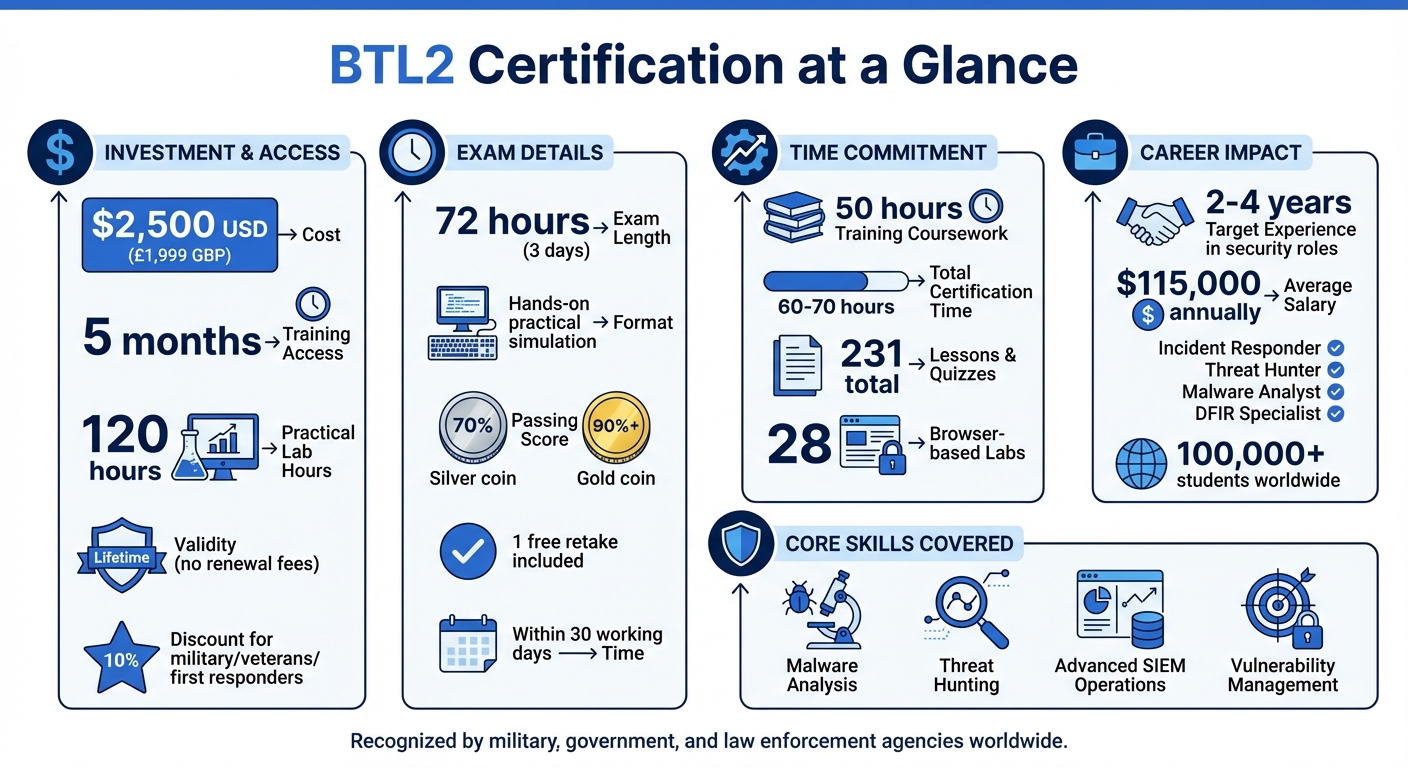
BTL2 Certification Overview: Cost, Duration, and Career Benefits
Eligibility and Prerequisites for BTL2 Certification
Experience and Knowledge Requirements
While there are no mandatory prerequisites for BTL2, the exam is best suited for professionals with some relevant experience [2]. It’s designed for those already familiar with security roles and practices. Security Blue Team describes the training as "intense", covering advanced topics like static and dynamic malware analysis, threat hunting, and advanced SIEM operations [2].
If you’re unsure whether your background aligns with BTL2 requirements, you can try the free one-hour BTL2 Demo, which offers sample content from the Malware Analysis, Threat Hunting, and SIEM modules [7]. For those who lack a strong foundation in security operations, completing the Blue Team Level 1 (BTL1) certification is highly recommended before attempting BTL2 [2]. The course assumes candidates have intermediate knowledge of Windows and Linux system administration. It does not cover basic operating system concepts or enterprise Active Directory fundamentals [6].
"BTL2 is aimed at security professionals with 2-4 years’ experience in a practical role, but can be suitable for individuals with less experience provided they can commit to the intense training." – Security Blue Team [2]
Cleared Professional Considerations
For professionals with security clearances, no specific clearance level is required to pursue BTL2 [2]. Your clearance status won’t impact your eligibility to enroll or take the exam. However, the certification’s cost – £1,999.00 GBP (around $2,500 USD) – often necessitates employer sponsorship [2]. To assist with this, Security Blue Team provides a pre-written funding request letter that professionals can use to seek training budget approval from their organizations [3,8].
This certification is particularly valuable in cleared environments, as it is recognized by military, government, and law enforcement agencies worldwide for training their defensive teams [4]. Additionally, military personnel, veterans, and first responders can receive a 10% discount by verifying their status through the Security Blue Team support portal [2]. Since BTL2 is generally considered a corporate training investment rather than a personal expense, many cleared professionals secure funding through their agency’s professional development or training budgets [5].
In the next section, we’ll explore the training structure, exam format, and the time commitment required to earn the BTL2 certification.
sbb-itb-bf7aa6b
BTL2 Training, Exam, and Time Commitment
Training Structure and Resources
The BTL2 certification program is tailored for cleared professionals, focusing on practical, hands-on skills through simulated incident response scenarios. The training is divided into four key areas: Malware Analysis, Threat Hunting, Advanced SIEM, and Vulnerability Management [8][2]. Across 231 lessons and quizzes, students build a strong theoretical foundation before diving into practical labs [2]. To accommodate busy schedules, participants are given five months of access to all materials, allowing them to learn at their own pace [2][9].
The practical portion includes 28 browser-based labs, providing 120 hours of dedicated access [2][7]. Using industry-standard tools like YARA, Velociraptor, Wireshark, and malware analysis utilities, students engage in a "Role Simulation" exercise. Here, they take on the role of an incident responder tasked with addressing sophisticated intrusions in a corporate environment [1]. This hands-on approach not only prepares candidates for the exam but also aligns closely with real-world scenarios.
"BTL2 is designed to strengthen technical defenders that already have experience and exposure to security operations. BTL2 will develop you in niche areas that make you stand out as an advanced defender." – Security Blue Team [2]
To make the most of the official lab time, it’s recommended to focus on exam-specific preparation and final reviews during the 120-hour lab access period. This ensures a smooth transition from training to the exam.
Exam Format and Assessment Process
The BTL2 exam is a 72-hour practical simulation where you act as an incident responder investigating a complex intrusion in a corporate network [1][2]. Unlike multiple-choice tests, this assessment requires you to submit a detailed technical report documenting your findings and evidence [1][3]. Security Blue Team provides a report template for this purpose, which you’ll complete during the investigation and submit for manual grading.
The exam is evaluated by instructors within 30 working days [2][9]. To pass, you’ll need a score of at least 70%, earning a silver challenge coin [1][2]. Achieving 90% or higher on your first attempt will earn you a gold challenge coin [1][2]. The certification remains valid for four years [2].
"The exam spans 3 days (72 hours) to provide flexibility, allowing you to take breaks, rest, and manage other commitments." – Security Blue Team Support [1]
If you don’t pass on your first attempt, the program includes one free retake, valid for 12 months [1]. Additional retakes cost $125 each, with a mandatory 10-day waiting period between attempts to prevent burnout [1]. Feedback is provided for unsuccessful attempts, helping candidates target areas for improvement before trying again [1][3].
Jeff Domedion, a SOC Analyst who completed the BTL2 exam, shared his experience:
"The report felt very redundant… I felt like with some pieces of information I was providing the same pieces of evidence 2 or 3 times. I also thought it would be quicker than it truly was." [3]
He suggests reviewing the entire report template before starting your analysis to avoid unnecessary repetition and ensure all required evidence is captured during the live lab session [3].
Time Commitment for Certification
Security Blue Team estimates that most candidates need 60 to 70 hours to complete the entire certification process. This includes approximately 50 hours for training coursework and labs [2]. The 72-hour exam window is continuous – once started, the timer doesn’t stop – so it’s important to plan time for analysis, breaks, report writing, and tool setup [1][3].
Many professionals prefer starting the exam on a Friday morning to make full use of the weekend [3]. Jeff Domedion shared his strategy:
"I dedicated 72 hours to it and submitted the report with only 10 hours left. So I feel it’s important to set time aside for this and let others know that you’ll be doing it." [3]
Here’s a breakdown of the time requirements:
| Component | Time Required | Access Duration |
|---|---|---|
| Training Coursework | ~50 hours | 5 months |
| Practical Labs | Included in training | 120 lab hours |
| Certification Exam | 72 hours (3 days) | 12 months to start |
| Total Commitment | 60–70 hours | N/A |
The exam voucher is valid for 12 months [10][2]. Even if you start the exam on the final day of this window, you’ll still have the full 72 hours to complete it [10]. This flexibility is especially helpful for professionals managing busy schedules or clearance-related travel.
Career Impact of BTL2 Certification
Roles and Career Paths Requiring BTL2
The BTL2 certification validates hands-on expertise, making it a direct qualifier for advanced roles in cleared cybersecurity. Aimed at seasoned professionals, it prepares candidates for positions like Security Analyst, Incident Responder, Threat Hunter, Malware Analyst, and DFIR Specialist.
Each of these roles aligns with the certification’s focus areas. For example, Threat Hunters leverage practical lab exercises to proactively identify adversaries, while Malware Analysts apply reverse engineering and analysis techniques to uncover indicators of compromise. The rigorous 72-hour exam simulation is particularly beneficial for DFIR Specialists, as it mirrors the intensity of real-world incident response scenarios.
For professionals in cleared environments, specialized skills such as adversary emulation and memory forensics are especially valuable in government and defense contracting roles. The hands-on, report-based exam serves as proof of technical proficiency, which is highly sought after by employers in these fields. These advanced roles not only offer competitive salaries but are also in high demand within the cleared cybersecurity market.
Salary Expectations and Market Demand
On average, BTL2-certified professionals earn approximately $115,000 annually [8], underscoring the certification’s value as an advanced credential for experienced cybersecurity defenders. The multi-day practical exam adds credibility by showcasing real-world incident response capabilities, which employers prioritize.
The certification’s focus on niche defensive skills addresses critical gaps in the cleared job market. Roles requiring expertise in malware analysis, large-scale threat hunting, and advanced SIEM operations are particularly sought after. To make the certification more accessible, Security Blue Team offers a 10% discount for verified students, military personnel, first responders, and veterans. The investment, when converted from £1,999, is approximately $2,600.
Additionally, the exam employs a manual grading process, where experts review your technical report within 30 working days. This feedback not only enhances your reporting skills but also strengthens your qualifications for senior-level roles.
Integration with Other Certifications
BTL2 certification not only boosts earning potential but also serves as a stepping stone for building a comprehensive professional credential portfolio. For those on a management track, pairing BTL2 with CISSP highlights both technical expertise and strategic security knowledge. Professionals aiming for a "purple team" skill set often combine BTL2 with OSCP, demonstrating mastery in both defensive and offensive operations.
The certification is featured on Paul Jerimy‘s Security Certification Roadmap, alongside advanced credentials like GCFA and CCD. Many professionals complement BTL2 with certifications such as eCDFP, eCTHP, and eCIR to establish a well-rounded defensive profile. For newcomers, starting with BTL1 provides a strong foundation before tackling BTL2’s advanced material.
While the digital badge and printed certificate are valid for four years, the BTL2 certification itself is lifetime valid. The expert evaluation of your technical report further enhances its credibility, making it a standout credential for advancing your cybersecurity career.
Preparing for BTL2 Certification Success
Study Strategies and Time Management
The BTL2 certification requires a well-organized preparation plan, especially for professionals juggling demanding cybersecurity roles. To set yourself up for success, make sure to complete all the course materials, quizzes, and labs before tackling the exam. This groundwork is essential for building the skills you’ll need for the 72-hour practical assessment [11].
A good strategy is to break your learning process into three phases. First, focus on understanding the theory behind the tools covered in the course. Next, practice using these tools in the BTL2 labs. Finally, expand your experience by working on external platforms. This approach, often referred to as a "capture-the-flag" mindset, prepares you for situations where no step-by-step instructions are available. Creating a personalized reference document with command-line switches and tool usage descriptions can also be a game-changer during the exam [11].
Plan for a continuous four-day block for the exam, including 72 hours for the test itself and an additional 24 hours for writing the report. Many professionals take Friday and Monday off to create this window [3]. To enhance your preparation, make use of targeted resources to deepen your understanding and sharpen your practical skills.
Recommended Learning Resources
Your primary resource is the Security Blue Team self-paced course, which includes 231 lessons and 28 browser-based labs, offering 120 hours of access over five months [2]. While this course is the foundation, supplementing it with external resources can give you a broader perspective. Platforms like Blue Team Labs Online (BTLO) provide gamified, scenario-based investigations in incident response and digital forensics, which are great for applying BTL2 concepts in diverse scenarios [12]. For those seeking even more depth, BTLO PRO subscriptions offer advanced scenario-based challenges [12].
Jeff Domedion, a security professional who successfully passed the BTL2 exam, highlighted the importance of using varied resources:
"I used outside resources heavily, both BTLO and TryHackMe. I did this because some of the TryHackMe labs gave me a better experience with the tools I was learning than what I found in BTL2 labs." [3]
To fill in any knowledge gaps, consider exploring content from experts like John Hammond, HuskyHacks, Didier Stevens, Josh Stroschein, and Matt Weiner. Regularly reading The DFIR Report can also deepen your understanding of threat actor tactics and techniques [11]. If you’re unsure about committing to the full course, check out the free BTL2 Demo course to gauge the difficulty and teaching style [7].
Common Challenges and How to Overcome Them
Malware analysis often emerges as the most difficult area for candidates. This domain requires advanced deobfuscation skills and familiarity with tools like CyberChef [9, 6]. Many struggle with intricate obfuscation techniques and analyzing beacons or C2 payloads. To build confidence, dedicate time to practicing these skills on platforms like BTLO or within personal VM environments before the exam [11].
Another challenge is the reporting process. Some candidates find the provided template repetitive, which can make it harder to stay organized. Reviewing the template early on can help you efficiently capture all necessary evidence during the exam [4, 9]. Additionally, technical issues with the labs can arise, so plan for extra time and document every step in real time using tools like Cherrytree or Obsidian. Screenshots are also crucial, as they may be required in your final report [6].
Lastly, be prepared for the wait after submitting your exam. Reports are graded manually within 30 working days, though some candidates have reported waits of up to 38 business days [3, 6]. Use this time to continue honing your skills and refining your approach based on the strategies outlined in this guide.
HackTheBox CDSA vs BTL2 | Detailed Comparison | Cyber Security Certifications
Conclusion
The BTL2 certification stands out as a lifetime credential that confirms your expertise in four key areas highly sought after by cleared cybersecurity employers: Malware Analysis, Threat Hunting, Vulnerability Management, and Advanced SIEM. Its 72-hour hands-on simulation goes beyond theory, immersing you in a realistic corporate network intrusion scenario. This practical approach ensures you’re prepared for the challenges of mid-to-senior-level defensive roles [1][2].
With a strong track record, BTL2 has trained over 100,000 students worldwide [2][4]. It’s designed for professionals with 2–4 years of experience who are aiming for roles such as DFIR Specialist, Senior SOC Analyst, or Threat Hunter [2]. The certification provides the real-world skill validation necessary to excel in advanced defensive positions.
Priced at £1,999.00 GBP (around $2,500 USD), BTL2 offers lifetime validity with no recurring renewal fees, making it a cost-effective long-term investment [2]. Additionally, cleared professionals with military backgrounds can take advantage of a 10% discount and access pre-written funding request letters provided by Security Blue Team [2]. This combination of affordability and practical training solidifies BTL2’s appeal for cybersecurity professionals looking to advance their careers.
FAQs
Is BTL2 worth it for cleared roles?
The BTL2 certification holds strong relevance for cybersecurity professionals working in cleared roles, especially those focused on advanced defensive security. It confirms expertise in critical areas like threat hunting, incident response, malware analysis, and vulnerability management. Tailored for individuals with over two years of experience, this certification aligns with the unique requirements of cleared environments. Its practical, hands-on focus and recognition across the industry make it an excellent step for advancing careers in high-level defensive cybersecurity positions.
How should I schedule the 72-hour exam?
You can start the 72-hour BTL2 exam whenever it fits your schedule. Once you begin, the countdown starts, giving you exactly 72 hours to complete it. You’re free to take breaks and step away, but remember, the clock keeps ticking. Plan your time wisely to ensure you finish within the allotted window.
What should I include in the exam report?
Your BTL2 exam report is a critical component of your certification process. It must provide a detailed account of your investigation into the simulated cyber intrusion. Here’s what your report should cover:
- Steps Taken: Clearly outline the sequence of actions you performed during the investigation. This includes identifying the breach, analyzing its scope, and any containment measures implemented.
- Tools and Techniques: Highlight the specific tools and methodologies you used. Whether it’s log analysis, network traffic monitoring, or forensic tools, explain how each was applied and why.
- Evidence Collected: Document the evidence gathered during the investigation. This may include logs, screenshots, malware samples, or any other relevant artifacts. Ensure the evidence is well-organized and supports your findings.
- Attack Assessment: Provide a thorough analysis of the attack. Describe its nature, entry points, and potential impact. Discuss the tactics, techniques, and procedures (TTPs) used by the adversary and link them to any known threat actors or frameworks like MITRE ATT&CK.
- Mitigation Strategies: Detail the measures you implemented to contain and remediate the intrusion. Explain why these strategies were effective and how they addressed the specific attack vectors.
- Prevention Recommendations: Offer actionable advice to prevent similar incidents in the future. This should include policy changes, system hardening, employee training, or any other proactive measures.
Remember, your report should reflect advanced cybersecurity expertise. Ensure it is well-structured, concise, and professional. Submit the completed report within the 72-hour exam window, as it is the primary factor in your certification evaluation.