

The Licensed Penetration Tester (LPT) certification is a premier credential for professionals in high-security roles, such as government, defense, and intelligence. It validates advanced penetration testing skills, including network pivoting, SSH tunneling, and overcoming layered defenses. Achieving this certification requires passing a rigorous 24-hour practical exam with a score of 90% or higher. Those scoring 70%-89% earn the Certified Penetration Testing Professional (CPENT) instead.
Key Highlights:
- Target Audience: Professionals with security clearance in classified environments.
- Prerequisites: Strongly recommended to have Certified Ethical Hacker (CEH) certification.
- Cost: Over $2,000 for training and exams, plus a $250 annual renewal fee.
- Exam Structure: Hands-on, live-proctored, 24-hour test with real-world scenarios.
- Career Impact: Opens doors to roles like Red Team Lead and Security Consultant, with salaries often exceeding $120,000.
This certification is ideal for those seeking leadership roles in penetration testing, especially in cleared environments. It emphasizes technical expertise, structured methodologies, and professional reporting skills.
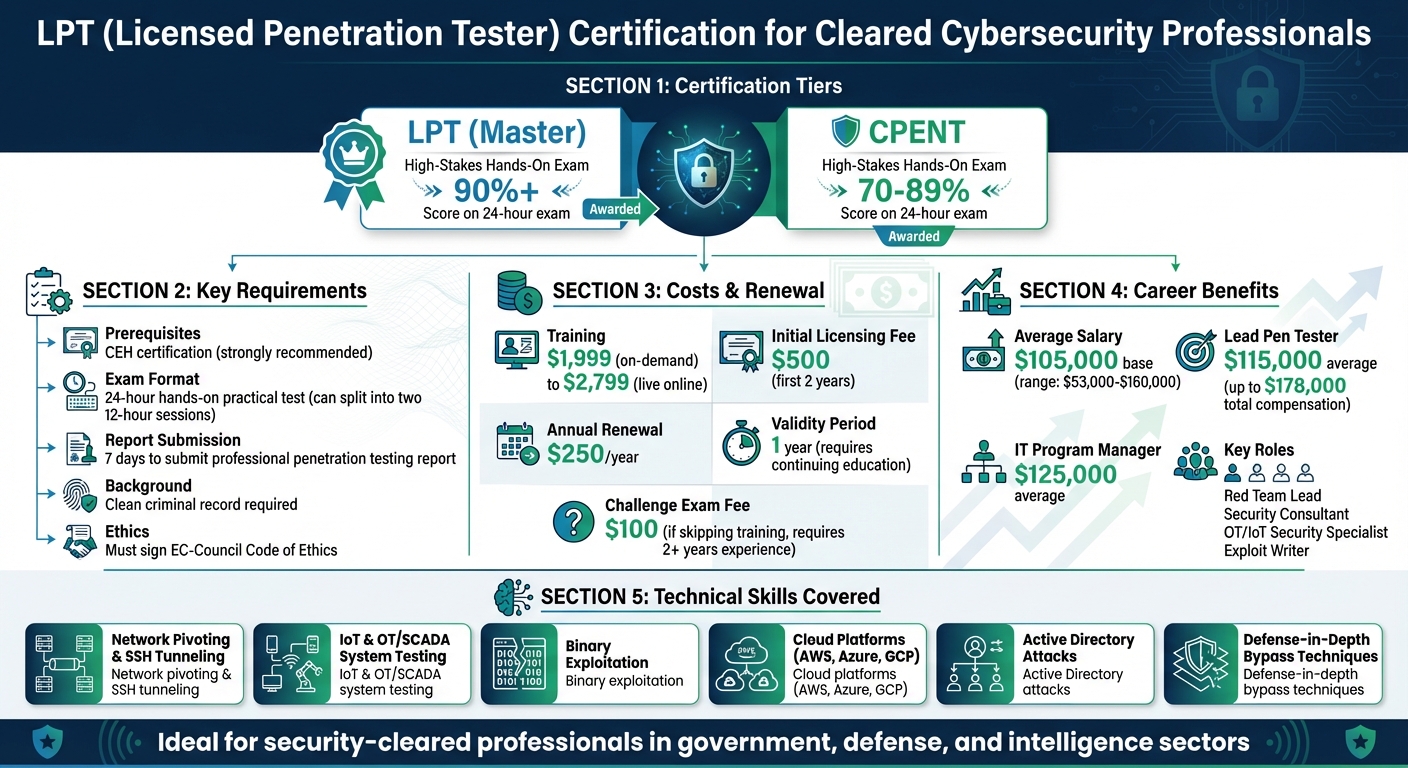
LPT Certification Requirements, Costs, and Career Benefits Overview
Eligibility and Prerequisites for the LPT Certification
Required Certifications and Experience
To earn the LPT (Master) certification, candidates must excel in the Certified Penetration Testing Professional (CPENT) exam. While not mandatory, the Certified Ethical Hacker (CEH) certification is highly recommended as it provides a strong foundation for the advanced skills required in penetration testing [2][7][8]. According to the EC-Council, there are no strict eligibility criteria to attempt the exam [6], but having a CEH background can significantly enhance preparedness.
Achieving the LPT (Master) designation requires scoring at least 90% on the 24-hour CPENT practical exam – a benchmark described by the EC-Council as exceptionally challenging [3]. Candidates who score between 70% and 89% receive the CPENT certification instead [3][6]. Additionally, you must submit a detailed penetration testing report that includes both technical insights for engineers and an executive summary tailored for stakeholders [2][10].
Applicants are also required to provide a resume, character references, and proof (or a declaration) of a clean criminal record. Signing the EC-Council Code of Ethics is mandatory. The licensing fee is $500 for the first two years, with an annual renewal fee of $250 thereafter [1][3][7][8].
How Security Clearance Affects Eligibility
While security clearance isn’t a direct requirement for the LPT certification, it plays a critical role in qualifying for certain cleared penetration testing roles. These roles, often within organizations like the CIA, FBI, or Department of Defense, demand an active security clearance as proof of trustworthiness and ethical conduct [9]. This aligns with the certification’s stringent ethical and documentation standards.
For professionals with an active security clearance, the required criminal background check can often be fulfilled using existing clearance documentation or a report from an investigative agency, simplifying the process [10]. However, keep in mind that security clearances remain valid only during employment in the designated role. If employment ends, the clearance can be reactivated within two years [9]. As of October 2015, approximately 4.2 million government and contractor employees were eligible for security clearances [9].
How to Earn the LPT Certification
Training and Preparation Resources
The EC-Council’s CPENT program is designed to push candidates into advanced technical areas, such as IoT and OT system attacks, binary exploitation, advanced Windows exploitation, and bypassing filtered networks. It’s a serious challenge meant for those ready to take their skills to the next level.
You can access official training through EC-Council’s iLearn online platform, Accredited Training Centers, or approved academic institutions. Before you sign up, make sure the training center is authorized by EC-Council to avoid issues with course materials or exam vouchers. Pricing starts at $1,999 for on-demand courses and $2,799 for live online sessions.
Before diving into CPENT, it’s crucial to have a solid grasp of CEH and ECSA concepts. Practicing in time-bound scenarios is equally important, as the CPENT program mirrors the high-pressure environment of the exam. The practice ranges include challenges like Active Directory, IoT systems, binary exploitation, and capture-the-flag scenarios. Pay special attention to multi-level pivoting techniques, such as single and double pivoting with SSH tunneling, since these are key for navigating hidden network segments. Additionally, refine your report-writing skills to produce both technical solutions and clear, concise executive summaries.
Once you’re confident in these areas, it’s time to focus on understanding the exam structure.
The 24-Hour Practical Exam Explained
The LPT exam is a fully hands-on, practical test conducted remotely and monitored live by EC-Council proctors. You’ll face a complex, multi-layered network equipped with defense-in-depth measures, and you’ll need to make quick, strategic decisions under tight time limits. The test is divided into three levels, each containing three challenges. You can choose to tackle the exam in one 24-hour session or split it into two 12-hour sessions.
One unique aspect of the exam is its "one exam, two certifications" structure. Your score determines whether you earn just the CPENT certification or progress to the LPT (Master) level. As EC-Council puts it:
"This exam has one purpose: To differentiate the experts from the novices in Penetration Testing!"
After completing your exam, you’ll have seven days to submit a professional penetration testing report. This report is a critical component of the certification process, as it must meet EC-Council’s standards to secure your certification. The CPENT exam is widely regarded as one of the most challenging practical tests in penetration testing, designed to validate top-tier expertise.
Once you pass, the next step is to complete the application and report submission process.
Application and Renewal Process
The rigorous training and exam requirements ensure that your certification reflects genuine expertise in penetration testing.
If you decide to skip official training and directly challenge the exam, you’ll need at least two years of verifiable experience in information security. Additionally, you’ll pay a $100 non-refundable eligibility application fee. The application review process typically takes 6 to 8 weeks. Once your report is approved and all conditions are met, you’ll receive your certification.
The LPT (Master) certification is valid for just one year, with annual renewal required under EC-Council’s Continuing Education policy. The renewal fee is $250, and you’ll need to meet specific continuing education requirements to maintain your certification. This short validity period reflects the fast-changing nature of penetration testing, ensuring that certified professionals stay up to date with new threats and techniques.
Career Benefits of LPT for Cleared Pen Test Leads
Access to Advanced Penetration Testing Roles
The LPT (Master) certification is crafted to highlight elite penetration testers[3][13]. Achieving this certification requires scoring 90% or higher on a rigorous practical exam, signaling to cleared employers that you excel in handling complex technical challenges found in advanced testing environments.
With this certification, professionals can transition from purely technical roles to strategic leadership positions like Red Team Lead or Security Consultant. These roles focus on designing testing methodologies rather than just executing scans[4]. The certification also validates expertise in specialized areas, such as IoT, OT/SCADA systems, and cloud platforms like AWS, Azure, and GCP – skills that are crucial for defense and government sectors[13].
Unlike beginner-level certifications that emphasize tools, the LPT showcases a comprehensive skill set. Candidates are required to produce professional-grade reports, demonstrating their ability to communicate risks effectively to both stakeholders and management. This communication skill is a defining trait of senior leads, setting them apart from junior testers[4][13]. Such advancements naturally lead to higher financial rewards and leadership opportunities for cleared penetration testers.
Salary Advantages for LPT-Certified Professionals
The financial upsides of earning the LPT certification are impressive for cleared pen test professionals. On average, LPT-certified individuals earn a base salary of $105,000, with the range stretching from $53,000 to $160,000 based on experience and the complexity of their role[12]. Lead Penetration Testers typically earn even more, with an average base salary of $115,000 and total compensation packages – including bonuses – reaching up to $178,000[14].
For those in managerial roles, such as IT Program Managers with the LPT certification, the average annual salary climbs to $125,000[12]. Pursuing senior or lead positions after certification is a proven way to maximize earning potential[14]. These financial incentives make the certification a gateway to roles that blend technical expertise with strategic decision-making.
Leadership and Specialized Roles
Earning the LPT (Master) certification unlocks opportunities for cleared penetration testers to take on roles that demand both technical depth and strategic insight. It positions professionals for leadership roles, such as Red Team Lead, or specialized positions like OT/IoT Security Specialist and Exploit Writer. Additionally, security consulting roles often require the ability to communicate high-level risks to executives – a skill honed through the LPT certification process[3][4][5].
For those with security clearance, the certification is particularly valuable in defense, intelligence, and government contracting organizations. Its emphasis on non-traditional environments, including IoT and operational technology, further enhances its appeal for critical infrastructure sectors[3][4].
sbb-itb-bf7aa6b
Using LPT Skills in Cleared Penetration Testing Roles
Testing in Classified and Hybrid Environments
The LPT certification equips professionals to tackle the complexities of classified networks and operational technology (OT) systems. These environments demand expertise that goes beyond standard IT testing. Specifically, the certification includes training on penetration testing for OT systems, a critical skill for cleared professionals working with industrial control systems or critical government infrastructure[3].
One key area of focus is the ability to test ICS/SCADA networks from the IT side. During the LPT exam, candidates encounter a dedicated zone for industrial control systems, where they must identify Programmable Logic Controllers (PLCs) and intercept Modbus communication protocols[13]. This mirrors challenges found at the intersection of IT and OT networks. The exam also evaluates advanced techniques like double-pivoting, SSH tunneling, and bypassing sophisticated defense mechanisms. These skills are essential for navigating classified networks while adhering to strict operational guidelines and legal boundaries[3][13][15].
Staying within the authorized scope of work is especially critical in cleared environments to prevent legal repercussions or security breaches.
Compliance and Reporting Requirements
LPT-certified professionals play a key role in meeting compliance mandates for cleared projects. The certification emphasizes professional reporting skills, directly supporting requirements like those outlined in NIST SP 800-53 (Control CA-8), which specifies:
"Penetration testing goes beyond automated vulnerability scanning and is conducted by agents and teams with demonstrable skills and experience that include technical expertise in network, operating system, and/or application level security."[16]
For contractors in the Defense Industrial Base, the CMMC 2.0 program, effective December 16, 2024, mandates certifications to protect Controlled Unclassified Information (CUI)[17]. LPT-certified professionals are well-equipped to conduct assessments aligned with NIST SP 800-171 R2 security requirements and submit results to the Enterprise Mission Assurance Support Service (eMASS) in compliance with specific data standards[17]. These reporting capabilities highlight the certification’s importance in high-security settings.
Additionally, dual-reporting – providing technical details for staff and executive summaries for leadership – is a must for cleared projects. Before any assessment begins, professionals must establish Rules of Engagement (RoE) that align with anticipated adversarial tools, techniques, and procedures[16].
Finding LPT Roles on Cleared Cyber Security Jobs

With advanced technical and compliance skills in hand, LPT-certified professionals are well-positioned for specialized cleared roles. Cleared Cyber Security Jobs offers a platform to connect these professionals with opportunities tailored to their expertise. The platform’s job search filters help candidates zero in on positions requiring advanced penetration testing credentials. Employers on the site often seek LPT-certified professionals for roles such as Red Team Lead, OT/IoT Security Specialist, and Security Consultant.
Candidates can use the site’s resume database to showcase their LPT (Master) credential, 24-hour practical exam achievement, and specialized skills in areas like OT/SCADA testing, binary exploitation, and cloud compliance. Job alerts ensure candidates are notified when new roles requiring LPT certification become available.
The platform’s veteran-founded mission aligns with the LPT certification’s relevance to military occupational specialties, making it particularly appealing for veterans transitioning into cleared cybersecurity roles[11]. Notably, employers on Cleared Cyber Security Jobs are direct-hire organizations, offering candidates direct access to decision-makers who value advanced certifications in high-security environments.
EC-Council Advanced Penetration Testing Program
Conclusion
The LPT (Master) certification stands as a premier credential for professionals aiming to excel in cleared penetration testing. It’s not just a test of skills but also a challenge in meticulous documentation, ensuring only the most skilled individuals achieve this distinction.
To prepare effectively, focus on mastering the basics through certifications like CEH or CPENT. Practice creating clear, concise reports with strong executive summaries, and build endurance for extended testing scenarios [4] [13].
This certification can open doors to leadership roles in government and defense sectors [4] [13]. Its coverage of advanced areas – such as IoT, OT/SCADA networks, cloud penetration testing, and binary exploitation – meets the intricate demands of classified environments.
Maintaining the certification requires an annual renewal fee of $250 and continuing education credits [3]. This ensures your skills remain sharp in the ever-changing landscape of penetration testing. With the credential valid for one year, staying active in communities like Cleared Cyber Security Jobs can help you maximize its potential.
Though earning the LPT (Master) is challenging, it offers clear benefits: career growth, higher earning potential, and recognition within the defense and intelligence sectors.
FAQs
How hard is the LPT exam, really?
The LPT (Master) exam is notorious for its difficulty, thanks to its grueling 18-hour, hands-on structure. It immerses candidates in real-world penetration testing scenarios, pushing them to demonstrate advanced skills like multi-level pivoting, exploiting vulnerabilities, and executing web application attacks – all while racing against the clock. To succeed, you’ll need not just technical expertise but also practical experience and the composure to handle intense pressure. It’s a true test of mastery in penetration testing.
What should I practice most for CPENT/LPT?
To get ready for the CPENT/LPT exams, it’s crucial to dive deep into advanced penetration testing skills and practice handling practical, real-world challenges. Focus on areas like exploiting filtered networks, targeting IoT/OT systems, crafting custom exploits, bypassing security defenses, and mastering intricate pivoting techniques. Success in these exams hinges on plenty of hands-on practice in simulated environments and a solid grasp of advanced tools and methodologies.
Will LPT help me land cleared lead roles faster?
Earning the LPT (Master) certification can fast-track your journey to securing top-tier leadership roles in cybersecurity. This certification highlights your advanced knowledge, demonstrates hands-on expertise, and proves your ability to perform effectively in high-pressure penetration testing situations – traits that are highly sought after in cybersecurity leadership.