

The eCPPT (eLearnSecurity Certified Professional Penetration Tester) is a hands-on certification tailored for cybersecurity professionals, particularly those in U.S. government and defense roles. It focuses on practical skills like Active Directory penetration testing, privilege escalation, and network pivoting – key abilities for navigating complex, secure environments. Unlike traditional certifications, the eCPPT emphasizes real-world scenarios through a 24-hour simulated penetration test.
Key Takeaways:
- Who is it for? Professionals with at least 2 years of experience in offensive security, system administration, or security engineering.
- Exam Focus: Active Directory (30%), exploitation/post-exploitation (25%), web application testing (15%), and more.
- Format: 24-hour practical test using a restricted Kali Linux instance, with auto-graded results.
- Cost: $200–$400 for the exam voucher; bundles with training range from $249–$599.
- Renewal: Requires 36 CPE credits over 3 years; renewal fees are $99 if completed on time.
This certification is especially relevant for cleared penetration testers, as it aligns with the skills required for working in segmented networks and meeting strict documentation standards. It also serves as a stepping stone to higher-paying roles, with salaries for penetration testers ranging from $75,000 to $143,000 or more, depending on experience and location.
Preparation Tips:
- Use INE’s Penetration Testing Professional (PTP) learning path for structured training.
- Practice extensively in labs, focusing on Active Directory attacks, privilege escalation, and pivoting techniques.
- Save offline resources like wordlists, scripts, and notes to simulate the exam’s restricted environment.
The eCPPT is a strong choice for cleared professionals looking to advance their careers in penetration testing or red team operations.
The Ultimate 2025 eCPPT Certification Guide | Hands-On Pentesting, AD Labs & Exam Success
sbb-itb-bf7aa6b
What is eCPPT Certification?
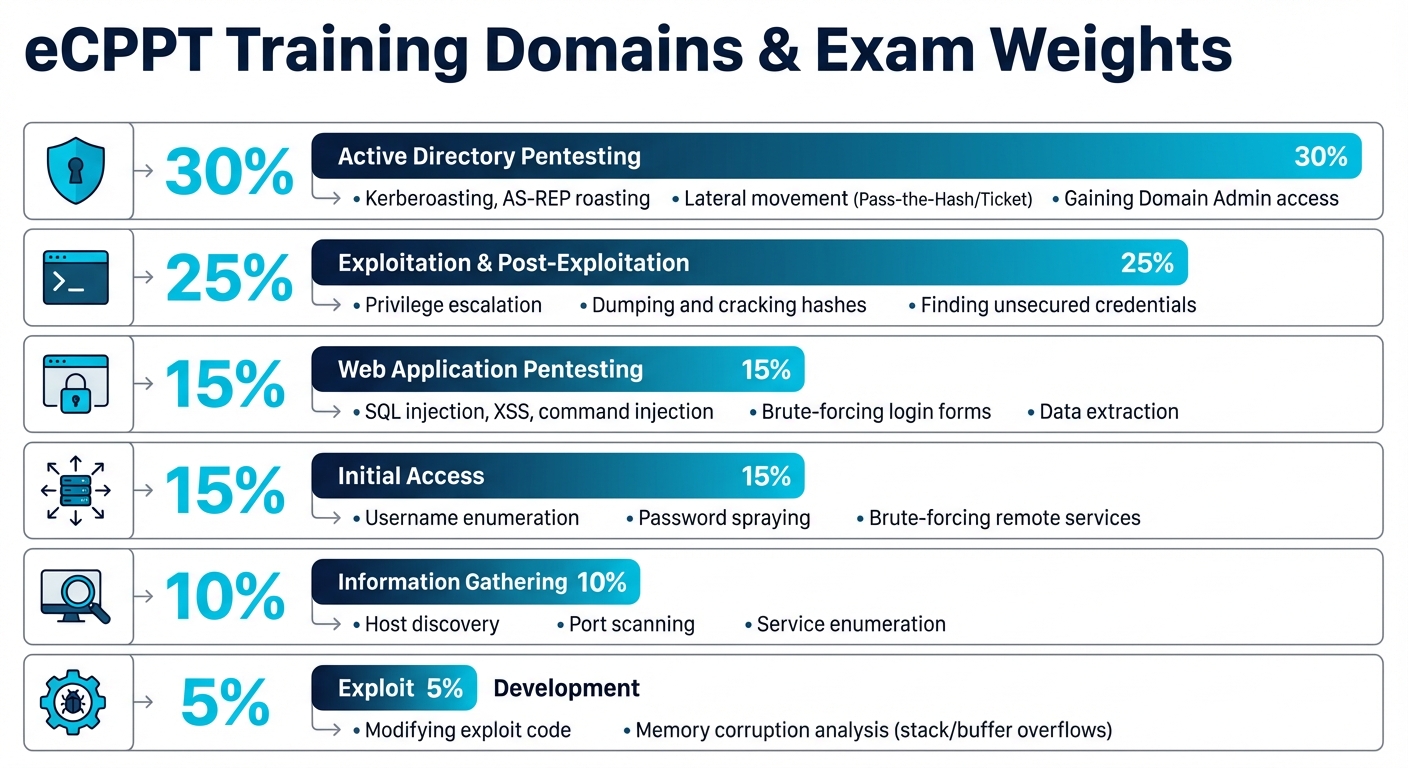
eCPPT Certification Training Domains and Exam Weight Distribution
The eCPPT (Certified Professional Penetration Tester) is a hands-on certification designed to showcase practical offensive security skills. Unlike traditional certifications that rely on multiple-choice exams, the eCPPT requires candidates to perform simulated, real-world penetration tests. It’s tailored for professionals with at least two years of experience in offensive security, system administration, or security engineering, proving their ability to execute real attacks [1].
The certification remains valid for three years and follows a structured training and testing approach.
eCPPT Training Modules
The eCPPT certification is supported by the Penetration Testing Professional (PTP) learning path, which focuses on six essential domains. These domains are weighted based on their relevance to real-world scenarios. For instance, Active Directory penetration testing carries the most weight at 30% of the exam score, reflecting its importance in modern corporate setups. Exploitation and post-exploitation techniques make up 25%, while web application testing and initial access each account for 15% [1] [4].
| Domain | Weight | Key Skills |
|---|---|---|
| Active Directory Pentesting | 30% | Techniques like Kerberoasting, AS-REP roasting, lateral movement (Pass-the-Hash/Ticket), and gaining Domain Admin access |
| Exploitation & Post-Exploitation | 25% | Privilege escalation, dumping and cracking hashes, finding unsecured credentials |
| Web Application Pentesting | 15% | Identifying SQL injection, XSS, command injection, brute-forcing login forms, and extracting data |
| Initial Access | 15% | Methods such as username enumeration, password spraying, and brute-forcing remote services |
| Information Gathering | 10% | Host discovery, port scanning, and service enumeration |
| Exploit Development | 5% | Modifying exploit code and analyzing memory corruption (e.g., stack/buffer overflows) |
These modules emphasize practice, helping candidates develop "muscle memory" for common attack techniques. Topics like network pivoting, credential abuse, and lateral movement are thoroughly covered, which are especially crucial for navigating segmented networks or restricted environments [4].
Exam Format and Hands-On Testing
The eCPPT exam builds on the training modules, placing candidates in a realistic 24-hour penetration test against a simulated corporate network [4]. Using an in-browser Kali Linux instance with restricted internet access, candidates rely on their offline resources, such as notes, wordlists, and custom scripts. This setup replicates the challenges of secure, offline networks often seen in high-security environments, testing a participant’s ability to adapt under pressure.
In 2024–2025, INE introduced an updated, auto-graded exam system that delivers results within hours instead of weeks [4]. The exam includes 45 multiple-choice questions directly linked to the practical tasks performed during the lab. Instead of submitting a traditional penetration test report, candidates are evaluated on their technical execution in real time. If a candidate doesn’t pass on the first try, most vouchers include a free retake within 14 days, as long as both attempts are within the voucher’s 180-day validity period [4].
The exam cost ranges from $200 to $400 for a standalone voucher. Bundles that include three months of INE Premium access typically range from $249 to $599. To maintain the certification, candidates need to earn 36 continuing professional education (CPE) credits over three years. Renewal fees are $99 if completed before expiration or $199 during a 90-day grace period [4].
Why eCPPT Matters for Cleared Penetration Testers
The eCPPT certification sets you apart in cleared penetration testing roles by focusing on practical, hands-on skills rather than rote memorization. It assesses your ability to simulate real-world attacks on enterprise networks – systems commonly used by government agencies and defense contractors. This makes the certification directly relevant to the challenges faced in cleared roles, where understanding and navigating complex infrastructure is critical.
How eCPPT Meets Cleared Job Requirements
Cleared penetration testing jobs demand expertise in handling segmented networks and exploiting Active Directory systems, both of which are core components of the eCPPT curriculum. The certification dives deep into areas like Kerberos abuse, lateral movement techniques, and achieving Domain Admin access – skills essential for working with federal networks [1][4].
The exam emphasizes practical post-exploitation skills, including:
- Privilege escalation
- Credential abuse
- Navigating restricted network segments
These competencies are crucial for tasks like assessing segmented defense networks or performing internal red team operations. The hands-on nature of the eCPPT exam mirrors the conditions penetration testers face in real scenarios.
"The certification exam assesses and validates that the individual has the knowledge, skills, and abilities required to fulfill the role of a modern Penetration Tester." – INE [1]
Additionally, the certification ensures that candidates master clear and actionable reporting, meeting the rigorous documentation standards required in federal environments [2].
Career Benefits for Cleared Professionals
The eCPPT certification enhances your career prospects in the cleared job market by validating skills that directly translate to higher earning potential. Entry-level penetration testers earn between $75,000 and $95,000, while seasoned professionals with advanced certifications can surpass $120,000 annually [5]. The certification’s three-year validity and requirement for 36 Continuing Professional Education (CPE) credits ensure that your skills remain relevant as threats evolve.
For many professionals, the eCPPT serves as a stepping stone from foundational certifications like Security+ to more advanced credentials. Its focus on Active Directory and internal network exploitation complements other offensive security certifications, creating a well-rounded skill set that appeals to government contractors.
"If you’re pursuing roles involving internal assessments, red teaming, or consulting on enterprise risk, eCPPT’s skill map aligns perfectly with what those jobs demand." – FlashGenius [4]
The updated exam format, introduced in 2024–2025, delivers results within hours instead of weeks. This quick turnaround allows candidates to demonstrate their technical skills promptly – an advantage when applying for cleared positions that require proof of current expertise. These streamlined processes and practical benefits underscore eCPPT’s value in advancing careers in the cleared penetration testing field.
How to Prepare for eCPPT Certification
Preparing for the eCPPT certification requires a focused, hands-on strategy that mirrors secure network conditions. This exam isn’t about rote memorization – it’s about practical skills. With its 24-hour, single-sitting format, success hinges on muscle memory built through extensive lab work. You’ll need to execute attacks under time pressure, with limited internet access, in a controlled environment.
Study Materials and Resources
The INE Penetration Testing Professional (PTP) Learning Path is the go-to resource, designed to align directly with the exam. An INE Premium subscription costs about $749 per year, offering full access to labs and materials. If you’re on a tighter budget, the Fundamentals Plan at $299 per year provides essential content. Exam vouchers alone range from $200 to $400, and promotional bundles combining the voucher with three months of Premium access typically cost between $249 and $599.
To complement INE’s materials, consider these additional resources:
- HackTheBox Academy’s "Active Directory Enumeration & Attacks" module to sharpen your AD-related skills.
- The PortSwigger Web Security Academy, which provides excellent practice for web vulnerabilities like SQL injection and command injection.
- TryHackMe’s "Wreath" room, offering realistic pivoting scenarios similar to the exam environment.
Since the exam limits internet access, prepare an offline workflow. Save essential wordlists (like rockyou.txt and seasons.txt), custom scripts, and cheatsheets locally. Ensure you’re proficient with tools like OpenVPN for lab access, Metasploit for exploitation, and Nmap for reconnaissance. These tools will form the backbone of your toolkit during the exam.
Once your resources are ready, shift your focus to intensive lab practice to build the necessary hands-on experience.
Hands-On Practice Tips
Practical lab work is critical for mastering the eCPPT exam environment. Dedicate more time to labs than to reading. Set up a local Active Directory lab using virtual machines to practice techniques like Kerberoasting, AS-REP roasting, and delegation abuse. Repeated practice with these scenarios will help you navigate internal network segments more efficiently.
"Reading is not enough. You must log hours in the lab to develop the muscle memory required for success." – FlashGenius [4]
Simulate the exam by conducting a 24-hour mock test using only approved tools. Practice your "first-90-minute workflow", focusing on reconnaissance, gaining a foothold, and privilege escalation. Mastering time management during this phase is key. Additionally, practice setting up SOCKS proxies and routing, as navigating segmented networks is a crucial skill.
Effective note-taking can make or break your exam performance. Keep detailed records of hosts (IP addresses, domains, operating systems), credentials (usernames, passwords, domain statuses), and scan results. Organize this information in tables to track progress. Tools like Screenpresso can help you capture findings quickly during the exam. Even though the exam includes auto-grading, maintaining detailed command logs ensures you don’t overlook critical flags.
"One of many reasons that made me succeed the exam was proper note-taking, it is crucial to pass the exam and without that there is a big risk of failure!" – Str4ngerX [6]
For buffer overflow preparation, use TryHackMe’s "Buffer Overflow Prep" rooms or set up a Windows VM with Immunity Debugger and mona.py. While the official course covers exploit development, these additional resources can fill in any gaps. Also, keep a persistent ping running to the exam webserver to avoid VPN disconnections during critical moments – this simple step can save you from unnecessary frustration.
These targeted practices not only prepare you for the eCPPT exam but also sharpen the skills you’ll need for real-world, high-security environments.
How to Pass the eCPPT Exam as a Cleared Professional
The eCPPT’s intense 24-hour, single-sitting format is designed to simulate high-pressure, real-world scenarios. Success requires a mix of precise time management, sharp technical skills, and strict adherence to security protocols.
Managing the 24-Hour Exam Window
Since the exam is auto-graded, there’s no traditional reporting phase, meaning you’ll need to maximize every minute. Active Directory pentesting is the heaviest scoring section at 30%, followed by Exploitation and Post-Exploitation at 25% each[4]. These weightings should guide how you allocate your time. A possible breakdown could look like this:
- First 90 minutes: Focus on recon and gaining an initial foothold.
- 8–10 hours: Dedicate to Active Directory enumeration and lateral movement.
- 6–8 hours: Work on privilege escalation.
- 2–3 hours: Wrap up with verification and cleanup.
"Optimize your first-90-minute workflow: recon → foothold → privilege escalation → DA." – FlashGenius[4]
If you hit a wall with credential brute-forcing, don’t waste more than 30 minutes on wordlist attacks. Instead, pivot to alternative enumeration methods[6]. Many candidates have completed the exam in about 19 hours, even with breaks[6]. Scheduling short rest periods can help maintain focus and avoid burnout.
These time management strategies not only help you succeed in the exam but also align with the structured workflows required in secure environments.
Compliance Considerations for Cleared Environments
The eCPPT exam emphasizes manual techniques, reflecting the precision and understanding needed in cleared environments. While automated tools can save time, the exam – and your future roles – focus on knowing the "why" behind every command. This approach minimizes noise, reduces risk, and ensures careful execution in sensitive networks[7].
The exam is delivered through a browser-based interface using Apache Guacamole, which introduces unique challenges for cleared professionals[7]. Before starting, coordinate with your security team to secure any necessary authorizations for network access if you’re working from a secured facility. The restricted exam environment, with limited tools and no internet access, mirrors the conditions of air-gapped or highly controlled networks often encountered in cleared roles[4].
To prepare, build an offline repository of critical techniques – such as pivoting methods, buffer overflow approaches, and Active Directory attack workflows. Storing these in formats like PDFs or Obsidian vaults can be a game-changer in environments where internet access is restricted[3][2]. This habit not only supports exam success but also equips you for the challenges of working in tightly controlled operational settings.
Using eCPPT to Advance Your Cleared Career
The eCPPT certification can be a game-changer for anyone looking to grow in the fast-paced world of cybersecurity. According to the U.S. Bureau of Labor Statistics, demand for information security analysts, including penetration testers, is projected to grow by 33% between 2023 and 2033[9]. With cybercrime costs expected to exceed $10 trillion annually by 2025, organizations are on the hunt for professionals who don’t just know the theory but can demonstrate real-world offensive security skills[10].
This demand also translates into impressive earning potential. As of July 2025, penetration testers in the U.S. earn an average salary of $143,000, with even higher pay in cleared hubs. For example, McLean, VA leads with $169,897, followed by Chantilly, VA at $150,546, and Arlington, VA at $130,274[9].
The eCPPT certification stands out because of its hands-on approach. It validates your ability to perform tasks like compromising hosts, navigating network pivots, and escalating privileges in enterprise environments. For cleared employers, this practical expertise is invaluable, especially for roles requiring immediate operational readiness in red team operations and internal security assessments[4].
Finding Jobs with Cleared Cyber Security Jobs

Once you’ve earned your eCPPT, the next step is finding the right job to match your skills. Cleared Cyber Security Jobs is a platform designed specifically for professionals with security clearances. It connects you with employers who value certifications like the eCPPT. The platform offers tools like job search filters to help you find roles that align with your clearance level and technical expertise. You can also upload your resume, set up alerts for penetration testing positions, and access resources tailored to the cleared workforce.
Another standout feature is the platform’s job fairs, where you can meet hiring managers directly – no intermediaries like staffing firms or third-party recruiters. For eCPPT holders, this is a golden opportunity to showcase your hands-on skills during conversations with employers who understand the certification’s technical depth. Best of all, these services are free for job seekers, though participation requires U.S. citizenship and an active security clearance.
Combining eCPPT with Other Certifications
To maximize its impact, the eCPPT works best when paired with other certifications. For instance, CISSP highlights your knowledge of security management, while CEH covers foundational ethical hacking concepts. The eCPPT complements these by proving you can execute sophisticated, real-world attacks. Together, they present a well-rounded skill set that balances strategic understanding with tactical expertise[4][8].
For cleared roles tied to the Defense Cyber Workforce Framework (DCWF), combining eCPPT with CompTIA Pentest+ is a strong move. While Pentest+ often meets DoD 8570 baseline requirements, the eCPPT demonstrates advanced skills like Active Directory exploitation and network pivoting, essential for high-level enterprise assessments[4][8][11]. If you’re transitioning from defensive roles such as SOC analysis or network engineering, this certification stack highlights your ability to operate effectively in both offensive and defensive capacities[5].
"The eCPPT certification stands out for its realism, efficiency, and focus on the technical depth that modern penetration testers need." – FlashGenius[4]
Conclusion
The eCPPT certification provides a practical, hands-on way to prove your skills in the cybersecurity field, especially within the cleared workforce. Unlike exams focused solely on theory, this certification shows you can perform real-world tasks – like exploiting Active Directory and network pivoting – in environments that closely resemble enterprise and government systems. This level of hands-on experience sets you up for success in demanding, high-pressure environments.
To make the most of your certification, take proactive steps to showcase your skills. Use platforms like Cleared Cyber Security Jobs to connect with hiring managers who value the technical expertise demonstrated by the eCPPT. Set up job alerts, attend job fairs, and emphasize your practical experience in your applications. Remember, your certification is valid for three years and requires 36 CPE credits for renewal [4]. Alternatively, you can aim for advanced certifications like OSCP or eWPT to further enhance your credentials.
Leverage the preparation strategies outlined in this guide to highlight your expertise. Build a polished, sanitized portfolio on platforms like GitHub or LinkedIn to showcase your projects and lab work. Regular lab practice will ensure your skills stay sharp and relevant.
"The eCPPT was well worth the time invested into it and I still occasionally reference my notes on my client engagements." – Jake Murphy, Offensive Security Team, Echelon Risk + Cyber
This certification demonstrates your ability to perform under pressure, navigate complex systems, and deliver the expertise that cleared employers are looking for.
FAQs
Is eCPPT accepted for DoD 8570/DCWF roles?
The eCPPT certification holds recognition under the DoD 8570 framework, making it valid for specific roles, including those at management and CSSP (Cybersecurity Service Provider) levels. Additionally, it aligns with the broader directives outlined in DoD 8140, ensuring its relevance for various essential job roles within the DCWF (DoD Cyber Workforce Framework).
What offline files should I bring to the exam?
While there aren’t any mandatory offline files for the eCPPT exam, it’s a good idea to come prepared with backups of your virtual machines, tools, documentation, and any binaries or scripts you plan to use. Double-check that your setup is complete and accessible before the exam begins. Having everything ready and backed up can make a big difference in ensuring a smooth experience.
How should I pace the 24-hour exam?
Starting the 24-hour eCPPT exam in the early afternoon can set you up for success. This timing allows you to work during peak alertness and still have flexibility for rest later. Time management is crucial – divide your focus across the exam’s domains, prioritizing areas like Active Directory penetration testing, which accounts for a significant 30% of the exam, and exploitation tasks.
Short breaks are essential to stay sharp, but keep them brief to avoid losing momentum. Fuel your focus with snacks and stay hydrated throughout the process. Reserve some time at the end to thoroughly review your work, ensuring no critical details are missed.