• Skip to primary navigation
  • Skip to main content
Cleared Cyber Security Jobs | CyberSecJobs.com

Cleared Cyber Security Jobs | CyberSecJobs.com

Cleared Cyber Security Jobs

  • Home
  • Search Cleared Cyber Jobs
  • Job Fairs
  • Career Resources

CyberSecJobs Editorial

CISM Certification Career Guide for Cleared Security Managers

CyberSecJobs Editorial · February 3, 2026 · Leave a Comment

The CISM certification is a must-have for security managers focusing on leadership and aligning information security with business goals. Offered by ISACA, it emphasizes governance, risk management, program development, and incident management – key areas for cleared professionals in government and defense roles. With job demand far outpacing the number of CISM-certified professionals, this credential can significantly enhance your earning potential and career prospects.

Key Takeaways:

  • High Demand: By late 2025, over 44,000 job openings required CISM, but only 20,300 professionals held the certification.
  • Earnings: Average salaries for CISM holders in the U.S. range from $149,000 to $165,863, with leadership roles earning even more.
  • DoD Alignment: Meets DoD 8140/8570.01-M standards, making it crucial for federal and defense roles.
  • Certification Requirements: 5 years of experience (3 in management), passing a 150-question exam, and ongoing education (120 CPE hours every 3 years).
  • Exam Focus: Domains 3 (Program Development) and 4 (Incident Management) cover 63% of the exam.

CISM is ideal for transitioning into senior roles like CISO, Security Director, or Risk Manager while commanding higher salaries and greater job opportunities in the cybersecurity field.
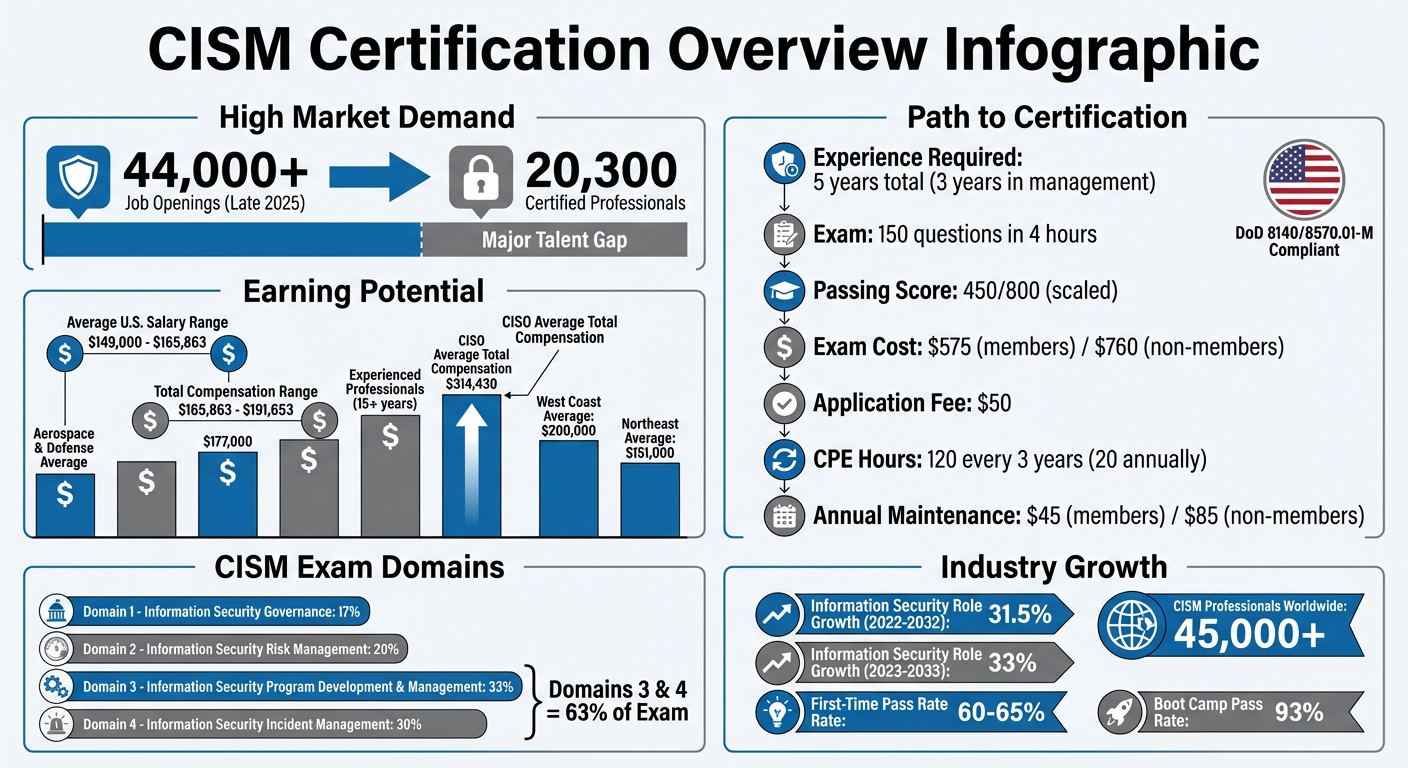
CISM Certification Requirements, Salary Data, and Career Statistics

CISM Certification Requirements, Salary Data, and Career Statistics

Introduction Video | 40-Hour Free CISM Exam Preparation Tutorial | ISACA CISM 2025 Full Course
ISACA

The Four CISM Domains for Cleared Security Managers

The CISM exam is built around four domains that reflect the core responsibilities of security managers. Each domain is weighted differently, with Domains 3 and 4 making up over 60% of the exam content [4][8]. Understanding these domains and how they relate to classified systems and federal compliance is key – not just for passing the exam but also for improving your leadership in security management. Below is an overview of each domain and its relevance to your role.

CISM Domain Exam Weight Key Focus Areas for Cleared Managers
1. Information Security Governance 17% Strategy alignment, NIST/Federal compliance, organizational structure.
2. Information Security Risk Management 20% Threat landscape, classified data risk assessment, risk response options.
3. Information Security Program Development & Management 33% Resource management, control implementation, security architecture.
4. Information Security Incident Management 30% Incident response plans, business continuity (BCP), disaster recovery (DRP).

Here’s a deeper dive into each domain and how it applies to your career.

1. Information Security Governance

This domain focuses on aligning security initiatives with organizational goals and federal regulations. It’s about setting up frameworks that comply with NIST standards and ensuring security is recognized as a strategic asset at the executive level.

You’ll gain skills to build business cases for security investments, define accountability structures, and create policies that guide your operations. As Destination Certification highlights:

Strong governance is foundational – it ensures security has visibility at the executive level and is positioned as a business enabler, not just a cost center.

For cleared managers, this is especially important when justifying complex security requirements to senior government or contracting leadership.

2. Information Security Risk Management

Making up 20% of the exam [4], this domain is all about identifying and addressing risks to information assets. It emphasizes assessing threats to classified data, conducting vulnerability analyses, and choosing risk responses – whether mitigating, transferring, avoiding, or accepting risks.

This domain equips you to evaluate threats in high-stakes environments like government or defense sectors. You’ll learn to perform detailed risk assessments and develop strategies that balance operational needs with security mandates. These skills are critical for managing the unique risks associated with classified systems.

3. Information Security Program Development and Management

Covering 33% of the exam [4], this domain is the largest and focuses on executing security strategies. It includes designing security architectures, managing personnel with security clearances, budgeting for specialized tools, and implementing controls to protect classified resources.

You’ll also learn to oversee the full lifecycle of security controls, from design to testing and evaluation. This includes tasks like asset classification, creating tailored training programs, and integrating security into contracts. Additionally, defining and tracking metrics to show program effectiveness is a key component. These responsibilities are essential for leading security programs that meet operational and compliance requirements in classified environments.

4. Information Security Incident Management

Making up 30% of the exam [4], this domain concentrates on incident readiness and response. It emphasizes creating response plans, conducting Business Impact Analyses (BIA), and managing recovery efforts to maintain continuity during incidents.

You’ll develop skills to establish detection and response systems, lead incident response teams, and implement disaster recovery processes tailored to classified environments. As Destination Certification notes:

Your incident management skills will often be the difference between a minor event and a costly breach.

In high-security settings, where incidents can have national security implications, a structured and proactive approach is essential. These skills not only prepare you for the exam but also enhance your ability to safeguard critical systems and data effectively.

CISM Certification Requirements

Earning your CISM certification is more than just passing an exam. ISACA sets specific criteria, including professional experience, ethical standards, and ongoing education, to ensure credential holders maintain their expertise. Here’s a breakdown of what’s required.

Work Experience Requirements

To qualify, you need five years of professional experience in information security, with at least three years in information security management across three or more CISM domains [9][10]. This experience must be completed within the 10 years before applying or within five years after passing the exam [9][12].

Interestingly, "management" doesn’t necessarily mean holding a formal managerial title. It refers to responsibilities like developing security strategies, overseeing program implementation, making risk-related decisions, or advising senior leadership [10]. Roles such as senior security analyst, security architect, or network security engineer may qualify if they involve strategic decision-making or program oversight [10].

Your experience must be verified by a supervisor, manager, colleague, or client [11]. Rob Witcher, CEO of Destination Certification, highlights:

The key is documenting how your technical work extended into strategic decision-making or program oversight – not just implementation.

Experience waivers can reduce the five-year requirement, though the three-year management minimum is non-negotiable. For example, holding a CISA or CISSP certification, or earning a Master’s degree in information security, grants a two-year waiver. A Bachelor’s degree in the field or certifications like Security+ reduce the requirement by one year [11][13].

Once your experience is clear, it’s time to tackle the exam.

Exam Format and Passing Score

The CISM exam includes 150 multiple-choice questions to be completed in four hours [10][12]. These scenario-based questions focus on management decision-making rather than technical details [8][12]. To pass, you’ll need a scaled score of 450 out of 800 [10][12].

The exam emphasizes program development and incident management, with Domain 3 (Information Security Program) at 33% and Domain 4 (Incident Management) at 30% making up the bulk of the content. Domain 2 (Risk Management) accounts for 20%, and Domain 1 (Governance) covers 17% [7][8].

Registration costs $575 for ISACA members and $760 for non-members [3][8]. You can take the exam at PSI testing centers or via remote proctoring [3]. After passing, you’ll have five years to meet the experience requirements and apply for certification [3][9][11].

Application Process and Continuing Education

Once you pass the exam and verify your work experience, you’ll need to complete the application process. This involves paying a one-time $50 fee and submitting your application within five years of passing the exam [9][3]. Ensure your MyISACA account profile matches your government ID to avoid delays [3].

CISM holders must follow ISACA’s Code of Professional Ethics, which outlines seven principles, including maintaining confidentiality, acting objectively, and supporting stakeholder education [9][13][12].

To keep your certification active, you’ll need to earn 120 Continuing Professional Education (CPE) hours every three years, with at least 20 hours completed annually [9][12]. Logging these hours monthly can simplify the annual audit process [12]. Annual maintenance fees are $45 for ISACA members and $85 for non-members [8][12]. Neglecting CPE requirements or failing to pay these fees could result in losing your certification [12].

Steps to Get Your CISM Certification

Earning your CISM certification involves three clear phases. Most professionals in the field complete this journey within three to six months [4].

1. Study for the Exam

Prepare to dedicate 150–200 focused study hours [4]. With first-time pass rates hovering around 60–65%, a structured study plan significantly improves your chances [4]. For example, Infosec‘s 5-day CISM Boot Camp boasts a pass rate of over 93% [14].

Start with ISACA’s Questions, Answers & Explanations (QAE) Database, which features over 1,000 practice questions [14][3]. This resource is invaluable because it helps you understand ISACA’s approach to security management decisions. Before investing in paid study materials, try the free 10-question practice quiz on ISACA’s website to gauge your starting point [14][3].

Interestingly, the challenge of the CISM exam isn’t rooted in technical difficulty. As Destination Certification notes:

The CISM exam is moderately difficult… What makes it challenging isn’t complicated technical concepts but the need to think like a security leader who balances security requirements with business objectives. [4]

Strategic focus is key. Concentrate on Domain 3 (Information Security Program) and Domain 4 (Incident Management), which together account for 63% of the exam [4]. When practicing questions, prioritize risk management and aligning security measures with business goals over purely technical fixes [4]. For government and defense professionals, CISM training aligns with ISO 17024 and DoD 8140/8570.01-M standards, making it highly relevant for such roles [2].

Once you feel confident in your preparation, move on to registering and scheduling your exam.

2. Register and Take the Exam

Joining ISACA can save you money. Membership costs $135 per year but lowers the exam fee by $185, reducing it from $760 to $575 [8][3]. Be sure your ISACA account name matches your government-issued ID to avoid any issues on exam day [3].

Registration is open year-round, giving you flexibility. Once you pay, you’ll have 12 months to schedule and take the exam [3]. Plan ahead by booking your appointment at least four to six weeks in advance through PSI, choosing between an in-person testing center or remote proctoring [3]. Be mindful of peak times, such as fiscal quarter ends or December, when slots can fill up quickly.

The exam itself includes 150 multiple-choice questions to be completed in four hours [15][8]. Preliminary results – pass or fail – are provided immediately after you finish. To pass, you’ll need a scaled score of 450 out of 800 [4]. If you don’t pass, you must wait 30 days for a second attempt and 90 days for a third or fourth attempt [4].

After passing, you’ll need to document your work experience to finalize your certification.

3. Submit Your Work Experience

The final step is to document your professional experience and submit your certification application. Your experience must cover at least three of the four CISM domains and must have occurred within the 10 years prior to your application [9][11].

Your application requires a full employment history and a completed Experience Verification Form. A supervisor, manager, colleague, or client can serve as your verifier, but family members or HR departments are not acceptable [11]. Submit your application online, via email, or through postal mail using ISACA’s submission portal [16].

There is a $50 application processing fee to complete this step [9][3].

sbb-itb-bf7aa6b

Career Benefits of CISM for Cleared Security Managers

Earning a CISM certification doesn’t just enhance your technical skills – it opens doors to career advancement and financial rewards. This certification translates your expertise into real-world opportunities, helping you achieve significant professional milestones.

1. Higher Salary Potential

One of the most immediate benefits of a CISM certification is its impact on earning potential. In the United States, CISM-certified security managers earn an average base salary of roughly $141,000. When factoring in bonuses and profit-sharing, total compensation typically falls between $165,863 and $191,653 [5][6][17][18].

For many professionals, the certification leads to a salary bump of $15,000 to $30,000 within the first year [6]. Those in the Aerospace and Defense sector see even higher averages, with total compensation reaching $177,000. Companies like SAIC and BAE Systems offer competitive packages, averaging $169,143 and $145,000, respectively [17][18].

Seasoned professionals with 15 or more years of experience can command salaries ranging from $200,000 to $250,000 [6]. Geographic location also plays a role – West Coast cybersecurity managers average $200,000 annually, compared to $151,000 in the Northeast [6]. Specialized skills, such as expertise in AI governance, can further boost salaries by $20,000 to $40,000 [6].

CISM-certified professionals consistently out-earn their non-certified peers.

Strategic career decisions, like switching employers every three to four years, can lead to even greater financial gains. Pairing a CISM certification with cloud security skills (e.g., AWS or Azure) can add up to $40,000 to your base salary [6].

2. Leadership Opportunities

CISM certification is a stepping stone to leadership. It demonstrates your ability to translate technical risks into business terms and align security strategies with organizational goals – key skills for senior roles.

With CISM, executive positions like Chief Information Security Officer (CISO), Chief Information Officer (CIO), and Director of Security become attainable [5][19]. CISOs with this certification earn an average total compensation of $314,430, with some top-tier roles exceeding $400,000 [5]. Other management opportunities, such as Information Security Manager (averaging $186,697 in total compensation), Security Director, Risk Manager, and IT Director, are also within reach [5][18].

In the cleared sector, federal agencies like the DoD, DHS, FBI, and NSA, as well as major defense contractors, highly value CISM-certified leaders [5].

Organizations prioritize leaders who can minimize risks while advancing business objectives – precisely the focus of CISM.

The numbers back this up: 70% of CISM-certified professionals report improved job performance, and their teams are 90% more effective [1][20]. Nearly half (48%) receive performance appraisals within a year of certification, and 42% earn pay raises directly linked to their CISM credential [20].

3. More Job Opportunities

The demand for cybersecurity managers is booming. From 2022 to 2032, information security roles are expected to grow by 31.5% [5]. For CISM-certified professionals, especially those with active security clearances, this growth means a wealth of opportunities.

Platforms like Cleared Cyber Security Jobs connect CISM holders with employers looking for cleared cybersecurity managers. These tools allow you to filter job searches, upload resumes, and set up alerts tailored to your expertise.

The rise of regulations like GDPR, HIPAA, and CMMC has further increased demand for professionals who can bridge technical security with governance [5][6]. As companies shift their focus from technical implementers to strategic advisors capable of managing large budgets and presenting to executive boards [5], CISM certification becomes even more valuable.

This growing demand positions CISM-certified professionals for success in a rapidly evolving field.

Using CISM to Find Cleared Security Jobs

Your CISM certification is more than just a credential – it’s a key to unlocking high-level cleared roles in the cybersecurity market. With fewer than 23,000 CISM professionals worldwide compared to over 100,000 CISA holders, this certification sets you apart in a competitive field [21]. Here’s how to make the most of it.

1. Add CISM to Your Resume

Make your CISM certification stand out on your resume. Place "CISM" right after your name at the top and include a dedicated certifications section prominently near the beginning [5]. This ensures recruiters notice your qualification immediately.

Organize your experience around the four core CISM domains: Information Security Governance, Information Risk Management, Information Security Program Development and Management, and Information Security Incident Management [4][5]. This structure highlights your strategic leadership skills, demonstrating that you’re more than just a technical expert.

Replace vague job descriptions with measurable achievements. For example, instead of saying "managed security incidents", use something like "reduced security incidents by 40% while supporting cloud transformation" [5]. Emphasize at least three years of security management experience to solidify your expertise.

Once your resume reflects your CISM qualifications, expand your job search using specialized platforms.

2. Search Job Boards for Cleared Professionals

Platforms like Cleared Cyber Security Jobs connect CISM-certified professionals with employers who need cleared cybersecurity experts. These job boards let you filter openings by clearance level – Secret, Top Secret, or TS/SCI – and offer tools like resume uploads and personalized job alerts tailored to your skills and clearance status.

To stand out, fully complete your online profile. Many recruiters review digital profiles before requesting a full resume [22]. Use targeted filters to find roles where your CISM certification delivers the most impact. The platform’s veteran-focused approach is especially helpful for those transitioning from military service or between cleared roles.

3. Network and Attend Job Fairs

Don’t rely solely on resumes and online applications – networking is a powerful tool in the cleared cybersecurity space. Industry events provide direct access to hiring managers and recruiters. Upcoming events include the CI or FS Poly Cleared Job Fair on February 5, 2026 (Hanover, MD), the Cleared Careers Virtual Huntsville Hiring Event on February 19, 2026, and additional events in Herndon, VA (March 5, 2026), Colorado Springs, CO (April 2, 2026), and Falls Church, VA (April 16, 2026) [23][24].

"For veterans especially, attending Cleared Job Fairs can be critical to a successful career transition." – G.B., Technical Project Manager, CACI [22]

Joining your local ISACA chapter is another way to build connections. These groups often offer exclusive networking opportunities with hiring managers and insights into which employers are actively seeking CISM-certified professionals [3][5]. Many roles are filled through personal connections before they’re even advertised. Prepare a clear elevator pitch that explains how your CISM certification helps translate technical risks into business solutions – exactly the kind of expertise sought by companies like Booz Allen Hamilton, Lockheed Martin, and Raytheon [22][5].

Conclusion

Earning a CISM certification is a smart move for cleared security managers looking to stand out in the cybersecurity field. With information security roles expected to grow by 33% between 2023 and 2033 [25] and over 45,000 professionals already holding this credential worldwide [4], the certification highlights your ability to bridge technical security operations with high-level decision-making. It positions you as a leader capable of driving strategic initiatives rather than just managing technical tasks.

For cleared professionals in areas like Washington, D.C., Virginia, and Maryland, the financial benefits are clear – CISM-certified managers consistently earn higher salaries than their non-certified counterparts. The certification’s four core domains provide a strong framework for managing enterprise-wide security programs, aligning security efforts with organizational goals, and effectively communicating risks to top executives [4].

To maximize the value of this certification, focus on mastering the core domains, passing the exam, and documenting your relevant experience. Networking through specialized platforms and events can also connect you with employers actively seeking professionals with your expertise. While the $575 investment for ISACA members may seem significant, it can lead to meaningful returns in salary growth, leadership roles, and career progression.

Combining your security clearance with a CISM certification gives you a distinct advantage in the cybersecurity job market. Use this powerful combination to take on strategic leadership roles and thrive in an ever-evolving industry.

FAQs

What are the main benefits of earning a CISM certification for security-cleared managers?

Earning a CISM certification can be a game-changer for security-cleared managers aiming to level up their careers. It showcases your ability to manage security programs, align cybersecurity strategies with business objectives, and handle risk mitigation with confidence.

Some standout perks include access to higher-paying positions (with average salaries climbing to $150,040), sharpened leadership abilities, and stronger industry credibility. This certification also paves the way for senior-level roles, establishing you as a respected leader in the security-cleared space.

How does the CISM certification meet DoD 8140/8570.01-M requirements?

The CISM certification is acknowledged under the DoD 8140/8570.01-M standards as a valid credential for Information Assurance Management (IAM) Levels II and III. This recognition underscores its importance in showcasing skills in information security management and governance.

Achieving the CISM allows cleared professionals to fulfill critical requirements for advancing within the DoD cyber workforce. It opens doors to leadership roles and broader career prospects in cybersecurity management.

How can I increase my earning potential after earning a CISM certification?

To maximize your earning potential with a CISM certification, focus on building practical experience in security management while emphasizing your leadership abilities. Roles like security director or chief information security officer (CISO) often demand a track record of aligning security initiatives with business objectives, so showcasing this skill set is crucial.

Keep growing through ongoing professional development. Deepening your expertise in areas such as risk management, governance, or incident response can help you stand out in a competitive job market. Adding certifications or gaining specialized skills can further increase your value to employers.

Use your CISM certification as leverage when negotiating promotions or salary adjustments. Connect with others in the cybersecurity community to expand your network, and aim for positions in industries where demand is high. Staying informed about the latest industry trends and consistently demonstrating strategic thinking can position you for top-tier compensation in the field.

Related Blog Posts

  • CIO-SP3 Cybersecurity Positions vs DISA Encore III – Which Vehicle Drives Your Career?
  • CISSP Cleared Cybersecurity vs CASP+ – The Certification ROI Debate for TS/SCI Holders
  • Cleared Cybersecurity Career Assessment – Your Success Scorecard and Action Plan
  • CISSP Certification Career Guide for Cleared Cyber Professionals
Related Guides

  • CAP Certification Career Guide for Cleared Authorization Pros
  • CGRC Certification Career Guide for Cleared GRC Analysts
  • CRISC Certification Career Guide for Cleared Risk Professionals
  • Cybersecurity Salary Guide 2026
  • TS/SCI Salary Premium: Real 2026 Numbers

CISSP Certification Career Guide for Cleared Cyber Professionals
CyberSecJobs Editorial · February 3, 2026 · Leave a Comment

The CISSP certification is one of the most sought-after credentials for cybersecurity professionals with security clearances. Here’s why it matters and how it can elevate your career in government and defense roles:

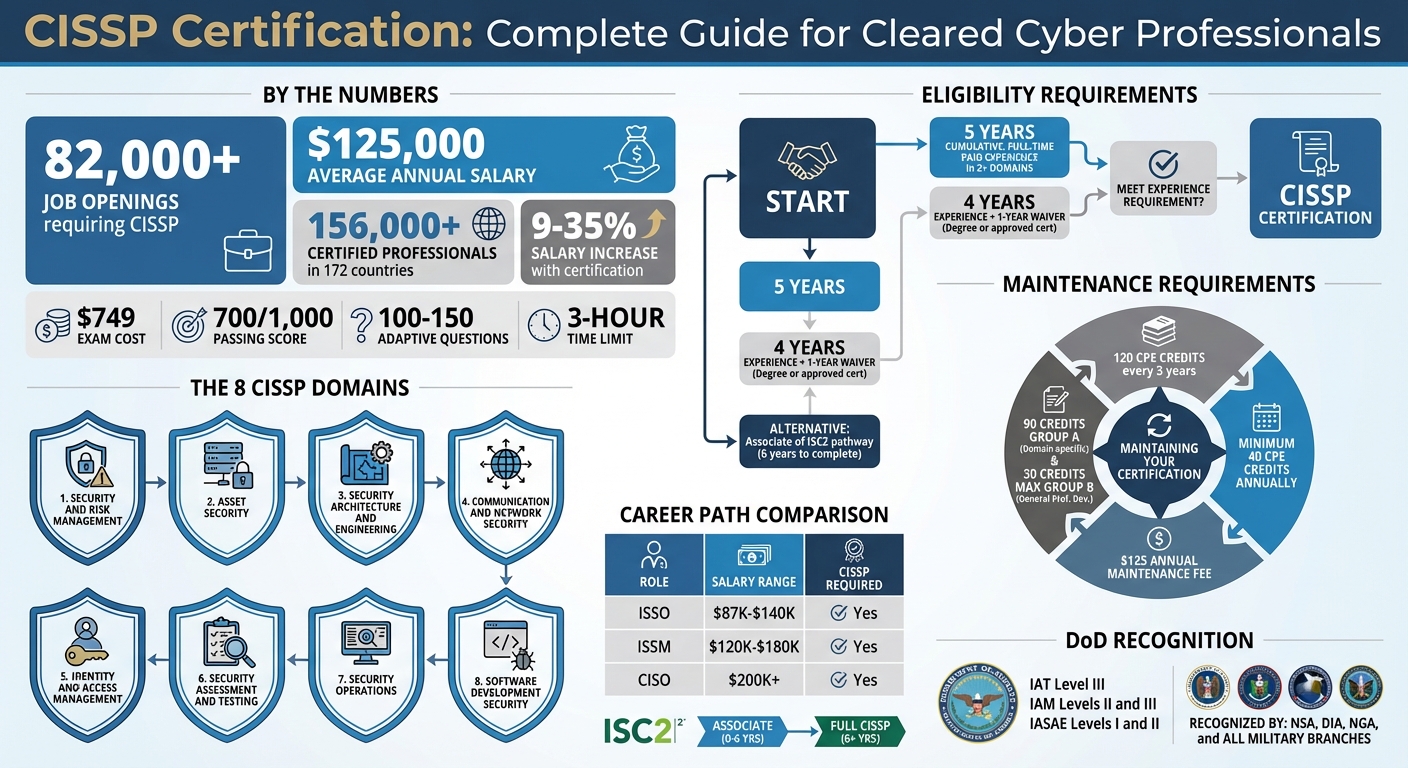
  • Key Benefits: Recognized by the U.S. Department of Defense (DoD) under Directive 8140, CISSP certification qualifies professionals for advanced cybersecurity roles, boosting salaries by 9%–35%. Average earnings for CISSP-certified individuals reach $125,000 annually.
  • Demand: Over 82,000 job openings require CISSP certification, making it a critical asset for cleared professionals aiming to work with agencies like NSA, DIA, and NGA.
  • Exam Overview: The CISSP exam costs $749, includes 100–150 adaptive questions, and requires a score of 700/1,000 to pass. It covers eight domains, including Security and Risk Management, Identity and Access Management, and Software Development Security.
  • Eligibility: Requires five years of experience in at least two CISSP domains. A one-year waiver is available for specific degrees or certifications like Security+ or CCNA.
  • Maintenance: Certification holders must earn 120 Continuing Professional Education (CPE) credits every three years and pay an annual maintenance fee of $125.

Why It Matters: CISSP certification aligns with federal frameworks like NIST SP 800-53 and the Risk Management Framework, ensuring professionals meet government standards while advancing to senior roles such as ISSO, ISSM, or even CISO.

Whether you’re starting as an Associate of ISC2 or meeting full certification requirements, CISSP is a career-defining credential for cleared cybersecurity professionals.

CISSP Certification Requirements and Career Benefits for Cleared Cybersecurity Professionals

CISSP Certification Requirements and Career Benefits for Cleared Cybersecurity Professionals

What You Need to Know About CISSP Certification

CISSP Definition and Recognition

The Certified Information Systems Security Professional (CISSP), managed by ISC2, is a credential that proves your ability to design, implement, and oversee a comprehensive cybersecurity program [2][8]. Often referred to as the gold standard in cybersecurity certifications, it stands out for its rigorous requirements and global reputation. It was also the first certification to align with the ANSI/ISO/IEC Standard 17024, setting it apart from entry-level options by requiring both technical and managerial expertise [7][11].

As of July 2022, more than 156,000 professionals in 172 countries held the CISSP certification. It’s also officially recognized by the U.S. Department of Defense for both Information Assurance Technical (IAT) and Managerial (IAM) roles under DoDD 8570 and DoDM 8140.03 [8][11]. Beyond passing the exam, candidates must complete an endorsement process, where an active ISC2 member verifies their professional experience [9].

Let’s break down the eight domains that the CISSP exam covers.

The 8 CISSP Domains

The CISSP exam evaluates candidates across eight domains, each reflecting key areas of cybersecurity expertise. Here’s a quick overview:

  • Security and Risk Management: Covers governance, compliance, and frameworks like NIST and FedRAMP.
  • Asset Security: Focuses on data classification and handling sensitive or classified information.
  • Security Architecture and Engineering: Includes security models like Bell-LaPadula and designing secure systems, such as SCIFs.
  • Communication and Network Security: Addresses secure network architectures, air-gapped networks, and encrypted communication.
  • Identity and Access Management: Explores authentication methods like MFA and Mandatory Access Control.
  • Security Assessment and Testing: Aligns with continuous monitoring and maintaining Authority to Operate (ATO).
  • Security Operations: Encompasses incident response and disaster recovery for SOCs.
  • Software Development Security: Focuses on secure coding and DevSecOps practices.

The exam itself uses Computerized Adaptive Testing (CAT), presenting between 100 and 150 questions within a 3-hour time limit. To pass, you’ll need a score of 700 out of 1,000 points. The exam fee is $749 [7][2][10].

Understanding these domains is critical for preparing for the exam, but meeting the eligibility requirements is just as important.

CISSP Requirements and Eligibility

To qualify for the CISSP, you need five years of cumulative, full-time, paid work experience in at least two of the eight CISSP domains [6][10]. Full-time work is defined as a minimum of 35 hours per week over four weeks per month. Part-time work can count too – 1,040 hours of part-time work equals six months of full-time experience [6].

If you hold a four-year college degree or an approved credential like Security+, CCNA, or CISM, you can waive one year of the experience requirement. However, only one waiver is allowed [6][9]. Starting April 1, 2026, ISC2 will update its waiver list, removing certifications like CISA, CEH, and several GIAC credentials [6].

If you don’t meet the experience requirement, you can still take the exam and earn the Associate of ISC2 designation. This gives you six years to gain the necessary work experience while qualifying for many DoD 8570/8140 roles [6][10]. After passing the exam, you’ll have nine months to complete the endorsement process with an active ISC2 member. Failing to do so will require you to retake the exam [9][10].

"The experience requirement is what separates CISSP from entry-level certifications. ISC2 requires five years of cumulative, paid, full-time work experience in at least two of the eight CISSP domains." – Elias Ward, Deep Coding Specialist [10]

When documenting your experience, focus on duties that align with the eight domains rather than job titles. Roles like System Administrator or Network Manager often include qualifying security tasks, even if “Security” isn’t in the title [9][10]. For classified work, describe your responsibilities at the highest unclassified level possible when submitting your endorsement [9].

To maintain your CISSP certification, you’ll need to earn 120 Continuing Professional Education (CPE) credits every three years, with a minimum of 40 credits per year. Additionally, there’s an annual maintenance fee of $125 [2][10].

How to pass the CISSP 2025 (Complete Roadmap)

Why CISSP Matters for Cleared Cybersecurity Professionals

For cybersecurity professionals working in the government and defense sectors, the CISSP certification is more than just a credential. It’s a key that unlocks career growth and helps meet critical compliance requirements.

Salary and Career Growth for Cleared Professionals

Earning a CISSP certification can significantly boost your career in the cleared cybersecurity space. On average, CISSP-certified professionals earn salaries that are 9%–35% higher, with typical earnings around $125,000 annually. For those in cleared roles, the certification often brings an additional $15,000–$35,000 per year on top of standard pay[2][13].

This certification isn’t just about higher pay; it also opens doors to senior-level positions that are typically out of reach for non-certified individuals. For instance:

  • Information Systems Security Officer (ISSO): Salaries range from $87,000 to $140,000.
  • Information Systems Security Manager (ISSM): Salaries range from $120,000 to $180,000.
  • Chief Information Security Officer (CISO): Earnings can exceed $200,000 annually[3].

With approximately 82,494 active job openings requiring CISSP certification and a total of 91,765 certified professionals, the demand is clear. These benefits not only enhance individual careers but also align with the stringent requirements of the Department of Defense (DoD).

Meeting DoD 8570 Requirements

For cleared professionals, CISSP is often a mandatory credential for specific roles under DoD Manual 8140 and the older Directive 8570[3]. It qualifies individuals for advanced categories, including:

  • IAT Level III
  • IAM Levels II and III
  • IASAE Levels I and II[12][13]

The certification is widely recognized across all branches of the military – Army, Navy, Air Force, and Marine Corps – as well as key defense agencies like the NSA, DIA, and NGA. This broad acceptance allows professionals to move between agencies and contractors without needing to re-certify. For defense contractors, CISSP is frequently a requirement to secure and staff government contracts[3].

Additionally, the CISSP curriculum aligns with federal guidelines such as FISMA, FedRAMP, and NIST SP 800-53 security controls, ensuring that certified professionals are well-equipped to meet government standards. New hires typically have 180 days from their start date to attain the certification, or they risk losing their position[13].

CISSP-Certified vs. Non-Certified Professionals

The career trajectory for CISSP-certified professionals is notably different from those without the certification. While CISSP-certified individuals often advance into strategic roles like CISO or ISSM, their non-certified counterparts tend to remain in more technical or operational positions. The certification serves as a marker of advanced expertise, particularly under the DoD 8140 framework.

Feature CISSP-Certified Non-Certified
DoD 8140 Eligibility Qualifies for advanced roles Limited to entry-level or non-DoD roles
Job Opportunities Access to 82,494+ active openings[2] Fewer opportunities
Salary Potential 9%–35% higher earnings[2] Standard market rates
Primary Responsibilities Security architecture, policy creation, and program oversight Technical and operational tasks
Career Path Strategic leadership roles (e.g., CISO, ISSM) Focused on technical roles

For cleared professionals, CISSP is more than just a certification – it’s a game-changer. It can even substitute for a college degree in many cases, making it an attractive option for those without a formal education. Plus, its vendor-neutral approach ensures flexibility, allowing professionals to work across various technology platforms without being tied to a specific ecosystem.

sbb-itb-bf7aa6b

How to Get and Keep Your CISSP Certification

Earning your CISSP certification requires passing a challenging exam and meeting specific experience requirements. The process involves three main steps: preparing for and passing the exam, using the Associate pathway if you don’t yet meet the experience criteria, and maintaining your certification through ongoing professional development.

Preparing for the CISSP Exam

The CISSP exam uses Computerized Adaptive Testing (CAT), meaning the difficulty adjusts based on your answers. You’ll face 100 to 150 questions within 3 hours, and you’ll need to score 700 out of 1,000 points to pass[7]. The exam fee is $749[10].

To prepare, focus on understanding and applying security principles in practical scenarios. The exam covers eight domains, with Security and Risk Management being the largest section. Many professionals find their daily work experience provides a solid base for the exam.

Most candidates dedicate 3 to 6 months to studying, setting aside 10–15 hours per week. Training resources like CBT Nuggets, which costs $59.00 per month (or $49.91 per month if billed annually)[15], are popular. Many employers are willing to cover these costs as part of professional development.

If you don’t yet have the required five years of experience, you can still pursue the certification through the Associate pathway.

Getting CISSP with Less Than 5 Years of Experience

You’re not required to have five years of experience before taking the CISSP exam. Passing the exam without meeting the experience criteria earns you the Associate of ISC2 designation while you work toward the necessary experience[14][6].

"The Associate of ISC2 badge demonstrates to employers that you have what it takes to add value to their cybersecurity team now as you progress on your journey to certification." – ISC2[14]

Associates have up to six years to fulfill the work experience requirement. You can reduce this to four years by claiming a one-year waiver for a qualifying degree or certification, such as a bachelor’s or master’s degree in a related field, or certifications like CompTIA Security+, CCNA, or CASP+[6][15]. However, only one waiver can be applied – you can’t combine a degree and certification for additional reductions[6][7].

While holding the Associate designation, you’ll pay a $50 Annual Maintenance Fee (AMF) and earn 15 CPE credits annually[14][17]. Once you gain the required experience, you’ll need to submit an endorsement application before your six-year term ends. An ISC2 member in good standing must verify your experience, or ISC2 can act as your endorser if needed[16]. Transitioning to full CISSP status requires an $85 fee[14].

Once certified, maintaining your CISSP becomes essential for long-term career success.

Maintaining Your CISSP: CPE Requirements

After achieving your CISSP certification, staying current is vital for your career in cybersecurity. To maintain your certification, you must earn 120 CPE credits every three years, with a minimum of 40 CPE credits annually[18][19]. The Annual Maintenance Fee (AMF) for fully certified members increases to $135[18][19].

CPE credits are divided into two categories:

  • Group A: Activities directly related to the eight CISSP domains.
  • Group B: General professional development, such as leadership or management training.

At least 90 of the 120 credits must come from Group A activities, with a maximum of 30 credits from Group B[18][19].

Cleared professionals can earn CPE credits through various activities. For example:

  • Attending ISC2 chapter meetings earns 1 credit per hour.
  • Reading NIST Special Publications or CISA threat reports counts as self-study.
  • Major work projects, like implementing a new security framework, can provide up to 40 CPEs annually[19].
  • Speaking engagements, published articles, and professional contributions also qualify.

ISC2-hosted webinars and events like the Security Congress often automatically upload credits to your portal, simplifying tracking[17]. To stay on track, aim for about 3.5 credits per month to meet the annual requirement[19]. Keep detailed records of all CPE activities for at least five years in case of an audit[19]. Missing these requirements could result in certification suspension, and if not resolved, you’d need to retake the exam[19].

Earning and maintaining your CISSP certification not only keeps you compliant but also reinforces your expertise in the competitive cybersecurity field.

Using CISSP to Find Cleared Cybersecurity Jobs

Your CISSP certification can be a game-changer in the cleared cybersecurity job market. Highlight it effectively on your resume and leverage it to land roles that align with your expertise and clearance level.

Adding CISSP to Your Resume

Make sure your CISSP certification stands out by listing it right next to your name in the header of your resume. Include it again in a dedicated "Certifications" section, along with the certification date and your ISC² member number. In your professional summary, explain how your CISSP aligns with the job requirements you’re targeting. When describing your work experience, tie your day-to-day responsibilities to specific CISSP domains. This approach not only highlights your technical skills but also shows how your certification is applied in real-world scenarios.

A well-crafted resume is your first step toward landing the right job.

Finding CISSP Jobs on Cleared Cyber Security Jobs

Cleared Cyber Security Jobs

Once your resume is polished, use specialized job search tools to find opportunities tailored to your CISSP and clearance level. Platforms like Cleared Cyber Security Jobs allow you to narrow your search. For example, the Boolean Search function lets you combine keywords like "CISSP AND TS/SCI" to pinpoint jobs requiring both the certification and a specific clearance level. The Skills Cloud feature also makes your CISSP credential stand out when recruiters view your profile.

To stay ahead, set up Job Alerts and use IntelliSearch, which matches your resume with high-demand CISSP positions instantly. Engaging in Pulse/Groups can also help you network with other professionals and connect with recruiters who specialize in cleared cybersecurity roles.

Interviewing as a CISSP-Certified Cleared Professional

Your CISSP certification isn’t just a resume booster – it’s a strong talking point during interviews. Use it to demonstrate how your knowledge informs your decision-making in security. Share examples from your professional experience, independent projects, or even home lab setups to show your initiative and problem-solving skills. Additionally, mention any efforts to stay current, like attending ISC² chapter meetings or pursuing extra courses, to highlight your dedication to growth.

As Chuxing Chen, Ph.D., CISSP, PMP, says, "Remember, CISSP is only a ‘door-knocker’, NOT a pass." [5]

While the CISSP opens doors, your hands-on experience and practical skills are what ultimately seal the deal during interviews.

Conclusion

The CISSP certification plays a key role in advancing careers within government and defense cybersecurity. With over 82,000 CISSP-specific job openings tied to DoD roles [2] and its alignment with 44% of DoD 8140 work roles [1], it’s clear why it’s considered the most sought-after credential in the cleared space. Whether you’re eyeing roles like ISSO, earning between $87,000 and $140,000, or senior ISSM positions with salaries ranging from $120,000 to $180,000, the CISSP opens doors that are often closed to non-certified professionals [3]. It serves as a cornerstone for the advanced opportunities discussed earlier.

"Government cybersecurity careers run on standardized credentials, and CISSP sits near the top of that hierarchy." – CertifiedCISSP.com [3]

Beyond job opportunities, the CISSP delivers a salary boost of over 20% and aligns with federal standards like NIST and the Risk Management Framework [3][4]. It’s recognized across all military branches and defense agencies, ensuring flexibility and mobility within the field [3].

Even if you’re starting as an Associate of (ISC)², this pathway provides a clear milestone while allowing you up to six years to meet the certification requirements – all while holding a recognized designation [2][6]. Whether you’re just beginning your career or advancing as a seasoned professional, the CISSP remains a powerful tool for growth. Once certified, maintaining your credential by earning 120 Continuing Professional Education (CPE) credits every three years ensures you stay competitive in a field expected to grow 29% between 2024 and 2034 [2].

When paired with clearance, the CISSP positions you at the intersection of regulatory knowledge and technical expertise. Leverage it wisely, and it will continue to unlock opportunities throughout your cybersecurity career.

FAQs

What are the key advantages of earning a CISSP certification for security-cleared professionals?

Earning a CISSP certification can be a game-changer for security-cleared professionals. This credential opens the door to a broader range of job opportunities, especially since many sought-after roles in the cleared cybersecurity field either require or strongly prefer it. Beyond that, it positions professionals as strong candidates for leadership and strategic roles, making it a powerful tool for climbing the career ladder.

The financial benefits are worth noting too. In the U.S., CISSP-certified professionals earn an average of $131,000 annually, with certain positions, like Security Architect, offering salaries as high as $148,000. Beyond boosting your resume, this certification showcases your expertise and dedication to the field, giving you a distinct advantage in interviews and career growth.

How does the CISSP certification meet DoD and federal cybersecurity standards?

The CISSP certification holds a strong reputation within the Department of Defense (DoD) and federal agencies, thanks to its alignment with the DoD 8140 framework (previously known as DoD 8570). This certification qualifies professionals for nearly half of the cyber workforce roles defined under this framework.

As a recognized standard for cybersecurity expertise, CISSP is approved for a range of positions across DoD and federal sectors. Its broad coverage of security domains ensures it meets the stringent requirements for cleared cybersecurity roles, making it an essential credential for those looking to advance their careers in this field.

How can I maintain my CISSP certification after earning it?

To keep your CISSP certification active, you’ll need to meet the Continuing Professional Education (CPE) requirements and follow ISC2’s guidelines. This includes earning 120 CPE credits within a three-year cycle. These credits can be earned through activities like attending cybersecurity conferences, completing relevant training courses, or engaging in professional development. Of these, at least 90 credits must directly relate to the eight CISSP domains to ensure your expertise remains current.

You’ll also need to pay an annual maintenance fee and adhere to the ISC2 Code of Ethics. These requirements reflect your dedication to staying informed and advancing in the dynamic world of cybersecurity.

Related Blog Posts

  • Top 10 Cyber Security Jobs for Cleared Professionals
  • CIO-SP3 Cybersecurity Positions vs DISA Encore III – Which Vehicle Drives Your Career?
  • CISSP Cleared Cybersecurity vs CASP+ – The Certification ROI Debate for TS/SCI Holders
  • Cleared Cybersecurity Career Assessment – Your Success Scorecard and Action Plan


Related Guides

  • CAP Certification Career Guide for Cleared Authorization Pros
  • CGRC Certification Career Guide for Cleared GRC Analysts
  • CRISC Certification Career Guide for Cleared Risk Professionals
  • Cybersecurity Salary Guide 2026
  • TS/SCI Salary Premium: Real 2026 Numbers

How to Showcase Technical Skills on Cybersecurity Resumes

CyberSecJobs Editorial · January 23, 2026 · Leave a Comment

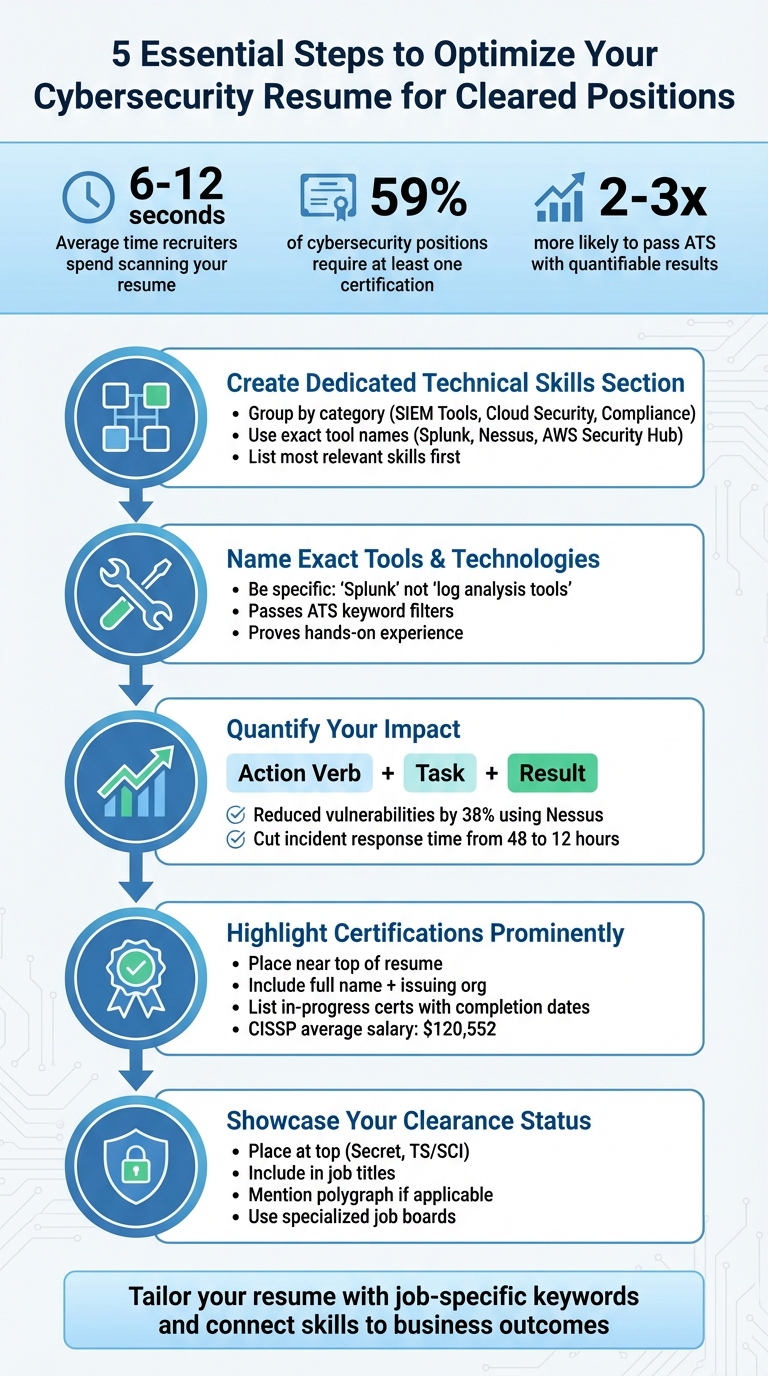
Your cybersecurity resume must immediately highlight your technical skills and clearance to stand out in a competitive job market. With recruiters spending just 6–12 seconds per resume and many companies using Applicant Tracking Systems (ATS), crafting a clear, results-driven resume is essential. Here’s how:

  • Prioritize Technical Skills: Create a dedicated "Technical Skills" section organized into categories like SIEM Tools, Cloud Security, and Compliance Frameworks. Use exact tool names (e.g., Splunk, Nessus) to pass ATS filters.
  • Show Results: Use metrics to demonstrate impact, such as "Reduced vulnerabilities by 38% using Nessus." Highlight achievements with action verbs and measurable outcomes.
  • Certifications Matter: List certifications (e.g., CISSP, Security+) prominently, including in-progress ones with completion dates. Tailor certifications to job requirements.
  • Leverage Clearance: Place your security clearance (e.g., TS/SCI) at the top of your resume and integrate it into job titles. Mention polygraphs if applicable.
5 Essential Steps to Optimize Your Cybersecurity Resume for Cleared Positions

5 Essential Steps to Optimize Your Cybersecurity Resume for Cleared Positions

The ULTIMATE RESUME GUIDE For CYBERSECURITY In 2026

How to Organize Your Technical Skills

Recruiters typically spend just 6 to 12 seconds scanning a resume during their initial review [7]. That’s barely enough time to skim, let alone read through lengthy paragraphs. If your technical skills are buried in dense text or scattered across your resume, they might get overlooked. To ensure your expertise stands out, dedicate a separate "Technical Skills" section. This should be distinct from soft skills and organized into clear, logical categories.

Group Skills by Category

Organizing your skills into categories transforms a jumbled list into a well-structured snapshot of your expertise. For example, instead of listing everything in one long line – like "Splunk, Python, NIST, AWS Security Hub, penetration testing" – break them down into groups such as Network Security, SIEM Tools, Scripting/Languages, Cloud Security, and Risk & Compliance. This format not only highlights your skills but also shows you understand how to present them effectively within the broader cybersecurity context.

For space efficiency and ATS compatibility, use a comma-separated format within each category. For example: "SIEM Tools: Splunk, IBM QRadar, LogRhythm." While tables can enhance clarity, avoid overly complex layouts or multi-column designs, as older ATS systems may struggle to process them.

Skill Category Example Tools & Technologies
Network Security Firewalls, VPNs, IDS/IPS, Wireshark, Cisco ASA, Fortinet
SIEM Platforms Splunk, IBM QRadar, LogRhythm
Vulnerability Management Nessus, Nmap, Qualys, OpenVAS
Cloud Security AWS Security Hub, Azure Security Center, Google Cloud Platform
Scripting & Languages Python, PowerShell, Bash, Java, C++
Compliance & Frameworks NIST, ISO 27001, GDPR, HIPAA, SOC2

Make sure to align these categories with the skills emphasized in the job description to capture the recruiter’s attention quickly.

List the Most Relevant Skills First

Start with the skills that directly match the job description. This ensures recruiters instantly see how you fit the role. For example, if the job posting highlights "experience with Splunk and threat hunting", make sure those terms are prominently featured at the top of your Technical Skills section.

Use exact keywords from the job listing to align with ATS filters, and keep descriptions concise – stick to one or two words rather than lengthy phrases. This focused strategy not only grabs attention but also sets the stage for showcasing your achievements with specific tools and technologies.

How to List Cybersecurity Tools and Technologies

List Common Industry Tools

When listing tools on your resume, be specific. Employers want to see the exact names of the tools you’ve worked with – not vague descriptions like "vulnerability scanners" or "security monitoring platforms." For example, mention Splunk for SIEM, Nessus for vulnerability scanning, Metasploit for penetration testing, or CrowdStrike for endpoint protection.

Why does specificity matter? Two key reasons:

  1. Applicant Tracking Systems (ATS): Many companies use ATS to scan resumes for keywords that match the job description. If the job posting mentions "Splunk" and your resume only says "log analysis tools", your application might not get past the automated screening.
  2. Hiring Managers and Recruiters: Specific tool names signal that you’re familiar with the platforms used in real-world cybersecurity operations. They don’t just show knowledge of concepts – they prove you’ve worked hands-on with the tools that matter.

"Naming any specific programming or scripting languages you’re familiar with, or data analytic programs you’ve worked with can impress an employer." – Zoë Morris, President, Frank Recruitment Group [2]

For roles requiring security clearance, focus on tools relevant to government and defense work. Highlight platforms that meet DoD 8570 compliance or support the Risk Management Framework (RMF). Additionally, with federal agencies increasingly adopting cloud solutions, expertise in AWS Security Hub, Azure Security Center, and container security tools like Docker and Kubernetes can set you apart [3][6]. Include scripting languages like Python for automation and tool development, and PowerShell for managing Windows environments and responding to incidents [3].

Don’t stop at listing tools – detail your results and accomplishments with them to make your resume stand out.

Explain How You Used Each Tool

Simply listing tools isn’t enough. To make an impact, show how you’ve used them to solve problems or achieve results. Instead of isolating tools in a skills section, integrate them into your work experience bullet points. This transforms a static list into a narrative that highlights your problem-solving abilities.

For instance, rather than just listing "Wireshark" under Network Security, craft a result-driven statement like: "Detected and mitigated 150+ intrusion attempts using Snort and Wireshark, reducing network breach incidents by 40% over six months." This format demonstrates not only your familiarity with the tool but also your ability to apply it effectively to protect an organization.

Use strong action verbs like "Architected," "Mitigated," "Detected," and "Optimized" to emphasize your initiative and ownership [6][8]. If you’re early in your career and lack professional experience, showcase tools you’ve used in personal projects or home labs. For example: "Built a virtualized network with pfSense and ELK stack for log analysis to simulate enterprise security monitoring." This highlights hands-on learning and self-motivation – qualities that resonate with employers [3].

How to Show Technical Skills Through Results

Use Numbers to Show Results

Numbers are a powerful way to turn responsibilities into measurable achievements. Considering that recruiters spend just six seconds scanning resumes, it’s no surprise that resumes with quantifiable results are 2–3 times more likely to make it past Applicant Tracking Systems [9]. In the field of cybersecurity, metrics are especially crucial.

"In cybersecurity, where threats are measured in dollars and downtime, numbers speak louder than buzzwords." – Resumly [9]

To effectively showcase your accomplishments, follow the "Action Verb + Task + Result" formula [10]. Instead of vague descriptions, use clear, data-driven examples like: "Reduced high-risk vulnerabilities by 38% within six months through weekly Nessus scans and automated patching."

Focus on areas that resonate with hiring managers, such as risk reduction, operational efficiency, team enablement, and technology adoption [9]. For instance, you could highlight efficiency improvements: "Cut incident response time from 48 hours to 12 hours by implementing automated threat detection with Splunk." Or, demonstrate reliability: "Maintained 99.9% uptime for secure networks supporting 5,000+ users" [1][9].

If exact numbers aren’t available, use conservative estimates and qualifiers like "approximately" or "over." Just be ready to explain your methodology during interviews [9]. For roles involving classified work, ensure your metrics remain high-level to avoid disclosing sensitive information. Focus on emphasizing your technical contributions and measurable results without breaching confidentiality [1].

By quantifying your achievements, you validate your technical expertise while showing how your work supports broader business objectives.

Connect Skills to Business Goals

Once you’ve presented measurable results, the next step is to tie your technical skills to the company’s strategic goals. While tools and methods highlight your technical abilities, linking those accomplishments to cost savings or compliance initiatives demonstrates your broader value to the organization.

Translate technical tasks into business outcomes. For example: "Reduced policy violations by 27% within three months, ensuring HIPAA compliance and avoiding potential $50,000 in regulatory fines" or "Saved $120,000 annually by automating patch management across 800 endpoints" [9].

For roles requiring security clearances, emphasize how your skills contributed to key objectives like meeting DoD 8570 compliance, improving Risk Management Framework (RMF) audit scores, or enabling mission-critical operations. Use specific metrics to show progress, such as: "Raised ISO 27001 compliance score from 78% to 95% through systematic control implementation" [9].

"Led 12 security workshops that boosted simulation pass rates from 62% to 91% and cut human-error risk by 47%." [9]

Whenever possible, include the timeframe and tools used in your descriptions to add credibility [9]. By connecting your technical achievements to business priorities, you underscore your ability to deliver value that goes beyond the technical realm.

sbb-itb-bf7aa6b

How to List Certifications and Compliance Knowledge

Certifications and compliance expertise are just as important as technical skills and measurable results when it comes to showcasing your readiness for cleared roles.

Certifications

Certifications serve as proof of your skills and can often secure you an interview. In fact, nearly 59% of all cybersecurity positions require at least one certification [5]. That makes this section a key element for cleared roles. Place your certifications prominently – ideally near the top of your resume – especially if they’re required for the role or strengthen your security clearance.

"I prefer when relevant certifications and clearances are near the top of the resume, such as TS/SCI, CISSP, Public Trust, Private Trust, etc. They should be current." – John Boyle, Senior Talent Director, CIBR Warriors [2]

Always include the full name of the certification and the issuing organization. For example, write "Certified Information Systems Security Professional (CISSP) – (ISC)²" instead of just "CISSP." If you’re in the process of earning a certification, list it as "In Progress" and include the expected completion date. This can be critical if the certification is a mandatory requirement for the job.

Tailor your certifications to match the job description. For instance, if the role emphasizes penetration testing, prioritize certifications like CEH or OSCP. For entry-level cleared roles, CompTIA Security+ is a must-have because it satisfies DoD 8570 requirements. Mid-level roles often value certifications like CEH and CISM, while advanced positions may require CISSP, which comes with an average annual salary of $120,552 [13].

Highlight Compliance Framework Experience

After listing your certifications, demonstrate your hands-on experience with compliance frameworks. This not only shows your technical expertise but also your understanding of risk management. Make a clear distinction between regulatory frameworks (e.g., GDPR, HIPAA, FISMA, CMMC) and information security frameworks (e.g., NIST CSF, ISO 27001, SOC 2). For cleared roles, focus on frameworks relevant to government work, such as NIST RMF and CMMC, which will be mandatory for all DoD contractors by 2026 [11].

Be specific about your contributions to each framework. For example, you could write, "Conducted gap analysis for NIST 800-171 compliance, developing 23 corrective action plans that increased compliance from 78% to 95%." If you’ve used GRC tools like Nessus, Qualys, or RSA Archer, include them to highlight your technical proficiency. Use terms like "NIST RMF – Expert" or "ISO 27001 – Advanced" to indicate your level of expertise.

Whenever possible, quantify your results. For instance, implementing privacy compliance procedures can reduce data breach incidents by up to 50% [12]. Highlight achievements such as "Achieved 100% PCI DSS compliance within 6 months" or "Reduced compliance-related fines by 40% over two years" to illustrate the real-world impact of your work.

How to Customize Your Resume for Cleared Cybersecurity Jobs

Cleared cybersecurity jobs require a tailored approach that differs from standard tech roles. Your resume needs to clearly demonstrate that you meet the unique demands of handling classified information and working within sensitive government systems.

Highlight Your Security Clearance

Your security clearance is one of your biggest assets in the cleared job market, so make sure it’s front and center. Place it prominently at the top of your resume, specifying the clearance level (e.g., Secret, Top Secret, TS/SCI). If you’ve undergone a polygraph (either CI or Full-Scope), mention that as well, along with the date of your most recent Periodic Reinvestigation.

"Having an active security clearance tells employers: You’ve passed extensive background checks, you understand secure systems and data protection, [and] you can be trusted with classified or sensitive projects." – LaunchCode [1]

To emphasize your clearance further, include it in job titles and project descriptions. For instance, instead of just listing your role as "Cybersecurity Analyst", you could write "Cybersecurity Analyst (TS/SCI)." This immediately signals that your clearance was integral to your job. However, be mindful of operational security – avoid sharing classified project details on public profiles or inappropriately disclosing sensitive information.

Once your clearance is clearly showcased, focus on platforms that cater to cleared professionals to ensure your resume lands in front of the right recruiters.

Leverage Specialized Job Boards

After emphasizing your clearance, use job boards specifically designed for cleared positions to connect with employers who value your credentials. Platforms like Cybersecjobs.com are excellent for targeting roles where both technical expertise and security clearances are essential. These sites are tailored to match candidates with hiring managers who understand the value of your qualifications.

To ensure your resume stands out, tailor it with keywords that align with cleared job descriptions and applicant tracking systems (ATS). Include terms like "TS/SCI developer", "security clearance", and "polygraph." Additionally, spell out acronyms at least once – such as "Top Secret/Sensitive Compartmented Information (TS/SCI)" – to ensure ATS software picks up on all relevant terms. Mirroring the language used in job descriptions can further highlight your clearance and technical skills.

"A well-crafted resume not only highlights your skills and experience but also sets you apart from other candidates vying for the same roles." – Cybersecjobs.com [4]

Conclusion

Your cybersecurity resume should highlight measurable achievements and showcase your qualifications effectively. Organize your information into clear sections, emphasize quantifiable results, and prominently display certifications to create a resume that stands out – especially for roles requiring security clearance.

Certifications play a crucial role in the cybersecurity field, with nearly 59% of positions requiring at least one professional credential [5]. Make sure to list your current certifications prominently and include any in-progress credentials, along with their expected completion dates.

For cleared positions, your security clearance is just as important as your technical skills. Place your clearance status – such as Secret, Top Secret, or TS/SCI – front and center. Don’t forget to mention polygraph details if applicable, and reiterate this information throughout your work history. Platforms like Cybersecjobs.com can help you connect with employers who value both your technical expertise and clearance credentials.

"A well-crafted resume not only highlights your skills and experience but also sets you apart from other candidates vying for the same roles." – CyberSecJobs [4]

Each section of your resume should reinforce your technical skills and clearance status. Tailor your resume with job-specific keywords and fully spelled-out acronyms to ensure it passes ATS filters. By linking your expertise to measurable outcomes, you can position yourself for success in this fast-growing field. Take the time to refine your resume and unlock opportunities that align with your career goals.

FAQs

What’s the best way to showcase technical skills on a cybersecurity resume?

To make your technical skills stand out on a cybersecurity resume, include a dedicated Skills or Core Competencies section near the top. Use this space to clearly list your most relevant technical abilities, certifications, and tools. This makes it easier for both recruiters and applicant tracking systems (ATS) to spot your qualifications quickly.

Another way to emphasize your skills is by incorporating them into your professional summary. This approach immediately showcases your expertise and aligns your resume with the job description. Be selective – focus on the qualifications that are most relevant to the role you’re targeting. Certifications like CISSP, CEH, or Security+ can add credibility and make your resume leave a stronger impression.

Why should I include specific tools and technologies on my cybersecurity resume?

Including specific tools and technologies on your cybersecurity resume is a smart way to showcase your hands-on experience and expertise with systems that matter in the field. It gives potential employers a clear sense of your capabilities and makes it easier for them to evaluate your qualifications.

For example, listing tools like firewalls, SIEM platforms, or vulnerability scanners signals your ability to tackle practical cybersecurity challenges. These details can give you an edge, particularly when applying for positions that demand cleared professionals who are ready to hit the ground running.

How can I effectively showcase my security clearance on a cybersecurity resume?

To make your security clearance stand out on your cybersecurity resume, place it prominently in your professional summary or near your contact information at the very top. This way, hiring managers can spot it immediately.

You should also weave your clearance level (e.g., Top Secret, TS/SCI) into relevant job titles or project descriptions, especially if those roles required such credentials. If applicable, mention polygraph details to further emphasize your qualifications. However, avoid disclosing any classified or sensitive information – just clearly state your clearance status to showcase your eligibility for sensitive positions.

For cleared professionals, platforms like Cybersecjobs.com can help connect you with employers actively seeking candidates with security clearances like yours.

Related Blog Posts

  • Contract Recompete Job Security – Your 90-Day Survival Action Plan
  • Python Cleared SOC Analyst Skills – The $20K Programming Premium
  • Cleared Resume OPSEC Guidelines – What NSA Says You Can and Can’t Say
  • Top Resume Tips for Cleared Cybersecurity Professionals

Related Guides

  • Cleared Professional LinkedIn Optimization – Building Your Cyber Brand Without OPSEC Violations
  • Cleared Job Application Timing – Why the First 48 Hours Win Positions
  • Cyber Security Job Search Checklist
  • TS/SCI Salary Premium: Real 2026 Numbers
  • Top 10 Cybersecurity Jobs for Cleared Pros

Top Resume Tips for Cleared Cybersecurity Professionals

CyberSecJobs Editorial · January 22, 2026 · Leave a Comment

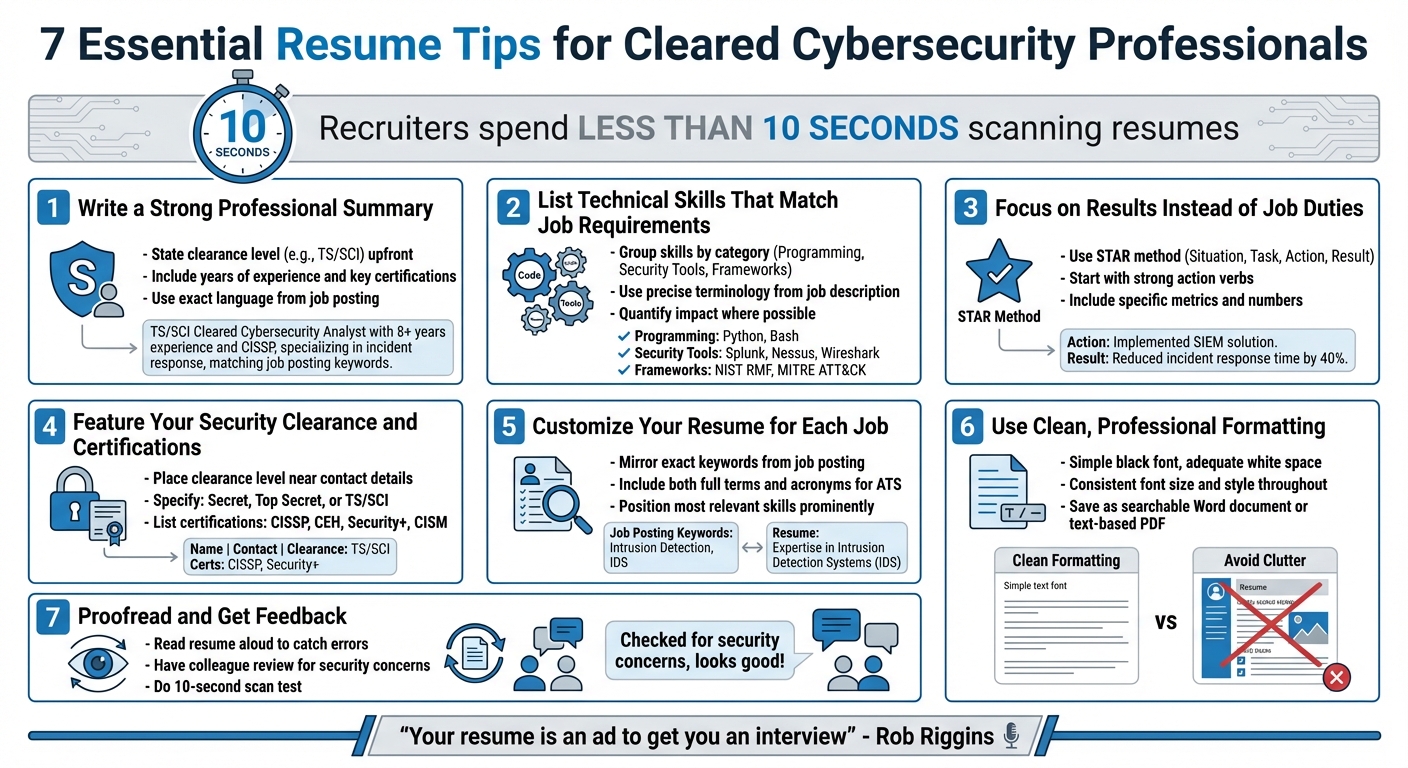
In the competitive world of cleared cybersecurity, your resume is your gateway to high-demand roles. With recruiters spending less than 10 seconds scanning resumes, it’s crucial to make your clearance, skills, and achievements stand out – while also navigating Applicant Tracking Systems (ATS). Here’s how to craft a resume that gets noticed:

  • Highlight your clearance upfront: Clearly state your active clearance level (e.g., "TS/SCI") near your contact details. If eligible for reinstatement, mention it.
  • Tailor your resume for each job: Use the exact keywords and terminology from the job description to pass ATS filters.
  • Focus on measurable achievements: Replace vague job duties with quantifiable results (e.g., "Reduced vulnerabilities by 35%").
  • List relevant technical skills: Include a dedicated skills section, grouping tools, frameworks, and certifications in categories.
  • Keep formatting clean and professional: Use simple fonts, adequate spacing, and ATS-friendly formats like Word or text-based PDFs.
  • Proofread carefully: Typos or grammatical errors can disqualify you. Have a trusted colleague review your resume for clarity and compliance with security guidelines.
7 Essential Resume Tips for Cleared Cybersecurity Professionals

7 Essential Resume Tips for Cleared Cybersecurity Professionals

From Entry-Level to Senior: Cybersecurity and GRC Resume Recommendations | Tips & Tricks

1. Write a Strong Professional Summary

Your professional summary is the first thing employers see on your resume, sitting right below your contact information. It’s your chance to make an immediate impression by clearly stating your clearance, years of experience, and key skills in just 2–3 lines.

Start with your clearance status (e.g., "Active Top Secret/SCI"), followed by your years of experience and technical expertise. For example:
"Active TS/SCI cleared Cybersecurity Analyst with 8+ years in network security, SIEM administration, and incident response. Hold CISSP and CompTIA Security+ certifications."

According to Martha Schneegans, a Senior Technical Recruiter at ManTech, using the exact language from the job posting is essential for getting past Applicant Tracking Systems (ATS) [4]. If the job description mentions "SIEM administration", make sure to use that exact phrase instead of a variation. Precision matters.

Steer clear of vague terms like "expert" or "highly skilled." Instead, back up your claims with specifics. For instance, writing "5+ years with Splunk" is far more effective than saying "extensive SIEM experience." As ClearedJobs.Net advises, your summary should highlight "crisp, clean, jargon-free critical experience and relevant attributes such as certifications" [3].

Finally, ensure the technical skills you mention directly align with the job requirements. Tailoring your summary this way sets a strong foundation for the rest of your resume.

2. List Technical Skills That Match Job Requirements

Including a dedicated technical skills section in your resume makes it easier for recruiters to quickly assess your qualifications and helps Applicant Tracking Systems (ATS) align your resume with the job requirements. To improve readability, group your skills into categories like "Programming Languages", "Security Tools", "Frameworks," and "Operating Systems."

Pay close attention to the exact terminology used in the job posting. For instance, if the listing specifies "vulnerability assessment", use that exact phrase instead of substituting synonyms. ATS systems are designed to look for precise matches, so this level of accuracy is essential to ensure your resume gets through the initial screening.

As of 2026, certain technical skills are particularly sought after in cleared cybersecurity roles. Expertise in AI and LLM security has become highly desirable, especially after AI-driven espionage campaigns were uncovered in September 2025. These incidents revealed that attackers could use AI to execute 80–90% of advanced hacking operations[6]. Additional key skills include proficiency in cloud infrastructure (especially AWS), familiarity with frameworks like RMF and MITRE ATT&CK, and programming languages such as Python and Java.

Where possible, quantify your impact to make your skills stand out. For example, instead of simply saying "SIEM administration", you could write: "Reduced system vulnerabilities by 35% through threat monitoring using LogRhythm." If you’re working toward a certification listed in the job requirements, include it along with the anticipated completion date to show your commitment to professional growth[1].

Be honest and list only the technical skills you can confidently discuss in a technical interview. Hiring managers are quick to identify gaps during screenings[4]. Additionally, spell out acronyms alongside their abbreviations to ensure ATS systems recognize them effectively[7].

3. Focus on Results Instead of Job Duties

Did you know hiring managers typically spend less than 10 seconds scanning a resume before deciding whether to keep reading? [4] That means you need to make every bullet point count by emphasizing measurable accomplishments instead of routine tasks. Think of your resume as a highlight reel of your capabilities, not a day-to-day job description.

To stand out, your achievements should clearly demonstrate tangible results. For example, instead of saying, "Conducted vulnerability assessments", aim for something like, "Identified and mitigated vulnerabilities, reducing system risk by 35%." This approach not only shows what you did but also the impact you made. A helpful way to craft these statements is by using the STAR method: Situation, Task, Action, Result. This structure keeps your points focused and results-driven.

Start each bullet point with a strong action verb like "Directed", "Increased", "Developed", or "Mitigated." Then back it up with specific metrics to highlight your contributions. For instance:

  • "Maintained secure infrastructure for 5,000+ users with 99.9% uptime"
  • "Oversaw the secure deployment of $50M in technical equipment"

While quantifying your work is essential, keep operational security in mind. Avoid disclosing sensitive details like classified project names, exact office sizes, or specific budget figures that could violate security protocols.

"Numbers and metrics help to paint a clear picture of your contributions and demonstrate your value to prospective employers."
– CyberSecJobs

4. Feature Your Security Clearance and Certifications

An active security clearance is a major advantage, saving employers both time and money by eliminating the need for clearance sponsorship [8]. To make an immediate impression, place your clearance level prominently near your contact details [4]. This approach complements the other resume strategies discussed earlier.

Be specific when listing your clearance. Clearly indicate whether it’s Secret, Top Secret, or TS/SCI, and always include the issuing agency, such as the Department of Defense (DoD), Department of Homeland Security (DHS), or National Security Agency (NSA). Employers often prefer candidates already vetted by a particular agency. If your clearance is inactive but within the 24-month eligibility window, label it as "Eligible for Reinstatement" instead of omitting it. This indicates it can be reactivated without requiring a full reinvestigation [8].

Certifications are equally important. Credentials like CISSP, CEH, Security+, and CISM showcase your expertise [1][2]. Create a dedicated "Certifications & Clearances" section on your resume to highlight these qualifications. If you’re working toward a certification, include it with an estimated completion date.

"Including an in-progress certification on your resume could make the difference in a recruiter contacting you or not if it’s a hard requirement of the job."
– CyberSecJobs [1]

sbb-itb-bf7aa6b

5. Customize Your Resume for Each Job

Tailoring your resume to match the requirements of each job is a must. By building on your professional summary and technical skills, you can craft a resume that aligns with what each employer is seeking. This is especially important for cleared cybersecurity roles, which often come with very specific expectations. Remember, recruiters typically spend less than 10 seconds scanning a resume at first glance, so the skills and keywords they’re looking for should stand out immediately [4].

Start by thoroughly reviewing the job description. Pay close attention to the exact language used and replicate those terms in your resume. For example, if the job posting specifies "network security", use that precise phrase [1]. Martha Schneegans, Senior Technical Recruiter at ManTech, underscores the importance of mirroring the job description’s terminology:

"If the job description has the words, tomato, ballerina, and cake decorator, make sure you include those on your resume." [4]

This strategy not only aligns your resume with what the employer wants but also improves its chances of passing through Applicant Tracking Systems (ATS). ATS software scans resumes for specific keywords before they ever reach a recruiter. To increase your odds, include both full terms and acronyms – like "Project Management Professional (PMP)" or "Database Architect (DBA)" – since recruiters may use different formats when searching [4]. Additionally, account for slight variations in phrasing, such as "System Engineer" versus "Systems Engineer" or "Software Development" versus "Software Engineering" [9].

When customizing your resume, position the most relevant technical skills prominently. For instance, if the role emphasizes SIEM solutions or specific firewalls, list those tools at the top of your Technical Skills section [1]. However, be truthful – never include skills you don’t actually have. Falsifying your qualifications can lead to immediate disqualification during the interview process [4].

Finally, save your resume in a format that ensures ATS readability, such as a Word document or a text-based PDF. A clean, well-formatted resume not only makes it easier for ATS to process but also showcases your attention to detail [4].

6. Use Clean, Professional Formatting

The way your resume is formatted can make or break its impact, especially when showcasing your clearance and technical expertise. Stick to a simple, black font – steer clear of decorative styles or colors, as these can interfere with ATS (Applicant Tracking System) scanning. Keep your font size legible and avoid the temptation to cram extra information by shrinking text.

Spacing matters too. Leave enough white space between bullet points and paragraphs to prevent your resume from appearing cluttered. As Rob Riggins puts it:

"If your resume is hard to read with dense paragraphs and tiny type, it will not be read. Your goal is a clean resume, with a simple font and adequate white space." [5]

Consistency is key to maintaining a polished look. Use the same font, size, and style throughout the document. Position essential headings like Summary, Skills, Experience, and Education on the left side to align with natural reading patterns. This structure makes it easier for recruiters to quickly find the information they’re looking for during their initial scan.

Don’t forget the basics: stick to standard margins and save your resume as a searchable Word document to ensure ATS compatibility. A well-organized, cleanly formatted resume not only reflects professionalism but also demonstrates the kind of attention to detail that’s crucial in cleared cybersecurity roles.

7. Proofread and Get Feedback

Even a single typo can hurt your chances of landing an interview. Ashley Jones, Editor at ClearedJobs.Net, emphasizes this point:

"A single typo or grammatical error can make you appear careless or unprofessional."

[10]

Recruiters often skim resumes quickly, so small mistakes can leave a lasting negative impression. That’s why carefully reviewing your resume is critical – not just for professionalism but also for maintaining operational security.

Start by reading your resume aloud. This simple step can help you catch errors that spell-checkers might miss [3]. Double-check essential details, like your contact information – surprisingly, candidates sometimes forget to include their phone number or email address [5]. Also, verify that your security clearance level is accurately and prominently displayed. Recruiters may use systems like JPAS to confirm this information [5].

It’s also a good idea to have a trusted colleague or mentor review your resume. They can spot errors you might have overlooked and flag potential operational security concerns. For instance, they might notice military or government acronyms that could confuse civilian recruiters [4]. They can also identify sensitive details, like classified project names or specific office information, that shouldn’t be included [3][2].

Make sure your technical skills are paired with relevant experience to give them proper context [5]. Finally, ask your reviewer to do a quick "scan test." Have them glance at your resume for 10 seconds and share what immediately stands out. If nothing grabs their attention or the layout feels cluttered, you’ll know where to make changes [4].

Conclusion

Creating a resume is about more than just listing your job history. It’s your first chance to make an impression, so make it count. Start by prominently showcasing your security clearance and emphasizing measurable achievements instead of just listing routine responsibilities. With recruiters spending less than 10 seconds scanning resumes [4], every word you choose has to work hard.

The best resumes feature clean, easy-to-read formatting, are tailored to each job application, and use the exact language found in job postings. Don’t forget to keep technical skills relevant to the role you’re targeting. As Rob Riggins wisely says:

"Your resume is not a biography… It’s an ad to get you an interview" [5].

Beyond crafting a strong resume, maintaining an active online profile is equally important. Some employers with cleared positions look directly at resume databases without ever posting jobs publicly [9]. By uploading your resume and regularly logging in to refresh your profile, you increase your chances of appearing at the top of recruiter searches [9].

Pairing a well-optimized resume with an active presence on platforms like Cleared Cyber Security Jobs (https://cybersecjobs.com) can significantly boost your visibility. This platform offers tools like job alerts, resume databases, and direct connections to employers seeking candidates with your clearance level and specialized skills.

Use these strategies to position yourself as a standout candidate in the competitive world of cleared cybersecurity.

FAQs

What are the best ways to make sure my resume gets through Applicant Tracking Systems (ATS)?

When crafting a resume designed to navigate Applicant Tracking Systems (ATS) effectively, simplicity is key. Opt for a clean, uncluttered format – steer clear of graphics, tables, or images, as these can confuse ATS software. Stick with a basic black font, make good use of white space, and maintain a straightforward layout to ensure it’s easy to read.

Save your resume as a Word document instead of a PDF, since some ATS struggle to process PDFs correctly. Be sure to weave relevant keywords from the job description naturally into your resume, particularly in the skills and experience sections. Lastly, focus on concise accomplishment statements that emphasize your achievements, rather than lengthy lists of responsibilities, to make your qualifications stand out.

What technical skills are most valuable for cybersecurity professionals with security clearance?

For professionals in cybersecurity with security clearance, certain technical skills are in high demand. These include security monitoring, threat detection, and vulnerability management. Familiarity with tools like SIEM (Security Information and Event Management) systems, crafting security alerts, and managing phishing incidents is especially valued. Additionally, having a strong grasp of network security and the ability to develop security awareness materials can help candidates stand out.

Certifications such as CompTIA Security+ and Certified Ethical Hacker (CEH) are often sought after to confirm a candidate’s technical abilities. Beyond technical expertise, employers look for individuals with strong problem-solving abilities, clear communication skills, and a keen attention to detail. These qualities are critical for tackling complex security issues and presenting findings in a way that’s easy to understand. Combining technical know-how with these soft skills is essential for thriving in cybersecurity roles that require clearance.

Why should I customize my resume for each cybersecurity job application?

Customizing your resume for each job application is crucial because it allows you to spotlight the skills, certifications, and experience that directly match the role you’re pursuing. This tailored approach not only grabs the hiring manager’s attention but also helps you navigate applicant tracking systems (ATS), which often screen candidates based on specific keywords.

For professionals in cleared cybersecurity roles, this strategy becomes even more critical. Emphasizing your security clearance and showcasing relevant technical skills can set you apart in a highly competitive field. A well-focused resume demonstrates to employers that you’ve taken the time to understand their needs and position yourself as the right candidate for the job.

Related Blog Posts

  • Contract Recompete Job Security – Your 90-Day Survival Action Plan
  • AI Security Clearance Jobs – Get Ahead of the Emerging Threat Landscape
  • Cleared Resume OPSEC Guidelines – What NSA Says You Can and Can’t Say
  • Cleared Job Application Timing – Why the First 48 Hours Win Positions

Related Guides

  • Stand Out in Your Cyber Security Job Search with T-Format Cover Letters
  • Elevate Your Cyber Security Job Search with a Winning Elevator Speech
  • Cleared Job Application Timing – Why the First 48 Hours Win Positions
  • TS/SCI Salary Premium: Real 2026 Numbers
  • Top 10 Cybersecurity Jobs for Cleared Pros

5 Outfit Tips for Cleared Professionals at Job Fairs

CyberSecJobs Editorial · January 22, 2026 · Leave a Comment

At cleared job fairs, your outfit can make or break your first impression. Recruiters often decide on candidates within seconds, and dressing professionally signals you’re prepared for the high standards of government and defense roles. Here’s a quick rundown of how to dress for success:

  • Business Professional Only: Full suits for men; pantsuits, skirt suits, or formal dresses for women.
  • Stick to Neutral Colors: Navy, gray, black, or beige – avoid bright or casual tones.
  • Clean and Pressed Clothes: Wrinkled or stained outfits suggest poor preparation.
  • Weather-Proof Professionalism: Layer smartly to stay polished, regardless of temperature.
  • Comfortable Shoes and Essentials: Closed-toe shoes and a structured bag for resumes and materials.

Your attire reflects your readiness, professionalism, and understanding of industry expectations. Dress one level more formal than you think is necessary, and you’ll stand out for the right reasons.

5 Essential Outfit Tips for Cleared Job Fair Success

5 Essential Outfit Tips for Cleared Job Fair Success

How to Dress for a Career Fair

1. Wear Business Professional Attire, Not Business Casual

A cleared cybersecurity job fair isn’t just a casual networking event – it’s a formal interview where every interaction counts. For men, this means a full suit with a tie. For women, a pantsuit, skirt suit, or formal dress is expected [3][5]. Leave the khakis and blazers at home; this is your chance to meet the high standards set by the defense and cybersecurity industries.

These fields share the conservative dress norms seen in finance, law, and politics [3]. Wearing a complete suit not only shows you understand these expectations but also signals that you’re detail-oriented and prepared to engage with high-level clients or officials [3].

"Dressing within these norms is a good way to show a potential employer that you understand ‘the game’ and are willing to be a team player." – Career Fair Plus [4]

In a survey of more than 40 recruiters, those dressed casually were almost always viewed as less educated, less qualified, and less professional compared to candidates in formal attire [1].

While the standard is clear, there are some exceptions. For instance, if you’re transitioning from the military, attending in uniform or cammies is perfectly acceptable at cleared job fairs [2]. For everyone else, sticking to strict business professional attire is non-negotiable. A good rule of thumb? Dress one level more formal than you think is necessary [3][5]. It’s always better to be slightly overdressed than to risk looking too casual.

2. Stick to Conservative Colors and Simple Accessories

The way you dress speaks volumes, and the colors and accessories you choose can subtly reinforce your professionalism. When it comes to suits, stick to classic shades like navy, charcoal gray, or black. Medium gray, light blue, and dark brown are also solid options that maintain a professional tone.

For shirts, neutral tones are your best bet. Think white, ivory, natural beige, or light blue – these shades keep the focus on you, not your outfit. Save tan, khaki, and beige for more casual settings, and steer clear of bright colors unless you’re targeting a creative role where boldness is part of the culture.

"Neutral colors like blue, black, gray, or tan look more professional than bright colors like pink, red, and yellow." – Career Fair Plus

Accessories should be understated and purposeful. A simple watch, modest earrings, or a discreet pendant can complete your look without drawing unnecessary attention. For men, matching your leather belt to your shoes is a small detail that makes a big difference. Avoid anything overly flashy, like ornate buckles or visible logos.

3. Keep Your Clothes Clean and Well-Pressed

First impressions matter, and recruiters often form theirs within 15–30 seconds of meeting you[1]. Wrinkled or stained clothing can instantly work against you, no matter how qualified you are. On the flip side, neatly pressed and clean attire signals qualities like preparation, professionalism, and reliability. Unkempt clothing, however, can send the wrong message, making you appear disorganized or unready.

"The prospect dressed in extremely casual clothing struck [recruiters] as being unprepared, irresponsible, less capable, educated and qualified, and possessing poor work habits." – Military.com[1]

To avoid this, plan your outfit well in advance. Make sure it fits perfectly and is free from stains, tears, or even minor details like collar rings or pet hair. These small imperfections can detract from your overall presentation. Employers notice everything – from the shine of your shoes to the way your clothes sit on you. For important events, consider using professional dry cleaning or pressing services to ensure your outfit is flawless.

Your grooming should complement your attire. Keep your hairstyle neat and facial hair, if any, well-trimmed. Be mindful of scents – strong colognes or perfumes can be overwhelming in close quarters. The goal is simple: let your skills and qualifications take center stage, not your fragrance or appearance.

sbb-itb-bf7aa6b

4. Dress for the Job You Want, Not the Weather

Job fairs aren’t just casual meet-and-greets – they’re formal interviews in disguise. This means your outfit should reflect the level of professionalism expected in the cybersecurity field, no matter what the weather outside is doing. Choosing comfort over a polished appearance could send the wrong message about your readiness for the role.

"A job fair is an interview, so look the part. Dress like the professional you are, or seek to be." – ClearedJobs[2]

To navigate fluctuating temperatures while maintaining a professional look, layering is your best friend. Job fair venues can swing from warm conference halls to freezing meeting rooms[5], so a lightweight blazer or cardigan over a polished shirt is a practical yet refined choice. Stick to breathable fabrics like cotton or linen for comfort, and save heavier materials like wool for your formal suit[3]. This way, you can adjust to the environment without compromising your presentation.

Dressing in business professional attire – regardless of the season – signals that you understand the expectations of the industry and are ready to step into the role with confidence and professionalism.

5. Wear Comfortable Shoes and Bring a Way to Carry Materials

After perfecting your outfit, don’t overlook the importance of practical accessories – they can leave just as strong an impression.

Job fairs often mean hours of standing and walking, so your footwear needs to combine style with comfort. For men, polished leather Oxfords or loafers in classic black or brown work well. Women should stick to closed-toe options like flats, low heels, or pumps – steer clear of sandals or open-toe shoes, as they can come across as too casual.

If you’re worried about being on your feet for long periods, consider shoes designed for extended comfort. Look for pairs with features like shock absorption and good arch support. This way, you’ll stay comfortable without sacrificing a polished appearance.

Beyond footwear, make sure to bring the essentials to keep you prepared and professional. Pack 20–40 high-quality copies of your resume, a small portfolio or structured bag, and a notebook with a pen for jotting down important details during conversations [6]. Having your own business cards ready to hand out is another great way to stand out and make follow-ups more personal.

Lastly, don’t forget the small details that tie everything together. Match your shoe color with your belt and trousers – for instance, black shoes with black slacks and a black belt. If you’re wearing flats, ensure your pants are tailored to avoid dragging on the floor. These subtle touches can elevate your overall look and leave a lasting impression.

Conclusion

What you wear to a cleared job fair says more than you might think – it’s not just about style but also about showcasing your qualifications. Dressing professionally eliminates distractions and signals that you understand the conservative expectations of the cleared and government contracting sectors. As the University of Cincinnati puts it, "Your outfit opens the door, but your confidence keeps it open." [5]

Here’s something to consider: at specialized polygraph job fairs, about 1 in 3 attendees walk away with an offer. Compare that to general clearance fairs, where the figure is closer to 1 in 10 [2]. Your attire plays a role in these odds, reflecting your work ethic and your readiness to represent an organization in the cleared community. In these environments, traditional business professional attire signals that you’re prepared to handle the responsibilities of sensitive government work [3].

By applying these five outfit tips, you move beyond just making a good first impression – you create a lasting one. With the right presentation, you’re setting yourself up to make meaningful connections and demonstrate your professional readiness.

Looking to put these insights to work? Head over to Cleared Cyber Security Jobs to explore upcoming job fairs and access tailored career resources for cleared cybersecurity professionals. The platform offers tools to refine your job search, expert advice, and direct connections to employers in the cleared sector – all aimed at helping you secure your next opportunity.

Dress with purpose, exude confidence, and make every conversation count.

FAQs

What’s the difference between business professional and business casual attire for job fairs?

The key distinction between business professional and business casual attire comes down to formality. Business professional outfits are more polished and formal, typically featuring suits, ties, dress shirts, and tailored pieces. This style is best suited for occasions like job fairs, interviews, or situations where making a strong, professional impression is essential.

In contrast, business casual strikes a balance between professional and relaxed. Think dress pants or skirts, blouses, button-down shirts, and sometimes sweaters. However, steer clear of overly casual items like jeans, sneakers, or T-shirts. If you’re unsure, it’s always safer to opt for business professional attire at job fairs – it demonstrates respect and a serious attitude toward the opportunity.

Why should I wear neutral colors and minimal accessories to a cleared job fair?

When attending a cleared job fair, sticking to neutral colors and keeping accessories minimal can help you project a professional and polished appearance. This ensures that the focus remains on what truly matters – your skills, qualifications, and how you carry yourself.

A clean, straightforward outfit not only exudes confidence but also reflects your attention to detail – traits that are highly regarded in the cybersecurity industry. Choosing neutral tones and subtle accessories aligns with the professional expectations of cleared roles, helping you leave a strong and memorable impression.

What should I wear to look professional and stay comfortable at a job fair?

When preparing for a job fair, aim for business casual attire that strikes a balance between professionalism and comfort. Make sure your outfit is clean, well-fitted, and appropriate for the occasion. Since you’ll likely spend a lot of time walking and standing, choose breathable fabrics and comfortable shoes. Dressing just a bit more formally than the typical company dress code can help you leave a polished and professional impression.

Opt for wrinkle-free clothing that suits the season and allows for easy movement. Avoid anything too tight, overly loose, or excessively flashy. If you’re unsure, go with an outfit that radiates confidence and professionalism while keeping you comfortable throughout the event.

Related Blog Posts

  • Contract Recompete Job Security – Your 90-Day Survival Action Plan
  • Cleared Job Red Flags – Warning Signs in Contract Job Postings
  • Cleared Resume OPSEC Guidelines – What NSA Says You Can and Can’t Say
  • Cleared Job Application Timing – Why the First 48 Hours Win Positions

Related Guides

  • Stand Out in Your Cyber Security Job Search with T-Format Cover Letters
  • Cleared Job Application Timing – Why the First 48 Hours Win Positions
  • Cleared Cybersecurity Recruiters – Working the Inside Game for Better Offers
  • TS/SCI Salary Premium: Real 2026 Numbers
  • Top 10 Cybersecurity Jobs for Cleared Pros
  • « Go to Previous Page
  • Go to page 1
  • Interim pages omitted …
  • Go to page 49
  • Go to page 50
  • Go to page 51
  • Go to page 52
  • Go to page 53
  • Interim pages omitted …
  • Go to page 68
  • Go to Next Page »
  • Facebook
  • Instagram
  • LinkedIn
  • Twitter
  • YouTube

Cleared Cyber Security Jobs | CyberSecJobs.com

  • Contact
  • About
  • Privacy Policy