

If you’re a security-cleared SIEM analyst, earning Splunk certifications can boost your career and salary. Certified professionals earn 40% more than their non-certified peers, and 71% report job satisfaction. Splunk is widely used in government and defense sectors for managing security events, threat hunting, and compliance. Certifications like Splunk Core Certified User and Splunk Enterprise Security Certified Admin validate your skills and open doors to roles like SOC Administrator or Security Architect. Exams cost $130 and must be renewed every three years. With 700,000 unfilled cybersecurity jobs in the U.S., demand for Splunk-certified talent is growing, making it a smart career move.
Key certifications include:
- Splunk Core Certified User: Entry-level, no prerequisites.
- Splunk Enterprise Security Certified Admin: For SIEM platform management.
- Splunk Certified Cybersecurity Defense Analyst/Engineer: Focused on threat detection and automation.
Splunk-certified professionals can earn up to $156,000 annually, with certifications directly improving skills in log analysis, threat detection, and incident response. Preparation involves hands-on practice with Splunk tools, official study guides, and training programs. Pairing these certifications with DoD-compliant credentials like CompTIA Security+ can further enhance career prospects.
To succeed, focus on aligning certifications with your career goals, stay updated with Splunk advancements, and leverage job platforms like Cleared Cyber Security Jobs to connect with employers seeking cleared professionals.
How To Pass The Splunk Core Certified User Exam | Everything You Need To Study and Pass

Key Splunk Certifications for Cleared SIEM Analysts
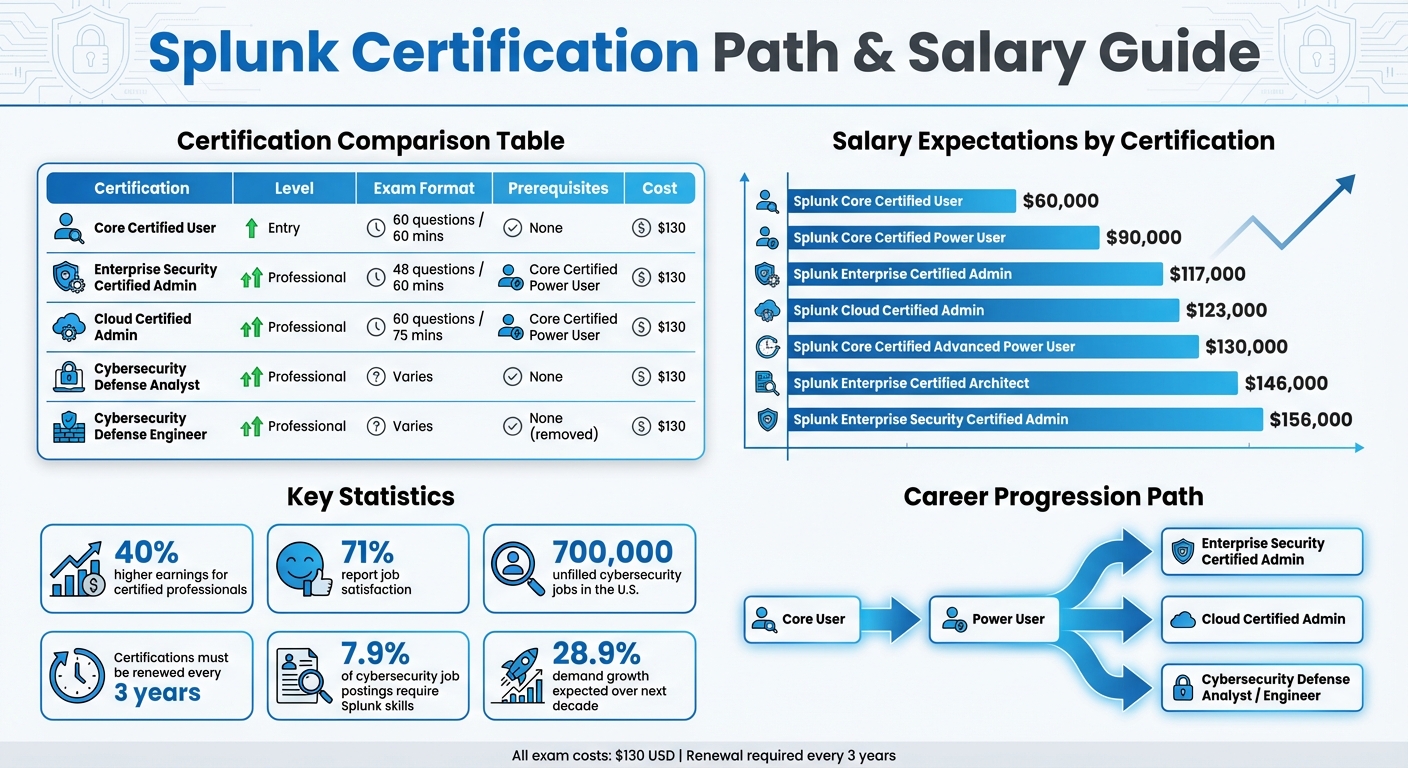
Splunk Certification Levels: Requirements, Costs, and Salary Expectations
Choosing the right certification depends on your experience and career goals. Splunk offers a variety of certifications tailored to security professionals working in cleared environments, each focusing on different aspects of SIEM operations. Below is an overview of these certifications and their relevance to cleared roles.
Splunk Core Certified User
The Splunk Core Certified User is the starting point for anyone new to the platform. This certification demonstrates your ability to carry out essential tasks like performing basic searches, using fields, creating alerts, and building simple dashboards – key skills for daily SOC (Security Operations Center) activities[6]. The 60-minute exam includes 60 questions and tests your proficiency in using SPL (Search Processing Language) to manage incident triage and monitoring tasks within cleared environments[6]. No prior certifications are required[6].
Splunk Enterprise Security Certified Admin
If you’re responsible for managing SIEM platforms, the Splunk Enterprise Security Certified Admin certification is a solid choice. It focuses on tasks like installing, configuring, and maintaining the Splunk ES application, as well as data normalization and risk analysis to reduce false positives[1][10]. The exam consists of 48 multiple-choice questions[10]. While this certification has been reclassified as Legacy, it remains highly relevant for on-premises Splunk deployments in government and defense settings. Note: The Splunk Core Certified Power User certification is a prerequisite[7].
For those seeking more specialized expertise, there are additional certifications worth exploring.
Other Splunk Certifications to Consider
Splunk also offers advanced certifications that cater to specific roles, such as threat hunting, automation, and cloud management, all of which are critical for cleared SIEM operations.
- Splunk Certified Cybersecurity Defense Analyst: Designed for SOC analysts, this certification covers threat hunting, risk-based alerting, and continuous monitoring best practices. These skills are directly applicable to the demands of cleared environments[1].
- Splunk Certified Cybersecurity Defense Engineer: Aimed at security engineers, this certification focuses on detection tuning and automation using SOAR (Security Orchestration, Automation, and Response). With no prerequisites required anymore, it’s now more accessible for professionals looking to enhance incident response capabilities in cleared settings[9].
- Splunk Cloud Certified Admin: Ideal for cleared environments shifting to cloud infrastructure, this certification addresses cloud-specific data management and monitoring. The exam includes 60 questions to be completed in 75 minutes and requires the Splunk Core Certified Power User as a prerequisite[8]. These skills are crucial for managing cloud-based SIEM operations.
| Certification | Level | Exam Format | Prerequisites | Cost |
|---|---|---|---|---|
| Core Certified User | Entry | 60 questions / 60 mins | None | $130 |
| Enterprise Security Certified Admin | Professional | 48 questions / 60 mins | Core Certified Power User | $130 |
| Cloud Certified Admin | Professional | 60 questions / 75 mins | Core Certified Power User | $130 |
| Cybersecurity Defense Analyst | Professional | Varies | None | $130 |
| Cybersecurity Defense Engineer | Professional | Varies | None (removed) | $130 |
Career Benefits of Splunk Certifications for Cleared Professionals
Demand for Splunk-Certified Professionals in Cleared Environments
The government and defense sectors are grappling with a severe shortage of cybersecurity professionals. With 700,000 unfilled cybersecurity positions across the U.S. and 76% of IT employers struggling to find the specialized talent they need[17], Splunk certifications offer a strong edge. Around 7.9% of all cybersecurity engineer and analyst job postings specifically list Splunk skills as a requirement[11], and this demand is expected to grow by 28.9% over the next decade[11].
These certifications bridge the gap between general cybersecurity expertise and the specialized knowledge required by government contractors[15]. Since agencies rely on Splunk for real-time threat detection and operational intelligence, certified analysts play a crucial role in SOC operations and incident response. Additionally, as security operations merge with IT observability, the relevance of these credentials now extends beyond traditional SIEM roles[12]. This growing demand translates into better career opportunities, higher earning potential, and enhanced job performance.
Salary Expectations for Certified SIEM Analysts
Splunk certifications can lead to noticeable salary increases. Professionals with multiple Splunk certifications are 4.9 times more likely to see a salary boost within a year compared to those without certifications[16]. On average, Splunk users have reported a 14% increase in compensation, with younger professionals earning up to 52% more than their non-certified peers[14].
| Certification Level | Average US Salary |
|---|---|
| Splunk Core Certified User | $60,000 |
| Splunk Core Certified Power User | $90,000 |
| Splunk Enterprise Certified Admin | $117,000 |
| Splunk Cloud Certified Admin | $123,000 |
| Splunk Core Certified Advanced Power User | $130,000 |
| Splunk Enterprise Certified Architect | $146,000 |
| Splunk Enterprise Security Certified Admin | $156,000 |
The median salary for professionals with Splunk expertise is $103,000, increasing to $114,000 for those with three to five years of experience[11]. For comparison, the average salary for an Information Security Analyst in 2026 is estimated at $124,910[17], while Splunk Enterprise Security Certified Admins earn a premium at $156,000[15]. Notably, 87% of technology leaders report offering higher salaries to candidates with specialized technical skills[17], making certifications a smart career investment.
How Certifications Improve Skills and Job Performance
Splunk certifications help professionals develop critical technical skills tailored for cleared environments. For example, mastering Splunk Processing Language (SPL) allows analysts to refine searches and extract actionable insights from vast amounts of log data – an essential skill in large-scale government operations[12]. Certifications like the Splunk Certified Cybersecurity Defense Analyst focus on areas such as threat hunting, detection engineering, and risk-based alerting, all of which are integral to SOC workflows[12][13].
Certified individuals excel at correlating logs, metrics, and event data across hybrid and cloud environments, enabling quicker handling of alerts, threat analysis, and forensic investigations. This efficiency boosts career stability: promotions for Splunk-certified professionals doubled in 2024 compared to the previous year[14], and many report increased job security.
"When you put in the effort to master your craft – and can show proof of that mastery – the market rewards you." – Eric Fusilero, VP of Global Education, Splunk[14]
The hands-on skills acquired during certification – like managing logs at scale, automating incident responses, and generating compliance reports – directly enhance performance in cleared SIEM roles. These abilities not only improve incident response workflows but also make SOC operations more efficient. This blend of technical expertise and practical application positions Splunk-certified professionals as standout candidates in the competitive cleared cybersecurity field[15].
sbb-itb-bf7aa6b
How to Prepare for Splunk Certifications
Study Resources and Training Options
Splunk offers a variety of learning paths tailored to different certification levels. For example, the Power User Fast Start eLearning program focuses on advanced SPL commands and working with knowledge objects, while the Administering Splunk Enterprise Security course delivers 13.5 hours of training on ES installation, configuration, and management. For those pursuing architectural roles, the Architecting Splunk Enterprise Deployments course covers essential design principles in just 9 hours of training[18].
If you’re just starting, check out Splunk’s free Search Tutorial, which includes sample data and teaches you the basics of SPL[19]. Other must-have resources include the Splunk Certification Candidate Handbook, Splunk Certification Exams Study Guide, and the Test Blueprint for your chosen certification. The Test Blueprint is especially useful – it breaks down the exam topics and their weightings, helping you focus on the most critical areas[1][5][21].
For additional support, explore community tools like Splunk Lantern, the official documentation site, and the Boss of the SOC (BOTS) program. These resources provide hands-on scenarios and technical insights that mimic real-world challenges[1][5]. Since exam attempts cost $130 USD each[5], investing time in preparation is key to avoiding unnecessary retakes.
Once you’ve gathered these materials, shift your attention to mastering test-taking strategies and building real-world experience.
Exam Preparation Tips for Cleared Professionals
Splunk certification exams are fast-paced and require proficiency with SPL commands, so you’ll need to rely on muscle memory rather than reference materials. Use the official Test Blueprint as a checklist to ensure you’ve practiced every required task – such as creating field aliases or building workflow actions – manually and thoroughly[20][21].
"The goal of having Splunk certifications is to prove your ability to use the product, not your ability to memorize test questions." – Kinney Group[20]
Avoid the temptation of using exam dumps. Not only do they violate Splunk’s certification policies, but they can also lead to a permanent ban from future certifications[20]. Instead, focus on fully understanding key concepts. For example, practice refactoring slow searches that use the transaction command into more efficient alternatives like stats or tstats – a skill often tested on exams[21].
Plan your study schedule over 2–4 weeks, integrating exam prep with your daily job tasks. Activities like building health dashboards or optimizing resource-heavy queries can reinforce your learning while improving your on-the-job skills[21].
Hands-on practice is a crucial part of this process – let’s explore how to make the most of it.
Using Hands-On Experience with Splunk
Practical experience is essential for certification success. Start by downloading a free Splunk Enterprise trial, which you can convert to a perpetual free license for use in a personal lab environment[19][21]. To practice SPL in a safe setting, load the Buttercup Games dataset from Splunk’s official search tutorial. This lets you work with realistic data without touching production systems[21].
Set up a Splunk Sandbox on your local workstation, VirtualBox, or Docker to experiment freely[19]. Here are some tips for effective lab work:
- Use the
headcommand to limit search results and avoid overloading your system resources[19]. - Clone dashboards or saved searches so you can edit them without risk[19].
- Practice creating and managing knowledge objects like field aliases, macros, tags, and event types[21].
- Learn to normalize data using the Common Information Model (CIM) and accelerate data models for better performance[21].
Take on small projects that align with exam topics. For instance, you could build a health dashboard that uses base search macros, timechart panels, and severity buckets. These activities not only help you prepare for the exam but also enhance your job performance – especially in high-security environments where efficient log analysis and incident response are critical to success.
Next Steps for Certification Success in Cleared Careers
With a strong foundation and practical experience, it’s time to chart the course for your next career moves.
Aligning Certifications with Career Goals
To align your certifications with your career ambitions, start by focusing on your 3–5 year professional goals. If you’re aiming for SOC or security analytics roles, begin with the Splunk Core Certified Power User to sharpen advanced search skills. Afterward, pursue the Splunk Enterprise Security Certified Admin to gain specialized knowledge in SIEM operations[22][23]. For system administration or DevOps paths, the Splunk Enterprise Certified Admin confirms your proficiency in installation, configuration, and data ingestion[23]. If leadership or architectural roles are your target, the Splunk Certified Architect demonstrates expertise in managing distributed deployments and ensuring high availability[23].
A suggested path for progression includes starting with Core User, moving to Power User, and then advancing into specialized certifications. In cleared environments, where practical skills are often prioritized over theory, these certifications validate hands-on expertise[22]. Keep an eye on certification expiration dates, as Splunk credentials must be renewed every three years[1]. Plan your certification timeline carefully.
For professionals in cleared roles, pairing Splunk certifications with DoD 8570/8140-compliant credentials, such as CompTIA Security+ (cost: $392), can help meet government requirements[2]. Additionally, specialized certifications like the Splunk Certified Cybersecurity Defense Analyst or Engineer are excellent for those focused on threat detection and mitigation using Splunk Enterprise Security and SOAR[1].
Using Cleared Cyber Security Jobs for Career Growth
Once you’ve mapped out your career path, leverage Cleared Cyber Security Jobs to connect your Splunk certifications with employers actively seeking security-cleared talent. This platform specializes in matching cybersecurity professionals with roles that align with their certifications and clearance levels. You can filter job searches by certification, clearance status, and preferred roles. Be sure to highlight your Splunk credentials on your profile and set up job alerts to stay connected with opportunities[4].
The platform also hosts job fairs, offering a chance to meet employers face-to-face and discuss how your certifications meet their SIEM and cybersecurity needs. As a veteran-founded platform, it’s tailored specifically for cleared professionals, making it easier to connect with employers who recognize the value of both your technical skills and your security clearance.
Tips for Long-Term Success
To stay competitive, it’s essential to keep up with Splunk’s advancements. Build on your certification prep by engaging in continuous learning and networking within the Splunk community. Join the Splunk Community and local user groups to exchange ideas and discover new opportunities in cleared environments[4][3]. Attending annual events like .conf can help you stay ahead by learning about updates and connecting with other professionals[4].
Make use of Splunk Lantern, a self-service tool offering guides and best practices to help you adapt as the platform evolves[1]. If you’ve gained substantial experience, consider becoming a Splunk Exam Subject Matter Expert (SME). This role allows you to stay at the forefront of product developments while contributing to the certification program[1].
As Splunk integrates more SOAR, Observability, and AI-driven workflows, keeping your skills current is critical[4]. With the global cybersecurity market expected to reach $345.4 billion by 2026[24], professionals who combine Splunk expertise with active security clearances will be in high demand. Regularly update your professional profiles to showcase new certifications and skills, making it easier for cleared employers to find you when urgent positions arise.
FAQs
Which Splunk certification should I get first for a cleared SIEM role?
The Splunk Core Certified User certification is an excellent first step for anyone aiming to start in a cleared SIEM role. This certification focuses on foundational skills like searching, navigation, and creating dashboards – key areas that every entry-level analyst needs to master. It equips you with the basic knowledge required to work efficiently with Splunk in a cybersecurity setting.
How do I choose between Splunk Enterprise Security and Splunk Cloud certifications?
When deciding between Splunk Enterprise Security (ES) certification and Splunk Cloud certification, the choice largely depends on your organization’s infrastructure and your career objectives. If your company operates with on-premises systems, the Splunk ES certification is a better fit. On the other hand, if your focus is on cloud-based environments, the Splunk Cloud certification aligns with that expertise. Evaluate your current setup – whether it’s on-premises or cloud – and choose the certification that supports both your organization’s direction and your personal career growth.
What’s the fastest way to get hands-on Splunk practice for the exams?
To get practical experience with Splunk quickly, start by diving into official study guides and working with actual datasets. Take advantage of Splunk’s free trial or sandbox environments to practice crafting search queries, utilizing SPL (Search Processing Language), building dashboards, and working with knowledge objects. Boost your learning by sticking to a structured study plan, tackling mini-projects, and reviewing exam blueprints to zero in on the key skills needed for certification success.