

Cleared security auditors play a key role in protecting classified government systems. They operate in secure environments like AWS GovCloud and Azure Government, ensuring compliance with federal standards. These roles require U.S. government security clearance, a bachelor’s degree in fields like cybersecurity or computer science, and certifications such as CISA, CISSP, or CISM.
Key highlights:
- Clearance Processing Times: Secret clearance takes 60–150 days; Top Secret can take 120–365+ days.
- Education: A bachelor’s degree is a baseline requirement; advanced degrees can accelerate career growth.
- Certifications: CISA is essential for auditing roles; CISSP and CISM are valuable for senior positions.
- Experience: Entry-level roles like Helpdesk Administrator or Cybersecurity Analyst build the foundation for auditing.
- Demand: Security analyst jobs are growing by 35% (2021–2031), with salaries ranging from $110,000 to $172,500 for cleared professionals.
Cleared security auditors are in high demand, especially with the rollout of CMMC 2.0 requirements. Combining education, certifications, and experience with an active clearance ensures strong career prospects in this field.
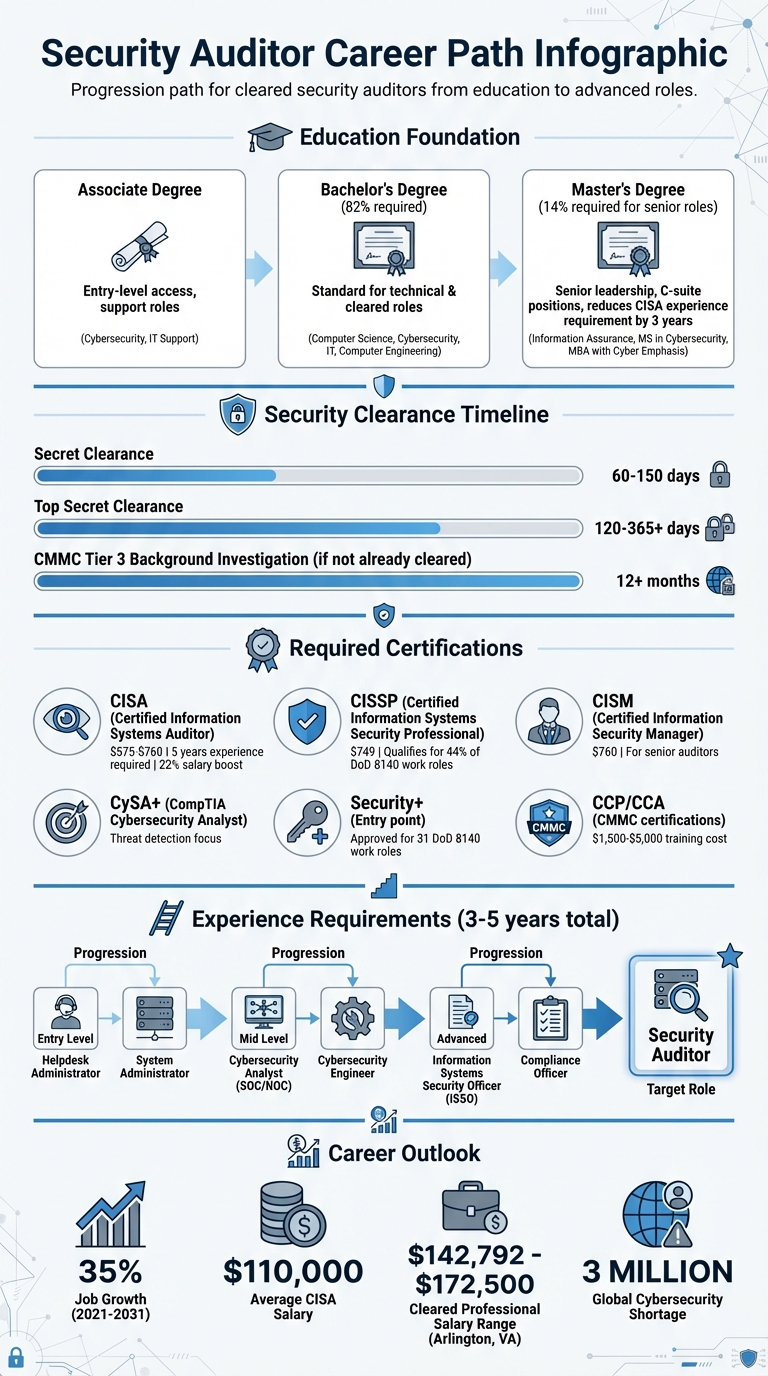
Security Auditor Career Path Requirements and Salary Guide for Cleared Professionals
Information Security Auditor – Information Security Auditor Salary and Skills You Need
Education and Background Requirements
To land most cleared security auditor positions, you’ll need at least a bachelor’s degree. This four-year degree is also essential for advancing into technical or mid-level roles. Common fields of study include Computer Science, Cybersecurity, Information Technology, Information Assurance, and Computer Engineering [1][2].
Tailor your coursework to meet the needs of cleared employers. Focus on areas like penetration testing, cryptography, database security, incident response, and network defense tools. Additionally, courses in governance and compliance – such as policy development, risk management, and information assurance – are critical for auditing roles [2][4].
"As an auditor, I quickly learned that you don’t have to know everything about one thing; you have to know a little about everything." – Swathi West, Healthcare Compliance Manager at BARR Advisory [1]
Degrees and Coursework
The demand for information security analysts is booming, with job growth projected at 35% from 2021 to 2031, far exceeding the national average for all occupations [1][3]. This makes your choice of degree more crucial than ever. For cleared auditing roles, 82% of employers require at least a bachelor’s degree [7].
If you’re still in school, consider pursuing cleared internships to gain real-world experience. Programs like the National Security Agency (NSA)’s 12-week paid summer internships provide hands-on exposure to active cyber operations, giving you a competitive edge when applying for cleared positions after graduation [1]. Additionally, align your electives with the NICE Workforce Framework standards, as many government-aligned programs use these guidelines to shape their curricula [4].
For those with leadership aspirations, advancing your education can open new doors.
Advanced Degrees and Career Impact
Building on your undergraduate education, pursuing a Master’s degree in Cybersecurity, Information Assurance, or an MBA with a cybersecurity focus can significantly accelerate your career. In fact, 14% of employers now require a master’s degree for senior roles [7]. While only 2% of IT auditors currently hold a master’s degree, it can set you apart in the competitive cybersecurity field [5].
An advanced degree offers tangible advantages. For example, it can substitute for up to three years of the five-year professional experience requirement for the Certified Information Systems Auditor (CISA) credential [1]. This is a game-changer, as CISA holders report a 22% salary boost and a 70% improvement in job performance [1]. If your ultimate goal is to step into a C-suite role like Chief Information Security Officer (CISO), an advanced degree is often a key requirement.
| Degree Level | Typical Career Impact | Relevant Majors |
|---|---|---|
| Associate Degree | Entry-level access; support roles | Cybersecurity, IT Support |
| Bachelor’s Degree | Standard for technical & cleared roles | Computer Science, Cybersecurity, IT, Computer Engineering |
| Master’s Degree | Senior leadership; C-suite; reduced experience for CISA | Information Assurance, MS in Cybersecurity, MBA (Cyber Emphasis) |
Getting Started: Entry-Level and Mid-Level Positions
Common Starting Roles
Breaking into security auditing often starts with hands-on technical experience. These early roles not only help you build essential skills but also position you to use your clearance effectively as you move toward specialized audit positions.
Starting as a Helpdesk Administrator is a great way to master IT troubleshooting and understand common system failures. This knowledge becomes critical when identifying vulnerabilities during audits. Moving into System Administrator roles helps you learn how systems are designed and secured, covering areas like operating systems, network setups, and infrastructure – key elements you’ll later evaluate for compliance. If you’re looking for direct experience in threat detection and monitoring, consider a Cybersecurity Analyst position in a Security Operations Center (SOC) or Network Operations Center (NOC). These roles often involve anomaly monitoring and, in some cases, compliance analysis to ensure systems are ready for audits.
For those with more experience, Cybersecurity Engineer and Information Systems Security Officer (ISSO) positions combine technical expertise with compliance responsibilities. ISSOs, in particular, focus on ensuring systems meet required laws and regulations, making this role a natural stepping stone to auditing. If you’re aiming for roles in the defense industrial base, working as a Compliance Officer or Consultant at a Managed Service Provider (MSP) can provide excellent preparation.
"I strongly believe that consultants need to be more knowledgeable than assessors on the topic of CMMC because not only do they need to know ‘what right looks like’, they also need to know how to implement it" – Amira Armond, Owner and Quality Manager at Kieri Solutions [8]
Why Experience Matters
Hands-on experience is critical for mastering the responsibilities of a security auditor. Beyond technical knowledge, auditors need the ability to independently assess evidence and verify whether systems effectively protect information from unauthorized access or loss. This means understanding the deeper technical reasoning behind every question you ask [1].
"The tricky part of this job is that you need to know the answers, as well [as the questions]" – Swathi West, Healthcare Compliance Manager at BARR Advisory [1]
Swathi West’s career is an excellent example of leveraging experience. She began as an intern at UnitedHealth Group and used her aerospace engineering background to learn compliance frameworks on the job.
Experience is also essential for earning industry-standard certifications. For instance, the CISA certification requires five years of relevant experience [1]. To qualify as a lead auditor for CMMC, candidates must first serve as team members on at least three Level 2 assessments [8]. Becoming a Certified CMMC Assessor (CCA) requires at least three years of cybersecurity experience and one year of assessment or audit experience. Advancing to Lead CCA status demands five years of cybersecurity experience, five years of management experience, and three years of assessment or audit experience [8].
If you hold a security clearance, you already have a major advantage. Many companies are willing to provide on-the-job training for clearable candidates in SOC or NOC roles. Those with an existing government clearance can often complete the suitability background check for auditing positions in under a month, while others may face a wait of over 12 months [8].
Certifications for Cleared Security Auditors
Top Certifications to Pursue
If you’re working in cleared environments, certifications aren’t just a nice-to-have – they’re mandatory. This is outlined in the Department of Defense Directive 8140 (formerly 8570), which applies to roughly 225,000 military, civilian, and contractor roles. Under this directive, you need to meet specific qualification requirements within nine months of starting a position [9][12].
Here are some of the key certifications to consider:
CISA (Certified Information Systems Auditor) is a must for anyone tasked with auditing IT systems or performing compliance reviews. To sit for the exam, you’ll need five years of relevant experience, and the exam itself costs between $575 and $760 [10][12].
"If you’re going to be auditing information systems, conducting security assessments, or ensuring compliance with security requirements, CISA is what you need."
– Mike McNelis, Training Camp [12]
CISSP (Certified Information Systems Security Professional) is another big one. Covering eight security domains, it qualifies professionals for a variety of roles under DoD 8140, accounting for 44% of approved work roles across five workforce categories. The exam fee is $749 [10][12].
CISM (Certified Information Security Manager) is tailored for those managing and governing an organization’s security program. It’s especially useful for senior auditors overseeing risk management. The exam costs $760 [10].
CySA+ (CompTIA Cybersecurity Analyst) focuses on threat detection and data analysis, making it ideal for technical auditors involved in security assessments and testing [10].
For those working in the Defense Industrial Base (DIB), certifications like Certified CMMC Professional (CCP) and Certified CMMC Assessor (CCA) are becoming increasingly relevant. With the Cybersecurity Maturity Model Certification (CMMC) showing up in contracts starting in late 2025, auditors who can guide organizations through Level 2 compliance (covering 110 security controls) are in high demand [12]. Training for these certifications ranges from $1,500 to $5,000 [8], and you’ll need a Tier 3 background investigation if you’re not already cleared – a process that can take over a year [8].
These certifications can lay the groundwork for advancing your career in cleared security auditing.
Selecting the Right Certification
Choosing the right certification is critical for meeting the unique demands of cleared cybersecurity roles. A good starting point is reviewing the DoD 8140/8570.01-M matrix to confirm that your chosen credential aligns with your target work role, whether that’s Auditor, ISSM, or Analyst [9]. Auditors, in particular, fall under the Cyber Security Service Provider (CSSP) category [11].
"One of the things to keep in mind with this chart is that you have a choice at each level to get several certifications. Which certification you go after will depend on where you are going."
– Kevin King, EC-Council [11]
If your focus is strictly on audit standards and control evaluations, CISA should be your top choice [10]. On the other hand, if you’re aiming for a broader role like Director of IT or security management, CISSP or CISM will give you the scope you need [11]. For those pursuing CMMC assessor roles, you’ll need to start with CCP and progress to CCA, often alongside a baseline certification like CISA or CISSP [8].
For newcomers, CompTIA Security+ is an excellent entry point. It’s approved for 31 different work roles under DoD 8140, making it one of the most versatile certifications [12]. If you’re looking to specialize in technical assessments, certifications like CEH (Certified Ethical Hacker) or CompTIA PenTest+ can give you an extra edge [12].
Certifications like CISSP also offer the benefit of cross-agency mobility. To prepare effectively, aim to score in the 90s on practice exams before attempting the real thing [11]. Keep in mind that government agencies rigorously verify certification statuses, so maintaining your credentials through annual Continuing Professional Education (CPE) credits is essential to avoid being removed from a contract [12].
With the right certifications, you can build a strong foundation for a career in cleared security auditing and ensure you meet the demands of this specialized field.
sbb-itb-bf7aa6b
Required Skills for Security Auditors
Technical Abilities
To excel as a security auditor in cleared environments, a solid foundation in programming, network security, penetration testing, cryptography, and software protocols is a must. These skills are crucial for analyzing code through both static (SAST) and dynamic methods.
Proficiency in languages like Java, Python, C/C++, JavaScript, .NET, and PHP is particularly important. These are the tools of the trade for conducting in-depth code reviews and applying SAST techniques to examine code without executing it. Dynamic analysis, on the other hand, helps identify vulnerabilities during runtime, making both approaches indispensable.
Cryptography is another critical area. Security auditors must understand concepts like public and private key encryption, digital signatures, RSA algorithms, and hashing functions to safeguard data during transmission. In cleared work, knowledge of compliance frameworks such as CMMC, NIST 800-171, and ISO 27001 is essential, as these standards guide how sensitive information is protected within defense and government sectors.
Network expertise plays a key role as well. Security auditors need to be familiar with network architecture, firewalls, and operating systems like Windows, Linux, macOS, and UNIX. Advanced testing methods, such as fuzzing and symbolic execution, are also valuable for uncovering vulnerabilities that might go unnoticed using traditional techniques.
"Security code auditors are like the special forces of cybersecurity teams."
– CybersecurityGuide.org
However, technical skills alone aren’t enough. Security auditors must also bring strong communication and analytical abilities to the table.
Interpersonal and Analytical Skills
While technical know-how gets you started, success in this field depends heavily on critical thinking and effective communication. Analytical skills are vital for evaluating audit data and identifying which vulnerabilities pose the most significant risks. Precision is equally important – missing a single misconfiguration in a cleared environment could lead to serious consequences.
Communication skills are just as crucial. Security auditors need to translate complex technical findings into language that non-technical stakeholders, such as senior executives and program managers, can understand. Explaining vulnerabilities in terms of business impact and presenting clear cost–benefit analyses can help decision-makers prioritize remediation efforts.
"Security code auditors are the brain surgeons of computer systems. They analyze, diagnose, and develop treatment plans for repairing any potentially problematic code vulnerabilities."
– CybersecurityGuide.org
For instance, in 2018, an audit of the U.S. Department of Homeland Security’s computer systems uncovered several vulnerabilities. The findings led to immediate actions like software patching and enhanced access controls, significantly reducing the risk of cyber attacks. This example highlights how effectively communicating audit results can prompt decisive action and improve overall security.
How to Advance Your Career
Continuing Education and Training
The cybersecurity world evolves rapidly, and staying ahead of the curve is essential for cleared security auditors. The Cybersecurity Maturity Model Certification (CMMC) is transforming Department of Defense (DoD) assessments by shifting from self-attestation to independent audits. Starting with the CMMC Certified Professional (CCP) lays a strong foundation, while progressing to the CMMC Certified Assessor (CCA) allows you to conduct official Level 2 assessments for defense contractors. ISACA, as the official CMMC Assessor and Instructor Certification Organization (CAICO), serves as a key resource for CMMC-related training.
"CMMC represents a strategic career investment – and a strong entry point for practitioners looking to specialize. It is poised to reshape cybersecurity roles in the defense sector, making certification a strategic move for advancement." – Pam Nigro, Vice President of Security and Security Officer, Medecision [13]
To maintain compliance with DoD 8140 standards, consider attending 3–4 day CISA boot camps. Tailor your training to focus on NIST SP 800-171, which applies to contractors handling Controlled Unclassified Information (CUI), and NIST SP 800-172 for Level 3 Expert assessments. If your work involves CUI in cloud environments, mastering FedRAMP Moderate requirements and FIPS 140-encryption standards is critical.
Once you’ve sharpened your skills, the next step is to expand your professional connections.
Building Your Professional Network
Networking in the cleared community is about more than just making connections – it’s about creating mutual value. Joining organizations like ISACA, Information Systems Security Association (ISSA), and (ISC)² can provide access to industry updates and specialized peer networks.
"Networking isn’t just about what you can gain – it’s about offering value in return. Don’t be that person who only reaches out when they need a favor." – Ashley Jones, Editor, ClearedJobs.Net [14]
Schedule 15–20 minute informational interviews with professionals in your target field to build meaningful relationships. Recruiters who focus on cleared positions are also valuable contacts, as they often know about contract opportunities before they’re officially announced. Keep an eye on major contract wins in your area of expertise, as these often signal hiring surges. When updating your profile on Cleared Cyber Security Jobs, use the STAR formula (Situation, Task, Action, Result) to highlight your accomplishments and make sure to refresh your "last active" date regularly. Recruiters tend to prioritize profiles that appear most recent.
Using Your Security Clearance
Once you’ve built your skills and network, use your security clearance strategically to open doors to exclusive opportunities. An active clearance, combined with advanced certifications and strong connections, sets you apart in the competitive cleared cybersecurity field. With CMMC 2.0 Level 2 aligning with all 110 requirements of NIST SP 800-171 and DFARS 252.204-7012 requiring contractors to report cyber incidents within 72 hours, the demand for cleared auditors continues to rise [13]. Your clearance also provides access to specialized job fairs and direct-hire opportunities with government agencies and defense contractors.
While you can include your clearance on secure job boards and at cleared job fairs, avoid listing it on public-facing platforms like LinkedIn to maintain operational security. Additionally, the phased rollout of CMMC requirements in DoD solicitations through 2025 and 2026 ensures that cleared auditors with the right certifications will remain in demand for years to come.
Conclusion
Building a career as a cleared security auditor requires a mix of education, certifications, practical experience, and an active clearance. About 82% of employers look for candidates with a bachelor’s degree for these roles [7]. Additionally, most positions demand 3–5 years of prior experience in IT or security-related jobs before moving into specialized auditing [6][7].
These qualifications pave the way for a career that offers both financial rewards and professional growth.
The Certified Information Systems Auditor (CISA) certification stands out as the top credential for this field. Professionals with this certification earn an average annual salary of $110,000, with a 22% pay boost after certification [7][1]. Pairing this with an active Secret or Top Secret/SCI clearance significantly increases earning potential, with salaries ranging from $142,792 to $172,500 in high-demand areas like Arlington, VA [15].
The demand for cleared security auditors is growing rapidly. Employment for security analysts is expected to increase by 35% from 2021 to 2031, and there’s currently a global shortage of nearly three million cybersecurity professionals [6][5]. This, coupled with the ever-changing regulatory environment, ensures that auditors with technical expertise, sharp analytical skills, and strong communication abilities remain essential to government agencies and defense contractors.
FAQs
Can I become a security auditor without a current clearance?
Yes, you can build a career as a security auditor even if you don’t currently hold a clearance. That said, having a clearance can open up more opportunities and potentially increase your earning potential. Employers often prioritize candidates with clearances because it allows them to handle sensitive projects, making this qualification a valuable advantage in the industry.
Which certification should I get first: Security+, CISA, or CISSP?
For those beginning their journey in cybersecurity and holding security clearances, Security+ is an excellent starting point. This certification lays the groundwork by covering essential topics like cybersecurity fundamentals, network security, and risk management – perfect for entry-level positions.
As you gain experience, you can explore more advanced certifications. For example, CISA is well-suited for professionals focusing on auditing and compliance, while CISSP is designed for those aiming for senior-level, advanced roles. Starting with Security+ ensures you establish a solid base and can then advance your credentials in line with your career aspirations.
What’s the fastest path from SOC or sysadmin work into auditing?
The quickest path from a SOC or sysadmin role to cybersecurity auditing involves tapping into your technical background and obtaining certifications like CISSP or CISA. Use your experience in areas like security monitoring, incident response, or system administration as a foundation. Then, expand your knowledge to include security frameworks, risk management, and compliance processes. This blend of hands-on expertise and recognized credentials can set you up for success in auditing positions.