

Security engineers in cleared environments play a critical role in protecting classified information and national defense systems. These roles require active security clearances, specialized certifications, and technical expertise in areas like network security, cloud platforms, and compliance with federal standards. Key employers include Lockheed Martin, Northrop Grumman, and Booz Allen Hamilton, with positions concentrated in regions like Northern Virginia and Maryland.
Key Takeaways:
- Clearance Levels: Secret and Top Secret clearances significantly impact job opportunities and earning potential, with Top Secret holders earning up to $119,000 annually.
- Certifications: Industry-recognized certifications like Security+, CISSP, and CEH are often mandatory and can increase salaries by $15,000–$25,000.
- Skills in Demand: Expertise in tools like Splunk, AWS GovCloud, and Zero Trust architecture is essential, alongside proficiency in programming languages like Python and PowerShell.
- Challenges: Continuous Vetting (CV) requires professionals to report life changes promptly, and financial issues remain a top reason for clearance denial.
- Career Progression: Entry-level roles start at $100,000/year, advancing to senior positions with salaries exceeding $250,000.
Whether transitioning from military service or advancing in your current role, focusing on certifications, technical skills, and clearance management is key to thriving in this field.
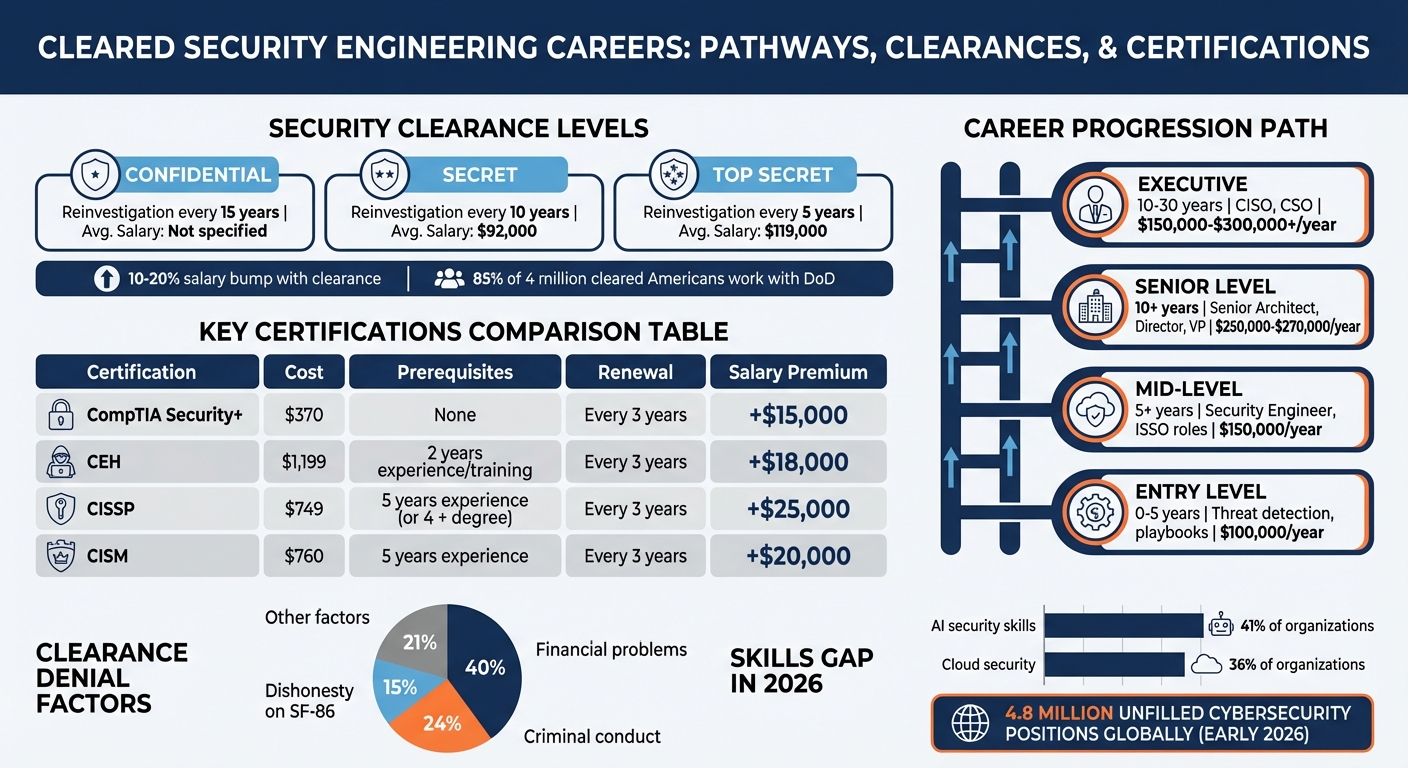
Security Clearance Levels and Certifications for Cleared Security Engineers
How to Get $100,000+/yr Government Security Clearance for Free (Full Guide Without the Military)
sbb-itb-bf7aa6b
What Security Engineers Do in Cleared Environments
In cleared environments, security engineers take on the critical task of safeguarding classified networks and systems that support national defense operations. Unlike their counterparts in commercial sectors, these professionals often work with air-gapped networks like SIPRNet and manage specialized government cloud platforms such as AWS GovCloud and Microsoft Azure Government [3]. Their primary focus is on defending information vital to national security, adhering strictly to federal standards and compliance protocols.
On a typical day, these engineers design secure system architectures, implement protective measures, and monitor network activity using tools like Splunk, firewalls, and IDS/IPS. They also conduct forensic investigations, analyze breaches, and ensure compliance with federal guidelines – all while managing risks tied to sensitive threat intelligence.
Core Responsibilities in Cleared Roles
Security engineers in these roles handle a wide range of tasks, including securing and auditing accredited systems, testing operating systems, and developing backup strategies to maintain infrastructure availability [1][3]. They perform risk assessments to identify vulnerabilities and implement security measures tailored to government requirements. Acting as a bridge between agencies, contractors, and internal teams, they ensure seamless collaboration [1].
Incident response in cleared environments comes with heightened complexity. Engineers must follow strict federal standards for documenting and reporting cyber events [2][3]. The "need-to-know" principle governs access to classified information, ensuring that engineers only interact with data relevant to their specific responsibilities [3].
In addition to their technical duties, these roles come with operational challenges unique to cleared environments.
Challenges Specific to Cleared Environments
Security engineers in cleared roles must navigate a range of challenges. For instance, adherence to the Trusted Workforce 2.0 (TW 2.0) framework is mandatory. This framework replaces periodic reinvestigations with Continuous Vetting (CV), requiring professionals to immediately report significant life events – such as arrests, financial changes, or new foreign contacts – to their Facility Security Officer (FSO) [3].
Adjudicators also review public-facing online activities, such as GitHub contributions, gaming forums, and professional networks, to assess compliance with operational security standards [3]. One of the most pressing concerns is financial management, as financial issues remain the top reason for clearance denial or revocation in 2026. Maintaining sound personal finances is, therefore, a critical aspect of working in these roles [3].
Required Qualifications and Certifications
Educational Requirements
For most cleared security engineer positions, a bachelor’s degree in computer science, information technology, or cybersecurity is the standard starting point [4]. Each field brings unique strengths to the table:
- Computer science focuses on programming and algorithms, essential for creating security tools.
- Information technology (IT) emphasizes network infrastructure and database management.
- Cybersecurity programs dive into network defense, ethical hacking, and digital forensics.
"A degree in computer science, information technology, or cybersecurity is often the first step. This provides a solid foundation in essential concepts and technical skills."
- ITU Online IT Training [4]
While 88% of cybersecurity job postings require at least a bachelor’s degree [8], the industry increasingly values hands-on certifications and bootcamps to complement formal education. Degrees provide the theoretical framework, while certifications validate real-world skills and meet government standards.
Key Certifications for Cleared Professionals
Certifications are essential for cleared roles, with the DoD 8570/8140 framework categorizing positions into Technical (IAT), Management (IAM), and System Architecture and Engineering (IASAE) levels. Before pursuing a certification, identify the required DoD 8570 level for your target role [7].
Here are some of the most sought-after certifications:
- CompTIA Security+: Often the entry-level certification, this vendor-neutral credential costs around $370. It’s widely accepted for government and defense contractor roles.
- CISSP (Certified Information Systems Security Professional): Regarded as the gold standard for senior positions, this certification focuses on security architecture and risk management. It costs approximately $749 and can boost your salary by an average of $25,000 [6].
- CEH (Certified Ethical Hacker): Priced at about $1,199, this certification demonstrates offensive security expertise, showing you can identify and counter vulnerabilities [7].
- CISM (Certified Information Systems Manager): Aimed at those in management roles, this certification costs around $760 and is tailored for enterprise-level security leadership.
"Certifications such as CISSP (Certified Information Systems Security Professional) are often mandatory for roles that involve the protection of sensitive information."
- ITU Online IT Training [4]
The table below summarizes key certifications:
| Certification | Cost | Prerequisites | Renewal | Salary Premium |
|---|---|---|---|---|
| CompTIA Security+ | $370 | None | Every 3 years | +$15,000 |
| CEH | $1,199 | 2 years experience/training | Every 3 years | +$18,000 |
| CISSP | $749 | 5 years experience (or 4 + degree) | Every 3 years | +$25,000 |
| CISM | $760 | 5 years experience | Every 3 years | +$20,000 |
Hands-on lab experience is increasingly critical, as many cleared employers now conduct technical entrance exams [7].
Security Clearance Requirements
A security clearance is not something you can obtain on your own – a federal agency or authorized cleared contractor must sponsor you for a position requiring access [4, 10]. As of 2026, the outdated e-QIP system has been replaced by eApp, a modernized platform for SF-86 submissions with real-time error checking [3].
There are three clearance levels:
- Confidential: Access to information that could cause damage to national security; reinvestigation every 15 years.
- Secret: Access to information that could cause serious damage; reinvestigation every 10 years.
- Top Secret: Access to information that could cause grave damage; reinvestigation every five years [5].
"A security clearance is like a background check… it ensures your ability to securely access, manage, and protect classified information."
- Coursera Editorial Team [5]
Holding a clearance can lead to a 10% to 20% salary bump, depending on the role. For example, Secret clearance holders earn around $92,000 annually, while Top Secret clearance holders average about $119,000. Additionally, 85% of the four million Americans with security clearances work with the Department of Defense [6, 10].
Factors That Impact Clearance Approval
Several issues can lead to clearance denials:
- Financial problems: Responsible for 40% of denials. Address any major credit delinquencies before applying.
- Criminal conduct: Accounts for 24% of denials.
- Dishonesty: Falsifying information on the SF-86 makes up 15% of denials [4, 10].
Automatic disqualifiers include:
- Non-U.S. citizenship
- Dishonorable military discharge
- Current illegal drug use
- Previous clearance revocation
- Being judged mentally incapacitated [5]
Proactively disclose any potential issues, as honesty is crucial. Falsifying information can be far more damaging than the issues themselves [4, 10].
Continuous Vetting (CV)
The traditional periodic reinvestigation system has been replaced by Continuous Vetting (CV), which monitors criminal, financial, and travel records in real time [4, 10]. Under CV, you must report arrests, major debts, or foreign travel within 72 hours to maintain compliance. Investigators also review public social media activity, so ensure your privacy settings are updated and review past posts before applying [4, 10].
Meeting clearance requirements not only fulfills government standards but also enhances your job prospects and earning potential in cleared roles.
Skills and Experience Needed for Success
Technical Skills for Cleared Professionals
Cleared security engineers need a strong foundation in advanced IT skills. Key areas of expertise include network protection – such as using firewalls, intrusion detection and prevention systems (IDS/IPS), and securing cloud platforms like AWS GovCloud and Microsoft Azure Government [3][9][11]. These skills are critical for effectively managing threats in Security Operations Centers (SOCs), where real-time responses are essential.
Proficiency in Zero Trust architecture and automation tools like Python, Bash, or PowerShell is also crucial for addressing modern security challenges at scale [3][9][11]. Staying ahead of emerging threats requires knowledge of cutting-edge technologies like quantum cryptography and AI/ML security [10][11].
"Textbook theory will only take you so far in a real-world security incident."
Practical experience is just as important as theoretical knowledge. You can sharpen your skills through Capture The Flag (CTF) competitions, red/blue team exercises, and certifications like OSCP for offensive security [9][11]. Strong communication abilities are equally vital – you’ll often need to break down complex technical issues for non-technical stakeholders [11].
While technical proficiency is a must, hands-on operational experience can set you apart as a top candidate.
How Military Experience Helps
Military experience provides a solid foundation for cleared security engineering roles, offering both technical expertise and a disciplined mindset. Veterans often have direct experience defending mission-critical systems against Advanced Persistent Threats (APTs), which translates seamlessly into civilian threat intelligence and enterprise security work [16]. For instance, if you’ve configured and protected military networks – like satellite communication links or secure data lines – you already have a head start in network security engineering [16].
The discipline instilled through military service is another major advantage. A commitment to high ethical standards and a strong motivation to safeguard systems and data align perfectly with civilian security engineering roles [14]. Your familiarity with structured incident response protocols mirrors the requirements of SOCs, and your experience with ongoing risk evaluation makes you well-suited for Governance, Risk, and Compliance (GRC) roles [16].
"Anybody who has worked in the operations centre in a warship, in a military unit or in an RAF station will have the experience and transferable skills needed for dealing with cyber security incidents."
- IBM Research [14]
Your understanding of Operational Security (OPSEC) and the "need-to-know" principle is another key asset. Handling sensitive information securely and avoiding unnecessary risks is second nature for veterans [13][14]. Employers also value the leadership and teamwork skills developed during military service, which contribute to veterans being promoted faster and staying with their employers longer than their non-veteran counterparts – 8.3% longer, on average [10][15].
When transitioning to civilian roles, it’s important to translate military jargon into terms civilian employers understand. For example, instead of listing "35N Signals Intelligence Analyst", describe yourself as a Cybersecurity and Data Professional [10][12]. Highlight your experience in operations centers, as these roles directly relate to threat monitoring and cyber operations management [14]. With 69.1% of veterans holding a bachelor’s degree or higher as of 2023, your combination of education and practical experience positions you to excel as a cleared security engineer [10].
Career Progression for Security Engineers in Cleared Roles
Typical Career Path
A career as a cleared security engineer generally follows four stages, each offering distinct responsibilities and salary brackets.
At the entry level (0–5 years), you’ll focus on threat detection using established playbooks, earning an average of $100,000 annually [18]. As you gain experience, you’ll transition into mid-level roles (5+ years), such as Security Engineer or Information Security Architect, where the focus shifts to designing and implementing security systems. In cleared environments, you might also step into roles like Information Systems Security Officer (ISSO), managing compliance with frameworks like the Risk Management Framework (RMF). These roles typically offer salaries around $150,000 [18].
With 10+ years of experience, you’ll move into senior-level positions like Senior Security Architect, Director, or Vice President. In these roles, you’ll lead teams and drive organizational security strategies, earning between $250,000 and $270,000 [18].
At the executive leadership level (10–30 years), roles such as Chief Information Security Officer (CISO) or Chief Security Officer (CSO) become attainable. Salaries range from $150,000 to $300,000, with compensation often exceeding this range in larger organizations [18].
Your clearance level plays a critical role in career progression. Advanced roles in areas like cloud security, forensics, or vulnerability research often require upgrading from a Secret (Tier 3) to a Top Secret/SCI (Tier 5) clearance. While obtaining a Secret clearance typically takes 60 to 150 days, a Top Secret clearance can take 120 to 240 days. If your role requires a polygraph, the process may extend to 180–365+ days due to appointment backlogs [3].
By understanding these stages and requirements, you can take strategic steps to accelerate your career growth.
How to Advance Your Career
To move up the career ladder, focus on specializing in high-demand areas like AI security, cloud environments, or Governance, Risk, and Compliance (GRC). As of 2026, 41% of organizations cite AI skills as their largest gap, followed by cloud security at 36% [17].
Earning advanced certifications can showcase your expertise and readiness for higher-level roles. Certifications like CISSP or ISSAP, which are platform-agnostic, are particularly valuable for positions focused on design and strategy [18]. Beyond certifications, building a public profile can set you apart. Speak at security conferences, contribute to open-source projects, or participate in bug bounty programs. Networking is also key – many senior roles are filled through connections rather than public postings. Joining professional organizations like ISACA, ISSA, or ISC2 can help you expand your network [17].
Consider roles in startups or cybersecurity vendors to accelerate your career. Startups often value technical skills and adaptability over rigid experience requirements [18]. Alternatively, high-paying positions in cybersecurity vendors – such as sales engineering, product management, or marketing – offer opportunities to combine technical expertise with business acumen [17].
Finally, maintain your digital hygiene to protect your clearance. Keep in mind that your clearance becomes inactive 24 months after leaving a sponsoring position, so plan your career moves carefully to avoid gaps [3]. With 4.8 million unfilled cybersecurity positions globally as of early 2026, the demand for cleared professionals continues to grow [17].
Job Search Strategies for Cleared Security Engineers
As you progress in your cleared cybersecurity career, it’s crucial to use focused job search strategies and refine your resume to stand out in this competitive field.
Using Cleared Cyber Security Jobs Effectively
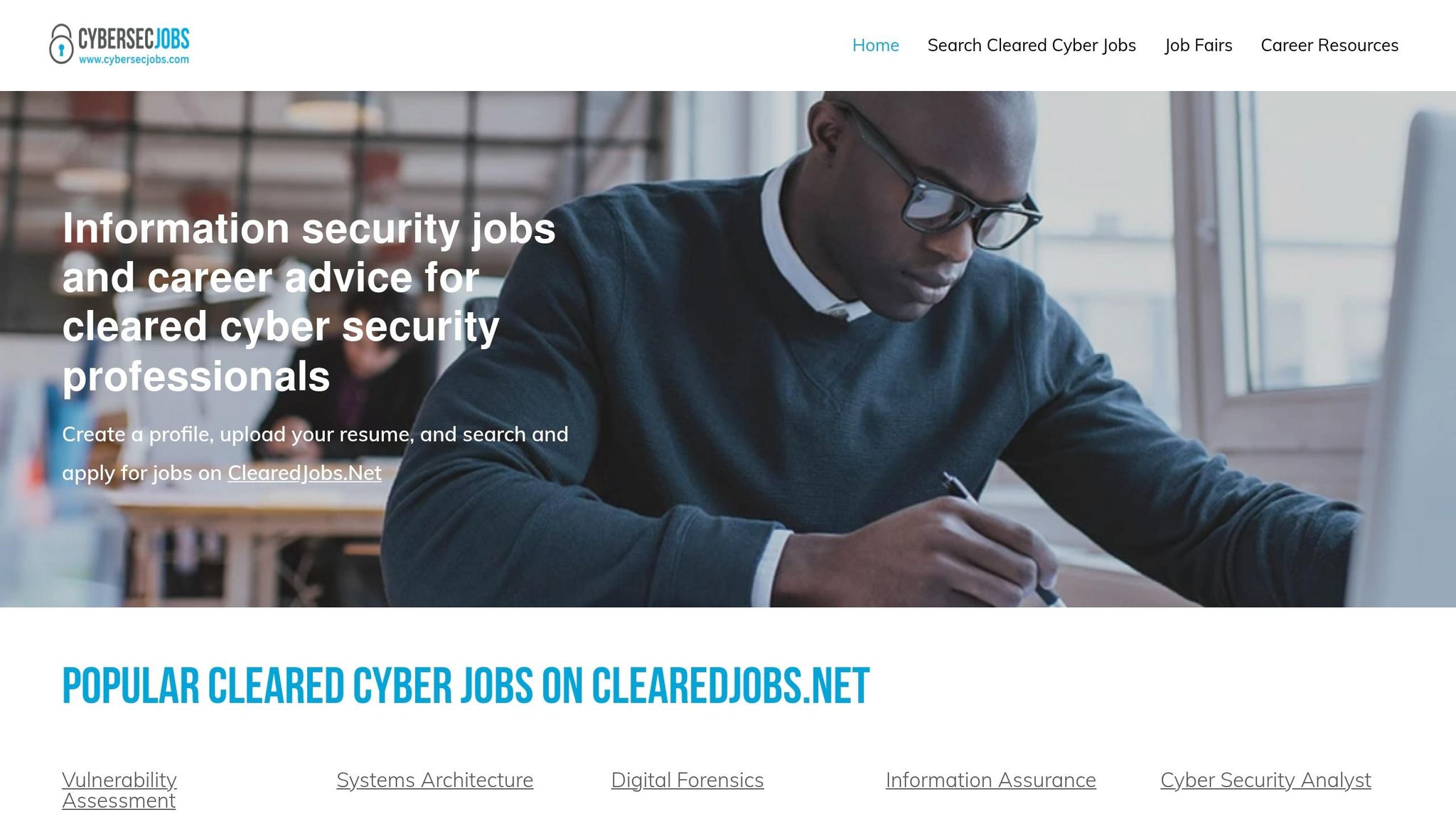
Landing the right cleared role takes more than uploading a resume and waiting for responses. Start by completing your profile entirely and logging in weekly to refresh your "last active" date. This keeps your profile visible to recruiters who prioritize active candidates in their searches [19][20]. Recruiters often see your profile details – like key skills and preferred work locations – before even looking at your resume. Appearing in those initial search results is key.
To refine your search, use Boolean logic. For example, search for terms like "Security Engineer" OR "Cybersecurity Engineer" and apply filters like Zip Code and mileage radius to find relevant roles [19][20]. Also, select all clearance levels you qualify for. For instance, if you hold a Top Secret clearance, include "Secret" in your filters to expand your options [19][20].
Setting up Job Agents or Job Alerts can save time by notifying you about new roles that match your clearance and keyword preferences [20][21]. Additionally, participating in Cleared Job Fairs – both virtual and in-person – offers a direct line to hiring managers and recruiters [20][21]. If privacy is a concern, make use of features like "Anonymous" mode to showcase your skills while keeping your identity hidden, or use the "Block Employer" option to prevent your current employer from viewing your profile [19][20].
Once your online profile is optimized, the next step is creating a resume that highlights your cleared experience effectively.
Tailoring Your Resume for Cleared Roles
Think of your resume as an advertisement for your skills – it’s meant to secure an interview, not provide your life story [22].
"Your security-cleared resume is not a biography or a mere list of qualifications. It’s an ad designed to help you land that coveted cleared job interview and move to the next stage of the hiring process." – Ashley Jones, Editor, ClearedJobs.Net [22]
Start with the essentials: list your clearance level (e.g., TS/SCI), location (city and state), one email address, and one phone number at the top [22][24]. Follow this with a professional summary – two to three lines highlighting your certifications, years of experience, and technical skills. Avoid subjective phrases like "results-oriented team player", which add little value [22].
"Keep subjective self-descriptions out of your summary section. I’m looking at you, Results-Oriented Team Players." – Bill Branstetter, 9th Way Insignia [22]
Structure your accomplishments using the STAR method (Situation, Task, Action, Result), and include measurable outcomes. For example:
"Assumed management of a failing contract. Within 90 days implemented new procedures that improved team efficiency by 35%, resolved all overdue items, and led the team to a successful contract re-award." – ClearedJobs.Net [22]
Metrics like "reduced security risks by 20%" or "mitigated 50+ vulnerabilities" clearly show your value in a cleared environment [22][25].
Operational security (OPSEC) is non-negotiable. While you should list your clearance level on cleared job boards, avoid mentioning classified project names, colleague names, office sizes, or budget details [22][24]. Keep your resume clean and ATS-friendly by avoiding graphics, shading, or fancy fonts [22]. If you’re working on a certification, include the expected completion date to show progress [25]. Lastly, tailor your resume for each job application instead of relying on a one-size-fits-all version [23].
Conclusion
Building a career in cleared security engineering takes a mix of technical know-how, careful planning, ongoing certifications, and diligent clearance management. Your security clearance is a powerful tool, opening the door to sought-after roles with major employers like CACI, Lockheed Martin, and Booz Allen Hamilton. With Continuous Vetting in place, it’s crucial to report significant life changes to your Security Officer right away to maintain your clearance status [3].
The demand for specialized technical skills in the cleared sector remains strong, especially in areas like AI/ML and cloud engineering. Pairing strategic planning with skill development and utilizing focused job search tools can make all the difference in landing the right role.
"For those that are saying, ‘I only have a Secret,’ let me tell you, at Katmai, 75% of our open positions require a Secret clearance. You have a number of job opportunities available to you." – Taylor Hayes, Talent Acquisition Assistant Manager, Katmai Government Services [26]
This guide emphasizes that staying ahead in cleared cybersecurity roles depends on constant learning and proactive clearance upkeep. Whether you’re just stepping into the field or aiming for senior leadership, tools like Cleared Cyber Security Jobs can help. From job alerts and detailed employer profiles to virtual and in-person job fairs, these resources connect you directly with hiring managers. They also help you track industry trends, fine-tune your resume for cleared roles, and set yourself up for long-term success in this competitive field.
Thriving in cleared cybersecurity requires preparation, persistence, and keeping both your technical skills and clearance credentials up to date.
FAQs
Can I get a security clearance on my own?
No, you can’t get a security clearance by yourself. It requires sponsorship from an employer or a government agency. The process involves an in-depth background check and rigorous vetting to determine if you’re eligible to access classified information.
Which certification should I get first for a cleared security engineer role?
The CISSP (Certified Information Systems Security Professional) is often considered the top choice for those pursuing cleared security engineering roles. It’s highly regarded and frequently listed as a requirement in the industry. While other certifications, such as CEH (Certified Ethical Hacker), can be helpful depending on your career path, the CISSP is typically the go-to starting point for cleared professionals.
How do I keep my clearance active if I change jobs?
To keep your security clearance active when switching jobs, it’s crucial to ensure it continues to be used. Generally, a clearance becomes inactive after roughly two years of non-use unless you’re part of a continuous evaluation program. Taking on part-time roles, such as a cleared escort or security guard, can help maintain it. Additionally, leaving your current position on good terms and staying updated on your clearance status can make job transitions smoother.