

The GIAC Certified Intrusion Analyst (GCIA) certification is a key credential for cybersecurity professionals in government and defense sectors. It validates expertise in network traffic analysis and intrusion detection, making it essential for cleared roles under Department of Defense (DoD) requirements.
Here’s what you need to know:
- Certification Overview: The GCIA focuses on hands-on skills through a practical, lab-based exam. It tests proficiency in tools like Wireshark, Snort, and Zeek, and requires knowledge of network protocols and intrusion detection systems.
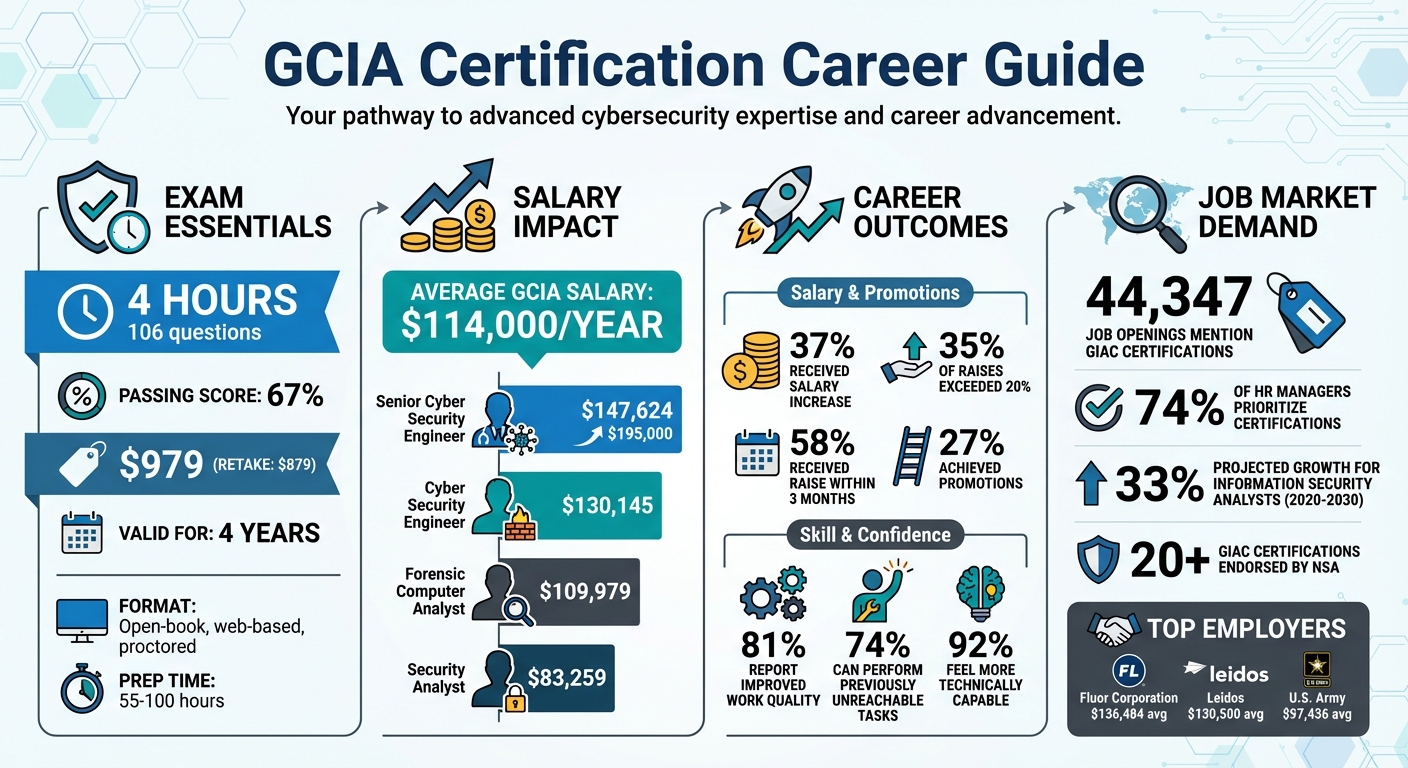
- Exam Details: 106 questions in 4 hours, with a passing score of 67%. The cost is $979, and the certification is valid for 4 years.
- Preparation: The SANS SEC503 course is the primary training resource, complemented by practice tests and hands-on experience with key tools.
- Career Impact: GCIA holders earn an average salary of $114,000, with roles like Cyber Security Engineer and Forensic Analyst offering even higher pay. Over 37% of certified professionals report salary increases, and 27% achieve promotions.
- Employer Demand: The certification is highly sought after by government agencies, defense contractors, and cleared employers like Leidos and the U.S. Army.
This certification not only meets DoD requirements but also boosts job performance, salary potential, and career opportunities in the cybersecurity field.
GCIA Certification Career Impact: Salary, Exam Details, and Professional Outcomes
Ultimate Guide to GIAC Certified Intrusion Analyst (GCIA) Certification | Exam Domains & Prep Tips
sbb-itb-bf7aa6b
GCIA Certification Requirements and Exam Details
Here’s a breakdown of what you need to know about the GCIA certification, including its requirements, exam structure, and renewal process.
Prerequisites for GCIA Certification
One of the standout features of the GCIA certification is its lack of formal prerequisites – you don’t need a specific degree or prior certification to take the exam [1][9]. This makes it an accessible option for professionals at different stages of their careers. That said, GIAC suggests having 2-3 years of hands-on experience in network security, especially in areas like network monitoring and intrusion detection systems [6].
To succeed, you’ll need a solid understanding of network protocols (TCP/IP, UDP, ICMP), hexadecimal, basic Linux commands, and tools such as Wireshark, tcpdump, and Snort [6]. While anyone can register without this background, the exam’s practical nature means these skills are crucial for success. The GCIA exam is also open-book, allowing you to bring hardcopy books and notes (but no electronic devices). Crafting a well-organized index of your study materials can be a game-changer [7][8].
Exam Format and Scoring
The GCIA exam consists of 106 questions, and you’ll have 4 hours to complete it [1][2]. To pass, you’ll need a minimum score of 67%, a standard that applies to all exams activated on or after January 21, 2023 [1][2]. The exam is web-based and proctored, with two options for delivery: remote proctoring through ProctorU or onsite testing at PearsonVUE centers [1][3].
A key feature of the exam is the CyberLive testing component, which involves performing real-world tasks in virtual lab environments. This section tests your ability to apply intrusion detection skills under pressure [1][2]. Once you activate your certification attempt, you’ll have 120 days to schedule and complete the exam [1]. The exam fee is $979, while a retake costs $879 if needed [6][8][9].
Certification Renewal and Maintenance
The GCIA certification is valid for four years from the date you pass the exam [10]. To renew, you have two options: earn 36 Continuing Professional Education (CPE) credits or retake the current version of the exam [10]. The renewal fee is $499, and you can start the process up to two years before your certification expires [10].
You can earn the required 36 CPE credits through various activities, such as SANS courses, graduate-level coursework, accredited certifications (e.g., CISSP or Security+), conferences (up to 18 CPEs), or field work (1 CPE per month, capped at 12 CPEs) [10][11]. If you hold multiple GIAC certifications, you’ll pay the full renewal fee for the first one but get a $249 discount on additional renewals within the same two-year window [10].
These details lay the groundwork for preparing effectively, which will be explored further in the next section.
How to Prepare for the GCIA Certification
To excel in the GCIA certification exam, it’s essential to have a solid preparation plan. This includes structured training, hands-on practice, and efficient time management. On average, candidates dedicate between 55 and 100 hours to preparation, including lab work [12][13]. Thankfully, you’ll have 120 days from the date you activate the exam to complete it, giving you about four months to prepare [1].
A key part of your preparation should involve leveraging the SANS SEC503 course as your primary study resource.
SANS SEC503: Intrusion Detection In-Depth
The SANS SEC503: Network Monitoring and Threat Detection In-Depth course is the cornerstone for GCIA exam prep [13][14]. It includes detailed textbooks, a virtual machine, and a lab workbook to help you develop practical skills. The course is available in various formats – Live, Live Online, and OnDemand – making it convenient to fit into your schedule [12]. Although the course costs over $7,000, it’s one of the most direct paths to certification [13].
Network engineer Andre Roberge shares his experience with the course:
"I probably spent 100 hours in the exercises alone… I went through the first time as I was following along with the course… The second time through, I did almost all the exercises without using any of the hints" [13].
Revisiting the lab exercises, first with hints and then independently, is an effective way to master essential tools like Wireshark, Snort, and tcpdump.
Tools for GCIA Preparation
Hands-on experience with key tools is a must, as the GCIA exam includes a CyberLive component that tests your ability to use real security tools [1]. Familiarity with the following tools will be crucial:
- Wireshark: For deep packet analysis.
- tcpdump and tshark: For command-line packet capture.
- Snort: For writing intrusion detection system (IDS) rules.
- Zeek (formerly Bro): For network security monitoring.
- SiLK: For analyzing network flow records.
- Scapy: For packet crafting.
Hexadecimal analysis is another critical focus area. You’ll need to parse protocols like TCP, UDP, ICMP, and DNS in hex format, as this is a recurring theme throughout the course [13][15]. SANS also offers official cheat sheets that cover port numbers, IPv4 breakdowns, and tool syntax, which can be valuable study aids [14]. If you’re short on time, consider listening to MP3 versions of course lectures during your commute to reinforce key concepts [14].
Study Tips and Time Management
Since the GCIA exam is open-book, creating a custom index of the SANS course books is a vital step [12][15]. SANS instructor Dr. Johannes Ullrich emphasizes this point:
"The way to pass is the good index" [15].
An alphabetized, personalized index not only speeds up information retrieval during the four-hour exam but also strengthens your understanding of the material.
Make good use of the two practice tests included with the course. These are excellent tools for identifying weak areas, testing your index, and refining your study approach [12]. Avoid taking both practice tests on the same day; instead, review your results, update your index, and tackle the second test later. Start studying immediately after completing SEC503, and schedule your exam when you feel ready [12]. Many candidates report using the entire four-hour exam window, so time management is critical [16].
Career Benefits of GCIA Certification in Cleared Cybersecurity
Higher Salary and Job Opportunities
Earning the GCIA certification can lead to better pay and access to specialized roles in the defense and intelligence sectors. On average, GCIA-certified professionals earn a base salary of $114,000 annually. Specific roles offer even higher compensation: Senior Cyber Security Engineers average $147,624 per year (with top earners reaching $195,000), Cyber Security Engineers average $130,145, Forensic Computer Analysts earn around $109,979, and Security Analysts make approximately $83,259 [17].
The certification also accelerates career growth. About 37% of professionals report receiving a salary increase after earning their GCIA, with 35% of those raises exceeding 20%. Furthermore, 58% of these salary boosts occur within three months of certification. Promotions are another common outcome, with 27% of certified individuals advancing to higher roles [19].
GCIA certification prepares professionals for advanced positions in network traffic analysis and intrusion detection. Key roles include Forensic Computer Analyst, Senior Cyber Security Engineer, and Information Security Manager [17][5]. These competitive salaries and career advancements reflect the high demand for GCIA-certified talent in the cybersecurity field.
Employer Demand for GCIA-Certified Analysts
Employers highly value GCIA-certified professionals because the certification proves hands-on expertise through CyberLive testing [1][21]. The demand is clear: as of 2025, Cyberseek data highlights 44,347 job openings that specifically mention GIAC certifications [18]. Additionally, 74% of HR managers consider certifications a key factor when hiring, and the need for information security analysts is expected to grow by 33% between 2020 and 2030 [20].
Arlin Halstead, Strategic HR Business Partner at NTT Security, emphasizes the employer perspective:
"GIAC certifications help an organization’s hiring managers and HR with a quick ROI for information security professionals. The job function specific, technical certification ensures that their employees have demonstrable knowledge and skills" [22].
Major cleared employers, including Fluor Corporation (average salary $136,484), Leidos (average salary $130,500), and the U.S. Army (average salary $97,436), actively seek GCIA-certified professionals [17]. The certification is also endorsed by the United States National Security Agency (NSA), with over 20 GIAC certifications recommended for federal workforce development in government and military sectors [18][22].
Beyond hiring advantages, the certification enhances job performance. Eighty-one percent of GCIA holders report improved quality and value in their work, while 74% state they can now take on tasks or roles that were previously out of reach [19]. Additionally, GCIA-certified professionals rate their job satisfaction at 4 out of 5 [17]. This strong employer demand and professional satisfaction make GCIA certification a valuable asset for cleared cybersecurity roles.
Using Cleared Cyber Security Jobs to Find GCIA Roles

Cleared Cyber Security Jobs offers a direct way to connect with employers seeking GCIA-certified professionals in the cleared community. As a veteran-founded platform, it focuses on pairing security-cleared talent with direct-hire employers in the defense and intelligence sectors.
The platform’s job search filters allow you to pinpoint positions requiring or preferring the GCIA certification. You can also set up job alerts to stay updated on new postings, ensuring you’re among the first to apply. Additionally, the site hosts job fairs, providing opportunities to meet hiring managers and recruiters from government agencies and defense contractors face-to-face.
Since the platform works exclusively with direct-hire employers, you bypass staffing agencies and connect directly with organizations that have immediate openings for intrusion analysts. The career resources section provides tailored advice to help you showcase your GCIA certification, emphasizing your expertise in network traffic analysis, intrusion detection, and hands-on skills proven through the certification’s practical testing.
Applying GCIA Skills in Cleared Environments
With a solid foundation of preparation and career advantages, using GCIA skills in cleared environments strengthens network defense strategies.
Use Cases for GCIA Skills
GCIA-certified analysts bring a deep understanding of packet-level data, which is critical for addressing threats in secured networks. By performing deep packet inspection, you can analyze the TCP/IP stack to uncover threats that standard signature-based tools might overlook [23].
Another essential application is protocol analysis. Examining protocols like DNS, SMB/CIFS, and HTTP/3 can reveal hidden anomalies within large datasets – an invaluable skill when adversaries exploit legitimate protocols to disguise their activities. Additionally, creating custom packets allows you to test your organization’s firewalls and IDS rules against newly identified vulnerabilities [23].
Network forensics is another key area where GCIA skills shine. By extracting files and data from network traffic, analysts can reconstruct incidents, pinpoint timelines, and identify those involved. On a broader scale, analyzing traffic patterns can help detect lateral movement across both traditional and cloud-based infrastructures [23].
Enhancing Security Operations with GCIA
These technical capabilities directly contribute to improving security operations.
GCIA-certified professionals help reduce alert fatigue and improve detection accuracy by fine-tuning IDS systems like Snort, Suricata, and Zeek. This ensures detectors generate fewer false positives, allowing SOC teams to concentrate on actual threats [6][2].
In addition to signature-based detection, behavioral threat hunting expands your ability to identify unusual activities. For example, creating automated correlation scripts in Zeek can help uncover behaviors that might indicate zero-day attacks. As Amit K from CBTProxy notes:
"There’s no better course to take if you want to learn how to perform effective threat hunting to detect zero-day activities on your network before they become public" [23].
Tools like Berkeley Packet Filters (BPF) are invaluable in high-volume environments, enabling analysts to focus on specific traffic traits at scale. Combining signature-based systems with behavioral monitoring creates a hybrid defense approach, offering protection against both known and unknown threats. Visualizing network flow data further simplifies operations and speeds up the identification of protocol anomalies [23].
Strengthening Team Collaboration and Processes
GCIA-certified analysts play a crucial role in bridging the gap between technical teams, such as network administrators and engineers, and security operations staff. By translating complex packet-level data into actionable insights, they help non-specialists understand and respond effectively to threats [1][24]. This collaborative approach is especially important during active incidents that require quick, coordinated action.
Fine-tuning IDS systems and creating custom signatures not only reduces false positives but also enhances the efficiency of SOC teams. These analysts also provide valuable input to software engineers, ensuring security is baked into the development process [24]. Automated correlation scripts in Zeek further streamline the detection of related malicious activities across the network.
Strategic sensor placement, informed by a deep understanding of network architecture, optimizes visibility in secured environments. By analyzing anomalies and tracking lateral movement, multidisciplinary teams can make smarter decisions about resource allocation and incident prioritization [23]. This combination of technical expertise and team coordination underscores the importance of GCIA certification in advancing careers in cleared cybersecurity roles.
Conclusion
The GCIA certification demonstrates expertise in intrusion detection and network traffic analysis, skills that are critical in secure environments. This is validated through CyberLive testing, ensuring hands-on proficiency [1][2]. In a competitive job market, where 74% of HR managers prefer hiring certified professionals, this credential can help you stand out [20].
On top of technical validation, the GCIA opens doors to roles like Network Security Analyst, Incident Response Specialist, and Cybersecurity Engineer, with average salaries hovering around $102,000 [20][4]. With information security analyst positions expected to grow by 33% from 2020 to 2030, this ANSI-accredited certification can position you for sustained career advancement across both government and private sectors [20][3].
Additionally, earning the GCIA enhances professional confidence. A reported 92% of candidates feel more technically capable after certification, and 80% achieve career milestones such as promotions or salary increases [25].
FAQs
What skills are assessed in the GCIA certification exam?
The GCIA certification exam focuses on the critical skills needed for intrusion analysts. These include setting up and managing intrusion detection systems, examining network traffic, interpreting log files, and grasping the basics of traffic analysis and network forensics.
The exam also assesses your understanding of application protocols, network behavior patterns, and your ability to spot potential threats in practical scenarios. Building expertise in these areas equips you to efficiently detect and respond to security incidents in sensitive environments.
How can the GCIA certification boost my career and salary in cybersecurity?
The GCIA certification can boost your career opportunities and increase your earning potential in the cybersecurity field. In the United States, professionals holding this credential typically earn an average salary of $110,000 per year, highlighting the strong demand for skills in areas like intrusion detection, network traffic analysis, and incident response.
Beyond validating your technical expertise, this certification paves the way for roles such as security analyst, intrusion detection specialist, and network security engineer. These positions are highly sought after by organizations focused on enhancing their cybersecurity defenses. With an emphasis on practical, hands-on problem-solving, the GCIA showcases your ability to tackle complex issues, making you a more sought-after professional in the cybersecurity sector.
What are the best strategies to prepare for the GCIA certification exam?
To succeed in the GCIA exam, a mix of structured learning, practical experience, and consistent review is essential. Begin by enrolling in SANS training courses, which cover critical topics like intrusion detection, network traffic analysis, and traffic forensics in depth. Make the most of these sessions by staying engaged – ask questions, take detailed notes, and apply what you learn to practical, real-world scenarios. This approach helps cement your understanding of complex concepts.
In addition to formal training, use practice exams to get comfortable with the test format and pinpoint areas where you need to improve. Develop a study plan that focuses on core topics such as IDS fundamentals, network protocols, and traffic analysis. Regular practice and targeted reviews will boost your confidence and readiness for the exam. Combining comprehensive training, active learning, and consistent practice is your best strategy for achieving success.