

If you’re a former Cryptologic Technician Networks (CTN) in the Navy, you’re in a prime position to transition into the thriving cybersecurity job market. Your hands-on experience in network defense, cyber operations, and intelligence aligns directly with civilian roles like SOC Analyst, Incident Responder, and Threat Intelligence Analyst. With a global shortage of 3.5 million cybersecurity professionals and U.S. roles projected to grow 33% by 2033, your skills are in demand. Plus, your TS/SCI clearance not only saves employers time and money but can also boost your salary by $15,000–$30,000.
Here’s how to make the most of your CTN experience:
- Certifications: Start with CompTIA Security+ for DoD 8140 compliance, then pursue specialized credentials like CySA+, CEH, or CISSP based on your career goals.
- Resume Tips: Highlight your clearance, translate military jargon into civilian terms, and quantify achievements (e.g., "secured networks for 2,400 users with 99.9% uptime").
- Networking: Build your LinkedIn profile, connect with recruiters, and attend events like DEF CON or BSides.
- Job Platforms: Use sites like ClearedJobs.net or ClearanceJobs.com to find roles requiring your clearance.
Your military background gives you an edge in the cybersecurity field. By pairing your expertise with the right certifications and a strong job-search strategy, you can secure high-paying, cleared roles in this growing industry.
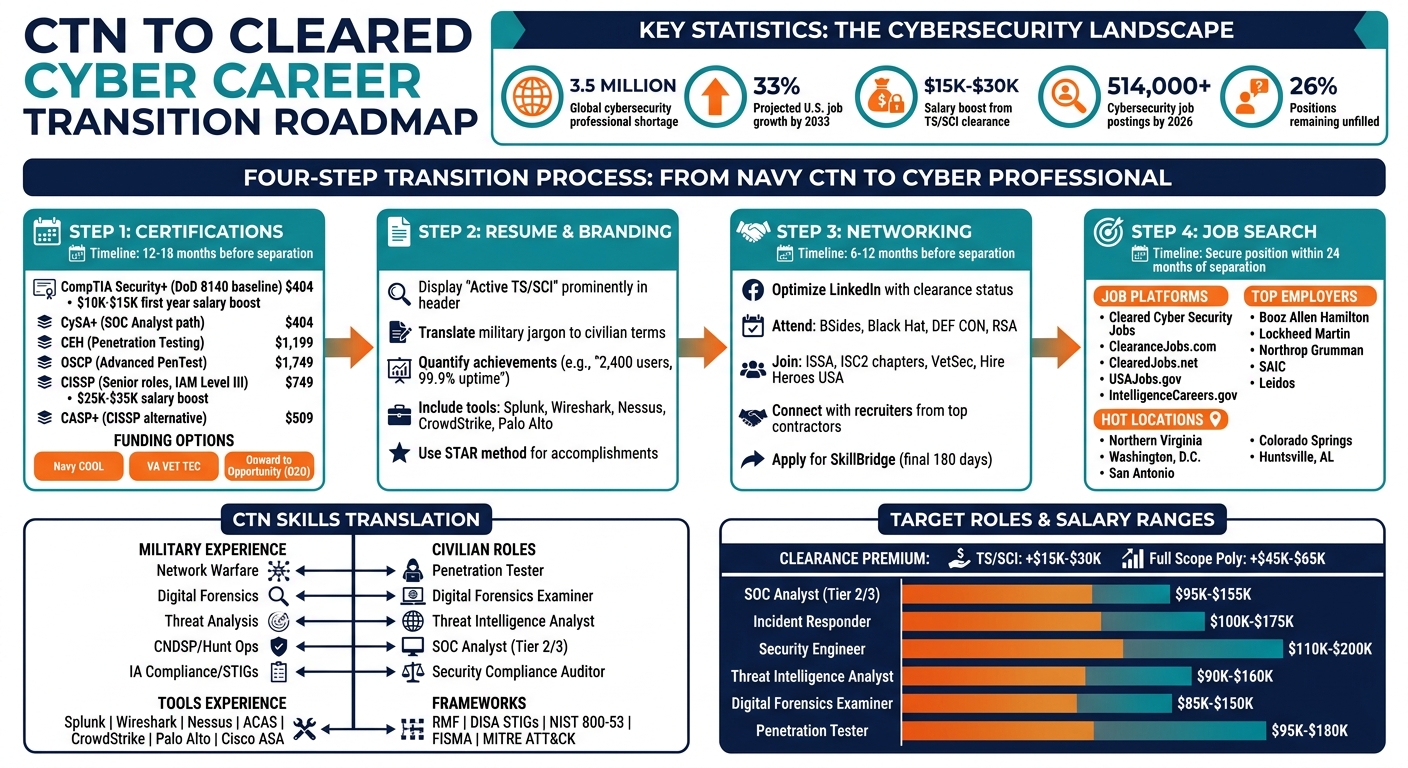
CTN to Cleared Cyber Career Transition Roadmap
WHAT IS A CTN! (Cryptologic Technicians Networks)
sbb-itb-bf7aa6b
What CTN Experience Brings to Cybersecurity
Your time as a CTN has provided you with something that most civilian cybersecurity candidates lack: direct, hands-on experience defending networks against actual threats[1]. While others may train using simulated scenarios, you’ve been in high-stakes situations, protecting systems tied to national security. That kind of pressure demands precision, accountability, and a level of expertise that defense contractors and federal agencies highly prize[1]. This background gives you a unique advantage and sets the stage for exploring the specific skills and responsibilities that make you stand out in civilian cybersecurity roles.
Technical and Operational Skills from CTN Service
The skills you honed during your CTN service align closely with the needs of civilian cybersecurity jobs. Your work in network warfare, digital forensics, and real-time threat analysis directly connects to roles like Cybersecurity Analyst, Digital Forensics Examiner, and Threat Intelligence Analyst. You’ve also gained hands-on experience with tools such as Splunk, Wireshark, Nessus, ACAS, and CrowdStrike – platforms widely used by civilian employers.
Your familiarity with RMF (Risk Management Framework) and DISA STIGs (Security Technical Implementation Guides) gives you a solid foundation for NIST 800-53 compliance, a critical requirement in many civilian cybersecurity roles. Defense contractors are especially eager to hire professionals who already understand these frameworks. Additionally, the constant vigilance required during monitoring shifts has prepared you for the demanding environment of Security Operations Centers (SOCs)[1].
Matching CTN Duties to Cleared Cyber Positions
The responsibilities you carried out as a CTN translate seamlessly to high-demand cleared cybersecurity roles. Tasks like network warfare, digital forensics, and threat analysis position you for roles such as Penetration Tester, Digital Forensics Examiner, SOC Analyst (Tier 2 or Tier 3), and Threat Intelligence Analyst. Your experience with CNDSP (Computer Network Defense Service Provider) or hunt operations equips you for Threat Intelligence positions that leverage frameworks like MITRE ATT&CK and tools like CrowdStrike. Similarly, your expertise in IA compliance and STIGs makes you a strong candidate for Security Compliance Auditor roles that require knowledge of RMF, NIST 800-53, and FISMA.
Perhaps one of your most valuable assets is the adversarial mindset you’ve developed. By thinking like an attacker, you’ve learned to identify vulnerabilities and predict threat actor behavior – an ability that helps uncover subtle security gaps that others might overlook[5][3].
Preparing for the Cleared Cyber Job Market
Transitioning your CTN experience into the civilian world means aligning your skills with what the cleared cybersecurity job market demands. This market operates differently than the broader tech industry – certifications play a critical role in meeting DoD 8140 compliance requirements[6]. And let’s not forget, your security clearance is your biggest asset[1]. The trick is knowing how to leverage both effectively.
Getting Cybersecurity Certifications
Start with CompTIA Security+, the baseline certification for cleared technical roles. It meets the DoD 8140 IAT Level II standard, which is required for most cleared cyber jobs[6]. At $404, the exam offers a massive return on investment, potentially boosting your salary by $10,000–$15,000 in the first year[6].
"Security+ is the DoD 8140 baseline for every cleared technical position. Without it, you simply won’t get hired for most cleared cyber roles." – CyberSecJobs Editorial[6]
Once you’ve got Security+, your next steps depend on your career goals. For penetration testing, add CEH ($1,199) and OSCP ($1,749)[6]. CEH is a contractor favorite that often appears in job requirements, while OSCP is highly regarded by hiring managers for its technical rigor. If you’re aiming for a SOC analyst position, pair Security+ with CySA+ ($404)[6]. For senior roles like ISSO or ISSM, go for CISSP ($749), which meets IAM Level III requirements and can increase your salary by $25,000–$35,000[6]. If you don’t yet have the required five years of experience for CISSP, CASP+ ($509) is a great alternative[6].
"One of our Army Signal NCOs went from E-6 to a $115K SOC analyst role in eight months. Security+ got him in the door. CySA+ got him the offer over other candidates. The clearance sealed it." – Brad Tachi, Founder, Best Military Resume[4]
Use military funding options to cover certification costs. Programs like Navy COOL (Credentialing Opportunities On-Line) can pay for exam vouchers before you separate[7]. After transitioning, the VA’s VET TEC program covers tuition and housing for tech training without using your GI Bill benefits[4]. Onward to Opportunity (O2O) also offers free training and exam vouchers for certifications like CompTIA, Cisco, and AWS[4]. Start your certification journey 12–18 months before leaving the service to ensure you’re ready[1].
Once certified, the next step is crafting a resume that showcases both your clearance and technical skills to civilian employers.
Writing Your Resume for Cleared Positions
Civilian hiring managers often spend just six seconds scanning resumes[3]. Make sure "Active TS/SCI" is prominently displayed in your contact header or summary to immediately highlight your value[8].
Translate military terms into language civilians understand. For instance, replace "COMSEC" with "cryptographic security" or "encryption key management", and "IA compliance" with "NIST 800-53" or "FISMA compliance." Use specific tools and platforms like Splunk, Wireshark, Nessus, CrowdStrike, Palo Alto, Cisco ASA to ensure your resume includes the right keywords for Applicant Tracking Systems[3].
Quantify your achievements whenever possible. Instead of saying "responsible for network security", try "administered network security for 2,400 users across three classified networks, maintaining 99.9% uptime"[3]. Use the STAR method (Situation, Task, Action, Result) to frame your accomplishments in a way that resonates with hiring managers[8]. Also, tailor your resume language to match the job posting to increase your chances of getting noticed[3][8].
Be mindful of operational security. Avoid mentioning classified project details, specific targets, or office sizes[8]. Focus on unclassified accomplishments that still demonstrate your technical expertise.
Connecting with the Cleared Cybersecurity Community
Certifications and a polished resume are just part of the equation – networking is equally important. Many cleared roles are filled through connections rather than online applications[9]. Start building your LinkedIn presence 6–12 months before separation[1]. Optimize your profile with cybersecurity keywords and your clearance status, and connect with recruiters from top defense contractors like Booz Allen Hamilton, SAIC, and Leidos[9].
Attend industry events like BSides, Black Hat, DEF CON, and RSA to meet hiring managers and technical leaders[9]. Volunteering at these events can often get you free access, and the informal networking opportunities – sometimes called "HallwayCon" – can be just as valuable as the sessions themselves[9].
Get involved with professional groups like ISSA (Information Systems Security Association) or ISC2 local chapters to build relationships with peers and mentors[1]. Veteran-specific organizations like VetSec and Hire Heroes USA offer career coaching tailored to your background[3]. Showcasing your skills through open-source projects on GitHub or participating in forums like Reddit’s r/netsec or Stack Overflow can also help establish your technical credibility[9].
Consider applying for SkillBridge internships during your final 180 days of service. Companies like Amazon (AWS), Microsoft, and Northrop Grumman offer internships that provide civilian experience while you’re still on military pay[3]. These internships often lead to full-time offers.
Focus your job search on platforms tailored to cleared professionals. Websites like Cleared Cyber Security Jobs, ClearanceJobs.com, and ClearedJobs.net are designed to connect security-cleared individuals with employers who value their unique qualifications[3]. These platforms are far more effective than general job boards like LinkedIn or Indeed for finding cleared opportunities.
Aim to secure a cleared position within 24 months of separation to keep your security clearance active[3]. Remember, your clearance has a shelf life – use it while it’s still valid.
Finding and Landing Cleared Cybersecurity Jobs
Identifying Cleared Cyber Employers and Openings
Once your resume is polished and your network is active, the next step is finding employers who value your clearance and skills. In the cleared job market, your active clearance is often the most important factor. Platforms like Cleared Cyber Security Jobs are tailored for professionals like you, filtering out roles that don’t require clearance and connecting you directly with employers who prioritize your qualifications.
Big names in the defense industry – such as Lockheed Martin, Booz Allen Hamilton, and Northrop Grumman – often have programs specifically geared toward veterans. These programs, available on their career portals, can streamline your application process through military-friendly hiring pipelines. For federal civilian roles, check out USAJobs.gov for GS-level positions and IntelligenceCareers.gov for openings in agencies like the NSA, CIA, and DIA that align with CTN expertise.
Your location can also impact your job search. Areas like Northern Virginia, Washington, D.C., San Antonio, Colorado Springs, and Huntsville, Alabama, are hotspots for cleared cybersecurity positions. While some commercial cyber roles offer remote work, most TS/SCI-level positions require you to work on-site in secure facilities.
To expand your search, use LinkedIn Boolean searches with terms like "TS/SCI" or "Full Scope Poly" to find recruiters and job postings that might not appear on specialized job boards. Optimize your LinkedIn profile with civilian job titles such as "Cybersecurity Engineer" or "Incident Responder" to increase your visibility. By 2026, the cybersecurity field is projected to have over 514,000 job postings, with around 26% of these positions remaining unfilled [10].
If you have more than four years of CTN experience, aim for mid-to-senior-level roles. Positions like SOC Analyst (Tier 2/3) or Incident Responder align well with your expertise and often come with competitive salaries. For example, SOC Analyst roles can pay between $95,000 and $155,000 annually, while Incident Response positions range from $100,000 to $175,000. Security Engineer roles can command salaries from $110,000 to $200,000. An active TS/SCI clearance could add $15,000 to $30,000 to your annual pay, and a Full Scope Polygraph might increase it by $45,000 to $65,000 [10].
Once you’ve identified potential employers, your focus should shift to preparing for interviews in these specialized roles.
Interviewing for Cleared Cyber Positions
Your technical skills and refined resume have set the stage for interview success. For cleared roles, interviews typically assess both your technical expertise and your ability to manage sensitive information. Employers will evaluate your trustworthiness using SEAD 4’s 13 Adjudicative Criteria, which include factors like financial stability, foreign contacts, and your history with classified information [11]. For positions requiring a polygraph, expect questions about topics such as criminal activity, drug use, or security breaches.
Technical questions often revolve around the core areas of cybersecurity: People, Process, and Technology. For CTNs, this might mean discussing network monitoring, incident response workflows, or vulnerability assessments. Use specific, measurable examples in your responses, such as, "Maintained 99.9% uptime across three networks supporting 2,400 users", while keeping your language unclassified. Mentioning tools like Splunk, Wireshark, Nessus, CrowdStrike, or Palo Alto Networks can further showcase your hands-on experience.
The STAR method (Situation, Task, Action, Result) is a great way to frame your accomplishments while maintaining operational security. Behavioral questions may also touch on your military background, particularly your ability to stay alert and manage escalation effectively.
"The cyber veterans I’ve seen transition most successfully are the ones who don’t settle for the first SOC analyst job offered to them. Your military experience puts you above entry-level – don’t let impostor syndrome push you into a role that’s two tiers below your actual capability." – Brad Tachi, CEO of Best Military Resume
For higher-level positions like Security Architect or CISO, focus on explaining complex technical concepts in simple terms for non-technical stakeholders. Additionally, prepare for hands-on technical assessments by staying sharp with platforms like Hack The Box or TryHackMe.
Finally, make your clearance a focal point. Include your clearance level (e.g., "Active TS/SCI with CI Poly") prominently in your resume header and mention it early in interviews. This ensures employers immediately recognize the value you bring to the table.
Conclusion
Your experience as a CTN positions you perfectly for a career in cleared cybersecurity. The hands-on expertise you’ve gained defending networks against real-world threats gives you an edge over candidates with only academic training. The challenge now is to translate that military knowledge into terms civilian hiring managers understand and pair it with the right certifications.
Start by earning the CompTIA Security+ certification to meet the baseline requirements of DoD 8140. From there, consider adding certifications like CySA+ or CISSP, depending on the roles you’re targeting. If you hold an active TS/SCI clearance, you’ll find it significantly boosts both your hiring potential and earning power [3][1]. Keep in mind, though, that you have just 24 months after separation to secure a cleared position before your clearance expires [3].
To make the most of your technical background, refine your resume by converting military jargon into civilian terms and quantifying your accomplishments. For instance, instead of saying "maintained COMSEC", you might write, "managed cryptographic key operations for 2,400 users." Use platforms like Cleared Cyber Security Jobs to connect with employers who value your clearance and skills.
When applying, aim for mid-to-senior-level roles that align with your experience. With four or more years as a CTN, you could qualify for positions such as SOC Analyst (Tier 2/3), Incident Responder, or Threat Intelligence Analyst, all of which come with competitive salaries [2][1]. Companies like Booz Allen Hamilton, Leidos, and SAIC are excellent places to start your search [2][1].
These steps summarize the strategies outlined in this guide and will help you transition successfully into a rewarding cybersecurity career.
FAQs
What civilian jobs match CTN experience best?
If you’ve served as a Cryptologic Technician Networks (CTN), you already have a strong foundation for transitioning into several civilian roles. Positions like Network Security Analyst, SIGINT Systems Technician, Cyber Operations Specialist, and Network Maintenance Engineer align closely with the expertise you’ve developed in network security, signals intelligence, and cyber operations.
To stand out even more, certifications such as CISSP (Certified Information Systems Security Professional) or CEH (Certified Ethical Hacker) can be game-changers. These credentials are often sought after for roles like Security Engineer or Threat Intelligence Analyst, where operational experience and security clearances are highly valued.
How do I keep my TS/SCI active after separation?
To keep your TS/SCI clearance active after separating from the military, you generally have a 2-year window for reinstatement. It’s important to stay on top of this timeline and make sure your clearance is properly documented. Verifying your clearance status with potential employers can also be a smart move to maintain eligibility for roles requiring it. By addressing these steps before your clearance expires, you can stay competitive in the job market for cleared positions.
Which cert should I get after Security+?
After earning Security+, you might want to look into certifications like CISSP (Certified Information Systems Security Professional) or CEH (Certified Ethical Hacker). These are well-respected in the cleared cybersecurity world and can open doors to better opportunities. Choose certifications that match your career goals and the specific needs of cleared roles to keep yourself ahead in the field.