

The EC-Council Certified Security Analyst (ECSA) is a certification designed for professionals skilled in advanced penetration testing and security analysis. It bridges the gap between entry-level ethical hacking and higher-level penetration testing roles, emphasizing structured methodologies, professional report writing, and compliance with federal standards like CNSS-4014. This makes it particularly relevant for individuals in government and defense roles requiring security clearances.
Key Highlights:
- Who it’s for: Ethical hackers, penetration testers, and security analysts, especially those in cleared environments.
- Eligibility: Requires either EC-Council training or two years of relevant experience (with a $100 application fee).
- Process:
- Complete hands-on challenges in EC-Council’s iLabs and submit a penetration testing report.
- Pass a 150-question exam (4 hours, 70% passing score).
- Cost: Training bundles range from $2,000–$3,500; exam fees are $650–$1,199.
- Career Impact: Average salary is $94,000, with roles like Penetration Tester and Security Assessor earning up to $135,000.
The certification focuses on advanced methodologies, compliance with standards like NIST, and skills in vulnerability assessment, reporting, and security architecture testing. It’s a strong credential for cleared professionals aiming to advance in cybersecurity roles.
ECSA Certification Requirements and Process
What is ECSA Certification?
The ECSA certification builds upon the CEH by focusing on structured analytical techniques and professional penetration testing. It’s tailored for ethical hackers, penetration testers, security analysts, and network administrators responsible for conducting thorough security assessments and documenting their findings. This certification is especially relevant for those working in cleared environments and aligns with federal training standards[3].
Eligibility and Prerequisites
To qualify for the ECSA certification, candidates must be at least 18 years old. Those under 18 can still apply but must provide parental consent and a letter from their institution[1]. Eligibility can be achieved in two ways:
- Training Path: Attend official EC-Council training, such as iLearn, instructor-led courses, or sessions at an Accredited Training Center.
- Experience Path: Demonstrate two years of professional experience in information security. This route requires a $100 non-refundable application fee and verified documentation[1].
For military personnel or cleared professionals, it’s essential to confirm that their service experience meets the two-year requirement. Once eligibility is established, candidates can proceed to the hands-on certification process.
Certification Process
The ECSA certification involves two main stages. First, candidates must tackle hands-on challenges through EC-Council’s iLabs platform and create a detailed penetration testing report. This report should outline their findings and recommended countermeasures[1]. Only after the report is approved can candidates advance to the final exam.
The final exam consists of 150 multiple-choice questions, with a time limit of 4 hours and a required passing score of 70%[3]. Candidates are allowed up to five attempts per year. While the first retake can be done immediately, any additional attempts require a 14-day waiting period[3]. Exam vouchers are priced between $650 and $999, depending on the selected training bundle[1].
"Only candidates who can successfully complete the challenges and pass the report writing portion of the course will be allowed to take the EC-Council Certified Security Analyst (ECSA) certification exam." – EC-Council[5]
To maintain the ECSA credential, certified professionals must earn 120 continuing education credits over three years, with a minimum of 20 credits required each year[1].
sbb-itb-bf7aa6b
Skills Gained from ECSA Certification
Penetration Testing Methodologies
The ECSA certification focuses on advanced penetration testing techniques, emphasizing structured, step-by-step methodologies that align with established standards like NIST and the Penetration Testing Execution Standard (PTES). This structured approach is particularly valuable in high-security environments, where thorough documentation and compliance are just as important as technical precision.
Training covers a wide array of security assessment areas, including testing perimeter devices, performing vulnerability analysis, and maintaining network access. These methods are designed to simulate advanced persistent threats (APTs) often encountered by government agencies. Through EC-Council iLabs, participants gain hands-on experience, practicing tasks like network pivoting and assessing firewalls and IDS/IPS systems that protect classified systems. The certification also meets the National Training Standards for Information Systems Security Officers (CNSS-4014) and System Certifiers (NSTISSI-4015), making it especially relevant for roles in federal agencies and defense contracting. These practical skills form the foundation for advanced vulnerability analysis and reporting, which the program delves into further.
Vulnerability Assessment and Reporting
ECSA-certified professionals are trained to go beyond simply using security tools – they learn how to analyze and interpret the results to identify real security gaps. The program emphasizes prioritizing exploitable vulnerabilities in critical systems and translating technical findings into actionable risk summaries.
A key component of the training is Module 12: Report Writing and Post Testing Actions, which focuses on documenting findings clearly and recommending specific countermeasures. The certification ensures that participants can produce professional-grade reports that meet the standards expected in enterprise and government audits. These skills are critical for communicating risks effectively to both technical teams and decision-makers in high-security settings.
Security Architecture Testing
Building on the foundation of analysis and reporting, the ECSA certification also prepares professionals to evaluate modern security architectures. The curriculum addresses both traditional infrastructures and emerging platforms like AWS, Azure, and hybrid cloud environments, which are increasingly common in government and defense operations.
Training includes assessing domain controllers, internal network segmentation, and web server security. These skills are essential for determining whether security architectures meet federal compliance requirements and effectively mitigate risks in classified settings. Participants learn how to evaluate internal segmentation controls designed to prevent lateral movement between classified and unclassified networks – an essential aspect of maintaining compliance in cleared facilities. By covering both legacy systems and modern cloud-based platforms, the ECSA ensures that professionals are equipped to handle the diverse range of systems present in today’s cybersecurity landscape.
EC-Council Certified Security Analyst (ECSA)
How to Obtain the ECSA Certification
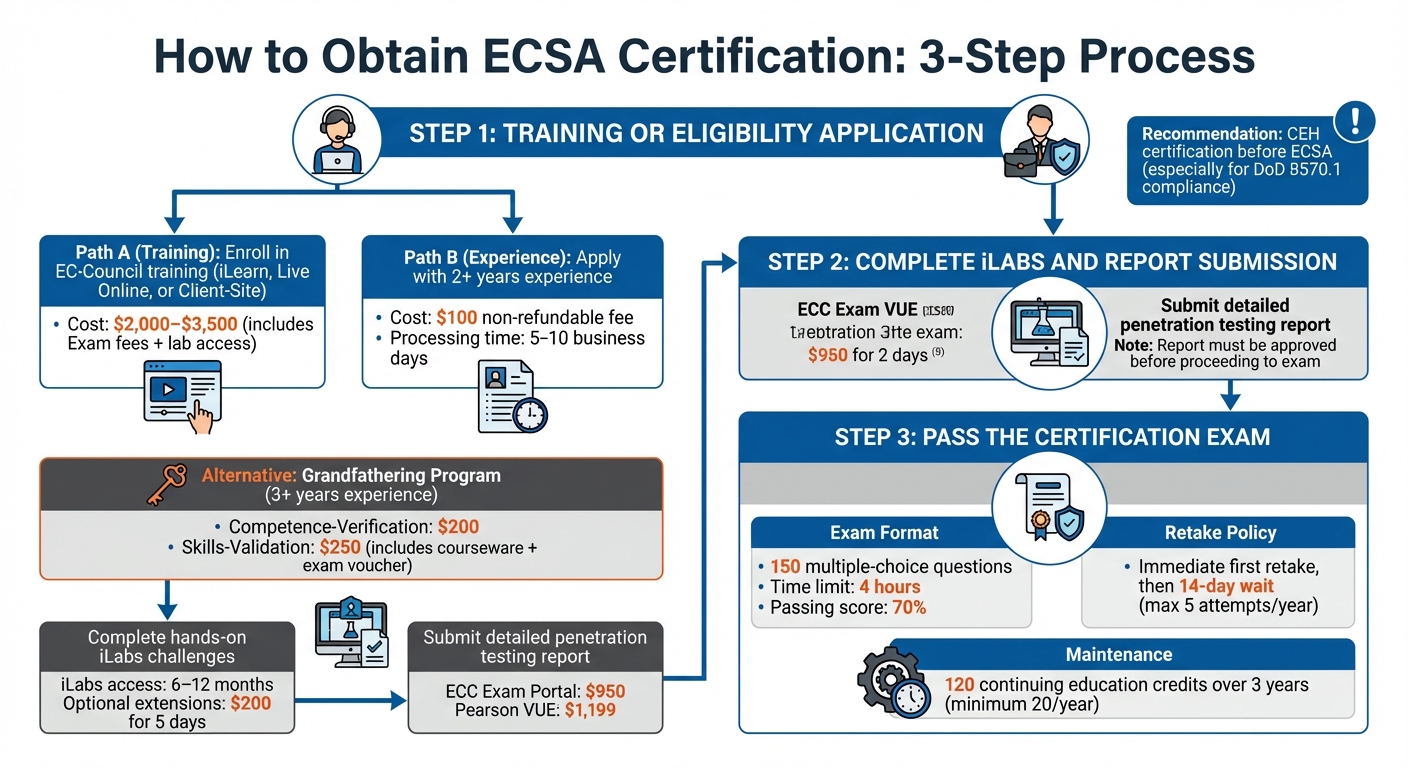
ECSA Certification Process: 3-Step Path to Becoming a Certified Security Analyst
Step 1: Training or Eligibility Application
The ECSA certification offers two distinct paths, depending on your experience level. If you’re new to the field, you can enroll in EC-Council training through options like iLearn, Live Online sessions, or Client-Site classes. These training bootcamps typically cost between $2,000 and $3,500 and include exam fees and lab access [5][9].
For seasoned professionals, there’s an alternative route. You can apply by providing proof of at least two years of relevant experience, along with a $100 non-refundable fee [6][10]. To avoid delays of 5–10 business days, make sure your references respond promptly [6][8].
Additionally, experienced candidates with three or more years in at least three core domains can explore the Grandfathering Program. This program has two options: Competence-Verification for $200 or Skills-Validation for $250, the latter including courseware and an exam voucher [8].
While the Certified Ethical Hacker (CEH) certification isn’t a strict requirement, it is highly recommended – especially for cleared professionals. CEH is explicitly listed under DoD 8570.1 compliance for roles like CND Analyst and Incident Responder, making it a valuable stepping stone before pursuing the ECSA [7][9].
Once you’ve chosen your eligibility path, the next step is to develop hands-on skills through iLabs challenges.
Step 2: Completing iLabs and Report Submission
You’ll need to complete iLabs challenges and submit a detailed penetration testing report [1][5]. Access to iLabs typically lasts between 6–12 months, with optional 5-day extensions available for $200 each [5][3].
Your report serves as the primary evidence of your testing skills, so professional documentation is critical [10]. Treat this process seriously – strong documentation skills are highly valued in the job market, particularly for cleared positions. Focus on creating a thorough and professional report as part of your preparation.
Once your report is reviewed and approved, you’ll be ready to move on to the exam.
Step 3: Passing the Certification Exam
After your report is validated, you can take the ECSA certification exam. The test consists of 150 questions, must be completed within 4 hours, and requires a 70% passing score [9][10]. You have two options for taking the exam: through the ECC Exam Portal for $950 or via Pearson VUE for $1,199 [6].
If you don’t pass the exam on your first attempt, you can retake it immediately. However, subsequent attempts require a 14-day waiting period, and you’re limited to five attempts per year [3].
To maintain your certification, you’ll need to earn 120 continuing education credits over three years, with a minimum of 20 credits per year [1].
Career Paths for ECSA-Certified Cleared Professionals
Cleared Job Roles That Require ECSA
For security-cleared professionals, earning an ECSA certification goes beyond just adding another credential to their resume. It validates advanced skills and opens doors to specialized, high-paying roles in cybersecurity. These roles often focus on structured penetration testing and include positions like Penetration Tester, Vulnerability Analyst, Security Assessor, Red Team Member, and Security Auditor [2][4]. These jobs align with the NICE Framework’s categories of "Protect and Defend", "Operate and Collect", and "Analyze" [3].
The ECSA certification prioritizes a methodical approach to penetration testing rather than simply relying on tools. It aligns with federal standards such as CNSS–4014 and NSTISSI–4015, which are critical in environments requiring assessments of hybrid setups that combine on-premise systems with cloud platforms [2][3].
"The ECSA is not a certification for entry-level learners; it is designed for professionals with a baseline understanding of cybersecurity who are ready to conduct methodical, structured penetration tests and document their findings with the same rigor and professionalism required in enterprise environments." – Examsnap [2]
Earning this certification can also lead to competitive salaries. On average, ECSA-certified professionals make $94,000 annually, with roles like Penetration Tester earning around $110,715 and top-tier positions like CISO reaching approximately $130,000. Salaries typically fall between $75,000 and $120,000, reflecting the certification’s value in the cleared job market [1][4][11].
ECSA Certification Advantages in the Cleared Job Market
The benefits of ECSA certification go beyond qualifying for specific roles. Its value lies in the competitive edge it provides within high-security environments. Here’s a breakdown of its key advantages and considerations:
| Advantages | Considerations |
|---|---|
| Hands-On Validation: iLabs simulate complex enterprise networks with layered defenses, showcasing practical skills [2] | Experience Requirement: Requires two years of relevant experience or completion of official training [1] |
| Professional Reporting: Mandatory report preparation trains analysts to meet strict documentation standards [2] | Rigorous Assessment: Success hinges on the quality of the submitted report [2] |
| Career Progression: Bridges foundational credentials like CEH to advanced certifications like LPT Master [1][2] | Continuing Education: Requires earning 120 credits over three years to maintain certification [1] |
| Market Growth: Cybersecurity market projected to grow from $172 billion in 2022 to over $345 billion by 2030 [4] | Specialized Focus: Less recognized than CEH or OSCP in certain non-government sectors [3] |
The ECSA’s focus on methodology-driven analysis – rather than tool-based testing – makes it particularly valuable in cleared environments. These settings demand structured assessment processes and professionals who can translate technical vulnerabilities into actionable insights for executives. This ability is essential for government agencies and defense contractors responsible for identifying system weaknesses and recommending improvements [2][4].
Using ECSA Certification on Cleared Cyber Security Jobs

Using Job Search Tools and Filters
If you’ve honed your penetration testing and reporting skills through your ECSA certification, you can make this credential work for you in the job market. Cleared Cyber Security Jobs offers tools to help you find positions tailored to your qualifications. Start by entering keywords like "ECSA" or "EC-Council Certified Security Analyst" in the search bar to uncover roles where this certification is highly valued [12]. Since the ECSA is recognized as a baseline skill by the U.S. Department of Defense (DoD) for its cyber workforce, these searches often lead to government contractor roles [9].
Refine your search results by applying filters for specific agencies or departments. Focus on organizations like the Department of Homeland Security (DHS) or the DoD, which actively seek EC-Council-certified professionals for their Security Operations Centers (SOC) [9][12]. The ECSA certification aligns with federal hiring standards, increasing your visibility to recruiters working within these frameworks [3].
Highlighting ECSA on Your Resume
When uploading your resume to Cleared Cyber Security Jobs, make sure your ECSA certification stands out in both the certifications and skills sections. Highlight your expertise in structured methodologies like the Penetration Testing Execution Standard (PTES) and NIST frameworks, which are integral to the ECSA curriculum [2]. Use specific terms such as "Security Architecture Testing" and "Vulnerability Reporting" to align with the language used by federal recruiters [3][9].
If you’ve gained hands-on experience with EC-Council iLabs, emphasize that to demonstrate your practical testing abilities [2]. Position your ECSA certification as a stepping stone between the Certified Ethical Hacker (CEH) and the Licensed Penetration Tester (LPT) Master certification, showcasing your progression toward advanced offensive security expertise [1][2]. For those who qualified through the two-year experience route instead of formal training, ensure your profile includes verifiable details of your professional background in information security [1].
Consider linking your EC-Council ASPEN digital badge directly to your profile. This feature allows employers to instantly verify your certification status and can help you stand out from candidates who only list their credentials without proof. Coupled with these resume strategies, the platform’s career resources can help you streamline your job search.
Using Career Resources and Job Alerts
Pair your polished resume with the career resources available through Cleared Cyber Security Jobs. The platform offers free tools tailored for security-cleared professionals, including advice on certification pathways and professional growth. Setting up ECSA-specific job alerts can help you quickly spot relevant positions. With penetration testers holding an ECSA certification earning an average salary of $96,000 annually – and top earners exceeding $135,000 – these alerts can guide you toward lucrative opportunities [9].
Additionally, the platform provides insights into recertification requirements. Since ECSA certification is valid for three years, you’ll need to either retake the exam or earn Continuing Education Units (CEUs) to maintain your status [9]. Staying on top of these requirements ensures your certification remains valid and attractive to potential employers. If you’re a veteran, the platform also offers guidance on using the GI Bill for test fee reimbursement, as the Department of Veterans Affairs includes ECSA under its eligible programs [9].
Conclusion
The ECSA certification showcases your ability to conduct structured, standards-based penetration tests. By training in frameworks like PTES and NIST, you’ll be prepared to tackle challenges in modern infrastructures, including cloud, mobile, and virtual environments [2][3]. Acting as a bridge between the foundational CEH skills and the advanced LPT Master certification, ECSA is a strategic credential for professionals aiming to advance in cybersecurity [2]. Additionally, meeting federal standards like CNSS-4014 and NSTISSI-4015 highlights its importance in government and defense roles [3]. This recognition not only validates your technical expertise but also opens doors to rewarding career paths.
Earning potential is another compelling factor. ECSA-certified professionals typically make between $75,000 and $120,000 annually, with top positions exceeding $130,000 [1][4]. As John Terra from Simplilearn explains, "ECSA is one of the five proven certifications that can significantly boost your cybersecurity career and enhance your earning power" [1].
To make the most of your ECSA credential, platforms like Cleared Cyber Security Jobs provide tools to connect you with real opportunities. Utilize keyword searches, apply agency-specific filters, and set up job alerts to stay informed about new openings. When crafting your resume, highlight not only your technical abilities but also your proficiency in documenting findings – a key ECSA skill that sets you apart as a trusted security consultant [2].
FAQs
Is ECSA worth it if I already have CEH?
Yes, earning an ECSA is worth considering even if you already hold a CEH. While the CEH lays the groundwork by teaching ethical hacking tools and techniques, the ECSA takes it a step further. It emphasizes applying those skills in real-world settings, focusing on methodology-based penetration testing and crafting detailed reports. This hands-on approach sharpens your practical abilities, making it a great option for professionals aiming to excel in security-cleared roles or climb the ladder in cybersecurity.
Which cleared roles benefit most from ECSA?
Cleared roles that gain the most from the ECSA certification include Cyber Security Engineers, Security Analysts, and Information Systems Security Managers (ISSM). These positions typically demand advanced expertise in areas like penetration testing, vulnerability assessment, and creating detailed security reports. The ECSA’s emphasis on hands-on testing and practical application makes it particularly useful for professionals in government or defense sectors looking to deepen their technical skills.
How hard is the ECSA iLabs report?
The challenge level of the ECSA iLabs report largely hinges on your familiarity with penetration testing. The exam presents around a dozen tasks, each increasing in complexity, designed to assess your ability to exploit vulnerabilities and document your findings effectively. With a 12-hour window to tackle at least five of these challenges and produce a comprehensive report, the process can feel intense – especially for those who may not be well-versed in structured methods or working under tight deadlines.