

Elastic SIEM is a powerful tool designed for security analysts in high-security environments like defense and intelligence. It centralizes log and event data, enabling faster threat detection and compliance with strict regulations. Key features include:
- 1,700+ Prebuilt Detection Rules: Updated biweekly, aligned with MITRE ATT&CK.
- Elastic Common Schema (ECS): Simplifies data normalization across sources.
- AI and Machine Learning: Automates anomaly detection, alert triage, and response.
- Compliance Support: Meets retention policies like OMB M-21-31 and NSM-8.
- Host Isolation: Contains incidents quickly in sensitive environments.
Elastic SIEM supports on-premises and air-gapped setups, making it ideal for classified networks. Analysts can enhance their skills in query languages (KQL, ES|QL), rule creation, and case management. Mastering Elastic SIEM opens doors to advanced roles, with salaries ranging from $60,000 to $200,000 annually. Certifications like Elastic Certified SIEM Analyst further validate expertise.
This guide covers workflows, tools, and configurations tailored for cleared environments, helping analysts streamline operations and meet compliance standards efficiently.
Core Features of Elastic SIEM
Data Ingestion and Normalization
Elastic SIEM simplifies data management by using the Elastic Common Schema (ECS) to standardize vendor-specific data into a unified format. Instead of dealing with multiple field names like src, client_ip, or src_ip for a source IP address, analysts can rely on a single field: source.ip. This eliminates the hassle of rewriting queries every time a new data source is integrated.
Eric Beahan from Elastic highlights the importance of this approach:
"By normalizing data to a single common model, you can uniformly examine your data using interactive search, visualizations, and automated analysis."[9]
This streamlined structure is especially helpful in environments where analysts need to correlate events across firewalls, endpoints, and cloud systems without wasting time on custom mappings. Once data is mapped to ECS, it instantly supports Elastic’s library of 1,300+ prebuilt detection rules and over 70 machine learning jobs, significantly reducing the need to build custom analytics from scratch[6].
Elastic Agent and Beats handle ECS field population during data ingestion, while ingest pipelines enrich the data with additional context like GeoIP, user agent details, and host metadata. For more specialized data sources, Elastic uses Large Language Models (LLMs) to create custom integrations that align with ECS. Security teams can also enforce validation rules to catch issues like missing ecs.version or incorrect event.category values, ensuring that all data is accurate and ready for effective threat detection.
This unified framework is the backbone for deploying advanced detection rules and leveraging AI-driven analytics.
Pre-Built Detection Rules and AI Capabilities
With ECS-normalized data in place, Elastic Security offers 1,300+ detection rules crafted by experts and aligned with the MITRE ATT&CK framework. These rules cover 54 different data sources and are updated biweekly – over 2,420 updates were made in 2024 alone – to keep pace with evolving threats[6][12]. This ensures analysts have up-to-date protection without the burden of manually maintaining rules.
Elastic supports various detection methods to identify threats effectively:
- Event Correlation (EQL): Tracks multi-step attack sequences by analyzing event patterns.
- Indicator Match: Compares logs against threat intelligence feeds to flag known risks.
- Threshold-Based Detection: Identifies anomalies like brute-force attacks by monitoring event volumes.
- New Terms Detection: Highlights previously unseen field values, useful for spotting unusual activity in stable environments[10].
The Elastic AI Assistant (available in the Enterprise tier) enhances productivity by resolving query errors, crafting detection rules, and automating alert triage and remediation tasks[6]. Kseniia Ignatovych from Elastic describes its purpose:
"Elastic Security is designed to help detection engineers – and anyone else responsible for security operations – build, manage, and optimize detection rules at scale so that you can focus on what matters most: protecting your organization."[6]
To combat alert fatigue, Elastic includes alert suppression, which consolidates similar alerts into a single notification. This allows analysts to concentrate on genuine threats rather than being overwhelmed by redundant alerts[6].
Entity Analytics and Anomaly Detection
Elastic SIEM incorporates over 70 prebuilt machine learning jobs, which analyze two weeks of historical data to establish baselines and then monitor for anomalies. These jobs detect unusual patterns such as rare processes, unexpected network activity, or suspicious logins, making them particularly effective in sensitive environments[6][8][11].
For instance:
- The
packetbeat_dns_tunnelingjob identifies an unusually high number of DNS queries to a single domain, which can indicate command-and-control (C2) activity or data exfiltration[8]. - The
windows_anomalous_user_name_ecsjob flags irregular user behavior that might suggest compromised credentials or lateral movement[8]. - Population-based analysis, like the "Anomalous Process For a Population" job, reduces false positives by focusing on processes that are rare across the entire environment rather than just on individual hosts[8].
These features help analysts detect threats efficiently while minimizing manual work. To ensure accuracy, analysts in regulated environments can tune prebuilt rules to account for authorized administrative activity. For example, tools like PsExec or WMI, commonly used in government settings, may trigger alerts. Cloning existing rules and adding filters – such as and not user.name: "authorized-admin" – can help reduce noise while maintaining detection precision[13].
Elastic also offers a manual rule run feature, enabling analysts to test new detection logic against up to 90 days of historical data. This allows teams to refine thresholds and assess potential noise levels before deploying changes live[6].
sbb-itb-bf7aa6b
Required Skills and Workflows for Cleared Analysts
Alert Triage and Prioritization
Cleared analysts face a daunting challenge: managing 8,000 alerts daily per cluster generated by 65 unique detection rules. Reviewing every alert manually is simply not feasible[14]. To tackle this, analysts rely on tools like Elasticsearch Query Language (ES|QL) and Kibana Query Language (KQL) to filter and transform data efficiently. These tools allow analysts to sort alerts by factors such as severity, MITRE ATT&CK techniques, or affected entities, making the process more manageable[15][17][18].
Higher-Order Rules (HOR) play a crucial role in streamlining triage. Instead of treating each alert as an isolated incident, HOR connects related signals across endpoint, network, and cloud data sources to reveal attack patterns. Samir Bousseaden from Elastic Security Labs puts it this way:
"Independent detections converging on the same entity compound confidence, where each additional signal multiplies the likelihood that the activity is real, not benign"[14].
This approach has proven effective, with production tests reducing alerts to around 30 per day, a volume SOC teams can handle comfortably[14].
Tools like the Elastic AI Assistant and Attack Discovery simplify triage further by consolidating hundreds of alerts into actionable attack chains. This allows analysts to focus on investigations rather than sifting through endless alerts. Nearly 20% of Elastic security customers already use the AI Assistant to boost efficiency[16][18][20]. Additionally, alert suppression and custom tags (e.g., Triage:Asset or Triage:PMFA) help automate workflows through SOAR platforms like Tines, which can close over 3,000 alerts daily without human involvement[2].
| Triage Step | Action | Estimated Time |
|---|---|---|
| Initial Assessment | Review severity, risk score, and MITRE mapping | 2 minutes |
| Context Gathering | Query related events using ES|QL (host, user, IP) | 3 minutes |
| Threat Intel Enrichment | Check indicators against threat intelligence feeds | 2 minutes |
| Classification | Decide: True Positive, False Positive, or Benign | 2 minutes |
| Documentation | Record rationale and evidence in Case Management | 1 minute |
Once triaged, alerts feed into streamlined investigation workflows, enabling analysts to act quickly and efficiently.
Investigation and Incident Enrichment
After prioritizing an alert, analysts must gather detailed context fast. Tools like Timeline visualize event sequences across datasets, while Analyze process tree and Run Osquery provide immediate host-level insights[15]. For instance, if a suspicious PowerShell command is flagged, Osquery can help uncover persistence mechanisms or map out parent-child relationships in the process tree to trace the origin.
ES|QL is particularly effective for correlating alerts with operational anomalies. Analysts can query system metrics – like CPU spikes or memory usage – to uncover compromises that may otherwise go undetected. Familiarity with ECS (Elastic Common Schema) ensures smooth cross-domain investigations by using consistent field mappings[14].
For threat intelligence enrichment, native connectors can automatically check file hashes against VirusTotal or query external databases for known malicious indicators[5]. The AI Assistant further speeds up investigations by summarizing alerts, offering classification rationale, and even generating or refining detection rule queries[6][5][20]. Santosh Krishnan, General Manager of Security at Elastic, highlights the value of these tools:
"Attack Discovery will power productivity and supplement practitioner knowledge to speed up threat detection, investigation, and response. It helps your people – and SOC – succeed"[20].
Case Management and Automation
With enriched incident data in hand, effective case management becomes crucial. Kibana Cases centralize all relevant information – attack summaries, alerts, observables, and events – into a single view[4]. Analysts can also add custom fields to track metrics like Mean Time to Resolution (MTTR) or trigger automated detection tuning requests with a click[19]. The Similar cases feature identifies recurring observables, offering insights into threat actor behavior[4].
Repetitive tasks can be automated using YAML-based Kibana playbooks. These playbooks handle tasks like checking VirusTotal, gathering host context, and sending alerts via Slack or PagerDuty[5]. A May 2024 workflow implemented by the Elastic InfoSec team is a striking example: by leveraging Tines and Elastic Security, they automated the triage and closure of over 50,000 alerts in 30 days. Custom tags like Triage:PMFA (used for phishing-resistant MFA checks) and Triage:Workstation (to verify managed status through proxy logs) played a key role. This automation eliminated the need for an estimated 94 additional full-time employees while maintaining visibility[2].
For critical actions like host isolation, workflows can be configured to pause for human approval via Slack, email, or Kibana UI[5]. When closing alerts – whether manually or through automation – specific reasons such as "False Positive", "Benign Positive", or "Duplicate" should be documented. This practice improves future filtering and enhances metrics[15].
Automation doesn’t replace analysts; it empowers them. As Crossley McEwen from Elastic puts it:
"Automation isn’t about replacing people; it’s about elevating them. When tedious tasks are handled by systems, analysts are freed to think, lead, and act"[16].
Configuring Elastic SIEM for Cleared Environments
Compliance and Governance
Elastic SIEM is designed to help cleared environments meet strict compliance standards while maintaining advanced detection capabilities. These environments often need to adhere to frameworks like CMMC, NIST 800-171, and NSM-8. Elastic SIEM supports all three CMMC levels – Foundational (Level 1), Advanced (Level 2), and Expert (Level 3) – making it a strong choice for defense contractors and government agencies[21]. Whether deployed on-premises, in the cloud, or within air-gapped networks, the platform is built to adapt to various operational needs[3].
A key compliance requirement is data retention. For example, NSM-8 mandates 72 hours for full packet capture, 12 months for active logs, and 18 months for cold storage. Elastic addresses this with its frozen tier storage and searchable snapshots, which can cut storage costs by up to 90% while maintaining fast search capabilities[22]. As Ken Melero, Public Sector Expert at Elastic, highlights:
"The speed and success of cyber incident response can be significantly influenced by the amount and nature of data recorded in network logs, as well as how that data is retained and accessed."[22]
Elastic’s Event Correlation System (ECS) ensures field standardization with mappings like @timestamp, event.kind, and event.category. This standardization simplifies cross-source correlation and auditing[7]. For effective governance, analysts should align custom detection rules with the MITRE ATT&CK framework to identify any gaps in coverage[24]. To manage noise from authorized activities – like security testing or admin scripts – it’s better to clone and modify prebuilt rules rather than disabling them. This approach reduces alert fatigue while preserving an audit trail[13][25].
| Requirement Category | Best Practice Configuration | Compliance Alignment |
|---|---|---|
| Data Retention | Use Frozen Tiers with Searchable Snapshots | NSM-8, EO 14028[22] |
| Access Control | Apply Role-Based Access Control (RBAC) | CMMC Level 2, NIST 800-171[21] |
| Integrity | Enable File Integrity Monitoring (FIM) | CMMC Level 3, NIST 800-172[21] |
| Threat Detection | Map custom rules to MITRE ATT&CK framework | NSM-8, Section 7[22][24] |
These compliance measures are further supported by Elastic SIEM’s operational capabilities, such as advanced host isolation and incident response features.
Host Isolation and Response Actions
In cleared environments, swift incident containment is essential. For high-severity alerts like "Windows Event Logs Cleared", Elastic SIEM offers native host isolation capabilities. These work seamlessly with Elastic Defend and third-party EDR platforms like CrowdStrike, Microsoft Defender for Endpoint, and SentinelOne[23]. For organizations using CrowdStrike’s government cloud, the connector must be configured with the US-GOV base URL: https://api.laggar.gcw.crowdstrike.com[26].
To adhere to security best practices, configure API clients with least privilege access. Create separate API clients for data access and action execution, ensuring each has only the permissions it requires[26]. Within Kibana, response actions need specific feature privileges under "Actions and Connectors" and "Endpoint Security", along with roles like SOC Manager or Endpoint Operations Analyst[26].
Automating response workflows can significantly reduce Mean Time to Respond (MTTR). Before deploying these workflows in classified networks, test them with open-source threat emulation tools like Stratus Red Team or Pacu to ensure they work as intended[26].
Elastic’s commitment to supporting on-premises users is evident in its platform overview:
"Unlike cloud-only providers, Elastic treats on-prem users as first-class citizens, with full SIEM capabilities even in air-gapped or DIL environments."[3]
For instance, in 2024, Sierra Nevada Corporation (SNC), a leading defense contractor, utilized Elastic Security to protect its infrastructure across both on-premises and cloud environments while meeting stringent security standards[3]. This example underscores Elastic’s ability to handle sensitive, defense-related operations while meeting compliance needs.
Introduction to Elastic Certified SIEM Analyst Exam preparation
Career Benefits of Elastic SIEM Expertise
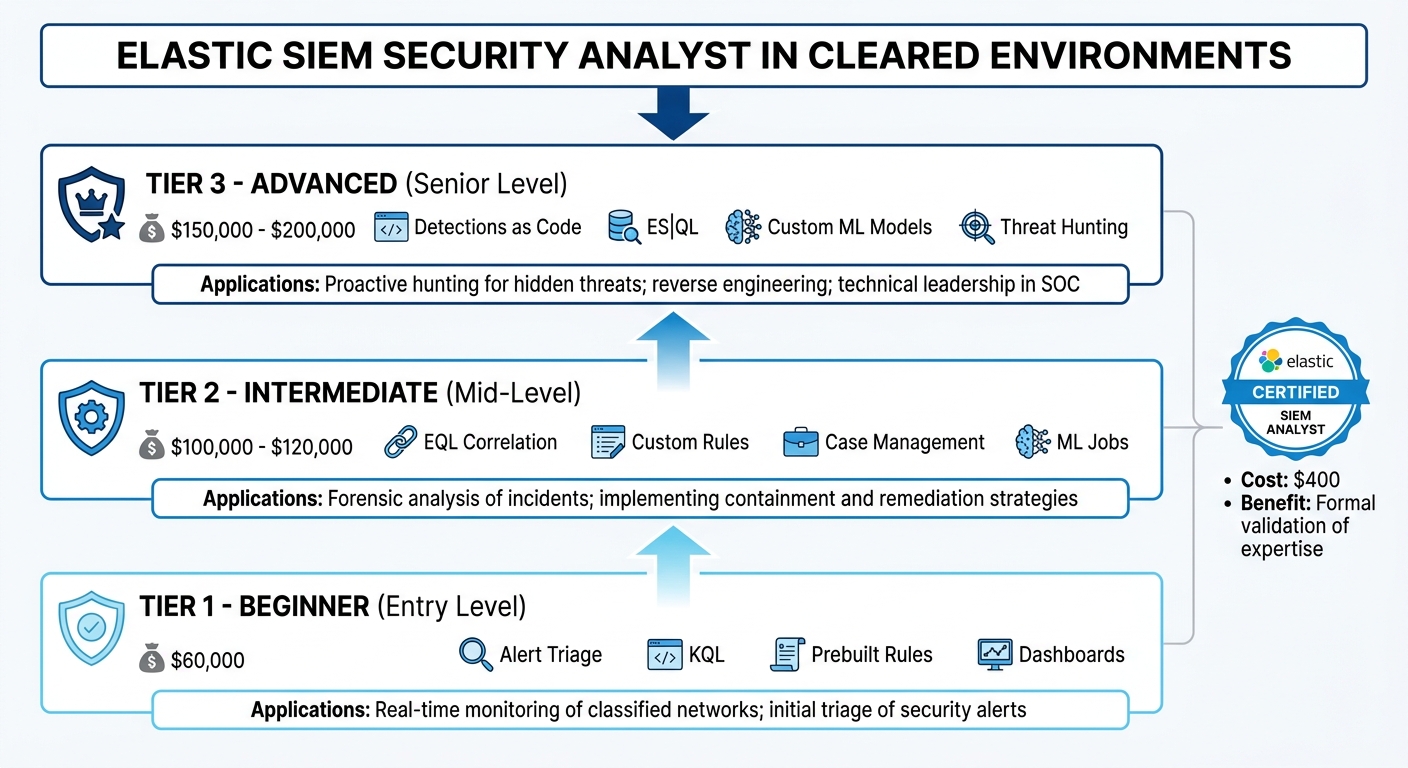
Elastic SIEM Skill Progression for Cleared Security Analysts
Skill Development for Cleared Roles
For security analysts working in cleared environments, gaining expertise in Elastic SIEM can lead to both operational excellence and promising career growth. Analysts enhance their skills in areas like AI-augmented workflows for alert summarization, query conversion, and automation. They also become adept in advanced query languages such as ES|QL, KQL, and EQL, which are crucial for identifying and mitigating complex attacks within classified networks[6][27][28].
The Elastic Common Schema (ECS) serves as a standardized framework, enabling analysts to correlate diverse data types from networks, endpoints, and cloud environments. This unified structure is particularly beneficial in government settings, where data is often stored in silos[28][27]. Advanced users can leverage "Detections as Code" (DaC) to bring version control and automated testing into rule management[6]. Organizations using AI-enhanced SIEM tools have reported impressive results, including a 300% boost in alert fidelity and a 34% decrease in investigation time[1][30].
The table below outlines the progression of skills for professionals working with Elastic SIEM, from foundational to advanced roles.
Skill Progression Table
| Skill Level | Elastic SIEM Features | Cleared-Specific Applications |
|---|---|---|
| Beginner (Tier 1) | Alert Triage, KQL, Prebuilt Rules, Dashboards | Real-time monitoring of classified networks; initial triage of security alerts. |
| Intermediate (Tier 2) | EQL Correlation, Custom Rules, Case Management, ML Jobs | Forensic analysis of incidents; implementing containment and remediation strategies. |
| Advanced (Tier 3) | Detections as Code, ES|QL, Custom ML Models, Threat Hunting | Proactive hunting for hidden threats; reverse engineering; technical leadership in SOC. |
Mastering these skills enhances operational performance and creates pathways to advanced roles and leadership positions.
Long-Term Career Impact
Elastic SIEM expertise can significantly boost earning potential. Entry-level analysts can expect salaries starting around $60,000, while senior professionals may earn up to $200,000 annually[29]. Additionally, the Elastic Certified SIEM Analyst certification, priced at $400, is a valuable credential that validates skills and opens doors to new opportunities[32].
Lucian P., Founder & Principal Consultant, highlights the value of certification:
"Taking the certification shows you the power of Elastic. [This certification] started getting recognized for this by our customers and they now know they are dealing with professionals."[31]
This expertise not only enhances roles within Security Operations Centers (SOC) but also paves the way for strategic positions such as Security Architect, Security Engineer, and SOC Manager[29].
Conclusion
This guide has shown how Elastic SIEM reshapes both security operations and career growth for professionals working in high-security, cleared environments. Gaining expertise in Elastic SIEM is a critical skill for security analysts, boosting both operational efficiency and career opportunities. Its secure architecture – designed with on-premises users as "first-class citizens" – makes it an excellent fit for environments where data residency and sovereignty are non-negotiable priorities [3].
Take Sierra Nevada Corporation, for example. In 2025, they achieved a tenfold increase in data ingestion while slashing query times from minutes to seconds using Elastic’s AI-driven SIEM. This improvement enabled them to offer a managed service that became a revenue generator. Similarly, Proficio achieved a 34% reduction in investigation time and a 75% improvement in response speeds, saving an estimated $1 million over three years [1]. With features like federated search across petabytes of data and access to over 1,300 prebuilt detection rules [6], Elastic SIEM demonstrates its ability to transform security operations. These results not only enhance organizational security but also pave the way for strong career advancement.
Elastic SIEM doesn’t just improve workflows – it also opens doors to significant career progression. Cleared professionals can move from entry-level roles, which typically pay around $60,000 annually, to senior positions earning over $200,000 per year as they master tools like ES|QL, KQL, and Detections as Code [29]. The Elastic Certified SIEM Analyst credential, priced at $400, provides formal recognition of these skills. As Jesse P., a Search Development Specialist, explains:
"When you get certified, you are going to be really valuable. People from all over the world are coming to me asking about Elasticsearch" [31].
Additionally, the integration of AI-driven analytics and natural language tools reduces the burden of manual tasks, allowing analysts to focus on advanced threat hunting. Features like Attack Discovery streamline alert triage, turning hundreds of alerts into actionable attack chains. This shift transforms analysts’ roles from reactive alert management to proactive security engineering, elevating both individual careers and organizational resilience in cleared environments [1][20]. By mastering Elastic SIEM, professionals not only safeguard their organizations but also position themselves for leadership roles in the rapidly evolving cybersecurity landscape.
FAQs
What data sources should I ingest first to get the most value from Elastic SIEM?
To make the most out of Elastic SIEM, focus on bringing in network traffic logs, endpoint data, and application logs first. These key data sources are essential for gaining visibility into potential threats and responding to incidents effectively. Starting with these logs creates a solid base for your security efforts and makes it easier to incorporate more data sources down the road. This approach ensures efficient monitoring and thorough investigation right from the beginning.
How do I tune prebuilt detection rules to reduce false positives from authorized admin activity?
To minimize false positives caused by legitimate admin activity in Elastic SIEM, start by cloning and customizing detection rules to align with your environment’s typical behavior and exceptions. Include exceptions for known admin tasks to avoid triggering unnecessary alerts. You can also tweak risk scores and turn off rules that seldom generate useful alerts. Head over to the Rules page in Elastic Security to efficiently manage, edit, and prioritize your detection rules.
What’s the best way to use ES|QL, KQL, and EQL together during alert triage and investigations?
Effectively working with ES|QL, KQL, and EQL means tapping into their specific strengths during various stages of alert triage and investigation. Use KQL to quickly filter and search within the SIEM interface, EQL to dive into event sequences and identify correlations over time, and ES|QL for crafting detection rules that demand complex data transformations or aggregations. Using these tools together streamlines workflows and improves precision in detecting threats.