

Space Force Delta 6, also known as the "Cyber Delta", is the U.S. Space Force’s primary unit for cyberspace operations. It protects critical space systems like military satellites and GPS infrastructure from cyber threats. Headquartered at Schriever Space Force Base, Colorado, Delta 6 offers specialized roles for security-cleared professionals in cybersecurity, satellite communications, and infrastructure management. Here’s what you need to know:
- Key Roles: Cyber Operations Specialists (enlisted), Cyberspace Effects Operations Officers (officer-level), and Cyber Systems Operations (enlisted/civilian).
- Qualifications: U.S. citizenship, Single Scope Background Investigation (SSBI) for security clearance, and STEM education or IT certifications like Security+ or CISSP.
- Locations: Schriever Space Force Base and detachments worldwide, including Guam and Greenland.
- Application Platforms: USAJOBS for civilians, Air Force recruiters for enlisted roles, and specialized job boards like Cleared Cyber Security Jobs.
Delta 6 focuses on safeguarding the $6.8 billion Satellite Control Network, ensuring the security of ground, link, and space systems critical to national defense. With salaries averaging $128,000 for cleared positions, it’s a prime opportunity for cybersecurity professionals.
What is Space Force Delta 6 and What Does It Do?
Delta 6 Overview
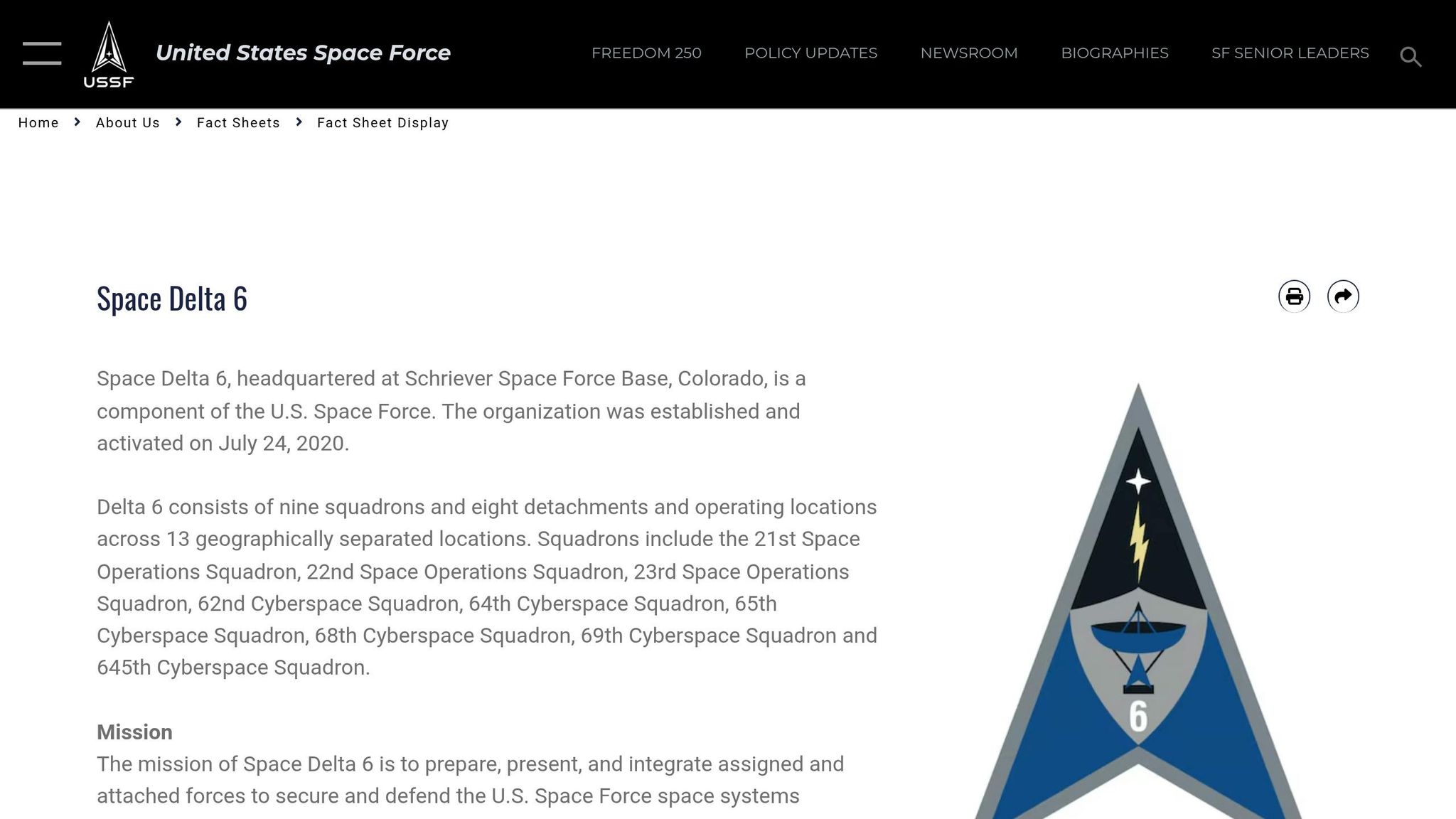
Delta 6 serves as the Space Force’s cyber warfare unit, tasked with managing the Satellite Control Network. This network is a global system of antennas and communication links that ensures command and control of both military and civilian satellites. It relies on strategically placed sites around the world to maintain seamless operations.
The unit is divided into three satellite operations squadrons that oversee daily network management and six cyberspace squadrons focused on defense. Each of these cyber squadrons is dedicated to protecting specific Space Force missions. For example:
- The 64th Cyberspace Squadron safeguards missile warning systems for Delta 4.
- The 68th Cyberspace Squadron defends satellite communications for Delta 8.
- The 69th Cyberspace Squadron secures orbital warfare capabilities for Delta 9.
Delta 6’s role goes far beyond standard IT operations. Its focus is mission-specific cyber warfare, where Guardians protect critical systems like satellite controls, GPS signals, and communications between ground stations and orbiting satellites. To streamline this focus, the Space Force is offloading general IT responsibilities to the 16th Air Force and private partners. This allows Delta 6 to concentrate exclusively on defending the space domain, emphasizing its importance in national defense.
Why Delta 6 Matters for National Security
Delta 6 plays a key role in safeguarding national security by addressing vulnerabilities in the cyber aspects of ground, link, and space systems. Modern military operations heavily depend on space-based assets like GPS for precision targeting, satellites for communication, and sensors for missile detection. A successful cyberattack on these systems could severely undermine U.S. military capabilities without the need for physical conflict.
To counter these threats, Delta 6 deploys Mission Defense Teams (MDTs). These teams act as embedded Cyber Security Service Providers within other Space Force deltas. Rather than waiting for attacks to happen, MDTs actively monitor, detect, and secure systems to stay ahead of potential threats.
"In order to perform the different capabilities within Information Warfare, the forces are dependent on and need space-based assets" [4]
The Space Force is also positioning Delta 6 as an independent cyber component under U.S. Cyber Command. This move highlights the increasing need for specialized expertise to protect orbital infrastructure, which differs significantly from traditional network defense. By focusing on the unique challenges of the space domain, Delta 6 is ensuring the resilience of critical systems that underpin national security.
sbb-itb-bf7aa6b
129 – 17X Cyberspace Warfare Officer with Maj Brian Thorn, Part 1
Types of Cleared Cyber Jobs at Space Force Delta 6
Space Force Delta 6 Cyber Career Paths Comparison Chart
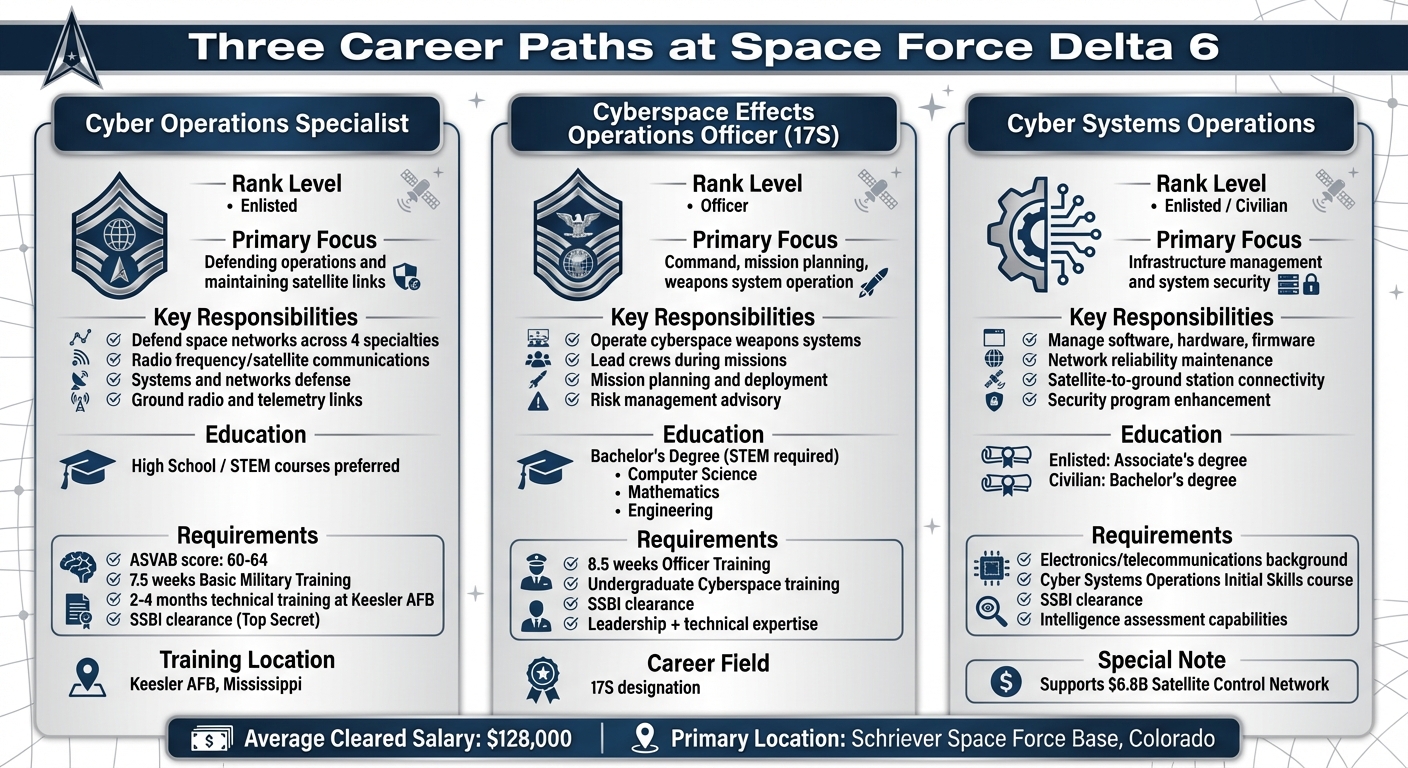
Delta 6 offers three distinct career paths for security-cleared professionals tasked with safeguarding the $6.8 billion Satellite Control Network [1][2]. These roles encompass technical experts, officers managing cyber weapons systems, and those overseeing mission-critical operations. Each path equips individuals with specialized skills to protect vital space assets.
Cyber Operations Specialists
Cyber Operations Specialists are enlisted personnel who focus on defending space networks across four key areas: defense, radio frequency/satellite communications, systems, and networks. Their duties include identifying vulnerabilities, repairing systems, and setting up ground radio and telemetry links between satellites and their ground stations.
"It’s our Cyber Operations specialist’s job to protect our cyber operations across four key specialties: defense, radio frequency and satellite communications, systems, and networks." – U.S. Space Force [3]
To qualify, candidates must achieve a score of 60–64 on the ASVAB, complete 7.5 weeks of Basic Military Training, and undergo 2 to 4 months of technical training at Keesler AFB in Mississippi. A Single Scope Background Investigation (SSBI) is required to secure top-secret clearance. Those with STEM coursework or IT certifications often have better placement opportunities within Delta 6’s specialized cyber units.
Cyberspace Effects Operations Officers
The 17S career field is for officer-level cyber warfare specialists. These officers operate cyberspace weapons systems, lead crews during missions, and manage operations in both planned and crisis scenarios. They are responsible for mission planning, deploying cyberspace capabilities, and advising on risk management strategies.
To enter this role, candidates need a Bachelor’s degree in a STEM discipline such as Computer Science, Mathematics, or Engineering. They must complete 8.5 weeks of Officer Training followed by Undergraduate Cyberspace training. This role requires a mix of leadership and technical expertise, as officers are responsible for tactical decisions and crew management, ensuring technical operations align with mission objectives.
Cyber Systems Operations
Cyber Systems Operations focuses on the infrastructure that underpins space operations. Specialists in this area manage software, hardware, and firmware, ensuring the reliability of networks that connect satellites to ground stations. Their work is critical to maintaining the confidentiality and integrity of the systems supporting the Satellite Control Network’s global operations.
Enlisted personnel in this specialty need a background in electronics and telecommunications, along with completion of the Cyber Systems Operations Initial Skills course. Civilian roles, on the other hand, typically require a Bachelor’s degree in a related field. These professionals enhance security programs and advise commanders on intelligence assessments to ensure mission safety.
| Role | Rank Level | Primary Focus | Minimum Education |
|---|---|---|---|
| Cyber Operations Specialist | Enlisted | Defending operations and maintaining satellite links | High School / STEM courses |
| Cyberspace Effects Operations Officer | Officer (17S) | Command, mission planning, weapons system operation | Bachelor’s Degree (STEM) |
| Cyber Systems Operations | Enlisted / Civilian | Infrastructure management and system security | Associate’s (Enlisted) / Bachelor’s (Civilian) |
Required Qualifications and Certifications
To secure a Delta 6 cyber role, you must meet specific citizenship, background, and technical requirements. U.S. citizenship is mandatory for all positions, along with the ability to obtain a Single Scope Background Investigation (SSBI), which provides either Top Secret or Secret clearance based on your role [3][2]. The clearance process now follows the Trusted Workforce 2.0 (TW 2.0) framework, replacing the older e-QIP system with a streamlined "eApp" platform that features logic-based questioning and real-time error checks [7]. Let’s break down the key qualifications, including security clearance, certifications, and education, needed to join Delta 6.
Security Clearance Requirements
Most Delta 6 cyber roles require either a Secret (Tier 3) or Top Secret (Tier 5) clearance to work with classified satellite control systems. As of 2026, processing times for clearances vary: Secret clearances take 60 to 150 days, while Top Secret clearances take 120 to 240 days [7]. Some candidates may qualify for an Interim Secret clearance, which can be issued within 10 to 30 days based on initial automated checks, allowing limited work to begin [7].
Clearance sponsorship by a federal agency or an authorized contractor is essential. Once obtained, your clearance is maintained through Continuous Vetting (CV), an automated system that monitors criminal, financial, and travel records in real time. This system eliminates the need for traditional five- or 10-year periodic reinvestigations [7]. Financial issues are a common reason for clearance denial, so it’s wise to review your credit and resolve any discrepancies before applying [7]. Keep in mind, clearance becomes inactive 24 months after leaving a sponsored role unless a new employer picks it up [7]. Alongside clearance, industry certifications bolster your qualifications.
Required Certifications for Cyber Professionals
Certifications play a vital role in validating your skills. The Air Force Credentialing Opportunities On-Line (COOL) program helps Guardians identify and fund industry-recognized credentials [8][2]. IT certifications are especially helpful for enlisted Cyber Operations specialists, particularly those with an associate’s degree or higher [3]. For senior leadership roles, advanced certifications like the Certified Information Systems Security Professional (CISSP) are often held by individuals such as the Deputy Director of Delta 6 [1].
In addition to certifications, personnel must complete the Cyber Systems Operations Initial Skills course and specialized training tailored to the $6.8 billion Satellite Control Network’s unique space-cyber threats [3][5][2]. Mission-specific training is also required to handle these advanced operations.
Education and Experience Requirements
Delta 6 emphasizes education and experience as critical factors in its hiring process. Requirements differ for civilian, enlisted, and officer roles:
- Civilian positions typically require a Bachelor’s degree in fields like computer science, mathematics, engineering, or management-information systems [5].
- Enlisted Guardians need at least a high school diploma, with STEM courses preferred, and must achieve a qualifying ASVAB score of 60–64 depending on the specialty [3][2].
- Officers entering through the Cyber Direct Commissioning Program must hold a Bachelor’s degree or higher, with advanced degrees and STEM fields preferred. They also need minimum AFOQT scores of 15 for Verbal and 10 for Quantitative [9].
Experience in areas like software development, network security, or related fields significantly enhances your application. Candidates for direct commission should document specialized training, such as malware programming or cloud architecture, to qualify for Constructive Service Credit, which can lead to a higher entry rank, ranging from Lieutenant to Colonel [9]. Career advancement for Guardians is based on competency, progressing through Basic, Senior, and Master proficiency levels rather than solely relying on time-in-service.
How to Apply for Delta 6 Cyber Jobs
If you’re aiming for a role within Delta 6, you’ll need to navigate federal hiring platforms and specialized job boards tailored for security-cleared professionals. The process differs depending on whether you’re pursuing a civilian or enlisted position. Civilian applicants use USAJOBS as their primary portal, while enlisted candidates work directly with Air Force recruiters and attend Basic Military Training at Joint Base San Antonio [10][3]. Here’s how to approach these systems, utilize Cleared Cyber Security Jobs, and strengthen your application.
Applying Through USAJOBS

USAJOBS serves as the official federal job portal for most civilian Delta 6 positions. Start by creating a profile and uploading a federal-style resume. Use relevant search terms such as "Space Force", "Delta 6", "Schriever Space Force Base", or specific unit names like "62nd Cyberspace Squadron" or "68th Cyberspace Squadron" [1][2].
Your application will need supporting documents like official college transcripts and proof of IT certifications, such as Security+ or CISSP [5]. It’s also crucial to specify your current clearance level – Secret, Top Secret, or TS/SCI. If you don’t have an active clearance, indicate your eligibility for a Single Scope Background Investigation to show you’re capable of obtaining one [2][3].
To refine your search, focus on locations where Delta 6 operates. Its headquarters is at Schriever Space Force Base in Colorado, with detachments at bases like Vandenberg SFB in California and New Boston Space Force Station in New Hampshire [1].
Using Cleared Cyber Security Jobs for Your Search
Cleared Cyber Security Jobs (cybersecjobs.com) is a specialized platform for professionals with active security clearances. It highlights positions requiring clearances ranging from Secret to TS/SCI with Full Scope Polygraph [11]. This focus is especially helpful, considering that 26% of cybersecurity positions are projected to remain unfilled by 2026 [11].
Use the platform’s advanced filters and alerts to zero in on locations like Colorado Springs and Schriever Space Force Base, where cleared salaries average around $128,000 [11][1]. Alongside government roles, the site also lists contractor positions with defense companies that require similar clearances.
The platform provides salary guides to help you understand how much more cleared roles pay. On average, cleared cybersecurity positions offer 20–40% higher salaries than comparable commercial roles, with additional premiums for higher clearance levels [11].
Application Tips and Best Practices
To stand out, your resume should go beyond listing certifications and emphasize practical experience. Highlight hands-on projects, such as building home labs or participating in Capture The Flag competitions, to showcase your technical abilities [11]. For entry-level roles, note that Security+ is often the minimum certification required under DoD 8140 compliance [11].
If you have a STEM background, be sure to include coursework or training in areas like operating systems, networking protocols, and hardware [12][3]. Enlisted candidates should aim for a minimum score of 64 on the ASVAB and 60 on the EDPT [12]. For civilian roles, structure your resume to reflect a clear path of skill development and continuous learning [11].
Career Growth and Advancement at Delta 6
Entry-Level to Mid-Level Career Path
At Delta 6, career paths differ for enlisted Guardians, officers, and civilians, offering tailored opportunities for each group. Enlisted Guardians typically start as Cyber Operations Specialists, focusing on one of four key areas: defense, radio frequency and satellite communications, systems, or networks. After completing the necessary training, they take on operational missions that align with Delta 6’s mission of safeguarding critical space systems [3]. Advancement for enlisted personnel follows a competency-based model, progressing through three stages: Basic, Senior, and Master cyber operator levels, based on demonstrated skills [2].
Officers begin their careers as Cyberspace Effects Operations Officers (17S) after completing 8.5 weeks of Officer Training and Undergraduate Cyberspace Training [6]. Initially, they lead tactical missions and operate cyberspace weapons systems. Over time, they move into leadership roles, such as Flight Commander or Mission Lead. Civilians, on the other hand, often join through the Air Force Civilian Service (AFCS) or as contractors. They typically start as Cybersecurity Specialists and can advance to roles like Senior Cybersecurity Analyst by showcasing their expertise.
Senior and Leadership Positions
Delta 6 provides a clear path to senior and leadership roles for those who excel in their initial positions. Senior roles include Squadron Commanders, who oversee units such as the 62nd or 68th Cyberspace Squadrons, and Delta Commanders, who manage the entire 1,200-person organization at the Colonel level [1]. Enlisted personnel have the opportunity to rise to Senior Enlisted Leader positions (CMSgt), while civilians can advance to Deputy Director roles at the GS-15 level. These higher-level positions demand extensive mission experience and proven leadership capabilities.
Additionally, Delta 6 is playing a key role in the Space Force’s establishment of an independent cyber component within U.S. Cyber Command (USCYBERCOM). This development opens up new senior leadership opportunities and highlights Delta 6’s shift toward a more warfare-oriented approach to cybersecurity – emphasizing a combat mindset rather than traditional IT administration [2].
Training and Professional Development Programs
Delta 6 places a strong emphasis on professional development through programs managed by the Space Training and Readiness Command (STARCOM). This includes the USSF Cyber Combat Course and other advanced training initiatives [1]. The unit also operates Combat Training Detachment 1 at Schriever Space Force Base, which focuses exclusively on cyber training. Enlisted Guardians have the added benefit of earning credits toward associate’s degrees in Electronic Systems Technology or Information Systems Technology through the Community College of the Air Force (CCAF) while serving [3].
Training at Delta 6 is designed to prepare personnel for defending orbital assets and managing satellite command-and-control infrastructure, including the $6.8 billion Satellite Control Network [2]. This comprehensive training framework equips individuals with the skills needed for continued career growth within the organization.
Summary: Next Steps for Cleared Cyber Professionals
Space Force Delta 6 provides three main entry routes for cleared cyber professionals: enlisted, officer, and civilian. The enlisted path requires ASVAB scores between 60–64, while officers typically pursue the 17S Cyberspace Effects Operations role. For civilians, a relevant STEM Bachelor’s degree is a must. Across all pathways, U.S. citizenship and the ability to pass a Single Scope Background Investigation (SSBI) are mandatory. Most positions also require TS/SCI eligibility. Notably, holding a TS/SCI clearance can boost annual earnings by $30K–$45K, and adding a Full Scope Polygraph can increase that by an additional $45K–$65K annually over a 20-year career span [11].
To get started, aim for a Security+ certification, which serves as the baseline for most DoD 8140/8570 cyber roles. Schriever Space Force Base in Colorado Springs is a key target location, hosting Delta 6’s headquarters and squadrons. The average cleared salary there is $128K ($121.9K when adjusted for cost of living) [11].
For civilian or contractor roles with Delta 6, Cleared Cyber Security Jobs is a valuable resource. This platform specializes in the cleared cybersecurity market, offering positions that typically pay 20–40% higher than commercial roles. It also provides verified salary data for 2026, tailored to specific clearance levels. With over 514,000 cybersecurity job postings projected in 2026 and about 26% of these positions remaining unfilled, cleared professionals hold a strong advantage in the job market [11].
When applying, highlight mission-critical skills, such as satellite communications (SATCOM), ground-link-space segment security, and defensive cyberspace operations. Be prepared for on-site work in a SCIF, as most high-clearance roles require it. Look for defense contractors that sponsor clearances or value long-term growth potential. Finally, keep in mind that Delta 6 is evolving into a warfare-oriented cyber force, prioritizing candidates with a combat-ready mindset over traditional IT experience [2].
FAQs
Do I need an active clearance to apply?
Yes, having an active security clearance is mandatory to apply for cleared cyber jobs with Space Force Delta 6. This requirement applies to all positions within this specialized unit.
What does Delta 6 cyber work look like day to day?
At Space Force Delta 6, the daily grind revolves around safeguarding space assets and ensuring secure communication channels. The team tackles a variety of tasks, including vulnerability assessments for satellite and ground systems, upgrading network infrastructure, and planning cyber missions.
These professionals are deeply involved in troubleshooting communication systems, defending against cyber threats, and keeping a close eye on the Satellite Control Network. Their efforts are vital to maintaining the integrity and reliability of space operations. Every aspect of their work is highly technical, mission-focused, and carried out in secure environments designed to protect sensitive information.
How can I boost my odds before I apply?
To boost your chances of landing a cyber role with Space Force Delta 6, focus on obtaining key certifications, such as a full-scope polygraph. Sharpen your expertise in areas like satellite communications, network security, and cyber defense, while building a solid foundation in STEM education. Prior experience in cybersecurity, particularly in roles safeguarding space assets, and a clear understanding of Delta 6’s mission can set you apart from other candidates.