

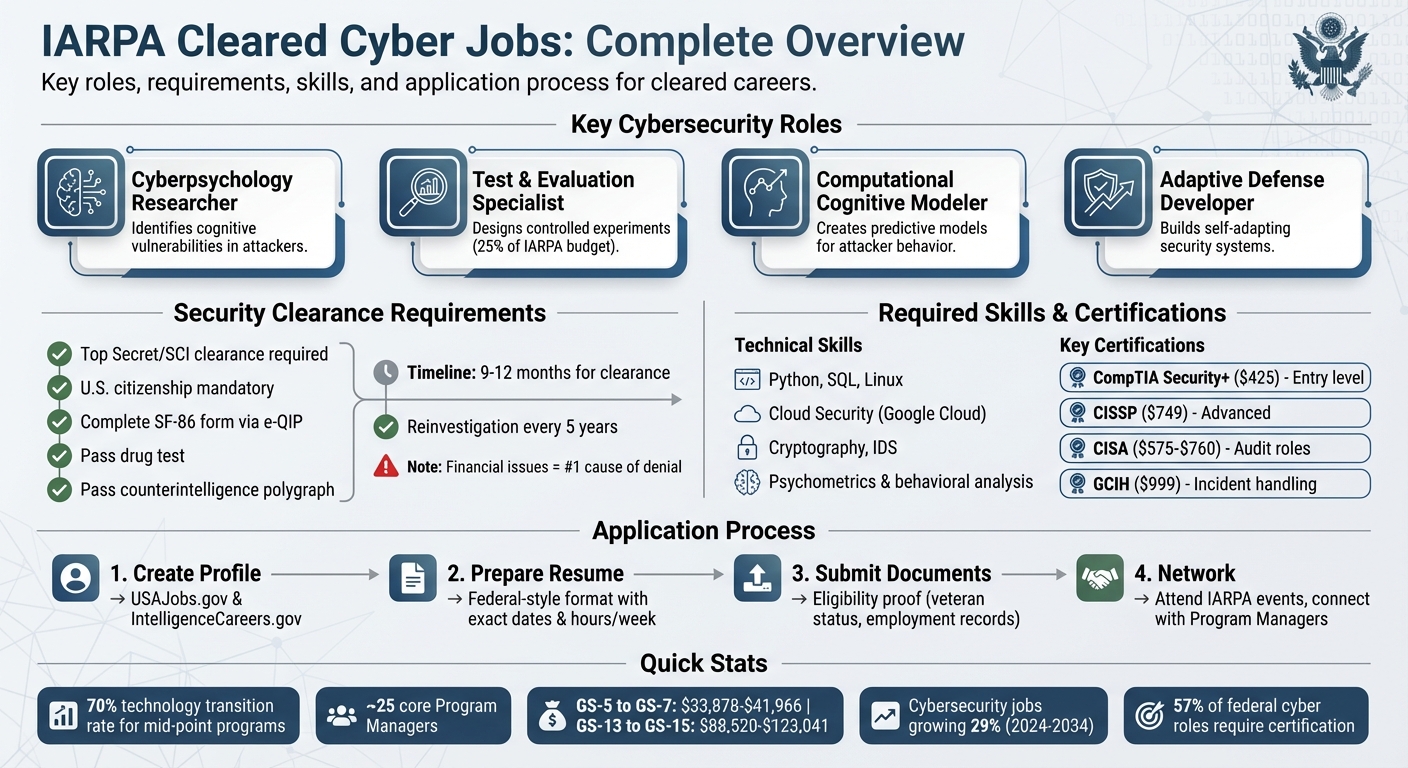
IARPA (Intelligence Advanced Research Projects Activity) focuses on high-risk research to advance cybersecurity within the U.S. Intelligence Community. This guide explains how to navigate careers at IARPA, including job roles, application processes, and security requirements. Here’s what you need to know:
- Key Roles: Positions like Cyberpsychology Researcher, Test and Evaluation Specialist, and Adaptive Defense Developer require expertise in cybersecurity, behavioral science, and programming (e.g., Python, SQL).
- Clearance Requirements: Most roles need a Top Secret/SCI clearance, polygraph exams, and a clean financial and personal history.
- Certifications: Credentials like CISSP, Security+, and GCIH can boost your application.
- Application Process: Jobs are listed on platforms like USAJobs.gov. A federal-style resume and detailed documentation are essential.
- Networking: Attend IARPA events, connect with Program Managers, and explore opportunities with contractors like Raytheon and Peraton.
IARPA offers a chance to contribute to cutting-edge cybersecurity research while collaborating with top experts across disciplines. Read on for a detailed breakdown of roles, skills, and tips to secure a position.
IARPA Cleared Cyber Jobs Application Process and Requirements
Cybersecurity Roles at IARPA
IARPA offers cybersecurity positions that blend cyber defense with behavioral science, creating a distinctive approach within the Intelligence Community. These roles focus on exploiting attacker cognitive vulnerabilities. A prime example is the ReSCIND program (Reimagining Security with Cyberpsychology-Informed Network Defenses), launched in 2023 under the leadership of Dr. Kimberly Ferguson‐Walter. Research contracts for ReSCIND were awarded to organizations like Charles River Analytics, Inc., GrammaTech, Inc., Peraton Labs, Raytheon Technologies Research Center, and SRI International [5][3].
All roles require Top Secret/SCI clearance and involve collaboration with top-tier testing partners such as MIT Lincoln Laboratory, Lawrence Livermore National Laboratory, and MITRE [5]. These positions demand a mix of technical skills and interdisciplinary expertise, combining computer science with psychology and behavioral analysis. Below are some of the key roles that showcase IARPA’s innovative approach to cybersecurity.
Cyberpsychology Researcher
This role focuses on identifying cognitive vulnerabilities that influence cyberattack behavior. You’ll develop "cyber triggers" to exploit these vulnerabilities and "sensors" to measure their effects. The ReSCIND program has already gathered data from over 20 human subjects research studies involving cyber experts to build its foundation [5].
Your work will contribute to creating cyberpsychology-informed defenses (CyphiDs) designed to leverage insights into attacker decision-making. This role requires skills in psychometrics, behavioral data analysis, and an understanding of decision-making biases. Dr. Ferguson‐Walter highlights the importance of this approach:
"This novel approach of focusing on the human behind the attack will significantly enhance our layered cyber defenses" [3].
Test and Evaluation Specialist
As a Test and Evaluation Specialist, you’ll design and conduct controlled experiments to assess cybersecurity interventions. This involves developing rigorous statistical tests, evaluating research teams against shared metrics, and measuring how these interventions impact attacker behavior [5][6]. IARPA dedicates about 25% of its budget to independent testing and evaluation, emphasizing its commitment to technical precision [6].
Your tasks will include organizing "tournaments" where multiple teams work toward the same technical objectives, validating their results, and ensuring robust testing processes. Regular responsibilities include bi-weekly conference calls with research teams, reviewing monthly reports, and attending quarterly site visits or Principal Investigator meetings [6].
Computational Cognitive Modeler
This role centers on creating predictive models tailored to anticipate attacker decisions based on observed behaviors. You’ll need expertise in algorithm development and behavioral forecasting to design automated defenses that can adapt in real time.
Adaptive Defense Developer
In this position, you’ll focus on building systems that dynamically adjust security measures. The goal is to design technology that exploits attacker cognitive vulnerabilities while automatically adapting defenses to increase the difficulty and time required for a successful breach [5]. This involves engineering self-adapting systems that respond to attacker behavior without human oversight. As the ODNI has stated:
"By combining traditional cybersecurity practices with the emerging field of cyberpsychology, IARPA is set to engineer a first-of-its-kind cyber technology that makes an attacker’s job that much harder" [3].
Your work supports Dr. Ferguson‐Walter’s broader vision:
"ReSCIND will enable the Intelligence Community’s cyber defenders to penalize attackers with the costs of wasted time and effort, which will delay, and potentially thwart, attacks and more rapidly expose the identities behind them" [3].
sbb-itb-bf7aa6b
Security Clearances and Qualifications
Required Security Clearances
To work at IARPA, most roles require a Top Secret/Sensitive Compartmented Information (TS/SCI) clearance [13]. This level of clearance can only be pursued after receiving a conditional job offer, either directly from IARPA or through a cleared contractor [7][9].
The process starts with completing Standard Form 86 (SF-86) via the e-QIP system [7][9]. For Intelligence Community positions, clearance investigations typically take 9–12 months [7]. The eligibility decision is based on 13 Adjudicative Criteria outlined in SEAD 4, which assess factors such as financial history, foreign influence, and personal conduct [7][9].
Financial issues are the leading cause of clearance denials, followed by concerns about personal conduct [8][9]. To avoid delays, resolve any financial problems beforehand and prepare a detailed 10-year history of your residences, employment, and foreign travel [8][9]. Honesty is critical – knowingly providing false information on the SF-86 is a felony, punishable by up to 5 years in prison [9]. Additionally, you’ll need to pass a drug test and a counterintelligence-scope polygraph examination [13].
U.S. citizenship is mandatory for IARPA positions [8][10]. While dual citizenship isn’t an automatic disqualifier, you must always use your U.S. passport when entering or leaving the country [12]. Once granted, clearances are subject to reinvestigation every 5 years to maintain eligibility [9][10]. In some cases, an interim clearance may be issued within a few weeks, allowing candidates to start work while the full investigation continues [9][10].
After securing your clearance, the next step is ensuring your skills align with IARPA’s demanding technical and interdisciplinary requirements.
Skills and Certifications
IARPA’s focus on cyberpsychology-informed defenses demands a unique combination of technical expertise and interdisciplinary knowledge. Most positions require at least a bachelor’s degree in computer science, IT, or a related field, with advanced degrees strongly preferred for research roles.
Technical skills are non-negotiable. Proficiency in SQL, Linux, Python programming, intrusion detection systems (IDS), cloud security (particularly Google Cloud and perimeter protection), and cryptography is essential. For roles involving behavioral research, experience in psychometrics, behavioral data analysis, and understanding decision-making biases is equally valuable.
Certifications aligned with the DoD 8140 Workforce Qualification Program can boost your qualifications. Entry-level candidates might start with the CompTIA Security+ ($425) [11]. For advanced research or management roles, consider certifications like:
- Certified Information Systems Security Professional (CISSP) ($749)
- Certified Information Systems Auditor (CISA) ($575 for members, $760 for non-members)
- GIAC Certified Incident Handler (GCIH) ($999)
These certifications are particularly valuable for roles involving incident response and investigation [11].
With the cybersecurity field projected to grow by 29% between 2024 and 2034 [11], IARPA’s approach – leveraging attacker cognitive vulnerabilities – marks a significant shift in the industry. Developing expertise in AI-driven defense and behavioral analysis will give you a competitive edge in this evolving landscape.
How to Apply for IARPA Cyber Jobs
Using USAJobs and IC Portals
IARPA job openings are listed on USAJobs.gov and intelligence community platforms like IntelligenceCareers.gov. To get started, create a profile on USAJobs and upload a federal-style resume. This type of resume is different from private-sector formats – it must include details like the hours you worked per week and the exact dates of employment. If you leave out this information, your application could be marked incomplete [15].
Take advantage of the advanced search filters to narrow down positions by criteria like clearance level, job type, and location. Pay close attention to the "Who may apply" section in each job announcement. You’ll need to submit proof of eligibility documents, such as records verifying your veteran status or federal employment [15].
Make sure your application doesn’t include any classified information. Submitting classified details will disqualify you from consideration, and IARPA may contact your security office to investigate further [15]. With a small core staff of about 25 program managers [6], competition for these roles is intense.
These steps will prepare you for additional opportunities that cleared candidates can pursue directly.
Using Job Boards for Cleared Professionals
Platforms like CyberSecJobs.com are excellent for finding IARPA-related roles. This site focuses on direct-hire employers, which means you won’t have to deal with staffing firms [14]. Create a free account to access job search filters tailored for cleared professionals, upload your resume, and set up alerts for IARPA openings.
"What makes us stand out in the recruitment industry is that we only allow direct-hire employers to source our career site and participate in job fairs. This eliminates inefficient crossover with staffing firms." – ClearedJobs.Net [14]
CyberSecJobs.com also hosts Cleared Job Fairs, where you can meet hiring managers from intelligence and defense contractors face-to-face. These events offer direct access to decision-makers, which can speed up your application process. Additionally, the platform provides career resources for cleared professionals, including advice on certifications and professional growth.
Since IARPA has a 70% technology transition rate for programs advancing past their midpoint [6], many contractor roles contribute to ongoing research projects. To boost your chances of landing a position, regularly check both government job portals and specialized boards like CyberSecJobs.com. Combining these strategies will help you stay ahead in your search for IARPA opportunities.
IARPA Work Environment and Career Growth
Research and Innovation at IARPA
IARPA serves as a driving force for change within the intelligence community, focusing on high-risk research with the potential for high rewards [6][1]. The agency thrives on a culture that prioritizes "technical truth" and "technical rigor", constantly challenging existing norms and embracing disruptive ideas [2]. This approach allows professionals to explore groundbreaking advancements in areas like quantum computing and machine learning. In fact, IARPA’s quantum computing research earned Science magazine’s "Breakthrough of the Year" award in 2010 [1].
"IARPA is committed to technical excellence and technical truth and insists that technical risk be accompanied by technical rigor." – IARPA/ODNI [2]
A unique aspect of IARPA’s structure is its term-limited Program Manager (PM) model, which brings in top experts from academia and industry for multi-year leadership roles [1]. This system ensures a steady influx of fresh perspectives, as PMs are granted significant autonomy to oversee their programs [6]. With about 25% of its budget dedicated to independent testing and evaluation, IARPA maintains strict standards while encouraging bold innovation [6]. Career success within the organization is often tied to the successful transition of technologies, with 70% of programs passing their midpoint achieving at least one transition [6].
Federal employees at IARPA are compensated under the General Schedule (GS) pay scale. Entry-level roles start at GS-5 to GS-7, with salaries ranging from $33,878 to $41,966 annually in 2024, while supervisory positions at GS-13 to GS-15 offer salaries between $88,520 and $123,041 [4]. Additionally, employees benefit from resources like the Federal Virtual Training Environment (FedVTE), which offers over 800 hours of free cybersecurity training, covering topics such as ethical hacking and risk management [4].
Networking and Referral Strategies
While IARPA fosters an environment of cutting-edge research, building strong professional connections is equally crucial for career opportunities. Program Managers often play a key role in recruiting their successors [6], making relationships with current PMs a valuable pathway into the agency. IARPA also promotes collaboration across disciplines, creating "thinking communities" that bring together experts from fields like cybersecurity, sociology, and political science [6]. The agency has supported research at over 500 organizations across more than a dozen countries, providing numerous networking opportunities [6].
To get noticed, participate in IARPA-sponsored competitions or attend industry events to demonstrate your expertise and connect with current PMs [1]. Employment at universities, federally funded research and development centers (FFRDCs), or small businesses that contract with IARPA can also serve as an entry point. About one-third of IARPA’s funding goes to universities, another third to small firms, and the remainder to larger organizations and government labs [6]. Industry and Proposers Days are particularly valuable for networking with PMs, who have significant independence in managing their programs [6][16]. Since much of IARPA’s research is unclassified and published in peer-reviewed journals [6][1], contributing to these fields can further increase your visibility within the agency’s professional network.
Conclusion
Key Points Recap
IARPA focuses on tackling the toughest challenges facing the Intelligence Community through bold research and scientific precision [2]. While the agency itself doesn’t directly deploy technologies, it plays a transformative role, with 70% of its mid-point programs successfully transitioning technology [6]. To work at IARPA, specific clearances and certifications are a must. For instance, about 57% of federal cybersecurity roles require at least one professional certification, such as CISSP, Security+, or CEH [4].
Navigating the application process requires strict adherence to federal standards. Applicants must include precise employment dates and weekly hours for each job on their resumes. Submitting classified information in your application will lead to immediate disqualification [15]. The clearance process itself can take anywhere from several months to over a year [6], so early preparation is essential. IARPA’s unique Program Manager model and its focus on building multidisciplinary teams offer opportunities for professionals who are ready to take on technical risks while maintaining rigorous standards [6]. These details are key to preparing for a role in IARPA’s cybersecurity initiatives.
Next Steps for Cleared Professionals
If you’re aiming for a position at IARPA, there are practical steps you can take to streamline the process. Start by creating an account on USAJOBS.gov and keeping an eye on IntelligenceCareers.gov for IARPA job postings [4][15]. Make sure your application includes all required documents, such as veteran status or federal employee records, and double-check the applicant merit list to avoid omissions [15]. Keep your security clearance current and gather all necessary documentation well ahead of time.
To strengthen your candidacy, consider contributing to peer-reviewed publications or attending IARPA-sponsored events. These activities align with the agency’s commitment to scientific rigor and technical accuracy. Networking opportunities like the BTO Innovation Opportunity Fair on June 5, 2026, in Tysons, Va., or the STO Industry Day on June 8–9, 2026, in Arlington, Va., are excellent chances to meet current Program Managers, who often scout for their successors at such events [6][16]. Employment at universities, federally funded research centers, or small businesses that partner with IARPA can also provide valuable experience.
The demand for cybersecurity professionals is growing rapidly, with information security analyst roles expected to increase by 33% over the next decade. Median wages in this field are projected to hit $124,910 in 2024 [4]. By maintaining relevant certifications, tailoring your federal resume, and engaging in IARPA’s research initiatives, you can demonstrate your dedication to technical expertise. Aligning your skills, documentation, and networking efforts can set you on the path to a rewarding career with IARPA.
FAQs
Can I apply to IARPA without a TS/SCI clearance?
To apply to IARPA, you must have a TS/SCI security clearance. This requirement is non-negotiable, as it ensures you are qualified to access and handle highly sensitive information.
How long does the TS/SCI + polygraph process usually take?
The process for obtaining a TS/SCI clearance can be lengthy, often taking several months to complete. When a polygraph examination is part of the process, the timeline can stretch even further – typically ranging from 6 to 12 months or more, depending on the specifics of the case. The exact duration varies for each individual.
What should I include in a federal-style resume for IARPA roles?
When creating a federal-style resume for IARPA roles, it’s crucial to include specific details that align with federal cybersecurity requirements. Make sure to clearly state your security clearance level (including the type and the date it was obtained), along with your cybersecurity skills and certifications. Highlight your job titles, responsibilities, and accomplishments that are directly relevant to these roles.
Additionally, list your education credentials and emphasize quantifiable achievements to showcase the impact of your work. Use the proper federal resume format, which includes clear headings, precise month/day/year dates, and concise bullet points to effectively communicate your qualifications.