

DARPA offers highly specialized cybersecurity roles requiring active security clearances, such as TS/SCI with Full Scope Polygraph. These positions, based in Arlington, VA, focus on advanced research in AI/ML security, blockchain, cryptography, and systems engineering. Professionals in these roles earn 20–40% more than non-cleared counterparts, with salaries boosted by $45,000–$65,000 annually for Full Scope Polygraph holders. Key roles include Cyberspace Liaison Officer, Security Control Assessor, Cyber Security Architect, and Cyber Tech SETA Support, each demanding certifications like CISSP, OSCP, or Security+, and expertise in tools like AWS, IDA Pro, or NIST frameworks.
With 26% of cybersecurity jobs projected to remain unfilled by 2026, DARPA’s positions offer a lucrative and impactful career path. Applications are submitted via USAJOBS, and networking through events like DARPAConnect or industry conferences is crucial. To succeed, focus on certifications, hands-on experience, and aligning skills with DARPA’s research priorities.
DARPA‘s Mission and Cybersecurity Work
DARPA is all about reshaping national security through cutting-edge technology. Operating through six technical offices, one of its standout divisions is the Information Innovation Office (I2O), which focuses on cyber technology and software resilience. Unlike commercial tech companies that often release patches after vulnerabilities are discovered, DARPA prioritizes creating software tools that are secure from the start, eliminating weaknesses before deployment.
The current patch-and-pray approach to software development for DOD systems is simply unacceptable when lives depend on those systems. [4]
One of DARPA’s key efforts is the Resilient Software Systems Capstone program. This initiative collaborates with military and space agencies to integrate formal verification tools into operational systems. A notable example occurred in June 2025, when the U.S. Air Force teamed up with DARPA to enhance the MQ-9 Reaper program, developed by General Atomics-Aeronautical Systems Incorporated (GA-ASI). Spearheaded by Stephen Kuhn and Oren Edwards, Chief Engineer of the Air Force Life Cycle Management Center’s Medium Altitude UAS Division, the project uses mathematical proofs to confirm software behavior during development. This proactive method speeds up the Authority to Operate (ATO) process and significantly reduces the traditional 12 to 18-month cybersecurity testing cycle. [4]
DARPA’s Cyber Technology Development
DARPA tackles modern cybersecurity challenges across areas like AI/ML security, blockchain, cryptography, and systems engineering. A critical focus is on safeguarding older IT infrastructure and legacy weapon systems, which are frequent targets for cyberattacks. By shifting verification activities earlier in the development process, DARPA not only improves efficiency but also bridges the gap between research and real-world application.
Using DARPA’s assurance acceleration tools to move certain verification activities upstream in the software development cycle will improve agility not only for the MQ-9 but will also present significant leverage opportunities for follow-on programs across the USAF and DOD. [4]
Recent projects highlight DARPA’s influence. In March 2026, the agency delivered an experimental fly-by-wire H-60Mx Black Hawk with DARPA-funded autonomy to the U.S. Army for testing. The following month, DARPA launched the HARQ program to push quantum computing beyond single-qubit systems. Additionally, the agency introduced the Bio-Attribution Challenge, featuring a $180,000 prize pool, to drive research into actionable national security solutions. [1]
This approach to early verification ensures the rigorous standards essential to DARPA’s operations.
Why DARPA Requires Security Clearances
With such advanced initiatives, strict security measures are non-negotiable. Security clearances are a cornerstone of DARPA’s work. Cleared professionals handle classified military code and reengineer systems that adversaries might target. These roles involve accessing sensitive files, critical infrastructure, and defense systems, all of which are vital to national security. Positions requiring Top Secret/Sensitive Compartmented Information (TS/SCI) clearances ensure adherence to cybersecurity protocols and protect information that, if compromised, could severely impact national defense. [4] [6] [2]
Clearance processes also guard against insider threats, with periodic re-screenings helping to minimize risks in high-stakes roles. [5]
Our program managers work closely with partners and stakeholders of all kinds. Together, we create technological surprise for U.S. national security. [1]
sbb-itb-bf7aa6b
Cleared Cyber Positions at DARPA
DARPA, known for its cutting-edge cyber research, relies on a specialized workforce to protect and advance its defense systems. These roles, primarily housed within the Information Innovation Office (I2O) and Strategic Technology Office (STO), are vital to supporting Program Managers in executing transformative research initiatives. Each position requires a Top Secret/SCI clearance, ensuring access to classified systems critical to DARPA’s mission. Let’s dive into some of the key positions shaping the agency’s cyber efforts.
Cyberspace Liaison Officer
This role acts as the bridge between DARPA Program Managers and external research teams from academia and industry. Responsibilities include organizing technical meetings, fostering collaboration among stakeholders, and overseeing Independent Verification and Validation (IV&V) testing to maintain project integrity. Strong technical writing skills and expertise in risk analysis are essential, as the liaison ensures seamless communication between government partners and teams developing next-generation cyber prototypes.
Security Control Assessor (SCA)
SCAs focus on ensuring DARPA’s compliance with DoD cybersecurity standards. Their tasks involve managing vulnerabilities, conducting thorough security assessments, and aligning projects with federal requirements. Using frameworks like NIST standards, SCAs identify system weaknesses and propose solutions. Certifications such as CISM and Security+ are crucial, along with a strong background in compliance and infrastructure protection.
Cyber Security Architect
Cyber Security Architects are responsible for designing secure systems tailored to DARPA’s mission needs. This role requires expertise in cloud platforms like AWS, Azure, or GCP and the ability to implement zero-trust architectures. These architects play a critical role in embedding security into DARPA’s research, especially as projects increasingly rely on cloud and distributed systems. A CISSP certification is a must, along with experience in defending against sophisticated cyber threats.
Cyber Tech SETA Support
Located in Arlington, VA, Cyber Tech SETA roles focus on advanced technical tasks like reverse engineering and vulnerability analysis. Responsibilities include developing proof-of-concept exploits, conducting red team exercises, and advising on defensive countermeasures. Proficiency in tools such as IDA Pro, Ghidra, and Binary Ninja, as well as programming languages like Python, C/C++, and Assembly, is required. Certifications like OSCP, OSCE, GPEN, GXPN, and GREM highlight the hands-on expertise needed for these offensive and defensive operations. These positions were available as of April 2026. [7]
Senior Cyber SETA
In May 2025, Amentum provided SETA Cybersecurity Engineers to support DARPA’s Advanced Capabilities Office/Advanced Resilience (ACO-AR). These engineers led project management efforts, coordinated program-funded testing, and conducted IV&V for network edge devices and commercial cybersecurity tools. Experience with classified network accreditation and COMSEC devices was a key requirement. [8]
Senior Cyber SETA roles demand leadership in research and development, often requiring advanced degrees like a Master’s or PhD. Specialized knowledge in Formal Methods, which uses automated reasoning tools for mathematically verifying software, is particularly valuable. These experts help DARPA maintain rigorous security standards while managing technical risks in high-stakes research programs.
Security Clearances and Required Qualifications
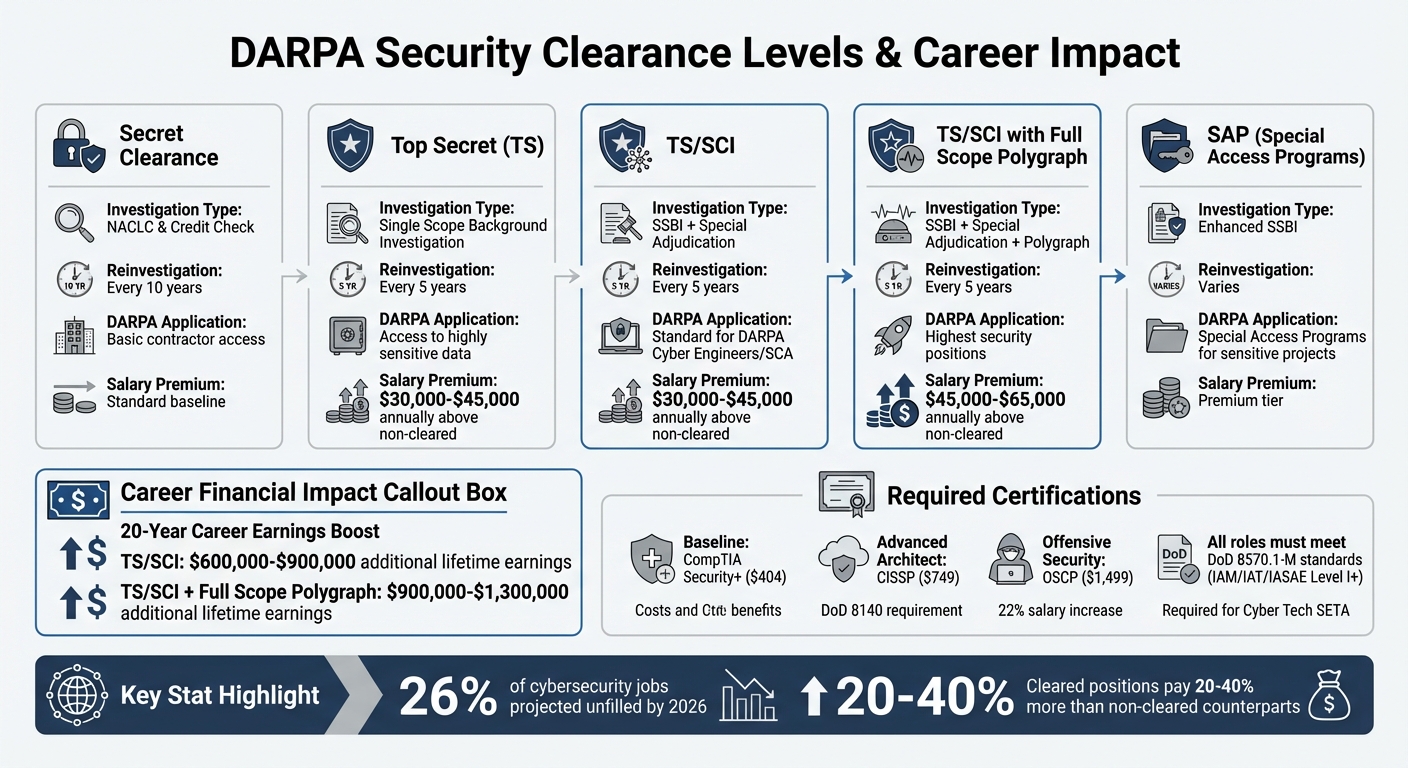
DARPA Security Clearance Levels and Salary Impact Comparison
This section dives into the security clearances and qualifications needed to thrive in DARPA cyber roles, building on the earlier discussion of these specialized positions.
Clearance Levels for DARPA Roles
Most DARPA cyber positions mandate a Top Secret/SCI (TS/SCI) clearance, reflecting the sensitive nature of the work. This clearance requires a Single Scope Background Investigation (SSBI) with reinvestigation every five years. Additionally, holding a TS/SCI clearance can significantly boost your earning potential – adding between $30,000 and $45,000 annually compared to non-cleared roles. For those with a Full Scope Polygraph, the salary increase can range from $45,000 to $65,000 annually. Over a 20-year career, this difference can amount to an extra $900,000 to $1.3 million in earnings [3].
| Clearance Level | Investigation Type | Reinvestigation Period | DARPA Application |
|---|---|---|---|
| Secret | NACLC & Credit Check | Every 10 years | Basic contractor access [9] |
| Top Secret (TS) | Single Scope Background Investigation | Every 5 years | Access to highly sensitive data [9] |
| TS/SCI | SSBI + Special Adjudication | Every 5 years | Standard for DARPA Cyber Engineers/SCA [6][10] |
| SAP | Enhanced SSBI | Varies | Special Access Programs for sensitive projects [9] |
While high-level clearances are vital, certifications and experience play an equally important role in qualifying for these positions.
Required Certifications and Experience
For most DARPA cyber roles, the CompTIA Security+ certification serves as the baseline under DoD 8140 guidelines. The exam costs about $404 [3]. Advanced positions, such as Cyber Security Architect, often require the CISSP certification, priced around $749, while offensive roles like Cyber Tech SETA typically call for the OSCP certification, which costs approximately $1,499 [3]. All roles must comply with DoD 8570.1-M standards at IAM, IAT, or IASAE Level I or higher. Educationally, a bachelor’s degree in fields like Cybersecurity, Engineering, or Mathematics is mandatory, with a master’s degree preferred for senior roles [6].
Experience is another key factor. Candidates should have at least three years of experience with DoD R&D programs [6]. For compliance-focused roles, familiarity with frameworks like Risk Management Framework (RMF), Assessment and Authorization (A&A), and NIST 800-53 security controls is essential. Cloud architects, meanwhile, should demonstrate practical knowledge of platforms like AWS, Azure, or Google Cloud Platform (GCP) [6][10].
Maintaining Certifications and Skills
Keeping certifications like CISSP and Security+ active requires earning Professional Development Units (PDUs) or Continuing Education Units (CEUs) [3]. Specializing in areas such as Zero Trust architecture, cloud security, and AI/ML can also enhance career prospects [3]. It’s important to avoid employment gaps longer than two years, as this can jeopardize your clearance status [9]. With projections indicating that 26% of cybersecurity roles will remain unfilled by 2026, staying current with certifications and clearances not only ensures job security but also offers the potential for salaries that are 20%–40% higher than non-cleared positions [3].
How to Apply for DARPA Cyber Jobs
Navigating the application process for DARPA cyber jobs requires familiarity with federal systems and an understanding of the agency’s expectations. Here’s a guide to help you through the process.
Applying Through USAJOBS

USAJOBS serves as the main platform for federal DARPA positions, covering both government civilian roles and contractor opportunities. To start, create a detailed profile that highlights your U.S. citizenship and active security clearance – both are non-negotiable for roles at DARPA’s headquarters in Arlington, Virginia [11]. If you’re aiming for cybersecurity positions, focus on the Information Innovation Office (I2O), which oversees most cyber-related research programs [1].
For Program Manager (PM) roles, the application process is more specific. You’ll need to submit a cover letter, resume, and a preliminary program concept proposal. This proposal must adhere to the Heilmeier Catechism, a framework of critical questions DARPA uses to evaluate research ideas [11]. Be careful not to include any classified information in your submission.
Tips for a Strong Application
Make sure to prominently display your active security clearance. DARPA is particularly interested in individuals who embrace bold ideas and aim for transformative breakthroughs rather than small, incremental changes. As the agency puts it:
We seek bold thinkers with the resilience to forge fearlessly into spaces unknown. We work in realms where failure is probable, and success is revolutionary [11].
Showcase projects where you took calculated risks and pursued ambitious goals. If you’re new to DARPA’s ecosystem, consider using DARPAConnect, a platform designed to help break down entry barriers by offering resources and guidance [12].
The DARPA Hiring Process
Once you’ve submitted your application via USAJOBS, expect a thorough review. For Program Manager roles, if your qualifications and proposal align with DARPA’s priorities, the agency will reach out to discuss the next steps [11]. These positions are typically two-year appointments but can extend to four years [11].
During interviews, be ready to discuss your technical skills and experience managing high-risk R&D projects. Reflecting DARPA’s culture of bold innovation, you’ll need to demonstrate how you’ve embraced risk and managed ambitious programs. DARPA seeks individuals who can oversee:
portfolios of ambitious and rigorous research and development (R&D) programs, guiding collaborations between world-class researchers and engineers from academia, government, and industry [11].
For contractor roles, such as SETA or SCA, the hiring process involves evaluations by both the contracting company and DARPA’s technical staff to review your qualifications and clearance status before extending an offer.
Networking and Career Strategies for DARPA Jobs
Landing a job at DARPA takes more than just a polished resume – it requires strategic networking and deliberate career planning within the security-cleared community. Here’s how you can set yourself up for success.
Using Cleared Job Boards
Specialized job boards tailored for security-cleared professionals are invaluable tools in your search. Platforms like Cybersecjobs.com not only list active DARPA openings but also allow you to upload your resume for recruiter reviews and participate in cyber-focused job fairs. These fairs connect you directly with hiring managers, giving you a competitive edge. Make sure your profile clearly highlights your clearance level and certifications like CISSP, CEH, or Security+. These platforms work hand-in-hand with in-person networking to strengthen your professional presence.
Building Your Network in the Cleared Community
Direct engagement with DARPA through its events can significantly boost your chances. The agency organizes Proposers Days and Industry Days throughout the year – excellent opportunities to meet Program Managers and explore ongoing research projects. For example, in 2026, don’t miss the STO Industry Day on June 8–9 in Arlington, VA, or the BTO Innovation Opportunity Fair on June 5 in Tysons, VA. If you’re new to the field, events like DARPAConnect – such as Mission Connect at the University of Michigan on May 7 – are specifically designed to help break into the national security space.
Major cybersecurity conferences like Black Hat, DEF CON, and RSA are also golden opportunities for networking. The informal chats between sessions, often referred to as "HallwayCon", can lead to meaningful connections with professionals already in the cleared community. Volunteering at these events can also open doors to exclusive sessions and interactions with industry leaders. After meeting someone, follow up with a brief thank-you email and periodic updates to maintain the connection.
Preparing Your Career for DARPA
In addition to networking and job boards, refining your technical skills is essential. Align your expertise with DARPA’s focus on transformational advancements rather than incremental improvements. Concentrate on areas like AI/ML security, zero trust architecture, cloud security, blockchain, and cryptography. These skills are particularly relevant to DARPA’s Information Innovation Office (I2O), which leads much of its cybersecurity research.
Showcase your abilities with concrete achievements. Participate in Capture The Flag (CTF) competitions, contribute to open-source security projects on GitHub, or build home labs to demonstrate your technical know-how. Update your LinkedIn profile to emphasize your clearance level and certifications. Additionally, consider reaching out to current DARPA Program Managers or SETA support staff for informational interviews. These conversations can provide valuable insights into DARPA’s culture and expectations, helping you stand out as a candidate.
Key Takeaways for DARPA Cyber Jobs
Breaking into DARPA’s cybersecurity ecosystem requires a few non-negotiables: U.S. citizenship, an active security clearance, and a strategic mix of skills and connections. The financial perks are impressive – holding a TS/SCI clearance with Full Scope Polygraph can boost your salary by $45,000 to $65,000 annually, offering a major long-term financial advantage [3].
When it comes to certifications, they’re important but not the whole picture. Start with DoD 8140-compliant credentials like CompTIA Security+ and work your way up to more advanced certifications. For senior roles, CISSP is a strong choice – it’s known to increase salaries by 22%. If your focus is on offensive security, consider certifications like OSCP. That said, avoid piling up certifications without gaining hands-on experience. A single, well-recognized certification paired with real-world application is far more effective [3].
Technical expertise is another cornerstone. Focus on areas like AI/ML security, zero trust architecture, blockchain, and cryptography, as these align closely with DARPA’s cybersecurity priorities. The Information Innovation Office (I2O) drives much of DARPA’s research in this area, so showcasing your skills through CTF competitions, open-source contributions, or home lab projects that tackle practical challenges can set you apart.
Networking is equally critical. Take advantage of events like DARPA Proposers Days and Industry Days to connect with Program Managers. Programs like DARPAConnect also provide access to cleared job boards and valuable networking opportunities. With around 26% of cybersecurity roles projected to remain unfilled by 2026 [3], proactive networking combined with technical skills can give you a significant edge.
Keep in mind that most DARPA roles are based in Arlington, Virginia, requiring work in secure facilities. Program Manager positions are term-limited, typically lasting two to four years [11]. Whether you aim for a Program Manager role or a SETA support position, rigorous preparation and strategic connections are essential for success.
These insights provide a strong foundation for navigating a cybersecurity career with DARPA.
FAQs
Can DARPA sponsor my TS/SCI or polygraph if I don’t have one?
DARPA cannot provide sponsorship for a TS/SCI clearance or a polygraph if you do not already hold one. These types of clearances require a Tier 5 background investigation, which is typically handled by specific government agencies. Securing these clearances falls outside of DARPA’s responsibilities.
What’s the fastest path to qualify for a DARPA cyber role?
To fast-track your qualification for a DARPA cyber role, start by securing a security clearance – either Secret or Top Secret/SCI. Pair this with industry-recognized certifications like Security+, CISSP, or CEH, which demonstrate your expertise. Gaining hands-on experience is equally important, especially in areas such as NIST standards, cloud security (like AWS GovCloud), and SIEM tools.
Additionally, building connections within the cleared community can open doors to opportunities. Make sure you meet the requirements for clearance eligibility, as this is a critical step in advancing your career in this field.
Do most DARPA cyber jobs require working onsite in Arlington, VA?
Yes, most DARPA cyber roles are based onsite in Arlington, VA. Job postings typically mention "In-Office" or "Arlington, VA" to highlight this requirement. Always check the specific job listing for detailed location information.