

The U.S. Department of the Treasury is on the frontlines of protecting financial systems from cyber threats. Cyber analyst roles here require security clearance, specialized certifications, and financial cybersecurity expertise. These positions offer competitive salaries, career advancement opportunities, and access to training programs like Google Cloud Certificates and the Pat Roberts Intelligence Scholarship.
Key Takeaways:
- Qualifications: Bachelor’s in IT-related fields + certifications (CISSP, CISM, CISA, CEH).
- Clearance: Secret or Top Secret clearance required.
- Salary: Median annual pay for information security analysts in finance is $126,970 (as of 2024).
- Job Roles: Threat analysis, incident response, and federal agency collaboration.
- Career Growth: Internal rotations, leadership paths, and specialized training available.
To land these roles, focus on building cybersecurity skills, gaining clearance, and tailoring your federal resume via USAJOBS. Treasury offers a clear path for professional growth in safeguarding national financial systems.
How to Answer "Tell Me About Yourself" in a Cybersecurity Interview
sbb-itb-bf7aa6b
Qualifications and Security Clearance Requirements
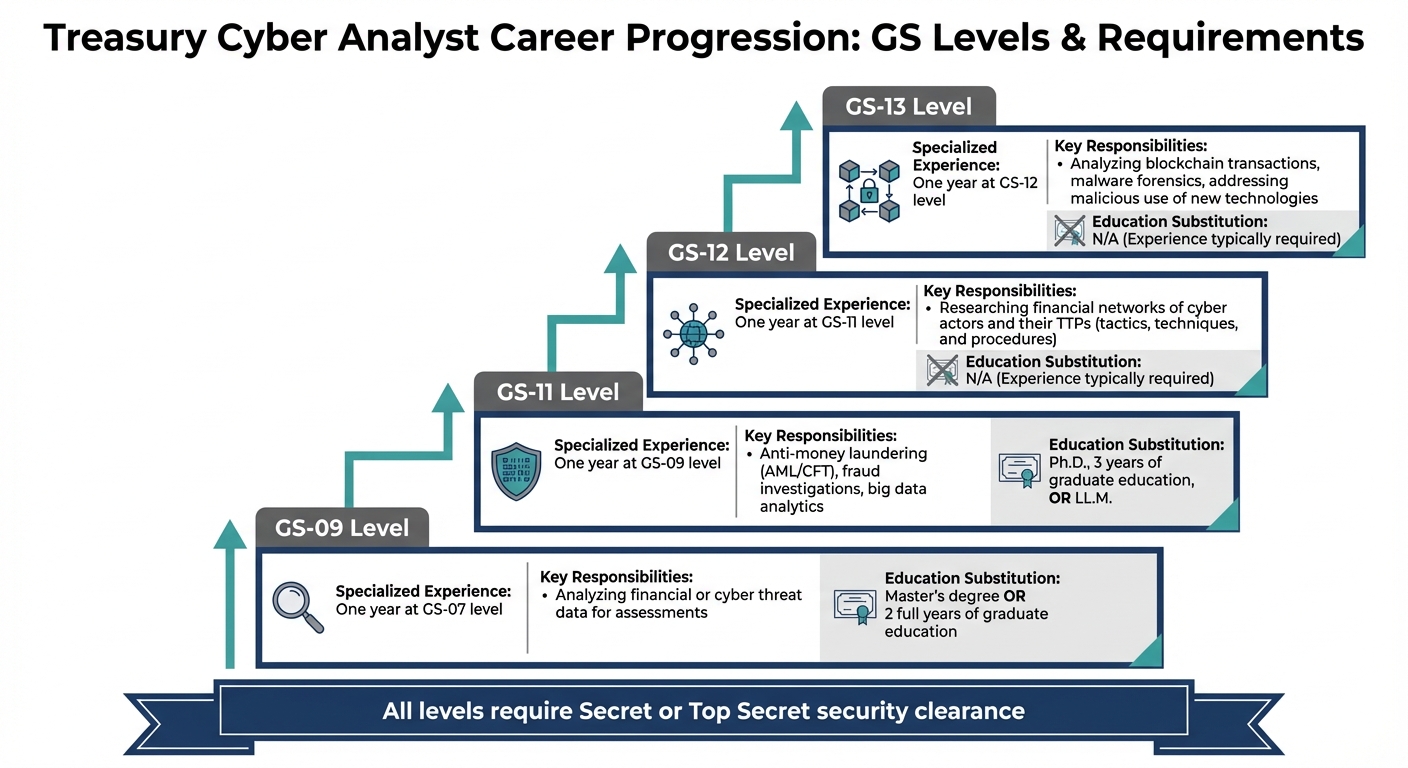
Treasury Cyber Analyst GS Level Requirements and Qualifications
Treasury cyber analyst roles come with specific expectations for education, certifications, and security clearances that are not typically found in private-sector positions. Candidates must demonstrate their cybersecurity knowledge through a mix of formal credentials and hands-on experience.
Required Skills and Education
To qualify for a Treasury cyber analyst role, you’ll need a bachelor’s degree in fields like computer science, information technology, engineering, or mathematics [2]. This academic background lays the groundwork for understanding the intricate systems used in both digital and financial environments. On top of that, professional certifications such as CISSP (Certified Information Systems Security Professional), CISM (Certified Information Security Manager), CISA (Certified Information Systems Auditor), and CEH (Certified Ethical Hacker) are highly regarded. These certifications serve as proof of your technical skills and industry knowledge [2][3][4].
Security Clearance Levels
Most Treasury cyber analyst positions require either a Secret or Top Secret security clearance, depending on the sensitivity of the work. Obtaining clearance involves an in-depth background investigation, which reviews areas like financial records, criminal history, and foreign contacts. If you’re offered a position, the Treasury will sponsor your clearance application, but honesty during the review process is essential.
In addition to clearance, practical experience plays a key role in moving up within the Treasury’s GS pay scale.
Work Experience Requirements
The Treasury follows the GS (General Schedule) pay scale, where advancing to higher grades depends on gaining increasingly specialized experience. Candidates need a well-rounded understanding of cybersecurity basics and how they intersect with financial crime investigations.
| GS Level | Specialized Experience Requirements | Education Substitution Option |
|---|---|---|
| GS-13 | One year at the GS-12 level; tasks include analyzing blockchain transactions, malware forensics, and addressing malicious use of new technologies. | N/A (Experience typically required) |
| GS-12 | One year at the GS-11 level; involves researching financial networks of cyber actors and their TTPs (tactics, techniques, and procedures). | N/A (Experience typically required) |
| GS-11 | One year at the GS-09 level; experience in areas like anti-money laundering (AML/CFT), fraud investigations, or big data analytics. | Ph.D., 3 years of graduate education, or LL.M. |
| GS-09 | One year at the GS-07 level; includes analyzing financial or cyber threat data for assessments. | Master’s degree or 2 full years of graduate education. |
Higher-level roles, such as GS-13, often focus on advanced skills like blockchain analysis and understanding the TTPs of cyber threat actors. If you have a background in cybersecurity or financial crime investigations, emphasize how these experiences intersect in your work.
Next, we’ll break down the core responsibilities of Treasury cyber analysts and how these qualifications translate into daily tasks.
Job Responsibilities of Treasury Cyber Analysts
Treasury cyber analysts play a vital role in safeguarding financial systems from digital threats. While specific duties may vary depending on the bureau – such as FinCEN‘s focus on financial intelligence or the Bureau of the Fiscal Service and the U.S. Mint‘s emphasis on IT solutions and secure data processing – the core mission remains the same: protecting the intersection of cybersecurity and financial security [1].
Threat Monitoring and Analysis
Your day-to-day responsibilities will include monitoring Treasury systems for unusual activity and identifying potential threats. This involves analyzing network traffic, reviewing logs, and spotting anomalies. You’ll also study the tactics used by cybercriminals targeting financial systems, enabling you to anticipate and mitigate future attacks. When vulnerabilities arise in financial technologies or payment systems, you’ll assess their impact on Treasury operations and recommend ways to strengthen defenses.
Incident Response and Investigation
When a security breach occurs, you’ll work with your team to contain the threat and limit the damage. This includes conducting forensic analyses to uncover how the breach happened, determining what data was compromised, and implementing measures to prevent similar incidents. You might analyze malware samples, trace digital footprints, or piece together the sequence of events to support a thorough investigation. Quick action is paramount to ensure the continuity of critical financial operations.
Federal Agency Collaboration
Collaboration is key in this role. You’ll work with federal agencies like DHS, the FBI, and intelligence community partners to share threat intelligence and coordinate responses across jurisdictions. Tasks may include participating in joint task forces, exchanging indicators of compromise, and contributing to government-wide cybersecurity initiatives. Building strong relationships within this network not only enhances the effectiveness of your work but can also pave the way for future career opportunities.
These responsibilities highlight the critical role Treasury cyber analysts play in securing the nation’s financial systems, laying the groundwork for understanding the next steps in the application process.
How to Apply for Treasury Cyber Analyst Positions
Navigating the federal hiring process for Treasury cyber analyst roles takes careful preparation. Each step plays a crucial part in submitting a strong application.
Where to Find Job Listings
Start your search on USAJOBS, the go-to platform for federal job openings. For Treasury-specific roles, head to treasury.usajobs.gov. Use filters like location, pay grade, and security clearance level to refine your search. To stay ahead, set up alerts on USAJOBS so you’re notified of new postings.
Another resource to explore is Cleared Cyber Security Jobs, which lists Treasury roles along with other federal cybersecurity positions. Keep in mind that all Treasury job announcements close at 11:59 pm Eastern Time on the specified date [6]. To avoid missing out, bookmark interesting positions and track their deadlines.
Once you’ve identified openings, the next step is crafting a standout resume.
Resume and Cover Letter Tips
Federal resumes need to be more detailed than private-sector ones. The USAJOBS Resume Builder is a great tool for structuring your resume. Be sure to include comprehensive information about your work experience, education, certifications, and any specialized skills. Highlight specific expertise, such as tools you’ve used or notable incident response cases. Aim for clarity and conciseness – typically, a two-page resume works best.
Don’t forget to attach all required documents, including transcripts, SF-50 forms, DD-214s, and your digital security clearance records, if applicable. The Treasury emphasizes the importance of accuracy; submitting false information is a violation of U.S. Code, Title 18, Section 1001, and could result in fines or imprisonment [5].
When you’re ready to apply on USAJOBS, you’ll upload these documents and complete a Treasury-specific questionnaire. This self-assessment gauges your experience with cybersecurity tasks, so answer truthfully – your responses determine whether your application is passed on to hiring managers.
Once your resume and cover letter are polished, it’s time to focus on acing the interview.
Interview Preparation
Before the interview, research Treasury’s cybersecurity challenges and recent threats to financial systems. Familiarity with the agency’s mission at the intersection of finance and cybersecurity demonstrates your understanding of the role’s importance.
Expect technical questions. For example, you might be asked how you’d handle a ransomware attack targeting a payment processing system, investigate flagged financial transactions, or coordinate with other agencies during a joint investigation. Structuring your answers using the STAR method (Situation, Task, Action, Result) can help you communicate clearly and effectively.
Be prepared to discuss your security clearance status and address any gaps in your employment history that could impact your background investigation. If you’re offered a tentative job, you’ll need to pass suitability and security background checks before final selection. Transparency during the interview is essential to avoid complications later on.
Career Advancement Opportunities at Treasury
Treasury provides structured career paths that emphasize skill development and growth. For cleared cyber analysts, there are numerous opportunities to expand expertise and move into leadership roles. With specialized training programs and internal promotions, investing in your professional development can lead to rapid advancement within the department.
Training and Certification Programs
Treasury is committed to enhancing cybersecurity skills through targeted training. Thanks to a collaboration with Google, employees gain free access to Google Cloud Certificates in areas like generative AI, cybersecurity, and data analytics.
"We are partnering with Google to provide the new Cloud Certificates training for our current and future employees to accelerate their careers in cybersecurity and data analytics." [8]
The Office of Terrorism and Financial Intelligence (TFI) offers a Core Knowledge Curriculum featuring monthly programs on national security and financial topics [9]. For professionals working at the intersection of finance and cybersecurity, earning the Certified Treasury Professional (CTP) credential is a significant way to validate expertise in financial systems and treasury operations [7].
"The CTP credential has enhanced my credibility and expertise in the field of treasury, opening up new opportunities for career advancement and professional growth." [7]
STEM-skilled analysts in the Office of Intelligence and Analysis (OIA) can apply for the Pat Roberts Intelligence Scholarship Program, which provides $5,000 to $25,000 per fiscal year for academic training, with a lifetime cap of $50,000. This funding can cover past or current educational expenses, making advanced degrees more attainable [9].
Promotion Paths and Leadership Roles
Treasury supports career growth through internal rotations across its various offices. Within TFI, employees can explore opportunities in components like OFAC, OIA, and FinCEN, as well as external assignments in prestigious roles.
"TFI also supports employees on internal TFI and Treasury Department rotational opportunities, as well as exclusive, high-profile opportunities at the National Security Council, Congressional fellowships, and overseas Treasury Financial Attaché assignments." [9]
These rotations are designed to broaden your skills and expand your professional network. Assignments like Congressional fellowships or Financial Attaché roles abroad offer unparalleled leadership experiences, paving the way for senior analyst or management positions. Participating in programs like the Core Knowledge Curriculum further demonstrates your dedication to professional growth and prepares you for greater responsibilities [9].
Networking in the Cleared Community
Building connections within the cleared community is key to unlocking new career opportunities. Treasury encourages collaboration through internal rotations and partnerships with the U.S. Intelligence Community, foreign governments, and private financial organizations [9].
Cleared hiring events provide a platform to meet recruitment teams and hiring managers, especially for professionals with Top Secret or higher clearances [10]. Resources like Cleared Cyber Security Jobs help you stay connected with other cleared professionals and keep up with industry trends. Attending industry-specific conferences boosts your visibility and reputation within the cleared community, positioning you for advancement both at Treasury and across the federal cybersecurity landscape.
Conclusion
Pursuing a cleared cyber analyst role at the U.S. Treasury not only protects the nation’s financial systems but also opens doors for advancing your federal cybersecurity career. To succeed, you’ll need the right combination of security clearance, education, and certifications.
Highlight your technical skills in areas like threat monitoring, incident response, and financial intelligence. Make sure your resume reflects your certifications and specialized experience. Be ready for both technical evaluations and behavioral interviews to demonstrate your expertise. This deliberate approach lays the foundation for long-term career success.
Once you’ve secured a position, take advantage of Treasury’s professional development programs and your cleared network to grow your skills and advance your career. Treasury offers a structured path for career progression, making it an ideal place for cybersecurity professionals aiming for growth.
FAQs
Can I apply without an active security clearance?
No, you usually need an active security clearance to apply for cyber analyst positions at the Treasury Department. These jobs often require handling classified information, which means having clearance in place beforehand is essential.
Which certifications matter most for Treasury cyber analyst roles?
Key certifications for treasury cyber analyst roles include the Certified Treasury Professional (CTP), which highlights expertise in treasury operations. Additionally, cybersecurity certifications, such as those recognized by NICCS and CompTIA, are crucial for addressing the technical demands of these roles. These credentials are widely respected in the field and align with the specialized skills required.
How long does the Treasury hiring and clearance process take?
The hiring process for the Treasury typically spans 3 to 5 months from application submission to the start date. Here’s how the timeline generally breaks down:
- Application collection: About 5 business days.
- Resume review: Takes 2–3 weeks.
- Interview scheduling: Around 1 month.
- Security clearance procedures: Usually 2–3 months.
While these are standard estimates, the exact timeline can vary depending on factors like the specific role, the required clearance level, and the number of applicants. The security clearance phase is often the most time-consuming part of the process.