

If you’re a 17A Cyber Operations Officer transitioning to a civilian cybersecurity career, you’re in a strong position. Your military experience, technical skills, and active security clearance make you a top candidate for high-paying roles. Here’s why and how you can make the leap:
- Demand is High: The cybersecurity field faces a global shortage of 3.5 million professionals, and roles like Information Security Analyst are set to grow by 33% through 2033.
- Lucrative Salaries: Senior roles like CISO, Security Architect, and Cybersecurity Manager pay $130,000–$200,000+, with active clearances adding $15,000–$60,000 to your salary.
- Security Clearance Advantage: Your TS/SCI clearance saves employers time and money, making you a priority hire.
- Certifications Matter: Certifications like Security+, CISSP, or OSCP are essential and often funded by military programs.
To succeed, translate your military experience into civilian terms, focus on leadership roles, and highlight your clearance and certifications. Networking, cleared job boards, and tailored resumes will help you land positions that match your expertise.
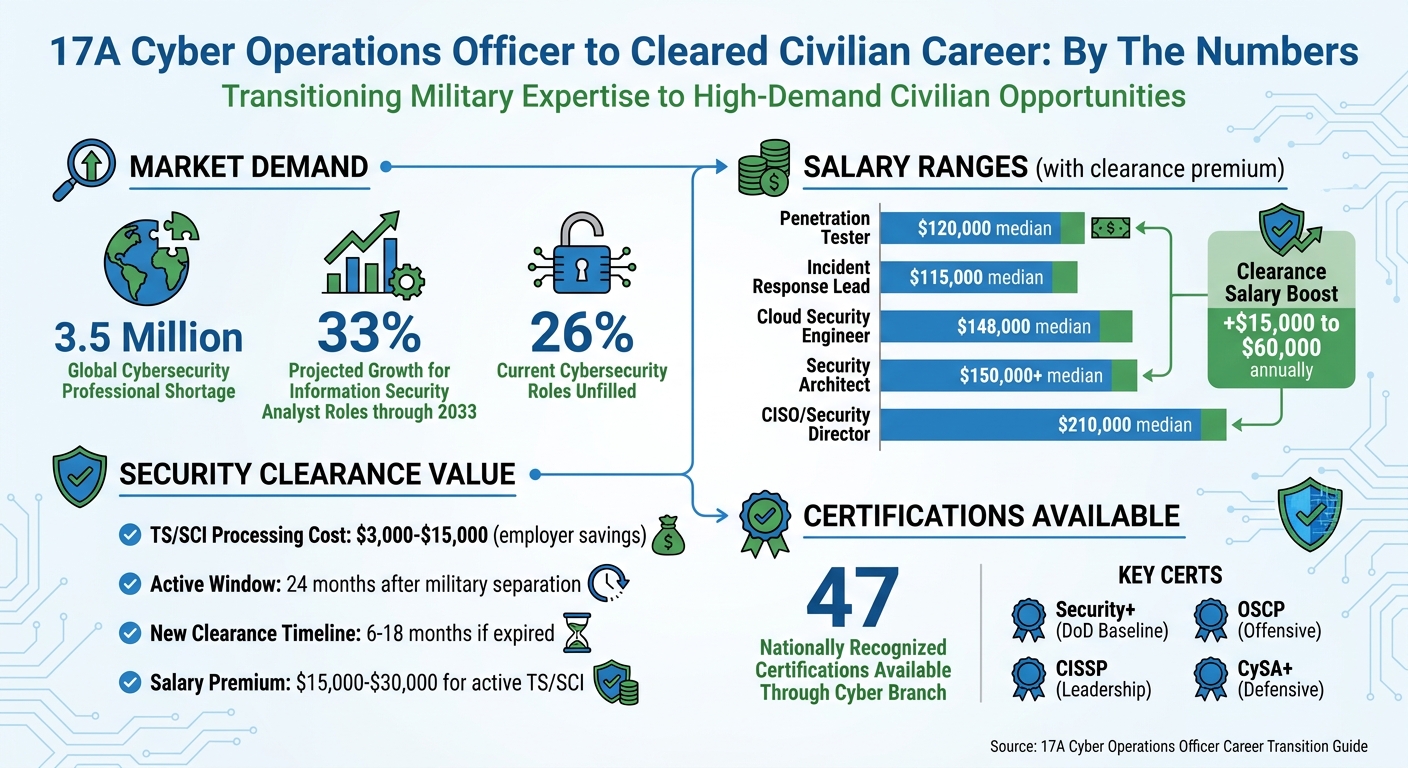
17A Cyber Officer to Civilian Transition: Key Stats and Salary Ranges
How Military Cyber Experience Translates to Civilian Careers
sbb-itb-bf7aa6b
What Does a 17A Cyber Operations Officer Do?
As a 17A Cyber Operations Officer, you take charge of cyber mission forces, steering both offensive and defensive operations. Your role combines technical expertise with strategic leadership, requiring you to manage high-pressure situations while protecting and advancing critical cyber capabilities.
Main Responsibilities of a 17A Cyber Operations Officer
In Offensive Cyberspace Operations (OCO), your mission is to disrupt or exploit adversary systems. This involves identifying weaknesses in their networks to neutralize threats or manipulate their communications[6]. On the other hand, Defensive Cyberspace Operations (DCO) task you with safeguarding friendly networks. You’ll monitor systems, detect potential threats, and respond to attacks aimed at compromising data or infrastructure[6].
Your responsibilities extend beyond operations. You align cyberspace activities with broader military strategies to secure key advantages in the field[6]. Additionally, you oversee network security by inspecting IT systems, controlling access, and ensuring your team is prepared for combat scenarios. This includes managing equipment accounts valued between $1 million and $24 million, a critical aspect of maintaining operational readiness[6].
These duties highlight the importance of advanced training and the role of security clearance in carrying out your responsibilities effectively.
Training and Certification Requirements
To prepare for this role, you’ll complete the Cyber Basic Officer Leaders Course (CBOLC) at Fort Eisenhower, GA. This rigorous program covers networking, operating systems, scripting (such as Python), exploitation techniques, and defensive strategies[5][7]. The training meets NSA standards, equipping you for the high-stakes nature of cyber operations[7]. Additionally, you must hold a Bachelor of Science or higher degree in a STEM-related field, such as computer science, electrical engineering, or information assurance[5].
Certifications are another key component of your preparation. The cyber branch offers access to 47 nationally recognized certifications[4]. Most officers begin with the CompTIA Security+ certification, which is required for DoD IAT Level II roles. From there, you can pursue advanced credentials like OSCP for offensive operations or CISSP for management pathways[3][7]. The Army supports funding for these certifications – some costing thousands of dollars – through programs like the GI Bill or Army IgnitED[3][7].
This training and certification pipeline ensures you’re not only ready for military operations but also highly competitive in the civilian cybersecurity sector.
Why Security Clearance Matters
A Top Secret/Sensitive Compartmented Information (TS/SCI) clearance is non-negotiable for the 17A role. This clearance allows you to access classified networks and operate across multiple domains, all of which directly impact national security[4]. The government invests between $3,000 and $15,000 to process your TS clearance[8], making it a valuable asset for transitioning into civilian roles.
Your clearance remains active for 24 months after you leave the military[8]. During this time, you can reactivate it for a civilian position without undergoing a full reinvestigation. Missing this window, however, could mean waiting 6 to 18 months for a new clearance[3]. This makes pursuing cleared positions immediately after your military service a strategic move for a smooth transition into the civilian workforce.
How to Translate 17A Skills to Civilian Cybersecurity Jobs
Your specialized training and clearance as a 17A cyber professional can open doors to high-demand roles in the civilian cybersecurity world. The skills you’ve honed in military operations are invaluable in the private sector, particularly because of the real-world operational experience they bring. As Brad Tachi, CEO of Best Military Resume, explains:
"Military cyber professionals have something that most civilian cybersecurity candidates don’t: real-world operational experience defending networks against actual threats, not just simulated ones" [3].
This hands-on expertise gives you a distinct advantage over many civilian candidates.
Matching Military Skills to Civilian Roles
The transition from military to civilian roles is more straightforward than it might seem. Your Offensive Cyberspace Operations (OCO) experience is a natural fit for leadership roles in Red Team operations and penetration testing. Identifying vulnerabilities under combat conditions directly prepares you for civilian penetration testing roles.
On the defensive side, your experience with Defensive Cyberspace Operations (DCO) aligns seamlessly with Blue Team roles, incident response leadership, and threat hunting. The strategic planning you’ve done – coordinating cyber activities with broader operational goals – positions you for senior roles like Chief Information Security Officer (CISO) or Security Architect.
Your familiarity with frameworks like the Risk Management Framework (RMF) and DISA STIGs translates well to civilian compliance standards such as NIST 800-53, FISMA, and FedRAMP. When describing your experience, replace military-specific terms with civilian equivalents. For instance, instead of "COMSEC", use "cryptographic key management." Be specific about your achievements – rather than saying "led a team", say something like, "Led a 12-person Cyber Protection Team defending a 500,000-endpoint network."
Additionally, your hands-on experience with tools like Splunk, Wireshark, Nessus, and ArcSight is highly relevant. These tools are staples in civilian cybersecurity roles, making your expertise directly applicable to positions requiring technical proficiency.
Common Cleared Cybersecurity Job Titles
Your leadership and technical skills make you a strong candidate for mid-to-senior-level positions. Brad Tachi cautions against undervaluing your worth:
"A TS/SCI-cleared cyber professional with 4+ years of operational experience should not be accepting $80K SOC analyst positions when the market pays $110K+ for that profile" [3].
An active TS/SCI clearance can increase your salary by $15,000 to $30,000, as it eliminates the need for employers to sponsor your clearance.
With your dual expertise in offensive and defensive operations, you’re well-suited for high-responsibility roles like Penetration Tester (median salary $120,000), Security Architect (median salary $150,000+), Incident Response Lead (median salary $115,000+), Cloud Security Engineer (median salary $148,000), and CISO/Security Director (median salary $210,000) [1].
Given that information security analyst roles are projected to grow by 33% through 2033 [2], focusing on positions emphasizing NIST frameworks, MITRE ATT&CK, and CIS controls will help you tap into the premium market for cleared professionals. These roles not only leverage your experience but also position you for long-term success in the cybersecurity industry.
How to Build a Resume for Cleared Cybersecurity Jobs
Your resume is your ticket to landing an interview. With recruiters spending just 6 to 7 seconds on an initial scan of your resume [10][2][14], every word has to count. The goal? Translate your military background into civilian terms while ensuring your security clearance is front and center for both human recruiters and Applicant Tracking Systems (ATS).
How to Highlight Your Military Experience
Start by swapping out military-specific terms like your rank or MOS code for civilian-friendly job titles that hiring managers will recognize. For example, instead of "17A Cyber Operations Officer", use titles such as Cybersecurity Operations Manager, Lead Penetration Tester, or Incident Response Lead [11][2][3]. When listing accomplishments, use the STAR (Situation, Task, Action, Result) or CAR (Challenge, Action, Result) method to quantify your impact. For instance, instead of saying, "Managed network security", try: "Led a 12-person team defending a 500,000-endpoint network, maintaining 99.9% availability while triaging 200+ security alerts daily."
Translate military jargon into civilian equivalents. For example:
- The Risk Management Framework (RMF) stays the same.
- DISA STIGs become "security hardening standards."
- COMSEC converts to "cryptographic key management" or "encryption key management" [3][2].
When describing your work environment, focus on quantifiable details like network size and user count, rather than mission specifics. For example: "3,000-user dual enterprise environment (classified/unclassified)" [3][9].
To make it past ATS filters, include unclassified tools and frameworks you’ve used, such as Splunk, Wireshark, Nessus, CrowdStrike, or Palo Alto firewalls. Also, mention frameworks like NIST RMF, MITRE ATT&CK, and CIS Controls [2][3]. These specifics show both technical expertise and hands-on experience.
| Military Term | Civilian Translation |
|---|---|
| 17A Cyber Operations Officer | Cybersecurity Operations Manager / Lead Penetration Tester |
| NIPR/SIPR Administrator | Dual Enterprise Network Manager (Classified/Unclassified) |
| COMSEC Custodian | Cryptographic Security / Encryption Key Manager |
| ACAS / STIG Compliance | Vulnerability Management & Security Hardening |
| DCO (Defensive Cyber Operations) | Incident Response & Network Defense |
Keep your resume format simple for ATS compatibility. Avoid graphics, shading, or intricate layouts that could confuse automated systems [10][14]. Stick to standard fonts and clear section headers. As Bill Branstetter from 9th Way Insignia advises:
"Keep subjective self-descriptions out of your summary section. I’m looking at you, Results-Oriented Team Players" [14].
Stick to hard facts and measurable achievements.
How to List Certifications and Training
Your certifications are vital in cleared cybersecurity roles, so place them near the top of your resume. CompTIA Security+ is a must-have for meeting DoD 8570/8140 compliance and should be prominently displayed [3][2]. For management or architecture roles, highlight CISSP. If you’re aiming for offensive roles, showcase OSCP or GPEN. For defensive roles or incident response, certifications like CySA+ or GIAC are key [3][2].
If you’re working toward a certification, include it with an expected completion date to show initiative [12][9]. For example: "CISSP (Certified Information Systems Security Professional) – ISC², January 2025."
Cloud security certifications are becoming increasingly important as more organizations shift to cloud-based infrastructure. Highlight certifications like AWS Certified Security Specialty or Azure Security Engineer, especially if you gained cloud-related training during your military service [3][2].
How to List Your Security Clearance
Your security clearance is a major asset – potentially adding $15,000 to $30,000 to your salary [3][13][2].
"I’ve talked to defense contractor recruiters who told me they literally search their ATS for ‘TS/SCI’ as their first filter before looking at anything else. If your clearance isn’t in a searchable text field on your resume… you’re invisible to these recruiters" [13].
To make it easy for recruiters to find, list your clearance in two places: directly under your contact information in the header and again in the "Core Competencies" or "Skills" section [13][14]. Use standard abbreviations like "TS/SCI" and specify whether it’s "Active" or "Current." If you have a polygraph, include the type (e.g., CI or Full-Scope), as this significantly boosts your value [13]. For example: "Active TS/SCI Clearance – Current (Full-Scope Polygraph)."
Keep in mind the 24-month window after military separation – your clearance remains "current" during this period, allowing employers to reactivate it without a full reinvestigation [13][2]. This is crucial since sponsoring a new TS/SCI clearance can cost employers $5,000 to $15,000 and take 6 to 18 months [3][13]. Transitioning into a cleared role quickly ensures you maximize this advantage.
Finally, avoid sharing sensitive details about your clearance. A simple, professional description is all you need [13][14].
Once your resume is polished, you’ll be ready to focus on targeted job searches and networking.
Job Search and Networking Strategies for Cleared Cybersecurity Roles
Once your resume is polished and ready, the next step is to approach your job search strategically. The cleared cybersecurity job market has its own unique dynamics. Your active security clearance is a standout advantage, but it’s crucial to present it effectively to make the most of this edge.
How to Use Cleared Job Boards
Platforms like Cleared Cyber Security Jobs are designed to connect you with employers who specifically value your qualifications. This veteran-founded site offers tools like clearance-level filters, resume uploads, job alerts, and resources tailored to the cleared community.
Dedicate about 15 minutes each morning to check job postings and stay updated. Additionally, review the career pages of major defense contractors – such as Booz Allen Hamilton, Lockheed Martin, and Leidos – twice a week. Setting up job alerts on these sites ensures you don’t miss out on opportunities.
When creating profiles, use civilian-equivalent titles like Cybersecurity Engineer or Incident Response Lead instead of military-specific designations. This adjustment helps recruiters searching for civilian terms find you more easily. Also, make sure to include your clearance level, polygraph type (if applicable), and investigation date in searchable text fields, rather than hiding them in attachments.
Once your job alerts are active and profiles are optimized, shift your attention to networking within the industry.
How to Network at Cleared Job Fairs and Events
Cleared job fairs offer direct access to hiring managers who understand and value military experience. Platforms like Cleared Cyber Security Jobs host both in-person and virtual job fairs, allowing you to bypass automated screening processes and make a direct impression.
Attending major cybersecurity conferences such as Black Hat, DEF CON, RSA, and BSides can also be highly beneficial. These events are ideal for informal networking, often referred to as "HallwayCon", where impromptu conversations with industry professionals can lead to unadvertised opportunities. Volunteering at these events is another way to connect directly with industry leaders.
Prepare a concise 30-second introduction that translates your military experience into civilian terms. For example:
"I led defensive cyber operations for a 500,000-endpoint network, managing incident response and vulnerability assessments. I hold an active TS/SCI with Full-Scope Polygraph and am transitioning into civilian cybersecurity architecture roles."
This type of introduction highlights your skills and experience clearly, making an immediate impact on hiring managers.
After meeting someone, follow up with an email within 24 hours. Reference a specific detail from your conversation to reinforce the connection and express interest in maintaining contact.
Outside of events, building deeper connections within the cleared community can significantly aid your transition.
How to Build Connections in the Cleared Community
Reaching out to former military colleagues now working in defense contracting can be immensely helpful. These connections often lead to direct referrals, allowing you to bypass applicant tracking systems and ensuring your resume gets into the right hands. Reconnect with former unit members, training classmates, and peers from joint exercises who have already transitioned into the civilian sector. Your shared experiences provide a natural starting point for these conversations.
Informational interviews are another powerful tool. These casual, short conversations with professionals in your target roles can provide insights into their day-to-day responsibilities, advice for transitioning, and potential job leads within their organizations.
You can also engage with specialized online communities like Reddit’s r/netsec or contribute to open-source security projects on GitHub. Active participation in these spaces not only showcases your technical skills but also helps you stay informed about the latest tools and trends in the field.
"Your clearance is a golden ticket, but only if you put it where employers can find it. A clearance buried on page two of your resume or missing from your online profile is a clearance that is not working for you."
– Brad Tachi, CEO, Best Military Resume
How to Prepare for Cleared Cybersecurity Interviews
Once you’ve polished your resume and honed your networking tactics, the next step is acing the interview. This is where you demonstrate how your military cybersecurity expertise can directly benefit civilian employers. Cleared cybersecurity interviews typically include behavioral questions about leadership and technical assessments of your skills. The trick is framing your military experience in a way that resonates with civilian hiring managers.
How to Discuss Leadership and Technical Skills
As a 17A Cyber Operations Officer, you’re likely aiming for senior roles like CISO, Security Architect, or Senior Cybersecurity Manager – not entry-level positions. To showcase your leadership, use specific metrics. For instance:
"Led a 12-person Cyber Protection Team defending a 500,000-endpoint network, maintaining 99.9% availability while triaging 200+ security alerts daily" [2][3].
A good formula to follow is Action + Technical Detail + Business Impact [9]. This approach makes it clear what value you can bring to an organization.
When discussing your experience, avoid military jargon and translate terms into civilian equivalents. For example:
- Instead of “COMSEC,” say “Encryption Key Management.”
- Replace “ACAS/STIGs” with “Vulnerability Scanning (Nessus) and Security Hardening Standards.”
Also, name unclassified tools you’ve used, like Splunk, Wireshark, Nessus, CrowdStrike, and Palo Alto Networks. Highlight your ability to work under pressure and relate military frameworks – like RMF (Risk Management Framework) – to civilian standards. Explain how your experience with DISA STIGs aligns with widely recognized security hardening practices.
How to Address Your Security Clearance Status
Your TS/SCI clearance is a major asset, so mention it early in the conversation. Employers value this because it eliminates the need for costly sponsorship (which can range from $5,000 to $15,000) and bypasses the lengthy 6 to 18-month investigation process [2][3]. Be clear and concise:
"I hold an active TS/SCI with Full-Scope Polygraph, current as of my last investigation in [month/year]."
Your clearance remains valid for 24 months after leaving the military, and a Facility Security Officer (FSO) can reactivate it through the Defense Information System for Security (DISS). During interviews, never share sensitive details like your SSN or case numbers – your name and date of birth are sufficient for verification [13].
If you have a Counter-Intelligence (CI) or Full-Scope Polygraph, emphasize it, as these are highly sought after by intelligence community contractors [13]. Present your clearance as evidence of your trustworthiness and ability to handle sensitive information.
"If you have an active TS/SCI and operational cyber experience, you are in a seller’s market. Multiple employers will compete for you."
– Brad Tachi, CEO, Best Military Resume [3]
How to Answer Behavioral and Technical Questions
Be ready to discuss both your leadership and technical skills in detail. For behavioral questions, use metrics to back up your claims. Examples include:
- "Investigated 150+ security incidents quarterly."
- "Hardened 95% of systems to DISA STIG standards within 6 months." [2][3]
When discussing leadership, mention managing Cyber Protection Teams or overseeing security for large-scale, multi-enclave environments [3].
For technical assessments, stay sharp by practicing on platforms like TryHackMe or HackTheBox [2][3]. Some interviews may include live technical challenges, so be prepared to demonstrate your familiarity with civilian frameworks like NIST, MITRE ATT&CK, and CIS controls [3]. Employers want assurance that your skills can be applied immediately.
| Military Term | Civilian Equivalent for Interviews |
|---|---|
| COMSEC | Cryptographic Security / Encryption Key Management |
| ACAS | Vulnerability Scanning (Nessus/Tenable) |
| DCO / OCO | Defensive / Offensive Cyber Operations |
| RMF | Risk Management Framework (Compliance) |
| SIPR / NIPR | Classified / Unclassified Enterprise Networks |
| CPT Lead | Cybersecurity Team Lead / Manager |
Avoid discussing specific SCI compartments, codewords, or classified programs during interviews. This could raise security concerns. Instead, focus on the complexity and scale of your work, showing that you can protect sensitive information while effectively communicating your expertise.
"Military cyber professionals have something that most civilian cybersecurity candidates don’t: real-world operational experience defending networks against actual threats, not just simulated ones."
– Brad Tachi, CEO, Best Military Resume [3]
Conclusion
Shifting from a 17A Cyber Operations Officer role to a cleared civilian cybersecurity career positions you as a standout candidate. Your hands-on experience in network defense and an active TS/SCI clearance set you apart from the competition. To make the most of this transition, focus on translating military jargon into civilian terms, highlight measurable achievements, and aim for mid-to-senior level roles like Security Architect, Senior Cybersecurity Manager, or even CISO – roles that align with your expertise rather than settling for entry-level positions.
Keep in mind, your clearance is a valuable but time-sensitive asset. It remains active for only 24 months after separation, and retaining an active TS/SCI clearance can boost your salary by $15,000 to $30,000. To maximize this opportunity, ensure your transition happens while your clearance is still valid [3]. Complement your experience with certifications such as Security+ for baseline DoD compliance and CISSP to highlight leadership capabilities. Make these certifications prominent on your resume to solidify your qualifications for high-paying cleared roles.
Strategize your job search by focusing on platforms like Cleared Cyber Security Jobs, which cater specifically to professionals with military backgrounds. These platforms connect you with employers seeking candidates like you and often feature roles that pay 20–40% more than commercial cybersecurity positions [15].
"The cyber veterans I’ve seen transition most successfully are the ones who don’t settle for the first SOC analyst job offered to them. Your military experience puts you above entry-level."
– Brad Tachi, CEO and Founder, Best Military Resume [3]
Start planning your transition 12 to 18 months in advance to ensure a smooth shift into a cleared role. Take advantage of programs like SkillBridge to gain corporate experience, and build connections within the cleared community through job fairs and networking events. With 26% of cybersecurity roles currently unfilled [15] and a projected 33% growth in information security analyst positions by 2033 [2], the demand for your expertise is at an all-time high.
FAQs
Which cleared cyber roles best match my 17A experience?
Roles that match your experience as a 17A Cyber Operations Officer include Threat Intelligence Analyst, Security Engineer, and Cybersecurity Manager. These positions leverage your expertise in operational cybersecurity, leadership abilities, and active security clearances. To transition smoothly into the cleared cybersecurity industry, target opportunities that appreciate your military background and technical skill set.
How do I keep my TS/SCI active during my transition?
To maintain your TS/SCI clearance, keep in mind that a Secret clearance generally remains valid for up to 2 years after you separate from the military. Within this window, you can reinstate it for civilian employment. To avoid losing your clearance, check its status regularly and complete any necessary steps for renewal or reinstatement. This might include updating your background investigation or working through your employer or contracting agency to ensure everything is up to date.
What certifications should I prioritize for the job I want?
For entry-level cybersecurity positions, certifications like Security+ can be a great starting point to demonstrate your foundational knowledge. If you’re aiming for senior roles, particularly if you bring military experience and hold security clearances, advanced certifications such as CISSP or CISA are worth pursuing. These credentials are highly regarded in the cleared cybersecurity sector and can help showcase your expertise while aligning your qualifications with industry demands.