

Looking to start a career in cyber operations with the Marine Forces Cyberspace (MARFORCYBER)? Here’s what you need to know:
- MARFORCYBER’s Mission: The Marine Corps’ cyber command focuses on network defense, offensive cyber operations, and integrating cyber capabilities to support military missions.
- Key Units: Includes MCCOG (network operations), MCCYWG (Cyber Mission Force readiness), and MARCOR INFOCOM (cyber and information integration).
- Job Roles: Positions like Cyber Warfare Operators, Network Defense Technicians, and Cyber Operations Planners require technical skills and security clearance.
- Clearance & Skills: Most roles demand a Top Secret/SCI clearance. Skills in network security, intrusion detection, incident response, and scripting (e.g., Python) are highly valued.
- Certifications: Certifications like Security+, CISSP, and CEH are critical for career advancement.
- Application Process: Jobs are listed on USAJobs.gov, and obtaining a security clearance is essential after a conditional offer.
Whether you’re transitioning from military service or entering the cyber field, MARFORCYBER offers opportunities to contribute to national security while advancing your career. Read on to explore qualifications, certifications, and tips to succeed in this field.
Military Occupations MOS That Can Be Used to Get Cybersecurity Jobs
sbb-itb-bf7aa6b
Types of Cleared Cyber Jobs in MARFORCYBER
MARFORCYBER’s mission is constantly growing, and with it comes a variety of career paths for cleared cyber professionals. With a workforce of approximately 800 personnel divided into units like MCCOG and MCCYWG, these teams focus on critical areas such as network defense, offensive operations, and mission planning.
Main Positions and What They Do
Cyber Warfare Operators: These professionals handle both offensive and defensive cyber operations, working closely with Cyber Mission Force teams[1]. Their efforts are central to MARFORCYBER’s goal of executing comprehensive cyberspace operations.
Network Defense Technicians: Positioned within MCCOG’s 24/7 Operations Center, these technicians oversee the Marine Corps Enterprise Network. They monitor network activity, respond to potential intrusions, and enforce security measures to ensure operational integrity[1].
Cyber Operations Planners: These planners play a pivotal role in coordinating cyberspace operations. By aligning offensive capabilities with Marine Corps and joint force needs, they ensure cyber activities are synchronized across various operational domains to achieve strategic goals[2][1].
Offensive Cyber Operations Planners: Focused on offensive strategies, these planners use adversary intelligence to create detailed plans for offensive cyberspace operations (OCO)[2][1].
Defensive Cyber Operations Specialists: These specialists concentrate on gathering and analyzing intelligence to develop tools and strategies that protect the Marine Corps from adversarial cyber threats. Their work directly supports defensive cyber operations aimed at maintaining a technological edge for Marine warfighters[1].
Each role demands a unique set of skills and clearance levels, making it essential for candidates to understand the specific requirements of their desired position.
Required Clearance Levels and Skills
Most positions at MARFORCYBER, including Cyber Warfare Operators, Network Defense Technicians, and Cyber Operations Planners, require a Top Secret/Sensitive Compartmented Information (TS/SCI) clearance. This level of clearance is necessary to access classified intelligence and operational data[1]. While some roles may only need a Secret clearance, holding a TS/SCI clearance can unlock more expansive career opportunities within the organization[1].
Key technical skills for these roles include:
- Network Security: Managing firewalls and network protocols.
- Intrusion Detection: Utilizing tools like SIEM and IDS/IPS.
- Incident Response: Handling and mitigating cyber incidents.
- Digital Forensics and Malware Analysis: Investigating and addressing security breaches.
Proficiency in scripting languages like Python or PowerShell is also highly valued, as it helps automate security tasks. Additionally, expertise in cloud security, particularly with platforms like Microsoft Azure, is becoming increasingly important as operations shift to cloud-based environments. Professionals with advanced cloud security skills often earn salary premiums of over $15,000 compared to their peers[3].
These roles combine technical expertise with high-level security access, making them critical to MARFORCYBER’s mission.
Required Qualifications and Certifications
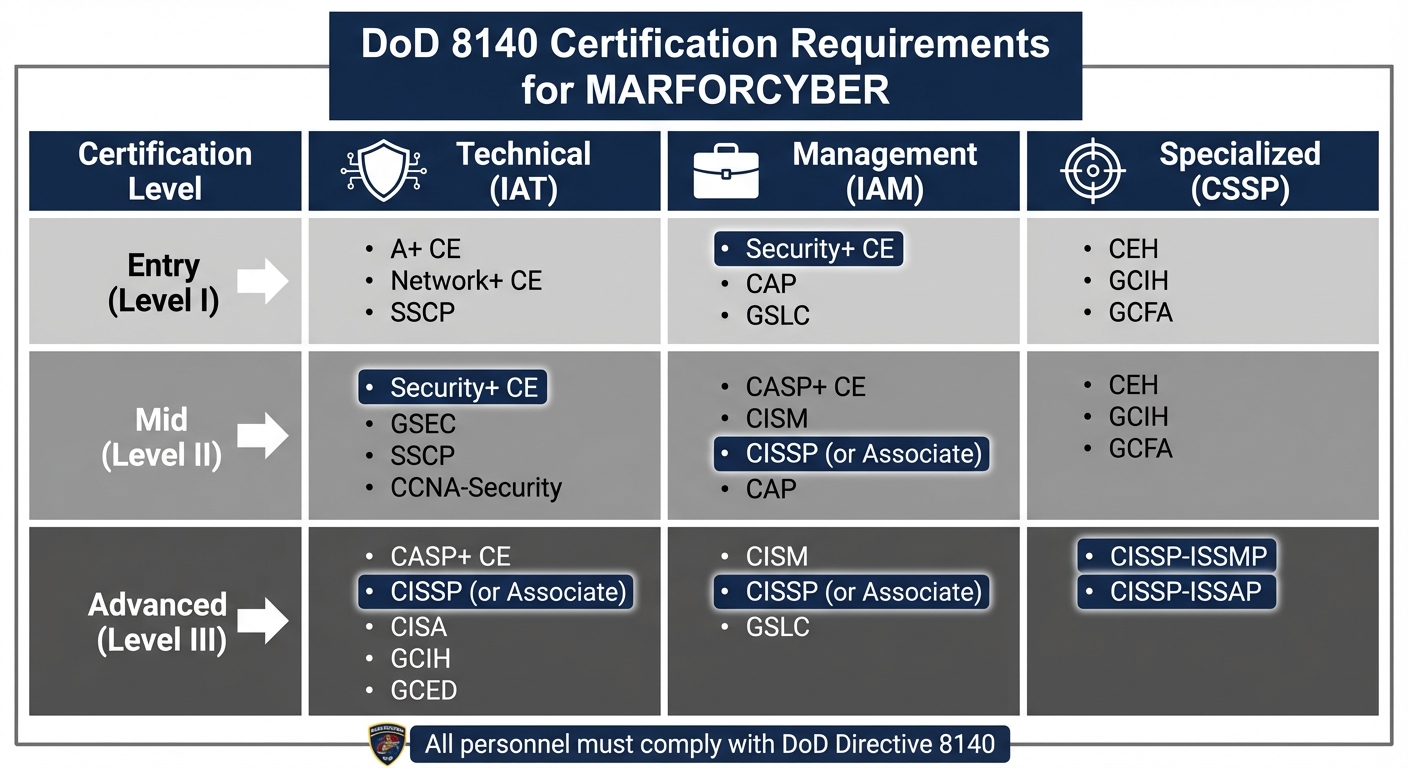
DoD 8140 Cybersecurity Certification Requirements by Level and Category
Cleared cyber roles at MARFORCYBER demand meeting both Department of Defense (DoD) and Marine Corps baseline standards. Knowing these requirements upfront can help you prepare for the path ahead.
Basic Requirements
To qualify for any cleared cyber position within MARFORCYBER, U.S. citizenship is non-negotiable[4]. Candidates must also secure and maintain a Top Secret security clearance, which involves rigorous background checks and ongoing evaluations[4]. Educational requirements differ depending on the role: enlisted personnel and warrant officers need at least a high school diploma or equivalent, while officer and specialist roles typically require a bachelor’s degree in fields like computer science, information systems, or programming[4][5]. Additionally, all applicants must meet the military’s medical and physical fitness standards. Age limits also apply: enlisted candidates must be between 17 and 34, while commissioned officer candidates must be at least 17 but under 31 by the year they are commissioned[4].
Compliance with DoD Directive 8140 is mandatory for all MARFORCYBER personnel, whether military, contractors, or civilians with privileged access to DoD systems[6]. This directive requires obtaining a baseline certification that aligns with your job category and level. Enlisted candidates must also pass entrance exams, while warrant officers need to complete the Cyber Capabilities Developer Assessment[4].
"As our C4 systems become netcentric and more linked with our weapons systems, it is essential that our IA workforce be up to the task of securing our networks." – Mike Knight, Naval NetWar Command[6]
Certifications play a critical role in career advancement, making them essential for progress.
Certifications from Entry Level to Advanced
Under DoD Directive 8140, certifications are divided into categories based on job focus: Technical (IAT), Management (IAM), Cyber Security Service Provider (CSSP), and Information Assurance System Architect and Engineer (IASAE). Each is further broken into three levels of expertise[6].
For entry-level technical roles (IAT Level I or II), CompTIA Security+ CE serves as the baseline certification[6]. Mid-level professionals aiming for IAT Level III or IAM Level II roles should pursue certifications like CISSP (or Associate) or CASP+ CE for more advanced technical or managerial positions[6]. Those specializing in incident response or forensics should focus on CSSP-specific certifications such as CEH, GCIH, or GCFA[6].
| Certification Level | Technical (IAT) | Management (IAM) | Specialized (CSSP) |
|---|---|---|---|
| Entry (Level I) | A+ CE, Network+ CE, SSCP | Security+ CE, CAP, GSLC | CEH, GCIH, GCFA |
| Mid (Level II) | Security+ CE, GSEC, SSCP, CCNA-Security | CASP+ CE, CISM, CISSP (or Associate), CAP | CEH, GCIH, GCFA |
| Advanced (Level III) | CASP+ CE, CISSP (or Associate), CISA, GCIH, GCED | CISM, CISSP (or Associate), GSLC | CISSP-ISSMP, CISSP-ISSAP |
For entry-level candidates, the Systems Security Certified Practitioner (SSCP) certification can provide a competitive edge when pursuing technical security roles[5]. Those with STEM degrees may qualify for leadership roles more quickly through direct commissioning programs[4]. Beyond certifications, critical skills like problem-solving, multitasking, and maintaining confidentiality are essential for success in cyber roles[5].
Typical Career Paths
Once you meet the qualifications and earn the required certifications, MARFORCYBER offers clear career paths. Most professionals start in Network Operations (NETOPS) or IT support roles within MCCOG, managing the Marine Corps Enterprise Network (MCEN). From there, they often advance into Defensive Cyber Operations (DCO) or join specialized Cyber Mission Force (CMF) teams under MCCYWG[1].
For example, many begin with entry-level network defense roles requiring a Security+ certification, move into cyber analyst positions that demand GCIH, and eventually progress to senior roles requiring certifications like CISSP or CASP+.
Another route might involve starting in systems engineering, focusing on infrastructure support, and later transitioning into cloud security specialist roles as operations migrate to platforms like Microsoft Azure. Technical roles can also lead to management positions – shifting from hands-on tasks to planning and leadership. These roles often require IAM-level certifications like CISM.
The Marine Corps Cyber Warfare Group ensures all personnel receive training aligned with USCYBERCOM Joint Cyberspace Training and Certification Standards, offering structured opportunities for growth throughout your career[1].
How to Apply for MARFORCYBER Jobs
Using the USAJobs Portal

All civilian federal jobs at MARFORCYBER are listed on USAJobs.gov, the official government hiring platform. To apply, locate a job announcement that matches your skills and click "Apply Online". You’ll then log in or create a new USAJOBS account. Make sure your resume includes key details like employer names, job dates (MM/YYYY), hours worked, and federal grade information. Use the USAJOBS Resume Builder to ensure all necessary federal HR details are included, and upload clear, legible supporting documents for any claims you make.
Part of the application process involves completing an online assessment questionnaire to measure skills in areas like Data and Content Management, Oral Communication, and Problem Solving. Before uploading any documents, make sure to remove sensitive information like Social Security Numbers and Dates of Birth. Applications must be submitted by 11:59 pm EST on the job posting’s closing date.
To increase your chances, opt to make your resume visible to other hiring managers within the agency. This allows your profile to stay on file for similar opportunities for up to 180 days. You can track your application status by clicking the "Application Status" link in your USAJOBS account. Many MARFORCYBER roles fall under the Cyber Excepted Service (CES) personnel system (10 U.S.C. 1599f), which often includes different qualification standards and a three-year probationary period compared to standard federal jobs.
Once your application is complete, the next step is securing the required security clearance.
Getting Your Security Clearance
After submitting your application, obtaining a security clearance is the next essential step. Clearances are only initiated once you receive a conditional job offer. MARFORCYBER roles often require Tier 3 (Secret) or Tier 5 (Top Secret/SCI) investigations. The legacy e-QIP system has been replaced by eApp, a digital platform that simplifies the SF-86 form with logic-based questions and real-time error checks.
Processing times for clearances vary: Secret clearances typically take 60 to 150 days, while Top Secret clearances range from 120 to 240 days. For positions requiring Top Secret/SCI with a polygraph, the timeline can extend to 180 to 365+ days, largely due to polygraph scheduling delays.
Before accessing the eApp system, gather details from the past 10 years, including residences, employment, education, and foreign contacts. Review your credit report and address any issues, such as unpaid debts, to avoid delays. Be completely truthful when completing the SF-86 form, as inaccuracies can result in denial. If you have potential red flags like past debts or drug use, disclose them upfront with evidence of mitigation. Remember, marijuana remains illegal at the federal level, and recent or ongoing use can disqualify you from MARFORCYBER positions.
Under Continuous Vetting (CV), traditional periodic reinvestigations have been replaced with automated checks for criminal activity, credit issues, and foreign travel. If significant life events occur – such as arrests or major debt – inform your Security Officer immediately to maintain your clearance eligibility.
Programs for Transitioning Military Personnel
To align with its mission, MARFORCYBER offers streamlined entry paths for transitioning service members. All applicants must pass a background check through a Military Entrance Processing Station (MEPS) and clear a criminal background check. Marine Corps applicants must be between 17 and 28 years old and possess U.S. citizenship or Legal Permanent Resident status (with a valid green card/I-551).
A high school diploma is the preferred minimum requirement. While candidates with a GED may still qualify, they might face limited options unless they have additional credentials, like 15 college credits. For positions requiring clearance, ensure your record is free of felony convictions, as the Marine Corps does not provide waivers for these offenses.
Additionally, all applicants must pass a pre-employment drug test, including screening for marijuana, regardless of its legal status in individual states. To learn how your background fits MARFORCYBER’s current needs, contact a recruiter for guidance. Some roles may align with specific mission priorities or existing vacancies.
Career Strategies and Professional Development
If you’re aiming for a role with MARFORCYBER, you’ll need both expertise and a plan to stand out in this competitive field. Here’s how to position yourself for success.
Networking and Job Fairs
Networking for MARFORCYBER roles isn’t just about shaking hands – it’s about being in the right place at the right time. Since cleared positions often require physical presence due to SCIF (Sensitive Compartmented Information Facility) requirements, focusing your efforts on key hubs like Augusta, Georgia, and Fort Meade, Maryland is crucial. Unlike remote-friendly commercial roles, these jobs demand location-specific networking.
Industry events like Black Hat, DEF CON, RSA Conference, and BSides are goldmines for meeting professionals with experience in cleared environments. Don’t overlook "HallwayCon", the informal chats between sessions where unlisted opportunities often come up. Connecting with transitioning military cyber experts, such as those with MOS 35N, 35S, or 1B4X1 backgrounds, can also give you insider knowledge.
For more intimate networking, join local cybersecurity meetups through platforms like Meetup.com or LinkedIn. Participating in niche online communities like GitHub projects or r/netsec can showcase your technical skills and help you build meaningful connections. Instead of casting a wide net, focus on building quality relationships. Reach out to professionals you admire for informational interviews, and follow up with personalized emails to keep the relationship alive.
A strong network, combined with a well-crafted resume, can significantly improve your chances of landing a cleared position.
How to Write Your Resume for Cleared Positions
Your resume is often your first impression, and it must pass through Applicant Tracking Systems (ATS) before it even reaches human eyes. Start by placing your security clearance level, preferred location, and availability date at the top – these are key details recruiters look for in cleared candidates. Use job-specific keywords like "network security", "penetration testing", "intrusion detection systems", or "SIEM solutions" to ensure your application gets flagged.
Dedicate a section to your technical skills, highlighting tools like firewalls, IDS platforms, vulnerability assessment software, and DoD-specific technologies. Certifications are critical in this field, so list them prominently, including any in-progress ones with expected completion dates. Use the STAR method (Situation, Task, Action, Result) to frame your accomplishments, focusing on measurable outcomes – like the number of vulnerabilities you mitigated or the percentage reduction in security incidents – rather than just listing responsibilities.
Avoid including classified project names, specifics about office sizes, or budget details. Keep your resume concise – one or two pages max – and use a clean, simple font that ATS systems can easily scan.
"Keep subjective self-descriptions out of your summary section. I’m looking at you, Results-Oriented Team Players" [8].
For your summary, stick to two or three lines that highlight your core experience without military jargon or unnecessary fluff. And remember, personal details like Social Security Numbers or marital status have no place on your resume.
Once your resume is polished, focus on continuous professional growth to stay competitive.
Professional Development Resources
For cleared cyber professionals, staying current with DoD 8140 standards is non-negotiable. Start with foundational certifications like Security+, but don’t fall into the trap of collecting certifications without applying your skills. As one hiring manager puts it:
"Stop collecting certifications. Start applying. I see too many people with 6 certs and no job applications. You need ONE good cert and 100 job applications, not six certs and 10 applications" [7].
Advancing your clearance level can also have a massive impact on your earning potential. A Full Scope Polygraph clearance, for example, can add $45,000 to $65,000 annually to your salary. Over a 20-year career, that translates to an additional $900,000 to $1.3 million [7]. On average, cleared cybersecurity professionals earn 20% to 40% more than their counterparts in the commercial sector [7]. With over 514,000 job postings available and a 12% year-over-year increase in demand, the opportunities in this field are only growing [7].
To build practical experience, set up a home lab to simulate virtualized networks, join Capture The Flag (CTF) competitions, and document side projects that showcase your hands-on skills. Platforms like Cleared Cyber Security Jobs offer career advice, certification guidance, salary insights, and job listings tailored to the cleared community. If you’re transitioning from military service, take advantage of educational benefits like tuition assistance or community college partnerships to fund certifications while expanding your professional network.
Conclusion
Preparing for a career at MARFORCYBER requires a mix of technical skills and thoughtful career planning. Joining this command means meeting high standards: technical expertise, proper security clearance, certifications aligned with USCYBERCOM, and a focused job search. With about 800 personnel handling a wide range of cyberspace operations – from DoDIN management to Offensive Cyberspace Operations – this is a chance to take on work that directly impacts Marine Corps readiness [1].
The financial rewards are impressive. A TS/SCI clearance with a Full Scope Polygraph can boost your salary by $45,000 to $65,000 annually, adding up to $900,000 to $1.3 million over a 20-year career [7]. Whether you’re assigned to defensive operations with the Marine Corps Cyberspace Operations Group or working on force training with the Marine Corps Cyber Warfare Group, these roles come with excellent compensation.
Key to success is earning the right certifications, building connections in hotspots like Fort Meade and Augusta, and applying consistently. As one cybersecurity hiring manager puts it:
"Stop collecting certifications. Start applying. I see too many people with 6 certs and no job applications. You need ONE good cert and 100 job applications, not six certs and 10 applications." [7]
Security+ is a great starting point, but the focus should shift quickly to applying for positions rather than accumulating certifications. Tools like Cleared Cyber Security Jobs can make your search easier by offering access to job openings, salary data for negotiations, and career advice tailored to the cleared community. With over 514,000 cybersecurity jobs currently posted, the opportunities are abundant – you just need to be ready to seize them [7].
MARFORCYBER’s mission is straightforward:
"plan, coordinate, integrate, synchronize, and direct the Corps’ full spectrum of cyberspace operations" [1].
Combining technical expertise with a strategic approach is essential to contributing effectively to MARFORCYBER’s operations. If you’re ready to take on this mission, the steps ahead are clear – secure your clearance, get certified, and start applying.
FAQs
Can I apply without already having a TS/SCI clearance?
To work in cleared cyber roles at Marine Forces Cyberspace, you must already hold a TS/SCI clearance. This clearance is a mandatory requirement for many of these positions, making it essential before you can even apply.
Which MARFORCYBER role fits my background best?
Your experience might align with roles such as Offensive Cyber Operations Planner or IT Cybersecurity Specialist.
The Planner role is centered on tasks like developing cyber policies, conducting network analysis, and engaging in strategic planning. This position is a great match for individuals with a solid technical background and a knack for high-level coordination.
On the other hand, the Specialist role focuses on defending against cyber threats. Key responsibilities include cybersecurity monitoring, incident response, and maintaining network security. This role is ideal for professionals with hands-on experience in information security and network defense.
Both positions typically require security clearances and a high level of technical expertise.
What can disqualify me during the clearance process?
Disqualifications in the security clearance process often stem from concerns about an individual’s reliability or trust. Some common reasons include illegal drug use, mental health challenges, dishonorable military discharge, previously revoked clearances, or serious financial difficulties that might make someone susceptible to coercion. The process places a strong emphasis on loyalty, integrity, and honesty. Misrepresenting facts or hiding information during the application can also lead to disqualification. Being transparent throughout the process is crucial to avoid complications.