

The CySA+ certification is a must-have for cleared SOC analysts aiming to excel in cybersecurity roles. It focuses on skills like behavioral analytics, incident response, and vulnerability management, making it ideal for managing classified systems and meeting DoD 8140/8570 requirements. Here’s a quick overview:
- Why It Matters: CySA+ supports roles like Cyber Defense Analyst and Incident Responder, with salaries ranging from $91,015 to over $107,090 annually. It also meets mandatory DoD standards for cleared environments.
- Exam Details: Costs $425, includes up to 85 questions, and requires a score of 750/900 to pass. Key focus areas include Security Operations (33%), Vulnerability Management (30%), Incident Response (20%), and Reporting/Communication (17%).
- Preparation Tips: Recommended for candidates with 4+ years of SOC experience. Use tools like Wireshark, SIEM platforms, and scripting languages (Python, PowerShell) alongside CompTIA’s CertMaster suite for study resources.
- Career Benefits: Opens doors to advanced roles like Threat Hunter, SOC Manager, and Detection Engineer. Holding a clearance can significantly boost salaries, with TS/SCI clearances adding $20,000–$30,000 or more annually.
CySA+ certification not only advances your skills but also positions you for leadership roles in high-demand cybersecurity markets.
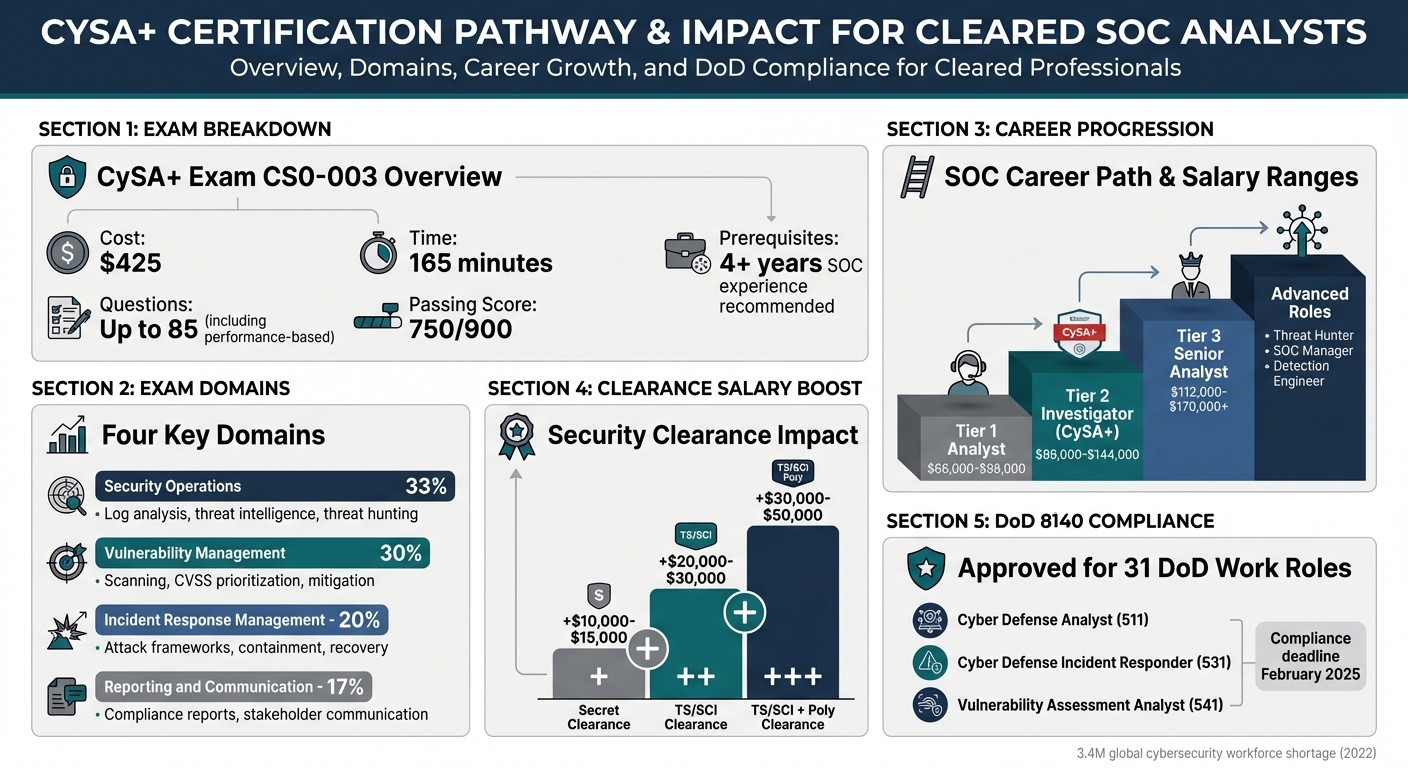
CySA+ Exam Domains and Career Progression for Cleared SOC Analysts
How to Study for the CompTIA CySA+ (and Pass the First Time)
sbb-itb-bf7aa6b
What is the CySA+ Certification?
The CompTIA Cybersecurity Analyst (CySA+) certification demonstrates your ability to identify, manage, and respond to cybersecurity threats through continuous monitoring and behavioral analytics. Unlike entry-level certifications that focus on general security concepts, CySA+ emphasizes detecting unusual activity patterns rather than relying on known threat signatures. This makes it a valuable credential for SOC analysts tasked with identifying sophisticated cyberattacks [6].
As a vendor-neutral certification, CySA+ equips you with skills that apply across various tools and platforms, including Wireshark, SIEM solutions, and scripting languages like Python and PowerShell [4]. The CS0-003 exam consists of up to 85 questions, including performance-based tasks that simulate real-world SOC scenarios. Candidates have 165 minutes to complete the test, and a passing score is 750 out of 900 [5]. This certification is ideal for roles such as SOC analysts, threat intelligence analysts, and incident responders. It is also approved under the DoD 8140/8570.01-M framework for cybersecurity roles. CompTIA recommends having prior certifications like Network+ or Security+, along with at least four years of hands-on experience in SOC operations or incident response [6][2]. These prerequisites ensure candidates are well-prepared for the exam’s focus on practical, real-world challenges.
CySA+ Exam Domains
The CySA+ exam is structured around four key domains that reflect the responsibilities of SOC professionals:
- Security Operations (33%): Focuses on tasks like analyzing logs, managing threat intelligence, and conducting threat-hunting activities.
- Vulnerability Management (30%): Tests your ability to perform vulnerability scans, prioritize risks using CVSS scores, and recommend mitigation strategies.
- Incident Response Management (20%): Covers the entire incident response process, from detection to containment and recovery, while referencing frameworks like MITRE ATT&CK and the Cyber Kill Chain.
- Reporting and Communication (17%): Highlights the importance of translating technical findings into reports and actionable intelligence, especially in environments dealing with sensitive data.
| Domain | Weight | Key Focus Areas |
|---|---|---|
| Security Operations | 33% | Log analysis, threat intelligence, threat hunting, SIEM/EDR tools, identity management, encryption |
| Vulnerability Management | 30% | Scanning, CVSS-based prioritization, mitigation strategies, patch management |
| Incident Response Management | 20% | Attack frameworks, containment, recovery, and lifecycle management |
| Reporting and Communication | 17% | Compliance reports, stakeholder communication, performance metrics |
The latest exam version (CS0-003) has been updated to address emerging trends like Security Orchestration and Automated Response (SOAR), Endpoint Detection and Response (EDR), Extended Detection and Response (XDR), cloud security, mobile threats, and zero trust architecture [2].
Why CySA+ Matters for Cleared SOC Analysts
The CySA+ certification goes beyond technical skills to meet the unique challenges of cleared environments, where professionals often face advanced persistent threats targeting classified systems. By focusing on behavioral analytics, CySA+ enables analysts to detect anomalies that traditional, signature-based tools might miss [3]. This is particularly important when safeguarding systems that manage sensitive government data, where breaches could have serious national security consequences.
The certification also emphasizes protecting sensitive information through encryption and secure architectures while ensuring compliance with regulations like the Federal Information Security Management Act (FISMA) [1]. Additionally, the Reporting and Communication domain equips analysts with the skills to document incidents and share findings without jeopardizing classified information – an essential capability for SOC professionals working in high-security environments.
How to Prepare for the CySA+ Exam
Exam Prerequisites and Recommended Experience
The CySA+ exam doesn’t require any previous certifications, so you can register for it without meeting specific prerequisites. However, CompTIA suggests that candidates have around four years of hands-on experience in roles like SOC analyst, incident response analyst, or something similar. This is because the test focuses heavily on practical, job-related skills rather than just theoretical knowledge.
If you’re working in a cleared government SOC environment, you’re likely already gaining experience in behavioral analytics, intrusion detection, and incident response – all of which align closely with the exam’s objectives. The certification is tied to several DoD 8140 work roles, such as Cyber Defense Analyst, Cyber Defense Incident Responder, and Vulnerability Assessment Analyst. If these responsibilities are part of your day-to-day work, you’re already building a solid base. For those with less SOC experience, it’s important to plan for extra study time to close any knowledge gaps.
Study Resources and Materials
Once you’ve assessed your experience, start preparing by reviewing the official exam objectives. You can download the CS0-003 exam objectives directly from CompTIA’s website to understand what areas to prioritize. CompTIA’s CertMaster suite offers resources tailored for this exam, including:
- CertMaster Learn: eLearning with videos and flashcards to build foundational knowledge.
- CertMaster Labs: Virtual environments for hands-on practice.
- CertMaster Practice: Adaptive tools with timed practice exams to help you prepare under test-like conditions.
If you’re already working in a cleared SOC environment, you can enhance your preparation by practicing with the tools you use daily. For example, set up virtual machines and work with tools like Wireshark, SIEM platforms, VirusTotal, Python, and PowerShell. Open-source tools such as Elastic Stack and threat intelligence feeds can also help reinforce practical skills. Taking full-length, timed practice tests using tools like CertMaster Practice is another great way to simulate the actual test environment.
Creating a Study Plan and Scheduling Your Exam
Once you’ve gathered your study materials, create a study plan that aligns your current SOC tasks with the exam’s four main domains. This approach helps you identify areas that need extra focus. The exam voucher itself costs $425, but you can save money by purchasing bundles that include training materials [4]. Tools like CertMaster Learn’s countdown calendar and personalized progress dashboard can be helpful for staying on track, especially if you’re juggling exam prep with a full-time cleared role.
When you feel ready, buy your exam voucher from the CompTIA Store and schedule your test through Pearson VUE. If you’re in the military and hold a cleared role, check if you qualify to take the exam at an on-base testing center, which can make scheduling and logistics easier.
Using CySA+ Skills in Cleared SOC Roles
Incident Response and Threat Management
In cleared environments, government systems often face advanced threats that can slip past traditional signature-based detection methods. Identifying these threats involves analyzing anomalies across networks, hosts, and applications [7][10]. With CySA+ certification, you’ll be equipped to use tools like Security Information and Event Management (SIEM) systems, Endpoint Detection and Response (EDR), and Extended Detection and Response (XDR) – tools that are staples in most SOCs [7][8].
The certification also teaches you to work with frameworks such as MITRE ATT&CK, the Cyber Kill Chain, and the Diamond Model. These frameworks provide a structured way to manage the incident response lifecycle, from detection and analysis to containment, eradication, and recovery [7][10]. This knowledge helps you better understand the behavior of threat actors and respond effectively.
CySA+ goes beyond incident response by teaching the distinction between threat intelligence and threat hunting. You’ll learn to analyze threat actor tactics, techniques, and procedures (TTPs) to proactively identify advanced threats before they can cause harm [7][8]. Since the certification is approved for multiple DoD 8140 work roles, such as Cyber Defense Incident Responder and Vulnerability Assessment Analyst, the skills you gain directly align with the needs of cleared SOC operations [7][9].
Vulnerability Assessment for Classified Systems
CySA+ also prepares you to manage vulnerabilities in classified systems, where precision is even more critical than in standard IT environments. You’ll learn to use various scanning methods – credentialed, agent-based, and active/passive – to achieve more accurate assessments [7]. For sensitive enclaves, credentialed scans are particularly useful as they minimize false positives and provide a clearer picture of your internal security posture [7].
The certification also covers identifying vulnerabilities in specialized systems often found in cleared environments, such as SCADA, Industrial Control Systems (ICS), and System-on-Chip (SoC) [11][12]. You’ll gain the skills to prioritize remediation using the Common Vulnerability Scoring System (CVSS) while considering factors like asset value and exploitability [7][11]. For systems that can’t be patched immediately due to mission-critical requirements, CySA+ helps you recommend alternative controls to reduce risk [7]. Additionally, you’ll learn to identify where systems deviate from enclave policies, local security guidelines, or federal regulations like FISMA [12][13].
Reporting and Communication with Classified Data
Beyond technical expertise, clear communication is essential in cleared environments. CySA+ dedicates 17% of its exam to reporting and communication, ensuring you can create actionable reports and deliver key performance metrics to both technical and non-technical stakeholders [7][14][15][16]. This skill is invaluable when presenting complex technical data to leadership or collaborating with other agencies [15][16].
"It validates a tech professional’s expertise in incident response and vulnerability management processes, emphasizing the critical communication skills necessary for effective security analysis and compliance." – CompTIA [7]
When working with classified data, maintaining accurate records of security incidents and response actions is not just a best practice – it’s a compliance requirement. These records ensure your organization adheres to industry standards and regulations [15].
Advancing Your Career with CySA+ Certification
SOC Career Progression Paths
CySA+ acts as a stepping stone for advancing from entry-level tasks to more complex responsibilities in a Security Operations Center (SOC). At Tier 1, your focus is on following predefined procedures and triaging alerts. Once you earn your CySA+ certification, you’ll take on more advanced duties, such as developing mitigation strategies, performing root cause analysis, and making critical containment decisions that require professional judgment [18].
This certification can open doors to senior technical roles like Threat Hunter or Detection Engineer, where you’ll create custom detection logic and lead hypothesis-driven investigations. It can also pave the way for leadership roles, such as SOC Manager or Team Lead, where your technical expertise helps shape strategic decisions [18].
The salary growth reflects these advancements. Tier 1 analysts typically earn between $66,000 and $98,000 annually, while Tier 2 investigators with CySA+ certification can see earnings climb to $86,000–$144,000. Senior Tier 3 analysts often earn $112,000–$170,000+ within four to seven years [18]. Security clearance can further boost these figures – holding a Secret clearance could add $10,000–$15,000 to your base salary, while a TS/SCI clearance might increase it by $20,000–$30,000. For roles requiring a TS/SCI with polygraph, compensation may rise by an additional $30,000–$50,000 [18].
To accelerate your career, invest in skills like scripting with Python or PowerShell to automate tasks such as log parsing and alert enrichment – 24% of mid-level Security Operations job listings mention these skills [18]. Additionally, mastering a specific SIEM platform can make you even more competitive. For instance, Splunk is mentioned in 37% of SOC Analyst postings, and Microsoft Sentinel appears in 50% of SIEM Engineer roles [18]. Pairing CySA+ certification with expertise in these tools positions you strongly in the job market, helping you advance to roles that require both technical and analytical expertise.
Meeting DoD 8140 Requirements
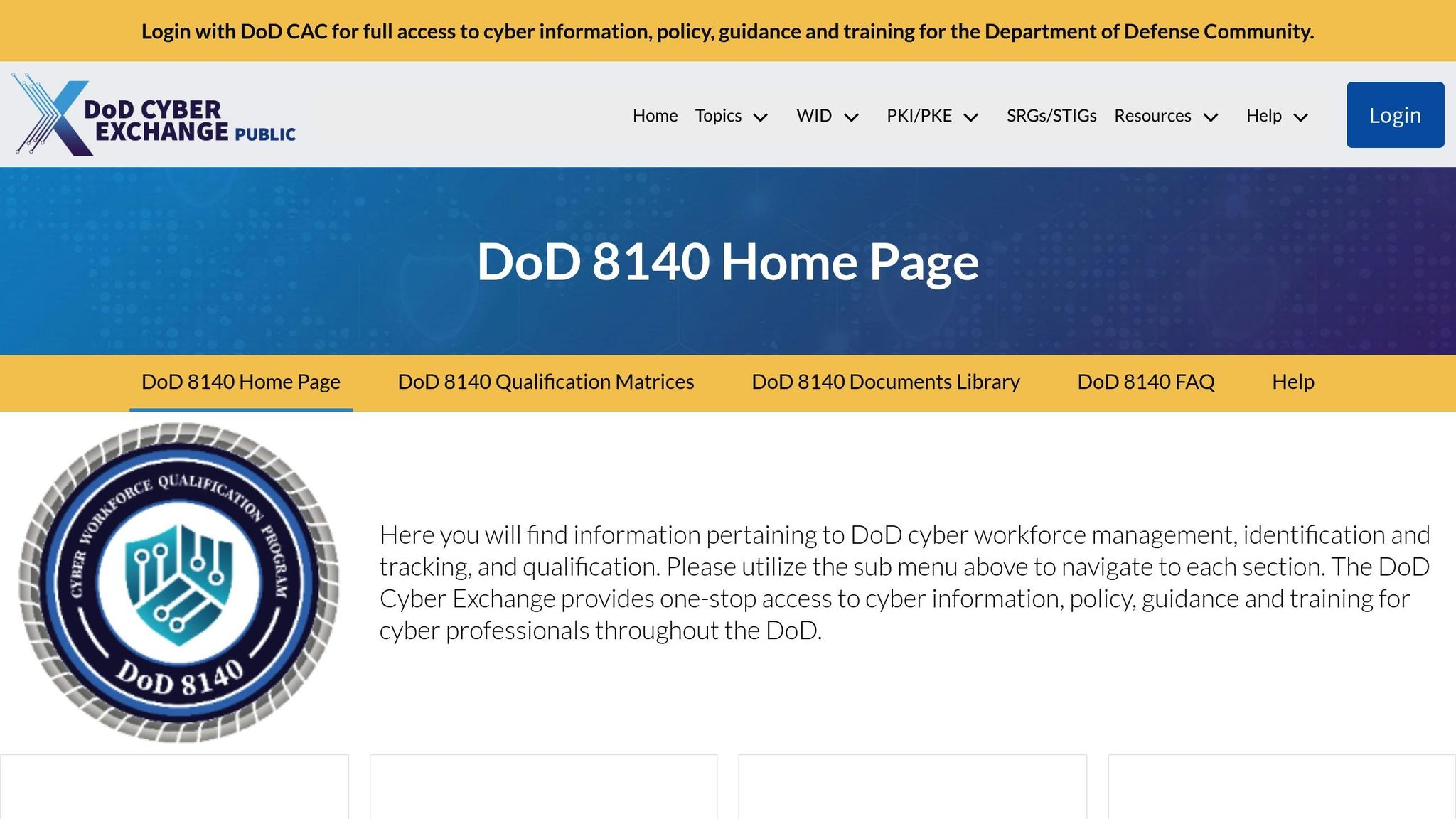
For professionals in cleared roles, CySA+ isn’t just a helpful credential – it’s often mandatory. The certification is approved for 31 specific work roles under the Department of Defense Manual 8140.03 framework, providing more versatility than many entry-level certifications [17]. These roles include Cyber Defense Analyst (511), Cyber Defense Incident Responder (531), and Vulnerability Assessment Analyst (541) [17].
"The DoDM 8140.03 qualification standards focus on a demonstration of capability rather than a compliance-based approach… ensuring that the cyber workforce is competent in performing the required functions of their job role." – CompTIA [17]
By February 2025, all DoD cybersecurity personnel are required to meet these standards [17]. If you’re new to a cleared role, you’ll typically have 180 days from your assignment date to obtain the necessary certification [20][21]. Missing this deadline can result in losing system access, so it’s essential to plan ahead.
Before scheduling your exam, confirm your specific DCWF (Department of Defense Cyber Workforce Framework) work role code with your Information Assurance Manager to ensure CySA+ aligns with your position [17][22]. The certification also meets requirements for Information Assurance Technical (IAT) Level II and various Cyber Security Service Provider (CSSP) roles, giving you flexibility to transition between cleared positions without needing additional certifications [20][21]. This alignment with DoD standards not only secures your current role but also opens up opportunities for growth in cleared cybersecurity positions.
Job Search Tips on Cleared Cyber Security Jobs

Earning your CySA+ certification enhances your technical skills and boosts your profile in the job market. When searching for roles on Cleared Cyber Security Jobs, highlight your CySA+ certification to target positions where it’s explicitly listed as a requirement, such as "Cyber Defense Analyst" or "Systems Security Analyst" [17]. Considering that 96% of HR managers use IT certifications as a filtering criterion during recruitment [19], showcasing your CySA+ credential on your resume can help you pass initial screening processes.
Focus your job search on high-demand areas like Arlington, VA, and Northern Virginia, where salaries for cleared, certified analysts tend to be the highest [18]. Use the platform’s job alert feature to receive notifications for positions that match your CySA+ certification and clearance level. With SOC Analyst ranked as the #1 most in-demand cybersecurity role [18], this is an excellent time to enter the market.
To stand out, go beyond listing your certification. Use GitHub to display scripts that demonstrate your automation skills, or create detailed write-ups of alert triage exercises to showcase your analytical expertise [18]. If you attend job fairs hosted by the platform, be ready to discuss how you’ve applied CySA+ concepts – such as mapping threats using the MITRE ATT&CK framework – in practical scenarios. Combining certification with hands-on experience and a clear demonstration of your skills positions you as a top-tier candidate in the competitive cybersecurity job market.
Conclusion
The CySA+ certification represents an important milestone for cleared SOC analysts aiming to advance their careers in government and defense cybersecurity. With a global shortage of 3.4 million cybersecurity professionals as of 2022 – and around 60% of organizations reporting open cybersecurity roles [23] – this certification equips you to meet growing demand while also satisfying the mandatory DoD 8140 requirements.
Success begins with thorough preparation. To tackle performance-based questions effectively, blend theoretical knowledge with hands-on experience using tools like SIEMs, Wireshark, and scripting languages. Though the $425 exam fee may seem steep, it’s an investment with the potential for significant returns, as certified professionals typically earn between $52,000 and $116,000 annually [9].
This preparation doesn’t just help you pass the exam – it builds practical expertise that’s critical in high-security environments. You’ll be ready to analyze SIEM alerts, evaluate vulnerabilities in classified systems, and handle incident response with precision, all while adhering to strict protocols for sensitive data.
Once certified, CySA+ opens doors to senior roles like Threat Hunter, Detection Engineer, or SOC Manager. When exploring opportunities on Cleared Cyber Security Jobs, highlight your certification prominently. Focus on high-demand areas such as Northern Virginia, where cleared and certified analysts often earn top-tier salaries. Don’t forget to set up job alerts to stay updated on roles that align with your qualifications.
FAQs
Is CySA+ harder than Security+?
Yes, CySA+ is often viewed as more challenging than Security+. While Security+ serves as an entry-level certification covering basic security principles, CySA+ takes things a step further. It’s an intermediate-level certification aimed at analysts, requiring a stronger grasp of topics like threat management, incident response, and security operations. Unlike Security+, CySA+ emphasizes applying foundational knowledge to practical, real-world situations, which many candidates find more demanding.
How long should I study for CySA+ if I work in a cleared SOC?
For SOC professionals with security clearances, getting ready for the CySA+ exam usually requires about 3 months of preparation. Aim to spend 10–15 hours per week studying, though the exact amount may vary based on your prior experience and understanding of cybersecurity concepts. Be flexible with your schedule to ensure you cover all necessary material and feel confident on exam day.
What jobs should I apply for after earning CySA+ with a clearance?
With a CySA+ certification and a security clearance, you’re well-positioned for roles such as SOC Analyst, Vulnerability Analyst, Threat Intelligence Analyst, or Cybersecurity Analyst. These jobs typically involve tasks like monitoring threats, responding to incidents, and managing vulnerabilities.
Your clearance can also open doors to government or defense positions, including roles like Cybersecurity Engineer or Cyber Defense Analyst. These positions often require advanced skills in detecting threats and implementing robust security measures.