

Tanium is a critical tool for securing classified networks, especially in government and Department of Defense (DoD) environments. It provides real-time visibility, control, and remediation across endpoints, addressing vulnerabilities faster than traditional security tools. Tanium’s peer-to-peer architecture ensures rapid responses, even in low-bandwidth environments, making it ideal for high-security operations.
Here’s what you need to know:
- Core Features: Asset discovery, threat detection, automated patch management, and incident response.
- Threat Response: Real-time monitoring with automated containment and remediation workflows.
- Government Compliance: Meets DoD standards through DISA STIGs, NIST 800-53, and other federal guidelines.
- Career Opportunities: Expertise in Tanium is highly sought after in cleared cybersecurity roles, with certifications like TCO, TCA, and TCPEM boosting job prospects.
- Deployment Best Practices: Secure configurations, compliance with federal standards, and optimized network settings ensure effective use in sensitive environments.
Tanium enables cleared professionals to protect endpoints, automate threat responses, and meet stringent security requirements, making it a valuable skill for high-demand roles in defense and government sectors.
Demo: Tanium Autonomous Endpoint Management (AEM) in action
sbb-itb-bf7aa6b
Using Tanium for Automated Threat Response
Automated threat response is transforming endpoint protection in classified networks. Instead of relying on manual investigations for every alert, Tanium’s Threat Response module offers continuous endpoint monitoring and immediate action when threats are detected. By using Tanium Signals – which deliver real-time alerts for suspicious activity regardless of whether endpoints are online or offline – teams can quickly identify compromised systems and halt malicious behavior within seconds [1][2].
How Tanium’s Threat Response Module Works
Tanium shifts the focus from analyzing historical logs to answering a more pressing, real-time question. As Jim Kelly, Domain Architect at Tanium, puts it:
Investigations evolve from, ‘Do we have logs for this?’ to a more useful question: ‘What’s true right now?’ [5]
The platform gathers live data on processes, services, files, and registry keys across the entire network [1]. When a threat is identified, Tanium can act immediately by stopping harmful processes, capturing suspicious files, closing unauthorized connections, and even deploying patches [1]. For containment, its Quarantine feature isolates compromised machines instantly, while maintaining a secure management channel on port 17472. This allows teams to perform remediation and collect forensic data without risking further spread of the threat [6]. This approach is particularly effective against advanced persistent threats, as it prevents lateral movement while enabling remote investigations and cleanup [1][2]. Additionally, security teams can perform forensic searches across systems without needing physical access – an essential feature for segmented or classified networks [1][2].
The Live Response framework automates the collection of critical forensic data, ensuring memory strings and file artifacts are consistently captured during incidents [6]. Integration with platforms like ThreatConnect further enhances this process by automatically delivering indicators and signatures as "intel packages", enabling proactive threat monitoring [3].
This level of automation lays the foundation for effective, real-time threat response scenarios.
Threat Automation in Practice
Tanium’s automated capabilities allow cleared professionals to execute precise, preconfigured responses that meet strict government security standards. These responses can include terminating processes, removing malicious files, or quarantining networks to neutralize threats swiftly [6]. For example, when a malware signature is detected, Tanium can automatically quarantine the affected endpoint, collect forensic evidence, and stop the attack before it spreads [4][6].
Tanium Automate Playbooks simplify these workflows, making it easier to standardize responses in high-security environments. By customizing Tanium Signals to align with the MITRE ATT&CK framework, teams can identify detection gaps and fine-tune alerts to address specific nation-state threats [1][2]. Furthermore, integrating Tanium with SIEM systems provides stakeholders with a complete view of the threat lifecycle, along with streamlined alert reporting [2].
This combination of automation, customization, and integration ensures that Tanium remains a powerful tool for safeguarding classified networks.
Deploying Tanium in DoD and Classified Systems
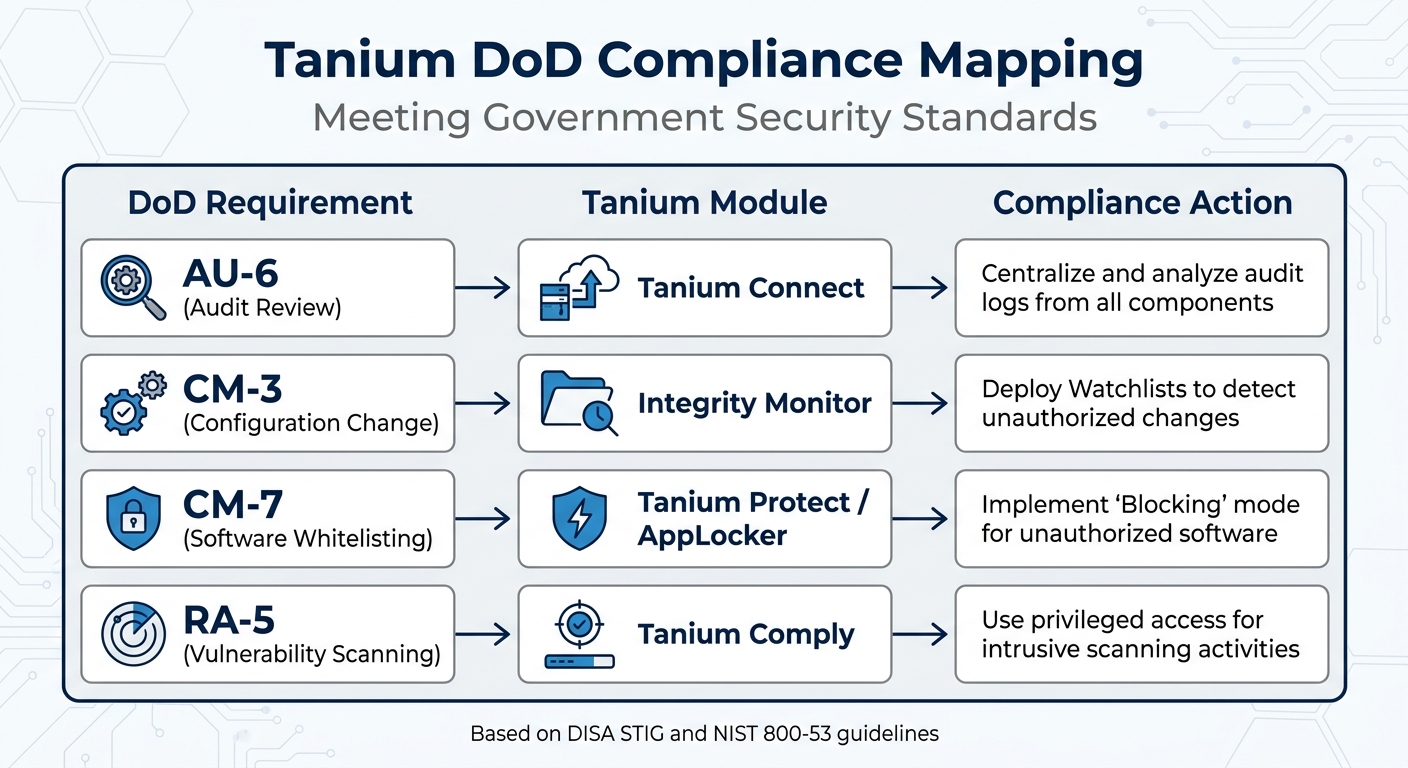
Tanium DoD Compliance Requirements and Security Modules
Setting up endpoint security in classified networks requires adherence to strict federal standards while maintaining operational efficiency. Tanium’s architecture is designed to meet these demands with its linear peer-to-peer design, which ensures fault tolerance across global WAN segments. Unlike conventional peer-to-peer systems, Tanium restricts communication to authenticated endpoints, ensuring that only authorized systems exchange data over designated TCP ports [7][11].
Meeting Government Security Standards with Tanium
Tanium aligns with DoD requirements through its DISA-published Security Technical Implementation Guide (STIG). The Tanium 7.3 STIG, built on NIST 800-53 and DoDI 8500.01 guidelines, guarantees secure operations in both Managed and SSLF settings [7][8][11].
The platform employs cryptographic signing and verification for all sensors, questions, actions, and file shards, which prevents Man-in-the-Middle (MitM) attacks [9]. Additionally, every endpoint installation requires the Tanium Server’s public key to ensure the integrity of registration data [9]. For software control, Tanium Protect uses AppLocker in a deny-all, permit-by-exception configuration to block unauthorized applications [9]. The Tanium Comply module ensures privileged access for vulnerability scans, while the Integrity Monitor automatically responds to unauthorized baseline configuration changes [9].
| DoD Requirement | Tanium Module | Compliance Action |
|---|---|---|
| AU-6 (Audit Review) | Tanium Connect | Centralize and analyze audit logs from all components |
| CM-3 (Configuration Change) | Integrity Monitor | Deploy Watchlists to detect unauthorized changes |
| CM-7 (Software Whitelisting) | Tanium Protect / AppLocker | Implement "Blocking" mode for unauthorized software |
| RA-5 (Vulnerability Scanning) | Tanium Comply | Use privileged access for intrusive scanning activities |
These measures provide a secure foundation for deploying Tanium in classified environments.
Deployment Best Practices for Classified Networks
After confirming compliance, follow these best practices to optimize Tanium’s deployment in sensitive networks. Begin by downloading the latest STIGs from the DoD Cyber Exchange (cyber.mil or public.cyber.mil) [11]. Always test configurations in a controlled environment before rolling them out to production to avoid disruptions [11].
For network configuration, open TCP port 17472 bi-directionally to enable both client-to-server and peer-to-peer communication within the same local area network [9]. Exclude Tanium files from security scans to prevent interference [9]. To harden the client, restrict Tanium Client service control to "SYSTEM" access only and set "SYSTEM"-only permissions on the Tanium Client directory to protect against malicious modifications [9]. Additionally, hide the client from "Add/Remove Programs" to prevent unauthorized tampering or removal [9].
Organizations can also leverage the Tanium Enforce module to import existing Group Policy Objects (GPOs), such as CIS Build Kits or Microsoft Security Baselines, ensuring seamless compliance during the transition to Tanium-managed configurations [10]. For appliance-based setups, follow the Tanium 7.x on TanOS STIG to secure the underlying operating system according to federal standards [11].
Developing Tanium Skills for Cleared Cybersecurity Careers
Becoming proficient in Tanium not only strengthens your ability to secure endpoints but also opens doors to high-level clearance roles. Mastery of Tanium is a sought-after skill among defense contractors and government agencies, especially for positions in areas like Chantilly and Alexandria, Virginia. Companies such as QinetiQ, Amentum, and Booz Allen Hamilton actively recruit for roles like Tanium Engineer and Platform Cybersecurity Lead in these classified environments [14][15].
Key Skills for Tanium Proficiency
To excel as a Tanium expert, you need both in-depth knowledge of the platform and a broad understanding of cybersecurity practices. Start with foundational platform knowledge, which includes navigating the interface and using core features to ensure visibility across large networks. Then, focus on developing advanced skills, such as:
- Endpoint Management: Learn how to use operations-focused modules to maintain network performance and stability.
- Security and Risk Mitigation: Use Tanium to uncover vulnerabilities, enforce security policies, and meet Department of Defense (DoD) requirements.
As organizations increasingly move classified workloads to secure cloud environments, cloud deployment expertise is becoming indispensable. This includes skills in planning, configuring, and operationalizing Tanium in these settings. Additionally, DoD compliance knowledge is critical – understanding how to implement Tanium in line with DISA STIGs and NIST 800-53 standards is essential. For example, the Tanium 7.x STIG, updated on May 14, 2025, enhances security measures for DoD systems [8].
Finally, integration and automation skills are key for modern security operations. Knowing how to link Tanium with security orchestration tools via APIs, GraphQL, and webhooks allows you to automate threat response workflows, a crucial capability in high-pressure environments.
Finding Tanium Jobs on Cybersecjobs.com

For those with active security clearances, Cybersecjobs.com is an excellent resource for finding Tanium-related roles. This veteran-founded platform connects cleared candidates with direct-hire employers in the cybersecurity sector. It offers tools like job search filters, resume uploads, and personalized job alerts, all free for job seekers who are U.S. citizens.
To enhance your job search, set up alerts for "Tanium" to receive notifications when relevant positions are posted [14][15]. Uploading your resume increases your visibility to hiring managers from defense contractors and government agencies. Additionally, the platform hosts job fairs where you can network directly with employers, bypassing intermediaries and creating opportunities for face-to-face interactions with decision-makers.
Tanium Certifications and Training Programs
Tanium provides a well-structured certification pathway to validate your technical skills and boost career opportunities. The journey begins with the Tanium Certified Operator (TCO) for foundational knowledge and progresses to more advanced certifications like the Tanium Certified Administrator (TCA). For professionals, certifications such as Tanium Certified Professional Endpoint Management (TCPEM) and Tanium Certified Professional Endpoint Risk and Security (TCPRS) are available. These professional-level certifications require 60 score points and remain valid for two years [12][13].
| Certification | Level | Focus Area |
|---|---|---|
| Tanium Certified Operator (TCO) | Entry | Basic platform functionality |
| Tanium Certified Administrator (TCA) | Intermediate | Platform management and administration |
| Tanium Certified Specialist Cloud Deployment (TCS_CD) | Specialist | Cloud deployment planning and configuration |
| Tanium Certified Professional Endpoint Management (TCPEM) | Professional | Operational module management |
| Tanium Certified Professional Endpoint Risk and Security (TCPRS) | Professional | Security and compliance use cases |
Exams can be taken at Pearson VUE Test Centers or online through the OnVUE testing service. To supplement certifications, explore role-specific "Learning Journeys" and attend webinars like "Titans LIVE!" and "Tuning Tanium" to stay updated on the platform’s latest features. For cleared professionals, understanding the Tanium 7.x STIG requirements is particularly important when configuring the platform for classified DoD networks [8].
Conclusion
Tanium plays a key role in cleared environments, offering real-time insights and automated threat remediation across all endpoints. Its ability to link threats with automated workflows allows security teams to isolate compromised endpoints and shut down malicious processes in seconds [16]. As highlighted earlier, Tanium’s threat detection and response capabilities have proven reliable even in large-scale environments.
For professionals in the defense sector, expertise in Tanium can unlock opportunities in high-demand roles. With over 3,390 companies relying on the platform – including industry leaders like Booz Allen Hamilton, Leidos, and Northrop Grumman – Tanium knowledge is a sought-after skill [17]. The platform’s combination of real-time response tools and compliance features not only protects networks but also helps professionals meet DoD security standards, paving the way for advanced career paths.
The certification pathway outlined earlier provides a structured approach for roles such as incident responders, threat hunters, and administrators [13]. By significantly reducing alert response times, as discussed in previous sections, Tanium proves its value in roles that require quick, decisive action in clearance-sensitive environments [16].
FAQs
Which Tanium modules matter most for DoD networks?
For Department of Defense (DoD) networks, the most important Tanium modules are those that address security and compliance. These modules support key technical controls, such as multifactor authentication and secure communication protocols. Tools for configuration management, vulnerability management, and endpoint detection are critical for enforcing TLS 1.2 Strict Only, ensuring secure data exchanges, and enabling real-time threat detection and response. These capabilities are designed to meet the stringent security standards demanded by the DoD.
How does Tanium quarantine endpoints without breaking management?
Tanium uses scheduled actions to quarantine endpoints, even if they’re offline. When these endpoints reconnect, the quarantine actions are executed, ensuring that compromised or high-risk devices are isolated promptly. This approach allows devices to remain manageable while maintaining security. Actions queued for offline devices automatically activate upon reconnection, balancing control and protection effectively.
What’s the fastest path to a Tanium certification for cleared roles?
The fastest path to earning a Tanium certification for cleared roles is by beginning with the Tanium Certified Operator (TCO) certification. This certification confirms your foundational understanding of Tanium’s features and capabilities. To prepare, take courses such as "Getting Started with Tanium" and "Tanium Essentials."
The TCO exam is designed for individuals with 1-3 years of IT or security experience and 3-6 months of hands-on Tanium use. The best part? There are no prerequisites to get started.