

The Offensive Security Certified Professional (OSCP) certification is a top credential for professionals in cybersecurity, especially those with security clearances. It demonstrates advanced penetration testing skills through a rigorous 24-hour exam, making it ideal for roles like penetration tester or red team operator.
Key takeaways:
- Salary Potential: OSCP-certified professionals in the U.S. earn between $90,000 and $168,000, with an average of $120,000 annually.
- Demand: By 2026, only 8,000 to 12,000 OSCP holders are expected in the U.S., making it a highly sought-after qualification.
- Job Growth: Information Security Analyst roles are projected to grow by 29% (2024–2034).
- Government Relevance: Meets DoD 8570/8140 requirements, making it valuable for defense and government jobs.
Preparation involves completing the PEN-200 (PWK) course, practicing hands-on labs, and mastering tools like Nmap, Burp Suite, and Hydra. The certification also opens doors to advanced certifications like OSEP, OSWE, and OSED for career progression.
Professionals with OSCP can find high-paying, cleared roles by leveraging platforms like Cleared Cyber Security Jobs and networking through industry events.
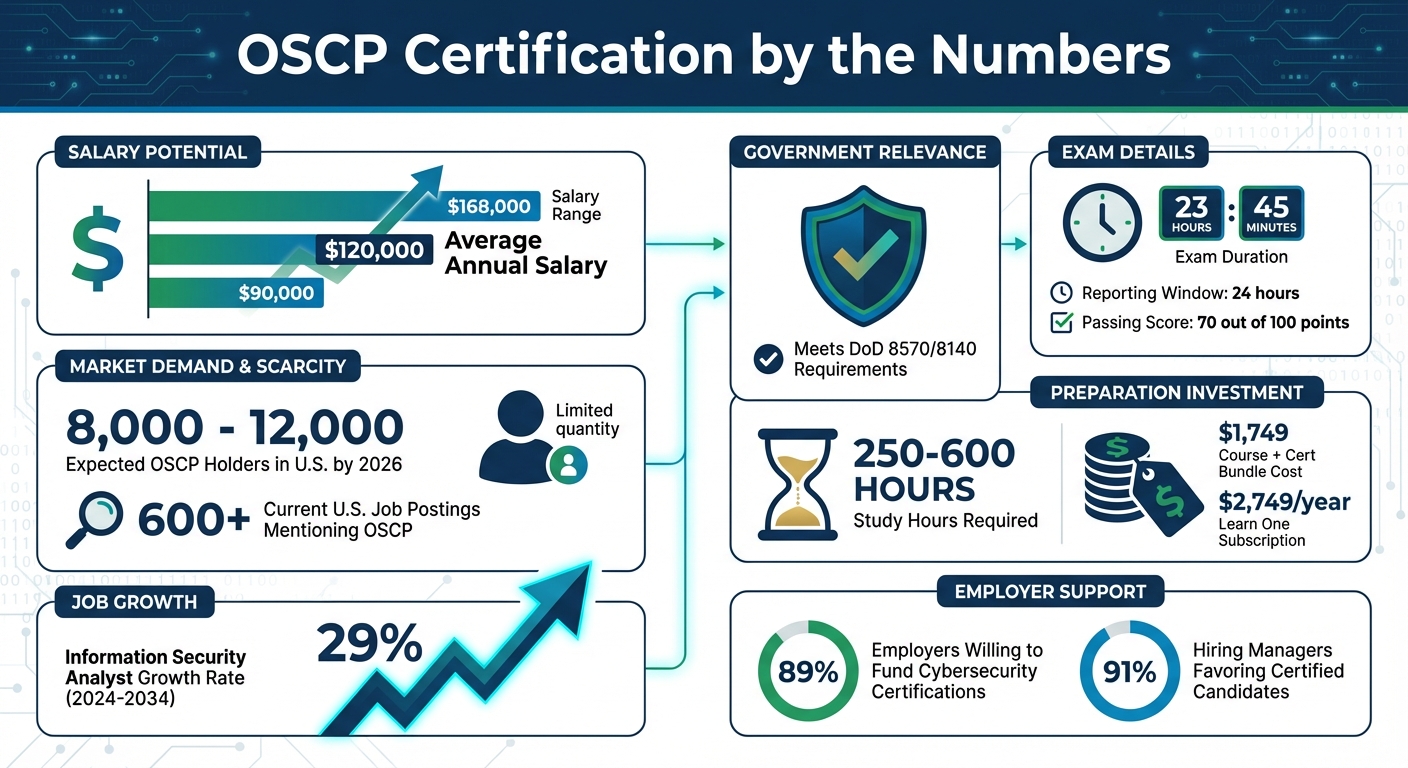
OSCP Certification Career Statistics: Salary, Demand, and Growth Projections
OSCP Certification Overview for Cleared Professionals
What is OSCP?
The Offensive Security Certified Professional (OSCP) is a hands-on certification designed to demonstrate your ability to conduct penetration testing on live systems. Unlike traditional multiple-choice exams, the OSCP requires candidates to breach real machines during a 23-hour, 45-minute exam, followed by a 24-hour window to submit a professional penetration test report [1]. To pass, you need to score at least 70 out of 100 points, which involves gaining initial access, escalating privileges on standalone systems, and compromising an Active Directory (AD) environment [1].
The AD component is particularly relevant for professionals working in government agencies or defense settings. It reflects real-world internal network environments where attackers often start with compromised credentials and move laterally across domain systems. The certification emphasizes essential offensive security skills, including information gathering, vulnerability analysis, privilege escalation on Windows and Linux, and exploiting Active Directory.
The OSCP certification has two renewal paths: the OSCP+, which requires renewal every three years, and the original OSCP, which remains valid indefinitely [1]. However, the certification comes with strict guidelines: no commercial vulnerability scanners like Nessus, no use of AI tools or chatbots, and limited reliance on automated tools such as Metasploit.
This structure closely mimics the challenges faced in government and defense security roles, making it highly relevant for professionals in these fields.
Why OSCP Matters for Cleared Offensive Security Jobs
The OSCP’s rigorous format sets it apart as a key differentiator for security-cleared professionals in a competitive market. With only 8,000 to 12,000 OSCP holders in the United States [3], earning this certification places you in an exclusive group capable of demonstrating technical expertise in realistic scenarios. It’s also gaining traction under DoD 8570/8140 mandates, further solidifying its value for government and defense contractor roles [3].
The hands-on nature of the certification validates critical skills, including exploitation techniques, detailed reporting, and actionable analysis – qualities that cleared employers prioritize. Currently, over 600 U.S. job postings specifically mention the OSCP, with many government and defense roles offering salaries between $95,000 and $120,000 annually [3]. As highlighted by Programs.com:
If CISSP is the manager’s cert, OSCP is the hacker’s cert. Anyone who wants to be taken seriously in offensive security should pursue it. [3]
With the Bureau of Labor Statistics forecasting a 29% growth rate for information security analysts through 2034 [1], the OSCP is a strategic investment for advancing your career in cleared offensive security positions.
OSCP Guide – Full Free Course
How to Prepare for the OSCP Exam
Getting ready for the OSCP exam does more than just prepare you for the test – it also enhances your qualifications for demanding security roles.
Penetration Testing with Kali Linux (PWK) Course and Labs
The PEN-200 (PWK) course is the official training program from OffSec, offering 282 hours of instruction spread across more than 20 modules [5][9]. This curriculum dives into essential topics like basic enumeration, exploiting Active Directory, privilege escalation on both Windows and Linux, and identifying web application vulnerabilities like XSS and SQL injection. Each module includes hands-on labs designed to help you practice these techniques in a controlled environment.
What sets this course apart are the 9 challenge labs. These labs combine various skills in scenarios that mimic real-world network breaches. Three of these labs are specifically designed to help you prepare for the OSCP exam by simulating its format [9][11]. These aren’t your typical CTF-style challenges – they replicate organizational networks with machine dependencies, credential reuse, and lateral movement, making them a great way to practice realistic attack scenarios [10].
To make the learning process smoother, OffSec provides a structured path that maps specific lab machines to the course modules. This approach is especially helpful for beginners tackling complex network setups [10]. Data shows a strong link between the number of lab machines you successfully compromise and your likelihood of passing the exam. Candidates who complete over 50 machines tend to have much higher success rates [6][10].
The Course + Cert Bundle costs $1,749, which includes 90 days of lab access and one exam attempt [5][9]. If you need more time or access to additional foundational courses like PEN-103, the Learn One Subscription is available for $2,749 per year and includes a full year of lab access plus two exam attempts [5][9].
While the PWK course builds a strong foundation, you’ll also need to refine your skills with a carefully selected toolkit to handle the exam’s unique challenges.
Tools You Need for OSCP Preparation
Choosing the right tools and understanding how to use them effectively is critical, especially since the exam comes with strict limitations. For example, commercial vulnerability scanners like Nessus and automated tools such as SQLmap are not allowed [2][6]. While Metasploit is permitted during lab practice, its use in the exam is limited to just one target machine [2].
Your go-to tools should include Nmap for reconnaissance, Burp Suite Free Edition for web application testing, and directory enumeration tools like Gobuster or Ffuf [6][7]. For password attacks, you’ll want to become proficient with tools such as Hydra, John the Ripper, and Hashcat. Privilege escalation tools like LinPEAS and WinPEAS are essential for identifying local vulnerabilities, while Netcat and MSFvenom are vital for creating payloads and setting up reverse shells [7].
The key here is not just knowing how to use these tools but also understanding the underlying techniques. Avoid over-relying on automation – make sure you can adapt and fine-tune exploit commands for specific targets [6].
Practice Labs and Hands-On Training
Practical experience is just as important as theoretical knowledge when it comes to OSCP preparation. OffSec Proving Grounds offers two options: PG Play, which is free and allows 3 hours of daily access to VulnHub community machines, and PG Practice, which costs $19 per month or $199 per year and includes OffSec-designed machines and retired OSCP exam labs [7][8].
A good starting point is free VulnHub VMs, such as the Kioptrix series, which are beginner-friendly [7]. As you progress, you can move on to premium platforms. The PortSwigger Web Security Academy is another excellent resource for honing your web exploitation skills [7].
For a structured 90-day prep plan, consider this approach:
- Spend the first 30 days rooting easy VulnHub boxes.
- Use the next 30 days to tackle medium-difficulty boxes and explore PG Play.
- Dedicate the final 30 days to mock exams and labs focused on Active Directory [7].
Consistency is key, with most candidates investing 200–300 hours of study time to feel fully prepared [6].
sbb-itb-bf7aa6b
Finding Cleared Jobs with Your OSCP Certification
With your OSCP certification in hand, it’s time to focus on finding the right career path. As mentioned earlier, there are over 600 U.S. job postings specifically seeking OSCP-certified professionals. That puts you in a strong position as you step into the job market.
Common Job Roles for OSCP-Certified Professionals
If you’re aiming for a Penetration Tester role, your OSCP skills are a perfect match. These jobs involve simulating cyberattacks to uncover weaknesses in government networks and systems [12]. You’ll perform authorized exploitation, document vulnerabilities, and recommend fixes – essentially what you mastered during your OSCP exam.
For those interested in Vulnerability Analyst positions, the focus shifts to identifying and assessing system flaws [12]. Your OSCP certification proves you can go beyond automated tools, manually verifying and exploiting vulnerabilities, which adds value to your expertise.
Jobs in cleared environments for OSCP-certified professionals often come with competitive salaries. Knowing the clearance requirements for these roles will help narrow your search.
Clearance Requirements and Job Examples
Many positions require a Secret clearance, while more sensitive roles demand Top Secret/SCI. For example, penetration testers working with classified networks typically need either Secret or TS/SCI clearances [12]. Vulnerability analysts may start with Public Trust or Secret clearances, depending on the agency.
Your OSCP training gives you a strong edge here. The hands-on experience from the exam – like 24-hour reporting and Active Directory (AD) exploitation – aligns closely with what employers in these roles are looking for. Many job postings now highlight skills like Kerberoasting and lateral movement, which are thoroughly covered in the updated OSCP curriculum [3]. Be sure to emphasize your 24-hour reporting experience, as this is a critical skill valued by cleared employers [3].
Using Cleared Cyber Security Jobs to Find OSCP Roles
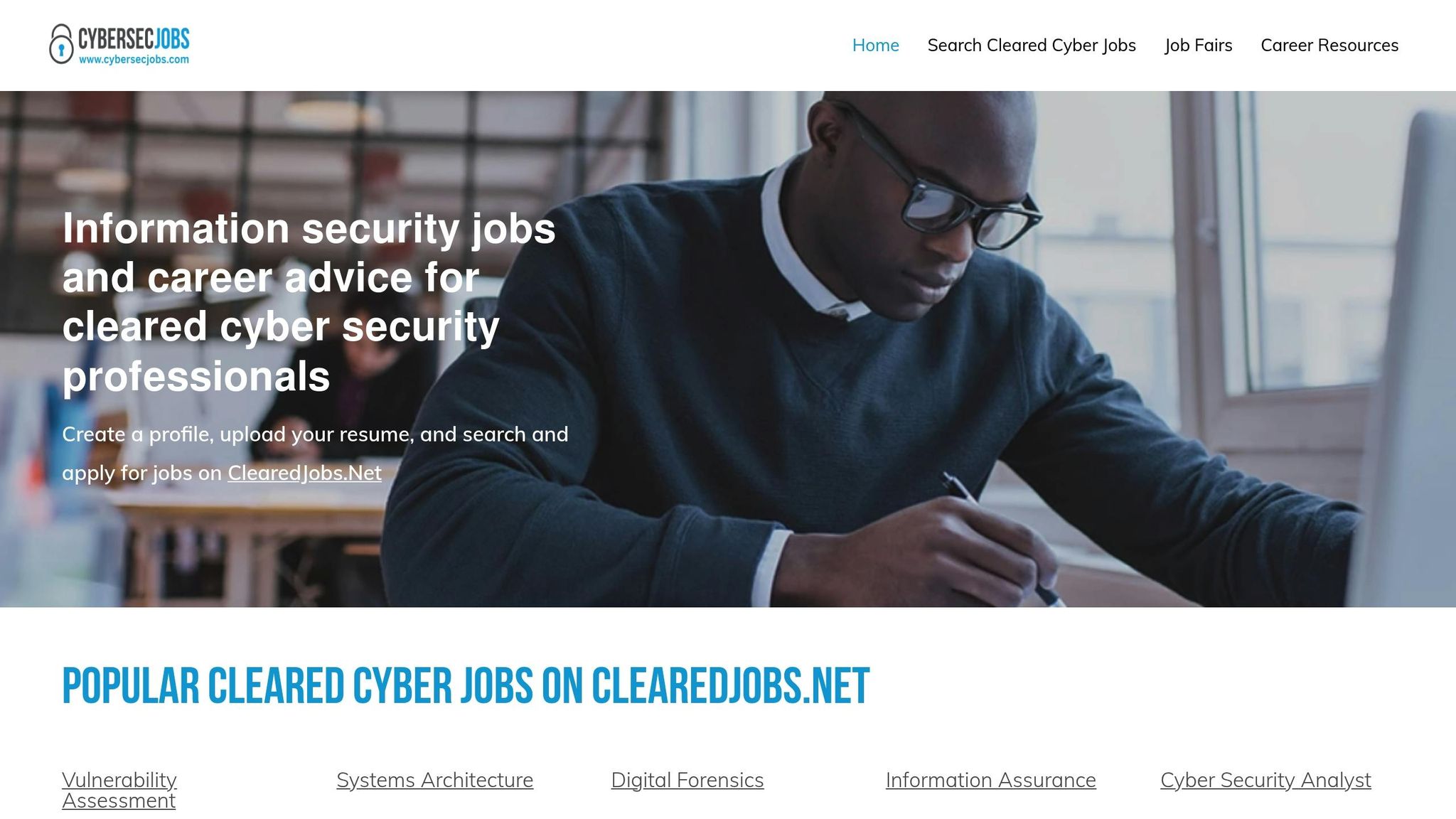
The Cleared Cyber Security Jobs platform offers tools tailored for security-cleared professionals. By uploading your resume, you can connect directly with government agencies and defense contractors. The platform avoids staffing firms, ensuring you’re dealing directly with hiring managers.
Set up job alerts using "OSCP" as a keyword to stay updated on new openings. You can refine your search by clearance level (Secret, TS, TS/SCI), job type (penetration tester, vulnerability analyst), and location. Some employers on the platform even provide full or partial tuition reimbursement for OSCP certification [3]. If you haven’t taken the exam yet, ask about this perk during interviews – it could save you the $1,749 course fee.
Additionally, the platform’s career resources section offers guides specifically for cleared professionals. These resources can help you position your OSCP certification alongside your clearance status, giving you a strong advantage in the job market. With relatively few OSCP holders, your certification becomes a standout credential in this niche field.
Advancing Your Career After OSCP
Earning your OSCP certification is just the beginning – it’s a launchpad for diving deeper into offensive security and pursuing advanced certifications that open doors to elite roles in the field [17].
Advanced Certifications Beyond OSCP
The OSCP lays the groundwork for OffSec’s advanced certifications, with the OSCE³ (OffSec Certified Expert³) being the ultimate achievement in their certification path. This title is automatically awarded upon completing three advanced certifications: OSEP, OSWE, and OSED [13][15]. Each certification focuses on a specialized area of offensive security and requires completing the corresponding advanced course.
"Having an OSCE³ certification proves you’re not just a penetration tester – you’re among the most advanced offensive security professionals in the world." – OffSec [13]
Here’s a breakdown of the advanced certifications:
- OSEP (OffSec Experienced Pentester): This certification delves into advanced evasion techniques, bypassing antivirus, and navigating hardened environments. It’s perfect for those aiming for senior red team roles or tackling network penetration in highly secure corporate systems [13][14].
- OSWE (OffSec Web Expert): Focused on white-box web application exploitation and source code analysis, this certification is ideal for roles in application security, bug bounty hunting, or DevSecOps. With web applications becoming central to modern environments, this skill set is increasingly relevant [14][17].
- OSED (OffSec Exploit Developer): This path emphasizes Windows user-mode exploit development, including bypassing protections like ASLR and DEP. It’s a must for those pursuing careers in exploit development or advanced security research [13][15].
For professionals working in the cleared space, OffSec offers the Learn One subscription at $2,749 per year, which includes access to one 300-level course, a year of lab access, and two exam attempts – making it an efficient way to progress through the OSCE³ track [13].
Other certifications worth exploring include the Certified Red Team Professional (CRTP), which focuses on Active Directory and stealth tactics in Windows environments [16]. For those considering leadership roles, the CISSP certification provides a balance of technical knowledge and security management skills, making it a strong choice for transitioning into managerial positions [16].
| Certification | Focus Area | Ideal Career Path | Pricing |
|---|---|---|---|
| OSEP | Advanced Evasion & Hardened Systems | Red Team Operator, Senior Pentester | Included in Learn One ($2,749/year) [13] |
| OSWE | Web App & Source Code Analysis | AppSec Researcher, DevSecOps | Included in Learn One ($2,749/year) [13] |
| OSED | Windows Exploit Development | Exploit Developer, Security Researcher | Included in Learn One ($2,749/year) [13] |
| CRTP | Active Directory & Windows Environments | Red Team Specialist | Varies [16] |
| CISSP | Security Management & Governance | Security Manager, Architect | Varies [16] |
Continuing Education and Networking in the Cleared Community
To stay competitive post-OSCP, continuous learning and networking are essential. Free resources like PortSwigger Academy (for web security) and BloodHound Community Edition (for Active Directory tactics) can help you build on your OSCP skills [18][21]. Platforms such as Hack The Box and TryHackMe offer increasingly challenging scenarios to refine your abilities [17]. For a more structured option, the OffSec Proving Grounds Practice subscription ($199/year) provides access to over 200 lab environments for ongoing skill development [19].
Networking is equally important, especially in the cleared community where referrals often outweigh job postings [18]. Engage with peers and industry experts through the OffSec Discord, which offers instructor-led office hours and walkthroughs [21]. Attending events like Security BSides, OWASP Chapter meetups, and DEF CON Groups can also connect you with hiring managers and keep you updated on industry trends.
Sharing your journey on platforms like Medium or LinkedIn demonstrates your technical writing skills and helps build your personal brand [18]. After each certification attempt, take time to review your performance and identify areas for improvement [21][18].
"Technical reporting may be the most transferable skill from the PEN-200 into real-world engagements." – Kieran Croucher, SpecterOps [21]
It’s also worth noting that 89% of employers are willing to fund cybersecurity certifications for their employees [20]. When interviewing for roles, ask about tuition reimbursement for advanced certifications – it could save you thousands while accelerating your career. With the demand for Information Security Analysts expected to grow by 29% between 2024 and 2034 [1], investing in your education now positions you for long-term success in offensive security.
Conclusion
The OSCP certification showcases your ability to penetrate live systems and create detailed professional reports, placing you among a group highly sought after by employers [3]. The rigorous 24-hour exam tests skills like enumeration, exploitation, and privilege escalation – practical abilities that align directly with offensive security roles offering an average annual salary of about $120,000 [3].
"OSCP alumni walk into jobs with credibility. They don’t need to prove they know what a reverse shell is." – Offensive Security 2026 Guide [3]
To succeed, dedicate 250–600 focused study hours over three to six months. Pay special attention to Active Directory attacks and fine-tuning your reporting skills, as these are common stumbling blocks for many candidates [3]. Build your foundation with the PEN-200 course and enhance your preparation using platforms like Hack The Box and OffSec Proving Grounds. If you’re considering tuition reimbursement, many defense contractors offer partial or full coverage – be sure to inquire during interviews [3]. Thorough preparation now sets you up for a smooth transition into high-demand security roles.
Once certified, prominently list "OSCP" on your resume to improve ATS visibility [22]. On Cleared Cyber Security Jobs, highlight how your OSCP aligns with DoD 8140/8570 requirements and take advantage of job alerts to connect with employers actively seeking hands-on expertise [23].
With 91% of hiring managers favoring candidates with certifications [5] and the growing demand for offensive security professionals reinforcing its value [4], the OSCP opens pathways to roles in red team operations, penetration testing, and even leadership. Pursue advanced certifications and actively network to further solidify your standing – the OSCP is just the beginning of your journey into elite offensive security work.
FAQs
Why is the OSCP certification important for careers in government and defense cybersecurity?
The OSCP certification holds a strong reputation in government and defense cybersecurity circles. Why? Because it demonstrates your ability to spot and ethically exploit vulnerabilities in actual systems. This hands-on skillset is crucial for tackling the intricate challenges tied to national security and defense.
What sets this certification apart is its emphasis on practical problem-solving and persistence – traits that are essential in offensive security roles. Employers in these sectors appreciate the OSCP because it prioritizes real-world skills over just theoretical understanding, making it a powerful tool for advancing your career in cleared cybersecurity positions.
What makes the OSCP exam’s hands-on approach unique compared to other cybersecurity certifications?
The OSCP exam is unique in its emphasis on practical skills over theoretical knowledge. Rather than tackling multiple-choice questions, candidates must find, exploit, and document vulnerabilities in a live lab setting. This hands-on format ensures that participants showcase their ability to handle real penetration testing tasks, aligning perfectly with the demands of offensive security roles.
What are the best advanced certifications to consider after earning the OSCP?
After achieving the OSCP, you might want to level up your expertise by exploring certifications that focus on more specialized areas of offensive security. Some excellent options include:
- OSCE: Perfect for diving into advanced exploitation techniques.
- GPEN: Focuses on honing penetration testing skills.
- CRTP: Offers a deeper understanding of Active Directory security.
If you’re looking to broaden your cybersecurity knowledge beyond offensive security, consider the CISSP, which is widely recognized and can open doors to senior-level roles.
These certifications are well-respected in the industry and can help you carve out a niche or advance to higher-level positions in offensive security.
Related Blog Posts
- OT Security Clearance Jobs – The Critical Infrastructure Opportunity
- Cleared Resume OPSEC Guidelines – What NSA Says You Can and Can’t Say
- Cleared Cybersecurity Career Assessment – Your Success Scorecard and Action Plan
- CEH Certified Ethical Hacker Career Guide for Cleared Pen Testers